
Tag: Lucas Hedges

Lady Bird (2017)

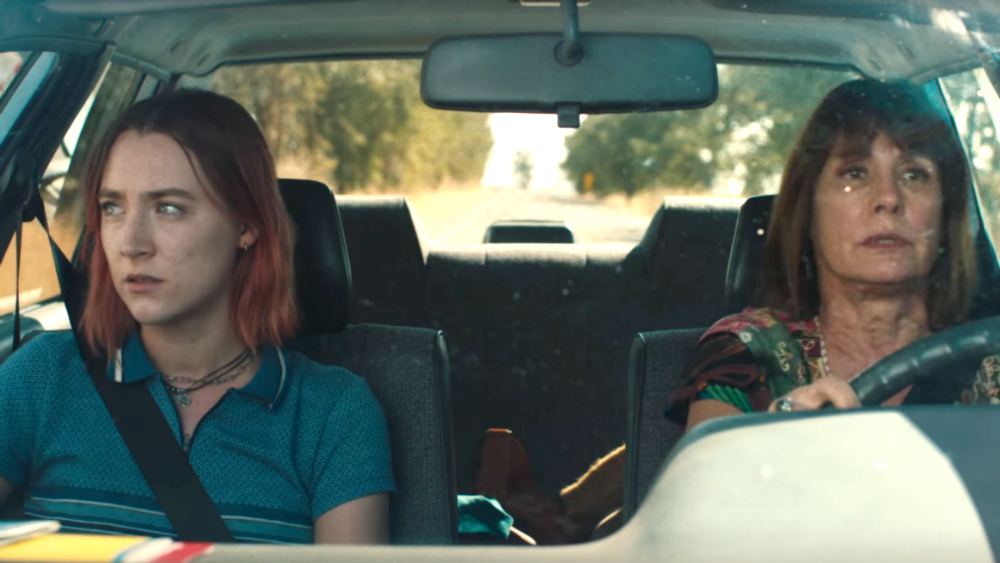
Saoirse Ronan and Laurie Metcalfe are mother and daughter with more in common than they think in Lady Bird

Director: Greta Gerwig

Cast: Saoirse Ronan (Christine “Lady Bird” McPherson), Laurie Metcalfe (Marion McPherson), Tracy Letts (Larry McPherson), Lucas Hedges (Danny O’Neill), Timothée Chalamet (Kyle Scheible), Beanie Feldstein (Julie Steffans), Lois Smith (Sister Sarah Joan), Stephen McKinley Henderson (Father Leviatch)
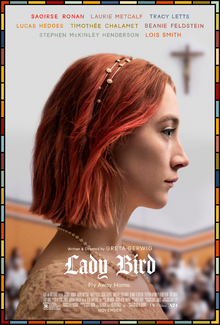
In Sacramento, California, in 2002 Christine “Lady Bird” McPherson (Saoirse Ronan) is a self-consciously assured teenager, constantly pushing to define herself as new and original, down to giving herself a new name (“Lady Bird”) and playfully enjoys pushing against the limits of what is acceptable at her Catholic school. She however butts heads with her mother Marion (Laurie Metcalfe), a hard-working nurse, supporting the family as her husband Larry (Tracy Letts) is unemployed and out-of-step skills-wise with the jobs market. Mother and daughter though are strikingly similar people, independent minded but with a streak of loving kindness.

It’s the relationship between these two characters that is the heart of Gerwig’s gently made coming-of-age (of a sort) drama. The key scenes that power the film are both the clashes and moments of fun between these two. There are feuds and angry words – but they often sit-by-side with a loving regard and a shared world perspective. Gerwig gets superb performances from both actors, with Ronan every inch the difficult teenager, full of promise but overwhelming with arrogance and mistakes that constantly hurt those around her. Metcalf is equally good as a woman weighed down with cares, who constantly makes time for others – and therefore finds her daughter’s lapses into selfishness all the more infuriating as they fly in the face of everything she values in life.

The film opens with a fight between these two that just seems to capture the moment. After a long drive to a perspective college, they finish an audiobook of The Grapes of Wrath both overcome with emotion from the stories end. Seconds after it finishes, Lady Bird goes to turn the radio on, her mother asks for a moment of reflection – and we are off from a shared emotional experience into a mother-daughter row. Setting the tone of how many of these will go – and the characters they display in the film – Lady Bird impulsively throws herself out of the car when she feels she is unable to come up with a decent comeback to a point. It’s a plaster cast she will wear for a large part of the film – and an example of the impulsive addiction to terrible decisions that seems to be constantly on the edge of ruining her friendships and chances.

A lot of this material is, to be honest, pretty standard stuff for movies of this genre. And Lady Bird herself is at times a rather irritating and even annoying lead character, one who seems to be constantly hurting people around her with very little regard for their feelings and seems to be continually forgiven regardless. Her treatment of her best friend Julie (a fine performance of endearing sweetness by Beanie Feldstein) sees her drop her and then pick her back up again with a suddenness that feels like it has missed the hurt and pain she has caused.

But then other parts work so well because the script approaches them with a quirky eye for a good joke and a sharp line. There are some very fine jokes among the script, a high point being a PE teacher turned drama director who directs his plays in the exact way he would plan out a football game. Little moments of character observation and behavioural ticks often strike home and frequently raise a smile.

But it also carries across the same observational honesty to less savoury attitudes of being a teenager. The selfishness, the feuding. Lady Bird’s sexual awakening of course happens with a self-obsessed arrogant would-be-poet aiming at a higher plane of intelligence (played with an assured arrogance by Timothée Chalamet). Lady Bird’s striving to constantly to be more or have more than she has always feels very teenager – life can’t just be what she has, she must need or be destined for greater things, or to improve in some way, to make it to the college she wants, to find some deeper meaning, to live a life that expands beyond her horizons and make her stand out.

But, the film suggests, she actually seems destined to become someone more like her mother –decent, kind, gentle, perhaps with a greater artistic calling, but fundamentally a thoughtful person. One early boyfriend – very well played by Lucas Hedges – who is revealed as unsuitable in a way not-at-all surprising when you consider he is the lead actor of the school drama group – is someone she accepts and comforts with a complete emotional openness. Her father’s travails in the job market is something she feels great empathy for. When returning to the company of her friend Julie, she is warm, caring and full of energetic affection.

It makes for a gentle and engaging film – perhaps nothing you haven’t really seen before, but presented with a lot of assurance and freshness by Gerwig, who is a director with an eye for the moving moment (a scene where Tracy Lett’s father sees his son go-up for the same job as him – a job for which the son is more qualified – is unmatched in its sad mix of acceptance and pride) and more than a taste for the eccentric comedy that brings spark to the drama. Powered by two excellent performances by Ronan and Metcalfe, Lady Bird may, like many teenagers, be difficult to like sometimes but has lots of promise.
Manchester By the Sea (2016)

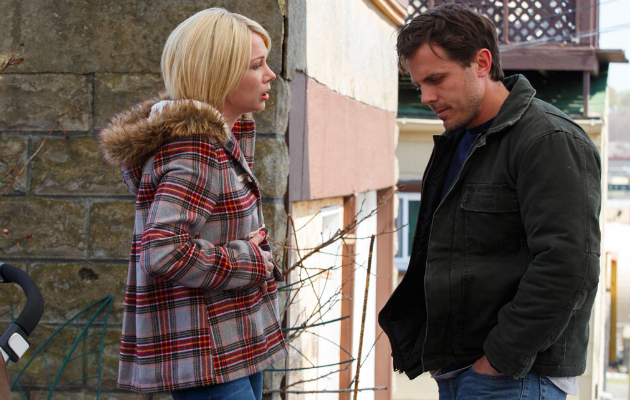
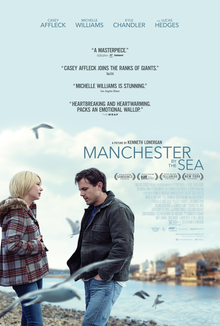
Michelle Williams and Casey Affleck deal with terrible burdens in Manchester By the Sea

Director: Kenneth Lonergan

Cast: Casey Affleck (Lee Chandler), Lucas Hedges (Patrick Chandler), Michelle Williams (Randi), Kyle Chandler (Joe Chandler), Gretchen Mol (Elisa Chandler), CJ Wilson (George), Tate Donovan (Hockey coach), Kara Hayward (Silvie), Anna Baryshnikov (Sandy), Heather Burns (Jill), Matthew Broderick (Jeffrey)

There are many films that front and centre the catharsis of overcoming grief. You know the sort of thing: the feel-good story of someone dealing with the impact of crushing events to emerge renewed and with a certain level of acceptance for the hand that life has dealt them. It’s rare to have a film that takes a very different approach – for it to tackle grief and the impact it has as a never-ending burden on your life, like a companion that will stay with you forever but which you must accept will colour every moment for the rest of your life.

Lee Chandler (Casey Affleck) is a quiet, inexpressive handyman in Boston who seems to be barely keeping under control a temper that explodes in the odd unprovoked barfight. Content to let his life drift away in a dead-end, poorly paid, job, Lee is summoned back to his family’s home in Manchester by the Sea, a coastal town in Massachusetts, after the death of his brother Joe (Kyle Chandler) from a heart condition. Much to his surprise, he discovers that Joe has named him as the guardian of Joe’s teenage son Patrick (Lucas Hedges). But Lee has no intention of remaining in this forced parental role – or of staying in Manchester by the Sea, his former home until he suffered an unbearably tragic loss for which he blames himself.

Manchester by the Sea seems ripe for setting up as a conventional tale of grief. All the ingredients are there: the man who is thrown together with a young teenager, the terrible tragic background event that he can never forget, the bottled up emotions that seem to be crying out for a big “cathartic” moment where all those emotions can be let out, a possible father-son relationship developing that can lead to Lee re-engaging fully with the world… It’s a testament the film’s courage that it avoids nearly all of these completely. Instead it offers a picture of life’s tragedy that feels human, studied, earned and above all real.

For starters, Lee is consumed with grief – and is unable to move on from it. This becomes much easier for the viewer to understand once we are introduced to the reason for his tragic mood halfway through – although hints have been dropped in flashbacks that are brilliantly woven (seemingly at random, but in fact with great thought and planning) throughout the film, where he has a wife and three young children. Saying that, the horror of what actually happened – and the gut wrenching sense of personal responsibility that Lee feels – are truly chilling. Is it any wonder with all of this that Lee can’t or won’t (or both) allow himself to move on?  That he clearly believes grief is his “sentence” for his “crime”, which has so shaped his entire life? No it really isn’t.

Lonergan’s film (and his brilliant script, one of the sharpest, tenderest and most humane modern film scripts you will read, with all the depth of a fabulous novel) explores wonderfully the contours of this human situation. There are no easy answers, no real relief and no simple emotional release. Instead this film shows that grief and guilt – certainly on this scale – never go away, that although you allow yourself moments of happiness, the shadow of the past never really leaves.

This makes the story sound incredibly bleak, when in fact it really isn’t. Among the many triumphs of Lonergan’s film is how funny this is. This humour is not always black (though it is tinged in places) but comes from Lonergan’s Mike Leigh or Alan Bennettish ability to neatly observe some of the absurdities of human interaction and everyday conversation. He understands that the mundanity of the everyday can carry huge emotional and comedic force for people, because it stems from situations we can all (to certain degrees) experience and understand. It’s those moments of recognition as Lee and Patrick struggle to get on, or when Lee is brought low by sudden memories that really speak to the viewer, which make this such a profound and often engaging viewing experience. Not to mention that Lee’s often blunt plain speaking frequently raises a chuckle, not least due to Patrick’s often exasperated plea as to why he can’t be “normal”.

But then Lee isn’t normal – he’s carefully suppressed his inner feelings as a protection measure to stop him from exploding in self-destructive guilt. It’s a performance from Casey Affleck that might just be one for the ages: a surly, buttoned-down man of low-key aggression and impatience which covers a deep and abiding sense of guilt and shame that he can’t seem to put behind him. He’s superb, and the performance is all the more admirable for the bravery of how Affleck does not fall back on actorly tricks and emoting. Instead his performance throbs with unspoken pain.

Affleck is one of several superb performances. Lucas Hedges is a revelation as a son who can’t articulate his feelings about his father’s death and his resentment and pain around it. Hedges and Affleck spark off each other with great effect, with scenes that alternate between hilarity and raw pain. Michelle Williams is also sublime in a carefully underused part as Lee’s ex-wife. Williams shares one particular beautiful scene with Affleck – one tinged with fabulous notes of sadness and regret – that is nearly worth the price of admission alone. But no one puts a foot wrong here.

Lonergan’s film is a beautiful, heartfelt, funny and intensely moving piece of cinema. Beautifully filmed, with a sublime score (part classics, part new compositions by Lesley Barber) it never lies to the audience, never sentimentalises, but leaves you moved and enthralled. It’s so rare to see a film that feels so very trueto the difficulties and complexities of real life. A great film.

Three Billboards Outside Ebbing, Missouri (2017)


Frances McDormand is looking for justice in Martin McDonagh’s razor sharp Three Billboards Outside Ebbing, Missouri

Director: Martin McDonagh

Cast: Frances McDormand (Mildred Hayes), Woody Harrelson (Sheriff Bill Willoughby), Sam Rockwell (Officer Jason Dixon), John Hawkes (Charlie Hayes), Peter Dinklage (James), Abbie Cornish (Anne Willoughby), Lucas Hedges (Robbie Hayes), Željko Ivanek (Sergeant Cedric Connolly), Caleb Landy Jones (Red Welby), Clarke Peters (Abercrombie), Samara Weaving (Penelope), Kerry Condon (Pamela), Darrell Britt-Gibson (Jerome), Amanda Warren (Denise), Kathryn Newton (Angela Hayes)

How do we deal with grief? What might it drive us to do? How does it make us behave – and what sort of person can it make us become? Martin McDonagh’s superbly scripted and directed, brilliantly acted film explores these themes in intriguing and compelling depth, consistently surprising the audience, not only with unexpected plot developments, but also wonderfully complex characters, whose personalities and decisions feel as distanced from convention as you can get.

Mildred Hayes (Frances McDormand) is a grieving mother, who feels let-down by the police and justice system as they have failed to locate and arrest the rapist who murdered her daughter. She hires three large billboards on a quiet road out of her town in Ebbing, and places on each of them a stark message: “Raped while dying”, “And still no arrests?” and “How come, Chief Willoughby?”. The billboards lead to Sherriff Bill Willoughby (Woody Harrelson) doing what he can to re-open the case – a case with no real evidence or leads. But the local community – many of whom adore Willoughby – are increasingly angered by the billboards, not least Willoughby’s semi-protégé, controversial red-neckish officer Joe Dixon (Sam Rockwell). The billboards lead to increasingly violent disagreement in the small community – and surprising allegiances developing.

McDonagh’s black comedy-drama balances immense sadness and searing rage with jet-black humour. McDonagh’s distinctive (and often foul-mouthed) style runs through the entire film. It’s a film that not only defies real categorisation, it also defies expectations. You would expect this film to be a commentary on a heart-rending grieving mother struggling against an indifferent, incompetent, racist (or all three) legal system. Perhaps even a film that will build towards a sort of “whodunit” murder mystery. All these expectations are constantly turned upon their head. Any obvious, traditional narrative development – and lord the film plays with this throughout its runtime – is diverted. You never know where the film is going – and you would certainly never have guessed its conclusion from the opening. 

Our expectations are immediately inverted when Woody Harrelson’s Sheriff meets with Frances McDormand’s mother in the opening moments. We expect him to be indifferent, annoyed or bitter – instead he’s liberal, concerned, sympathetic and hurt, while understanding why Mildred has done what she has done. Mildred, who we expect to be moved by, whose pain we expect to empathise with – instead she’s burning with fury and resentment, is amazingly confrontational and unyielding, and her ideas for investigating the crime border on the ruthlessly right-wing. Far from the predictable drama you might expect, you are thrown into something unusual – and real.

The storyline continues throughout in this vein – McDonagh never takes the expected route, but constantly pushes towards something unexpected. His trademark spikey dialogue throws you off balance – this is surely one of the few films where you’ll see a son affectionately call his mother “an old c**t”, or a happily married, middle-class couple address each other with a stunning, loving crudity. Pay-offs to plot developments are confidently unorthodox, and devoid of the expected sentimentality. The murder mystery element of the story is played with in a unique way: even the crime itself remains unexplored and unexplained, with only a few grim photos and a few hints dropped in dialogue as to what happened.

Instead, the film focuses on how grief and upheaval affects a community. All of the characters deal with a profound personal loss over the course of the story, and the impact of this on them leads not just to anger and rage, but also in some a profound reassessment of their life and choices. It’s a film that looks at the struggle we have to control the narratives of our own lives, to not be a victim but instead to give the things that have happened to us meaning and importance. Each character wants to find a way to make the things that have happen to them have meaning, and to find a sense of closure. It asks what can and can’t we forgive, and how far do we need to take actions to find a sense of closure. The film’s open-ended conclusion both points towards suggested answers to these questions, while at the same time offering few.

Frances McDormand gives a compelling performance in the lead role, as a domineering, strong-willed woman who resolutely refuses to be a victim, but wants revenge. Burning with a simmering rage at the world, and quick to respond with aggression and even violence, McDormand never allows the character to become fully sympathetic, but constantly challenges us. It’s the sharpest-edged grieving mother you’ll see on film, as full of prejudice and judgemental behaviour as she is pain and guilt. She attacks each scene like a bull in a china shop, and Mildred Hayes is a smart, ruthless woman who takes no prisoners.

The part was written especially for McDormand, as was that of Joe Dixon for Sam Rockwell. Rockwell, one of those eminently reliable supporting actors, gives an extraordinary powder-keg performance as an on-the-surface dumb, racist bully with poor impulse control, who is barely able to hide a vulnerable mummy’s-boy complex and a strangely touching sense of loyalty. Rockwell is dynamite in each scene, but constantly gives us interesting and varied line-readings, changing our perceptions of his character with each scene. 

To briefly address a controversy that has arisen about the film.  McDonagh has explored extremes like this in the past – his work in the past has humanised murderers, child-killers, terrorists and executioners, while not excusing their actions. The film has courted controversy by refusing to condemn Dixon’s racism, or for not ‘punishing’ the character enough, but it instead asks us to understand why Dixon has done or said the things he says – and to empathise with the pain, despair and anger in his own life. Is Dixon a racist? He’s a product of his time and place, I’d say he’s really just very angry, without understanding why, and without having the emotional intelligence to deal with it. He might have done unpleasant things – in the film doesn’t dodge this – but it asks us to question why he might have done this, rather than paint him as a demon.

Equally brilliant (perhaps one of his greatest performances) is Woody Harrelson as the surprisingly liberal, good-natured, patient and humane Sherriff Willoughby. Surely no one could expect the authority figure in a film of this nature to be the most sympathetic and likeable character in the film, the one with perhaps the most moving personal story. Harrelson is simply superb in the part, and his gentle, lingering regret hangs over the film.

But the whole cast is marvellous. Hawkes is a deeply troubled and pained man hiding it under anger and mid-life crisis. Dinklage is a sad eyed, lonely man. Cornish sports a slightly unusual accent but is warmly loving and very normal as Willoughby’s wife. Hedges is impressive as Mildred’s son, whose life is made increasingly difficult by his mother’s unwillingness to compromise. Landy Jones is excellent as the empathetic billboard manager, too good for this town. Peters brings a reassuring air of authority and dignity to the film. With the dialogue a gift for actors, there isn’t a weak performance in the film.

McDonagh’s fine, simple direction adds a Western-style sweep to the action and allows the story to speak for itself, working with the actors to bring out some brilliant, unique characterisations. It’s an intelligent and thought-provoking film, that constantly pushes you in unexpected directions and asks intriguing and challenging questions about profound issues, especially grief. Despite this, it’s a laugh-out-loud black comedy, that will move you and which has the courage to leave many of its plot issues open-ended and true-to-life. It asks questions, but it also acknowledges that life doesn’t give us answers. It also reminds us that we can never judge people from our initial impressions or expectations.