Tag: Lupita Nyong’o

Black Panther: Wakanda Forever (2022)

Black Panther: Wakanda Forever (2022)

Grief and loss are the beating heart of this tender and heartfelt Marvel film, mixed with standard action tropes

Director: Ryan Coogler

Cast: Letitia Wright (Shuri), Lupita Nyong’o (Nakia), Danai Gurira (Okoye), Angela Bassett (Queen Ramonda), Tenich Huerta Mejía (Namor), Dominique Thorne (Riri Williams), Winston Duke (M’Baku), Martin Freeman (Everett K Ross), Julia Louis-Dreyfus (Valentina Allegra de Fontaine), Florence Kasumba (Ayo), Michaela Coel (Aneka)

There is one thing you can never imagine – and never want to – having to plan for in your franchise. The tragic loss of your lynchpin. For Black Panther that man was Chadwick Boseman, and his heart-breaking early passing hangs over the film like a shroud.

Black Panther: Wakanda Forever is two films in one. One is a standard Marvel adventure film, with gags, set pieces and careful groundwork laid for future entries. The other is a heartfelt eulogy, a processing of the raw shock the people making the film – and many watching it – felt at the loss of this fine actor. In universe, T’Challa (Boseman) has passed away. His sister Shuri (Letitia Wright) blames herself for failing to save his life and his mother Queen Ramonda (Angela Bassett) has become protective and unrelenting in her judgements.

With its monopoly on vibranium, Wakanda is now the most powerful nation on Earth. Other powers want a piece of that apple – and the US are plumping the deaths of the oceans for vibranium. But their search intrudes on a secret underwater civilisation led by wing-footed, super-strength Namor (Huerta Mejía). Namor threatens to unleash destruction unless Wakanda deliver him the scientist who created the US’s vibranium detector – who turns out to be a college student genius with Tony Stark vibes, Riri Williams (Dominique Thorne). When Shuri refuses to hand her over, Namor states he is coming for the surface – and will destroy Wakanda, a country he cannot trust.

Black Panther: Wakanda Forever is bookended by two heart-breakingly genuine moments of emotion. The death of T’Challa (off screen) and his funeral – a grief stricken, beautifully filmed funeral procession – carries a great deal of genuine rawness. A final montage of shots of Boseman, presented as the memories of Shuri finally coming to terms with her brother’s death is moving. The strongest parts of the film are these human moments. Wright has been open at her shock and pain at Boseman’s death and this translates beautifully in her affecting performance.

These adjustments to the script are the strongest parts of the film. Letitia Wright and Angela Bassett provide subtle, delicate work as two people affected by grief in very different ways, but both now more reckless, protective and retributive than before. The responses, guilt and pain of several characters carry real force and leave the deepest mark on the audience. It also builds a subtle “passing the torch” narrative, as Wakanda fears they have seen the last of their “Black Panther” who protected their nation through history.

Away from this, the film settles into being a more traditional Marvel franchise extender. Rightly much time has been given to the real-life tragedy, but this means much of the remainder of the plot feels rushed. Our new antagonists are hurriedly introduced – so much so that leader Namor (well played by Tenich Huerta Mejía with a charisma that covers an under-written part) introduces his people’s entire culture in an awkward info dump an hour into the film. Not a single other character of his merman race gets so much as a name (as I can remember) let alone a personality.

Despite being a slightly silly concept of an Atlantan (but definitely not Atlantis because that’s already been claimed by another franchise) underwater city with water pressure having given its inhabitants super-human strength, it is another strong commitment to diversity. These people descend from the Mayan civilisation, meaning they share the same history of persecution by the West as the African nations Wakanda represents. It should make them natural allies, right?

Of course, it doesn’t as this is a film that pivots on the mistakes and miscalculations of political leaders and how these force them into war. The film makes its point about political rivalries early with Ramonda giving the French and US an almighty ticking off at (a surprisingly small) UN for their ruthless attempt to obtain vibranium for themselves. However, Black Panther: Wakanda Forever dodges really delving into the most interesting implications of this.

Because there is a kernel of a really interesting, challenging idea here. In many ways Wakanda behaves with exactly the same domineering arrogance as the Western powers they criticise. The Wakandans take unilateral decisions for the world because they know best, treat other nations like recalcitrant children and horde the world’s most powerful resource for themselves. They are this close to a benign, dictatorial state. But the film isn’t interested in exploring this.

Bringing Wakanda and Talokan into rivalry on the grounds of Talokan seeing them as potential oppressors – as the most powerful among the surface nations they have always feared would crush them – would have been more interesting than the confused, convoluted “with us or against us” war we end up with. But I understand that a film, which prides itself on celebrating African culture, is not going to want to be seen as undermining any of that with something sharper.

Besides, this is all a set-up for the inevitable large scale action sequences. The finest is a haunting attack on a ship, where the Talokans use their siren voices to inspire the crew of an American black ops ship to drown themselves. There’s a decent car chase, some well-choreographed fights a pitched battles that thrill. It’s also notable that the loss of Boseman has led to this franchise being dominated by women of colour, all of whom deal with the sort of dilemmas and consequences that are normally the preserve of male (and white) comic-book heroes.

But the film’s heart is in the personal moments – and more interesting when looking at Shuri’s protective affection for Dominique Thorne’s plucky (sometimes overly so) inventor. It’s also interesting that this is a film that flirts more than I was expecting with its leads choosing anger and vengeance, over forgiveness and conciliation. Shuri and Ramonda lash out, with dangerous consequences, and express minimal regret. Black Panther: Wakanda Forever deserves points for being willing to tackle the negative implications of grief.

That’s the strength of the film, just as a pain of Boseman’s death is the beating heart. Black Panther: Wakanda Forever is overlong and skips more challenging ideas, but it is also shot through with genuine grief. It’s not perfect, but it’s real, well-meaning and (for all its silliness and bombast in places) has a heart firmly in the right place. When a Black Panther rises in the final act, you will feel the film has earned it.

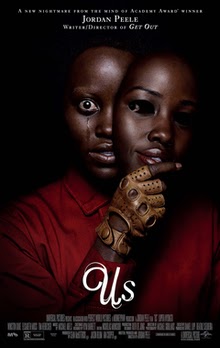
Us (2019)

Lupita Nyong’o prepares to take on the dreaded Us

Director: Jordan Peele

Cast: Lupita Nyong’o (Adelaide Wilson), Winston Duke (Gabe Wilson), Shahadi Wright Joseph (Zora Wilson), Evan Alex (Jason Wilson), Elisabeth Moss (Kitty Tyler), Tim Heidecker (Rosh Tyler), Yahya Abdul-Mateen II (Russel Thomas), Anna Diop (Rayne Thomas), Madison Curry (Young Adelaide)

Jordan Peele’s Get Out is a tough film to follow. Smart, socially aware, funny, scary and haunting, it’s both one of the best horror films in years, and also one of the finest films made about modern America. It means his follow-up has some tough shoes to fill. Us perhaps doesn’t quite fill them as well, but judged on its own terms it’s another example of what a witty, skilled and intelligent film-maker Jordan Peele is and how skilfully he is able to both defy and define genre tropes.

The less you know about the plot the better, but Lupita Nyong’o plays Adelaide Wilson, a woman returning with her family to spend a holiday at Santa Cruz beach. While her husband Gabe (Winston Duke) and children Zora (Shahadi Wright Joseph) and Evan (Jason Wilson) are filled with excitement about the trip away, Adelaide fears returning to the location where she traumatically got lost one night in a hall of mirrors and encountered what felt like a doppelganger of herself. But as strange coincidences begin to mount up on their holiday, Adelaide begins to fear her whole family may in fact be in great danger…

Us mixes moments of unbearable tension with beats of almost slapstick humour. But, like Get Out, it’s also a film that leaves you grasping at the implications of its setting and ideas and opens up an ocean of possible interpretations and meanings. There is no chance at all Jordan Peele is a one-hit wonder, because this film is a blindingly good, brilliantly made chiller/thriller that stays with you once you leave the cinema. 

It has such an impact largely because Peele is such an immersive and mesmerising director. His mastery of the tricks and turns of the genre are obvious, but what really makes this go the extra mile in effectiveness is his brilliant understanding of cinema. The camera work here is superb: he knows exactly how long to let a shot linger, exactly how a slow zoom or pull out can build tension and fear to such excellent effect, how the right choice of music can give a scene anything from an ominous Omen­-like terror to a streak of black comedy (there is one musical choice that is so perfectly hilarious and yet bleakly dark that it will have you laughing out loud despite the horror of the scene it accompanies). Us is a superbly made film by a master movie-maker, with every moment giving some imaginative flourish or striking image.

Us is also a film that works because of its depth and the humanity of its characters. Each character is given establishing moments – big and small – that immediately ring true and allow you to understand and relate to that person in seconds. Peele’s horror comes not from blood and guts – which is present but never exploitative (this is a million miles away from a mindless slasher) – but from watching people we have grown to care for and like going through ghastly events. A prolonged home invasion sequence is almost unbearable to watch in the chilling hopelessness of the family caught up in it: and it works because the empathy we have built up for these people allows us to put ourselves immediately into their shoes. The film has a brilliant understanding of our universal fears, from not being safe in our homes to being powerless to protect our children, and uses these for great effect.

The second half of the film (thankfully!) doesn’t continue this unbearable, stomach pulling dread (if it did you wouldn’t be able to watch it) and probably segues more into science-fiction-thriller territory. Not that that’s a problem as the film remains gripping and compelling throughout. It also delves further into the fascinating themes that Peele is confident enough to place on the table without feeling the need to hammer home an interpretation or meaning for the viewer. There are questions here throughout about the underbelly of America, the unspoken questions of class that run through the country. “We are Americans” the ‘villains’ of the film proudly state at one point – and the more we learn about them, the more we understand about why they cling to this idea of belonging. And of course why they feel the way they feel about their country.

What is class in America? How is this nation divided by the haves and the have nots – and how does it affect the decisions people make about their lives? What impact does commercialisation and the need to both have things and to be part of something have on us? What in modern America can both bring us together and drive us further apart? These are questions that run throughout the film – without clear cut answers – but challenge you to think for yourself.

The performances in amongst all this are brilliant. Lupita Nyong’o probably won’t get the awards recognition she deserves here for an extraordinary performance of empathetic gentleness and distress hardening into a grim determination to do whatever is necessary to protect her family. Nyong’o has a double role in the film, and this second performance is equally wonderful, a triumph not only of physical acting but also of tortured psyche. Winston Duke is equally good as a lovable doofus of a husband, while Wright Joseph and Evan Alex give exceptional performances as their children. 

Peele throws in a late narrative twist – effectively signposted throughout – which challenges many of our assumptions about what we have been watching, but doesn’t distract from the social questions he has been tackling throughout the film in a subtle way. Once again his narrative control is flawless and the depth he can suggest behind horror tropes is staggering. Us is perhaps more of a fairground ride than Get Out, more about the terror of being chased and the black comedy of ordinary people fighting back with extreme violence, but it’s a damn entertaining one and leaves you with more to think about the longer you reflect on it.

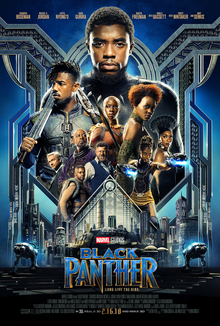
Black Panther (2018)

Chadwick Boseman is the legendary Black Panther in Marvel’s solid comic book outing

Director: Ryan Coogler

Cast: Chadwick Boseman (T’Challa/Black Panther), Michael B. Jordan (N’Jadaka/Erik Kilmonger Stevens), Lupita Nyong’o (Nakia), Danai Gurira (Okoye), Martin Freeman (Everett K Ross), Daniel Kaluuya (W’Kabi), Letitia Wright (Shuri), Winston Duke (M’Baku), Angela Bassett (Ramonda), Forest Whitaker (Zuri), Andy Serkis (Ulysses Klaue), John Kani (T’Chaka)

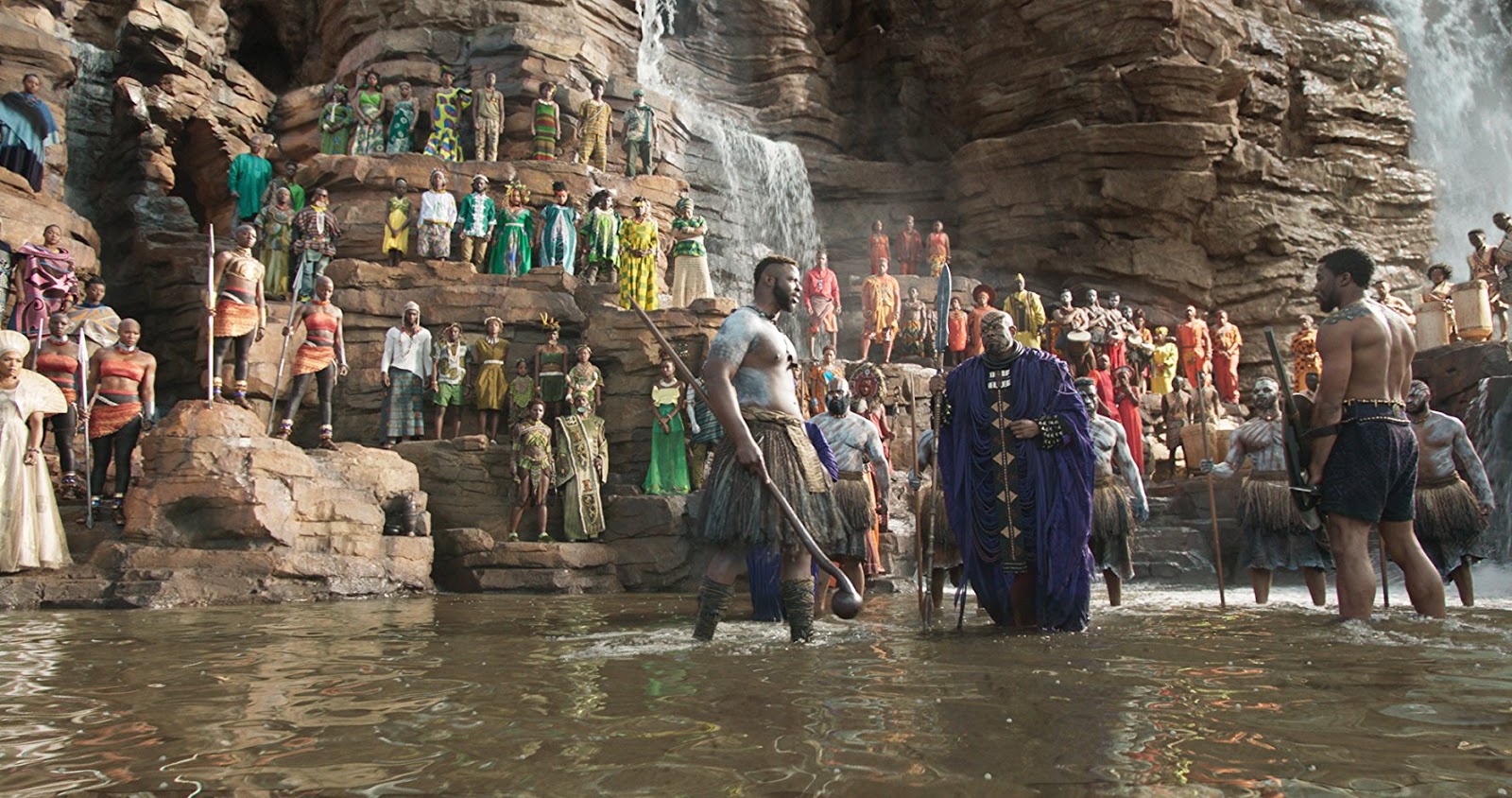
Marvel’s comic book world is now so stuffed with characters, worlds and dimensions that it is remarkable how many of its heroes are white and male. Black Panther does something completely different, giving us a set of African heroes and placing the common framework of a Marvel film within a very proud, and distinct, African heritage. So you can pretty much guarantee you ain’t seen a comic book film quite like this one.

After the death of his father (in Captain America: Civil War), T’Challa (Chadwick Boseman) becomes king of the secretive nation of Wakanda. Camouflaging itself as a poor and unadvanced nation in order to avoid interaction with the rest of the world, Wakanda has in fact for centuries been mining a remarkable metal, vibranium, that has helped the nation become hugely technologically advanced. Its king also bears the responsibility of being the “Black Panther”, ingesting a vibranium-infused herb to gain superhuman speed and strength. However, others have their eye on the throne, not least Erik “Kilmonger” Stevens (Michael B Jordan), who wants to turn Wakanda into a force that could protect the black people of the world from their historical oppressors and avenge centuries of slavery.

Black Panther never fails to be entertaining. The film is shot with a genuinely vibrant excitement, and I love the way it proudly embraces a comic book twist on African tribal heritage. In fact the film’s depiction of an African nation which is secretly the most powerful and advanced nation in the world is really quite an impressive political statement.

Ryan Coogler directs the film with flashy brilliance and comes up with a few ways of presenting what are (essentially) action sequences we’ve seen many times before in unique new ways. The stand-out is an early action scene in a Korean bar, filmed to appear as an immersive single take around a large set, the camera dipping and zooming from character to character. Coogler also brings a fair amount of visual wit to the fights while not losing the emotional and character depth the story is aiming for.

The film also has some fine performances, with Boseman dripping dignity, nobility and decency as T’Challa. Regular Coogler collaborator Michael B. Jordan gives a great contrast as bitter LA slums kid turned misguided would-be dictator Kilmonger. Danai Gurira stands out as proud general Okoye, torn between duty and personal loyalties. Hell even Forest Whitaker – clearly loving every moment of this OTT Marvel world – gets some weight and dignity out of his typical grandstanding style.

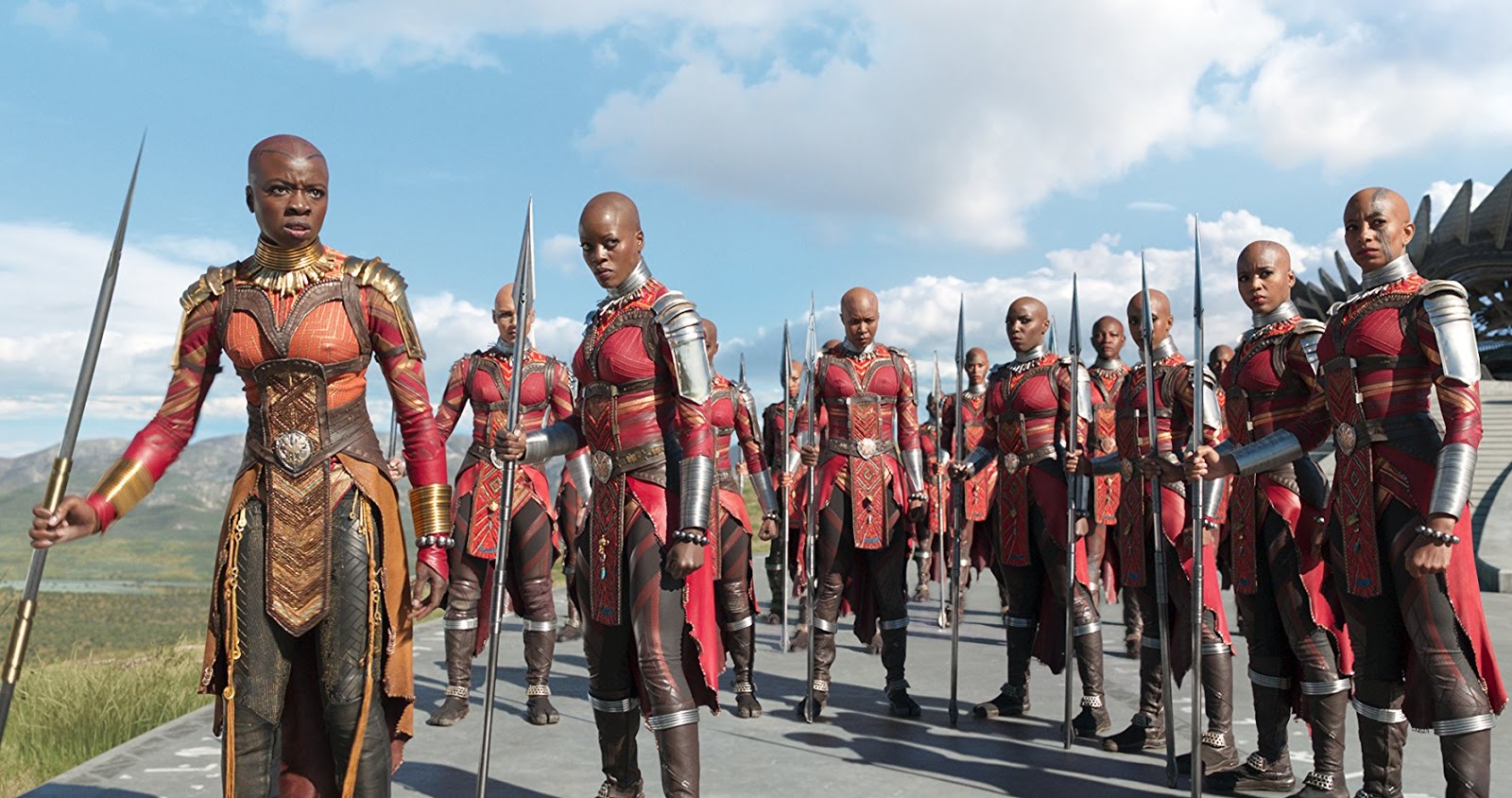
It’s another mark for the film that the world of Wakanda is so effectively gender neutral. Kings of Wakanda have a Praetorian Guard of female warriors, most of the leading voices on its council are women, and its technical genius is T’Challa’s sister Shuri (played by Letitia Wright in a charming, star-making performance). Sure it doesn’t feel like the role of Black Panther himself is up for grabs for anyone lacking a penis, but this is a world where women are equal, if not leading, partners in the action.

The film also addresses issues of post-colonial struggle, not least attitudes towards slavery and oppression handed out to Africa over centuries. Kilmonger’s fiendish plot is, in many ways, actually quite sympathetic – he wants to use Wakanda’s resources to protect those of African descent across the world. Jordan gets some good moments from his speeches laced with anger at the historical treatment of Afro-Caribbeans and, to be honest, it’s hard not to see his point. So hard in fact that the film has to drop hints that Kilmonger is a potential tyrant to stop him from seeing too reasonable. 

This is where the film’s plot starts to get slightly hazy. The character arc of T’Challa himself is pretty unclear. Traditionally in these films, the character must embrace his destiny. Problem is, a lot of this arc was covered in Captain America: Civil War. The writers are unable to give him a truly compelling replacement arc here. T’Challa drops a few references early on to not feeling ready – but basically swiftly embraces it. He never outlines a real alternative agenda to Kilmonger – there are characters in the film who argue “Wakanda doesn’t get involved in the world”, but he isn’t one of them, so there is no journey towards engagement with the outside world (on far more humanitarian terms than Kilmonger advocates). 

Frankly, Okoye is given a better character arc than T’Challa, beginning by advocating “we must serve the throne and respect our traditions even if we doubt them”, and learning later to follow her own conscience. T’Challa, in contrast, is no discernibly different at the end of the film to how he was at the beginning. 

T’Challa’s journey is basically getting something, losing it and then getting it back. Strip away Boseman’s performance and the character is basically pretty dull. He partly suffers, as does the rest of the film, from an overstuffed cast spreading the focus of the film far too thinly and leading to character arcs and interconnections feeling rushed. Kilmonger’s connection with T’Challa is forced – they only know each other for at best two days! – and there is a superfluity of villains. There’s not only decoy antagonist Klaue (and his gang) hanging about for a good chunk of the film, but also Daniel Kaluuya’s ill-defined best friend turned opponent, W’Kabi. Combining Kilmonger and W’Kabi would have helped no end, allowing two different, divergent agendas to develop and cause a relationship rift between two friends (Kaluuya is instead totally wasted in a nothing part, whose allegiances change depending on the demands of the plot). 

The good guys fare no better: Lupita Nyong’o is completely wasted as a love interest who feels stuffed into the movie because, y’know, these films gotta have one. She does nothing in the film that could not be easily done by another character, and nearly all of T’Challa’s emotional scenes – and personal motivation – are tied into his sister rather than this are-they-aren’t-they-a-couple. 

It’s all part of the traditionalism that underlies the film. Its structure is familiar and, like many Marvel origin films, the villain is a dark reflection of the hero with similar skills. The final battle is traditional and a little dull (and feels very similar to Avengers: Infinity War). The film avoids showing T’Challa torn between isolation and intervention – he in fact advocates both in the first 15 minutes – and doesn’t really make much of the prospect of a hero changing his mind or developing his views to embrace a wider world.

But it stands out because it is different. And it deserves no end of praise for making such a film so full of love and respect for its heritage. It walks a very difficult line between enjoying the bright exotic colours while not making the film patronising or overly “other-worldly”. How many other Hollywood films have, at best, two white characters (well played in both cases by Martin Freeman and Andy Serkis)? How many others would dare have the villain make a defiant, sizzling and emotionally inspirational speech about racial oppression and the hypocrisy of the West (though the film goes easy on America, with the speech taking place at the hilarious “Museum of Great Britain”. Where is this place – please get my tickets!).

That it slightly dodges and fudges the implication of these themes in its plotting and the conception of its hero – who is basically a dull character played by a charismatic actor – doesn’t reduce its pleasure at doing something different. I’m not sure it will stand up to repeated viewings – look past the setting and it does little new – but it’s a worthy entrance in a crowded universe.