Tag: Madeline Stowe

12 Monkeys (1995)

12 Monkeys (1995)

A world-ending-virus can only be cured through the power of time-travel in Gilliam’s twisty, paradox time loop

Director: Terry Gilliam

Cast: Bruce Willis (James Cole), Madeleine Stowe (Dr Kathryn Railly), Brad Pitt (Jeffrey Goines), Christopher Plummer (Dr Leland Goines), David Morse (Dr Peters), Jon Seda (Jose), Christopher Meloni (Lt Halperin), Frank Gorshin (Dr Fletcher), Bob Adrian (Geologist), Simon Jones (Zoologist), Carol Florence (Astrophysicist), Bill Raymon (Microbiologist)

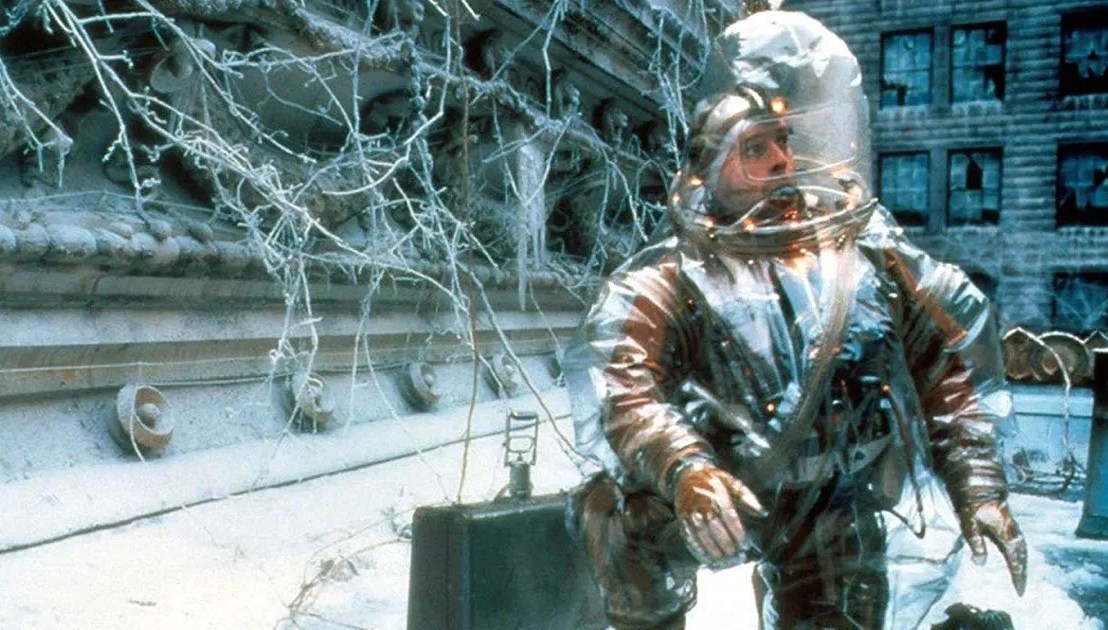
2035 and the world is a plastic-coated hell, where what remains of mankind huddle below the Earth in rudimentary, environmentally controlled, airtight refuges. The surface is a dream, now home to a deadly virus that wiped out 99% of the population. That virus was unleashed in Philadelphia in 1996: nothing can stop that. But time travel can help the scientists of 2035 gain a sample of the original pre-mutation virus. They believe it was unleashed by an organisation called “The 12 Monkeys”. Track the organisation in the past and find an original sample of the virus. Easy right?

Wrong. Time travel messes with your mind, making it hard to tell what’s real and what’s not. The travellers are penal “volunteers”. James Cole (Bruce Willis) is selected as he has a photographic memory and a strong memory from 1996 of witnessing a Philadelphia airport shooting, that will help send him back. However, he’s flung back to 1990 and thrown into an asylum, treated by Dr Kathryn Railly (Madeleine Stowe) and sharing a room with environmentalist Jeffrey Goines (Brad Pitt). Rescued and correctly sent to 1996, can Cole convince Railly he’s telling the truth and track Goines who has become the leader of the 12 Monkeys?

12 Monkeys is one of the most intriguing time-travel films ever made – and its future, ripped apart with plague, seems chillingly closer today. It puts a vulnerable, scared person at its centre – and makes him a dangerous, inarticulate Cassandra who reacts with violence when no-one listens him (which they never do). It repeatedly tells us things cannot end well, but still gets us hoping they might anyway. It presents puzzles that provoke debate and stretch the imagination.

Gilliam’s most main-stream film is an eccentric, unsettling, tricksy film that juggles time travel and paradoxes, as well as mental health and the nature of reality. Shot with a Dutch-angle infused oddness – reflecting its hero’s mental unbalance – and scored with a French-inflected whirly-gig musical theme that is reminiscent of the demented street people that pepper the film (and may, or may not, be other unbalanced time travellers), it constantly puts you on edge and unsettles.

This extends to its casting, which takes two Hollywood superstars – Willis and Pitt – and deglamorises them to a shocking degree. As Cole, Willis is shambling, vulnerable, scared and struggling to distinguish between reality and fantasy. An 8-year-old boy when the virus destroyed the world, in a way he’s never grown up. He looks around the world of the past with a wide-eyed wonder (he adores the sun and the feel of the soil beneath his feet) but has the stroppy impulsiveness of a maladjusted teenager. He’s so twitchy and insecure, you start wondering if he is the mentally disturbed man who imagines he’s from the future, that his doctors think he is. It’s Willis’ least-Willis performance ever and one of his finest.

Similarly, Pitt pushes himself as the disturbed, aggressive Goines. Prone to obsessive rambling, that stretches Pitt’s languorous vocal register (he trained for months to improve his vocal range), Pitt’s performance is wide-eyed, unpredictable and unsettlingly dangerous. With a single eye swollen and askew, it’s a performance that plays with being OTT but manages to work because he mostly avoids actorly showing off. Madeline Stowe, by contrast, has the most difficult role as the ‘normal person’, a sceptical psychiatrist becoming more and more convinced Cole is telling the truth.

Of course, despite the film’s efforts to play with reality, the audience are always pretty certain he isn’t wrong about the future. But, with the sight of fellow deranged time travellers, not to mention Willis’ vulnerable performance, that Cole could still be crazy. Even if you are right, doesn’t mean you are sane.

Gilliam’s surrealist future helps with this. Every time Cole is pulled back to 2035, the world becomes ever more deranged. Is his grip on reality eroding, as he is feared it is. Design wise the future is a triumph – but it also seems eerily similar to the 1990 asylum Cole is in. Has the building, and the things in it, been repurposed in 2035? Or, as the scientists of 2035 become ever more surreal (including serenading Cole at one point in a Dennis-Potteresque fantasy), questioning Cole via a circular floating series of TV screens while he sits in a suspended chair, is Cole’s grip on reality gone?

It keeps the tension up in the ‘past’ plotline, even as the things Cole has seen in the future – strange messages on walls, photos, voicemail messages – accumulate. 12 Monkeys is a fascinating time-travel movie, that establishes from the very first moment it is impossible to change the past (something the audience, like the characters, get sucked into forgetting). After all, if the plague was stopped, then time travel would never be invented in the first place. All Cole, and the other travellers, can do is collect information.

But that doesn’t stop the future influencing the past. Goines decides to form the 12 Monkeys based on a conversation with Cole in 1990. Dr Railly becomes fascinated with apocalyptic predictions – writing a book that will influence the man planning viral annihilation in 1996 – only because she meets Cole. And, above all, 2035 Cole’s presence in 1996 leads to that strong childhood memory happening in the first placce. The final reveal of the meaning behind Cole’s recurring memory-dream is the perfect example of a time-loop closing (so much so the scientists in the future bend over backwards, giving Cole a doomed mission, to ensure it happens).
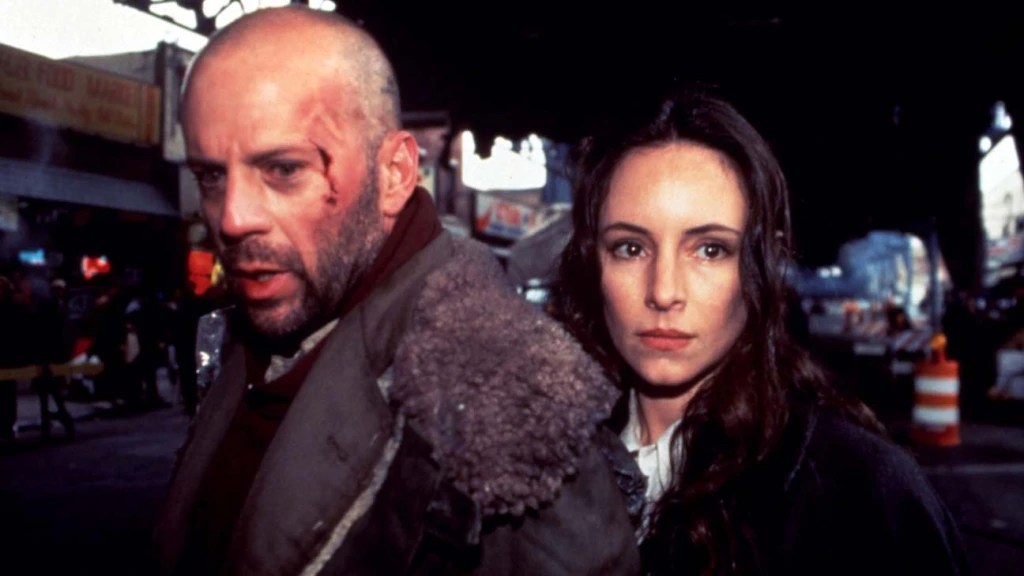
It also explains why he is drawn towards Stowe’s Railly, who resembles (with the exception of her lack of Hitchcock Blonde hair) the woman in his dream. The relationship between Cole and Railly develops into a slightly forced romance (it feels like a script requirement, for all Gilliam’s taking the characters to watch Vertigo to hammer home the obvious contrasts). But when it focuses on two people drawn together for reasons they can’t quite understand (and there are hints of predestination) it just about works. That and the commitment of both actors to the roles.

12 Monkeys is about 15 minutes too long (it’s 1990 section outstays its welcome), especially as the audience is never in doubt that the plague is real (after all this is a movie). But Gilliam keeps us on our toes with how confident we feel in Cole: we’re repeatedly shown he’s violent, inarticulate and impulsive. The final half of the film, where the origins behind events we have been shown or heard in the first half, is fascinating. The tragic turns of the film’s paradoxical temporal loop is brilliantly executed and haunting. Gilliam’s film is quirky, unsettling and a design triumph: but it also tells a fascinating story. It’s his most accessible and crowd-pleasing film.

Short Cuts (1993)

Anne Archer and Jack Lemmon are just two of many intersecting lives in Altman’s Short Cuts

Director: Robert Altman

Cast: Andie MacDowell (Ann Finnigan), Bruce Davison (Howard Finnigan), Julianne Moore (Marian Wyman), Matthew Modine (Dr Ralph Wyman), Anne Archer (Claire Kane), Fred Ward (Stuart Kane), Jennifer Jason Leigh (Lois Kaiser), Chris Penn (Jerry Kaiser), Lili Taylor (Honey Bush), Robert Downey Jnr (Bill Bush), Madeleine Stowe (Sherri Shepard), Tim Robbins (Gene Shepard), Lily Tomlin (Doreen Piggot), Tom Waits (Earl Piggot), Frances McDormand (Betty Weathers), Peter Gallagher (Stormy Weathers), Annie Ross (Tess Trainer), Lori Singer (Zoe Trainer), Jack Lemmon (Paul Finnigan), Lyle Lovett (Andy Bitkower), Buck Henry (Gordon Johnson), Huey Lewis (Vern Miller)

Helicopters fly over Los Angeles, spraying against medflies. Beneath them, people’s lives entwine over the course of a couple of days. It could only be an Altman film. The man who turned the whole of Nashville into a set for, repeats the trick here with a brilliantly handled adaptation of a series of Raymond Carver short stories into one single inter-linked narrative, that explores a full gamut of emotions in that strange race we call humanity.

The son of TV commentator Howard (Bruce Davison) and his wife Anne (Andie MacDowell) is hospitalised after he is accidentally clipped by the car of waitress Doreen (Lily Tomlin). He’s treated by Dr Ralph Wyman (Matthew Modine), currently feuding with artist wife Marian (Julianne Moore). Marian befriends clown Claire (Anne Archer), who is horrified when her husband Stuart (Fred Ward) and his friends decide not to let finding a dead body spoil their fishing trip. Marian’s sister Sherri (Madeline Stowe) is becoming increasingly exasperated with philandering cop husband Gene (Tim Robbins), who is having an affair with Betty (Frances McDormand) estranged wife of Stormy Weathers (Peter Gallagher) who flew one of those helicopters spraying medflies. That’s not even mentioning a furious baker (Lyle Lovett), a sexually frustrated pool cleaner (Chris Penn) and his phone-sex worker wife (Jennifer Jason Leigh) or Howard’s unreliable father Paul (Jack Lemmon).

There aren’t many directors in Hollywood who could throw this many plates onto sticks and keep them spinning. Certainly very few who could make it look as easy as Altman does. With no less than twenty leading characters spread out across at least nine storylines, many of which intersect but without those taking part of them being aware of it, this is such a carefully woven tapestry even a single loose thread could have led to the entire image unravelling into a sorry collection of fabric. The fact it doesn’t, and the film moves so confidently and vibrantly from place-to-place, shifting from perspective to perspective without ever once confusing or alienating the audience, demonstrates this is the work of a master at the top of his game.

Altman’s verité style is at its best here. There is no need for flash or intrusive cinematic tricks, when the entire film is a brilliant expression of the potential of cinematic narrative. Altman’s camera, with its observational stillness, is perfectly matched with masterful editing (the film is superbly assembled by Geraldine Peroni) that not only makes this a coherent whole, but also finds every trace of reaction and nuance from the characters. Time and time again the camera (and the editing) searches out and finds that little moment of reaction that adds a whole world of depth to the story.

Because, like some of Altman’s best films, this is all about a cascade of little moments that combine into one beautifully enlightening whole. Each story demonstrates a different facet of the human experience, but what they all have in common is the unpredictability of how events many turn out and how people may react to them. There is a wonderful unknowability about people which the film captures. Just when we think we have a person sussed, they will do or say something we don’t expect. A philanderer’s wife will be amused by his cheating than horrified. An abusive baker will have depths of kindness. Feuding couples will find they have more in common than not.

There’s also darkness and sadness. The film is largely anchored by the increasingly heart-string tugging collapse of Howard and Ann’s son – and the pain that can lie in parent-child relationships is also seen in the dysfunctional relationship between jazz singer Tess (Annie Ross) and her talented but depressed celloist daughter Zoe (Lori Singer). As Ann, Andie MacDowell gives one of her finest performances as a powerless mother desperate to do the right thing, her fear and vulnerability as touching as her pain is devastating. Somehow, it’s all the more affecting by knowing how distraught Lily Tomlin’s Doreen would be if she knew the terrible impact of her very minor accident was.

That’s another beauty of this tapestry. As characters ‘guest’ in each other’s stories, we don’t see them in black-and-white but as ordinary people doing their best. Tim Robbins’ cop would probably seem a selfish rogue agent in the eyes of several characters, but as we see more of his home life (dysfunctional but strangely loving), it’s hard not to warm to him. We understand why Ralph (Matthew Modine) is a bit distant with the Finnegans, because he’s distracted by concerns that his wife is having an affair. We can’t be angry at Doreen, because we know she’s such a decent person.

The film doesn’t shy away from the darkness of people, not less the slow bubble of sad-eyed depression in the eyes of Chris Penn, jealous of the people his wife (a very good Jennifer Jason Leigh) talks dirty to down a phoneline – a bubble that will burst before the film’s end. Peter Gallagher’s cocksure and charming pilot has the potential in him to do something quite unpleasant to his wife. Even Tim Robbins’ cop seems only a few degrees from potentially taking the law into his own hands.

Short Cuts is wonderfully constructed – and never feels overbearing or overlong despite its great length – but it’s not perfect. It’s very hard not to notice today that it’s view of the great melting pot of Los Angeles is overwhelmingly white. Nearly every single woman takes her clothes off at some point (Julianne Moore famously does an entire domestic argument nude from the waist down, which is making a point about the impact of long-term marriage but still Modine is fully clothed). Altman at times lets his cynicism (and even slight condescension) for some characters show a little too clearly.

But, despite those flaws, Short Cuts is an almost perfect example of smorgasbord story-telling in cinema. And no one else could surely have done it with such ease and wit as Altman did.

The General's Daughter (1999)


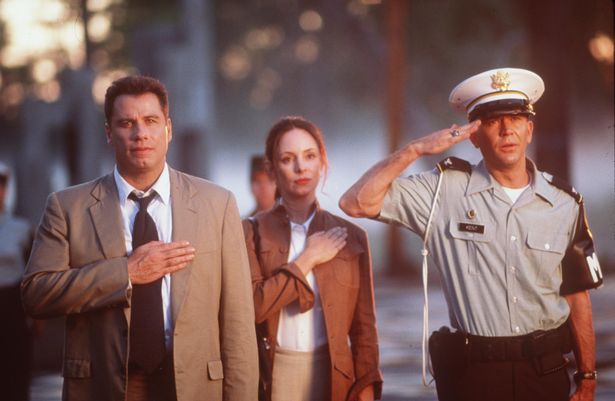
Probably one of the most subtle moments from Travolta’s appalling star vehicle about rape

Director: Simon West

Cast: John Travolta (Chief Warrant Officer Paul Brenner), Madeleine Stowe (Chief Warrant Officer Sarah Sunhill), James Cromwell (Lt. General Joseph Campbell), Timothy Hutton (Col. William Kent), Leslie Stefanson (Captain Elisabeth Campbell), Clarence Williams III (Col. George Fowler), James Woods (Col. Dr. Robert Moore)

The General’s Daughter is a mundane thriller from the late 1990s, now largely forgotten and quite rightly too. Travolta plays an army Warrant Officer, called in to investigate the rape and murder of the daughter of a decorated Army general (played in his best martinet style by James Cromwell). He works with a female Warrant Officer (Madeleine Stowe) with whom he has Unresolved Sexual Tension. Investigations quickly reveal of course that virtually everyone on the base seems to have had some sort of intimate relationship with the victim.

It’s a pretty straight-forward investigative thriller, but it takes a rather unpleasant leering interest in its victim, with the camera lingering frequently too long on her naked body – even during a rape scene the camera and direction invites the audience to admire the victim’s body: “Sure this is awful, but look ain’t she got great legs!”. Revelations that the victim has a sex dungeon, and indulged in sadomasochistic sex with several people, immediately lead our heroes to state that of course “the circumstances of her death are linked to her life” or words to that effect. In fact, the whole film has a slightly unpleasant air of exploitation about it.

Even more unsettlingly after that, the film-makers strap the fig-leaf of social concern over their film with an end card that mouths platitudes about female soldiers and asks us to pat ourselves on the back about the rise in number of female soldiers and the steps taken to prevent rape occurring in the army again. A bit rich from a film that has taken an ogling fascination in its victim as sexual figure throughout the film.

So let’s be charitable and say its attitudes are a bit dated, and that it does sort of try to say something at the end (however ham-fistedly). It’s still not that good a movie. I’ll give it a point for the fact that I didn’t guess the final killer (though I really should have done), although my wife and I managed to predict pretty much everything else between us. And its attempts to tuttingly wag its finger at the army’s attitude to female soldiers are totally undermined by its pervy aesthetic and grimy, exploitative subject matter.

Travolta throughout aims for cocky maverick but comes across more as a complete cock. His chemistry with Stowe is pretty much zero, which is appropriate as that is the same level of interest I had in their ill-defined past relationship. James Woods phones in another of his quirky wackos, James Cromwell is pretty decent as the General. The best performance probably comes from Clarence Williams III as a hero-worshipping adjutant.

The first twenty minutes of the film are a showpiece for an out-of-shape Travolta to rough up a few suspects and to give him “a very personal motivation” for the case (which almost suggests a guy can’t be expected to care that much about a rape victim unless he had met and flirted with her in advance) – it could effectively be skipped to be honest. The rest of the plot is as basic, half thought-out and mildly tasteless as the film itself. If you wanted to make a film about promoting the rights of women in the army, then this was almost a textbook example of how not to do it.