Tag: Mads Mikkelsen

Indiana Jones and the Dial of Destiny (2023)

Indiana Jones and the Dial of Destiny (2023)

Is there a place for Indy in the 2020s? The nostalgia-tinged would-be epic doesn’t provide an easy answer

Director: James Mangold

Cast: Harrison Ford (Indiana Jones), Phoebe Waller-Bridge (Helena Shaw), Mads Mikkelsen (Jurgen Voller), Antonio Banderas (Renaldo), John Rhys-Davies (Sallah), Toby Jones (Basil Shaw), Boyd Holbrook (Klaber), Ethann Isidore (Teddy Kumar), Karen Allen (Marion Ravenwood), Shaunette Renée Wilson (Mason), Thomas Kretschmann (Oberst Weber), Olivier Richters (Hauke)

Okay let’s get the elephant out of the room: It’s better than The Kingdom of the Crystal Skull. Yes folks, we have a new fourth-best Indiana Jones film. Is that something to celebrate? Indiana Jones and the Dial of Destiny makes some of the same errors as the previous valedictory effort, but at least it learned a few things and it’s been made by people who clearly love Indy. But they loved it too much, creating an often overblown, hellishly overlong, everything-but-the-kitchen-sink film which never just jump when it can flip, spring, bounce then explode at the end of it.

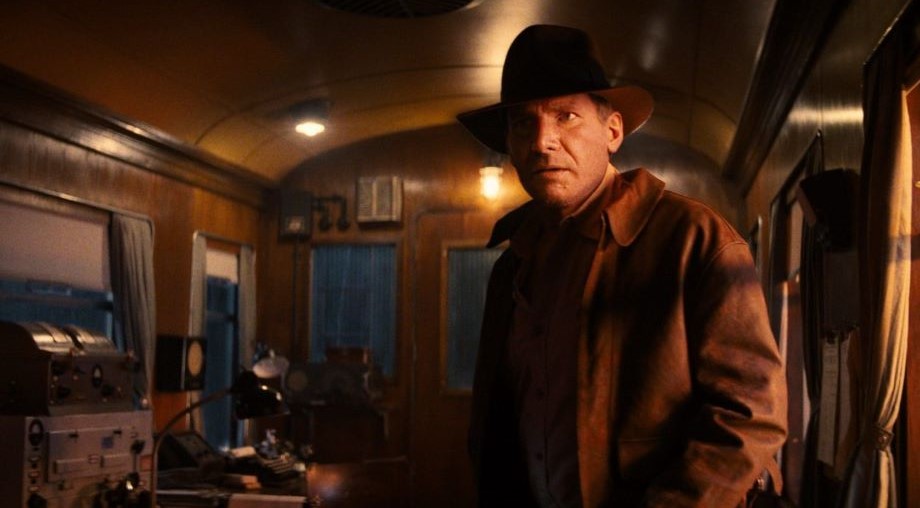
It opens with a (younger) Indy (Harrison Ford) battling Nazis in the dying days of the Second World War, trying to save a train full of precious artefacts. After defeating them, we flash forward to 1969 with Indy now a retiring archaeology professor to disinterested students in New York’s Public University, out of a place in an era where man has stepped on the moon. Grouchy, separated and fed-up, Indy’s life gets disrupted one more time when his god-daughter Helena Shaw (Phoebe Waller-Bridge) turns up on the hunt for Archimedes’ Dial. Indy knows about this dial as it was also the obsession of Nazi physicist Jurgen Voller (Mads Mikkelsen), last seen on that train in 1945 and now the brains behind the NASA moon landings. Indy and the unscrupulous Helena end up in a duel with Voller to find the dial – the prize being what Voller believes is a chance to change history.

Back in the day, Raiders of the Lost Ark was largely made so Spielberg and Lucas could show they could make an action-packed, crowd-pleaser quick and cheap. Today The Dial of Destiny is one of the most expensive films ever made (lagging only behind assorted Avengers films, the recent Star Wars trilogy and various other franchise entries). So much mony to make something less than half as good.

What this has allowed is Mangold and co to act like kids given the keys to their parents’ car. The Dial of Destiny is an explosion of Indy ideas, all rammed into the film willy-nilly. It’s made by people who feel this is their only chance to make an Indy film and don’t want to miss the opportunity to include every idea they’ve ever had.

We end up with a film that feels both far too long and yet strangely rushed. The Dial of Destiny would be immeasurably improved if about twenty minutes (at least) had been cut from its run-time and its poorly sketched thematic ideas condensed down. Its narrative structure has one too many quests, with Indy and Helena forever searching for a thing that leads to a thing that leads to yet another thing. An entire sequence, involving a pointless cameo from Banderas as a one-legged diver, would have been better slashed to ribbons or cut altogether. Every single one of the mega-budget chase sequences go on at least 2-3 minutes too long, straining the interest.

At the same time, the film manages to feel rushed. Ideas are presented and then taken nowhere at all. We see Indy tipping most of a bottle of whisky into his coffee in the morning – this suggested alcoholism never rears its head again. Voller is working in partnership (it seems) with the CIA, but their motives for this are never explained and Voller calmly ditches them part way through the film. Indy is framed for murder, but this plot thread is judicially abandoned by the time we get to the end. John Rhys-Davies literally pops up to drive Indy to an airport and make a trailer-friendly speech.
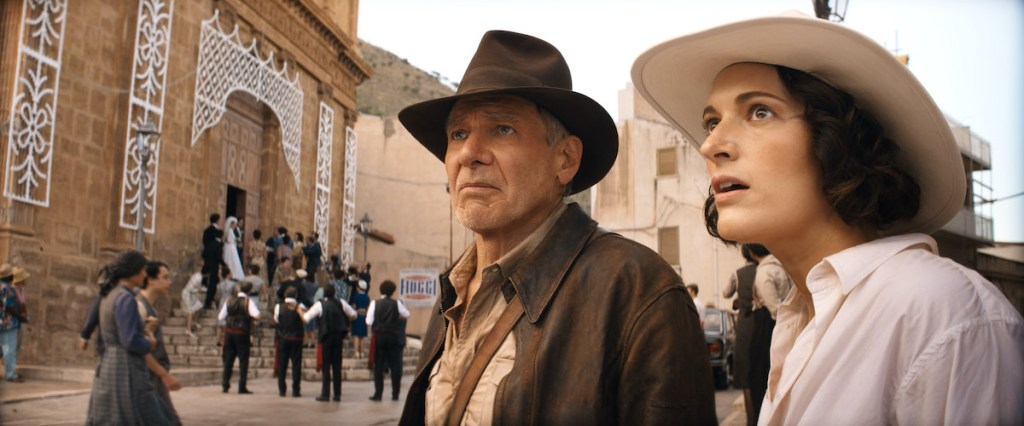
Most strikingly, all the films blaring action and endless bangijg stuff buries the most interesting plot thread of a tired, depressed Indy who no longer knows his place is in the world. The film solves Shia LaBeouf’s toxic unpopularity by having Mutt die in Vietnam, giving Indy a burden of guilt and grief. This is an Indy who has fallen from his Princeton heights, as ancient to his students as the artefacts he lectures about. It’s a thread though that the film only intermittently remembers, so crowded out is it by overlong chases, so that when the film’s conclusion returns to it as a major motivator for Indy it feels forced.

In any case, the film’s action set-pieces peak with the 1945 opening section with a digitally de-aged Ford and Mikkelsen facing off on a speeding train. I think the de-aging effect is very well done (though Indy speaks with Ford’s current 80-year-old voice), and this sequence has a sort of nostalgic charm to it and at least it feels of a piece with the originals. Not that its perfect: it’s overlong and overblown of course – a castle explodes, Indy runs over the top of a speeding train – and looks like something created with blue-screens and digital effects rather than in reality. (It’s also clear a digitally de-aged Ford head has been placed on a stunt double at key points.)

But it’s a bright-spot. There are others: Harrison Ford, again, is perfect for the role – crusty, resigned but still with the glamour of excitement in his eyes. He and the film don’t back away from his advanced age – Indy looks more vulnerable than ever – and Ford sells the moments he’s allowed in the film’s breakneck speed to reveal Indy’s emotional turmoil. He also has a great chemistry with Phoebe Waller-Bridge, who effectively channels Han Solo as an immoral adventurer who learns about decency. Mikkelsen’s mastery makes him an impressive villain.

I’ve been really hard on this film. It is fun I promise. I laughed and at times I was thrilled. But it is too much. Even the settings of the chases offer a sensory and time overload: a chase around a ticker-tape parade in New York onto a subway (with Indy on a horse) has an overload of visual details. A chase through the streets of Marrakesh goes on forever – and is over-built with our heroes chasing Voller while also being chased by Helena’s gangster-former-fiancee. film culminates in a final sequence which is just about not as silly as aliens – but by any other score is incredibly silly.

Essentially The Dial of Destiny is undermined by fan love. Mangold is a good director but doesn’t know where to stop. The film leans into nostalgia too hard but, above all, it offers far too much bang for your buck. The film is frequently at its most effective in its quieter, character-driven moments. Like Crystal Skull, it mistakes bigger for better. It’s still a more entertaining and a better film than Crystal Skull – but, somehow, its excessive overindulgence makes you feel strangely disappointed.

Fantastic Beasts: The Secrets of Dumbledore (2022)

Fantastic Beasts: The Secrets of Dumbledore (2022)

The Potterverse goes through its death throws in this anaemic offering in a misguided franchise

Director: David Yates

Cast: Eddie Redmayne (Newt Scamander), Jude Law (Albus Dumbledore), Mads Mikkelsen (Gellert Gindelwald), Ezra Miller (Credence Barebone/Aurelius Dumbledore), Dan Fogler (Jacob Kowalski), Alison Sudol (Queenie Goldstein), William Nadylam (Yusof Kama), Callum Turner (Theseus Scamander), Jessica Williams (Lally Hicks), Victoria Yeates (Bunty), Richard Coyle (Aberforth Dumbledore), Poppy Corby-Tuech (Vinda Rosier), Fiona Glascott (Minerva McGonagall), Katherine Waterston (Tina Goldstein)

If the House of Potter teetered after the not-very-good Crimes of Grindelwald, it collapsed with the release of The Secrets of Dumbledore to waves of indifference. It’s proof that if you super-size your series not because you have a genuine story reason but because you think a fat goose will lay even more golden eggs than a thin one, you’ll eventually end up with a dead obese goose.

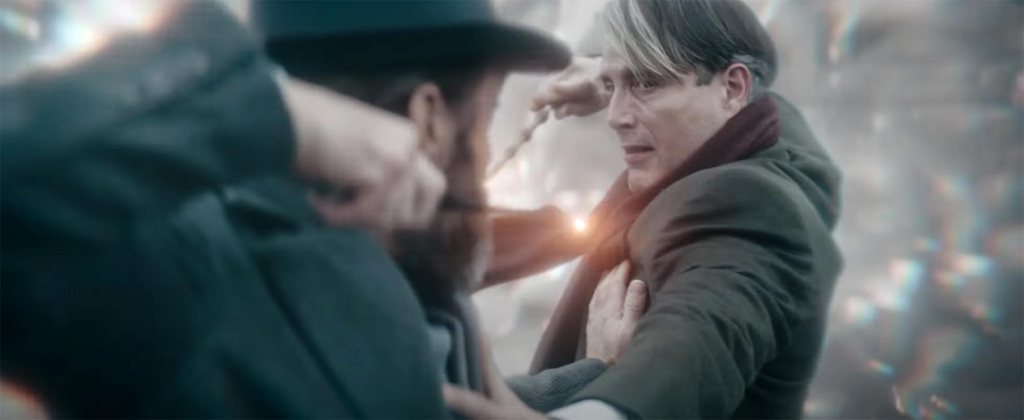
A year or something has passed and Dumbledore (Jude Law) and Grindelwald (now Mads Mikkelsen, thank God) continue circling, neither quite willing to end their ‘friendship’. Grindelwald is determined though to seize control of the Wizarding World by manipulating the election for the Supreme Leader to launch his anti-Muggle war. Dumbledore recruits a team, led by Newt (Eddie Redmayne), to stop him – but with Grindelwald’s new power to see the future, seized from a Fantastic Beast, Dumbledore can’t tell anyone his plan (plus ca change). Meanwhile Credence (Ezra Miller), is groomed by Grindelwald to destroy Hogwarts’ favourite professor.

The Secrets of Dumbledore may be flabby, over-extended and frequently meander down alleyways and byways that feel frustratingly pointless – but it is a better film than The Crimes of Grindelwald. Its problem is, it’s nowhere near good enough to win back the massive loss of audience faith that complete shit-show (combined with all sorts of social media storms) caused.

The Secrets of Dumbledore’s major positive is the arrival of Mikkelsen as Grindelwald. Replacing Johnny Depp (and his “personal problems”), he gives the film an automatic upgrade. If you want an arrogant, sinister, manipulative, but also dashing, romantic villain, why in God’s name wouldn’t you have cast Mikkelsen in the first place? The film is more daring on the Dumbledore and Grindelwald relationship than any other Potter film before – we even hear the “L” word.

Anything focused on these two – either together or alone – is invariably the good stuff. The two of them (Jude Law is equally good) semi-threatening, semi-reminiscing, semi-flirting in a café at the start is the finest scene, and the genuine regret between them is rather well done. Rowling also writes in, pretty much direct from the final book, the entire tragic Dumbledore-backstory reveal which the final Deathly Hallows film bizarrely cut (perhaps she thought it was as terrible an idea as I did?). Law plays this little moment to perfection.

You end up wishing the film was a more personal story between these two. Unfortunately, we get this over-inflated mess. The most bizarre thing about Secrets of Dumbledore is that simultaneously loads is going and the plot feels incredibly slight and mostly pointless. Frequently events bend down alleys or fizzle out into pointlessness. Far from being full of secrets, Dumbledore and his brother fall over themselves to share their secrets at every opportunity to keep the plot moving forward.

After the money-grabbing decision to squeeze as much cash out of this franchise (five movies!) as possible, The Secrets of Dumbledore feels like it has taken on a lot of padding to get up to length. Rowling, to put it frankly, isn’t that great at structuring a screenplay (it’s telling Steven Kloves was bought back to help bang this into shape). It’s a reminder it’s a very different set of skills telling a coherent story, full of twists, turns and universe building over 2 hours compared to 700 pages.

Grindelwald’s plan involves the complex and poorly explained, killing and resurrection of a magic goat. There is a lot of talk of “the people getting a say” in the election: an election where no one gets a say, since the leader of this civilisation is chosen on the whim of said magic goat. Our heroes go to the German Ministry of Magic solely, it seems, so Newt’s brother can be captured. A “spy” is planted among Grindelwald’s forces who does no spying, has parts of his memory wiped for no reason and then rejoins the heroes. Two characters communicate via a magic mirror, even though they’ve never met and couldn’t know who the other is. A labyrinthine plot about an assassination has so many hastily explained twists I genuinely have no idea what was going on. At regular intervals the heroes reconvene with Dumbledore, like players in a video game being given a brief for the next level.

Even more than the last one, the “Fantastic Beasts” idea feels like a burden. They’d have done better just starting a new “Dumbledore vs Grindelwald” franchise. The plot sort of revolves around a poorly explained magic animal. Theseus is whacked in a prison guarded by a deadly scorpion. In a bizarre tonal zig-zag, Newt distracts this beast’s scorpion-y minions by doing a funny dance – interrupted every so often by it grabbing a “political prisoner”, eating them alive and then spitting out the half-chewed corpse for its minions to consume. Remember when this felt like this series was going to be about the charming adventures of a naïve zoologist?

The legacy characters stumble through with little to do. Redmayne’s Newt is a character so bizarrely ill-conceived as the lead in a prelude-to-war series he’s often quietly relegated to side missions. Dan Fogler’s Jacob and Alison Sudol’s Queenie continue a nonsensical emotional journey (she, let’s not forget, defected to Grindelwald – the man who wants to destroy Muggles – because she wasn’t allowed to marry a Muggle). Katherine Waterston’s Tina is relegated to a cameo.

Then there’s Credence. This character, the central Macguffin of the last two films, is here relegated to the role of heavy whose long-hyped clash with Dumbledore is a little more than a dull one-sided scuffle. It’s hard not to think the character has been reduced to glorified extra due to the increasingly toxic public image of Ezra Miller (has there ever been a franchise more unlucky in its casting?). But the unceremonious dumping of this entire plotline so crucial to films one and two hammers home the feeling that there is no consistent planning going on here at all.

I said in Crimes of Grindelwald this franchise in need of a new creative eye. David Yates directs his seventh Potter film and, while he does nothing wrong, I don’t think he’s got a single new idea in the tank. The look and feel of this film, its visuals, the effects, its tone, its colour palette – all of it is now achingly familiar, making it feel even more like something tipped carelessly off a production line. It also looks shockingly over-processed: I know it’s about magic but by Merlin’s Beard nothing looks real. Does it feel magic to be back at Hogwarts? No, it looks like a freaking CGI nightmare.

The lack of freshness surely contributed to its death at the box-office. No one seems to have stopped and asked “would someone who hasn’t been working on Potter full time for over 12 years care about this?”. I don’t think they did. If you work the Golden Goose night and day, demanding it produces an egg a day, eventually it will keel over. It didn’t have to be like this, but there is more chance of Depp returning than anyone making the next two films in this misbegotten series.

Another Round (2020)

Another Round (2020)

Vinterberg’s film explores our complex relationship with alcohol with a surprising lack of judgement

Director: Thomas Vinterberg

Cast: Mads Mikkelsen (Martin), Thomas Bo Larsen (Tommy), Magnus Millang (Nikolaj), Lars Ranthe (Peter), Maria Bonnevie (Anika), Helene Reingaard Neumann (Amalie), Susse Wold (Principal)

Mankind’s most difficult relationship? Might just be with alcohol. Ever since Noah first toppled over pissed, we’ve struggled to balance that delightful buzz a touch of intoxication gives with the destructive impact way too much has. It’s a relationship explored in Thomas Vinterberg’s curious mix of warning and celebration, Another Round, which (slightly obliquely) looks at the positives and negatives of alcohol consumption.

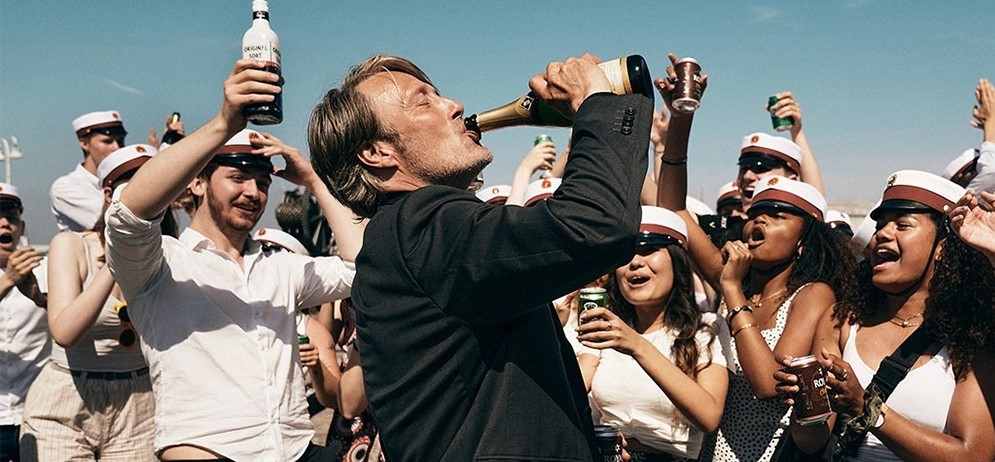
In a gymnasium school in Copenhagen, history teacher Martin (Mads Mikkeslen) has lost all passion and interest in his students (so much so they try to have him removed) and his marriage is stuck in an increasingly distant rut. After a birthday meal, he and three friends – PE teacher Tommy (Thomas Bo Larsen), psychology teacher Nikolaj (Magnus Millang) and music teacher Peter (Lars Ranthe) – agree to a pact to combat their ennui. After reading a theory that mankind is born with 0.05% blood alcohol content deficiency (and topping it up makes you more creative and relaxed), they decide to experiment with maintaining a certain level of inebriation. At first it has a positive impact; but as they push the boundaries of the experiment, the negatives swiftly multiply.

Vinterberg’s film is notable for not taking an obvious (or firm) stance on alcohol consumption. It’s easy to imagine an American or British film dwelling on the negatives at the cost of everything, or demonstrating deep regret in the friends for ever starting on this journey in the first place. Another Round doesn’t do this. In fact, it rather bravely points out the positives we can feel from the happiness and relaxation alcohol can give. So much so that, at first, it actually improves people’s lives. After all, if it was always all bad – we wouldn’t drink it would we?

This is most notable in the case of Martin. He might stumble in the staffroom on the way to class, but (after a swig of vodka) his teaching becomes more inspiring, electric and engaging. He rediscovers a passion for working with students, dropping the disengaged drawling of semi-confused facts we see him use earlier (where he doesn’t even seem to be listening to himself, randomly drifting from the Industrial revolution to Churchill) and replacing it with insightful parallels, high-energy tempo and fun activities. Whether it’s psychological or something else, being able to relax clearly has a positive short-term impact on his ability to teach.

It’s matched in the others as well. Peter gets his students singing with an intensity and beauty he couldn’t begin to get them to reach earlier. Tommy, in his work with a primary school football team, brings out the skilled footballer in a shy, bespectacled student (although his uncomfortable blurring of the line between teacher and surrogate parent with this boy hints at Tommy’s lack of control, which the film will explore in more depth). Vinterberg echoes the giddy feeling of elation all four feel by subtle use of a free-moving handheld camera, compared to the more staid rigidity of the earlier stable shots.

Martin also dramatically improves his personal life. He starts to reconnect with his family and rebuild passions with his wife. Sure, there are negatives. Hidden alcohol stashes at the school are discovered. It becomes harder to hide their intoxication in the common room. But it still feels good, right? Problem is, Martin makes the mistake many of us have. If a small amount of this makes me feel this good – why don’t I take a large amount? Surely if I up the blood alcohol content even higher, the positives will be all the greater. Sadly, of course, it doesn’t work like that.

Vinterberg’s film is careful not to use labels like alcoholism. But, in the same way it isn’t afraid to show the world-beating confidence a stiff drink or two can give you, it doesn’t shy away from the impact of over-consumption. Deciding, “as an experiment”, to push their drinking to absurd levels for one night only, to get as intoxicated as possible, the four have a fab night. But the next morning? Peter loses all his clothes diving in the sea. Nikolaj wets the marriage bed in a confused stupor. Martin wakes up, face bleeding, on the pavement having tried (and failed) to use his keys on his neighbour’s house, and is carried home by his humiliated children.

This is as nothing compared to the terrible impact of alcohol on Tommy. While all four of the men no doubt become increasingly dependent, it’s Tommy who tips into full blown alcoholism. Beautifully played by Thomas Bo Larsen, its painful to watch this gruff-but-playful bachelor dip increasingly into confused, stumbling, permanent inebriation, living in a home made of finished bottles and unable to hide from colleagues or students his intoxication.

But, for all that much of the second half of the film focuses on these negatives, it doesn’t offer easy solutions. All four realise things have gone too far – but none of them can forswear (or even seem to consider doing so) alcohol. Martin’s marriage collapses and Nikolaj’s nearly goes the same way. But they still gather at the film’s end for a drink. It’s at this point that it can be a little unclear what Vinterberg’s thoughts are on the demon. But then perhaps that is the point: we all know it’s bad for us anyway, so a film that looks at how we balance that desire with a certain level of responsibility is always, perhaps, going to shy away from either easy answers or definitive statements.

It’s perhaps why the film ends with a surprisingly blissful, up-beat ending of hope for the future rather than despair, as Martin explodes into a riotous improvised dance routine. It’s easy to forget Mikkelsen is a trained dancer, and the fact he provides such a striking, memorable ending to the film is fitting as it’s a triumph for him. At first a shambling, sad-sack figure, Mikkelsen’s Martin finds a casualness and relaxation that seemed beyond him (the film is a physical triumph for Mikkelsen – his drunken move through a common room worthy of Gene Kelly or Buster Keaton). Mikkelsen’s work is extraordinary in its emotional complexity – bursts of pained sorrow, rage, guilt, self-loathing, despair and hope flash across his face and he holds the entire film together.

He’s ably supported by Larsen, Millang and Ranthe – all superb – and Vinterberg’s deceptively casual and unobtrusive direction helps craft a film that offers scenarios but not lectures. While I could have hoped for the film perhaps taking a bit more of a stance one way or the other – or give a more unflinching look at the impact on others of alcohol abuse – as a personal story Another Round is vibrant, honest and (strangely) hopeful, for all the terrible impacts it displays. It lingers with you like a hangover.

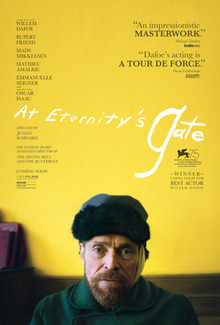
At Eternity's Gate (2018)

Willem Dafoe is the great Van Gogh standing At Eternity’s Gate

Director: Julian Schnabel

Cast: Willem Dafoe (Vincent van Gogh), Rupert Friend (Theo van Gogh), Oscar Isaac (Paul Gauguin), Mads Mikkelsen (Priest), Mathieu Amalric (Dr Paul Gachet), Emmanuelle Seigner (Woman from Arles/Madame Ginoux), Niels Arestup (Madman), Vladimir Consigny (Dr Felix Ray), Amira Casar (Johanna von Gogh-Bonger)

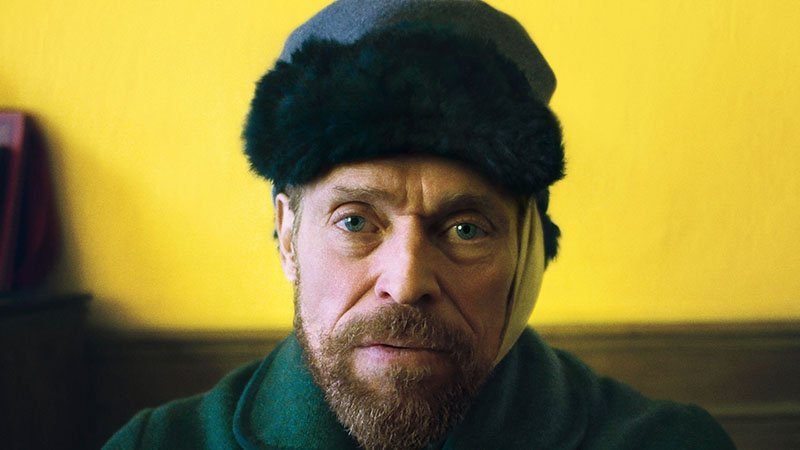
Vincent van Gogh has a constant fascination for film-makers. Perhaps it’s because, as this film suggests, he sat permanently “at eternity’s gate”, painting for those yet to be born. It’s well known van Gogh only found success, fame and artistic recognition after his death. The sad tragedy of his life – he was a deeply troubled man, who struggled profoundly with depression – has been fuel for many films with van Gogh played by actors ranging from Kirk Douglas to Benedict Cumberbatch. Now Willem Dafoe – a very close physical match to the painter (even if he is almost 25 years older than van Gogh at his death) – takes the role on in artist Julian Schnabel’s film.

You’d expect Schnabel, a renowned artist and film-maker, to create a film that offers insight and even revelations on van Gogh and the process of art creation. It’s a shame then that At Eternity’s Gate doesn’t quite succeed in doing this. Schnabel stated in interviews that the existence of the Kirk Douglas/Vincente Minnelli Lust for Life (a far more conventional narrative retelling of van Gogh’s life spliced with melodrama) removed the need for him to worry about telling the clear facts of van Gogh’s life. While I guess it’s true that the basic litany of van Gogh’s final years (which the film focuses on) of Arles-Gauguin row-ear removal-asylum-Gachet-suicide is pretty familiar to many people (and I suspect everyone likely to see this film!), Schnabel’s film drains the drama from this.

Instead Schnabel offers up a film straining at complexity, but which feels rather slight and unsatisfactory. It only seems to scratch the surface of art and the thinking behind van Gogh’s creations. In fact, whenever the film actually tries to talk about art it largely comes across as stodgy and lumpen. Oscar Isaac in particular is saddled with several speeches and dialogue exchanges on art that fall lamely to the floor. Van Gogh gets a few more poetic contributions, but these are few and far between and essentially seem to sum up to a wistful love of nature and the beauty around us.

On top of this, I don’t feel like I get a real understanding or insight in this film into van Gogh’s inner life. In 2011 an episode of Doctor Who written by Richard Curtis made profound and moving material out of Van Gogh’s depression in the episode Vincent and the Doctor. The pain of inner turmoil, the volatility of depression, the way joy can switch to anger and suicidal self-loathing as if a switch has been flicked – it’s all there in that episode. It’s a side of van Gogh that seems missing in this film. The demons, for want of a better word, are missing. 

The film indeed averts its eyes from van Gogh’s bleakest moments. The arguments with Gauguin happen mostly off-screen – I guess the film is placing us in van Gogh’s shoes in that it’s as much a surprise to us that Gauguin announces he can’t bear it any more as it clearly was to van Gogh. The ear cutting is related to us by a calmer van Gogh days later. The film also follows the line of the recent 2011 biography of van Gogh in believing his death was not suicide but manslaughter, a theory that I’m not sure I can really support (since it seems to be founded on a lack of understanding about how the depressed can seem fine one day and then suicidal the next) so maybe this is all intentional.

What the film does do well is get a sense of van Gogh as a soulful and gentle man. Willem Dafoe, as well as being a remarkable physical match for van Gogh, is also an actor made for both suffering and imbalance. After a career of martyrs, the intense, the unhinged, the mutilated and Jesus Christ, his face seems lined already with the cares of the world. Dafoe is very good here, soulful and vulnerable but with a monomania for painting under the surface that guides all his actions. But he has a wistful, childlike tenderness to him and a sense of a gentle man adrift in a world he can’t understand.

It’s a shame the film doesn’t have slightly more to it. Visually it gets a good sense of van Gogh’s striking colours. But I was put off by Schnabel’s addiction to using a wild hand-held camera. Often sloshing woozily around the frame, the camerawork is clearly an attempt to capture the urgent brush strokes and movement of van Gogh’s painting in its visual style – like his paintings it never sits still. It’s also perhaps an attempt to capture the mania of van Gogh’s inner life: it’s noticeable the camera work only calms when van Gogh himself is calm (i.e. painting). But it’s still not exactly easy to watch – like reading a book on the upper deck of a ship during some particularly choppy seas.

At Eternity’s Gate feels like it should be a better film than it is. Irritating camera work aside, it is well made and it has a fine performance at its centre. There are some decent cameos from the other performers – best of all Mads Mikkelsen as a kindly priest who gently, and with great sadness, breaks it to van Gogh that his work is clearly rubbish – but it never really feels like it gives any real insight into either van Gogh or his artwork. For all its panache, it’s strangely empty.

King Arthur (2004)


Clive Owen leads his merry men in clumsy would-be Arthurian epic King Arthur

Director: Antoine Fuqua

Cast: Clive Owen (Arthur), Ioan Gruffudd (Lancelot), Keira Knightley (Guinevere), Stellan Skarsgård (Cerdric), Ray Winstone (Bors), Mads Mikkelsen (Tristan), Joel Edgerton (Gawain), Hugh Dancy (Galahad), Ray Stevenson (Dagonet), Stephen Dillane (Merlin), Til Schweiger (Cyrnic)

The story of King Arthur has entertained generations for so long, it’s actually a bit of a surprise that there hasn’t been a great movie made about it. Sure there have been entertaining guilty pleasures (like my love for the bobbins Excalibur) but there hasn’t been a great action adventure made about the legendary king. And this Jerry Bruckheimer actioner sure ain’t it. But it re-enforces my seemingly never-ending appetite for distinctly poor, big-budget, epic films.

Arthur (Clive Owen) is a half-Celtic Roman cavalry officer who commands a Sarmatian cavalry unit, serving a fixed term of service with Rome. They help to guard Hadrian’s Wall against rebel native Britons. Before their discharge, the knights are given one last job: go behind enemy lines to rescue a prominent Roman citizen living beyond the wall. Once they arrive, they find he has enslaved the local Brits – including imprisoning a young woman named Guinevere (Keira Knightley). Knowing a Saxon invasion force lead by the fearsome Cerdric (Stellan Skarsgård) is ravaging Britain – and that the Romans are withdrawing from the empire – Arthur decides to lead the whole group back to the wall and safety.

King Arthur isn’t a terrible film, just a totally mediocre one. It’s an uninspired coupling together of half-a-dozen other better movie: from its Dirty Dozen line-up, through its Gladiator style score (Hans Zimmer rips himself off again), to its remix of a thousand period sword epics from Spartacus on, mixed with its Braveheart style design and battle scenes. It’s almost completely unoriginal from start to finish. There is no inspiration here at all – it’s made by people who have seen other films and based everything on that rather than wanting to make a film themselves.

It even wraps itself up with an unseemly haste, as if all involved knew they hadn’t nailed it so decided the best thing to was to knock the whole thing on the head and call it a bad job.

The film probably stumbles from the start with its claim to present a sort of “true historical story” of King Arthur. Now I’m not one to get hung up on historical accuracy too much – except when it’s making extravagant claims which are just not true – but the “true story” here is bobbins. Nothing really feels right – from the Roman politics to the idea of a group of loaded Roman settlers setting up a huge estate deep into Scotland (I mean what the fuck was Hadrian’s Wall for eh?). The knights bear very little resemblance indeed to their legendary counterpoints. In fact it’s almost as if they had a script about a brave band of Roman soldiers and just stuck the name King Arthur on it for the name recognition (perish the thought!).

The idea of a group of seasoned, grizzled warriors isn’t a bad one – and it works rather well here because most of the actors in these roles are pretty good (particularly Mads Mikkelsen as a sort of Samurai Tristan). It makes for some interesting dynamics and always some fine character work – the best arc going to Ray Stevenson’s Dagonet as a knight who finds something to fight for. It also contrasts rather well with Stellan Skarsgard’s world-weary villain, who’s seen it all and finds it hard to get excited about ravaging and pillaging anymore.

But it’s a shame that this promising set-up gets wasted. After a good start, when we get to see all our heroes’ personalities reflected in their fighting styles as they repel an attack on a bishop, these dynamics quickly settle down into the usual tropes: you’ve got the joker, the cocky one, the reluctant one who’s only out for himself… Fortunately the Director’s Cut (which I watched) deletes the worst of Ray Winstone’s comic “banter”, but it’s still pretty standard stuff.

The mission behind the wall then pretty much follows the pattern you would expect: the guy they go to rescue is an unsympathetic bastard, they find themselves protecting the weak, it’s a dangerous journey back to safety, blah-blah-blah. Although a battle on the ice has some genuine excitement to it, there isn’t anything new here at all. Everyone just feels like they are going through the motions. 

When the battles kick off in earnest, they are pretty well mounted – even if they are hugely reminiscent of the opening battle of Gladiator and the low-camera, immersive battles of Braveheart. Sure there is a smoky immediacy about them, like a sword wielding Saving Private Ryan, but it’s still pretty much what you would expect. The action pans out with no real surprises – our heroes and villains even match up for the expected clashes.

Clive Owen is a fine actor, but he is manifestly wrong for the role of a classical hero and the awe-inspiring battlefield heroics he is called to carry out here. He’s too modern an actor, with too much of the world-weary smoothness to him, for him to really convince as this hardened medieval warrior. Owen’s delivery and style is so restrained he can’t bring the bombast or elemental force the part requires. Allegedly he was cast because Bruckheimer believed he would be the next James Bond – the actor they turned down for Arthur? Daniel Craig… 

Nope. Sorry.

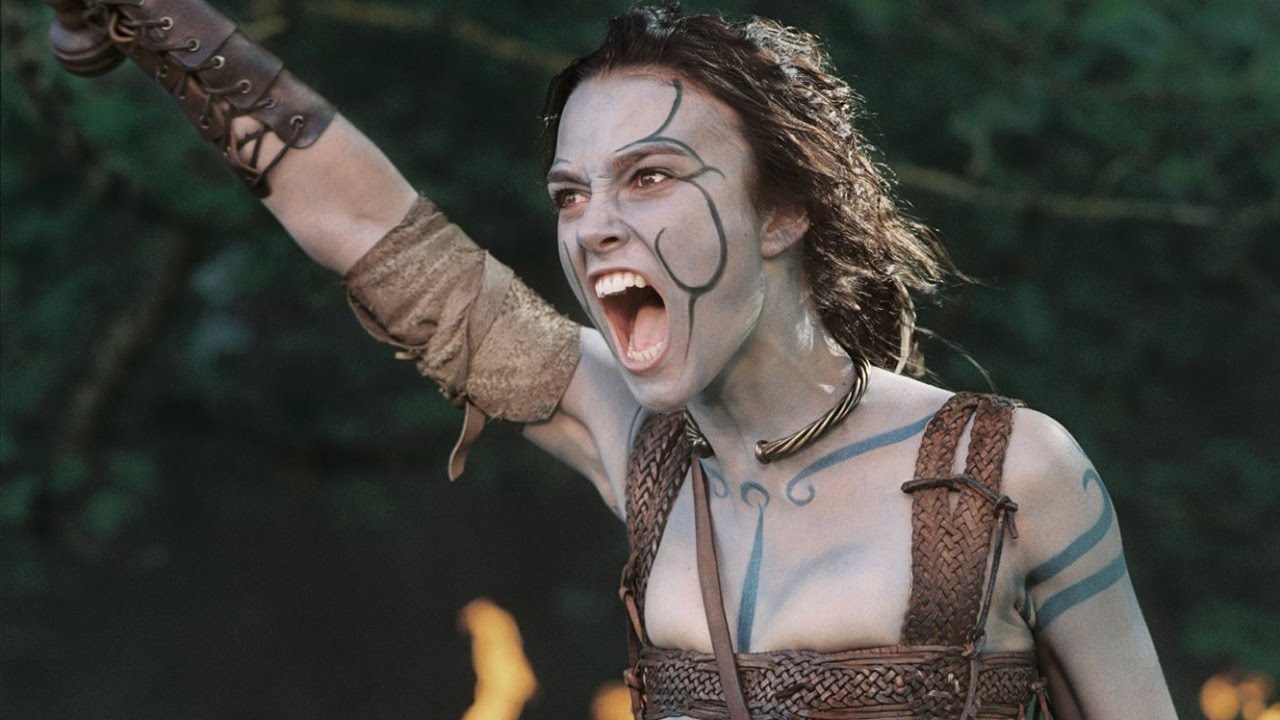
Similarly Kiera Knightley is just as miscast. Let’s put aside the fact that she is half Owen’s age. There is a prep school headgirlishness to her that just doesn’t work when we are asked to buy her as woad-covered warrior princess. She’s too strait-laced, too polite, too sophisticated. When she does step into the full-on Boudicca look, you’ll giggle rather than tremble. For all her exertion, she’s not convincing in the role either.

But then that’s King Arthur all over: trying hard but not convincing, with such a tenuous link back to the original myth that the fact they are just using the Arthur name to flog some more tickets is all the more obvious. Major elements of the legend are missing – in particular the Arthur-Lancelot-Guinevere love triangle is cut down to the merest of suggestions, enough for it to be noticed but not enough for it to feel like a real plot – and other elements (Merlin, the Sword in the Stone, the Round Table) seem shoe-horned in for no real effect. It’s basically just a bombastic B-movie, a sort of Gladiator rip-off without the poetry. Moments of fun, but still not that good.

Rogue One: A Star Wars Story (2016)


The characters of Rogue One. I struggle to remember their Dingly-Dang sci-fi names.

Director: Gareth Edwards (Tony Gilroy)

Cast: Felicity Jones (Jyn Erso), Diego Luna (Cassian Andor), Ben Mendelsohn (Director Krennic), Donnie Yen (Chirrut Imwe), Mads Mikkelsen (Galen Erso), Alan Tudyk (K-2SO), Riz Ahmed (Bohdi Rook), Jiang Wen (Baze Malbus), Forest Whitaker (Saw Gerrera), Genevieve O’Reilly (Mon Mothma), Jimmy Smits (Bail Organa), Guy Henry (Grand Moff Tarkin), Alistair Petrie (General Draven)

When Disney got hold of the complete rights for Star Wars, they were motivated by one thing above all: making a shitload of cash. In that goal, they’ve been very, very successful. Rogue One fills out (pads out) the story of how the Rebels got hold of the Death Star plans, something the original film (correctly?) reckoned could be covered in a few lines of dialogue. Anyway, for complex, muddily explained reasons, the rebels needs Jyn Erso (Felicity Jones), daughter of chief designer on the Death Star Galen (Mads Mikkelsen), to rescue a pilot from a rogue general to get a message from her father. Or something. Anyway, things eventually lead to a major space battle as our heroes try to steal the plans from a giant computer database.

Rogue One is hugely popular. You’ll go a long way before you meet someone willing to say a bad word about it. It’s been hailed as a far superior dip into the franchise ocean than JJ Abrams’ The Force Awakens. This is inexplicable to me. I genuinely can’t understand it. As far as I can tell, Rogue One is little more than a fair to middling action film, hugely reliant on ramming in as many references and easter eggs from previous films as it can, rather than actually doing anything new or unique with the franchise. 

For me it’s a sprawling, rather dull film with no depth or patience. The first hour is genuinely quite boring, with each over-designed location blending into the next. The whole film seems designed to require as little attention as possible: short scenes, planet to planet, each having little real impact on the next emotionally. The battles are designed and shot like things intended to be cut up into YouTube clips. No-one talks during the fights, we rarely learn anything about characters during the prolonged action – instead it’s a series of moments, straining at the leash to be cool, with personal sacrifices determined by plot requirements rather than by natural character growth. 

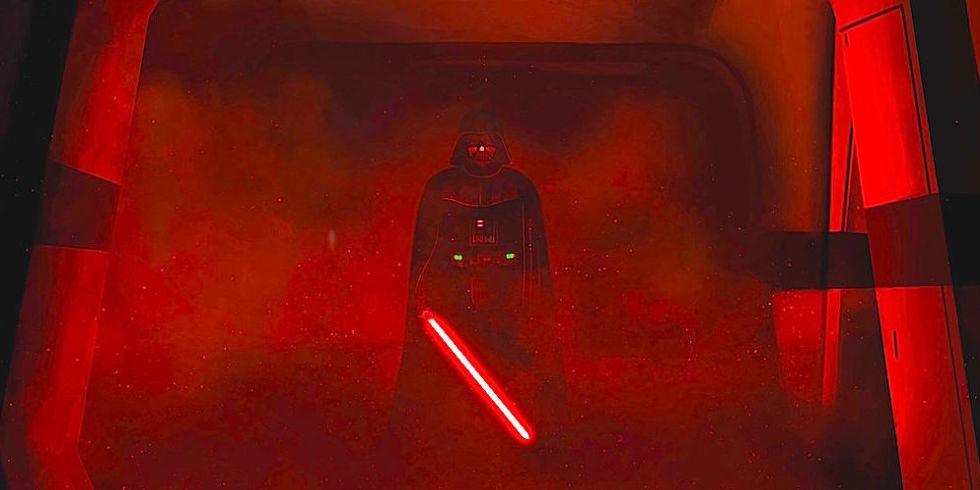
Watching parts of it you can enjoy the moments: a blind man taking out Stormtroopers, or Darth Vader cutting down rebels. But there is little to tie these moments together. Plot and characterisation are treated in the same chunked way – events grind to a halt so Mads Mikkelson can tell us what happens next, or Cassian can bluntly talk about how being a rebel is tough on the nerves. In the original Star Wars, plot, character and action were woven together so we learned about all three together. Here they are silos, with action the focus. It feels like a film made for YouTube, more interested in pop culture references with only the flimsiest story propping it up, designed to be spliced up online.

Darth Vader lets rip in a section that seems designed as a YouTube moment of the future

Now the lead character, Jyn Erso. I don’t understand this character. Who is she? What is it she actually wants? For the first hour or so of the film she makes no decisions at all, but does what a series of older male characters tell her to do. There is nothing in the film that allows us to get to know her. Her actions aren’t dictated by character, or even logic, she simply shuttles around the carousel of ever-changing planets whenever the plot needs her to, mouthing whatever sentiments the film needs in order to move on. The film needs her to be a disaffected criminal? She is. The film needs her to be a distraught daddy’s girl? There we go. The film needs her conversion into a rebel freedom fighter? Boom. What does she feel about this? What awakes her idealism, and converts her from criminal to self-sacrificing hero? Nobody knows, the film doesn’t care. It doesn’t help that Felicity Jones’ headgirlish primness is a total mismatch for a gritty, tough-as-nails fighter from the wrong-end-of-the-tracks.

There are many people in this film, but precious few characters. It’s quite damning that the person who makes the biggest impact isn’t a person at all but a robot – and K-2SO is basically a walking cynical punchline, a battle-ready C3PO. Diego Luna’s Cassian is so thinly sketched it’s hard to invest in him at all: the film has no interest in character development so we are bluntly told his characteristics in ham-fisted dialogue. He has a vague speech about how he’s Seen Bad Things, and that’s deemed sufficient to explain all his actions. The worst is Riz Ahmed’s pilot, whose motivations are so unaddressed he spits out some final words to supply his motivation just as he snuffs it. Donnie Yen and Jiang Wen are little more than a collection of cool sounding quirks – Blind One, and Blind One’s Friend. Can you even remember their names? 

On the plus side, Ben Mendelsohn is pretty good as an ambitious Imperial officer edging his way up the greasy pole – most of the more interesting dialogue scenes feature Death Star office politics. Mads Mikkelson mines every inch of humanity and compassion from his role. At the other end of the spectrum, an unrestrained Forest Whitaker lets rip as a plot mouthpiece, delivered in his most overripe manner. (There’s some kind of backstory to his relationship with Jyn, but the film never bothers to go into this, because that time is better spent with Whitaker spouting bland, faux-epic, lines like “Save the rebellion. Save the dream”, round mouthfuls of scenery.)

There has been a lot of discussion of the digital recreation of Peter Cushing as Grand Moff Tarkin – I’ve no real moral problem with it (lord knows, a glance at his CV tells you Cushing would probably have loved to have been in this film), and Guy Henry does a pretty good vocal recreation of Cushing. It looks a little odd the more you watch it – it’s probably going to date the film quite badly in ten years time – with more than a hint of the “uncanny valley” in Tarkin’s face. It makes sense, though, including the character in the film – and at least we get some characterisation and motivation.

Edward’s visual ability allows him to film his toy collection in a way that at least feels a bit fresh, but it’s a film made by a fanboy, more interested in getting as many references from the past in than creating something new. Edwards rams in everything from Blue Milk to AT-ATs. Now there is a certain pleasure in spotting this stuff, don’t get me wrong. But will it reward future viewing? The final space battle sequence might as well be a child filming smashing his toys together.

My point is, remove all the vast amount of Star Wars ephemera from this, and what do you have left? Once you’ve exhausted the pleasure of seeing that bloke Obi-Wan cuts the arm off in the bar in the first film, or you’re no longer excited by admiring the recreation of the Rebels’ base, what is there left in the film for you to enjoy? Imagine this was a stand-alone story – what would really make you come back? It’s so shrunken and dependent on Star Wars that it stops almost exactly 5 minutes before Star Wars starts – and, I would argue, means the start of that film makes much less sense.

That’s the final problem – for all the talk of Star Wars being a huge universe, this film only stresses how small it is, how reliant it is on events that have already happened or spinning its plotlines off from references in other films. No matter where we go, the same people keep popping up, the same beats keep getting hit. The film is daring, I suppose, in killing off nearly the entire cast over the course of the film – but these characters have been so poorly developed that their deaths lack any impact. It’s a film overwhelmingly fascinated by surface and fan-wanking over the old films, than showing anything new. 

Now I know you could level some of these charges against The Force Awakens – but that was a film with engaging characters and fresh, enjoyable dialogue that introduced a few new concepts for the films to go forward with. Within moments of their first appearances, you knew what kind of person Rey was (bold, determined, wistful, searching) or Finn (conscience-stricken, inventive, desperate) – hell the dinky robot had more character than the cardboard cutouts here. The internet obsession with shipping Finn & Po shows how much these characters came alive. Can you imagine anyone spinning out theories of backstory or subtext about any of the people here? No, because they’re not people, they’re plot devices. 

If a truly inventive director had got hold of this material, we could have ended up with something that felt really fresh. Instead we have something that is basically juvenile and dim: front row seats at a child’s game that jumps from set-piece to set-piece with no interest in weaving them together. Possibly only the 6th best Star Wars film.

Doctor Strange (2016)


Benedict Cumberbatch goes into battle with magic. Silly but in a good way.

Director: Scott Derrickson

Cast: Benedict Cumberbatch (Dr Stephen Strange), Chiwetel Ejiofor (Karl Mordo), Rachel McAdams (Christine Palmer), Mads Mikkelsen (Kaecilius), Tilda Swinton (The Ancient One), Benedict Wong (Wong), Michael Stuhlbarg (Dr Nicodemus West), Benjamin Bratt (Jonathan Pangborn)

Arrogant surgeon (is there any other kind in the movies?) Stephen Strange (Benedict Cumberbatch) loses the fine motor control of his hands after a car crash caused by his reckless driving. With science unable to find a cure, he travels across the world to find another solution, eventually joining a secret group of sorcerers, led by The Ancient One (Tilda Swinton), who use energy from parallel universes to perform feats of magic in our world. Trained by Karl Mordo (Chiwetel Ejiofor) he is absorbed into a clash between the sorcerers and a rogue former protégé of The Ancient One, Kaecilius (Mads Mikkelsen) who wants to destroy the boundaries between worlds and unleash chaos.

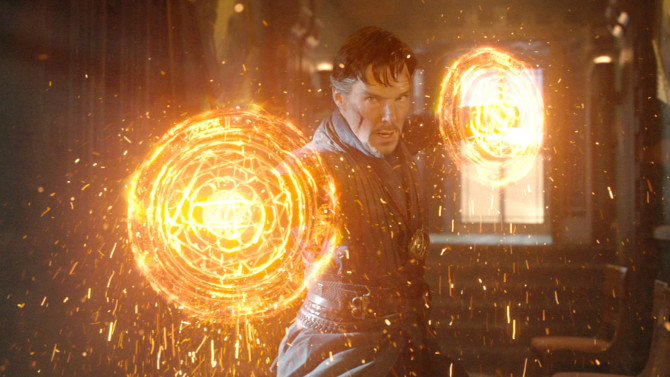
In a film franchise that threatens to get increasingly samey, Doctor Strange is in many ways a breath of fresh air. Its twisting, mind-bending special effects (part Escher, part Inception) are stunning and showcase a great deal of visual and narrative imagination in the film, immediately making it look different from the dozens of city-smashing films we’ve seen in the Marvel franchise. It’s also told with a fair amount of wit, tongue-in-cheek beats and some lovely sight gags (Strange’s Cloak of Levitation is clearly inspired by the Carpet from Aladdin). This lightness of touch is essential to stop this concept feeling silly: with a more po-faced style this story, full of magic and things like “the Eye of Agamatto”, would have stumbled over its own ridiculousness.

This is however pretty close to being the best comic-book origins film, and certainly in the top five of this franchise. For a start, despite the visual glory, it feels like a focused more personal story: there are only really 6-7 characters (compare that to the sprawling cast of Captain America: Civil War), and the real heart of the film is the lead character’s struggle to overcome an existential crisis and find a new purpose while rediscovering his humanity. Even the final confrontation is a spin on the formula, avoiding city-wrecking super-punches in favour of intelligence and humour saving the day. It still crams in the action, and the characters are still cartoons made flesh, but at least they have been given a real depth here. There is an emotional weight to the story that makes you care about Strange and his world.

No actor right now is better able to embody intellectual brilliance matched with cool arrogance and societal disconnection than Benedict Cumberbatch. So in many ways, Strange is a part that falls well within his comfort zone. But Cumberbatch shows he can carry a major motion picture by making Strange a charismatic lead who grows and develops. Strange is deliberately unlikeable at first, but Cumberbatch invests him with an underlying vulnerability and a cocky charm that is increasingly broadened and shaded as the film progresses. Almost without realising it, you find yourself actually rather liking him halfway through (while still happy to give him a smack in the mouth for his cockiness). Cumberbatch is in almost every scene and carries the film effortlessly.

The film is dominated by it’s lead character, but gives moments to the rest of the cast. Tilda Swinton overcomes the controversy of her casting by investing The Ancient One with both a serene wisdom with dark hints of anger and impatience bubbling under the surface. Ejiofor is good as an increasingly disillusioned mentor and Wong has some great comic beats. Mads Mikkelsen, one of the greatest actors in the world, is rather wasted as a villain who never becomes quite as interesting as you’d hope. Most misused is Rachael McAdams, whose character serves very little purpose other than “ex-girlfriend” – even the director, in an interview, described her role as being there to love him, so that we can see why we should love him.

It’s still a Marvel film, and it still follows the Marvel formula, however newly presented it might be. The arc of despair, rejection, slow progress, revelation, disillusionment, rallying and overcoming personal problems is pretty recognisable from everything from Thor to Iron Man. But it is enough of an inversion, it’s got a good enough script, it’s directed with enough focus on character as well as action, and it has a sufficiently good leading actor to lift and elevate the whole idea into something that feels richer while keeping it entertaining. It’s a very good comic book movie, and it’s trying to do something different, And it mostly succeeds.