Tag: Maggie Gyllenhaal

The Lost Daughter (2021)

The Lost Daughter (2021)

Motherhood, loss and guilt are at the heart of this over-extended drama that doesn’t feel like it focuses on the right things

Director: Maggie Gyllenhaal

Cast: Olivia Colman (Leda Caruso), Jessie Buckley (Young Leda Caruso), Dakota Johnson (Nina), Ed Harris (Lyle), Dagmara Dominczyk (Callie), Paul Mescal (Will), Peter Sarsgaard (Professor Hardy), Jack Farthing (Joe), Oliver Jackson-Cohen (Toni), Athena Martin (Elena), Robyn Elwell (Bianca), Ellie Blake (Martha)
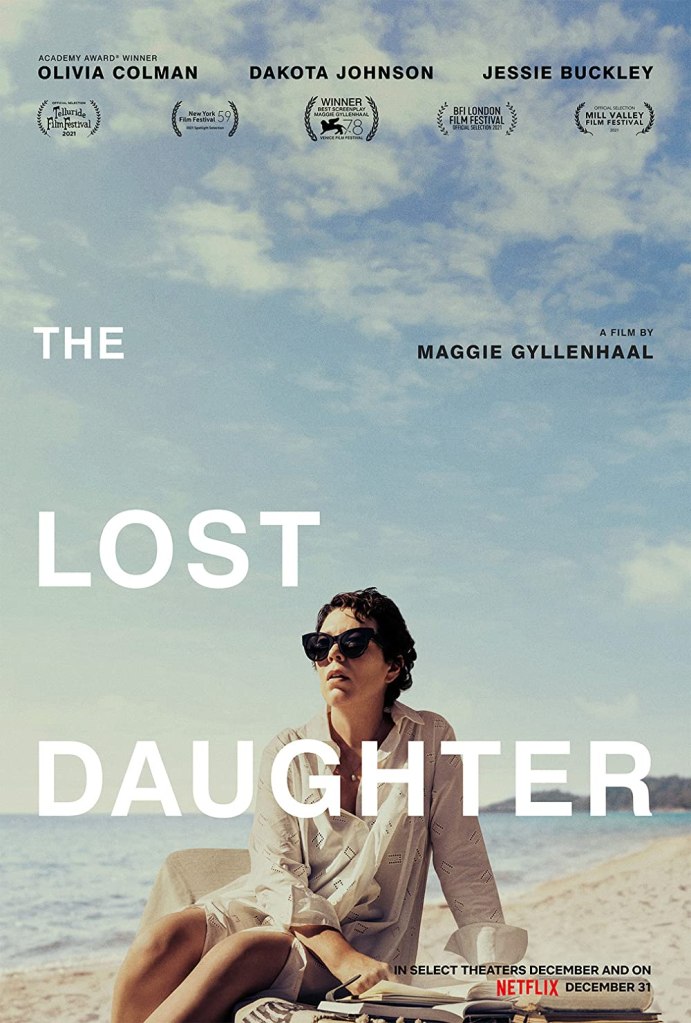
Leda (Olivia Colman), a professor of Italian Literature, holidays in Greece. That holiday is disturbed by the arrival of a noisy, aggressive family from Queens. A member of that family, unhappy young mother Nina (Dakota Johnson) loses her daughter on a beach. Leda finds her, but it triggers her own unhappy memories of motherhood (Jessie Buckley plays the young Leda). She impulsively steals the child’s beloved doll, as her paranoia and mournful reflections grow.

Maggie Gyllenhaal’s directorial debut is a confident, assured piece of film-making, but I found it a cold and slightly unsatisfying film. There is a fascinating subject here, that the film fails to really tackle. One of life’s great unspoken expectations is that everyone should find being a parent – especially being a mother – hugely rewarding. This film studies a woman who didn’t, but still wants to reassure us of the love and happiness found in the bond with a child, no matter your mistakes as a parent. In doing so, it marginally ducks an important societal issue and reaches conclusions that feel predictable, for all the ambiguity the film ends with.

Colman’s expressive face and ability to suggest acres of unhappiness in a forced smile or gallons of frustration with a single intake of breath, are used to maximum effect. Leda is a woman comfortable with her own company, forced and uncomfortable in conversation, her eyes flicking away as if looking for an exit. She seems confused about how to respond to the quiet advances of handyman Lyle (a gentle Ed Harris) and increasingly resents the intrusion into her holiday of outsiders.

How much is this slightly misanthropic, isolated view of the world her natural personality, and how much has it grown from her choices in the past? Flashbacks reveal her struggles as a mother – and the strained relationship with her children today – and it’s clear Leda is a bubble of confused emotions, uncertain about what she thinks and feels.

That past, to me, is the real area of interest, rather than the distant, cold woman those choices have created. I’d argue a stronger film – and one that would feel like it was really making a unique point – would have focused on the younger Leda. Expertly played by an Oscar-nominated Jessie Buckley –brittle and growing in claustrophobic depression – she loves her two girls. But, most of the time, finds them overbearing, all-consuming and more than a little irritating. She’ll laugh at their jokes and be terrified when one of them gets lost, while still resenting their domineering impact on her life.

When she wants to work, they demand attention. When her daughter has a small cut on her finger, Leda is repeatedly asked to kiss it better like a broken record. Leda gives her other daughter her own childhood doll – and then throws it out of a window in fit of hurt fury when the daughter covers it in crayon and says she doesn’t like it. The kids get in the way of everything: be it work (she retreats behind headphones to focus), holidays, sex with her husband or even masturbation.

Her feelings go beyond post-natal depression. She is someone who genuinely loves her children, but can’t bear the idea of mothering them. This is the meat of the film, far more than the present-day narrative. Gyllenhaal sensitively tackles a rarely discussed topic: what can we do if we find parenthood was a mistake? Knuckle down or give up and run away? A film exploring this could have been compelling: but it only takes up a quarter of an over-extended film.

Instead, by focusing on the maladjusted present-day Leda, the film presents her motherhood difficulties as the root cause of her problems. Leda sees a potential kindred spirit in young mother Nina – a brash and exhausted Dakota Fanning – who seems equally frustrated by parenting. But Leda is so insular and self-obsessed, is she only seeing what she wants to see? If she thinks Nina is also failing as a mother, will that make her feel better about her own failures?

The Lost Daughter is an unreliable narrator film – and Gyllenhaal expertly suggests much of what we see are Leda’s perceptions rather than necessarily the truth. The menace from Nina’s loud and aggressive extended family is a constant presence: but is it real, or just Lena’s paranoia. Does the family really cover every tree with a missing poster for a child’s lost doll, or does it just that way to Leda? Does Nina share Leda’s own resentments with motherhood, or does Leda just want her to?

It’s a subtle ambiguity that continues until the film’s close. It leaves many questions unanswered and open to the viewers interpretation. Different viewers will take very different messages from it. But for me, the film wasn’t quite interesting enough – and shied away from exploring the questions of guilt and doubt about parenthood. At no point does Leda even voice the possibility that she regrets having kids – for all that she surely does – which feels odd. For me the film takes a long time to not quite say as much as I feel it could have done.
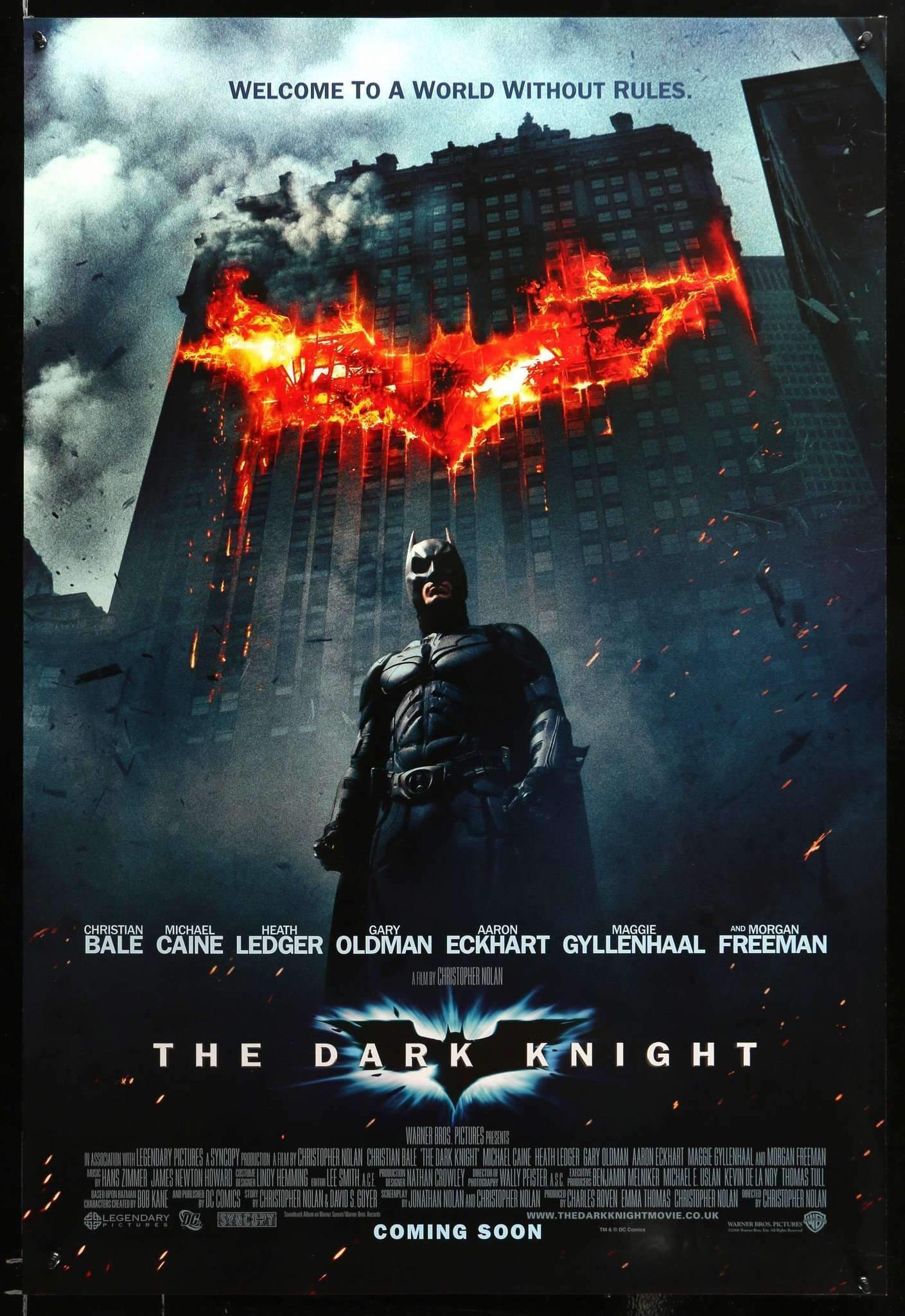
The Dark Knight (2008)

Heath Ledger leaves a great legacy as The Joker in The Dark Knight

Director: Christopher Nolan

Cast: Christian Bale (Bruce Wayne/Batman), Michael Caine (Alfred Pennyworth), Heath Ledger (The Joker), Gary Oldman (Lt James Gordon), Aaron Eckhart (Harvey Dent), Maggie Gyllenhaal (Rachel Dawes), Morgan Freeman (Lucius Fox), Eric Roberts (Sal Maroni), Monique Gabriela Curnen (Detective Ramirez), Ng Chn Han (Lau), Ritchie Oster (The Chechan), Colin McFarlane (Commissioner Loeb) Anthony Michael Hall (Mike Engel), Joshua Harto (Coleman Reese), Cillian Murphy (Scarecrow)

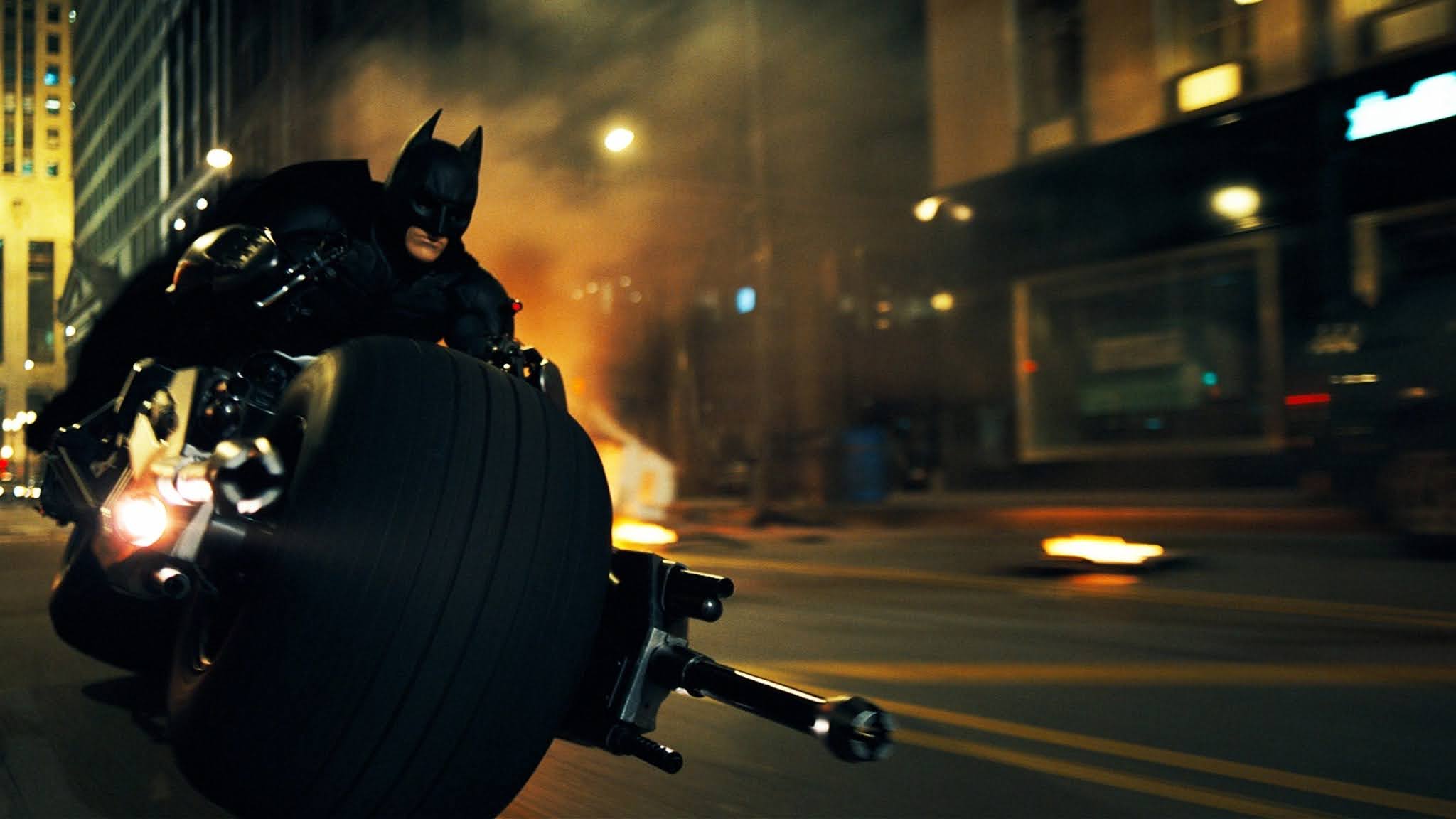
Christopher Nolan’s Batman Begins reset the table for superhero films. The Dark Knight took that table, picked it up, overturned it and rebuilt it from scratch. This influential film is certainly the greatest superhero film ever made and the calling card Nolan will carry for the rest of his life. Its exclusion from the 2008 Best Picture list at the Oscars (and Nolan’s snubbing for Best Director) was so widely condemned as snobbery (especially as the slot went to the atrocious awards-bait The Reader, a film even Oscar-host Hugh Jackman quipped he hadn’t seen) it led to the Oscars doubling the number of Best Picture Nominees (something benefiting several genre films inferior to this one). The Dark Knight declared forever superhero films could be proper films with characters, intriguing stories and interesting things to say.

It’s been a year or so since Bruce Wayne (Christian Bale) began his caped crusade as Batman, wiping out organised crime in the city. District Attorney Harvey Dent (Aaron Eckhart) – working closely with Bruce’s childhood sweetheart Rachael Dawes (Maggie Gyllenhaal) – has launched his own tough on crime crusade that has led to many mobsters landing behind bars. In the police force, Lt James Gordon (Gary Oldman – superb as a man whose good intentions lead to great harm) is straightening out the most bent police force on record. Now the gangs are desperate and in retreat – so desperate that they turn to the sort of dangerous, anarchic freak they would never usually countenance working with: a man known only as The Joker (Heath Ledger). The Joker though has his own plans for the city, for Batman and his own crazed ideas of social anarchy.

The Dark Knight is told on a huge scale: but Nolan never once loses sense of the fact this is an adventure film, while making sure that it explores ideas around society and humanity that leaves most high-brow films standing. Sumptuously made, a technical marvel it has set-pieces that stand with the greatest in cinema, dialogue that is crisp and brimming with intelligence and every performance in it excels. Nolan’s cinematic verve creates a film that always feels fresh.

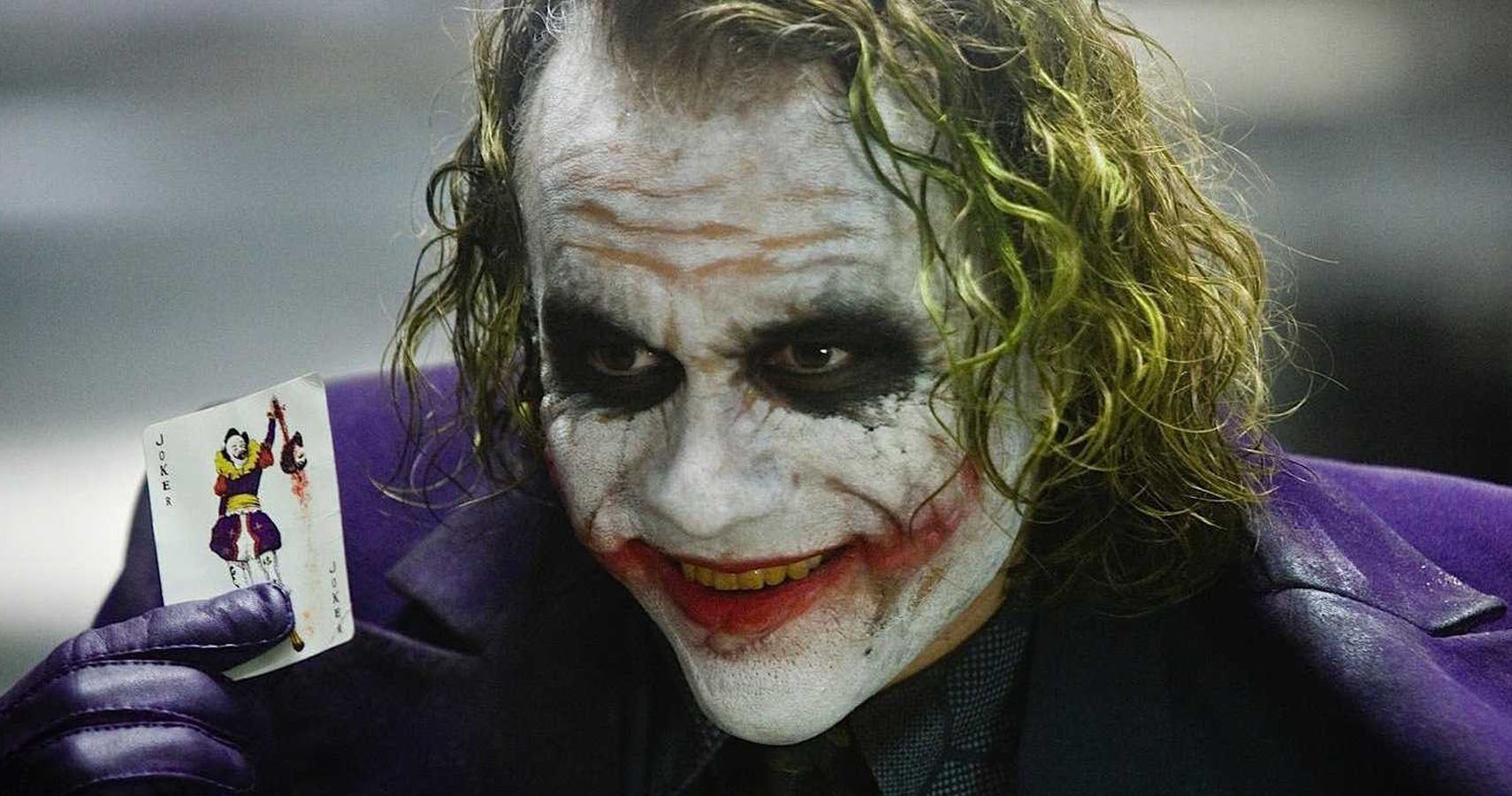
It’s hard not to reflect on the film without remembering the tragic death of Heath Ledger. A controversial choice for the Joker – despite Brokeback Mountain he was seen by many as a lightweight actor – Ledger’s performance is astounding. He radically redefines the character, giving every scene an eerie edge somewhere between violence and black comedy. His Joker has the bowed head and animalistic prowling of a hyena (along with the laugh), a snake-like licking exploration of his facial wounds, a voice that switches from a deep baritone to a high-pitched giggle.

He’s dangerously, psychotically violent, with a dark, demonic delight in mayhem, a wickedness that is not funny so much as unsettlingly comic and an unpredictability laced with a sharp and intimidating intelligence. Ledger essentially redefined a character who had existed for decades. It’s an extraordinary performance, winning numerous awards, that stands as the definitive interpretation of the character as a scuzzy, streetwise hood with the willingness to do anything at all.

The Joker is the channel Nolan’s film uses to explore fascinating ideas around order and chaos, and the clash between anarchy and rules. Nolan understands that, for all his confused psyche – heading out to beat up criminals for his nightly activities – Batman is a bastion of law and order and moral righteousness. He’s a fiercely ordered and meticulous man, who plans several steps ahead of his enemies, holds rigidly to a moral code and has the confidence (arrogance?) to believe he is best placed to make the big calls for the many. They are personally traits he shares with all the films heroes: he, Gordon and Dent are all men who harvest long-term plans to deliver mass benefits.

Standing against them is their antithesis. The Joker believes principles are bunkum, with life motivated by randomness and selfishness. These are polar opposite theories of life being explored here – and the Joker’s plans (such as they are) are to show that mankind is, at heart, an awful, terrible thing that can only destroy. But the schemes of our heroes also smack of arrogance and control – a sense of almost divine certainty in their righteousness.

Basically, what we get here is a discussion on our fear of anarchy. Deep down we all like conspiracy theories, because it shows someone is in charge. Randomness is terrifying. We all like to feel there is an organising force behind events – no one wants to meet their end by the toss of coin. We feel comforted by being part of an overall plan – even if it’s a plan for our demise. The Joker’s power comes not from his skills in themselves, but his willingness to break all rules and destroy anything and anyone at any time for any reason. There is no protecting against this. And it’s terrifying.

Nolan introduces the concept – and the character’s warped way of thinking – from the very start. The stunning opening sequence features a bank heist (with a neat cameo from Heat veteran William Fichtner – a deliberate homage) where the Joker has devised a ragged, but brutal plan which involves each member of the gang offing each other in turn (not that they are aware of that!). It’s a blazingly, triumphantly cinematic opening and a brilliant entrée to Nolan’s superbly directed, engrossing film.

While juggling intelligent ideas it’s also a brilliant, edge-of-the-seat ride crammed with jaw-dropping set-pieces. Each of them is underpinned by that rich psychological clash. Bruce Wayne is trapped in tactics utterly unsuited for his opponent, his assumption that criminals are simple people motivated by greed. Even worse, the Joker delights in identifying the clear lines Batman won’t cross, and dances right across them, wiping out the psychological advantages that Batman has over other criminals: once the Joker establishes Batman will never kill him, he forever knows he has the upper-hand.

Bravely the film ends not with a bang, but a character-driven, personal three-way confrontation between its three heroes (Batman, Gordon and Dent), low-key but bubbling with resentments, fury and pain. It’s a perfect cap – and a capturing of the film’s argument that the greatest damage people like the Joker can cause is not to our property but to our souls.

It’s easy in all this to overlook Christian Bale, but he is wonderful as Wayne (and again this is a film that is as much, if not more, about Wayne than Batman). Increasingly distancing himself from people – his last links to human warmth being Alfred (Michael Caine, again in wonderful mentor form) and Rachel Dawes (re-cast to terrific effect with Maggie Gyllenhaal, who brings wonderful depth and complexity to the role) – Wayne carries a martyr complex, damaging to his psyche.

Nolan’s film is a dense and rich thematic exploration of chaos and certainty which expertly combines thills and actions with a character driven plot. Superbly acted, wonderfully paced, rich and intelligent – with a genre defining performance by Ledger – this is truly great film-making, one of the greatest blockbusters of all time.

Donnie Darko (2001)


Welcome to the weirdness: Donnie Darko ultimate 00’s cult hit

Director: Richard Kelly

Cast: Jake Gyllenhaal (Donnie Darko), Jena Malone (Gretchen Ross), Mary McDonnell (Rose Darko), Holmes Osborne (Eddie Darko), Katherine Ross (Dr Lilian Thurman), Maggie Gyllenhaal (Elizabeth Darko), Daveigh Chase (Samantha Darko), James Duval (Frank), Drew Barrymore (Karen Pomeroy), Patrick Swayze (Jim Cunnningham), Noah Wyle (Dr Kenneth Monnitoff), Beth Grant (Kitty Farmer)

Donnie Darko was a surprise cult hit. In fact, it was such a cult hit that Kelly made a “director’s cut” version of the film five years later. Funnily enough, the Director’s Cut was largely rejected by the very people who loved the first film. Why? Well probably because the film was loved because it was so weird. It was so esoteric, so hard to understand, so much of its logic unclearly defined, that much of that love was based on trying to work out what the hell is going on in it – and the director’s cut supplies lots of answers, ruining the game! 

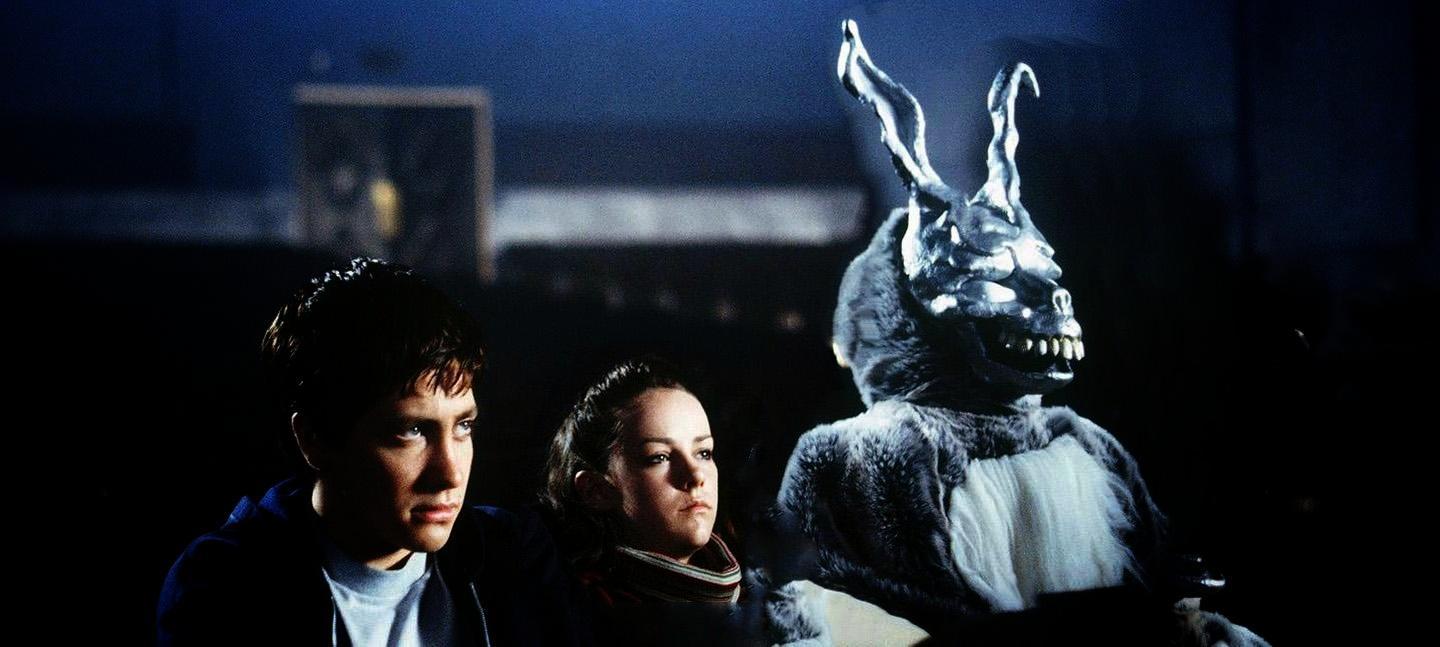
In 1988, troubled teenager Donnie Darko (Jaky Gyllenhaal) sleepwalks out of his house onto a local golf course and meets with a mysterious figure in a gruesome rabbit costume – “Frank”. Frank tells Donnie the world will end in 28 days, 6 hours, 42 minutes and 12 seconds. Donnie sleeps on the golf course overnight – and returns home to find a jet engine has crashed through his bedroom. Plagued by strange visions and hallucinations, and visitations from Frank, is Donnie suffering from schizophrenia or is he genuinely in a position to save the world? And is there a danger from the way Frank is starting to influence Donnie’s actions?

Richard Kelly’s film is a bizarre, inventive, dreamy, creepy oddball flick that deliberately never really explains what the hell is going on. Never mind the mystery of Donnie’s mental state – the film’s confusing structure, its unexplained elements of time-travel, mind-control and predestination, all of this is just left hanging out there. It’s actually a testament to how much restriction can sometimes be the mother of invention. Kelly was told that the film could not be longer than a couple of hours, meaning a lot of the more traditional explanation (reintroduced for the director’s cut) was removed to keep the run-time down. But the great thing is, this actually leaves it very open for the viewer to create their own idea of what the film is about and what is going on. It really works.

This is particularly because Kelly manages to marry the clever-clever weirdness with a real emotional investment in the characters. Not just in Donnie either: his family are all extremely well-drawn, who we grow to care for over the course of the film, from his cheery father to his loving but frustrated mother, brilliantly played by Mary McDonnell. Equally strong is Maggie Gyllenhaal as Donnie’s sister. These characters, along with dozens of other characters quickly established, but all feeling very real, are what keep you interested in the film. If it was just oddness and alienating weirdness, it would be hard to care. But this is a story that mixes science fiction oddness with genuine family drama heart.

There is a lot of oddness in there though. Frank is a character practically designed to be iconic, a twisted giant rabbit like a demonic Harvey. Combined with this are a series of curiously unsettling images and storylines. So we get Donnie with visions of streams of transparent liquid streaming out of people’s chests – possibly their future paths leading them forward. We get Donnie facing strange barriers, that seem to repel and reflect his world. Donnie is plagued with strange visions and increasingly unsettling instructions from Frank. He carries out a series of impossible feats under Frank’s direction. There are elliptical conversations about time travel and physics and while the film drops hints it never explains a damn thing. So when you finally get to the end – well lord alone knows what happens, but you’ll certainly have a hell of a lot of fun trying to work it out.

Around this, the film cuts rather a neat parody of teenage life in the 1980s and the 1980s Brat Pack films. Actors like Drew Barrymore and Noah Wyle have a lot of fun as closeted liberal teachers struggling in a school is run by an oppressive, fiercely religious set of governors. But not as much fun as Beth Grant as a PE cum civics teacher, both blinkered in her love of traditional education (and “safeguarding our youth” from the dangers of literature) while in love with Patrick Swayze’s smug self-help guru (whose bullshit “conquer your fear” videos and mantra are a superb spoof). The film has a nice eye for the politics of school classes, and placing this end-of-world fear into the all-consuming self-importance of teenage life works very well.

Throughout Kelly shoots with a confidence that belies his “first-time film director” status. Yes there is the occasional overly clever camera shot that you get from someone enjoying the toy set for the first time, but there is lots of terrific stuff. His assembly of events is brilliant, he works with actors very well indeed.

But the other factor that really makes the film work is Jake Gyllenhaal’s superb performance in the lead role. Gyllenhaal gets the balance between Darko’s vulnerability and his (possible) darkness absolutely spot-on. He manages to turn himself perfectly into a gangly, awkward, nervous kid – totally believable as the sort of young man unsure of where he stands in the world and angry. It feeds perfectly into the mystery of the film. Is Donnie a dangerous schizophrenic? Or is he right in thinking he might be important? Gyllenhaal captures all this, but also really makes us care for Donnie, turning him into someone truly sensitive and confused (helped as well by a very good Jena Malone as his awkward love interest). It’s a brilliantly distinctive performance that captures a true idea of teenage difficulties.

Any maybe that’s also why Donnie Darko works so well. Because it’s as much about teenage awkwardness and not knowing what you are doing here and why, as it is all the bizarre and unexplainable pseudo-science, time travel and predestination paradoxes that the film allows to play around the edges. It places at the centre of a brilliant science fiction drama, a real human and emotional story that feels very real and grounded and like something we have all experienced at one time in our lives. It’s a puzzle and mystery that also has a heart. It’s a difficult trick to pull off – so difficult Kelly has failed to pull it off again since.