Tag: Malcolm McDowell

Time After Time (1979)

Time After Time (1979)

HG Wells zooms through time on the trail of Jack the Ripper in this surprisingly charming time travel romantic thriller

Director: Nicholas Meyer

Cast: Malcolm McDowell (HG Wells), David Warner (Dr John Leslie Stevenson), Mary Steenburgen (Amy Robbins), Charles Cioffi (Lt Mitchell), Kent Williams (Assistant), Patti d’Arbanville (Shirley), Joseph Maher (Adams)
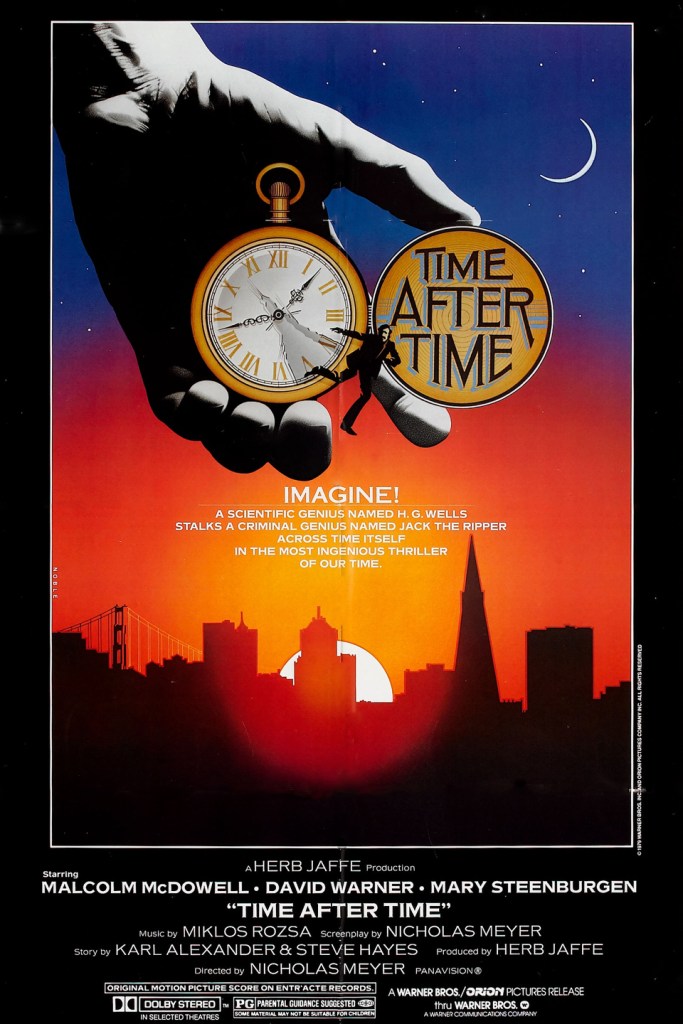
1979 was clearly the Year of the Ripper. New conspiracy theories abounded on his mysterious identity. In Murder By Decree, Sherlock Holmes took on the investigation. And in Nicholas Meyer’s Time Travel fish-out-of-water drama, he pops up in 1970s San Francisco, still up to his wicked ways. How did he get there? Well, imagine instead of just writing The Time Machine, HG Wells had actually built it: and that, during a dinner with a doctor friend, he not only discovers his friend is the infamous killer, but watches him pinch his time machine to escape the long arm of the law.

HG Wells is played by Malcolm McDowell – who surely when he was sent the script assumed he was being asked to take a look at the role of the Ripper – who uses his machine to follow the Ripper to the 1970s to find him. The Ripper is played by David Warner (one of the few actors even more demonic than McDowell), and he’s rather more at home in the 1970s than Wells, who expected to find a utopia. Wells is helped by Amy Robbins (Mary Steenburgen), who is drawn to this charming Englishman, who she believes is a Scotland Yard detective on the hunt for a serial killer.

Meyer’s first film is a little raw – you can see he’s still learning his craft, a few shots are a little rough around the edges in their framing and some plot points and transitions are not easy to follow – but rather charming, for all it’s about the hunt for a serial killer. Meyer gets a lot of affectionate comic mileage from Wells – the quintessential gentle Englishman, timid but determined when riled – working out the social rules of the 1970s. From crossing the road, to hailing a taxi, from consuming a McDonalds (“Fries are pomme frites!” – some silver presumably crossed Meyer’s hands to show the novelist chomping down thrilled on the fast food chain’s merchandise) to working out the rate of exchange for his fifteen Victorian pounds doesn’t translate to many dollars, it’s got a fish-out-of-water delight and a shrewd comic energy.

It’s helped a great deal by McDowell’s gentle, playful and thoroughly engaging performance – Time After Time leaves you sad he doesn’t get to play more roles like this. Wells is optimistic, polite, gentlemanly and admirably brave: even more so, because he’s so hesitant about risk. He travels around the 1970s with a wide-eyed wonder and has a humanitarian streak a mile wide. He’s one of the nicest guys you could meet.

No wonder Amy falls for him so swiftly. There is an electric chemistry between Mary Steenburgen – full of Southern sweetness but with a very modern (but never grating) feminism – and McDowell (and clearly off screen as well, as they married almost immediately after). Meyer plays this romance like a classic rom-com, with meet-cutes at the bank and McDowell’s playing of this shy Victorian gentleman’s courtly manners (he touchingly stops a kiss to make absolutely sure he has full consent – which Amy makes clear he more than does!) works like a charm.

The jokes are genuinely well-thought out and keep the film brisk. I love the alias Well’s plucks out of the air when pretending to the police to be a Scotland Yard detective: he seizes upon what he guesses will be a long forgotten popular fiction character of his day and calls himself Sherlock Holmes. McDowell and Steenburgen have an affinity for physical comedy – watch McDowell hail a taxi with a jaunty wave or Steenburgen sitting frustratedly on a sofa waiting for Wells to make a move. The fish-out-of-water elements work a treat (you can see the clear groundwork for gags Meyer would take even further in his next time-travel hit Star Trek IV: The Voyage Home).

Time After Time sits this comedy next to a genuine Ripper-flick. The film opens with a long POV shot as the Ripper strikes in the streets of London. David Warner gives a very good performance as a world-weary psychopathic, who can hide his depravity but not control his urges. Unlike Wells, the Ripper adjusts very naturally to the modern world – probably because he’s more used to pretence than the honest Wells – dressing in progressively more relaxed 70s garb. His murders are shot with discretion – mostly off screen with the inevitable splash of scarlet on a surface or face from off camera. The actual historical elements of the Ripper are bunkum, but the handling is well done.

The time travel elements are rather laboriously explained, with much talk of keys, return-prevention locks and stabilisers. Wells points out the various features of the machine with a bluntness that all but has Meyer tapping you on the shoulder and saying “remember that it will be important later” – you can utterly (correctly) guess the eventual ending purely from this lecture. But the time travel effects use a mixture of 2001-ish camera tricks rather effectively and the film plays a little bit with paradox and timeline tweaking (although without any depth).

Meyer’s film is an enjoyable ride, even if some plot developments gear shift swiftly (the Ripper seems to have had a sudden emotional breakdown at some point between his penultimate and final scene and the reasons for the time machines physical shift to San Francisco are barely explained) and it at times loses its drive (the Ripper is all-too-obviously presumed dead at one point and his determination to grab a key that controls the time machine oscillates with urgency from act to act). But as a debut, it’s an enjoyable piece of pulp. And it’s got a hugely likeable performance from McDowell and very assured support from Steenburgen and Warner. It’s a very enjoyable romp.

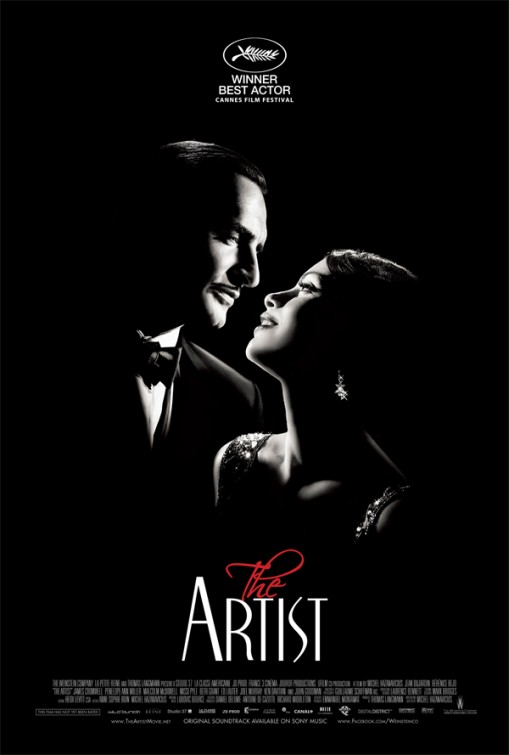
The Artist (2011)

Jean Dujardin and Bérénice Bejo delight in the light, frothy, charming Best Picture winner The Artist

Director: Michel Hazanavicius

Cast: Jean Dujardin (George Valentin), Bérénice Bejo (Peppy Miller), John Goodman (Al Zimmer), James Cromwell (Clifton), Missi Pyle (Constance), Penelope Ann Miller (Doris Valentin), Malcolm McDowell (Butler)

In 1920s Hollywood George Valentin (Jean Dujardin) is King of the Silver Screen. Why would he want anything to change? Surely these ‘Talkies’ are just a passing fad, right? Ooops. Before he knows what has happened, Valentin has gone from top of the world to the very bottom, left behind (like so many real-life silent stars) by change. Meanwhile, Peppy Miller (Bérénice Bejo), the young extra from his glory days whom Valentin briefly mentored, become a star of the Talkies. But Peppy still loves Valentin – and maybe he loves her – even while Hollywood pulls them apart.

Plot-wise, The Artist is pretty conventional. What really makes it stand out is that it’s a silent film about silent film. Perhaps that’s why the whole world went gaga for it (gifting it five Oscars, including wins for Hazanavicius, Dujardin and the Big One) – it was a genuine burst of nostalgia-tinged novelty. Everything old is eventually new again: I remember the novelty myself – sitting in a cinema and suddenly, after the music stops, hearing nothing but silence. Match that with the undeniable charm and energy the story is told with and, boom, you had a hit.

Does The Artist survive repeated viewings? Just about – though it looks increasingly like a slight film, that raises warm feelings but makes little lasting impact (I was surprised how much of it I had forgotten). Hazanvicius’ study of silent cinema has clearly been thorough, and this is undeniably a wonderful love letter to Hollywood’s history. Every technical detail is carefully reproduced, and the pastiche Fairbanks-style adventure stories Valentin stars in is spot on. The actors fully embrace the slightly exaggerated mannerisms of silent acting, telegraphing emotions with urgency.

Hazanvicius uses sound, when it comes, brilliantly. The opening of the film is bathed in music as we watch the premiere of one of Valentin’s films – only for all the sound to drop out the second the film-within-a-film ends. (We even see a “Silence behind the screen” sign before it does). We only hear everyday sounds twice – once in a hilariously haunting dream of Valentin’s where objects make noise but he cannot – and at the end of the film as Valentin finally finds a place in Talking Hollywood. Other than that, it’s scores, speaking cards (some of them witty, like Valentin’s wife’s question “Why do you refuse to talk?”) and all the style of silent cinema.

It’s a sweet and gentle film. There is no trace of the ruthless business Hollywood is, and not a trace of the darkness that touched many of this era. There is never any prospect of Valentin turning into, say, Sunset Boulevard’s Norma Desmond or any of the other washed-up waxworks in her house of broken dreams. Valentin loses everything, but remains a generous and decent guy, firing the loyal chauffer he hasn’t paid in a year (and giving him his car for free!) because otherwise he’ll never leave him. And of course, his dog loves him, so he must be a great guy. (The dog by the way was the break-out star, this charming, brave canine even getting a campaign for best supporting actor).

The film centres a love story between Valentin and Peppy. The two of them have an instant connection – but Valentin is the star, with Peppy the ingenue. This bond can survive nearly everything, even while Valentin resents her success. Hazanavicius manages to make this very sweet, even though Peppy is sometimes tediously saintly in her devotion. Valentin may have mixed feelings about his protégé – but in a housefire, the only thing he saves is footage of the two of them messing around in outtakes from one of his old films.

The film seems unbothered as well by the fact that Valentin is married. The wife (a thankless role for Penelope Ann Miller) doesn’t get a name, let alone any sense of a personality other than (it seems) being some sort of shrew.

You could also see Peppy, if you wanted to be uncharitable, as a bit of a stalker. She buys up (by proxy) all of Valentin’s goods when he goes broke, practically abducts him from the hospital after he is caught in a fire, hires his staff. Tip your head to one side and you can see her boiling a few bunnies. The Artist though sees her as more of a “Guardian Angel” (as per the title of one of Peppy’s movies) – and you can argue that there is something old-fashioned (not always in a good way) about a film where the female lead defines her success only by how it can help the man she loves.

The tinge of creepy to the Valentin-Peppy relationship isn’t helped by using a huge chunk of the Bernard Herrmann Vertigo score to underscore the film’s conclusion, not to mention the left-field melodrama of Peppy racing across town to prevent Valentin from committing suicide (motivated it seems by realising Peppy is his Guardian Angel). It’s an odd mis-step – and the sequence not only feels radically different from the rest of the film, it also seems to heavy for such a light confection.

But, negatives aside, it’s a decent little film. Jean Dujardin is the epitome of charm and old-school Hollywood wit as Valentin – it’s a master-class in physicality and he oozes matinee idol cool, and a certain boyishness. Bejo is very good as the well-meaning, kindly Peppy. The film is a puff of air, and once you get over the novelty, you’ll be amazed how little there is to it. But it’s told with such energy, charm and nostalgic wit (and ends with a lovely dance routine) as well as affectionate nods to old-school Hollywood, you won’t mind too much, even if you’re surprised it won as many awards as it did.

A Clockwork Orange (1971)

Malcolm McDowell burns up the screen in Kubrick’s masterful but cold A Clockwork Orange

Director: Stanley Kubrick

Cast: Malcolm McDowell (Alex DeLarge), Patrick Magee (Mr Frank Alexander), Michael Bates (Chief Guard Barnes), Warren Clarke (Dim), Adrienne Corri (Mrs Mary Alexander), Carl Duering (Dr Brodky), Paul Farrell (Tramp), Clive Francis (Joe the Lodger), Michael Gover (Prison Governor), Miriam Karlin (Catlady), James Marcus (Georgie), Aubrey Morris (PR Deltoid), Godfrey Quigley (Prison Chaplain), Sheila Raynor (Mum), Madge Ryan (Dr Branom), Anthony Sharp (Minister), Philip Stone (Dad)

For decades, A Clockwork Orange was unseen in Britain. After a number of copycat crimes led to a backlash, Kubrick – who had complete control over the rights of the film in the UK, his adopted country – essentially refused to let the film be shown anywhere in the country during his lifetime. This gave Clockwork Orange a sort of mystique for UK audiences that it has only slowly worn off, the air of the banned product, impossible to see other than through a dodgy knock-off or by travelling to another country. Released from the vaults this century, the film still carries a chilling pull, even if it’s a compelling but still muddled piece of intellectualism.

Adapted faithfully from Anthony Burgess’ novel, the film follows the life of violent young man Alex DeLarge (Malcolm McDowell), leader of a gang of street thugs who delight in evenings of “ultra violence”, with a bit of “the old in-out” thrown in for good measure. Which, in the invented Ingsoc style dialogue Burgess came up with, basically means Alex is essentially a psychotic rapist, albeit one with a huge degree of anti-authoritarian charm and cheek. Alex’s crimes eventually catch up with him however, whereupon he is imprisoned and volunteers for what he assumes is an easy option: an experimental psychiatric aversion treatment, designed to make him incapable of taking parts in acts of violence and sex. Released back into the world, Alex finds it and himself unchanged – the only difference being that violence makes him feel sick, which is poor defence as he encounters all his victims yet again, all bent on revenge.

Did something about the film scare Kubrick? Was part of his later mixed feelings about the film based around the fact the film is seduced by Alex, that it indulges his awfulness and utter lack of morality and makes points comparing the authoritarian government with the murderer they are trying to deal with. Yes, Kubrick makes clear that Alex feels nothing but pleasure about his awful acts, and the distorted fish-eyed lens he uses to capture much of this really hammers home the awfulness of his actions. But it’s also a film that takes a giddy delight in Alex’s charm and larger-than-life persona, and makes it easier for us to find him an attractive figure.

Of course part of this is through the way Kubrick seizes upon a once-in-a-lifetime performance from Malcolm McDowell, who roars through the film with such giddy power, such perverse force of nature electricity that he never captured it again. McDowell’s impish delight is what powers the film, and Kubrick’s clear admiration for the actor’s improvisation, his pushing of boundaries (the film’s most famous sequence, Alex singing Singin’ in the Rain while assaulting and – off camera – raping a woman, was McDowell’s own improvisation). McDowell’s performance is a magnet, his sneering contempt for authority and his sexy confidence and cultured intelligence makes Alex a character far more attractive than he should be.

And quite possibly to Kubrick as well. The film’s moral force loses some of its direction from the novel, by its skill in presenting in such a bravura way Alex’s horrors and because McDowell charges through the film. Kubrick was always the ultimate technician of film, so it’s not a surprise that A Clockwork Orange is a triumph of style and design; perhaps that is at the heart of its enduring power and impact. Kubrick’s design pushes the film a few degrees into the future from 1971, with a grimy, rundown look at Britain mixed with primary colours and garish 70s design. The look of Alex and Droogs is inspired, the sort of cos-play triumph that was way ahead of its time.

The film wants to make points about morality and free will, but these ideas get lost in the mastery of the film-making and the technical triumph of Kubrick (and John Alcott’s) camerawork. The film makes extensive use of fish-eyed, wide angle lenses that distort the world around Alex, hammering home the ultra-realism of the film. At several points Kubrick uses slow pan outs that go from tight shots to reveal more and more of the world of the film, granting an epic status to this squalid world (and increasing the status of Alex all the more). It’s sublimely made, but this is part of the problem.

The main problem is that Kubrick as a director is all technocrat genius, and no heart at all. He loses himself in what he can do, and forgets what he should do. It’s a film where it’s easy to sympathise with the anti-hero, as no voice is really given to the victims. Kubrick seems able to overlook the horror of the events, in his admiration for the actor and the technique. It muddies as well the questions of morality around the mind-altering control of the state – and these ideas are less thought-provoking than Kubrick might have thought anyway. It wants us to ask if a repressive state that prevents someone from committing violent acts – but does nothing to change their basic personality or desire to change, only forces them to do so – can really take the moral high ground? The film argues not – and the Kubrick’s general misanthropy is focused as much on how violence from one naturally begets violence in others – but this is pretty basic stuff.

Perhaps if Kubrick had invested more time in the reality of moments, to off-set the ultra-realism of Alex’s violence and the epic grandeur of McDowell, the film might have been able to explore this further. We see all of Alex’s victims respond with anger and fury and violence when given their chance for revenge in the second half of the film, but we don’t get a sense of the internal journey that takes them there. What we get is the look of horror (and later the near panicked reaction when he realises he has given shelter to his wife’s rapist) from Patrick Magee’s Mr Alexander, but that’s it. Otherwise, the focus places the victims on the outside of the drama and zooms in on the perpetrator and the government trying to control him.

It makes for a misbalanced film, which fails to make the points you wish it could make. Kubrick’s film is an electric piece of filmmaking, dynamic and skilled behind the camera, but the film lacks the heart it needs to counterbalance its coldness and slightly smug satire. It grips and envelops you when watching it – not least due to McDowell’s genius in the lead role – but it’s not a film that works as well as it should. You admire it and then realise its lack of soul.

If… (1968)

Malcolm McDowell as contemptuous bitter student Mick Travis in counter-culture classic If…

Director: Lindsay Anderson

Cast: Malcolm McDowell (Mick Travis), Richard Warwick (Wallace), David Wood (Johnny), Christine Noonan (The Girl), Robert Swann (Rowntree), Peter Jeffrey (Headmaster), Arthur Lowe (Mr Kemp), Mona Washbourne (Matron), Ben Aris (John Thomas), Robin Askwith (Keating), Robin Davis (Machin), Rupert Webster (Bobby Phillips), Geoffrey Chater (Chaplain), Anthony Nicholls (General Denson), Graham Crowden (History Master)

Lindsay Anderson’s If…emerged in the late 1960s, at a time of furious counter-culture reaction to the establishment. Only a few months before its release, Paris had been torn by student riots against everything from the government to class discrimination, which had sparked over a month of protests and strikes that consumed every part of society. If… was released in the midst of the aftermath to this event – and managed to capture the mood of Europe with an astonishing prescience.

In an unnamed English public school, “College House” is run by the senior prefects (“Whips”) who impose a harsh discipline upon the rest of the students. The head of house (Arthur Lowe) is an easily manipulated weakling, the school headmaster (Peter Jeffrey) is a well-meaning but distant figure, most of the staff are either bizarre, creepy, disinterested or all three. Mick Travis (Malcolm McDowell) and his friends Wallace (Richard Warwick) and Johnny (David Wood) are three persecuted lower sixth formers, who (particularly Mick) have a burning resentment for the structures and traditions for the school: a resentment that slowly builds towards outright rebellion.

Lindsay Anderson’s background was Cheltenham College followed by Oxford. Only someone so thoroughly grounded in the background of private education as that could surely have produced a public school film as furious as this one. The entire film is like a kick in the teeth. Anderson understands the cruel traditions and oppressive rules of public schools completely, and the entire film is awash with moments like this that govern school life. There is not a single, solitary moment where there appear to be any positives at all in the life at the school, or any educational benefits (the school is proudly focused on turning out “gentlemen”). 

Anderson shoots all this with a careful eye for the surreal and flights of fancy. Much has been made about the black and white sequences that pepper the film. The natural light in the chapel caused the colour stock to be over-exposed, forcing Anderson to shoot the scenes there in black and white. However, Anderson loved the effect, and filled the film with scenes shot in monochrome to unsettle the audience and make them question the nature of what they are seeing. And that’s something you need to do with If…, as the film walks a fine tightrope between what is real and what is imagination.

While the film starts off grounded in a reality of cruelty and traditions, as it progresses it develops into something unusual and perverse. An extended sequence where Travis and Johnny skip school and head into town, steal a motorbike, drive to a country café and Travis seduces a Girl (Christine Noonan) becomes ever-more hyper real. Is the Girl even real? The speed of her seduction certainly seems to owe more to the boys’ adolescent fantasies of attractive women than any reality. In fact, the use of Noonan’s character (as sex object) is both a dated moment and an expression of the boys’ immaturity and fantastical longings.

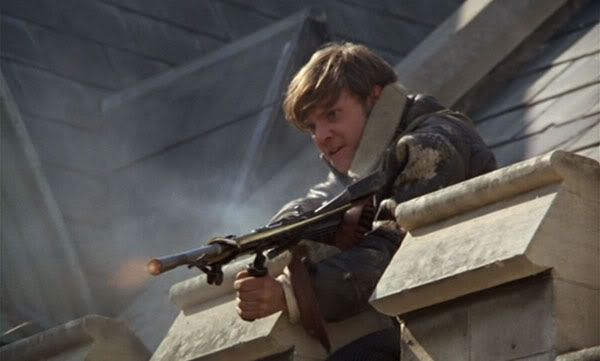
The film is building of course towards the final act of rebellion: a firearms-laden shoot-out after the rebel boys discover a secret cache of automatic weapons on campus (this is in itself unlikely) and then proceed to machine gun visiting dignitaries and their oppressors from the roof of the school, who in turn return fire with their own machine guns. How much of this is real and how much is a flight of fancy from the students and from the film makers? It’s unclear – there is no consistency in the filming of this sequence. When does reality in the film start to cross over to fantasy? There are plenty of moments where this could be happening.

It comes down to the title of the film. If – is this Kiplingesque title suggesting the possibility of such things happening, or such things coming to pass in certain situations, rather than an actual reality? Anderson’s fury at the ghastliness of the class system in this country, and the institutions that promote it (the army, politicians and the church get the same short shrift) suggest a fantasy of bringing the whole system down in a violent outburst. It’s a fantasy, initially grounded in reality, that suggests a poetic realism with lashings of the surreal (most famously the reveal of the schools bullying and vile chaplain as living in a large drawer of a desk in the Headmaster’s office).

The film’s fury and counter-culture joy has the perfect lead actor in Malcolm McDowell, whose simmering, edgy anger as an actor, and chippy rage with a sneering sense of defiance, are perfect for Travis. I’m not sure if McDowell ever topped this first performance, one where he burns through every frame and brilliantly seems to embody every single cog in the system that wanted to thumb its nose at the boss (to mix some metaphors). Anderson and McDowell are clearly working in perfect sync in this film (they collaborated three more times on spiritual sequels). It’s a beautiful performance of simmering resentment and fury at the hypocrisy around him.

The film’s exploration of the injustice of the school doesn’t feel outdated at all. The brutality of fagging and caning plays is like a darkly twisted version of Tom Brown’s Schooldays. Robert Swann is particularly good as leading Whip Rowntree, a hypocritical patrician, and memorable sequences capture the eccentric inadequacy of the teaching, the drilling of school rules into new students (brainwashing them into continuing the pattern in the future) and the arbitrary cruelty of the Whips. Peter Jeffrey’s liberal but distant and ineffective Headmaster is a perfect Thomas Arnold parody, a man with grand ideas but no knowledge of the actual school he is running, who claims to understand the boys but knows nothing about them.

However, interestingly, it’s the rebellion itself that seems rather dated today. In the 1960s, it was easier to whole-heartedly invest our sympathies in the counter-culture rebellion of Mick and his friends – but it’s harder today, with our climate of school shootings in America (there was one the day before I watched this film), to root for our heroes carrying out an indiscriminate shooting, for all the vileness of the institutions Travis is taking on. Of course this sequence is shot with a surreal eye (and I’m not sure any of it is meant to be an expression of something that is literally true, just spiritually true), but it’s a little uncomfortable today.

But at the time, this gut punch of a picture by Anderson wouldn’t have been troubled by these doubts. It’s a brilliantly directed film, that burns with a genuine fury against the institutions it is addressing. There is virtually nothing sentimental or kind about the film – it’s entirely about kicking against the tracks. Nothing in the school is redeemable or decent, everything is corrupt and twisted. It’s a sneering, burning, angry shout of a movie that manages to avoid preaching to the audience and instead presents its hellish vision of class in this country with a witty grace. If… is a film that perfectly captures the mood of the time and understands the “small world” culture of public schools like few others: it’s an essential classic.