
Tag: Margaret Qualley

The Substance (2024)

The Substance (2024)

Twisted body horror isn’t quite the feminist statement it thinks it is, but still a unique film

Director: Coralie Fargeat

Cast: Demi Moore (Elizabeth Sparkle), Margaret Qualley (Sue), Dennis Quaid (Harvey), Edward Hamilton (Fred), Gore Abrams (Oliver), Oscar Lesage (Troy), Christian Erickson (Man at diner)
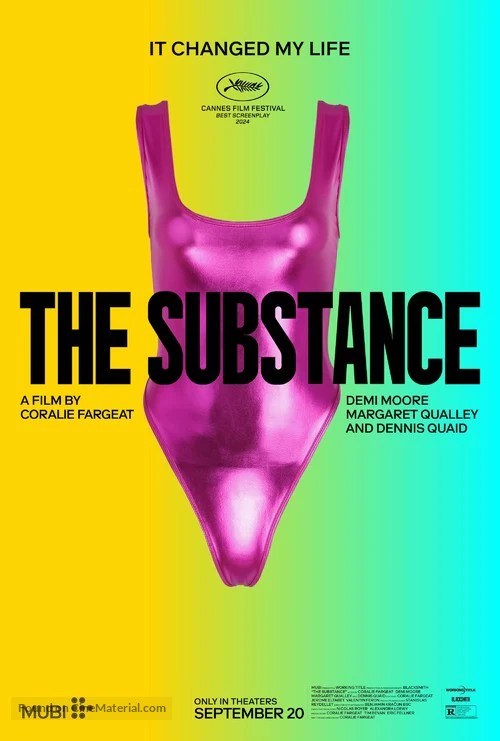
Getting old in Hollywood is not kind. Particularly for women. Elizabeth Sparkle (Demi Moore), a big star of the 90s, now eeks out a living as exercise queen for a daytime TV show. But TV exec Harvey (Dennis Quaid) decides people don’t want to watch a woman in her 50s and unceremoniously gives her the boot. Fearing a life of lonely irrelevance, miles from the limelight, Elizabeth accepts an invitation to try ‘The Substance’. This black-market drug creates a ‘younger, more beautiful, more perfect’ version of you – birthed from your spine. Taking the drug, Elizabeth spawns Sue (Margaret Qualley), a 20s version of herself who promptly lands her old job on the exercise show.

The two must swop places every week, one living their life (either in obscurity or vicariously enjoying much-lusted after career success) the other lying comatose on the bathroom floor. At first the balance works, but they soon grow to resent each other: Sue despises Elizabeth’s self-loathing bitterness while Elizabeth becomes consumed with envy at Sue’s hedonistic success. Quickly the balanced life between the two collapses, leading to inevitable disaster.

The Substance is one of those films you can pretty much guarantee people will remember about 2024. Pretty much everything in it is dialled up to eleven, a crazy mix of The Picture of Dorian Gray and Cronenberg-body horror (particularly The Fly) by way of David Lynch. Fargeat shoots it with a deliberate grindhouse intensity, revelling in the vast amounts of icky body horror, gallons of blood and guts, often filmed in a mix of dream-like drifting and trashy exploitation.

It’s a sharply directed, extremely intense film from Coralie Fargeat (who also scripts), punchy, vicious and darkly hilarious. It’s also been shot to be almost as uncomfortable to watch as possible. The camerawork is frequently disjointed, full of disconcerting jerky close-up. Nightmare Lynch-style dream horror images pop-up, along with haunting Mulholland Dr style floating heads and Kubrickian homages. Every moment of body horror is accompanied with revolting, squelching sound-effects. You’ve rarely seen anything as intensely, bizarrely OTT as this, the film carefully designed to get audiences either screaming “fucking hell!” or hiding their eyes behind their popcorn.

The film’s most successful moments are these moments of shocking body horror. Created from a host of ingenious practical effects (The Substance surely is destined for a make-up Oscar), the film superbly creates everything from green-fluid soaked birthing scenes to the grim disintegration of various body parts that slowly ages Demi Moore into a wizened babushka to the final hellish Elephant Man by way of the The Fly inspired ending. It’s superbly done, deeply unsettling, but blackly entertaining in its extremity. And The Substance is incredibly extreme, pulling absolutely no punches in this blood-soaked, Angela Carteresque fairy-tale horror.

Fargeat draws an extremely committed performances from Demi Moore, given the sort of acting challenge she never got when she was the biggest star in Hollywood, playing a woman so consumed with ingrained self-loathing and disgust (having so completely swallowed the ideology that your personal value is directly connected to your appearance) that she would rather live as a recluse in the shadow of another version of herself than build a new life. There is an extraordinary scene where a panic stricken Elizabeth prepares for a date with an old schoolfriend (possibly her last chance at a normal life) but is so consumed by self-loathing and doubt about her appearance (painfully ironic, since she of course looks great) that she goes through multiple attempts at make-up up in the movie, each time rubbing it off with such increasing fury that by the end she’s virtually sand-papering her face as if trying to erase herself from existence.

Just as fine is Margaret Qualley as the ‘perfect’ version of Elizabeth, but who has just the same self-loathing and insecurity as the original. It’s a similarly committed performance by Qualley, a carefully studied, surprisingly vulnerable performance while also being ruthlessly ambitious and self-indulgent, which embraces the hyper-sexualised expectations of young women in Hollywood. Dennis Quaid also throws in a fun cameo as a lasciviously camp, OTT executive full of ruthless, heartless bonhomie who sees women only as window-dressing for perverts. After all it’s an industry that forgets: from the opening montage of Elizabeth’s Hollywood star going from eagerly photographed to forgotten, through to the insultingly trivial gift stuffed in her hands as she is dismissed.

But The Substance’s satire is often rather forced and obvious (right down to Quaid’s exec being called Harvey). It feels like it misses a trick by having its only female character being a woman who has so swallowed the ageist views of Hollywood, she literally can’t imagine questioning it. So much so, her clone equally embraces life as a sex object. While The Substance invites us to understand the poison of this world independently, there is virtually no commentary on the unjust sexism within the film. In fact, The Substance so echoes the leering camera angles and pervy shots of the worst kinds of sexist cinema that sometimes it’s a bit hard to see it as satire and (as the camera stares at Qualley’s butt or down her top) more as just reality.

At no point do Elizabeth or Sue make any form of realisation about how they have been indoctrinated to only understand themselves as being worth something so long as they look like a pin-up. While The Picture of Dorian Gray understood the temptations of a selfish hedonism even when we know its wrong and The Fly was all about the damaging impact of ambition, for all its pointed smirking fun The Substance is at heart more of a pulpy gore-show revelling in extreme than a sort of social satire.

In fact the more you watch The Substance the more you think it’s real inspiration is Whatever Happened to Baby Jane and the ‘hag-horror’ of the 60s. A star name of yesteryear, takes on a role that riffs on their loss of youth and beauty, throwing them into an ever more twisted tale of obsession and revenge. You could argue The Substance trusts us to see for ourselves that all this rampant sexism is wrong: but you could also quite happily watch the film and assume it was Elizabeth’s vanity that caused all the problems, not the system that inoculated it in her.

There is another version of The Substance that could match its pulpy love of horror thrills with a bit more of an insightful commentary on gender politics. But the fact the film ends in an explosion of blood that makes The Shining look positively restrained (a sequence that goes on too long in an overlong film), you suspect its real heart is actually in creating shocking images rather than really exploring the issues it wants you to think it is addressing.

Poor Things (2023)

Poor Things (2023)

Distinctive, challenging and hilarious film that mixes social issues with quotable dialogue

Director: Yorgos Lanthimos

Cast: Emma Stone (Bella Baxter/Victoria Blessington), Mark Ruffalo (Duncan Wedderburn), Willem Dafoe (Dr Godwin Baxter), Ramy Youssef (Max McCandles), Christopher Abbott (Alfie Blessington), Kathryn Hunter (Madame Swiney), Jerrod Carmichael (Harry Astley), Hanna Schygulla (Martha von Kurtzroc), Margaret Qualley (Felicity), Vicki Pepperdine (Mrs Prim), Suzy Bemba (Toinette)

“It’s Alive!” cries Frankenstein as his creation is sparked to life before abandoning it to become a revenging monster. Yorgos Lanthimos’ Poor Things imagines a different creature – nurtured (admittedly as part of an eccentric experiment), maturing at an accelerated rate, discovering physical and intellectual stimulation and deciding they can’t get enough of either of them. Adapted from Alastair Gray’s novel, Poor Things is a vibrant and challenging film that, for all its sex, is a feminism-tinged Frankenstein that says no to societally enforced ideas of shame and conformity.

In Victorian London, Bella Baxter (Emma Stone) is the creature, a stumbling, barely articulate young woman when she is introduced to trainee doctor Max McCandles (Ramy Youssef) by her guardian (her “God”) Dr Godwin Baxter (Willem Dafoe). “Bella” is resurrected corpse – the body of a suicidal pregnant woman, the brain of the child she carried. Developing at an accelerated rate, Bella is both Godwin’s experiment and his surrogate child. But as Bella discovers the pleasures of the body and the wonders of the world around her, she wants to experience life outside of the house. Eloping – with the agreement of her guardian – with roguish lawyer Duncan Wedderburn (Mark Ruffalo), Bella discovers not only sensual pleasures but deeply engaging intellectual pleasures across Europe, determined to become her own woman defined by no-one.

Poor Things is practically a dictionary definition of a Lanthimos epic (fish-eyed lenses, spidery text captions, a jarring mix of period and modern) and is almost impossible to categorise. It is, in turn, serious and thought-provoking, laugh-out-loud funny, uncomfortable and challenging. Shot in a deliberately artificial manner, its cinematography and sets reminiscent of Bram Stoker’s Dracula, it’s Victorian but also a remix of everything from Metropolis to the mansion at the heart of Sunset Boulevard, here turned into a Dr Moreau style den of freakishly spliced animals. It makes for something wildly, unpredictably unique visually, a smorgasbord of the real, the overblown and plain weird.

With a sharp script by Tony MacNamara, crammed with quotable lines (sometimes Lanthimos has a bit too much of an eye on creating GIF moments) Poor Things reinvents itself as constantly as its hero. Opening in rich black-and-white to chronicle Bella’s early years, it explodes into a gorgeously expressive Powell and Pressburger colours as she experiences the world. It superbly mixes the real with the weird, shaping its collection of bizarre characters into living-breathing people while keeping the world around them a melting-pot of styles and genres.

Poor Things has been attacked by some as semi-pornographic or exploitative. In fact, it’s a complex and daring look at female empowerment. On first discovering the pleasures of, well, self-pleasure (with a selection of vegetables), Bella is immediately told such things are not done in polite society. But Bella refuses to see “furious jumping” as shameful, but just a source of pleasure and experience like any other. If she takes pleasure in the act with someone, why should be ashamed? And if she makes all the decisions about what does and doesn’t happen with her body, who should judge her?

Bella is a curious hybrid her whole life: the body and feelings of an adult, with a swiftly developing brain, absorbing understanding of the world around her swiftly. Like a child she lashes out at the rules Godwin and his protégé Max place over her (partly for her protection, partly to continue their psychological development experiment). But this comes from her increasing frustration at having her horizons limited by these men, deciding what and who she can see. Lanthimos takes clear from the start Bella can take as much sensual pleasure in feeling fallen leaves under her body or watching fireworks in the sky as anything else and doesn’t feel she should be denied it.

Poor Things sees Bella demanding, and then making, her own decisions – and to hell with expectations. Whether throwing plates at dinner because she wants to leave or choosing to run away to Europe with caddish Duncan for the experience of it, she shall make her own choices. Decisions being made for her, infuriate her: Max’s refusal to let her leave or Duncan’s decision to take her, unannounced, on a cruise. Bella will talk to who she wants and experience anything she finds curious. If she decides to go on the game in Paris in a high-class brothel (on the basis that she enjoys sex, the hours are short and it pays well) who gives a damn if Duncan is appalled. He doesn’t – for all he might like to think so – own her.

These are complex and challenging ideas, as Bella jokes she has become “the means of her own production”. But Bella believes the only thing in the world should make us ashamed is the suffering of others: witnessing a slum in Alexandria she is moved to tears at the indifference that lets children die in poverty, with only platitudes for these “poor things”. And you can see her point: why flinch at personal misconduct but not even blush at the idea of others dying because of our inaction. That’s why she doesn’t want to be constrained by societies ideal, be that enjoying sex, reading Marxism, dancing all night long or wanting to punch a baby that won’t stop crying in a restaurant.

All these complex ideas are brilliantly captured in Emma Stone’s extraordinary performance. It is, of course, a physical marvel, her body slowly, jerkily, developing, but also a rivetingly complex embodiment of a hugely complex personality, absorbing everything around her, processing it and then shaping it into her own world view. It’s reflected in the gorgeous eccentricity of her dialogue – she is “a changeable feast” of views, peppering her sentences with astute (and funny) unique metaphors “finding being alive fascinating”. She makes Bella determined, naïve, exceptionally wise and insightful, uncertain, kind and unforgiving. It sits perfectly at the heart of a film about a woman refusing to be ashamed and determined to better the world around her. It’s a brilliant creation.

One of many in the film. Godwin, a hideously disfigured famous surgeon, was the subject of his own father’s experiments (Godwin describes with matter-of-fact scientific curiosity a series of repugnant surgical experiments, including the removal of organs to discover if the body needs them – “turns out we do”). Godwin seems at first a blinkered mad scientist, but in Dafoe’s brilliantly layered performance, a humanitarian with a sense of fair play is revealed, who genuinely cares for his creation and refuses to stand in her way. Although she calls him “God” he is far from a messianic tyrant, instead refusing to repeat the mistakes of his own tyrannical parent.

He contrasts neatly with Ruffalo’s rake. Ruffalo has a whale of a time in a ‘leave nothing in the locker room’ performance of comedic excess. Duncan seems at first a threatening rake, but becomes infatuated with the mysterious Bella (something she finds more and more wearing), crumbling from worldly-wise playboy to a spoilt schoolboy whining about things he can’t have. Ruffalo inverts Bella’s development: as she becomes more mature, he degenerates into a dependent child.

Which fits because Poor Things is a Frankenstein-in-reverse story of a woman not being defined by men. Those who try fail, left to choose either to support her or flail against her rights. Lanthimos’ work is striking, original and hugely dynamic, brilliantly mixing striking visuals with searching questions. Why shouldn’t women feel the same lack of shame in their bodies and accomplishments as Bella does? It’s an urgent question – that’s getting lost in discussions about the films. Often as wildly funny as it is freakily weird, its deliberate artificiality and anachronisms help create a film that is a playground of ideas. I’m still working out what I feel about it all now – and how refreshing to have a film as bold as that to consider?