Tag: Margaret Wycherly

Random Harvest (1942)

Random Harvest (1942)

Two superb leading performances hold together a romantic confection of a film

Director: Mervyn Le Roy

Cast: Ronald Colman (Charles Rainier/”Smithy”), Greer Garson (Paula Ridgeway/ “Margaret Hanson”), Philip Dorn (Dr. Jonathan Benet), Susan Peters (Kitty Chilcet), Henry Travers (Dr. Sims), Reginald Owen (Biffer), Bramwell Fletcher (Harrison), Rhys Williams (Sam), Una O’Connor (Tobacco Shopkeeper), Aubrey Mather (Sheldon), Margaret Wycherly (Mrs. Deventer), Arthur Margetson (Chetwynd Rainier), Melville Cooper (George Rainier), Alan Napier (Julian Rainier), Jill Esmond (Lydia Rainier)

Random Harvest is one of the most fondly remembered romances of Golden Age Hollywood – if you want yearning dedication bought to life, this is the film for you. It might also be one of the barmiest films ever made, stuffed with so many outlandish plot developments, hilarious logic gaps and hand-waved contrivances it would put a Netflix soap to shame. You can see why Syndey Pollack and Anthony Minghella eventually abandoned remakes: you can’t imagine a modern audience going with Random Harvest’s essential loopiness and not laughing somewhere along the line. Which is not to say it isn’t beautifully made and winningly bought to life at times.

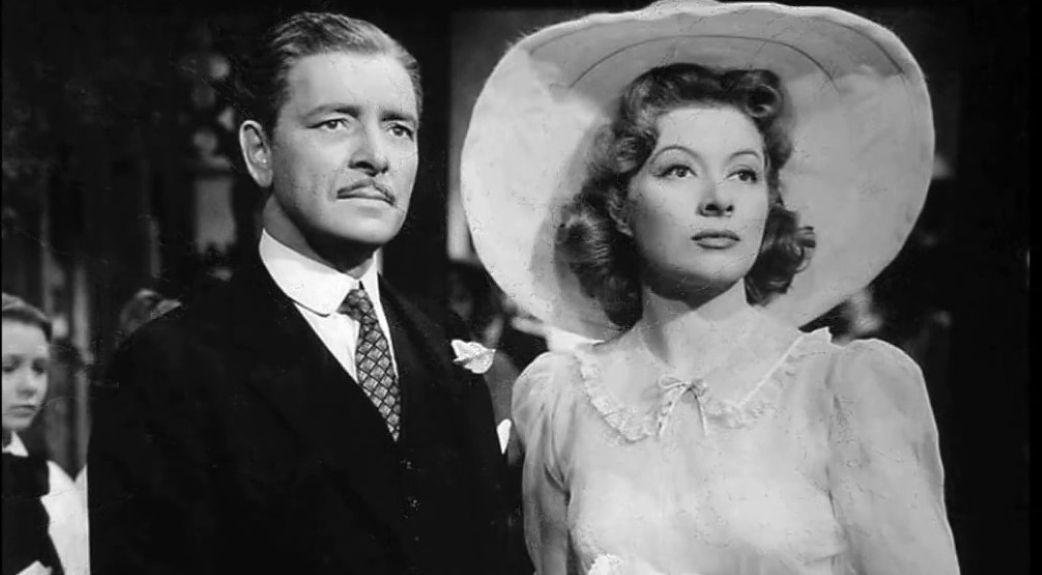
It’s the final days of World War One, and amnesic soldier “John Smith” (Ronald Colman) can’t remember anything about his life. On the final day of the war, he sneaks out of the asylum and runs into music hall performer Paula (Greer Garson). She takes a shine to “Smithy” and decides to save him. They run away to the country, fall in love, get married, have a baby, he starts to write, goes to Liverpool to start a journalism career… and gets hit by a cab. The collision restores his original memory – but also causes him to forget everything about Paula and his life as Smithy. Instead, he restarts his original life as industrial heir Charles Rainier, presumed dead by his family. While he lives this life for years, Paula takes a job as his secretary “Margaret”. Will he remember who she is?

It says a lot that that summary only scratches the surface of a plot that throws in the kitchen sink in attempting to ring as many tear-soaked tissues out of you as possible. Smithy and Paula carry out their little memory dance over the course of over twenty years. It’s the sort of a film where millionaire Charles only thinks about investigating what might have happened to him in Liverpool when nudged to do so after over a decade. Where the couple enter a ‘marriage of convenience’ as the memory-free Charles and fake Margaret. Where Charles’ owns a major factory in the town where our lovers first met, but neither (a) stepped foot there in 15 years (since the moment he does his memory starts to return) and (b) the heir to the town’s major employer wasn’t recognised by anyone while living in an asylum five minutes walk down the road.

Take it on the merits of logic and conventional narrative and Random Harvest crashes and burns. But this isn’t a film about those things. This is a classic weepie that stole the hearts of a war-torn nation in 1942 (it was the biggest hit of the year). Powered by two committed and emotional performances, if it hits you in the right mood its probably irresistible. The sort of long-term adversity that makes Romeo and Juliet’s look like a casual dalliance (so full of tragedy, the death of their son is literally a throwaway moment). It’s framed with a great, sensual beauty by Mervyn LeRoy and powered by an emotionally throbbing score by Herbert Stothart that’s just the right side of sickly.

Ronald Colman’s performance is quiet, measured and vulnerable (especially in his “Smithy” performance). From the start, he has eyes of hesitant, unknown sorrow and stumbles into a relationship with Paula like a new-born discovering life. Threads of his gentleness and excitability work their way into his Charles persona, tinged this time with the natural confidence of wealth. Nevertheless, Colman makes Charles a man who has dealt with unnerving amnesia by actively not thinking about it, carrying on a watch-chain the key to his “Smithy” home as a subconscious reminder. It’s a fine performance – so much so you can overlook he’s twenty-five years too old (the restored Charles forgoes returning to university, something that looks long gone for Colman).

Just as fine is Greer Garson, fully embracing an emotional roller-coaster as Paula. Introduced as a good-natured music hall singer (and Garson sings a high-kicking She’s Ma Daisy number in possibly the shortest skirt the Hays Code ever allowed), Garson’s warm and playful Paula is drawn towards “Smithy” in ways she almost can’t understand. But it’s a wonderfully different side for an actress so often associated with self-sacrificing wives and mothers: Paula is vivacious, forward and seizes the things she wants from life. It’s the second half – the patient, yearning desperation of “Margaret” hoping her husband will remember her – that leans more into her Mrs Miniver wheelhouse, but Garson mixes this with a real lingering, desperate sadness tinged with just enough hope that her husband might just recognise her.

Both performers overwhelmingly lift this otherwise (frankly) slightly contrived film into something rather sweet and endearing. It is, however, a film that would be even more so if it was shorter: the general morass of missed opportunities, misunderstandings and wrong ends of sticks being grasped would be easier to sustain over 90 than 120 minutes. It’s a rare film that covers so much ground over so much time that it’s lead character is declared dead twice.

The second declaration is Paula gaining that status for “Smithy”, dissolving their marriage and removing (you suspect for Hay’s Code reasons) the risk that Charles might accidentally commit bigamy by marrying his young niece. This is a lovely performance of youthful idealism and earnest devotion from Susan Peters (a tragic accident shortly after curtailed her promising career), and if the whole years-long subplot of the possibility of Charles marrying his besotted niece is a narrative cul-de-sac the overall film would be better without, it does at least mean we get the pleasure of Peters, performance captured forever.

But Random Harvest remains a pure romance: where no less than two women spend decades of their life in selfless, one-sided devotion for the lead and he still comes across as the sort of saintly man cheered by his own factory workers for sorting out a strike. The whole confection is a very fragile thing, but LeRoy carries this fully-loaded glass ornament with pure skill and the performances of Colman and Garson set the bar for classic Hollywood tragic romance. Minghella and Pollack were right – our cynical age can’t believe the nonsense – but on its own terms it still works.

Sergeant York (1941)

Sergeant York (1941)

Patriotic flag-waver with a great performance from Cooper and plenty of genuine heart

Director: Howard Hawks

Cast: Gary Cooper (Alvin C. York), Walter Brennan (Pastor Rosier Pile), Joan Leslie (Gracie Williams), George Tobias (“Pusher” Ross), Stanley Ridges (Major Buxton), Margaret Wycherly (Mother York), Ward Bond (Ike Botkin), Noah Beery Jr. (Buck Lipscomb), June Lockhart (Rosie York), Dickie Moore (George York), Clem Bevans (Zeke), Howard Da Silva (Lem), Charles Trowbridge (Cordell Hull)

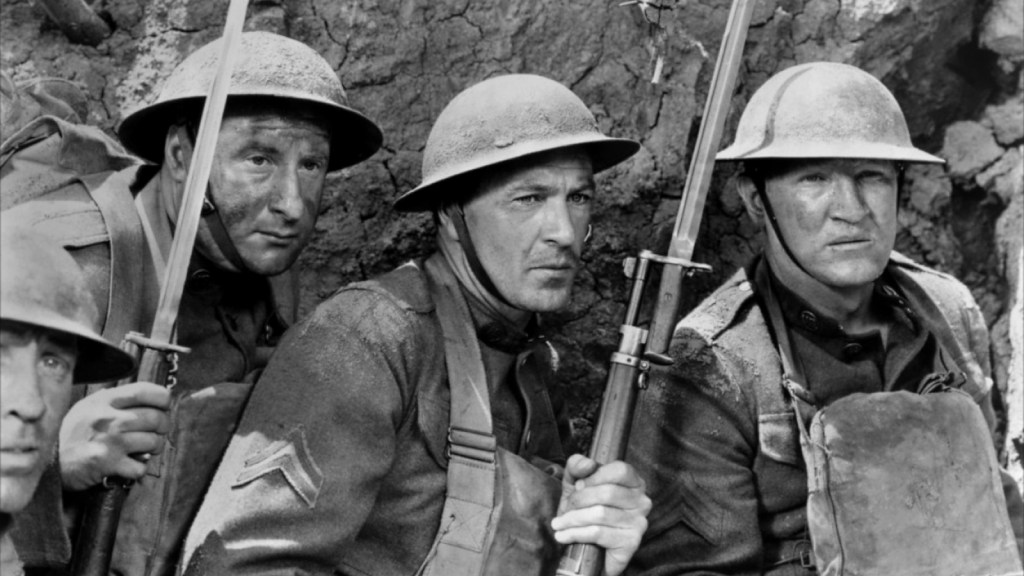
In 1941, after Japanese bombs landed on Pearl Harbor, America needed patriotic big-screen heroes. Few stood out more than Alvin York. A young man (over ten years younger than Gary Cooper) who had lived a youth of drunken rough-and-tumble before he found the light. When America joined the First World War, the 30-year-old York was called up. A gifted sharp-shooter, York was perfect for soldiering – but had to wrestle with his conviction to stick to the Commandments from the Good Book. Finding a solution to his moral quandary, York fought in France where his sharp-shooting instincts saw him almost single handedly capture a German machine gun embankment and 132 Germans (it’s an achievement that sounds pure Hollywood, but is in fact entirely true).

It’s an inspiring hero story that Warner Brothers bought to the screen at the perfect time, it’s release seeing tales of streams of young men walking from the cinema straight to the enlistment office. Producer Jesse L Lasky spent no less than twenty-two years attempting to persuade the notoriously publicity-shy and modest York (just as in the film, the real York couldn’t wait to leave the glitz and glamour of his triumphant homecoming behind and return to his fiancé, farm and work with the Church) to grant him the film rights to his life. York agreed only with the advance of Hitler, a hefty payment to his Church and a promise that no-less than Gary Cooper would play.

Cooper was reluctant – pointing out he was far too old to play this national hero – but really no other actor could have done it. Cooper won his first Oscar for the role, and it’s his understated sincerity and decency that really sells the film. He turns what could otherwise by a potentially cloyingly perfect man into someone utterly sympathetic and endearing. There is an aw shucks quality to Cooper, as he captures York’s modesty, his shrugging off his accomplishments as no more than his duty, his palpable discomfort with attention (be it from congressmen or his fellow Tennessee farmers commending his shooting) and a deep-rooted genuineness in his love for his beau Gracie (Joan Leslie giving a commendable performance of endearing brightness that helps you overlook she was 24 years younger than Cooper – thankfully she doesn’t look it).

Cooper’s performance powers a sprightly, very enjoyable film by Howard Hawks (who picked up his only Oscar nomination for this) that manages to transcend the danger of being an overbearing flag-waver. (Don’t get me wrong though – this film waves the flag so much, you can practically feel the strain in its arms). Hawks produces a film that in many ways owes as much to The Adventures of Robin Hood as an heroic All Quiet on the Western Front. Despite the patriotic focus being the final few Acts, as York carries out his act of astonishing heroism, the film’s real heart is in the opening half and the conversion of a man who is never-too-naughty into one who casts aside the demon drink, works hard to earn what he has, and puts his faith and the good of others before his own concerns.

Hawks shoots this part of the film with a palpable energy and a rough-and-tumble sense of humour. It’s there from the film’s opening as Walter Brennan (in a role he invests with all his wheezy, twinkly dignity) finds his sermon constantly interrupted by the gunplay of the drunken York and his buddies. There is a light humour when Margaret Wycherly – a little too ethereal for my taste as York’s saintly mum (although her casting does make York and White Heat’s Cody Jarrett siblings) – archly observes that, even when drunk, her son’s accuracy with a shooter is second to none. That’s the skill of Sergeant York there: in it’s end is it’s beginning, York is already deeply skilled and as his slightly embarrassed reaction shows when he sobers up, reformation is not a long journey.

A large part of the success is making York one of us. Striving to save the money he needs to buy the farmland of his dreams, Hawks provides a sweet montage of York undertaking no end of backbreaking, thankless work and returning home to tick off his slowly accumulating dollars under the smiling approval of Ma. When, after all his work, he finds the land has nevertheless been sold (because the owner never believed this previously idle lush could hold on to his hard-earned pennies), his outrage at the breaking of another man’s word is a clarion call to all of us who have played by the rules and been shafted. When his conversion comes, it’s not as out-of-the-blue as it could seem, but a logical conclusion for a journey we’ve watched him go on.

It’s undercut with scenes that drip with Hawksian skill. A marksmanship competition is crammed with a playful Robin Hoodesque skill. A bar-fight that the drunken York gets wrapped up in is so full of comedic tumbles and prat falls it’s hilarious. York’s constantly being fetched for various tasks by his kid brother is expertly played for subtle laughs. Alongside this, the romance between York and Gracie (and the off-screen slapping he hands out to a rival who treats her with disrespect) is beautifully handled.

The only real Hawksian touch missing is that little slice of cynicism, that ability to look under the skin of a legend (like with Wayne in Red River) and see a more flawed person. York basically is perfect, and in a film dripping with patriotism there can’t be any fault with either the army or the moral question of whether gunning down your fellow humans is alright in the service of your country. There is a version of Sergeant York where his commanding officer’s invitation that he take some time and read his way through the history of America (a replacement good book) was an act of naked manipulation of a guileless man. Or where we see the sort of guilt at his taking of life that the real York felt, play out across Cooper’s face. There’s none of that here.

In fact, after the vibrant, playful, heartfelt first few acts, you feel Hawks felt less interested in the war itself. There is a functionality about the final acts of Sergeant York as York aces his shooting tests on the range (although the flabbergasted reaction of his training officer and York’s apologetic manner at his failure to only manage five dead-on bulls-eyes on his first time using an army-issue rifle are funny). Hawks spices it up with York’s turkey-shoot metaphor, and a warm supporting turn from George Tobias (as a New Yorker soldier) and York’s gobble-gobbles to distract his German opponents. But, for all the realism of the trenches, there is an air of duty about this sequence.

But then Sergeant York works not because of the deed, but the man. And the film’s success in investing us in a man who could very easily have been all-too-perfect, in a playful and energetic first half works wonders. With a very fine, perfectly judged performance by Gary Cooper, this may not be Hawks most characterful work – but as the sort of film to showcase a man who inspires you to achieve acts of heroism, it hits the target perfectly.

White Heat (1949)

Top of the World Ma! Cagney excels in his final and greatest Gangster role White Heat

Director: Raoul Walsh

Cast: James Cagney (Cody Jarrett), Virginia Mayo (Verna Jarrett), Edmond O’Brien (Hank Fallon/Vic Prado), Margaret Wycherly (Ma Jarrett), Steve Cochan (“Big Ed” Somers), John Archer (Philip Evans), Wally Cassell (“Cotton” Valletti), Fred Clark (Daniel “The Trader” Winston)

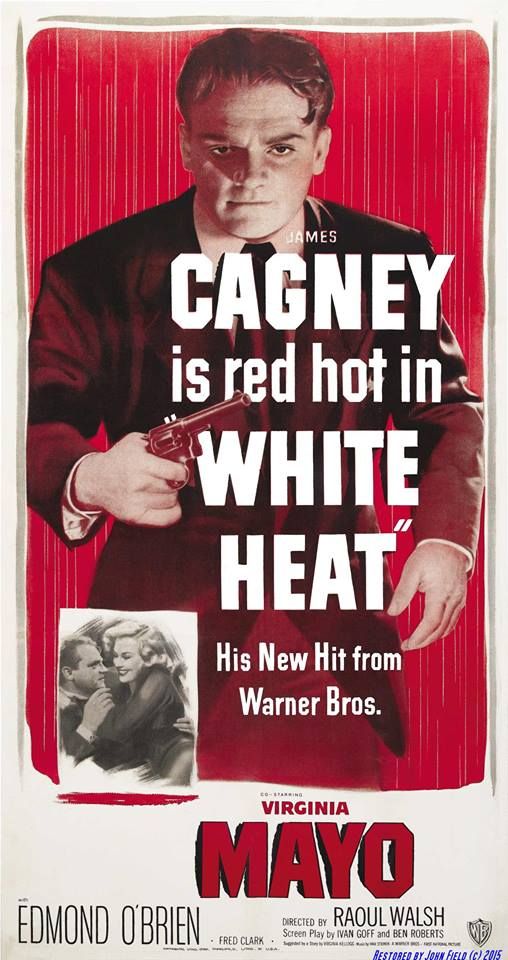
After winning an Oscar for Yankee Doodle Dandy, Cagney left Warner Brothers to form his own production company. When that folded, he swallowed his pride and re-entered the Warners’ fold. Money was driving the relationship: and it was the pay cheque that got Cagney to return one last time to the role of a psychotic gangster in White Heat. And if he had to go back, why not make that gangster the most psychotic of the lot? After all who else could make it to “the top of the world”?

Cody Jarrett (James Cagney) is the leader of a gang of criminals, to whom no act of larceny, violence or murder is taboo. A botched train hijack – during which Jarrett shoots two unarmed train drivers – attracts the full attention of the law, but Jarrett dodges justice by having himself sent down for a minor crime that happened at the same time as the train hijack. Not fooled, the Feds send an undercover operative, Hank (Edmond O’Brien), into the prison as Cody’s cellmate “Vic Prado”, tasked with getting the details of the train job and locating the mysterious fixer who set up the job. But such schemes didn’t take into account Jarrett’s psychological disturbance – powered above all by his obsessive, overwhelming love for his mother (Margaret Wycherly), the one dominant influence over his life.

Raoul Walsh’s film is a brutally efficient gangster flick which may be a little too long (the mechanisms of tracing and tracking a car are covered in far too great a depth…), but ticks all the boxes of the genre with exceptional skill and dexterity. It’s shoot-from-the-hip (literally) melodrama, and has all the internal logic of a schoolground game of cops and robbers, but Walsh’s direction is pin-point perfect, and the film is based around a series of stunning and effective set-pieces and crammed with a sort of deep (even disturbing) psychological insight that puts it miles ahead of many of films of the genre. Walsh also throws in some of the finest stylistic touches of film noir, with Virginia Mayo’s femme fatale, darkened frames, dubious morals among even our heroes (one of whom is a practised deceiver and liar) and a whirlwind monster at the centre.

But the film soars and flies because of Cagney, and the no-holds barred sharpness of Jarrett. The film revolves above all around the deep emotional emptiness and need in Jarrett, which sees him lean on O’Brien’s Falon (“like my kid brother!”) and, most famously, fixate like a toddler on his mother. Freud would have had a field day with Jarrett’s obsessive love for his mother, with Cagney turning him into the little boy lost. Consumed with headaches, he literally climbs into her lap so she can comfort him. The slightest criticism of her leads to instant reaction (not least knocking his wife off her chair – how can the poor woman compete with this beatified mother figure?)

This culminates in one of the film’s most famous sequences, as Jarrett digests in prison the news that his mother has died. Sitting in a crowded dining room, he passes word down to a new inmate for an update on his mother. Slowly the question is passed down the line of prisoners – and with trepidation the news of her death is passed back. And here is the Cagney magic. He seems too stunned at first to take it in then a series of low moans explodes into a titanic screaming fit, matched only by the violence he takes out on all who stand in his way. Walsh and Cagney kept the response secret from the entire room of 300 extras, all of whom seem as stunned as us by Jarrett’s total lack of control, his complete consumption in grief.

Cagney’s performance is just about perfect, a simmering mummy’s boy who is also a charismatic leader of men. A dangerous psycho who seems aware that he is not quite normal. A lonely man desperate for love. And Cagney has so many beautiful touches that could only be him – the quip as he plugs with bullets a car boot with a luckless gang member in it, the sly kick away at Virginia Mayo, that screaming sequence. It’s a performance of complete power and charisma, the gangster psychoanalysed and reduced to his bare essentials for a personality barely functional and obsessed with his mother.

Margaret Wycherly is similarly excellent as that mother, as sly and self-confident as her son and clearly as accomplished at leading a gang as him (I love the smug half smile she gives herself after evading the FBI tail she picks up). Edmond O’Brien does sterling work in the “straight man” role of the undercover cop, walking a line between judging and even perhaps sorta liking Jarrett a bit (even if he does get saddled with the mandatory “that’s the moral of the story” final line). Virginia Mayo is a wonderful mix of sex appeal and needling cheapness as Jarrett’s two-faced wife.

The film culminates in one of the most famous endings of all time – one you’ll know even if you haven’t seen the film – as the law catches up with Jarrett at last in a shoot-out at a gas plant. Finally driven mad by betrayal and abandonment – although lord Cagney’s performance makes clear that only a tenuous grip on sanity has been present in Jarrett from the start, fractured beyond repair by the loss of his mother – Jarrett insanely shoots at the police from atop a burning gas plant, before immolating himself (and most of the factory) with the cry “Made it Ma! Top of the world!”. As Jarrett heads down to a firey hell, so Cagney signed off on the gangster flick with perhaps the most dangerous, disturbed and also intriguing gangster on film. It’s such a mighty performance that the Hays-Code mandated final line of tutting disapproval at the criminal life from O’Brien feels even more forced and unnecessary than ever.