Tag: Mark Gatiss

The Fantastic Four: First Steps (2025)

The Fantastic Four: First Steps (2025)

Fun entry in the MCU, bright, pacey and entertaining – but never engages with its deeper issues

Director: Matt Shakman

Cast: Pedro Pascal (Reed Richards / Mister Fantastic), Vanessa Kirby (Sue Storm / Invisible Woman), Ebon Moss-Bachrach (Ben Grimm / The Thing), Joseph Quinn as (Johnny Storm / Human Torch), Julia Garner (Shalla-Bal / Silver Surfer), Ralph Ineson (Galactus), Sarah Niles (Lynne Nichols), Mark Gatiss (Ted Gilbert), Natasha Lyonne (Rachel Rozman), Paul Walter Hauser (Harvey Elder / Mole Man)

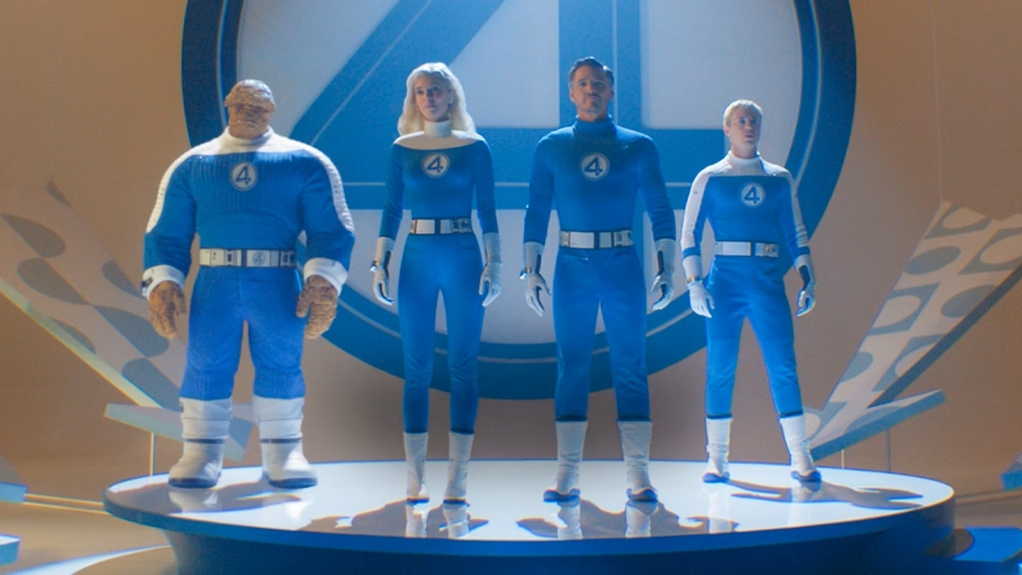
It’s taken almost seventeen years (can you believe the MCU has been going for so long?!) but ‘Marvel’s First Family’ finally make it to the party, escaping one of those legacy rights deals the comic giant signed before working out it could make films itself. Since, for those interested, there are already three Fantastic Four origins-films for you to seek out (they gained their powers from flying through a space storm), Fantastic Four throws us straight into the second Act of our heroes lives, communicating their origins in an in-universe TV show celebration of their achievements (including a montage of them defeating a parade of second tier villains, including Mole Man and an army of super-intelligent chimps) before throwing them up against their biggest challenge yet.

For their unofficial leaders, Reed Richards (Pedro Pascal – whose real life super-power seems to be that he appears in all movies) aka Mr Fantastic science super-genius and master strategist with limbs of rubber and Sue Storm (Vanessa Kirby) aka Invisible Woman, the world’s greatest diplomat, who can create forcefields and make herself (and others) invisible) there is the challenge of impending parenthood. And for the whole gang, also including scientist and wild-child Johnny Storm (Joseph Quinn) – he can set his body on fire – and Reed’s best friend, astronaut and Herculean powered made-of-stone Ben Grimm – it’s the threat of Galacticus (Ralph Ineson) a planet-eating giant whose herald (Julia Garner) arrives on a silver surfboard and announces Earth will be his next snack, unless the Four hand over Sue’s unborn child.

The Fantastic Four’s decision to skip the origins story throws us straight into a story that’s a lot of fun. A very enjoyable romp with some well-sketched out characters (played by engaging and charismatic actors), a few extremely well-made set-pieces, plenty of humour, just enough heart and a decent, city-crushing, smackdown at the end. It’s directed with a lot of bounce and joy by Matt Shakman and despite being about literally earth-shattering events manages to keep the focus tightly on the family at its core (perhaps a little too tightly, but more on that later).

It’s also a delightful triumph of design. Set in a sort of cyber-punk 1960s (the idea being that Richard’s intellect has super-powered mankind’s development), it’s a gorgeously realised world of 60s design, all curving surfaces and primary colours, intermixed with souped-up 60s technology like ingenious androids that run on cassette decks and flying cars, like The Jetsons made flesh (doubly engaging as the film so obviously committed to real sets rather than blue-screen invention). I also rather liked the implied joke that the world has progressed only in the areas Richards’ considered worthwhile: so this world has faster-than-light travel, flying cars and abundant energy sources, but totally lacks hi-def television or social media (and who can blame Richards for that).

There is also a certain charm in how the Four are universally beloved heroes. Everywhere they go, they are flooded by admirers and merchandise wearing children (it’s quietly never explored if the Four paid for their colossal, futuristic tower and private space base with a fortune in image deals). Reed fills time between inventing the future with hosting a TV show about science for kids, while Sue essentially runs the United Nations. Johnny is the star of every social event and Ben bashfully lifts the cars for the kids in his Brooklyn neighbourhood and flirts shyly with a primary school teacher (Natasha Lyonne).

This world is pleasingly shaken up by the arrival of the Silver Surfer, a charismatically unreadable turn from Julia Garner (under a CGI naked silver body). First Steps successfully uses this threat to humanise a group of heroes who otherwise might have proved too good to be true. For starters, their confident assurances all will be well when they head for space turns out to be far from the case when they are comprehensively outmatched by an immortal planet eater and his physics-defying silver herald. First Steps most exciting and thrillingly assembled scene is their retreat from a first encounter with this giant, a brilliantly managed high-octane chase around a black hole with a few extra personal perils thrown in on top, made even more gripping by Michael Giacchani’s pitch-perfect score.

That’s before the devilish conundrum of balancing the fate of seven billion people with Sue’s unborn son. If First Steps refuses to really dive fully into it, it does successfully raise the emotional stakes. It’s also a ‘reasonable’ offer from Galactus, a surprisingly soulful anti-villain, played with a mix of disdainful arrogance and death-dreaming melancholy by Ralph Ineson (there is a lovely moment when he takes a break from imminent city-smashing to pick up and sniff a fistful of Earth as if he’s forgotten the smell) desperate to escape the cycle of endlessly devouring planets to maintain his interminable life.

Horrific as it is to imagine a baby taking his place, First Steps avoids really delving into this intergalactic trolley problem. Because, at heart, it’s a film where superheroes alarmingly make decisions for billions of people with no oversight or pushback. Having unilaterally decided to reject Galactus’ offer, the Four seem surprised the rest of Earth are less than thrilled at their impending demise because the Four won’t make a Sophie’s Choice. There is some rich potential here to really delve into the way the Four are, arguably, benign dictators, reshaping this world in their own image and accepting adulation and unquestioning following. First Steps ignores it – the world’s discontent underdone by a single speech from Sue – and only for a split second is the moral quandary treated as something meriting genuine debate. As the surfer points out, if the kid was an adult he would certainly accept: is it right to take that choice from him?

But it’s a comic book movie, right? So, let’s not overthink it. And Marvel was never going to darken its First Family with hints of elitest oppression, demanding sacrifices from others (and the world makes huge sacrifices to protect their child) but not themselves. First Steps is a fun film. I liked its vibe, like a live-action Incredibles (only not that good), I enjoyed the BB4-like robot Herbie, all four of its leads are highly likeable with excellent chemistry. So, I’m trying to just not think about where this onrushing trolley is going and instead enjoy the view.

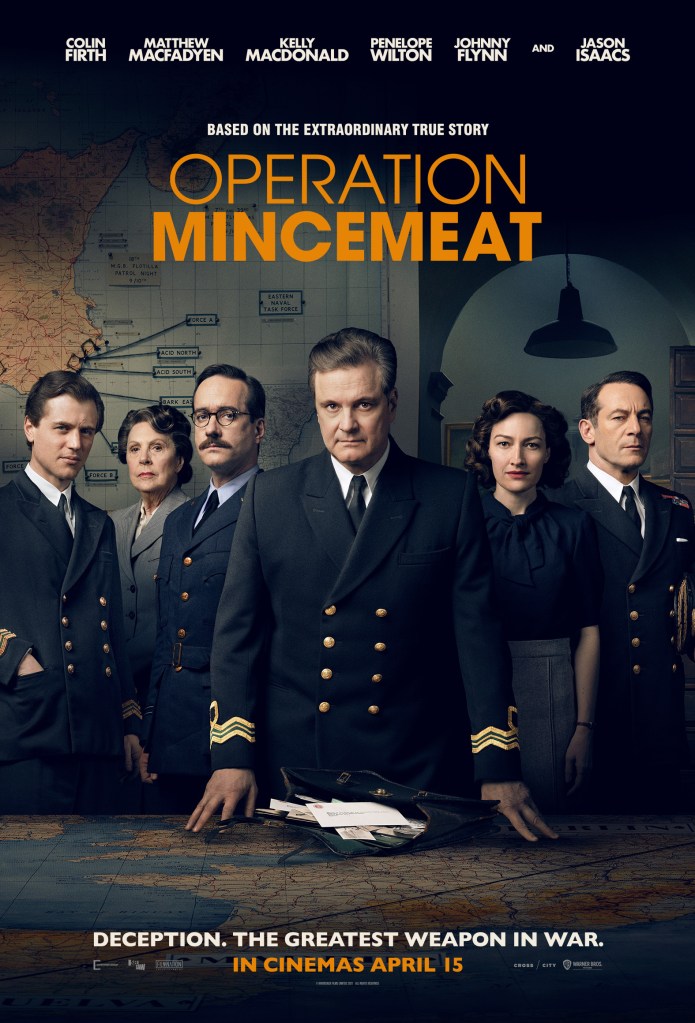
Operation Mincemeat (2022)

Operation Mincemeat (2022)

Wartime heroics get bogged down in bland love-triangles and tedious inventions

Director: John Madden

Cast: Colin Firth (Ewen Montagu), Matthew Macfadyen (Charles Cholmondeley), Kelly Macdonald (Jean Leslie), Penelope Wilton (Hester Leggett), Johnny Flynn (Ian Fleming), Jason Isaacs (Admiral John Godfrey), Simon Russell Beale (Winston Churchill), Paul Ritter (Bentley Purchase), Mark Gatiss (Ivor Montagu), Nicholas Rowe (Captain David Ainsworth), Alex Jennings (John Masterman)

In April 1943 a body washed up on the shore of neutral Spain. It was a Major William Martin, carrying Allied plans to launch a massive invasion of Greece in July 1943. German agents intercepted these plans before they could be returned to the British and the Germans shifted their troops to counter this invasion. Problem for them was, Major Martin wasn’t real, the plans he carried were inventions and the Allies were planning to attack Sicily. Welcome to Operation Mincemeat.

Adapted from an entertainingly written and well researched book by Ben MacIntyre, Operation Mincemeat is about one of the most successful wartime deception plans ever launched. The film is a bit of a deception operation itself. Although it looks like a Boys-Own caper film, with eccentric boffins solving problems and running circles around the Nazis, it’s actually a dry, slow, sombre film that seems embarrassed at even the faintest idea of flag-waving Wartime heroism. Instead, everything is glum, depressing and bogged down in invented details that never convince.

Which is a real shame, because when the film focuses on the things that actually happened it’s both entertaining and informative. To create Major Martin, MI6 needed a body – specifically a military-age male who drowned. That was almost impossible to find in London at the time – and the final ‘candidate’ had to be kept as ’fresh’ as possible for months. The letters he carried included ‘private correspondence’ from one British General to another – a letter that went through almost twenty drafts as the British authorities squabbled about how blunt its ‘personal’ views could be. When the body washed up, a helpful Spanish officer tried to return the papers immediately. When the film is on this material it’s good.

But it feels embarrassed by the idea of enjoying this stuff. After all, war is hell and the idea that we could even for a moment think these eccentrics (nearly all of whom spend their time penning spy stories) might find part of this subterfuge fun is disgraceful to it. So, we are constantly reminded of the horrors of war: the moral quandaries of using a person’s body for an operation, the troubling “wilderness of mirrors” of espionage. All this means that lighter moments – or moments where we could enjoy the ingenuity of the characters – are rushed over as soon as possible.

The other thing the film is embarrassed about are the lack of female characters. As such Kelly MacDonald’s Jean Leslie – who contributed a vital photograph of herself as ‘Major Martin’s’ paramour and the background of this fictional relationship – is elevated to third wheel in the planning. But, in a move that feels bizarrely more sexist and conservative, she also becomes the apex of a love triangle between herself and Firth and MacFadyen’s characters. This tedious triangle takes up a huge amount of time in an overlong film and is fatally scuppered by the total lack of chemistry between any of the participants.

It also means our heroes are forced to spend a lot of time running around like love-sick, horny teenagers, following each other and passing notes in class. At one point Cholmondeley tells Jean about Montagu’s wife with all the subtlety of “I saw X kissing Y behind the bike sheds”. This also means that the matey “all in this together” feeling essential to these sort of caper films (which is what this story really is) is undermined. This ends up feeling rather like a group of people who learn to dislike each other but vaguely put personal feelings aside for the greater good.

The real exciting history clearly isn’t exciting enough. Instead, ludicrous, artificial “improvements” littered through the story. I get that Jason Isaacs’ Admiral Godfrey is turned into a moronic, obstructive bureaucrat for narrative reasons. But the ridiculous shoe-horning in of a link between the Operation and the Anti-Nazi resistance in Germany in the second half of the film feels blatantly untrue even while it’s happening. By the time one of our heroes is being confronted by a German agent in their own home, the film has checked out of reality.

Truth is, this is a bad film, over-long, overly dry and crammed with artificial flourishes. Partially narrated by Ian Fleming (a woefully flat performance by Johnny Flynn, sounding oddly like Alex Jennings), the film attempts to draw links between this and the formation of James Bond but these fall as flat as everything else. MacFadyen gives probably the best performance among some wasted Brit stars. The truth is, a one-hour straight-to-camera lecture from Ben MacIntyre would have been twice as entertaining and interesting and half as long. A chronic misfire.

The Father (2020)

Olivia Colman and Anthony Hopkins excel in Florian Zeller’s sublime The Father

Director: Florian Zeller

Cast: Anthony Hopkins (Anthony), Olivia Colman (Anne), Rufus Sewell (Paul), Imogen Poots (Laura), Olivia Williams (The Woman), Mark Gatiss (The Man)

Is there any worse nightmare than the thought of losing your mind? Worse of all, to lose your mind in stages: to be aware, in every moment, that things are not as they should be, that people and places no longer seem to fit your memory of them. That you can walk into a room and completely forget why or meet someone close to you and have no a clue who they are. It’s an unimaginable condition to go through – and the subject of Florian Zeller’s exceptional adaptation of his award-winning play, The Father.

Anthony (Anthony Hopkins) is a retired engineer slowly succumbing to dementia. Events are increasingly confusing to him. Is he living in his own flat, or is he living with his daughter Anne (Olivia Colman)? Is Anne moving to France or not? Is she married to Paul (Rufus Sewell) or not? Where is his other daughter who looks so like a woman who may-or-may-not be his new carer, Laura (Imogen Poots)? From moment-to-moment Anthony struggles with confusion, rage and fear as the world constantly fails to coalesce into a meaningful picture, but instead remains a fragmented jumble.

That’s the brilliance behind Zeller’s adaptation of his own award-winning play. It captures the perspective of the world for those suffering from dementia in a way no film has done before. The play’s timeline is disjointed in an almost Nolan-esque way, and it’s not clear whether we are watching ‘real’ events’ or if all of these events are memories of Anthony’s which dementia has shuffled, reordered and recast. Either way, the film constantly refuses to allow you any grounding from scene-to-scene, and refuses to present clear answers (although you can infer much).

Even the sets betray us. From to scene to scene the apartment is redressed, sometimes in subtle ways, sometimes in jarringly different ways. The same fundamental layout sees every room constantly redesigned. Sometimes it could be Anthony’s apartment. Sometimes Anne’s apartment. Sometimes a mix of the two. Sometimes it’s a hospital, in others a retirement home. Often it might be a combination of one or more of these locations all at once. The style of decoration is inconsistent, the furniture changes, pictures move, even the colours of bedsheets change. Every single scene disorientates us: it’s only a movie for us, but for Anthony this is his life.

In fact, if The Father has a filmic influence, interestingly it’s a horror-film. Anthony is a man trapped in a situation where he knows everything is wrong, but can never fully understand why, or get people to listen to him. Often the camera catches discomfort and fear on Hopkins’ face, and it’s clear he neither knows where he is or, in many cases, who the people with him are. But for fear of not being believed or a sense of powerlessness, he’s too proud and scared to ask. It taps into the powerlessness of horror films, where you are relentlessly chased by a force outside your control: in The Father that force is life, which has become for Anthony a disturbing kaleidoscope where everything makes sense to everyone except him.

Of course, a large part of this is sold by Anthony Hopkins Oscar-winning lead performance. Hopkins delivers to an astonishing degree: this might just be the greatest performance of his career. Although we see flashes of ‘the true Anthony’ – his wit, playfulness and intelligence – Hopkins deftly and subtly demonstrates the wildly varying mood swings dementia brings. At times he’s paranoid, defensive and even aggressive. At others he’s stunningly vulnerable and scared – he has two breakdown scenes of such heart-breaking vulnerability and boyish fear, they are tough to watch.

The film opens with Anne telling Anthony she’ll be leaving for Paris, and Hopkins’ face collapses into a crumpled, puffy, scared-little-boy face while he plaintively asks what will happen to him. Anthony fixates on things that give him any sense of control: he is obsessed with his watch, hiding it and continuously searching for it. He will dredge up a fact from the distant past to ‘prove’ he has not lost his memory. He snaps angrily when he feels he is being talked down to. His resentment expresses itself in viciously cruel verbal assaults on Anne, labelling her a disappointment, failure and his least favourite child. Then a few scenes later he’ll squeeze her shoulder and quietly and lovingly thank her for everything she has done for him. All of this is delivered by Hopkins with no grand-standing, but with a hugely affecting truthfulness. It’s an astonishingly good performance.

Every scene carefully demonstrates time and again Anthony’s fear and vulnerability. Actors are even replaced by other actors in several scenes. In Anne’s second appearance she is played by Olivia Williams. In a beautiful piece of subtle acting by both Hopkins and Williams, it’s clear Anthony doesn’t recognise Anne and she realises this but decides not to say anything. Anne’s husband (or boyfriend – Anthony remains unclear, so at times so do we) Paul (as he’s called most of the time) is mostly played by Rufus Sewell, but sometimes by Mark Gatiss. Paul is the closest the film has to an antagonist, although much of that is filtered through Anthony’s confused perception and, in any case, Paul is right that Anthony’s condition is making it too difficult for him to remain at home.

And we can see his point. Although each scene more-or-less makes sense within itself, the complete film is like looking at a jigsaw puzzle with all the pieces upside down and no picture, and then being asked to assemble it. In one particularly brilliant dinner scene, the film starts with Anthony witnessing a conversation between Paul and Anne, then loops through the scene and ends with Anthony witnessing exactly the same conversation again. The film is a deliberately, brilliantly, opaque tableau that defies easy meaning.

In all, The Father is a quite unique and brilliant film, that translates a theatrical piece into something highly cinematic. Hopkins is breath-taking, but Colman is also superb as Anne, in a part tailor-made for her ready empathy and easy emotionalism. Zeller’s direction is astonishingly confident and dynamic for a first-timer and the film slots you into the world of a dementia sufferer with an alarming immediacy. A superb film.

Our Kind of Traitor (2016)

Stellan Skarsgård is the Russian traitor whose secrets pose a danger for the British elite in Our Kind of Traitor

Director: Susanna White

Cast: Ewan McGregor (Perry MacKendrick), Stellan Skarsgård (Dima), Damian Lewis (Hector), Naomie Harris (Gail MacKendrick), Jeremy Northam (Aubrey Longrigg), Khalid Abdalla (Luke), Velibor Topic (Emilio Del Oro), Alicia von Rittberg (Natasha), Mark Gatiss (Billy Matlock), Mark Stanley (Ollie)

John Le Carré’s works often revolve around a dark, cynical view of government agencies as corrupt, indolent and focused on petty or personal concerns rather than doing what’s best for the country and its people. Is it any wonder that there has been such a burst of interest in adaptations on film and television of his work? 

Our Kind of Traitor is straight out of the Le Carré wheelhouse. On a holiday to save their marriage (after his infidelity), Perry (Ewan McGregor) and Gail (Naomi Harris) bump into charismatic Russian gangster Dima (Stellan Skarsgård). Perry and he strike up a surprising friendship – and before he knows it Perry is agreeing to carry information from Dima to the British intelligence services. This attracts the attention of MI6 officer Hector (Damian Lewis) who sees this as an opportunity to expose the corrupt links between Russian criminals and high-level British bankers and politicians. Dima, however, will only hand over the goods if he is promised asylum for his family – something the British authorities, aware of the mess his revelations could cause, are not happy to allow…

Susanna White, veteran of some excellent television series of the last few years, puts together a confidently mounted and generally well-paced drama, with many of the expected Le Carré twists and turns. If she leans a little too heavily on the murk – the green and blue filters on the camera get a big workout here – it does at least mean that we get a real sense of the twilight world the characters operate in, meaning flashes of wide open space and bright daylight carry real impact. She also really understands how violence is often more shocking when we see the reaction of witnesses rather than the deed itself – all the most violent and tragic events in the film are seen at least partly from the perspective of the reactions of those witnessing them. The sense of danger on the edges of every action, stays with us while watching this unjust nightmare unravel.

It also works really well with one of the core themes of the movie: our ability to feel empathy for other people and how it affects our choices. Dima is driven towards defection because of his distaste for the increasing violence of the next generation of Russian criminals, and their lack of discrimination about who they harm. He’s all but adopted the orphaned children of a previous victim of violence, and his motivation at all points is to insure his family’s safety. Hector, our case officer, is motivated overwhelmingly by a sense of tragic, impotent fury about his rival ensuring Hector’s son is serving a long sentence in prison for drug smuggling.

And Perry is pulled into all this because he has a strong protective streak – something that eventually saves his marriage. Perry frequently throws himself forward to protect the weak, with no regard for his safety, from his unending efforts to protect Dima’s family to throwing himself in fury at a mobster roughing up a young woman. His intense empathy and protective streak motor all his actions and run through the whole movie.

It’s a shame then that his actual character isn’t quite interesting enough to hold the story together. Nothing wrong with McGregor’s performance, the character itself is rather sketchily written. Aside from his protectiveness we don’t get much of a sense of him and – naturally enough – he’s often a passenger or witness to events around him. Similarly, Naomie Harris does her best with a character that barely exists.

Instead the plaudits (and meaty parts) go to Skarsgård and Lewis. Skarsgård dominates the film with an exuberant, larger than life character who never feels like a caricature and reveals increasing depths of humanity and vulnerability beneath the surface. Lewis matches him just as well, at first seeming like a buttoned-up George Smiley type, but with his own tragic background motivating a long-term career man to slowly build his own conscience.

Our Kind of Traitor handles many of these personal themes very well, but it doesn’t quite manage to tie them into something that really feels special. Instead this feels a bit more like a Le Carré-by- numbers. We get the shady secret services, government greed, good people trapped in the middle – even some of the characters, from the foul-mouthed spook played by Mark Gatiss to Jeremy Northam’s jet black Aubrey, seem like they could have appeared in any number of his novels. 

There is a film here that is wanting to be made about the invasion of the UK by dirty Russian money – but it never quite comes out as this Dante-esque, Miltonian spiral. Instead the film too often settles for more functional thrills, a more traditional or middle-brow approach that works very well while you watch it, but doesn’t go the extra mile to turn this into something you will really remember.

The Favourite (2018)

Olivia Colman is at the centre of a complex rivalry in The Favourite

Director: Yorgos Lanthimos

Cast: Olivia Colman (Queen Anne), Emma Stone (Abigail Hill), Rachel Weisz (Sarah Churchill, Duchess of Marlborough), Nicholas Hoult (Lord Robert Harley), Joe Alwyn (Colonel Lord Masham), Mark Gatiss (Lord Marlborough), James Smith (Lord Godolphin)

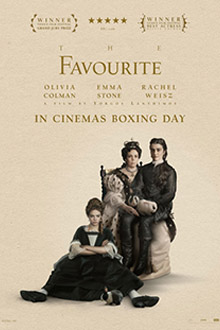
Looking around the cinema, I couldn’t help but wonder how many of the audience were expecting The Favourite to be a Sunday night-style costume drama about Queen Anne. Goodness only knows what they made of this skittishly filmed, acidic, sharp-tongued, very rude drama about squabbles in the court of Queen Anne. The Crown it ain’t.

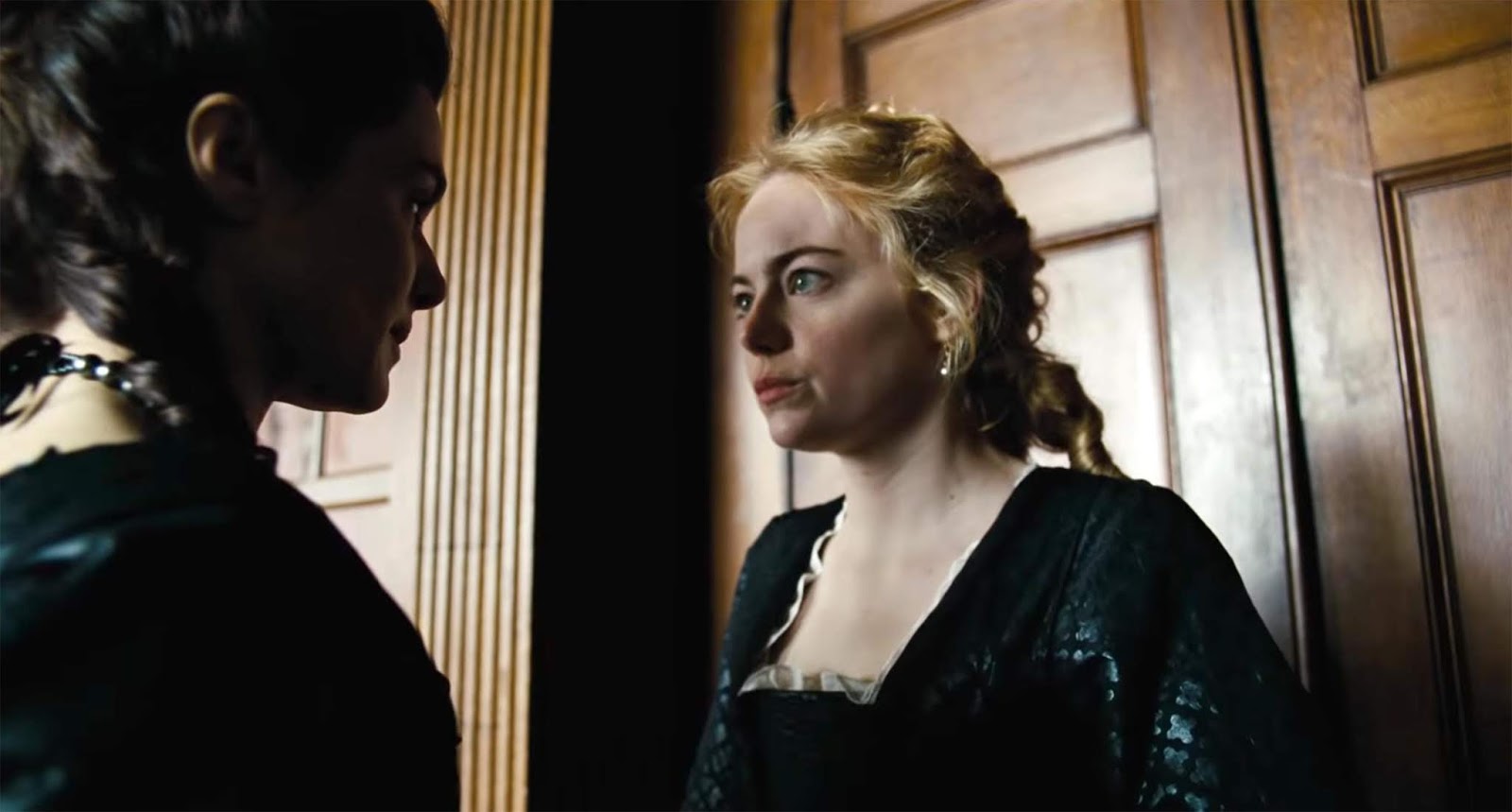
In 1708, the court of Queen Anne (Olivia Colman) is dominated completely by her head of household, chief advisor, secret lover and domineering best friend Sarah Churchill, Duchess of Marlborough (Rachel Weisz). But Sarah’s control over Queen Anne is set to be challenged by the arrival in court of seemingly charming, but in fact ruthlessly ambitious, cousin Abigail Hill (Emma Stone), a former aristocrat who has fallen on hard times. Soon Sarah and Abigail find themselves in the middle of a bitter, ruthless clash for control over Anne – who, seemingly weak-willed and disinterested in government, in fact takes an eager pleasure from the rivalry of the two women.

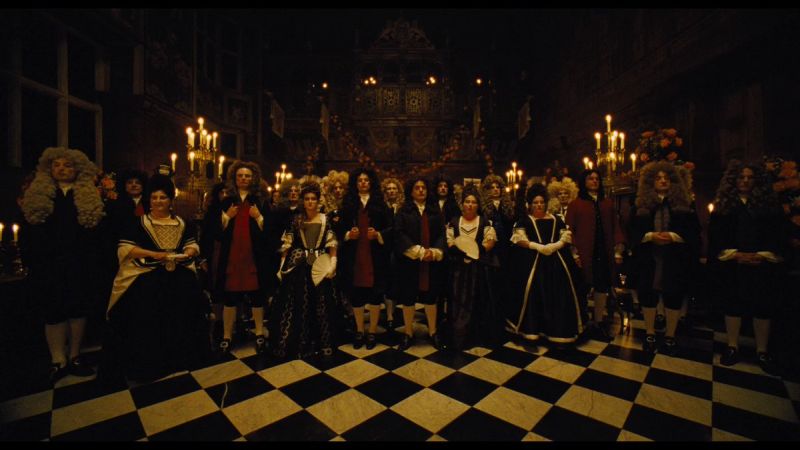
The Favourite is a brilliant, acerbic, very dark comedy that treats its period setting with a hilarious lack of reverence. It’s a frequently laugh-out loud comedy, with its often foul-mouthed dialogue just on the edge of being anachronistic (a trait that also comes into the hilarious non-period dancing). It takes a moment to tune up, but leans just enough on the fourth wall to work. Lanthimos’ film doubles down on the insane pressure bowl of Anne’s courts, turning the court of the 1700s into a bizarre, semi-surreal state where you have no idea what insanity you might see around the corner – from racing ducks, to rabbits roaming free, to a naked man being pelted with oranges. 

But then this is the sort of bizarreness that stems from the top, and Olivia Colman’s Queen Anne is a domineering eccentric. In a film-career-making performance from Colman, her Queen Anne is part infantalised puppet, part needy insecure lover, part bitter control freak. Anne will change from scene to scene from a furious, knee-jerk rage to a weeping vulnerability. Her interest in actually ruling the kingdom has been largely beaten out of her, but she still needs to feel that she holds the power. With her body raddled with gout, Anne alternates between demanding independence and being wheeled from place to place. Colman’s performance bravely skits between temper tantrums and a desperate, panicked loneliness and sadness – it’s a terrific performance.

A woman as uncertain and unhappy in herself as Anne is basically pretty ripe for control and manipulation. History has not been kind to Sarah Churchill, who is often seen as a ruthless, power-hungry manipulator only out for what she can get, obsessed with the power her role brings her. This film takes a different, more interesting slant, thanks in part to Rachel Weisz’s superb performance. Weisz plays Churchill as a strong-minded, hard to like woman, who has a genuine bond with Anne, but honestly believes she is better suited to execute the powers of royalty than her lover. But that doesn’t stop her having feelings for her – or priding herself on refusing to lie to Anne about anything (from her appearance to her behaviour). But this doesn’t stop Sarah from ruthlessly bullying Anne or threatening her – though she’s equally happy to climb into bed with her when required.

But Sarah Churchill here is doing the things she is doing because she honestly believes that it is what is best for the kingdom and (by extension) Anne, and the moments of shared remembrance between Anne and Sarah have a genuine warmth and feeling to them. Which makes her totally different from the ruthless Abigail, played with a stunning brilliance by Emma Stone. Abigail doesn’t give a damn about anything or anyone but herself: something the rest of the servants in the household seem to recognise instinctively as soon as she arrives, but a danger Sarah doesn’t detect until too late. Abigail’s every action is to promote her own wealth and prestige, and she’ll do whatever it takes to do that, from crawling through the mud for herbs to crawling between the sheets to pleasure Anne at night. Stone’s Abigail is ruthless, self-obsessed, uncaring and on the make in another terrific performance.

The film focuses in large part on the see-sawing fortunes of these two rivals for the role of favourite – with Anne as the fulcrum in the middle. The film is split into eight chapters, each of which is opened by a quirky quote from the chapter itself. It neatly structures the film, and also gives it a slight off-the-wall quality. The film is packed with electric scenes, as the women wear the trousers in the court (often literally, in Sarah Churchill’s case), riding and shooting in their spare time and slapping down the assorted politicians and lords desperately trying to promote their interests on the edge of the court. This battle of wits and wills is a fabulous, increasingly no-holds barred, rivalry that motors the film brilliantly.

Lanthimos loves every moment of scheming and double crossing the film supplies. He shoots the film with a selection of low-angle and fisheye lenses, which make the palace settings seem as imposing, large and domineering as possible – and also distorts the world just as the feud between the two women is doing. The film looks fabulous, with its intricate design and it’s candle lit lighting. Lanthimos’ court always looks gloomy and secretive, with only a few spots of orange warmth.

Lanthimos also understands that there is very little room for sentiment or feeling here, and the flashes of it we get are never allowed time to really grow. That’s not a negative of course, as this sharp comic drama is also an arch commentary on some of the selfishness and distortion of events that lies under politics (sound familiar?), with the interests of the ordinary people of the realm raising very little interest from any side on the political divide. And Anne is such a bizarre character, so pulled between pillar and post, so desperately unhappy so much of the time, so utterly spoilt the rest, that you understand how she has become such a chew toy for court faction, and why she is happy to tacitly encourage this world where her every whim is played to for advantage.

I laughed out loud several times during The Favourite. It’s obvious to say that it feels like a film for the #metoo era – but it certainly has three fabulous, brilliant, hilarious and strangely heartfelt performances from its three female leads, three of the best actresses in the business. Wonderfully directed, beautifully written and fabulously designed, this is properly fantastic cinema.