
Tag: Mark Rydell

On Golden Pond (1981)

On Golden Pond (1981)

Sentimental drama, sickly-sweet, which owes any success it is to its legendary leads

Director: Mark Rydell

Cast: Katharine Hepburn (Ethel Thayer), Henry Fonda (Norman Thayer), Jane Fonda (Chelsea Thayer), Doug McKeon (Billy Ray Jnr), Dabney Coleman (Dr Bill Ray)

The, admittedly luscious, score by Dave Grusin gives you a pretty good idea of what to expect, as Billy Williams’ camerawork drifts over a sun-kissed lake. On Golden Pond is an overwhelmingly sentimental film, just about lifted above its Hallmark Classic material by its legendary cast. Justified residual affection for them made this frequently mawkish, sickly-sweet film a massive box-office hit. Instigated by Jane Fonda, as a late bridge for a final reconciliation with her father Henry, it won him an Oscar 41 years after his last (and only previous) nomination.

Henry Fonda plays Norman Thayer, a curmudgeonly academic on the cusp of his 80th birthday, whose avuncular abruptness covers a fear of death and the slow decline of his wits. Along with his supportive, sparky wife Ethel (Katharine Hepburn) he’s spending this birthday at their summer home on the shore of New England golden lake. They are joined, unexpectantly, by their marginally estranged daughter Chelsea (Jane Fonda) with her new boyfriend Bill (Dabney Coleman) and his thirteen-year-old son Billy (Doug McKeon) in tow. Chelsea and Bill leave for a holiday in Europe, leaving Billy behind. Can Billy and Norman find common ground, and will the presence of this young man help Norman and Chelsea find reconciliation and understanding after years of tension.

If you don’t know the answer, you’ve not seen enough movies. Pretty much every development in On Golden Pond could be jotted down correctly on a pad in advance. Of course, Norman’s hostility will melt slightly as he rediscovers something of his playful youth and vigour in the kid. Of course, Billy’s contempt for the gentle pleasures of Golden Pond will wash away as he embraces the delights of fishing, reading classic novels and playing board games under the increasingly warm surrogate parental eyes of Norman and Ethel. Of course, Chelsea’s ostentatious determination to only refer to Norman by his name will eventually see her calling him ‘Dad’. Of course, Norman will finally allow himself to confess his love for his daughter.

All these inevitable emotional plot developments are hit with assured smoothness in Rydell’s straight-forward film, perfectly packaged for mass appeal. Every character is an archetype: the grouchy old guy with a heart of gold, the loving wife who devotes herself to exasperatingly caring for her husband and smoothing over those he offends, the prickly daughter whose resentment hides her desperate need for her father’s love… You could argue the film’s very predictability is the secret sauce behind its success.

It can be safely consumed as a heart-warming fable. So much so, it’s easy to miss how biased the film is in favour of the older generation. So sentimental is the eye it casts over Norman, so forgiving and sympathetic is it to his quiet raging against the dying of the light, that it effectively gives him a pass for any responsibility for the coldness between him and his daughter, partially born from his domineering expectations and demands of her.

When Chelsea complains to Esther about her father’s coldness, distance and high standards, she’s roundly told she should have seen past this to the love her father buried deep down. (Esther even slaps her for questioning it!). This is a film that firmly states the younger generation should adjust to fit in with the older. Chelsea should pull herself together, stop whining, and get over the fact her Dad never really told her how he feels: that, effectively, the problem they have is her expectations rather than his failures. It’s fitting with a film that, however charmingly it does it, also sees Billy adapting and changing to better fit in with the Thayers rather than any vice versa. God knows what it would make of something like Five Easy Pieces.

The film’s patronising, one-sided view of generational conflict and its soppy sentimentality would make it unbearable, if it wasn’t for the performers at its heart. Henry Fonda, with less than a year to live, takes a cliched character and invests Norman with a richness and depth of personality that is far more than the film deserves. Fonda’s precise diction and ability to turn those blue eyes cold is perfect for Norman’s grouching, but when those same eyes collapse into panicked fear (such as when Norman gets lost in woods he has walked all his life) it’s as moving as his attempt to shrug off his failing memory.

Fonda’s perfectly delivers both the irritation and hidden fear when he stares at photos of himself and his younger family and plaintively asks who they are.  He makes the bond with Doug McKeon’s Billy (also excellent) genuinely rather sweet, these two kindred souls shooting the breeze and catching fish like life-long buddies (Fonda fills Norman here with an almost teenage sense of naughtiness). It’s a rich, charming performance.

He’s expertly supported by Katharine Hepburn, who brings her customary spark, fierce intelligence, take-no-nonsense assurance and dry wit to Esther. Truthfully the role, for which she won a record-breaking fourth Oscar, is almost identical to Guess Who’s Coming to Dinner. Once again, she is the dutiful but loving wife, smoothing over the feathers her husband disrupts and speaking home truths to her disappointed child. Hepburn could probably do this standing on her head, but that doesn’t mean she doesn’t nail it. Jane Fonda, a far more generous performer than she gets credit for, plays Chelsea with such emotional commitment it can’t help but pull some heartstrings. Even Dabney Coleman is restrained and gentle.

Of course, a lot of this success also comes from the deeply blurred lines between truth and fiction that abound in On Golden Pond. It’s no secret to anyone watching that the Norman-Chelsea relationship has multiple parallels with that of Henry-Jane. Jane Fonda had planned the film as a tribute to her father (much to the disappointment of James Stewart who dreamed of playing it), and when the duelling father and daughter quietly reconcile, it’s impossible to not also see the real actors themselves building bridges after a lifetime of disagreements. It’s a greater emotional impact than the actual film itself and surely contributed to its success.

On Golden Pond is less successful on its own merits. An overly sentimental film, with a golden-eyed regard for the dignity and decency of the older generation, where inter-generational conflict is resolved with a few gentle words and a backflip off a diving board. Remove the actors – and the emotional truth behind its making – and you have a very slight, predictable and manipulative movie.

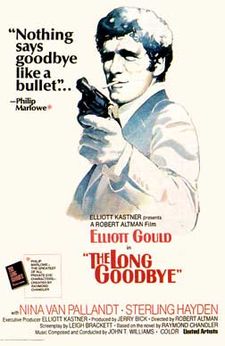
The Long Goodbye (1973)

Philip Marlowe: You ain’t seen the great detective this dishevelled before

Director: Robert Altman
Cast: Elliott Gould (Philip Marlowe), Nina van Pallandt (Eileen Wade), Sterling Hayden (Roger Wade), Mark Rydell (Marty Augustine), Henry Gibson (Dr. Verringer), David Arkin (Harry), Jim Bouton (Terry Lennox), Ken Sansom (Colony Guard)

Philip Marlowe: The Great Gumshoe as you’ve never seen him before. Altman has taken Chandler’s original novel and re-set it into the 1970s. Marlowe (Elliot Gould) is still a private eye but a sort of eccentric Don Quixote, an ambling, mumbling oddity too noble to take on “divorce work”. After he gives his friend Terry Lennox (Jim Bouton) a lift to Mexico, he is left facing police wrath after Terry’s wife is found dead. He is cleared only when Terry is found dead in Mexico, having signed a confession. But Marlowe can’t believe his friend capable of murder – and investigates further.

Altman’s Chandler adaptation was widely criticised at the time – largely because it was completely mis-sold as a mystery detective yarn, which it certainly is not. There are no clues, the mystery is pretty vague at best and the detective hero not only does virtually no detective whatsoever, but is such a naïve soul with such a trusting 1950s style code of honour that he seems swept along by events like a broken reed in a stream. Far from the Marlowe of Bogart or Mitchum, Gould’s Marlowe was an almost wilfully uncool, awkward social misfit, whose lack of engagement with the world stemmed far more from his own lack of understanding than any cynicism.

On top of that, the film is an unusual blend of old and new. Marlowe is a scruffy man out of time, constantly smoking (no one else in the film does) and shuffling from encounter to encounter. Vital conversations happen outside of our (and Marlowe’s) hearing. The camera roams as wilfully as its lead character, rarely standing still to let us absorb the action, but constantly offering us a series of subjective angles. Like much of Altman’s work, the naturalistic sound recording lets dialogue overlap and clash. The entire soundtrack is a riff on the themes in the title song, the music popping up throughout like pleasant musak. Vilmos Zsigmond’s photography is both an inversion of film noir with its California brightness and (through a technique of deliberate overexposure called ‘flashing’) a sepia infected look at the 1970s that draws a link back to the source material’s 1940s origins.

But the tone of the movie is the most unusual thing: a strangely addictive hipsterish take on Marlowe, in which the majority of other characters are as shallow and self-obsessed as you would expect of the 1970s: aside from Marlowe, the only character who seems to apologise or keep to his word at any point is the film’s least sympathetic and most violent character. The eventual killer reacts to being confronted with his crime with a blasé self-entitlement. Across the apartment from Marlowe’s bizarre old-school Hollywood apartment block, a commune of hippie ladies exercise topless outside at all hours; everywhere you turn there are clashes between the old and the new.

The film’s opening immediately establishes what the film is going to be like, and is also one of the best sequences in the film: a quiet, gently paced quest Marlowe undertakes to find cat-food in the middle of the night and his inability to persuade said cat to eat the “wrong” brand of food that he brings back home. This secluded existence is only broken by the arrival of Terry Lennox, who immediately beats Marlowe at a bet on the number of 7s in the serial number on a $10 bill (which he wins despite Marlowe having the higher number of 7s, as he successfully lures Marlowe into an incorrect challenge). It’s a wonderful summation of the film’s plot, as well as a series of clear insights into Marlowe’s personality: a man out of time easily manipulated by those around him, who can’t fool a cat or win a bet with the best hand.

Gould’s performance is absolutely central to the mood and tone of the film. His Marlowe is a counterpoint to the hard-bitten detectives of film noir. Instead, he is a scruffy mumbler, whose continual, conversational patter throughout the film feels more like a commentary he is running for his own amusement than any attempt to communicate with the world around him. Gould’s charm and otherworldly quality basically is the film: he’s hardly off screen and he “sets the tone”: the film’s ambling, slightly confused glances at the modern world, where dialogue and motives are both equally unclear, exactly match the beats of Gould’s interpretation of the character. It’s a perfect performance for the film, a sly gag that also has heart and character.

The film’s off beat tone and lackadaisical attitude are punctured at several moments by astonishingly sudden upturns in tempo, and scenes that sizzle with the threat of (or actual) violence. These moments are linked to Mark Rydell’s brilliant performance as fast-talking Marty Augustine, a man whose actions are totally unpredictable. He is responsible for the film’s only real act of violence – but it’s a striking moment of brutality that no-one sees coming (least of all the other characters, on whose shocked faces and stunned silence the camera lingers).

Rydell’s exceptional performance is the stand out supporting one here, but there is also some very good work from Nina van Pallandt as a woman who is part vulnerable wife, part femme fatale, and whose emotional state and motivations constantly seem to shift and change (at a pace the audience barely keeps up with, let alone poor Marlowe). Sterling Hayden’s Hemingway-esque author is one of those primal force-of-nature performances that can grate, but it works in a film where so many of the other characters are restrained.

The film is an absorbing character study, and at the same time a sly commentary on both the 1970s, the source material and film itself: Gould’s Marlowe at points seems to be pushing on the wall of self-awareness (most notably in a hospital scene late in the film, a masterpiece of misdirection): later, Third Man style, he walks past another character without offering a beat of recognition, before (as the credits roll) he inexplicably starts dancing down a boulevard, the camera watching him in long shot. Hooray for Hollywood (the only other music in the film) bookends the film.

It’s a fascinating and highly enjoyable film with a series of striking scenes and character moments that capture the attention and imagination. It’s a film that needs, however, a certain expectation going into it. Don’t expect a detective story, don’t expect detection even, but instead a unique merging of comedy, social commentary, satire and drama powered by an almost wilfully off-hand lead performance. It’s the sort of unique concoction only Altman could have made. There isn’t really anything else like it.