Tag: Mark Wahlberg

The Fighter (2010)

The Fighter (2010)

A fighter has a title shot, in a surprisingly heartwarming film about the importance of family, no matter how messed up it is

Director: David O Russell

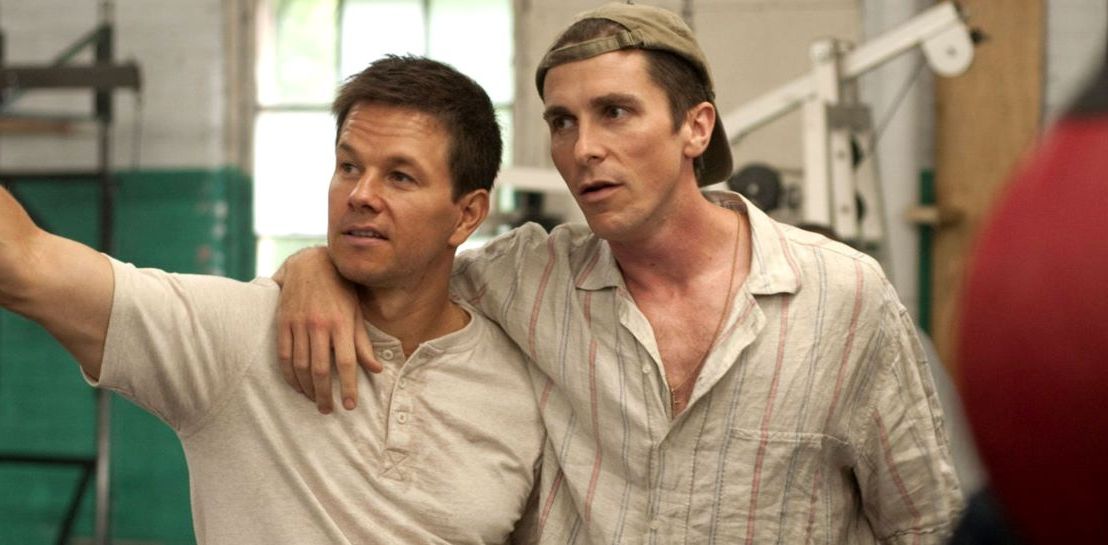
Cast: Mark Wahlberg (Micky Ward), Christian Bale (Dicky Eklund), Amy Adams (Charlene Fleming), Melissa Leo (Alice Eklund-Ward), Jack McGee (George Ward), Frank Renzulli (Sal Lanano), Mickey O’Keefe (Himself)

Everyone loves Rocky. We all want to that local-hero-turned-good, the guy who went the distance. Lowell, Massachusetts had that in Dicky Eklund. Eklund, a minor pro-boxer, once went the distance against Sugar Ray Leonard in 1978 (he argues he knocked him down, although many are convinced Leonard slipped). “The Pride of Lowell” then became… a crack addict, tumbling from disaster to let-down, helping and hindering the career of his brother, fellow boxer Micky Ward.

The story of the two brothers – leading up to Ward’s eventual title shot in 1997 – comes to the screen in Russell’s affectionate, if traditional, boxing drama, long a passion project of Mark Wahlberg who plays Micky. Wahlberg kept himself in boxer-condition for years as he dreamed of making the film, recruiting director and cast and producing the film. The fine, sensitive film we’ve ended up with is a tribute to his commitment and producing skills, while the fact that Wahlberg casts himself in the least dynamic part is a nice sign of his generosity.

Because it’s only really on the surface a Micky Ward film. Sure, the film follows the vital events in his life. It opens with him bashed up in a mis-match, filling his role as a “stepping stone” fighter, someone the future champs flex their muscles against. We follow his struggles to escape from under the thumb of his large brash family – above all his bombastic, domineering mother Alice (Melissa Leo). He forms a relationship with ambitious-but-caring Charlene (Amy Adams), moves up the ranking, lands that title shot, fights the big bout. But it never quite feels like Micky is the star.

Because, really, this feels like it’s about Dicky Eklund working out the first act of his life is over, and trying to find if he has what it takes to start a second, more humble, one. The film opens with Dicky followed by an HBO crew for a fly-on-the-wall documentary. Dicky’s convinced himself it’s to chart his boxing come-back. It’s actually about the horrific impact of crack addiction. Dicky is a strung-out, unreliable junkie, living on past glories but screwing up everything he touches, being enabled by the fawning worship of his mother and sisters, who still worship him as the families main event (and continue to do so, even as Micky rises to title shot). The film’s heart is Eklund sinking to rock bottom and realising he has forced the compliant Micky into playing a subservient role in his own life.

Perhaps it feels like a film more focused on the remoulding of this charming but selfish figure because of the compelling performance of Christian Bale. Starving himself down to match Eklund’s wizened, strung-out physique (he’s still got the boxer moves, but his body has wasted away) is a day’s work for a transformative actor like Bale. But this isn’t just a physical performance, but a deep immersion into the personality of a person who almost doesn’t realise until it is too late how fundamentally flawed he is. Bale’s a ball of fizzling energy and electric wit coated in a lethargic drug-induced incoherence. His energy is frantic but uncontrolled, wild and mis-focused. It’s a superb, heartfelt performance of loveable but dangerous uselessness that nabbed Bale an Oscar.

But what makes The Fighter a surprisingly warm film is that, for all his many flaws, selfishness and self-obsession, Dicky genuinely cares for his brother. He wants the best for him, he believes in and loves him. Much of the power of Bale’s performance comes from the fact he never forgets this, even when Dicky is at his worst. In fact, Russell’s whole film works because that warmth and love everyone feels for Micky is never forgotten and never weaponised by Russell into helping us make moral judgements about the characters. Nor does it forget that Micky may sometimes hate his family, but he never stops loving and needing them.

A weaker film would have stressed the trailer-trash greed of Melissa Leo’s Alice. Leo (who also scored an Oscar and famously dropped the f-bomb on live TV, condemning the ceremony to a permanent time delayed broadcast ever since) is in many ways playing an awful character: controlling, nakedly favouring Eklund over his brother, quick to judge, rude and aggressive. She’s never truly likeable – but Russell’s film understands everything she does is motivated by love. She genuinely wants the best for Micky, even while she pushes him into bad fights and never listens to him. She tries to protect him, and expresses this in destructive selfishness.

In many ways she’s just like Micky’s girlfriend Charlene, who recognises early that Micky’s family (who have turned him into a timid hen-pecked type) can’t be trusted to run his whole career, but who also subtly pushes herself into Alice’s place as the leading decision-making influence in his life. Very well played by Amy Adams (who lost the Oscar to Leo), Charlene is smart, sexy, loving but just as determined that it’s her way or the highway.

What Micky needs to do, the film carefully (if rather safely) outlines, is take the best qualities of all his influences. It’s Eklund’s “job” to realise Micky needs everyone he loves singing from the same hymn-sheet. It needs compromise and putting other people first. It makes for a nice little paean to the importance of family relationships, founded on forgiveness and admitting when you are wrong. Micky forgives his mother and brother for their selfishness: they, in turn, acknowledge their mistakes. Eklund is crucial here: Bale is again superb as a man who suddenly realises pride has nearly ruined his life and embraces the junior role in the relationship with his brother.

Sure, none of this reinvents this wheel, but it still makes for engaging and rather sweet drama. Russell mixes it with some neat stylistic flourishes that don’t overwhelm the film. It’s shot with an edgy, handheld immediacy reflecting its street roots. The fights are shot with old TV cameras, so that invented footage can fuse with 90s HBO coverage. Russell of course gets great performances from his actors, as he always does.

The Fighter is in many ways predictable. But it wears its heart very much on its sleeve, and Wahlberg deserves credit for assembling it and for giving a quiet, generous performance at the centre of it. And the film’s commitment to the idea that, no matter the problems in our families, we can all find the courage to admit our mistakes and pull in the same direction remains heartwarming.
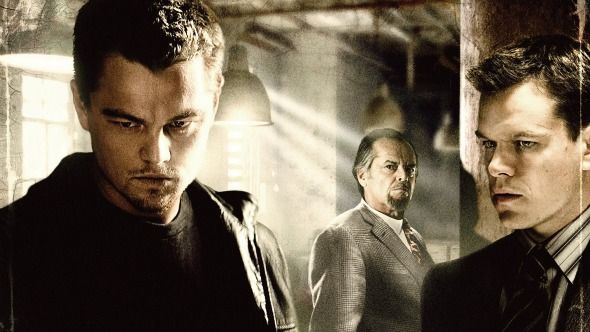
The Departed (2006)

DiCaprio, Nicholson and Damon runaround in Scorsese’s cartoonish Oscar-winner The Departed

Director: Martin Scorsese

Cast: Leonardo DiCaprio (Billy Costigan), Matt Damon (Colin Sullivan), Jack Nicholson (Frank Costello), Mark Wahlberg (Sean Dignam), Martin Sheen (Captain Queenan), Ray Winstone (Mr French), Vera Farmiga (Dr Madolyn Madden), Alec Baldwin (Captain Ellerby), Anthony Anderson (Trooper Brown), James Badge Dale (Trooper Barrigan), David O’Hara (Fitzy), Mark Rolston (Tim Delahunt)

It’s one of those historical oddities that Scorsese finally won his Oscar for his lightest (comparatively speaking) most out-right entertaining film. I’ll confess I’ve never been a huge fan of The Departed. It won Best Picture in a year without a clear front runner, with the Academy feeling an overwhelming sense that Scorsese was ‘due a win’. The Departed is certainly entertaining, but as a great big, violent cartoon which feels like a different universe from the director’s real gangster masterpieces, such as Goodfellas, Mean Streets and Casino. The Departed also can’t hold a candle to Raging Bull, Taxi Driver and The Aviator (I know that last one is controversial). Still it may be just a bit of fun, but at least it is fun.

Boston is a city where the Irish community is split, between cops and robbers. Crime lord Frank Costello (Jack Nicholson) gets a man on the inside by pushing his protégé Colin Sullivan (Matt Damon) to train as a police officer so he can get tips from the inside. Simultaneously, Captain Queenan (Martin Sheen) recruits officer trainee Billy Costigan (Leonardo DiCaprio), an honest young man with a dodgy family, to go under cover in Costello’s gang. Both moles feed information on their ‘side’ to the other – but the stakes heighten as they both become aware of the others existence and race to unmask the other’s identity.

Based on a Hong Kong action film, Infernal Affairs (which has the same plot, but tells the story in about half the time). The Departed takes the basic template and ratchets almost everything up to an even more frenzied pitch. Scorsese throws in fast-cutting visual flair, makes effective use of montage and lays The Rolling Stones over the soundtrack (he really does love Gimme Shelter doesn’t he?). It’s hard to tell, watching The Departed, how much Scorsese’s tongue was in his cheek. This could very easily be a parody piss-take of Casino, with its bright-lights, extreme violence, effing and jeffing and toxic masculinity.

What is clear is that The Departed has all the logic of a playground game. Nothing ever feels particularly real, all emotions and personalities are dialled up to eleven. Big name actors have fun with big, chewable dialogue fully of sweary one-liners. There is barely any sense of a wider world, The Departed really being a chamber piece involving a few key characters, played out in a graphic novel style. In real life both Costigan and Sullivan would have been uncovered in seconds (it makes Line of Dutylook like a fly-on-the-wall documentary). If it has links to any Scorsese film, it’s probably Cape Fear, which was a similar heightened pastiche (of Hitchcock). Don’t get me wrong, there is a lot of fun in watching Scorsese essentially take himself off, and it’s nice to see him having fun, but the film’s constant resorting to foul-mouthed, cartoonish action means depths are missed.

For starters, the film touches on but never really dives into the complex divided loyalties Costigan and Sullivan feel for their sides. After years (at least I think its years, there is very little sense of timeline in the film) pretending to serve one master while actually serving another, you’d expect an exploration of loyalty being increasingly torn between these two masters. It’s not a sense that comes across in the film. Instead, both of them feel fear of their false master and resentment to the true master. Both want to retire – seemingly to the same (lawful) side. The film spends time on the psychological impact of the constant stress of living a lie – but its analysis of this is skin-deep, trauma exhibiting as a bubbling, unpredictable temper (especially with DiCaprio’s Costigan) rather than really giving us an understanding of the psychological trauma. All the final shots in the world of a rat crawling across a railing in front of the court house, doesn’t translate into insight.

The film also misses the mark in exploring the dangerous masculinity of this world. The intense male attitudes here – with the macho posturing and the constant use of sexual and homophobic slurs – are obviously part and parcel of this world. But you feel a smarter film would have unpacked this more, rather than using it for punchlines and chuckles. There’s only really one woman here – a female psychiatrist who (obviously) becomes involved with both men – and you feel more could have been made of how the destructive bloodshed of this film is at least partly powered by overgrown schoolboys on both sides burning the world down to prove their manliness.

But this film is designed as an entertainment, not the sort of insightful character study Scorsese has delivered in the past. And with its primary colour pallet and shots – like a character falling from a building, and low-angle Dutch angle shots of characters checking phones – that seem inspired by graphic novels, it’s clear that we are not meant to take things too seriously here.

That carries across to the performances, many of which are Grand Guignal in their excess. None more so than Jack Nicholson in a performance of such flamboyant “Jack-ness” that it will either delight you or make you wonder whether Scorsese gave him any limits at all. The cast is roughly split between the OTT and the method. Mark Wahlberg follows Nicholson’s lead as a foul-mouthed, permanently angry cop, with rigid morals (he was Oscar-nominated and gets most of the film’s funniest lines) while Baldwin showboats amusingly on the chewy dialogue. At the other end, Sheen brings a fatherly warmth to Queenan while Winstone mumbles a lot as Costello’s number two.

In the leads, DiCaprio brings an edgy, firecracker intensity to Costigan, a man who seems constantly on the edge of a nervous breakdown. Damon, by contrast, underplays rather effectively as the seemingly straight-laced Sullivan, letting the Boston accent roll around his tongue and riffing effectively off his “boy next door” looks. Vera Farmiga does decent work as the woman caught in the middle – even if she’s not 1% convincing as a trained trauma psychologist.

That doesn’t matter though in the heightened, cartoony posturing, blazing gun battles and operatic shouting that makes up the crazy world of The Departed. Scorsese lifting the Oscar for this is rather like David Hockney winning the Turner Prize for a doodle. I enjoyed it a lot more this time around, but it’s still a big, crude, graphic novel, something that looks and sounds clever., but is only a B-movie imitation of Scorsese’s finest work. The Departed is frothy but misses the mark when it aims for true thematic or character exploration.

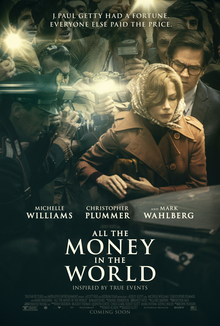
All the Money in the World (2017)

Christopher Plummer dominates (at short notice!) Ridley Scott’s pedestrian true-life kidnap thriller All the Money in the World

Director: Ridley Scott

Cast: Michelle Williams (Gail Harris), Christopher Plummer (J. Paul Getty), Mark Wahlberg (Fletcher Chace), Romain Duris (Cinquanta), Timothy Hutton (Oswald Hinge), Charlie Plummer (John Paul Getty III), Andrew Buchan (John Paul Getty II), Marco Leonardi (Mammoliti)

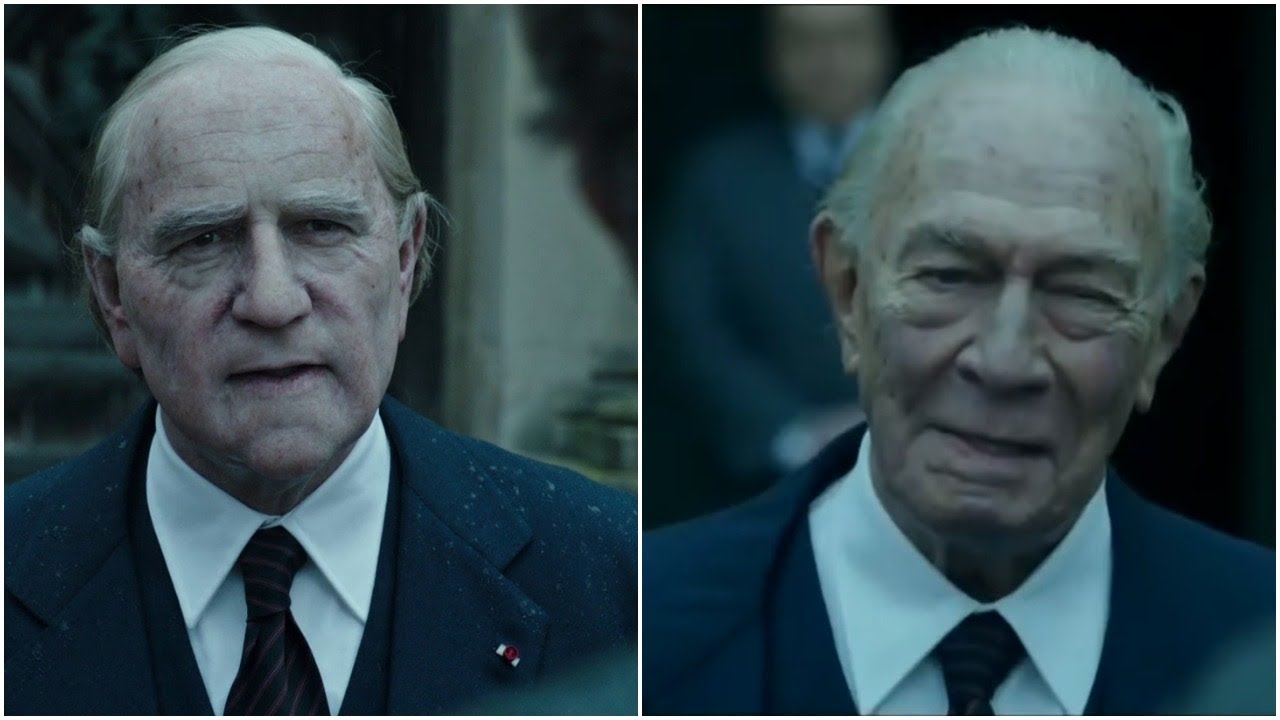
In 2017 something quite extraordinary happened. A string of unpleasant allegations emerged about Kevin Spacey, turning him overnight from the toast of Hollywood into a pariah. Not good news for Ridley Scott’s Getty kidnap drama All the Money in the World, which was only a month away from opening – and had Kevin Spacey in a central, Oscar-bait role as J. Paul Getty. The film looked like box office poison – until Scott decided to reshoot large chunks of the film four weeks before opening, with Christopher Plummer taking over the role of Getty. And of course they would still make the release date.

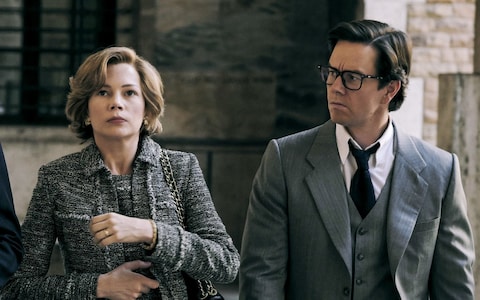
John Paul Getty (Christopher Plummer) is an oil tycoon, and the richest man in history, worth at least a billion dollars (the film opens with a dry history lesson showing how Getty gained a monopoly for selling Saudi oil for the Saudis, thus becoming richer then Croesus and Midas rolled into one). Scott’s drama follows the kidnapping of Getty’s grandson John Paul Getty III (Charlie Plummer – no relation) in Rome in 1973. The kidnappers want $17 million dollars. The famously frugal Getty’s response is that he’s got 13 other grandchildren and won’t run the risk of seeing them all being kidnapped for cash, so he won’t pay a dime. This leaves the kidnapped boy’s mother Gail Harris (Michelle Williams) in despair – after a divorce from Getty’s son, she agreed to not take a penny and can’t pay the ransom. Getty does send his fixer Fletcher Chace (Mark Wahlberg) to work with the police and negotiate – but basically Gail hasn’t a hope unless Getty relents.

Spot the difference: Spacey (left) heavily made up and Plummer

It’s astonishing Scott managed to completely recast, re-shoot and re-edit the second most important part in the film at such short notice – and apparently in eight days. It’s also brilliant that this gives us another vintage Christopher Plummer performance. With cold firmness, gimlet-eyed focus, and a dark twinkly charm which switches in a moment to disengaged indifference, Plummer is so perfectly cast as Getty you wonder why they didn’t get him in the first place. Plummer set a record as the oldest Academy Award nominee for his work on this film – and surely also set some sort of record in being nominated for an Oscar less than two months after he signed on to make the film!

We should be glad that Plummer got this great role – particularly as, to be honest, his performance and the story of how it came about is literally the only reason to remember this film. If it lasts at all it will solely be because of such chutzpah at defying the odds – as a film, this is a dud almost from start to finish.

Long, turgid, dull, lacking in any emotional or human interest, no sense of drama – rarely has a kidnap victim been so boring, or his fate carried so little tension – shot with a lazy blue filter that seems to say “it’s the 1970s, everything was a bit faded”, this turns a compelling story into a viewing chore. How can this happen? How can such an interesting story be made so bloody flat?

A film like this should either be a pressure-cooker, against-the-clock drama or a Faustian journey into the darkness of a man (Getty) who sold his soul for riches, or a sort of dark comedy wherein a billionaire refuses to pay out comparative peanuts. What it becomes is none of those things. It relishes Getty’s greed, but never really gets under the skin of what makes him like this. It gets bogged down in the mechanics of kidnapping but never makes them interesting. It enjoys (and most of this is down to Plummer) Getty’s indifference and selfishness, but doesn’t have the guts to go for black comedy. It’s a nothing film.

Part of it is the film’s odd opening structure. Much of the first 30 minutes is a confusing series of flashbacks and flashforwards, establishing multiple events – Getty’s fortune rising from the 1930s, the story of young Getty’s parents’ divorce in the 60s, the kidnapping of young Getty in 1973 – all are cut together with such a lack of regard for narrative drive that it’s both difficult to follow what is happening and when, and also hard to engage with anyone involved in the story. From there, when we reach a conventional timeline, events feel like they are being ticked off rather than being fashioned into a compelling and tense drama. It’s all just flat and lifeless.

It should be a film where Michelle Williams’ Gail comes to the fore, and we feel her pain, fear and frustration at being unable to save her son. Instead she is competing with so many alternative viewpoints that her story gets truncated down into the sort of performance we admire as being basically good, but develop no real empathy for. It’s a real shame, but she’s a victim of this being such a dry and lifeless film. 

It’s not helped that she also has to share screen time with Wahlberg. The two actors have virtually no chemistry whatsoever, and Wahlberg is way out of his depth here, totally unable to bring anything to the part other than his earthy chippiness. Chase is a dull character who ends up feeling increasingly irrelevant – eventually an invented scene showing him threatening Getty to stump up the cash is thrown in, you feel to give Wahlberg a “moment” rather than because it grows out of a sense that Chase has grown closer to Gail and her family.

But then that’s the whole film – it feels perfunctory and routine where it should be compelling. Rather than building a terrifying momentum as the kidnapping becomes more and dangerous for the young Getty, the tension seems to leak out of the edges. By the end you barely care about anyone involved in it. It really says something that, with only a week’s notice or so, Plummer blows most of the rest of the cast out of the water with his performance. He and his casting are the only reason to ever remember this turgid disappointment.