

Some funny lines isn’t quite enough for this romantic comedy to work as well as it should
Director: Herbert Ross
Cast: Richard Dreyfuss (Elliot Garfield), Marsha Mason (Paula McFadden), Quinn Cummings (Lucy McFadden), Paul Benedict (Mark Bodine), Barbara Rhoades (Donna Douglas), Nicol Williamson (Oliver Fry)
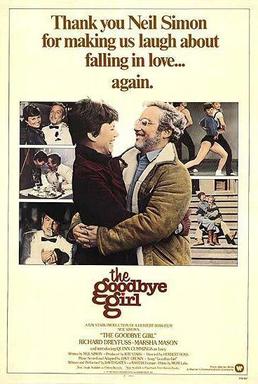
Working as a performer sucks. There’s no money and who knows when the next job is round the corner? It’s even tougher when you are forever unlucky in love. That’s the case for semi-retired dancer Paula McFadden (Marsha Mason). She’s been jilted twice by actors who disappear for a big break somewhere else, leaving only a cursory apology behind. It makes being a single mother to precocious-but-vulnerable ten-year-old Lucy (Quinn Cummings) even harder. Harder again is that her recent awful boyfriend, as a parting gift, sublet their apartment without her knowledge to Elliot Garfield (Richard Dreyfuss), an actor as neurotic as Paula, arriving in New York for his big break. Paula refuses to leave her home and the two kick off a territorial feud, which settles into a truce and a flat share. But could it lead to anything else?
It probably won’t be a surprise to say yes it does, in this sharply written film from Neil Simon, crammed with fast-paced, theatrical, gag-filled dialogue which keeps the film’s pace up without really converting it into something real. The main problem with The Goodbye Girl is that it’s hard to believe in, or really care for, either of its two lead character. I don’t think it’s an exaggeration to say both of them would be incredibly hard work to live with. After all, they can frequently be rather trying just to watch. Simon makes them both brittle, neurotic, high-strung and prone to performative bursts of euphoria and rage. Both can swing on a six-pence between these. It’s probably meant to make them the perfect match, like a feuding Bogart (who Garfield impersonates at one point) and Bacall, but after a while just starts to wear you down. You want to give both of them a bit of a shake and say “pull yourself together!”
The ability to stick with the film revolves around how charming you find both performers. Here, Richard Dreyfuss has the definite advantage. Coming off a hot-streak that had seen almost every film he had made turn into a smash hit, Dreyfuss’ performance made him (at 29) the youngest winner of the Best Actor Oscar. A late replacement for a fired Robert De Niro (can you even begin to imagine De Niro’s deadpan intensity working here?), the part is a perfect match for Dreyfuss’ youthful, madcap energy. He seizes on the rat-a-tat dialogue, embraces Garfield’s zany love for New Agey thinking (yoga, guitar and sleeping “buffo”) and bounces around the film as likely to make monkey noises while euphorically chinning up on a door frame as he is to play sweet imagination games with young Lucy. He brings a lot of charm to a highly strung, difficult man, uncovering a lot of his essential decency and kindness.
He actually settles more into the difficult balance than Marsha Mason, the person (Simon’s wife) who the film was written for. Mason never really manages to find the softness and likability in this role. It’s not entirely her fault: while the point is that Paula is a woman with serious trust issues, the film never gives her a moment of calmness or reflection to open up about this. Instead, it takes a lazier route of having this turn her into an abrasive comic character, the sort of person who responds to a “morning after” with a furious expectation of betrayal. Mason never quite manages to find a softness or likeability under this prickly defensiveness. Interestingly, for all the project was written for her, she has few of the truly funny lines and is effectively the obstacle that must be fixed rather than having the more engaging role of charming disrupter.
To be honest there is not a lot of chemistry between the two. Simon so enjoys the competitive dialogue feuding over territory, bills and who will have what room and when, that he rather forgets to show them actually falling in love. In fact, he ends up relying on the age-old formula of a precocious, New York Times reading child being the bridge to bring them together. Quinn Cummings is rather good as the sort of kid who only exists in the movies, as adept with the witty retort as the adults. But between Elliot and Paula, the romance always feels a bit too inevitable rather than natural, the eventual thawing occurring swiftly rather than feeling it has developed naturally and gently.
It’s part of the slightly formulaic nature of The Goodbye Girl. It’s a highly safe film, with a very conventional romantic storyline, that bubbles along to a happy ending. You can feel the box-ticking from scene-after-scene, just as you can feel the inevitability of its happy ending. It’s also overly theatrical, feels constrained by its location and never quite light enough on its feet. There are a few too many stand-up rows around the apartment block (their poor neighbours) and Herbert Ross’ direction struggles as much as Simon’s script to give us a reason to really root for this couple.
There are though some decent digs at the working life in the arts. Paula, trying to get back into the dancing game, is hideously off-the-pace and takes a job as an enthusiastic glamour-girl flogging Japanese cars at trade show. Elliot is forced to fall back a doorman gig at a strip club. It’s a tough old trade, especially as Elliot’s big break in New York falls apart after he is forced by a pretentious, talentless director to perform Richard III as a limp-wristed, 1970s stereotype of a gay man, mincing around and lisping his lines to the ridicule and disgust of audiences and critics. This comic highlight feels a little awkward now (the joke is the stereotyped gay behaviour, rather than the appalling idea, making it a little uncomfortable to watch at times, rather as if Elliot was being made to play it in black face).
The Goodbye Girl just isn’t quite charming or likeable enough and its characters are never people we really end up warming to or rooting for. Its sharp dialogue ends up making them feel less like real people and more like theatrical characters, bouncing off each other for effect. Dreyfuss comes off best here, but Ross’ direction is uninspired, its romantic coupling never really convincing and it tends to rather overstay its welcome.
 Movie Musings