

Pacino roars to Oscar-glory with an impressive turn in an enjoyable but predictable coming-of-age drama
Director: Martin Brest
Cast: Al Pacino (Lt Col Frank Slade), Chris O’Donnell (Charlie Simms), James Rebhorn (Mr Trask), Gabrielle Anwar (Donna), Philip Seymour Hoffman (George Willis Jnr), Ron Eldard (Officer Gore), Richard Venture (Willie Slade), Bradley Whitford (Randy), Nicholas Sadler (Harry Havemeyer)

Hoo-ha! It took eight nominations, but Pacino finally lifted the Oscar for his abrasive, damaged, charismatic turn as blind retired army Lt Colonel Frank Slade in Scent of a Woman. It’s not really a surprise: it’s a gift of a part, tailor-made for an actor as in love with bombast as Pacino to rip into, and rip he does. But he also manages to find the moments of gentleness, pathos, fear and self-loathing while expertly calibrating his internal acting dial to pings with explosive entertainment when the big show-stopping speeches come. It’s a million miles away from Michael Corleone’s bolted down, internalised rage – but it’s also a hell of a lot of fun to watch.
Pacino picks Scent of a Woman up and carries it single- handedly through enemy lines. Almost nothing will surprise you in this cosily familiar mix of coming-of-age posh-school drama and well-worn “odd couple” friendship, where an abrasive older guy toughens up a reluctant mild protégé. But, whaddya know, the kid also softens the old guy up. Charlie Sims (Chris O’Donnell), decent and polite scholarship kid at super-posh Baird school, faces expulsion because his principles won’t let him snitch on the spoilt, trust-fund, tosspot kids who played a prank on the school’s sanctimonious headmaster (James Rebhorn). Taking Thanksgiving to think about what to do, he accepts a job looking after Slade who promptly ropes him into a trip to New York, where the blind Slade plans on one final glorious weekend before blowing his brains out in a five-star hotel.
Of course, the film doesn’t end with Pacino’s little grey cells dripping down the side of the Waldorf’s no-expense-spared wallpaper. It will not surprise you at all that Martin Brest’s film heading where all feel-good films like this head: learned lessons, love of life re-embraced and a big speech from the big star solving all the problems. Scent of a Woman’s biggest flaw is it takes a very long time to hit all these familiar beats on the way towards its cookie-cutter capping of its coming-of-age/road trip set-up. Martin Brest was never a director to tell a story in a few sentences when a whole chapter would do, and Scent of a Woman is the last time he got the balance right between the length of the journey and the pleasure of being on it.
But then, as mentioned, a lion’s share of the credit belongs to Pacino. Surly but with just enough cheek. charm and biting wit, it’s a hugely entertaining role with big meaty speeches to chew on. Pacino makes it very funny, from his don’t-give-a-crap rudeness to his don’t-take-no-for-an-answer insistence on getting his own way. The film gives him a memorable set-piece moment pretty much every 15 minutes: his surly introduction, via a speech on the beautiful scents of women, the film’s iconic tango-dancing with Gabrielle Anwar, driving a Ferrari around the empty streets of the Bronx (and convincing a cop who pulls him over that he’s not blind), a thwarted suicide with the sort of barked refrain Pacino loves (“I’m in the DARK here!”) to a leave-no-prisoners final “courtroom” speech that’s one of the best of its kind. This is all meat and drink for Pacino.
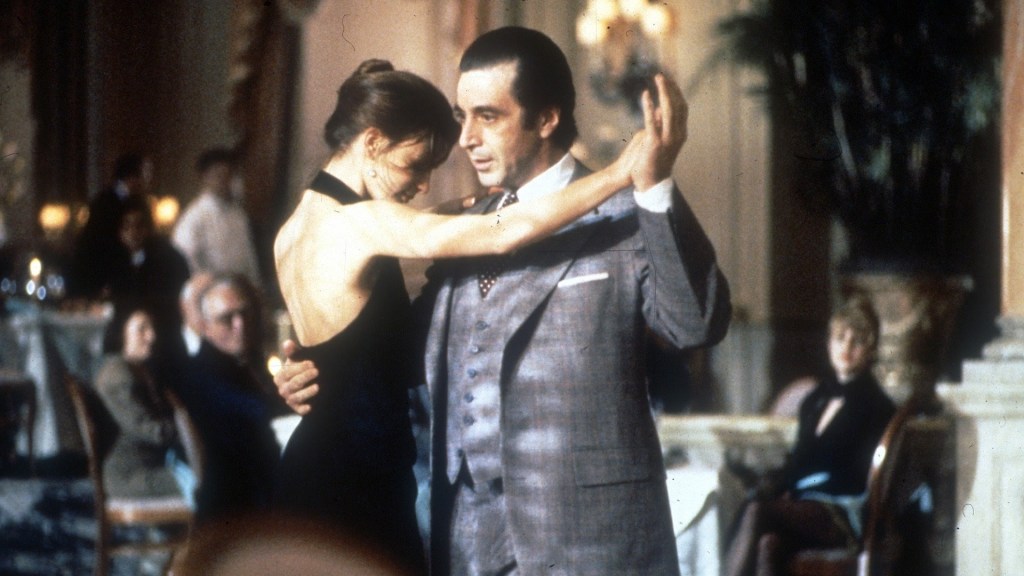
But this is a more nuanced performance than just a star’s turn. Pacino makes Slade a deeply unhappy man, slowly realising he has been so most of his life. A man who uses anger, wit and cruelty as shields to drive people away and make himself look and feel tough. Blindness has become a constant reminder of his vulnerability and dependence, but also made the shell of isolation he has built around himself all consuming. He’s realising pretty much everyone he knows hates him, whose family (from youngest to oldest) want as little to do with him as possible, who has never had a meaningful relationship and clings to a war record he frequently garnishes to appear more important. Pacino manages to convey all this deep-down regret and self-loathing extremely well, matched with a physically dedicated performance of approximating blindness that is one of the best there is on film.
There’s a striking scene midway through where Slade crashes his brother’s Thanksgiving dinner. The family are less than happy to see him, but tolerate him at a table he dominates, first with garrulous (uninvited) army stories and then increasingly rude, sexual comments about his nephew’s wife. The nephew (Bradley Whitford) eventually tears him off a strip: in 1992 some felt sorry for this merciless puncturing of Slade’s self-mythologising, but today I can’t help but agree with Whitford’s takedown of Slade’s bullying. Slade’s eventual assault on his nephew is allegedly for calling Charlie “Chuck” once too often, but really feels like a desperate attempt to take revenge without feeling in the wrong. It’s a scene that actually cements what an awful negative force Slade has been, something he’s just starting to realise no end of whimsy can fix. This is a complex stuff among the Hoo-Ha.
Pacino’s helped by a very fine, generous performance from Chris O’Donnell as a young man who may be naïve and innocent but, in his own way, has more guts and integrity than the mercurial Slade ever did. While Slade is fundamentally selfish (and always has been), Charlie will make sacrifices for people he knows will never do the same for him and won’t flex his principles for any personal gain. O’Donnell also does some magnificent reacting throughout, frequently generously providing the dramatic context and crucial reaction points to make Pacino’s character work effectively.
Scent of a Woman’s posh-school drama provides a few more straight-forward figures of loathing: from James Rebhorn’s headmaster, via Philip Seymour Hoffman’s smug, gutless, entitled fellow student (a prototype of his role in The Talented Mr Ripley) who hangs Charlie out to dry, culminating in the three unbearably arrogant rich kids who carry out the prank. In some ways the plot here is far more engaging than Slade’s suicide run, even though nothing surprising really happens at all throughout it’s runtime. It also allows Brest to caps it off with such a dynamite speech from Pacino that it made the Oscar probably a foregone decision (even though Denzel Washington’s Malcolm X could feel rightly aggrieved at missing out on the little bald man).
That kind of sums the whole film up. Despite moments of complexity in its character study – forcefully delivered with depth and feeling by Pacino – Scent of a Woman is a film that offers virtually no surprises at all while expertly hitting every single beat you would expect to see while giving maximum entertainment factor along the way. It’s the sort of thing that Oscars are grown from.
 Movie Musings