
Tag: Martin McDonagh

The Banshees of Inisherin (2022)

The Banshees of Inisherin (2022)

Director: Martin McDonagh

Cast: Colin Farrell (Pádraic Súilleabháin), Brendan Gleeson (Colm Doherty), Kerry Condon (Siobhan Súilleabháin), Barry Keoghan (Dominic Kearney), Pat Shortt (Jonjo Devine), Jon Kenny (Gerry), Brid Ni Neachtain (Mrs O’Riordan), Gary Lydon (Paedar Kearney), Aaron Monaghan (Declan), Shelia Fitton (Mrs McCormick), David Pearse (Priest)

Pádraic (Colin Farrell) and Colm (Brendan Gleeson) are life-long friends on the small Irish island of Inisherin. Until one day, in 1923, Colm bluntly says he won’t speak to Pádraic again as “I just don’t like ya no more”. What on earth has led to this seemingly permanent severance? Did Pádraic do something wrong? The torment of not knowing will create a huge strain on Padraic, who prides himself on “being nice” and can’t understand why the older Colm doesn’t want to chat him. Just as Colm can’t understand why Pádraic can’t leave him alone, especially as he is almost universally agreed to be dull. Eventually this blunt stop to a friendship swiftly escalates out of all control.

McDonagh’s film is packed with the scintillating dialogue you would expect, and he combines it with an intriguing, tragedy-tinged character study where two sympathetic characters tip themselves into destruction through the unwillingness of either of them to compromise. It’s no coincidence that the film is set during the Irish Civil War. Cut off from the mainland on their tranquil island (where life feels like it hasn’t changed for the best part of 100 years), the characters are disturbed from their own civil war, every now and again, by the sound of gunfire and explosions from the mainland. The Banshees of Inisherin can be seen as a commentary on civil wars: don’t they all start, essentially, from someone deciding they have had enough and “just don’t like ya” anymore?

This marvellously rich film boils down a whole country tearing itself apart over what sort of future it wants, into one personal clash over two people’s future. The future increasingly obsesses Colm, a man preoccupied with mortality (who assumes his life can now be counted in years rather than decades), suffering from depression, worried he will disappear leaving no mark. A talented fiddle player, he wants to be like Mozart, remembered decades later – and he can’t do that wasting time every day for hours on end listening to Pádraic talking about his “wee donkey’s shite”.

It’s a perspective on the future, that Pádraic just can’t understand. For him, what does it matter what people you’ll never meet think about you? What matters to him is that the people around him like him and remember him as a “nice fella”. Not in a million years does legacy occur to him: the familiarity of everyday being the same is the most comforting thing, and change a horrific and terrifying thing to be avoided as much as possible.

You can see all this instantly in Colin Farrell’s heart-rending performance as this gentle, fragile but unimaginative soul, heart-broken at the inexplicable loss of his best friend. The film is a striking reminder that, contrary to his looks, Farrell’s best work is in embodying lost souls, the sort of people never ready for the life’s hurdles. Pádraic certainly isn’t, and his attempt to process what has happened defeats him. A man who considers his pet goat his next best friend and is as reliant as a child on his sister, doesn’t have the ability to understand what Colm is driving at about mortality, assuming instead he will stumble across the right words to be welcomed back into Colm’s company. He becomes the unstoppable object, trying to batter down Colm’s wall of silence.

He’s onto a losing battle, as Colm reveals himself to be – either due to his depression or his just not caring any more – the immovable force. Wonderfully played with a tinge of sadness and a depression-induced monomania, by Brendan Gleeson, Colm is a decent guy in many ways but fails to appreciate or consider the effect his actions will have on others. Instead he is focused on achieving at least something notable from his life. It leads to dramatic steps to drive Pádraic away, Colm threatening to cut off one of his fiddle playing fingers every time Pádraic bothers him, a threat he transpires to be more than willing to carry out.

And so civil war breaks out. As well as the parallels with Ireland’s war, I also felt strong echoes of our own poisoned social-media discourse. By his own lights, Colm believes his sudden severing of contact with Pádraic is perfectly reasonable. Many people who have “ghosted” others no doubt feel the same. Colm is reasonable when he explains it, and he still steps in with silent acts of comfort and support when Pádraic falls foul of the island’s brutish police office. But he never considers the traumatic impact this unexplained change will have on Pádraic – or how flashes of kindness can be as cruel as hours of non-acknowledgement.

Radicalism, in civil war and social media, quickly takes hold. What else can you call Colm’s threat to slice off his own fingers (the fingers he needs to live his dream of fiddle-playing legacy)? Just like people blowing hard on Twitter, he needs to deliver or lose face. Pádraic makes angry, passionate condemnations of Colm in the pub, like he’s posting rants online. Things escalate to a point where no-one feels they can step away or backdown.

That’s the tragedy McDonagh identifies here. This one decision of Colm’s – no matter the motives – ends up having disastrous effects on both men. Pádraic changes from a gentle soul to someone capable of wrathful fury and lifelong grudges. Colm literally disfigures himself, guaranteeing he will never achieve the very thing he started this for. Could there be a better parable for the destructive nature of civil combat? Neither Colm or Pádraic are willing to compromise: what if Colm said he would only see Pádraic once or twice a week, eh? Just like Ireland, they burn the world down.
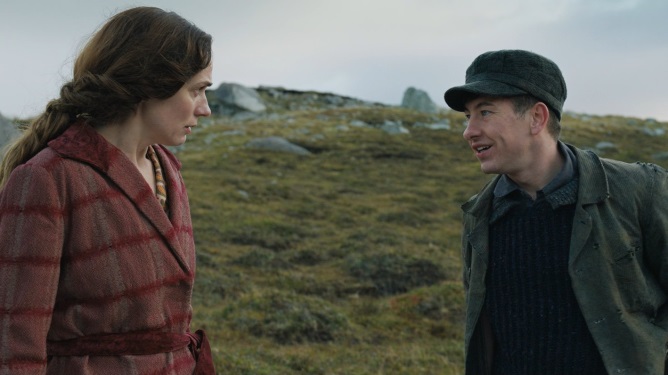
This all takes place in a rich framework, with McDonagh skilfully working in clever, challenging sub-plots. The legend of the banshee, who foretold death and enjoyed watching destruction, is woven throughout, embodied by the sinister Mrs McCormick (a ghostly Shelia Fitton). The most forward-looking person on the island is Pádraic’s sister Siobhan – brilliantly played by Kerry Condon – who finds herself wondering why on earth she stays in such a self-destructive small-world. Barry Keoghan (also superb) plays the universally acknowledged village dunce, who (if you stop and listen to him) quotes French and poetry and (for all his crudeness and lack of social graces) is clearly a man stunted under the heel of his abusive father, the village policeman.

As events escalate and rush out of control – McDonagh’s pacing is very effective here – the film slows for carefully judged moments of emotional power, from the burial of a beloved pet to a character weeping in bed at the painful choices that must be made. McDonagh has created a powerful universal metaphor for the dangers of extreme, definitive choices and a total rejection of compromise by boiling it down to the smallest scale possible.

And your sympathies ebb and flow, due to the beautiful performances from its leads. Farrell is heartbreaking, a memory you carry as he becomes more vengeful. Gleeson is coldly reasonable, even as we grow to understand his crushing sense of mortality and character-altering depression. These two actors power an intelligent and thought-provoking film that achieves a huge amount with subtle and rewarding brushstrokes.
In Bruges (2008)

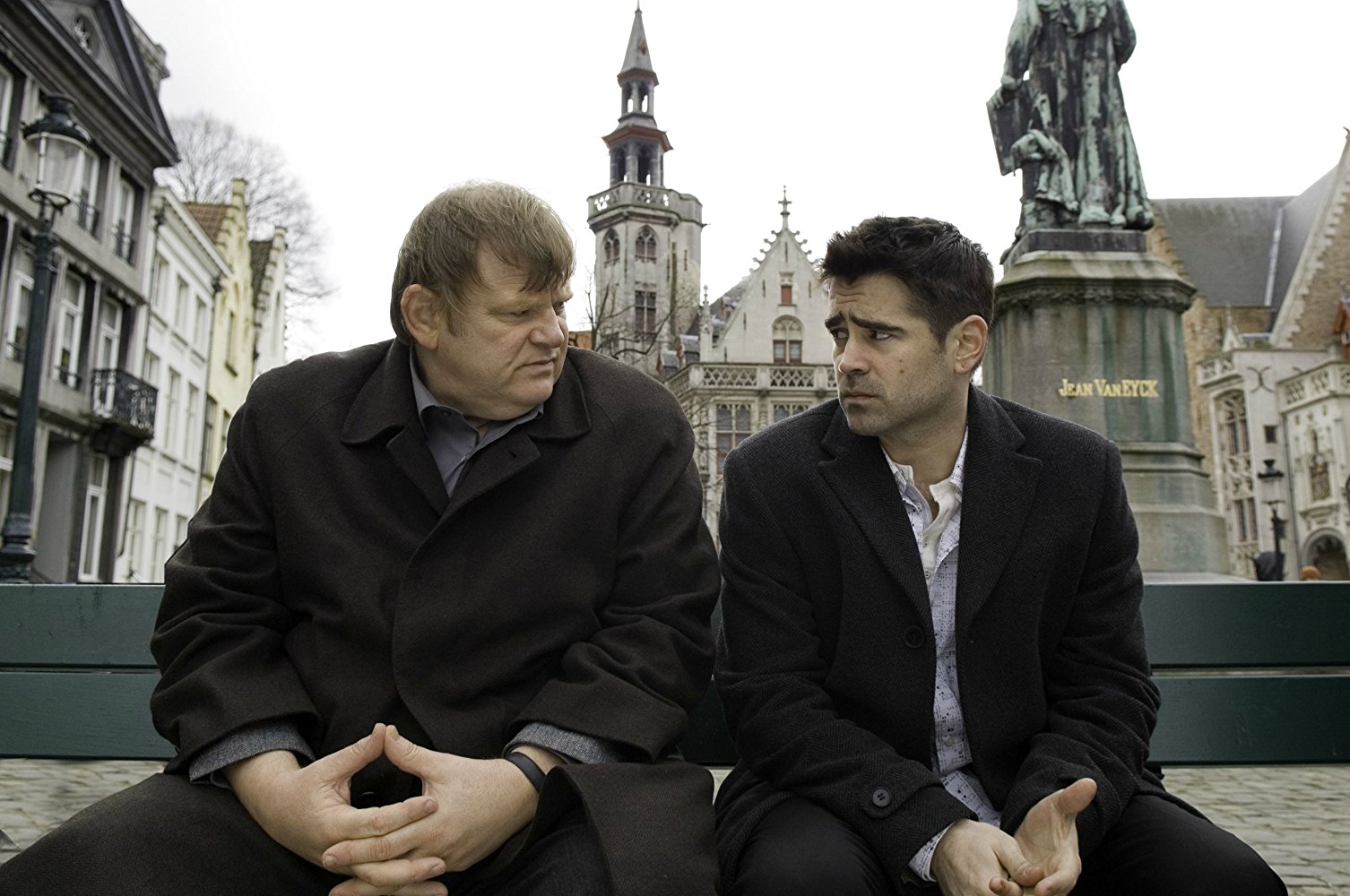
Brendan Gleeson and Colin Farell excel in hitman comedy In Bruges

Director: Martin McDonagh

Cast: Colin Farrell (Ray), Brendan Gleeson (Ken Daley), Ralph Fiennes (Harry Waters), Clémence Poésy (Chloë Villette), Jordan Prentice (Jimmy), Thekla Reuten (Marie), Jérémie Renier (Elrik), Anna Madeley (Denise), Elizabeth Berrington (Natalie Walters), Eric Godon (Yuri), Željiko Ivanek (Canadian)

Who hasn’t been dragged somewhere for sightseeing and culture, and longed to be somewhere else (anywhere else?). Most of us right? So how many of us are hitmen hiding out after a job gone wrong? Probably not that many (I hope!). It’s this mixture of the everyday and the bizarre that Martin McDonagh nails so well in his debut film, a sharp as nails, laugh-out-loud but also moving piece of work, possibly one of the sharpest written, well-made debut films you’ll find.

Ray (Colin Farrell) and Ken (Brendan Gleeson) have been sent to Bruges to hide out for a few weeks after a job gone horribly wrong in Dublin. Ken is fascinated by the city, its culture and buildings and enthusiastically buys a guide book. Ray responds like a surly, miserable kid and is desperately unimpressed with everything he sees. Their long weekend in the city becomes increasingly unusual and dangerous as they encounter angry tourists, a racist dwarf (Jordan Prentice) and a drug-dealing film assistant (Clémence Poésy), and dodge the rage of their boss Harry Waters (Ralph Fiennes).

In Bruges is a hilarious piece of film-making, with every scene featuring some moment of black humour, wry observation or un-PC laugh-out-loud comedy. It’s foul-mouthed, sometimes violent, very rude – but also deals with profound feelings of guilt and regret with a real humanity. McDonagh’s work expertly combines jet black comedy, with a warmth for its deeply flawed characters. It’s got a compelling, masterful story that packs character development, incident and intricate plot threads together with assured expertise.

McDonagh’s gift is to make you relate for all of these characters, all of whom are made to feel very real and human. It skilfully leads you to overlook their many flaws and embrace them as people. It says a lot that the most sympathetic, likeable person in the film is a multiple murderer with an (implied) cocaine habit. Everything we learn or see about the characters is designed to make us understand and relate to them more.

Ray initially seems little more than a foul-mouthed thug. But as the film progress – and thanks to Colin Farrell’s masterful performance of brashness covering deep insecurity and vulnerability – we learn he is a rather sweet, even loving man who has stumbled into a career he is deeply unsuited to. Farrell gets these switches perfectly – and his childishness is hugely endearing. From stropping around like a sulky teenager to bouncing up to a film shoot with a childish, excited shriek of joy, he defies expectations. McDonagh throws in a perfect note of tragedy once we find out the mistake Ray made – and suddenly Farrell’s performance overflows with guilt, self-loathing and an unbearable regret that makes you re-evaluate everything you’ve seen him do.

But then that is the whole film right there: it makes you laugh uproariously, then chucks you a curveball and before you know it you are hugely emotionally invested, with a huge sense of empathy for their slowly revealed depths. That goes for every character – even the nominal villains have a sadness, or a firm set of principles, or a certain dignity to them that makes you care. It’s a brilliant piece of writing and directing – and masterfully acted.

Brendan Gleeson plays the other lead in Ken: and few other actors could surely have managed to turn Ken into such a warm avuncular figure, a gentle giant who feels he has come to terms with his choice of career but experiences a subtle shift over the course of the film. Gleeson’s performance is sublime, warm and witty with a careful thread of sadness underneath it – it’s some of his best work. 

But then the whole cast is great. Prentice’s bitterness as the angry Jimmy is brilliant – and he is very funny – while Poésy’s gentle bad-girl is a terrific, radiant performance. The film also has third act dynamite with Ralph Fiennes’ Harry Waters, a foul-mouthed, furiously angry, tour-de-force character who shakes up the whole film – but who has a strange sense of nobility about him, even while he is (hilariously) effing and blinding left, right and centre.

And the film has a brilliantly anti-PC vein of humour. Jokes about drug-taking and dwarves. Foul-mouthed gags about every subject under the sun. Brilliant encounters with “large” American tourists (brilliantly paid off later in the film), jobsworth ticket sellers, angry tourists in restaurants – the film is crammed with hilarious moments. All of it is brilliantly funny because it comes naturally out of characters who feel real.

It’s also so thematically rich. As the characters stand in front of Hieronymus Bosch’s The Last Judgement, you realise that the entire film is a metaphor for purgatory, with Bruges’ medieval beauty carefully chosen to reflect this. Our heroes, laden down with sins, wait in Bruges for an unspecified length of time to discover where they will head next. Amends have to be paid, sins have to be reconciled – and all these threads come together brilliantly in a final, dream-like sequence that you suddenly realise the whole film has been carefully building towards from the start.

So the film, after a scabrous, brilliantly hilarious, darkly foul-mouthed start, slowly becomes something which (while still hilarious) is also a discussion of morality, principles and guilt. We see characters do things we might never have imagined them doing at the start, some are redeemed, others make principled decisions. And it’s really funny. I’m not sure Colin Farrell or Brendan Gleeson will ever be better than they are here. It’s a brilliant play script turned into a wonderful film. A classic.

Three Billboards Outside Ebbing, Missouri (2017)


Frances McDormand is looking for justice in Martin McDonagh’s razor sharp Three Billboards Outside Ebbing, Missouri

Director: Martin McDonagh

Cast: Frances McDormand (Mildred Hayes), Woody Harrelson (Sheriff Bill Willoughby), Sam Rockwell (Officer Jason Dixon), John Hawkes (Charlie Hayes), Peter Dinklage (James), Abbie Cornish (Anne Willoughby), Lucas Hedges (Robbie Hayes), Željko Ivanek (Sergeant Cedric Connolly), Caleb Landy Jones (Red Welby), Clarke Peters (Abercrombie), Samara Weaving (Penelope), Kerry Condon (Pamela), Darrell Britt-Gibson (Jerome), Amanda Warren (Denise), Kathryn Newton (Angela Hayes)

How do we deal with grief? What might it drive us to do? How does it make us behave – and what sort of person can it make us become? Martin McDonagh’s superbly scripted and directed, brilliantly acted film explores these themes in intriguing and compelling depth, consistently surprising the audience, not only with unexpected plot developments, but also wonderfully complex characters, whose personalities and decisions feel as distanced from convention as you can get.

Mildred Hayes (Frances McDormand) is a grieving mother, who feels let-down by the police and justice system as they have failed to locate and arrest the rapist who murdered her daughter. She hires three large billboards on a quiet road out of her town in Ebbing, and places on each of them a stark message: “Raped while dying”, “And still no arrests?” and “How come, Chief Willoughby?”. The billboards lead to Sherriff Bill Willoughby (Woody Harrelson) doing what he can to re-open the case – a case with no real evidence or leads. But the local community – many of whom adore Willoughby – are increasingly angered by the billboards, not least Willoughby’s semi-protégé, controversial red-neckish officer Joe Dixon (Sam Rockwell). The billboards lead to increasingly violent disagreement in the small community – and surprising allegiances developing.

McDonagh’s black comedy-drama balances immense sadness and searing rage with jet-black humour. McDonagh’s distinctive (and often foul-mouthed) style runs through the entire film. It’s a film that not only defies real categorisation, it also defies expectations. You would expect this film to be a commentary on a heart-rending grieving mother struggling against an indifferent, incompetent, racist (or all three) legal system. Perhaps even a film that will build towards a sort of “whodunit” murder mystery. All these expectations are constantly turned upon their head. Any obvious, traditional narrative development – and lord the film plays with this throughout its runtime – is diverted. You never know where the film is going – and you would certainly never have guessed its conclusion from the opening. 

Our expectations are immediately inverted when Woody Harrelson’s Sheriff meets with Frances McDormand’s mother in the opening moments. We expect him to be indifferent, annoyed or bitter – instead he’s liberal, concerned, sympathetic and hurt, while understanding why Mildred has done what she has done. Mildred, who we expect to be moved by, whose pain we expect to empathise with – instead she’s burning with fury and resentment, is amazingly confrontational and unyielding, and her ideas for investigating the crime border on the ruthlessly right-wing. Far from the predictable drama you might expect, you are thrown into something unusual – and real.

The storyline continues throughout in this vein – McDonagh never takes the expected route, but constantly pushes towards something unexpected. His trademark spikey dialogue throws you off balance – this is surely one of the few films where you’ll see a son affectionately call his mother “an old c**t”, or a happily married, middle-class couple address each other with a stunning, loving crudity. Pay-offs to plot developments are confidently unorthodox, and devoid of the expected sentimentality. The murder mystery element of the story is played with in a unique way: even the crime itself remains unexplored and unexplained, with only a few grim photos and a few hints dropped in dialogue as to what happened.

Instead, the film focuses on how grief and upheaval affects a community. All of the characters deal with a profound personal loss over the course of the story, and the impact of this on them leads not just to anger and rage, but also in some a profound reassessment of their life and choices. It’s a film that looks at the struggle we have to control the narratives of our own lives, to not be a victim but instead to give the things that have happened to us meaning and importance. Each character wants to find a way to make the things that have happen to them have meaning, and to find a sense of closure. It asks what can and can’t we forgive, and how far do we need to take actions to find a sense of closure. The film’s open-ended conclusion both points towards suggested answers to these questions, while at the same time offering few.

Frances McDormand gives a compelling performance in the lead role, as a domineering, strong-willed woman who resolutely refuses to be a victim, but wants revenge. Burning with a simmering rage at the world, and quick to respond with aggression and even violence, McDormand never allows the character to become fully sympathetic, but constantly challenges us. It’s the sharpest-edged grieving mother you’ll see on film, as full of prejudice and judgemental behaviour as she is pain and guilt. She attacks each scene like a bull in a china shop, and Mildred Hayes is a smart, ruthless woman who takes no prisoners.

The part was written especially for McDormand, as was that of Joe Dixon for Sam Rockwell. Rockwell, one of those eminently reliable supporting actors, gives an extraordinary powder-keg performance as an on-the-surface dumb, racist bully with poor impulse control, who is barely able to hide a vulnerable mummy’s-boy complex and a strangely touching sense of loyalty. Rockwell is dynamite in each scene, but constantly gives us interesting and varied line-readings, changing our perceptions of his character with each scene. 

To briefly address a controversy that has arisen about the film.  McDonagh has explored extremes like this in the past – his work in the past has humanised murderers, child-killers, terrorists and executioners, while not excusing their actions. The film has courted controversy by refusing to condemn Dixon’s racism, or for not ‘punishing’ the character enough, but it instead asks us to understand why Dixon has done or said the things he says – and to empathise with the pain, despair and anger in his own life. Is Dixon a racist? He’s a product of his time and place, I’d say he’s really just very angry, without understanding why, and without having the emotional intelligence to deal with it. He might have done unpleasant things – in the film doesn’t dodge this – but it asks us to question why he might have done this, rather than paint him as a demon.

Equally brilliant (perhaps one of his greatest performances) is Woody Harrelson as the surprisingly liberal, good-natured, patient and humane Sherriff Willoughby. Surely no one could expect the authority figure in a film of this nature to be the most sympathetic and likeable character in the film, the one with perhaps the most moving personal story. Harrelson is simply superb in the part, and his gentle, lingering regret hangs over the film.

But the whole cast is marvellous. Hawkes is a deeply troubled and pained man hiding it under anger and mid-life crisis. Dinklage is a sad eyed, lonely man. Cornish sports a slightly unusual accent but is warmly loving and very normal as Willoughby’s wife. Hedges is impressive as Mildred’s son, whose life is made increasingly difficult by his mother’s unwillingness to compromise. Landy Jones is excellent as the empathetic billboard manager, too good for this town. Peters brings a reassuring air of authority and dignity to the film. With the dialogue a gift for actors, there isn’t a weak performance in the film.

McDonagh’s fine, simple direction adds a Western-style sweep to the action and allows the story to speak for itself, working with the actors to bring out some brilliant, unique characterisations. It’s an intelligent and thought-provoking film, that constantly pushes you in unexpected directions and asks intriguing and challenging questions about profound issues, especially grief. Despite this, it’s a laugh-out-loud black comedy, that will move you and which has the courage to leave many of its plot issues open-ended and true-to-life. It asks questions, but it also acknowledges that life doesn’t give us answers. It also reminds us that we can never judge people from our initial impressions or expectations.