Tag: Marton Csorkas

Kingdom of Heaven (2005)

Kingdom of Heaven (2005)

Scott’s crusader epic is a much better, more thoughtful film than you’ve been led to believe

Director: Ridley Scott

Cast: Orlando Bloom (Balian of Ibelin), Eva Green (Sibylla of Jerusalem), Jeremy Irons (Lord Tiberias), David Thewlis (Hospitaller), Liam Neeson (Godfrey of Ibelin), Brendan Gleeson (Raynald of Chatillon), Marton Csokas (Guy de Lusignan), Edward Norton (King Baldwin IV), Ghassan Massoud (Saladin), Michael Sheen (Priest), Velibor Topić (Almaric), Alexander Siddig (Imad ad-Din al-Isfahani), Kevin McKidd (Sergeant), Jon Finch (Patriarch Heraclius), Ulrich Thomsen (Gerard de Ridefort), Nikolaj Coster-Waldau (Godfrey’s nephew), Iain Glen (Richard I)

Version control: This review cover the Director’s cut of Kingdom of Heaven, a three-hour film that is much better than the original theatrical version.

For hundreds of years the Middle East has been the site of wars over land and religion: the more things change, the more they stay the same. Ridley Scott’s Kingdom of Heaven is a grand, melancholic epic about the crusades, a period of history that seems to become even more divisive and controversial if every passing year. During the First Crusade (1096-99), a European Christian army had bloodily seized control of Jerusalem (massacring its Muslim population). The Crusaders built a state that lived through fragile truces, in a constant state of cold war with the Muslim states that opposed their conquest. Scott’s film picks up the final years of that ‘kingdom of Heaven’.

He does so through fictionalised version of the events. Balian (Orlando Bloom), a former military engineer, is now a widowed blacksmith in Northern France – until Godfrey of Ibelin (Liam Neeson), a crusader lord, returns to claim him as his illegitimate son. Fleeing his home after murdering his bullying priest brother (Michael Sheen), Balian arrives in the Holy Land as the new Lord of Ibelin. But he not a paradise, but a kingdom full of ambitious lords and zealots, surrounded by the armies of Saladin (Ghassan Massoud) with the whole thing only just held together by the wise leper king Baldwin IV (Edward Norton). There is already a power struggle for who will control Baldwin’s heir, the child of his sister Sibylla (Eva Green). Will it be the moderates led by Tiberias (Jeremy Irons) or the zealot Templars led by Sibylla’s husband Guy de Lusignan (Marton Csorkas)?

I’ve always been interested in this period of history, and I’m a sucker for a grand historical epics. So I’m pretty much the target for this ambitious, luscious, flawed but engaging film. It helps when it’s assembled by a director as full of visual flair as Ridley Scott. Kingdom of Heaven is an extraordinarily beautiful film – one of those where you really could snip out every frame and hang it up on your wall. Gorgeously lensed by John Mathieson, it moves from a chilly, blue-filtered North France (a land of artistic snow fall and permafreeze) to a David Leanesque desert land, of rolling sand dunes and skies tinged with deepest blue. It’s a film of breathtaking scale, as medieval armies converge, legions of siege weapons roll up to never-ending city walls and the desert stretches as far as the eye can see.

It makes a fantastic backdrop for a film that’s tries really, really hard to take a measured, reasonable view on human nature and religion. It’s fair to say that this makes Kingdom of Heaven a very serious film (there is barely a few minutes of humour in its entire three hour runtime – a joke about Neeson once fighting three days with an arrow in his testicle is about all you’re gonna get), but it’s also nice to have a film celebrating compromise and moderation. Really, Kingdom of Heaven isn’t a true representation of the Crusader period at all – the real Balian and Baldwin would scarcely recognise the humanist liberals they become here – but as a sort of fantasia on balancing conflicting demands in a place that seems to make men mad, it’s hard not to be respect that it’s trying as hard as it is.

To achieve it’s aims, Kingdom of Heaven divides both sides of the argument into goodies and baddies. For the goodies, Baldwin and Saladin are reasonable, just men willing to strive for a world where all can worship freely. Edward Norton – unbilled under a silver mask and English accent – brings a great deal of strength and wisdom to Baldwin, matched by Ghassan Massoud’s superbly patient Saladin. On the other side, we have the “God wills it!” brigade. Admittedly on the Muslim side, they are embodied by one of Saladin’s advisors, whereas the crusaders are awash in angry, Holy War bloodlust types who believe any killing is justified if it’s in God’s name.

Kingdom of Heaven has a respect for faith, particularly when filtered through the words of characters who don’t believe painting a cross on their chest allows them to kill anyone who disagrees with them. Several times, Balian argues doing sensible, reasonable things technically against the word of the Biblewill be understood by God (if he’s worthy of the name). It playfully suggests David Thewlis’ (in an excellent performance) reasonable Hospitaler might actually be an angel, with his power to appear undetected and prodding of Balian towards doing the right thing (Thewlis even disappears into a burning bush at one point).

But, if I’m honest, much of the rest makes its points rather forcefully, showing a world where fine words are corrupted by ambition and anger. Many of those preaching faith are really motivated by a constant hunger for more –power, land, you name it. The closer a character is to the Church, the more likely they are to be either a pantomime, mustachio-twirling villain (like Marton Csorkas imperious Guy or Brendan Gleeson’s playfully-psychotic Raynald) or snivelling hypocrites like Jon Finch’s Patriach (who counsels converting to Islam and repenting later when the shit hits the fan).

Kingdom of Heaven lays out this earnest, well-meaning political viewpoint of how moderation should trump fanaticism, while filling its wonderful visuals with gorgeous costumes, stupendous sets, a brilliant score and some stunning battle sequences. But there is always a fascinating lack of hope in Kingdom of Heaven. When Balian troops up Gethsemane on his arrival in Jerusalem, he only hears the wind not the word of God. When offered the chance to save the kingdom from itself, it comes with such a morally compromised price-tag a straight-shooter like Balian is always going to say no. While his father (one of Neeson’s patented performances of weary, maverick nobility) clings to ideals, the film is perhaps best summed up by Jeremy Irons’ wonderfully world-weary performance as the cynical Tiberias: mournful, depressed and wondering what the hell it’s all been for.

It’s no wonder it’s such a savage world. Kingdom of Heaven doesn’t shirk on the medieval violence. Bodies are hacked to pieces with fountains of blood. It opens by introducing us to a regular Dirty Dozen of toughened Crusader veterans – only to slaughter nearly all of them in the first act. Death is only seconds away in this dangerous world: even sailing to the Holy Land is to risk near certain shipwreck. It’s fascinating that the film’s amazing reconstruction of the Siege of Jerusalem sees Balian fighting to make the siege so difficult that Saladin will be forced to offer terms rather than slaughter the city’s population as the First Crusaders did hundreds of years ago.

Sadly, the film’s main weakness is Orlando Bloom. Surfing the peak of his post LOTR popularity, Bloom’s limitations are ruthlessly exposed by carrying this historical epic. His delivery lacks shade and depth, he doesn’t have the charisma for the big speeches and he never convinces as either a man consumed with grief or a battle-hardened veteran (he doesn’t even remotely look like Michael Sheen’s older brother). It’s a part that needs a role of commanding presence, but Bloom doesn’t have it. It’s unlucky he also has to play off Eva Green giving a complex, well-judged performance as a Queen who learns humility the hard way (the director’s cut restores an entire plot-line for her, which adds hugely to the film’s quiet air of inevitable tragedy).

Kingdom of Heaven has a lot going for it: it looks amazing, it’s crammed with stunning scenes on a truly epic scale and gives excellent opportunities to a host of great actors. It’s an interesting, surprisingly glum exploration of the struggle to find peace. Sure, it’s view of the Crusades has very little link to do with the actual crusades and it’s a little one-sided in its views. But it’s also a thoughtful film that’s really trying to say something that’s worth hearing about moderation, all with some truly breath-taking epic film-making. It’s not a lost masterpiece, but it’s a much more impressive film than its reputation suggests.

The Last Duel (2021)

The Last Duel header1
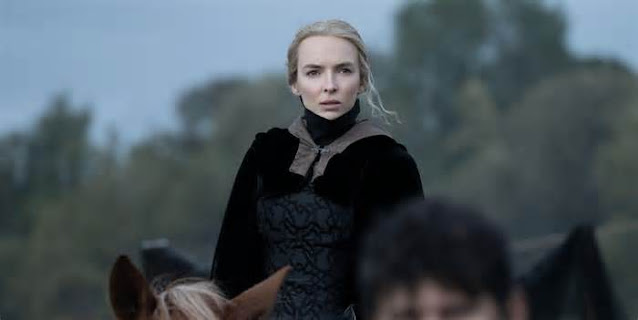
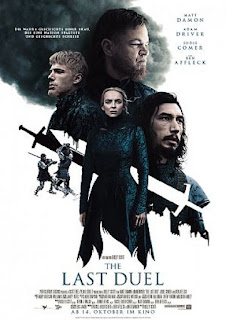
Adam Driver and Matt Damon fight The Last Duel in medieval France

Director: Ridley Scott

Cast: Matt Damon (Sir Jean de Carrouges), Adam Driver (Jacques Le Gris), Jodie Comer (Marguerite de Carrouges), Ben Affleck (Count Pierre d’Alencon), Harriet Walter (Nicole de Buchard), Alex Lawther (King Charles VI), Marton Csorkas (Crespin), Željko Ivanek (Le Coq), Tallulah Haddon (Marie), Bryony Hannah (Alice), Nathaniel Parker (Sir Robert de Thibouville), Adam Nagaitis (Adam Louvel)

The medieval era had its own solution for “He said, She said”. Let God decide via a fight to the death. After all, He would never let the injured party lose, would he? Scott’s The Last Duel is a dramatisation of one of the last French judicial duels, in December 1386, between Sir Jean de Carrouges (Matt Damon) and his former friend Jacques le Gris (Adam Driver), after Le Gris is accused of raping Carrouge’s wife Marguerite (Jodie Comer). Scott’s Rashomon-inspired film shows the events leading up to the duel from all three characters’ perspectives.

The three different stories we see are not radically different. Unlike Rashomon – which presented totally different versions of the same events, according to the prejudices or agendas of the storytellers – The Last Duel’s versions stress subtly different reactions or presents different fragments of an overall story. So, for instance, Le Gris and Carrouges remember different elements of a battle. Carrouges recalls the noble charge to save the innocent, saving Le Gris’ life in the final stages of combat. To Le Gris it’s a suicidal charge, in which he saves an unhorsed Carrouge’s life. After the rape, Carrouge remembers offering his wife sympathy; she remembers his anger and demand they have sex at once to “cleanse her” of the stain.

These mixed recollections work best when we see each of them remember a fateful reconciliation meeting between Le Gris and Carrouges (where Le Gris and Marguerite first meet). A wedge has been driven between them ever since Carrouges believed Le Gris cheated him out of both land and his father’s former position. When the two agree to try and put the past behind them, Carrouge asks Marguerite to give Le Gris a kiss of peace. He remembers her surprise and timidity. Le Gris remembers her as being quietly excited with a kiss that lingers. Marguerite remembers a kiss from Le Gris that lingers too long. Small moments like this are where the film is at its strongest, making its concept feel very relevant today in our world of accusation and counter accusation.

But these moments are few and far between. Most of the time there isn’t this subtle variation. Where the film is weakest is when we (frequently) see the same events, presented the same way, three times. While our perception of Carrouges changes – from the ill-treated noble he sees himself to the sullen, self-entitled whiner everyone else sees – our idea of Le Gris is fundamentally the same (blissfully self-entitled). Fundamentally, when we see events the first time, later versions only really tweak our perception of them rather than challenge it.

You can see this in the rape itself, which we first see from Le Gris’ perspective. The film shows Le Gris’ understanding of consent has been twisted by most of his sexual experience being court orgies with playfully protesting prostitutes. His pursuit of a genuinely unwilling Margeurite around her room echoes exactly the pretend-chases and “chat up lines” he’s used in those earlier scenes, so we understand it’s possible he doesn’t actually understand he’s raped her. But no viewer can see Le Gris’ version as anything other than rape. In fact, the only tangible difference when we see the event from her perspective is that her screams of “No” and “Stop” are louder and the camera focuses more on her anguished face. If the film is presenting any tension about whether this is a consensual encounter or rape, it ends the second we see Le Gris’ story.

This negatively effects the drama – and actually makes Marguerite’s version seem strangely superfluous. You start to feel we might as well see all three perspectives at the same time, as the narrative trick ends up adding little to the film – especially since the film categorically states Marguerite’s version is the truth. Why not just tell the whole film from her perspective in that case? It also doesn’t help that Marguerite goes last – which means until an hour into the film, the character we should be most engaged with and sympathetic towards has stood on the side-lines.

This is particularly unfortunate as the film is striving for a feminist message. The men are callous and self-obsessed, treating women as sex toys or assets – and are praised for it. Marguerite though is intelligent and principled, marginalised by her husband and condemned as a whore when she protests her rape. She pushes her case with determination, despite discovering she will be condemned to burn if Carrouge loses (he of course is only in his own honour). Her word is only good if backed a man, and she is powerless to defend her innocence.

It’s the lot of medieval women. Harriet Walter (rocking a bizarre appearance, straight out of David Lynch’s Dune) as Carrouge’s mother tells Marguerite the same thing happened to her, but she considered it pointless (and dangerous) to press charges. What we see of the judicial system is ruthlessly unjust and misanthropic, with women harangued to confess their guild for tempting men.

But it doesn’t quite click together. It’s a shame, as many scenes are highly effective. The rape – both times we see it – is alarming. The final duel is brilliantly shot and hugely tense, not least because Marguerite stands literally on the top of an unlit bonfire watching every blow. Scott’s shoots the film with the same blue-filtered beauty he gave to the early scenes of Kingdom of Heaven.

There is of course an oddness in seeing such American actors as Damon, Affleck and Driver in period setting. The accents are an odd mix: Comer basically uses her regular (non-Scouse) performance voice, Damon does a gravelly version of his own, Walter an American twang to match Damon, Affleck is halfway to plummy Brit, Driver flattens his Californian tones. Damon is pretty good as the sulky, surly Carrouge who gets less sympathetic the more we see him, Driver is suitably charming on the surface but selfish. Comer plays wounded injustice extremely well and brings a lot of emotion to a difficult role. Affleck has the most fun, flouncing around in a blonde wig as a lordly, hedonistic pervert who likes nothing more than belittling Carrouge.

The Last Duel is part way to a decent film, but it just lacks that little bit extra to make it really come to life. Its alternative versions of the truth don’t illuminate as much as they need to – even if they are at points pleasingly subtle in their differences. It has an admirable feminist message, but defers most of it to the second half of the film (were they worried about sidelining the famous male actors?) and it’s concern that we should not doubt Marguerite at any point does undermine its drama. Handsomely filmed, it doesn’t make the impact it should. Perhaps that’s why it was one of the leading box office disasters of the Covid Pandemic?

Loving (2016)

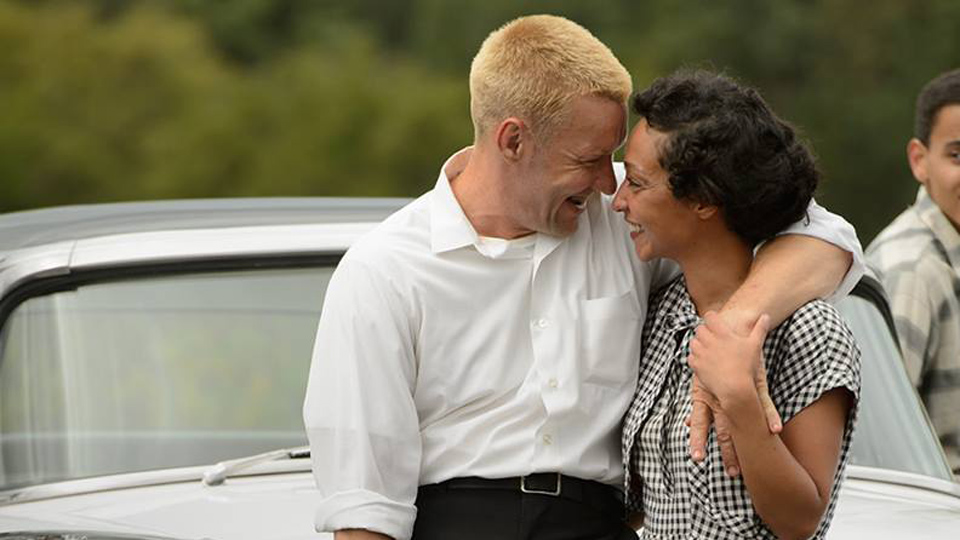
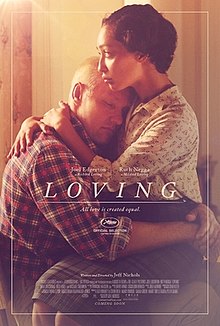
Joel Edgerton and Ruth Negga in a love story that fails to capture fire

Director: Jeff Nichols

Cast: Joel Edgerton (Richard Loving), Ruth Negga (Mildred Loving), Marton Csokas (Sheriff Brooks), Nick Kroll (Bernie Cohen), Michael Shannon (Grey Villet), Terri Abney (Garnet Jeter), Alano Miller (Raymond Green), Bill Camp (Frank Beazley)

Imagine the idea of the state dictating whom you could and couldn’t marry. This was the predicament Richard and Mildred Loving found themselves in, when the appalling segregationist policies of America in the 1950s saw them arrested for the crime of a white man marrying a black woman. Over time, especially from the 60s onwards, their case was seized upon by Civil Rights movements as a possible cause celebre for repealing many of the worst excesses of laws against mixed-race marriages. But the Lovings themselves remained quiet, private and determined to lead as normal a life as possible, while others fought this battle for them in the court.

Jeff Nichols’ film is full of affection, empathy and regard for these very everyday, normal people. What it is not – for all the skill of Joel Edgerton and Ruth Negga’s performances in the leads – is a film that manages to raise any real interest at all. This is a frequently slow-moving story that manages to drain any drama out of what should be a really dramatic story.

Racial inequality is the sort of topic that desperately should be throwing up rage and anger. Imagine Spike Lee tackling this sort of content. Loving settles instead for being a polite, even rather patronising homage to the quiet lack of drive and energy in Richard Loving (in particular). The sort of film that honours his decision to, essentially, get involved as little as possible in the case, to avoid engaging as much as he can in the wider implications their legal battle has for the nation and to studiously resist any attempts to get either side involved in it.

This may be great for reality, but it’s strikingly poor drama. You feel that a drama that focused instead on those actively campaigning for the rights for equal marriage rights to be recognised, the ones who actually fought these battles in court and brought energy and fire to the debate might be a more interesting film. Instead this settles for being a film about regular, not special people, while around the edges of their lives far more interesting events and actions are constantly taking place. 

There are some things to admire in the making of the film – Nichols’ brings his usual poetic skill to it – but this is a glacially paced, unabsorbing, overlong film that manages to make a scintillating and passionate subject as dull as dish water. Negga and Edgerton both do fine jobs – and clearly really admire the everyday nature of their characters – but these softly spoken, unengaged people to whom events happen, but who never take a stand of any sort of try and shape these events or set the direction of their own life, slowly switches the audience off.

Where is the fire here? Nichols’ film instead tries to become a tribute to the honesty of the working man, to Richard’s everyday values, simple, homespun viewpoints. It hails his lack of education (the film dances around where on the education spectrum Richard would be placed today), social awareness or even opinions as something which somehow makes him more “real” than anything else. This attitude, to be honest, becomes both trying and even a little patronising in its bluntness and sense of importance.

Just in case we are ever in danger of ever forgetting that he is a working man, the film can’t go longer than about five minutes without showing Richard laying some bricks. Mildred gets a little more engagement with the social issues of the 1960s – and the film does a good job of suggesting that she was a woman of considerably more hinterland than her husband, but who loyally followed his lead in the world. But neither of them come into focus as truly engaging characters. And because they are so hard to invest in, because the story and their film gives us so little personality for either of them to latch onto,  in the end you don’t get as fired up by the injustice of their case as you should do.

Instead you are left thinking at the end that this sort of racism is bad because, well, we know it was at the start. Following the story of two basically boring people who were in the right place at the right time to become the face of overturning some terrible laws, doesn’t make them interesting and doesn’t make a story that focuses on their lives at the cost of any of the wider issues or actual battles that were being fought, suddenly interesting either.

Noah (2014)

Russell Crowe is getting ready for action as the rains come to Noah

Director: Darren Aronofsky

Cast: Russell Crowe (Noah), Jennifer Connelly (Naameh), Emma Watson (Ila), Ray Winstone (Tubal-Cain), Logan Lerman (Ham), Douglas Booth (Shem), Anthony Hopkins (Methuselah), Marton Csorkas (Lamech), Nick Nolte (Samyaza), Frank Langella (Og)

Everyone kind of understands what they are going to get when watching a Biblical epic right? A lot of “thous” and “thees”, sandals and swords, priests with long beards, sweeping musical scores and an actor like Charlton Heston (ideally just Charlton Heston) at the centre, standing tall with the word of God behind him. Obviously Darren Aronofsky must have been unfamiliar with this formula as he put together Noah, without a shadow of a doubt the weirdest Biblical epic you are ever going to see.

Set at a time that could be thousands of years either in the future or the past (with a steam-punk aesthetic and timeless mix of ancient and medieval technology with hints at modern ruins), God has had enough of man wrecking the world. He sends a cryptic vision to Noah (Russell Crowe), last descendent of Abel, telling him that a flood will take out the world. Noah will build an ark to protect the animals – but Noah also becomes convinced that God’s will is that mankind will not survive the flood. After Noah and his children die that’s it. This fanaticism is met with concern by his family, but also with fury from the rest of mankind led by descendant of Cain, Tubal-Cain (Ray Winstone). 

And that’s only scratching the surface of the film’s trippy eccentricity. The story of the ark is familiar to generations of children, and the image of Noah as a jolly bearded fella saving the animals like some sort of nautical Doctor Doolittle is one we all share. Aronofsky remixes this into a more adult mood by reminding us that this bloke was also happy to stand by and watch the rest of mankind drown, and followed the word of God with a fanatical monomania. Noah is, for large chunks of this film, not a nice bloke. As he tells son Shem “He chose me because he knew I would finish the job”. No hugs on this boat.

It makes sense that Noah is embodied by Russell Crowe at his most gritty. Going through a series of haircuts that reflect his journey from nature lover to chosen man of God to fanatical cult leader through to reborn family man, Crowe gives the role a blunt determination and earthiness ­– so much so you half expect him to address everyone as “mate”. But it’s essential for Aronofsky’s reimagining of the role as part environmentalist part cult leader. Noah is uncompromising, unshakeable and totally certain that all his decisions come direct from God, ergo they are unquestionable. As he shows time and time again in the film, he is willing to commit actions that are at best morally questionable, at worst down right bad, to do what needs to be done.

He’s the man who is willing to watch his crapsack world burn (or rather drown) and feel that, yes, it is good. Aronofsky’s vision of this wasteland of a world fits this perfectly. Resources are low, mankind has turned (it is heavily implied) partly cannibal, industry has destroyed nature, the law of man has become the law of the strong. There is a clear modern parallel here with environmentalism, and Noah himself is strongly reimagined as a man with a deep respect for nature – and the balance mankind must make with it; and the danger of us burning through our resources with no regard for the future is a major theme throughout the film. 

Evil mankind is represented by Ray Winstone as Tubal-Cain. Greedy, selfish, ambitious and a demagogue, Winstone is at his most physically imposing and dangerous here, a fitting obstacle for this reimagined muscular Noah. Aronofsky does however acknowledge that, for all his faults – and his unashamed embracing of violence – Tubal-Cain does have a point: it’s not fair for all of mankind to be sentenced to oblivion with no chance to save itself, regardless of their personal morality.

This uncomfortable darkness behind the story of Noah – and the destruction of mankind by their creator – is one of many things that made some Christians uncomfortable with the film. The Creator (as he is referred to throughout the film) is noticeable by his silence, speaking only to Noah through dreams and everyone else, not at all. Noah’s hardline interpretation of God’s plans (extinction) is enforced by him with all the obsession of a fanatic (a large chunk of the second half of the film is given over to the danger of an expectant mother sharing a boat with a man who has stated his intention to end the race with his immediate family). Of course the film shows Noah eventually changing his mind (and getting royally pissed in self-disgust at his lack of will), but it’s a way darker tone to take for a story more familiar to people through children’s playsets.

Aronofsky places this film at a hinge point of what sort of race are we. It’s expressed in several scenes that mankind is still fighting the struggle between Cain and Abel. Is it violence and strength that wins out? Or are there better qualities in man that can end the cycle of destruction? What sort of world has man built – and what sort of world does Noah believe could emerge from the floods? Striking imagery accompanies this musing throughout, not least a flashback to Cain killing Abel in silhouette against a blue dappled starry night sky – an image that shifts and changes at one point to replace the brothers with antagonists from our entire history of warfare.

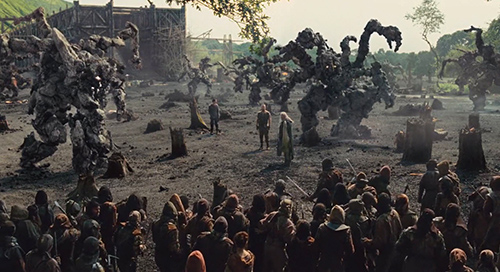
There are miracles and divine power in this film, but its actions seem to be based around inspiring fear and obedience rather than devotion. Forests spring from the ground for Noah to build from. Geysers of water take out mankind. Fires take out armies. There are moments of gentleness – a woman given back her ability to have children, rainbows etc. – but the Creator is a hard taskmaster. Noah is assisted by a gang of fallen angels – the Watchers – who, as punishment for siding with mankind when Adam and Eve were expelled from Eden, were thrown to the ground and encased in stone, turning them into freakish, gangly, giant rock monsters. Despite this, they retain their devotion to their creator – and their assistance is essential for the construction of the ark.

The inclusion of Giant Rock Monsters shows you again how far off the Biblical beaten track Aronofsky goes. This same embracing of unconventional oddness is seen throughout the film’s aesthetic – dirty clothes that have been cobbled together from several different eras, hints of metalwork and industrial ruins throughout Tubal-Cain’s kingdom, blasted wastelands – it’s miles away from The Ten Commandments. But it all sort of works because, regardless of his eccentricity, Aronofsky is a unique and intelligent director of visuals and his work is full of striking images and staging that draws inspirations from all over the shop, from old films to classical children’s story book images from Biblical tales.

Noah ain’t perfect. It’s overlong and its genre defying oddness occasionally feels a little too much. It suffers from the fact that the visuals and themes are so overwhelming that they crush most of the characters: Jennifer Connolly has little to do as Noah’s wife, while Emma Watson et al playing various Noah family members are left with just crusts to chew on. But embrace its bizarreness and the points it wants to make and you are left with a film that is quite unlike anything else you are likely to see. Aronofsky has made a Biblical epic unlike any that has ever, or will ever, be made. And that at least is worth some praise.

The Equalizer (2014)

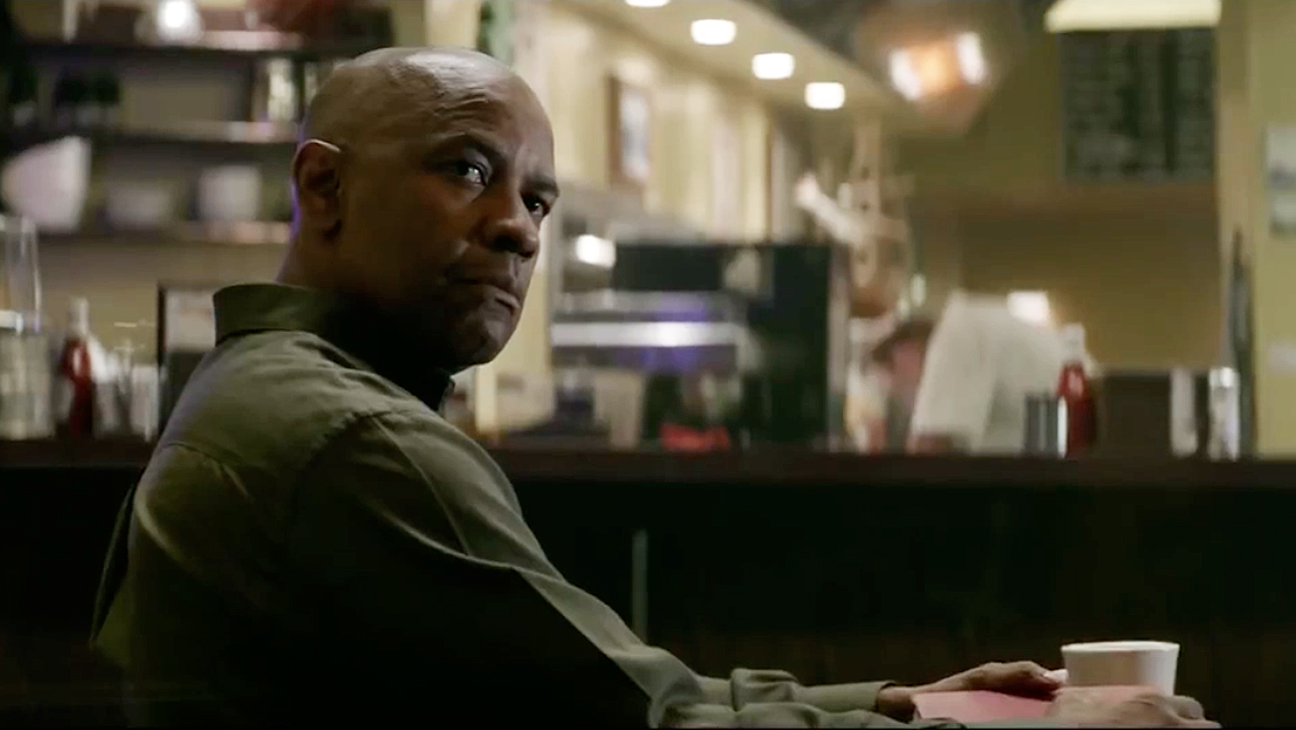
Denzel rests up. In about five seconds of screen time that scolding hot coffee will probably be in someone’s face.

Director: Antoine Fuqua
Cast: Denzel Washington (Robert McCall), Marton Csokas (Nicolai Itchenko) , Chloe Grace Moretz (Alina/Teri), Melissa Leo (Susan Plummer), Bill Pullman (Brian Plummer), David Harbour (Frank Masters), Johnny Skourtis (Ralph)

In the 1980s Edward Woodward had a sudden massive success in the States starring as Robert McCall, akaThe Equalizer, a former agent of a Government Agency, making atonement for past misdeeds by offering his skills free-of-charge to help the innocent and falsely accused. It ran for four seasons and then largely faded from memory. As such, it seems a strange choice for Denzel Washington to bring back to life – until you remember that Washington has a fondness for appearing in trashy action films. Kinda like I have a fondness for watching them.

Because I’ll be honest, this film is more or less exactly what you would expect from a film whose poster is the star male actor holding a gun (and, after watching this on Netflix and seeing my recommendations I am now aware how many films out there have posters of late middle age actors holding guns. Liam Neeson has a lot to answer for. Half of Hollywood’s middle aged men should be paying him some sort of commission.)

Here McCall is reimagined as a quietly retired man, works at a hardware store, is beloved by his colleagues and in mourning for his wife, who of course he promised he would leave his old life behind. There are hints that he has a certain level of OCD, and meticulously times every action he carries out. Concerned at the poor treatment handed out to a teenage prostitute by her Russian Mafia pimp, he attempts to intervene politely but firmly – but of course a blood bath of slaughtered goons ensues, and before we know it the whole Russian mafia is trying to work out who our hero is and what he wants.

It’s a pretty familiar set-up and the film wastes no time in letting us understand it before hurling us into events that will shatter any peace its lead character has. After all we all know that this zen peace isn’t going to last and that Washington will soon be dishing out pain and taking names like nobody’s business. What the film does do quite well though is sketch out the everyday folk in the film so well (with only brief moments on screen of things like baseball games) that you actually do care for them, and you actually do understand why McCall finds this life so enjoyably unstressful.

The violence when it comes is very effectively filmed. It has a great “Bourne-ish” quality to it, as McCall uses a series of everyday items with lethal effect. The final sequence takes place in the very hardware store McCall works at, and there is some imaginative use of the various products contained therein. Similarly, throughout the film McCall uses various hardware items for purposes other than those intended by the manufacturer, and niftily cleans the items to return them for sale (a great way of junking the evidence).

My one issue with the violence in this film is that I felt, at times, it was a little too graphic, a little too delighting in its mayhem. It largely gets away with this as it establishes that the victims of the violence throughout the film are mobsters and killers. The film is also slightly too long – the momentum dries up in places – and the script or direction fails to deliver a single key ‘moment’ to make this stand out from the crowd of films in this genre. It’s entertaining and good fun for fans of the genre, but it never really seems completely original, instead an effective remix of things from other movies.

Denzel Washington is of course the film’s MVP, and he tackles the part extremely well, adding a great deal of depth to McCall’s shame at his past, his discomfort with violence and his need to carefully organise his life into time managed compartments. He has the quiet, cool confidence that the part needs and suitably manages to look normal enough that you can believe he would fade into the background. Of course he could do the part standing on his head, but he still gives it a lot of interest. Marton Csorkas also does a good job as his nemesis, though the part is paper thin.

The ending feels rather tacked on and designed as sequel bait – but there are far worse films out there that will get sequels. Decent fun, nothing special, an effective remix of other films.