Tag: Marvel Franchise

Avengers: Age of Ultron (2015)


The Avengers Assemble to take on robotic villain Ultron

Director: Joss Whedon

Cast: Robert Downey Jnr (Tony Stark), Chris Hemsworth (Thor), Mark Ruffalo (Bruce Banner), Chris Evans (Captain Steve Rogers), Scarlett Johansson (Natasha Romanoff), Jeremy Renner (Clint “Hawkeye” Barton), James Spader (Ultron), Samuel L Jackson (Nick Fury), Don Cheadle (James Rhodes), Aaron Taylor-Johnson (Pietro Maximoff), Elisabeth Olsen (Wanda Maximoff), Paul Bettany (JARVIS/Vision), Cobie Smulders (Maria Hill), Anthony Mackie (Sam Wilson), Hayey Atwell (Peggy Carter), Idris Elba (Heimdell), Stellan Skarsgard (Erik Selvig), Thomas Kretschmann (Baron von Strucker), Linda Cardellini (Laura Barton)

The Marvel Cinematic Universe: with the wrong director, it can be top a heavy mess, but Whedon showed with the first Avengers film that the right writer/director can weave the competing plotlines into a story that win overs an audience and leave them thrilled and entertained. His problem here was repeating that trick with the sequel.

After (it seems) finally defeating HYDRA, the Avengers relax at last – little knowing that Tony Stark (Robert Downey Jnr) is using multi-film-macguffin Loki’s staff to explore the possibility of creating an intelligent army of robots to defend the Earth. Instead, he creates Ultron (James Spader), a deeply flawed robotic version of his own personality, who grows to believe the best way to save the world is to wipe out mankind. Time for the Avengers to saddle up once more!

The greatest nemesis the Avengers faced here was that the first of these superhero smackdown films (2011’s Avengers Assemble) was far better than anyone had a right to expect. It was witty and had a plausible script, a very good villain in Tom Hiddleston (much missed here), and a winning structure that saw our heroes initially far apart and later drawn together into a family. On top of that, it gave all the jaw-dropping action and geeky thrills of watching iconic characters fighting together (in every sense of the word) that the fans expected. It worked so well that, consciously or not, Whedon ended up imitating it its structure here.

Both films open with a piece of shady alien tech: it’s stolen, and our heroes’ noble intentions for its use which   backfire. The villain is an outcast with a personal (familial) connection to one of our heroes (Ultron is, to all intents and purposes, Stark’s son). A first attempt to take on the villains ends in chaos as no-one works together, leaving the gang disheartened. Hulk is unleashed, causes chaos and needs to be restrained. A pep talk from Fury perks the gang back up. They head back into a battle over a city, against overwhelming odds, where they finally work together and turn a weapon of mass destruction into their salvation. With some small thematic twists and some adjustments to the plot they are fundamentally the same movie.

This might be connected to the greater studio interference Whedon dealt with. This conflict of visions results in a wonky balance between pay-off from past films and build up to future ones, and several plot lines being poorly developed. Most obviously most of Thor’s sub-plot ended-up on the cutting room floor. What was meant to be a series of revelations about infinity stones turns into essentially Chris Hemsworth sitting in a puddle. Whedon confirmed that the studio instructed he delete either this sequence or the sequence set at Barton’s log cabin (the emotional heart of the movie) so it’s not surprising that this paid the price. Needless to say, not a frame of the terrifically dull and overextended Iron Man vs. Hulk battle was allowed to hit the cutting room floor.

This confused cutting down of ideas is present throughout the movie. Villain Strucker, introduced with fanfare at the end of the last movie, is unceremoniously bumped off off-screen. Andy Serkis pops up to serve as an introduction to a future movie. The creation of Paul Bettany’s Vision is only vaguely explained. Ultron is never really given time (despite a pitch perfect performance of cold smarm from James Spader) for his plans to fall into shape, or for the audience to really understand him as a character. A backstory for Natasha is fitfully sketched out – but with hardly any time to explore it, the final product was so clumsily done that the film drew heavy (unfairly personal) criticism from the Twitterati, claiming Whedon was denouncing any woman choosing not to have children (“I’m a monster” says Natasha remembering her brutal education, which included GBH, murder and her voluntary sterilisation). He clearly isn’t, but as the plotline is rushed, it becomes easier to read an unintended message in it.

The area Whedon does handle well is juggling the huge number of characters he needs to keep tabs on at any one time – with careful plotting and some decent, fleet-footed scripting, he manages to allow each of the heroes a moment in the sun and a chance for the actors to breathe and perform. Those moments where the film takes five and doesn’t worry about the explosions and comic lore are the ones that work best – and also, perhaps, the ones most warmly embraced by the fans (never the best judges of what they think they will like – in advance they would probably have named the bland Iron Man-Hulk battle as the movie’s big sequence).

There’s a reason why most people would probably remember sequences like the party scene, where our heroes playfully take it in turns to lift Thor’s hammer: they feel real and they deal with emotions and friendships that we can understand and relate to, in a way we can’t with a giant robot man hitting a big green guy for no real eason (can you tell I didn’t like that bit?). It’s why the sequence Whedon fought so hard to keep in the film – Barton’s log cabin – feels genuinely rather sweet and moving. These are sequences where our characters behave like human beings, and they are the sequences that make us connect with the film.

Anyway take a look at these two scenes – which is more interesting and engaging? Make up your own mind!

The best Marvel films have always had an eye for the incongruous insertion of our heroes into a real world. And by placing Barton (an empathetic Jeremy Renner) front and centre as the moral cornerstone of the film, contrasting his (albeit well-trained) normality against the Gods he fights with, Whedon allows elements of relatability to anchor the film. Renner makes an awful lot of Barton’s wistful longing for something away from Avenging, while his relationship with his wife (who “fully supports your Avenging”) is one of the first relationships in these films that feels like it could be from a regular movie.

It’s strengths like this that Whedon brings to these films. It’s not directorial vision – at heart Whedon is quite a televisual director, using simple camera set-ups without much visual flair. The action the film provides is entertaining enough, but in truth we’ve seen all this super action before, and few of the set pieces are really memorable. Even a few days away I’m struggling to remember them all. Which is not to say they are badly staged at all – they’re just nothing new or special, and in many ways just higher budget developments of things from the first film. Whedon’s real visual strength is in his instinct for a comic beat or sight gag – and the film delivers several of these.

Whedon also crucially forced through (against studio objections) the death of Quicksilver. Marvel strongly urged a cop-out final shot of Quicksilver either in a hospital bed or in recuperation, but Whedon wisely stuck to his guns. It was an important struggle, as it forces a sense of peril into this world and gives the viewer the sense that sometimes things might not always turn out well. This is particularly important, since Stark’s entire plot about his fears would make no sense in a world without stakes or consequences. It also allows Whedon to do some very neat audience misdirection with Barton – how many of us, watching Barton solemnly promise his wife that this will be ‘one last mission’, were expecting him to bite the big one later in the film?

Avengers: Age of Ultron is a compromised film, but still a decent one. It’s not in the top five Marvel films, let alone the top five superhero films, but it’s entertaining, has some decent action – and, above all, Whedon manages to put a bit of heart in heart, enough for us to care about the characters. It’s this factor so many of these films miss out on – and it’s a reason that, while Age of Ultron is flawed, it’s not fatally so, and will continue to entertain for a good many years yet.
Guardians of the Galaxy Vol. 2 (2017)

Our heroes line up for action in a fun follow-up to a more fun movie

Director: James Gunn

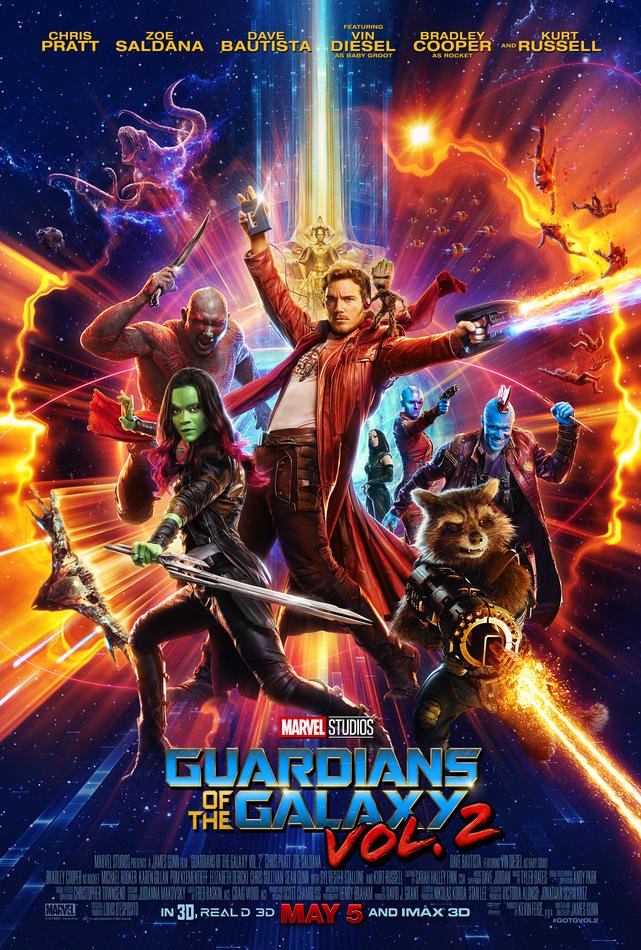
Cast: Chris Pratt (Peter Quill), Zoe Saldana (Gamora), Dave Bautista (Drax), Bradley Cooper (Rocket), Vin Diesel (Baby Groot), Michael Rooker (Yondo Udonta), Karen Gillan (Nebula), Pom Klementieff (Mantis), Kurt Russell (Ego), Elizabeth Debicki (Ayesha), Sean Gunn (Kraglin), Sylvester Stallone (Stakar Ogord)

In 2014, Guardians of the Galaxy was expected to be Marvel’s first flop: an odd collection of ridiculous looking characters, from a comic book few had ever heard of. Instead, its oddball charm and wit made it one of the most popular in the franchise. This is the tricky second album, which has to deliver more of the same while trying to build on the first film.

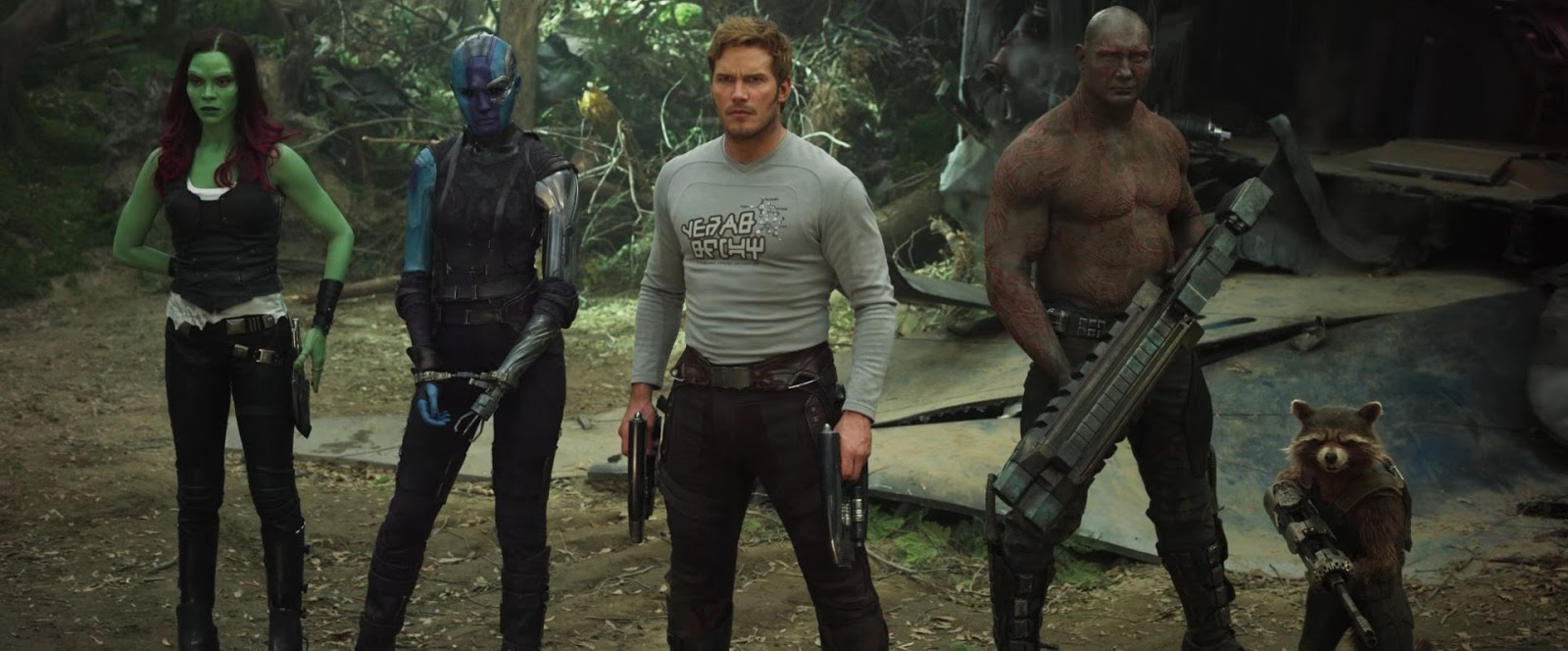
Set a few months after the first film, the Guardians are left stranded on an alien planet after a job for elitist race The Sovereign (led by a drily witty Elizabeth Debecki) goes badly wrong. They are saved by Ego (Kurt Russell) who reveals himself as Peter Quill’s long-lost father. Quill (Chris Pratt), Gamora (Zoe Saldana) and Drax (Dave Bautista) follow Ego to his homeworld, while Rocket (Bradley Cooper) stays to repair the ship with their captive Nebula (Karen Gillan). While Ego’s world hides a range of dangers, Rocket and Nebula come under attack from Peter’s former guardian Yondo (Michael Rooker), whose pirates have been hired to capture the Guardians.

First the good things: this is a very entertaining film, packed full of funny lines and entertaining moments, solidly acted (with some stand-outs) by a cast who are able to communicate their enjoyment with the audience watching. Like the best of the Marvel films, it focuses on a core cast and establishes an audience bond with their characters very swiftly, and care about their fate. The focus of the film is actually skewed in favour of character over plot and action, which makes a nice change from many of these films (the action quotient is actually fairly low for a Marvel movie, and a large chunk of the film largely involves spending time with our heroes). It’s also admirable that the film doesn’t shy away from the fact that, to varying degrees, all of our heroes are in some way anti-heroes, or perfectly willing to perform selfish, dangerous or questionable acts for their own immediate gain (even if on the bigger issues their hearts in the right place).

It’s clear what type of movie you can expect right from the opening credits, where the camera focuses on (adorable) Baby Groot dancing to music in close-up, while (out of focus) our heroes combat a space monster in the background, each of them at key moments interacting with Groot in a way that demonstrates their character. It’s a lovely, witty way of opening the movie (perfectly scored to ELO’s Mr. Blue Sky) and firmly states that character and personality will be central. Baby Groot is, by the way, possibly the star of the movie, Gunn making sure the character isn’t overused or becomes wearing. The film gets the tone more or less right: it would be easy for this to feel like a private party we’ve been invited to watch, but it just about feels inclusive enough (and avoids smugness or self-satisfaction at its own wit) to remain charming and fun.

The focus is so much on jokes and fun that the actual plot of the movie is a little bit weak: a (predictable) villain reveal is made late-on, seemingly to give the film an antagonist. The actual plot content of the film is pretty lightweight. What plot there is, is nothing new (Daddy issues, spliced with Universe-in-peril) I’d also say that the films length is probably a bit too much – considering not a lot really happens, the film takes a long time to do it – it could do with a bit more discipline in the editing room, and a bit more willingness to trim out some of the material. This is, however, not a major problem –– and the film just gets away with it because it gets the character moments so right you simply enjoy spending time with this group, even if what they are getting up to is little more than a second-rate episode of Star Trek.

Where Guardians 2 falls a little bit flat is the wearily on-the-nose “emotional” sections of the script. While in the first film much of this goes unspoken, here several scenes are featured where the characters carefully spell out their feelings. The most egregious examples are an almost laughably overplayed game of catch between Peter and his Dad, and a terrible “everything spelled out” conversation between feuding sisters Gamora and Nebula. Whenever this film goes near this emotional content, its points land with heavy punches, while coating the content with sticky sentiment that gets “bad laughs” from the audience. The film has plenty of well-crafted and funny impact lines, but its script rushes through the areas where depth is needed, and doesn’t seem to trust the audience to understand the emotions that underlie the bickering between the characters, or that some of them may be tempted to do terrible things to fulfil their emotional needs. Only the final sacrifice of a character really works – and that’s because it is the only emotional connection that is quietly built in the background of the movie, rather than in the foreground.

But that’s probably a movie trying too hard for good reasons, rather than bad. There is more than enough here to recommend the film. Interestingly, Pratt’s Peter Quill is largely sidelined for chunks of the film (the fact that its nominal plot is all about Quill and he feels like a supporting role tells you how weak the plot is) so other members of the cast really stand out. Saldana has a slightly thankless role as the “Big Sister” of the group, but manages to bring a lot of unspoken depth to her role. Bautista provides excellent comic relief as Drax (though his lines are such gifts, it would be hard to screw them up), Baby Groot is very funny, Cooper’s Rocket has a juvenile, rebellious attitude that  that deserves a more interesting subplot. Surprisingly though, the film is repositioned more as a redemption journey for Michael Rooker’s space rogue Yondo, and Rooker delivers a surprisingly emotional performance as a confirmed killer and thief struggling with his conscience. Gunn allows him contemplative moments that really ring true within the chaos of most of the rest of the film, and this feels like one of the best displays of simple “acting” you’ll see in the MCU.

Guardians 2 is not a perfect film, and I suspect its weak plot, predictable and uninteresting villain, and often ham-fisted emotional moments will grate more and more once the exuberance of the ride has worn off on the second or third viewing. But it’s got a lot going for it: genuinely funny jokes, an intention to entertain which it largely succeeds in, some charming performances and enough action in it without letting that overwhelm the film. It’s a roller-coaster rather than a gift that will keep giving, and it lacks the first film’s well balanced plotting and world-building, but it’s entertaining and a great deal of fun (if 20 minutes too long) and the final reel’s sad events do carry an emotional weight (because they are based on largely unspoken feelings) that will stay with you after the film wraps. Not as fun as the first one – but still better than many others.

Doctor Strange (2016)


Benedict Cumberbatch goes into battle with magic. Silly but in a good way.

Director: Scott Derrickson

Cast: Benedict Cumberbatch (Dr Stephen Strange), Chiwetel Ejiofor (Karl Mordo), Rachel McAdams (Christine Palmer), Mads Mikkelsen (Kaecilius), Tilda Swinton (The Ancient One), Benedict Wong (Wong), Michael Stuhlbarg (Dr Nicodemus West), Benjamin Bratt (Jonathan Pangborn)

Arrogant surgeon (is there any other kind in the movies?) Stephen Strange (Benedict Cumberbatch) loses the fine motor control of his hands after a car crash caused by his reckless driving. With science unable to find a cure, he travels across the world to find another solution, eventually joining a secret group of sorcerers, led by The Ancient One (Tilda Swinton), who use energy from parallel universes to perform feats of magic in our world. Trained by Karl Mordo (Chiwetel Ejiofor) he is absorbed into a clash between the sorcerers and a rogue former protégé of The Ancient One, Kaecilius (Mads Mikkelsen) who wants to destroy the boundaries between worlds and unleash chaos.

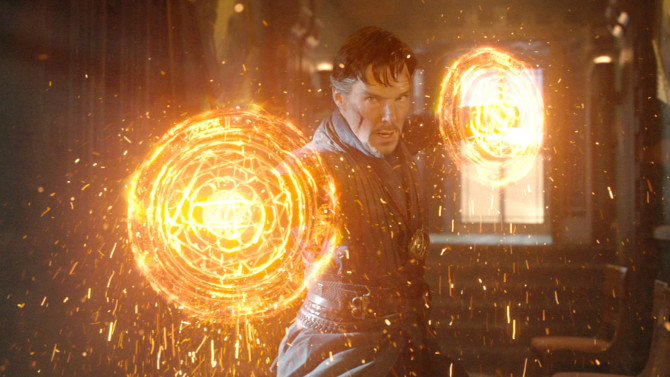
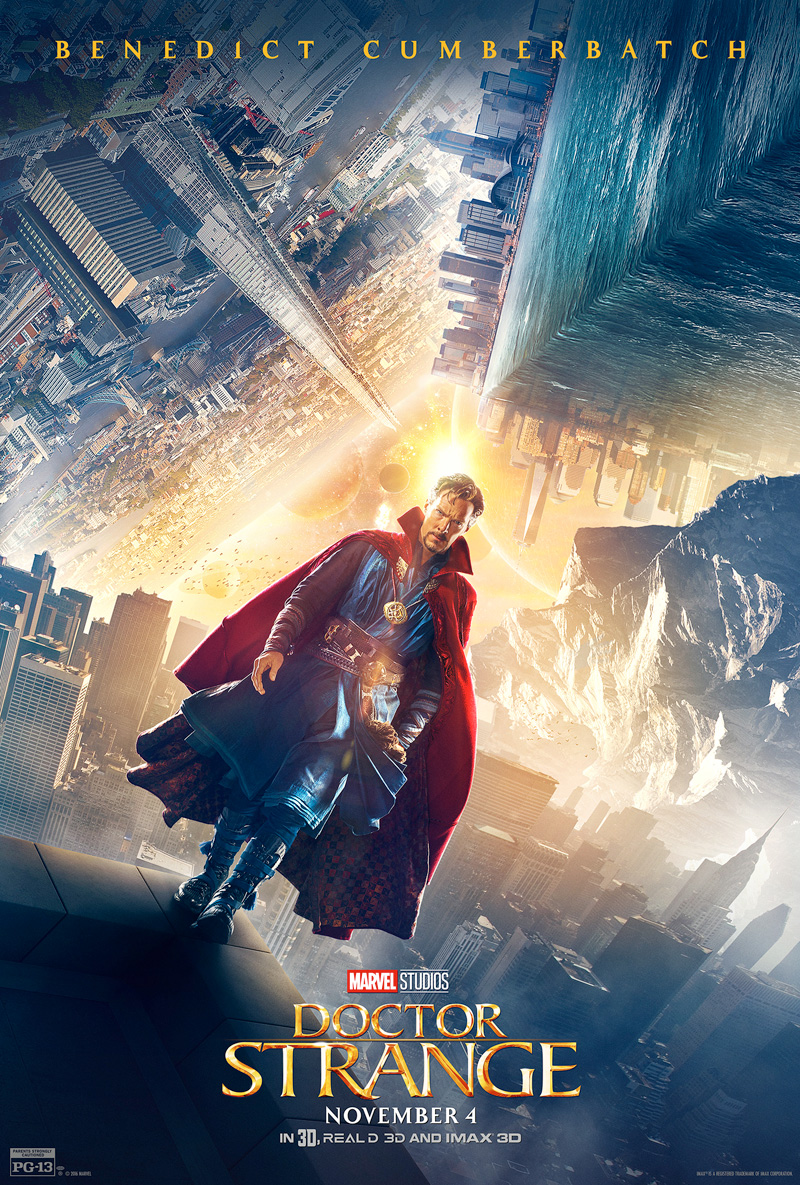
In a film franchise that threatens to get increasingly samey, Doctor Strange is in many ways a breath of fresh air. Its twisting, mind-bending special effects (part Escher, part Inception) are stunning and showcase a great deal of visual and narrative imagination in the film, immediately making it look different from the dozens of city-smashing films we’ve seen in the Marvel franchise. It’s also told with a fair amount of wit, tongue-in-cheek beats and some lovely sight gags (Strange’s Cloak of Levitation is clearly inspired by the Carpet from Aladdin). This lightness of touch is essential to stop this concept feeling silly: with a more po-faced style this story, full of magic and things like “the Eye of Agamatto”, would have stumbled over its own ridiculousness.

This is however pretty close to being the best comic-book origins film, and certainly in the top five of this franchise. For a start, despite the visual glory, it feels like a focused more personal story: there are only really 6-7 characters (compare that to the sprawling cast of Captain America: Civil War), and the real heart of the film is the lead character’s struggle to overcome an existential crisis and find a new purpose while rediscovering his humanity. Even the final confrontation is a spin on the formula, avoiding city-wrecking super-punches in favour of intelligence and humour saving the day. It still crams in the action, and the characters are still cartoons made flesh, but at least they have been given a real depth here. There is an emotional weight to the story that makes you care about Strange and his world.

No actor right now is better able to embody intellectual brilliance matched with cool arrogance and societal disconnection than Benedict Cumberbatch. So in many ways, Strange is a part that falls well within his comfort zone. But Cumberbatch shows he can carry a major motion picture by making Strange a charismatic lead who grows and develops. Strange is deliberately unlikeable at first, but Cumberbatch invests him with an underlying vulnerability and a cocky charm that is increasingly broadened and shaded as the film progresses. Almost without realising it, you find yourself actually rather liking him halfway through (while still happy to give him a smack in the mouth for his cockiness). Cumberbatch is in almost every scene and carries the film effortlessly.

The film is dominated by it’s lead character, but gives moments to the rest of the cast. Tilda Swinton overcomes the controversy of her casting by investing The Ancient One with both a serene wisdom with dark hints of anger and impatience bubbling under the surface. Ejiofor is good as an increasingly disillusioned mentor and Wong has some great comic beats. Mads Mikkelsen, one of the greatest actors in the world, is rather wasted as a villain who never becomes quite as interesting as you’d hope. Most misused is Rachael McAdams, whose character serves very little purpose other than “ex-girlfriend” – even the director, in an interview, described her role as being there to love him, so that we can see why we should love him.

It’s still a Marvel film, and it still follows the Marvel formula, however newly presented it might be. The arc of despair, rejection, slow progress, revelation, disillusionment, rallying and overcoming personal problems is pretty recognisable from everything from Thor to Iron Man. But it is enough of an inversion, it’s got a good enough script, it’s directed with enough focus on character as well as action, and it has a sufficiently good leading actor to lift and elevate the whole idea into something that feels richer while keeping it entertaining. It’s a very good comic book movie, and it’s trying to do something different, And it mostly succeeds.