

The Odyssey retold as an exploration of trauma and guilt in a rich and rewarding film
Director: Uberto Pasolini
Cast: Ralph Fiennes (Odysseus), Juliette Binoche (Penelope), Charlie Plummer (Telemachus), Tom Rhys Harries (Pisander), Marwan Kenzai (Antinous), Claudio Santamaria (Eumaeus), Ayman Al Aboud (Indius), Amir Wilson (Philoetius)
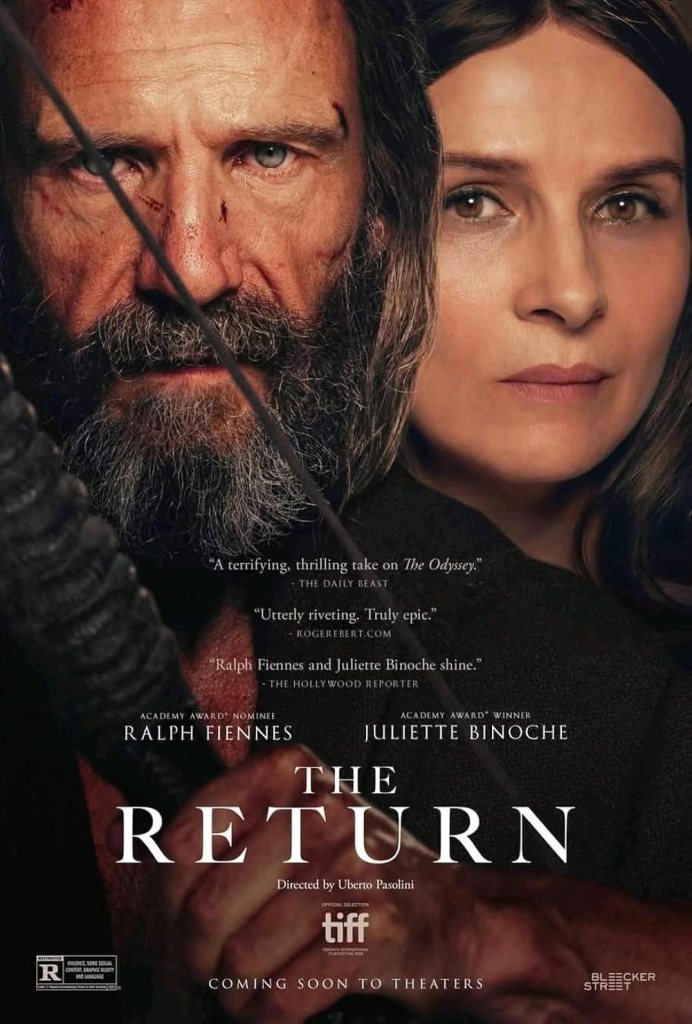
War can tear your soul apart, even if it’s become an ancient clash of legend: the memory of the deeds you did and the lives (both friend and foe) you left behind can haunt you. The pain of guilt and trauma swims behind the expressive eyes of Ralph Fiennes’ Odysseus in this unique adaptation of Homer’s famous tale of the longest journey home. A version that, as the title suggests, jettisons the journey itself (along with all those Gods) focusing instead on the spiritual journey a soul must take to come-to-terms with things seen and done and to face the consequences on those left behind. Pasolini’s film does this with expressive, melancholic beauty, bringing a unique vision to a story told many times before.
A shipwrecked Odysseus is washed, naked, up on the shore of his kingdom of Ithica – although its heavily implied this is an accident as he is clueless at first to where he is. In fact, lying naked on the beach, suggests the cunning old warrior has in many ways been born again: this time to face the pain of those he left behind. That doesn’t just include his wife Penelope (Juliette Binoche) waiting fruitlessly for years for word of his whereabouts, but also his bitter son Telemachus (Charlie Plummer) who deeply resents his absent father. It’s also the people of his kingdom, now poor and ravaged, the cream of a generation lost under his leadership, the island pillaged by a parade of cruel suitors for Penelope desperate to claim the kingdom. So great is Odysseus’ guilt he continues to conceal his identity – perhaps worried as much at confronting the truth about himself as he is the myriad people on the island with reason to hate him.
The Return replays Homer as an exploration of war trauma and PTSD. In many ways it has more in common with William Wyler’s The Best Years of Our Lives than Wolfgang Petersen’s Troy. No matter the era, it’s never easy for warriors to find a place in a world of peace they left far behind. Powered by a deeply affecting, sensitive performance from Fiennes, The Return centres a man beaten down by shame and regret, barely able to look others in the eye. This is the lasting impact of conflict. While the war at Troy is already being mythologised by the young, Odysseus’s stories focus on the ordinary citizens of Troy, who longed for peace and met their end in fire and blood. Fire and blood, what’s more, that he visited upon them.
Mix that in with the constant memory of the boatloads of Ithica’s finest young men, who have not returned with him, their souls lost in conflict and at sea. No wonder Odysseus feels solely tempted to forget himself, to become just another anonymous beggar. The Return is the tragedy of an incredibly smart, cunning man shamed that his gifts are harnessed best for death and destruction. In battle he is ruthlessly efficient, using the strengths of others against them, constantly identifying every possible advantage.
It’s a fate that he – and Penelope – fear may absorb their son. Telemachus, played with a frustrated petulance by Charlie Plummer, has watched his father’s kingdom fall apart, felt abandoned by both his parents (one to war, the other to stoic silent) and straining at the leash to do something to prove himself. If that means testing how far the parade of Penelope’s suitors will go, so be it – even if their patience with this boy becoming a man is wearing fatally thin. Tension hangs over The Return: will Telemachus follow in those footsteps Odysseus so bitterly regrets – will violence consume the next generation as much as the first?
What it will do is leave more victims behind. Juliette Binoche – with an instinctive chemistry, gives a deeply humane but fascinatingly cryptic performance – simmers with the never-ending pressure of trying to keep home and family together, very aware her own home is now awash with dangerous men she can only just control. Binoche is a tight-wound bundle of tension, suppressed fear and unacknowledged anger at her betrayal. This is a woman clinging to hope of her husband’s return, as it offers the only escape from the trap he has left her in – and if that means forcing his hand so be it.
Ithica has become a ragged island. Pasolini’s visuals for the film, influenced by Baroque artwork in its parade of barely-clothed nudes in rural settings and run-down classical wrecks, not only look gorgeously artful but successfully conveys the impression of a kingdom on its last legs. With everyone thinly clothed and living in shacks, Odysseus’ palace crumbling and lives being cheaply taken whenever the suitors fancy, it’s clear the world he left behind has disintegrated. The suitors are largely a gang of louts, increasingly fed-up with waiting (‘This fuckin’ place!’ Tom Rhys Harris’ Pisander petulantly whines at one point after getting lost in a futile chase through the maze-like woodland). They are fragilely led by Marwan Kenzai’s Antinous, whose tragedy is that he genuinely loves Penelope. In another life, indeed, you can imagine him making a considerate and kind husband if unreturned affection hadn’t made him bitter.
These ideas and concepts bring a fresh vision to The Odyssey, grounding this adaptation in a world of post-traumatic guilt and the horror of violence, devoid of gods and monsters. Fiennes, his body muscled up like a burnt and tanned roll of taut rope, is a warrior struggling against awakening. We all know eventually he will of course – but the enormous psychological burden of once again using your wit and ingenuity to efficiently slaughter other people is always palpable. It doesn’t matter if the targets ‘deserve’ it: the psychological damage remains the same.
The Return explores all the subtly, with beautifully measured performances from Fiennes and Binoche and impressive supporting turns not least from Claudio Santamaria as Odysseus’ old servant, shrewdly aware of his master’s identity earlier than he admits and determined to rouse the king to take responsibility for his actions. Sombre, wonderfully filmed and a compelling reimagination of the myth, it’s a unique view of Greek mythology that carries real emotional impact.


 Movie Musings