
Tag: Mary Elizabeth Mastrantonio

Robin Hood: Prince of Thieves (1991)

Robin Hood: Prince of Thieves (1991)

I can’t lie: no matter how many faults it has, Costner’s Robin Hood epic is above all criticism for me

Director: Kevin Reynolds

Cast: Kevin Costner (Robin of Locksley), Morgan Freeman (Azeem), Mary Elizabeth Mastrantonio (Lady Marian), Christian Slater (Will Scarlett), Alan Rickman (Sheriff of Nottingham), Geraldine McEwan (Mortianna), Michael McShane (Friar Tuck), Brian Blessed (Lock Locksley), Michael Wincott (Guy of Gisborne), Nick Brimble (Little John), Harold Innocent (Bishop), Walter Sparrow (Duncan), Daniel Newman (Wulf), Daniel Peacock (Bull), Sean Connery (King Richard)

I find there’s a simple way of telling if someone is the same generation as me. Hum a few bars of Bryan Adam’s Everything I Do. Adopt an American accent and proclaim you are showing “English courage”. Rasp about cutting someone’s heart out with a spoon or calling off Christmas. Mime shooting a flame tipped arrow or say before carrying out anything complex that you’ve “seen it done many times…on horses.” All of which is to say, if you haven’t already guessed from this parade of in-jokes, that Robin Hood: Prince of Thieves is one of those films of my youth immune from criticism.

The second biggest box-office hit of 1991, having beaten a crowd of Robin Hood pictures to the screen, Prince of Thieves is, to be honest, a ridiculous cheese-fest of wildly inconsistent tone and acting styles, murkily shot and hurriedly plotted. It feels at times like what it is – a film rushed to the screen as quickly as possible to hit a deadline. I know truth be told, it’s a bit of a mess. But it doesn’t matter. I love it. If you, like me, saw this for the first time around 12 or 13 how could you not? For all its many flaws, it’s a massive, rollicking adventure. So, while my head tells me Errol Flynn is the finest Robin Hood on screen…my heart will always be with Costner’s oddly accented outlaw.

In 1194 Robin of Locksley (Kevin Costner) the son of a baron (Brian Blessed of all people!), is captured by the Moors on Crusade and escapes along with fellow prisoner Azeem (Morgan Freeman), who vows to repay his life debt to him. Together they arrive in England to find the land in urgent need of healing. The tyrannical Sheriff of Nottingham (Alan Rickman) plots to seize the throne and Robin is named an outlaw. He and Azeem find sanctuary in Sherwood Forest, where Robin becomes the leader of a band of outlaws. He robs the rich to give to the poor, romances Marian (Mary Elizabeth Mastrantonio), and fights to uphold justice.

All of this is played out in the very best blockbuster style, with logic frequently thrown out of the window in favour of excitement, jokes and gravity defying arrows. Kevin Reynolds was hired to direct to lure on board his fellow Kevin (and mate) Costner, then the biggest star in the world. Costner as the wealth-redistributing bandit is, in reality, as bizarre a piece of casting as Richard Gere playing Lancelot. Never the most confident with accents, rushed producers essentially told Costner told to not bother, concluding most moviegoers wouldn’t give a toss if Nottingham’s most-famous son spoke with a Californian twang. They were right. And to be honest, it’s part of the film’s crazy charm.

After all, the film plays fast and loose with everything else about England. This is the film where Robin arrives at the White Cliffs of Dover and announces it’s a day’s walk to Nottingham. That is, let me tell you, a very long day – particularly when you go via Hadrian’s Wall (which Costner then confidently tells us is but five miles from Nottingham). Any grasp of actual English history is completely irrelevant to a film set in a fantasy merrie-England, where the Bayeux Tapestry, Celtic warrior tribes, lords who dress like the KKK, witches and a King Richard who looks and sounds like Sean Connery (the real Richard was 38 and French) all co-exist.
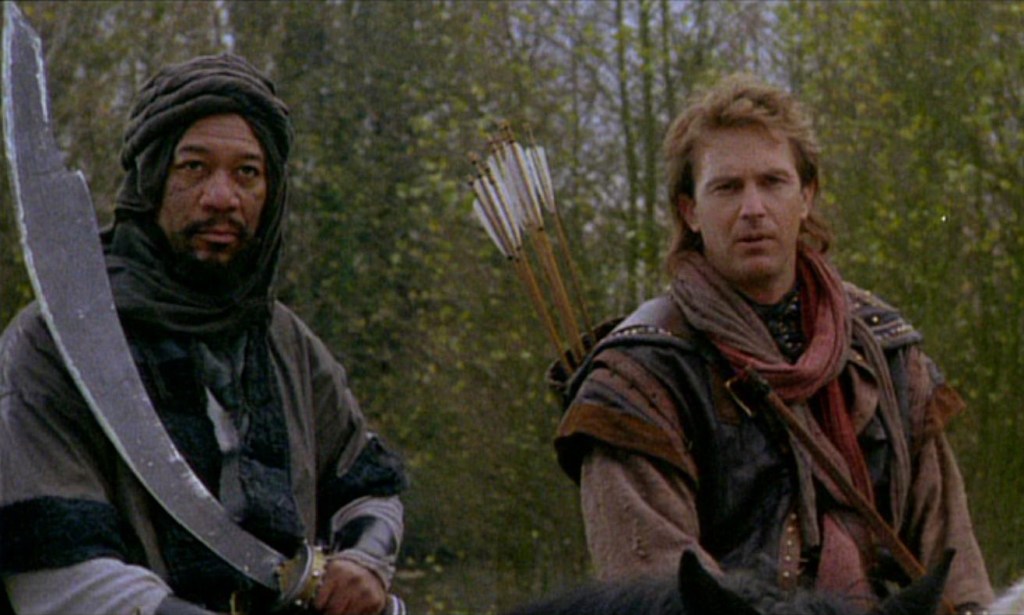
But who cares? Nothing in the film is meant to be taken seriously, and surely Reynolds and co reckoned we’d work that out when Costner – for whom five years in prison has made no impact on his film-star good-looks but left his fellow prisoners scrawny, wasted men of skin and bone – slams his hand down on an anvil and announces to a man preparing to cut his hand off “This is English courage!” in that Californian lilt. It’s not just him: accent-wise the film is all over the place. Christian Slater also makes no attempt at an accent while Mastrantonio’s is impeccable; the Merry Men come from all over the place, Mike McShane vaguely flattens his Canadian accent and Morgan Freeman goes all in on a Moorish accent. This all adds to the fun.

And what fun it is. Reynolds can shoot the hell out of an action set piece and if you don’t get a buzz from seeing Costner shoot a flaming arrow in slow-mo, firing another through a rope, or taking down rampaging Celts with them like they were heat-seeking missiles, there is something wrong with you. A flame-soaked battle in Sherwood is an action highlight – full of drama and terror – and the film’s closing grudge-match between Robin and the Sheriff a high-octane mano-a-mano sword fight.

It gains a huge amount from its impeccable score. Of course, we all remember Bryan Adam’s Everything I Do (it was number one for most of 1991). But the film’s real MVP is Michael Kamen, whose luscious, rousing score lifts even the film’s weakest moments to the heights of classic action adventure. The film’s opening number is a triumph of epic scene-setting. His work fills moments of triumph with joy, beautifully complements (and improves!) comedy and provides a genuinely moving romance theme that bolsters the chemistry between Costner and Mastrantonio’s strong-willed and independent Marian (even though film rules demand the woman introduced to us as something akin to a ninja ends the film a white-dressed damsel-in-distress).

The film’s other MVP is, of course, the late, great Alan Rickman. If you wonder why a generation of people worshipped Rickman, you need only look at his leave-nothing-in-the-dressing-room performance here. So reluctant to play another villain that he only agreed when given carte blanche to play the role however he wanted (including re-writing all his lines with the aid of friends Ruby Wax and Peter Barnes), Rickman delivers his second iconic villain after Gruber. He has a gleeful, OTT, pantomime glee, seething with frustrated impatience at his incompetent underlings but carrying more than enough genuine menace to be threatening. Every line he has – almost every single one – is laugh-out loud funny, either due to its grandiosity or Rickman’s utter commitment and darkly sexy energy (he also makes a beautiful double bill with Geraldine McEwan: two pros milking the film’s comic potential for all it is worth).

Rickman dominates the film – although of course, as he himself said, he had the far more fun and wilder part than Costner – and is central to many of its most iconic moments. What makes it work is Rickman is very serious about not taking the film very seriously: he’s not laughing at it or wanting us to know how superior he is to it: instead he throws himself with gusto into an all-action panto.

With this sort of thing, you can forgive the film’s wildly inconsistent tone (it ends with a prolonged semi-rape joke for goodness sake!), its at times forced attempt to suggest a community among a random collection of Brit character actors playing the merry men, or its meandering into some dark material. Morgan Freeman not only shows surprising action chops, he also gets a showcase for his mentor and comedic abilities. The resolution of the antagonistic relationship between Robin and Will Scarlett is surprisingly effective (it’s another note of the film’s bizarreness that we are meant to believe Costner and Slater both sprang from the Blessed loins) and those action set-pieces work.

The film wasn’t always a happy experience – Reynolds was forced to shoot it in ten weeks on no real prep and was locked out of the editing suite – but perhaps the rush helped create the boisterous adventure we end up with. Maybe years of study and research would just have been less fun. Who cares about dusty books when Robin and Marian can kiss at a misty riverside to the tune of Bryan Adams or Costner splits an arrow in two with another arrow at a thousand paces? Robin Hood: Prince of Thieves is a big, silly, action film full of flaws. And I wouldn’t change a frame of it.
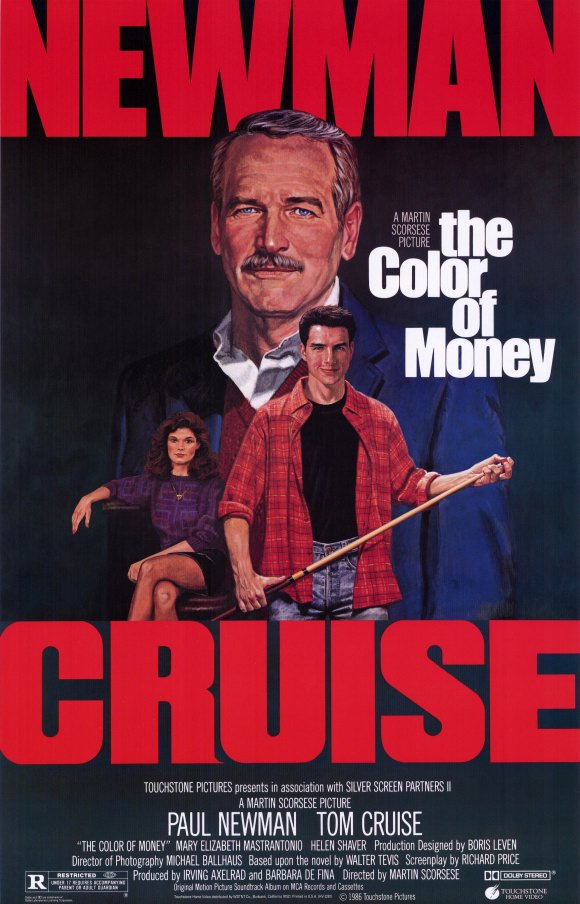
The Color of Money (1986)

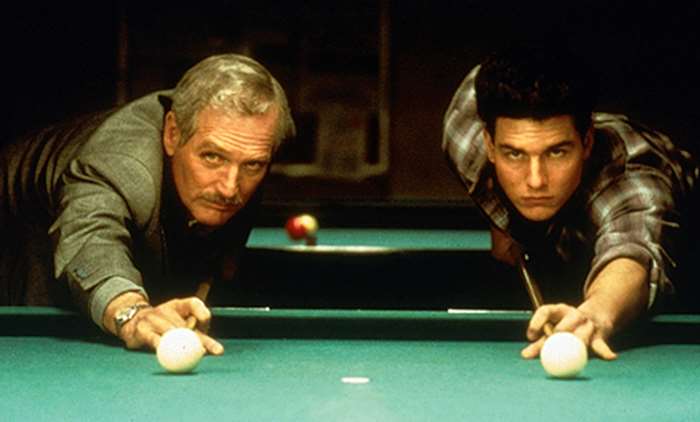
Newman and Cruise set the table in The Color of Money

Director: Martin Scorsese

Cast: Paul Newman (“Fast” Eddie Felsen), Tom Cruise (Vincent Lauria), Mary Elizabeth Mastrantonio (Carmen), Helen Shaver (Janelle), John Turturro (Julian), Bill Cobbs (Orvis), Forest Whitaker (Amos), Keith McGready (Grady Sessions)

The Hustler is one of Newman’s most iconic roles. It’s remembered for his cocksure cool, leaning across the table and dispatching balls with a twinkling smirk. What people don’t remember is that The Hustler is actually more of a kitchen-sink drama than a Rat Pack party. It deals with depression, assault, corruption, injustice and suicide. It’s not even remotely a laugh a minute. The Color of Money is a belated sequel, that feels made by people who remember their impression of what The Hustler was, but don’t actually remember the tone of the film itself. But then, Scorsese intended from the very start to make an entertainment to showcase a star, so I’m sure he knew that making a real tonal companion to the original film was always going to be a no-no.

It’s 25 years since “Fast Eddie” Felsen (Paul Newman) was banished from pool clubs throughout the land by gangsters. He now earns a living selling booze to clubs, largely so he can hang out pool clubs and mentor and stake the ‘hustler’s and stars of tomorrow. The kid who catches his eye is Vincent Lauria (Tom Cruise) an exceptionally gifted pool player with a cocksure confidence and a love of the game, that perhaps reminds Eddie more than a little of himself. Vincent, and his girlfriend Carmen’s (Mary Elizabeth Mastrantonio) grifting skills leave a lot to be desired: but Eddie sees promise and takes them out on a road trip to train them up and make a fortune.

It’s a fitting title, as it’s pretty clear that The Color of Money was the main thing on Scorsese’s mind when he made this. Don’t get me wrong, this is an enjoyable and well-made star vehicle, but it’s also the only time Scorsese was a hired gun working for a star who made films he grew up watching. Scorsese has spoken openly that his main aim here was to bring it in on time and on budget (he made it faster and cheaper than that), in order to help win studio backing for The Last Temptation of Christ. (Ironically of course, most people have far fonder memories of The Color of Money than that film, but then this is a film designed to entertain not challenge.)

It’s a fairly traditional and even predictable storyline. The mentor and the mentee, the latter jaded but rediscovering some of his old fire from the callow exuberance of the other. To be honest not very much actually happens in the film other than pool games and some predictable feuds before the final reconciliation. Inevitable lessons are learned and understandings are achieved. Compared to The Hustler, this is a very callow piece of work indeed, a straight entertainment vehicle that takes the fun, memorable beats of the original and crafts a whole film around them. In many ways you could argue it’s as much a sort of spiritual sequel to Newman’s work in The Sting as anything else.

But Scorsese shoots the hell out of it, so there is always something to look at. No end of editing and camera tricks are used for the pool games, which are shot like action sequences. Swift pans, tracking shots, sharp camera spins are all used to turn a game of knocking nine balls into pockets into something epic. Interesting shots abound, especially several sequences where a camera is mounted on a car bonnet to product an odd Steadicam effect. This is work way beyond a journey-man-pro director, but compared to Scorsese’s other works it’s minor. Scorsese opens the film by delivering a voiceover introducing nine-ball-pool, but the film never feels personal.

What it is, is a triumph for its two leading men. The year before Newman had won an honorary ‘career’ Oscar, which he accepted with a slight air of surprised resentment. No wonder, since he won a ‘real’ Oscar a year later for this reprise. To be honest, the film doesn’t ask anything particularly demanding of Newman, compared to the heights he had achieved in, for instance, The Verdict. It’s a lot of charm and aged confidence, mixed with a mentor exasperation and an unspoken concern that his powers are fading. Newman does spice things up with some interesting character work – there is a great scene when Eddie berates himself for being suckered by pool shark Amos (also a beautiful cameo from Forest Whitaker), humiliated for having lost his touch. But, whereas the first film was a below-the-skin character study, this is more like a victory parade for a charismatic star who even signs off the film by stating “I’m back!”. He’s great but not challenged.

Cruise raises game as he always does when working with legends (see also his work with Hoffman and Nicholson). The film captures perfectly both his cocksure confidence and the gentleness and vulnerability that Cruise manages to hide beneath it. You only need to see how vulnerable and scared Vincent is of being abandoned by the more sophisticated Carmen, to know that his karate moves with a pool cue while singing along to Werewolves of London is a front of a young man wanting to look like a big one to the world. Mastrantonio is pretty good in a fairly simplistic role, that is essentially a twist on a hooker-with-a-heart-of-gold.

The Color of Money offers up fairly predictable charms and plot twists and no real surprises at all. While its original film was a piece of neo-realism tinged social drama, this is a brash entertainment, stuffed with pop songs and charismatic actors doing their thing. All pulled together by a director who wanted to prove he could make something as glossy and empty as the next man. Entertaining but forgettable.

Scarface (1983)

“Shay hell-o to my leetle friend!” Al Pacino puts it all out there in Scarface

Director: Brian de Palma

Cast: Al Pacino (Tony Montana), Steven Bauer (Manny Ray), Michell Pfeiffer (Elvira), Mary Elizabeth Mastrantonio (Gina), Robert Loggia (Frank Lopez), Miram Colon (Mama Montana), F. Murray Abraham (Omar), Paul Shenar (Alejandro Sosa), Harris Yulin (Detective Bernstein), Mark Margolis (Shadow)

Remember when Al Pacino played the softly spoken, chillingly self-contained Michael Corleone? Watching The Godfather, who could have imagined that performance would be the outlier in a career that gleefully embraced the insanely OTT in a way few other great actors have dared. And possibly no other performance in Pacino’s career was as large as in Scarface, a ball of nervous energy, foul-mouthed aggression and drug-fuelled instability, the burning heart at the centre of Brian de Palma’s wildfire of a film. Scarface dials every single thing up to about 11 and then some, becoming the director’s brashest and most enduring work – but it owes everything to Pacino’s furious, unreserved energy at its centre.

Pacino plays Tony Montana, a working-class crook from Cuba dispatched (along with boatloads of undesirables from Castro’s regime) to Miami in the early 80s. There, in refugee camps and the local community, it’s crime and violence that give these guys the best chance of grabbing a share of the American Dream. Montana is no different, graduating from hits to drug deals and swiftly moving up the chain with his determination, gruff no-nonsense attitude, fierce loyalty and ruthless focus. But once you hit the top and the world is yours, there is really only one way to go – back down again, made easier when you are hooked on snorting mountains of your own product, incestuously in love with your sister Gina (Mary Elizabeth Mastrantonio) and your increasing arrogance and unreliability put you on the wrong side of your partners and kingpins in South America.

A remake of the 1932 original by Howard Hawks (the film is dedicated to Hawks and the scriptwriter Ben Hecht), Scarface is a brash, unsettling, nervy and incredibly violent cartoon-style gangster movie that owes almost its entire legacy to Pacino’s snarling wit at the centre. Is Pacino taking the piss here with this performance? Surely, he must have wondered if he could get away with it. This is a whirlwind tour-de-force, Pacino throwing himself into it with nothing left in the locker-room. He delightedly wraps his vocal chords around a thick Cuban accent (turning words like cockroach into a three syllable delight – “Cock-ah-roatch”) and embraces his small stature by turning Tony into a little pressure cooker. Seemingly incapable (bar one scene) of staying still, he’s supremely tense, his shoulders hunched up, his teeth on edge, voice growling.

It gives the film an unpredictable energy, because you don’t know what Pacino the performer will do any more than the characters do. He’ll suddenly throw you off with a moment of silence, just as often as he will blast your eardrums with a roar of anger. Emotionally Tony is a complete mess. His obsession with his sister is obvious, a devotion that Tony seems to only half (if that) understand is sexual in nature. But he also has a slight homoerotic bond with best friend Manny Ray (Steven Bauer – the only actor of Cuban heritage in the film), their closeness and macho-posturing carrying more than a whiff of Top Gun-ish “he protests too much”.

Pacino also invests Tony with strangely sympathetic qualities. Sure he’s a violent and ruthless killer and dedicated criminal, but he’s also got a firm sense of loyalty and certain moral lines he won’t cross. He’s got no time for bullshitters and respects only strength and honesty – watch the scene where he brutally talks over the weasely Omar (F. Murray Abraham – jetting back and forth between shooting this and Amadeus for goodness sake!) during a negotiation with drug lord Sosa – he has no respect or regard for his more politically minded boss, only for straight-talking that makes a deal.

It’s all this that ends up making Tony an anti-hero the viewer sort of ends up liking – even while he dopes himself to the brim with coke and funnels piles of it onto the street (not that we see any of that). Tony is a violent killer, but he’s a sort of honest man, a monster yes but a public one that we enjoy seeing. Tony himself recognises this, calling out a crowd of people in a posh restaurant for treating him as a monster so that they can feel better about themselves (slightly undermined by the fact he’s coked to the eyeballs, incoherent and has brutally ended his marriage a second earlier).

So much is Tony a force of nature that, hilariously, it feels like many of the fans of the film – bling gangsters and wannabe street punks – miss that this film is a brutal satire of the culture of excess and greed. Tony’s life falls apart the more money he gets, his addictions and problems growing as his wealth does. He’s an instinctive, but not wise, man who builds a household of fantastic excess and tasteless ostentation (surely, like Saddam, his taps are gold-plated) but also manages to destroy his business and life in a few months due to his greed, stupidity and self-destructive streak.

The things that made him a high-riser are lost the more Tony surrounds himself with garish status symbols. Inevitable destruction walks hand-in-hand with Tony’s “more is more” attitude. The more he attempts to add class and polish to his life, the more he demonstrates his own lack of both qualities. Also, as he gets more obsessed with pointless status symbols he loses the very skills – honesty, energy, shrewdness – that made him a kingpin in the first place. Instead he becomes a drug-fuelled narcissist, making impulsively stupid decisions and wrecking everything he spent the first half of the film building up. Tony Montana is the face of a certain type of Reagan/Thatcher economics, where private enterprise rolls in and ruthlessly takes and takes, with no regard for the impact on other people and no interest in sustainability.

De Palma captures this pretty well – although he probably ends up making this satire of excess more of a hubristic tragedy. Largely because the film falls so hard for Tony – or rather Pacino – that the fact that Tony is, despite his own moral code, a pretty reprehensible person can be easily lost. Not that de Palma probably cares that much, since his main aim here seems to be to create a hell of a ride. And there are some great set-pieces, and some wonderfully character beats – not least a sequence where Tony seizes control of the empire from weak boss Robert Loggia and sinister corrupt cop Harris Yulin.

The film certainly does that, flying from set-piece to set-piece so swiftly and with such a sense of pace and shark-like momentum, you almost don’t notice that it runs for as long as it does. Every few minutes gives us a scene with stand-out moments of either Pacino grandstanding, shocking violence or both. Scarfaceis a very violent film – everything from chain saws to bullets are used to pull gangster bodies apart – and while it has a sort of moral message (“Excess is bad”) it’s really just an excuse like Cecil B DeMille to make us feel good about ourselves by watching someone pretty bad (but with a few redeeming qualities) dance like a bear for two and a bit hours doing terrible things (entertainingly) before being carved down in a hail of bullets as the devil comes round to collect.