
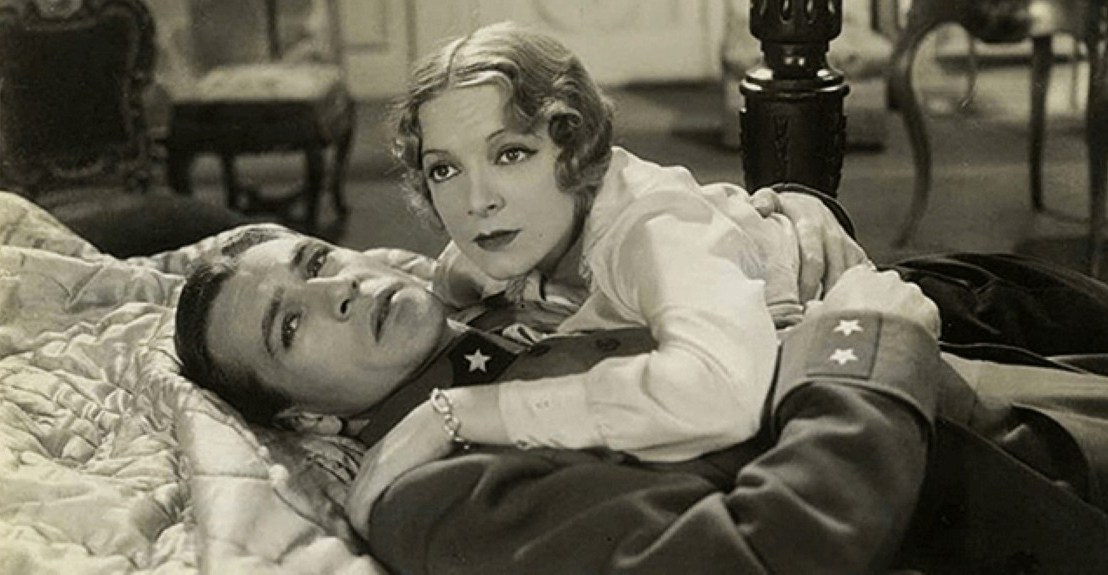
Hemingway hated this lusciously made high romance version of this novel, very well-filmed
Director: Frank Borzage
Cast: Helen Hayes (Catherine Barkley), Gary Cooper (Lt Frederic Henry), Adolphe Menjou (Captain Rinaldi), Mary Philips (Helen Ferguson), Jack La Rue (Priest), Blanche Friderici (Head Nurse), Mary Forbes (Miss Van Campen)
If there was one thing Ernest Hemingway got out of David O Selznick’s A Farewell to Arms it was a lifelong mate in Gary Cooper. Presumably, they agreed never to discuss the film during their boozing sessions, as Hemingway loathed it. Probably because Selznick’s crowd-pleasing version carefully strips out the political and moral themes of Hemingway in favour of ramping up the romance. Of course, Selznick was right that it’s quite a damn big part of the book. But it’s not how Hemingway liked to see it.
In any case, a romance is what we get – and, of course,it’s tinged with tragedy. Lt Frederic Henry (Gary Cooper) is an American serving during the First World War with the Italian Army ambulance corp. Returning to hospital, he encounters English nurse Catherine Barkley (Helen Hayes), herself mourning the death of her fiancée. After an initial bad impression, they start a romance. One that’s hard to sustain across the vast distances of war and the jealous censoring of their mail by Henry’s friend Captain Rinaldi (Adolphe Menjou) who hates his pal losing his head over a woman. When a pregnant Catherine has desperate news, fate conspires to keep them apart.
Hemingway was of course right that this version of his novel was more a tragic romance, rather than the sort of state-of-moral-consciousness story he felt it was. It almost wasn’t even a tragic romance, since Selznick had two endings shot, with the happy ending attacked to many out-of-city screenings. The film still struggled, cut down by ten minutes after its release to meet the stringent requirements of the production code. But I wonder, did Hemingway really prefer the more serious, self-important remake that followed? (Probably not, since he famously told Selznick to shove it up his ass).
At least with this Farewell to Arms he had the rich, imaginative camera work by Frank Borzage. There are several striking tracking shots, as Borzage follows in the wake of characters entering the grand houses converted into hospitals. There is also some gloriously imaginative work where the camera takes the place of Cooper as he is wheeled into hospital on a gurney in a sustained POV shot. Ceilings track past us, faces loom in over the frame and it culminates in an almost completely unclear close-up of Hayes as she looms tightly into shot to inspect him. Combine that with a striking filmic montage that plays out the horrors of combat in one well-edited montage (in addition the very first shot is a corpse on a hill – no doubt war is hell) and you’ve got some striking film-making throughout from a director with an impressive visual eye.
Farewell to Arms also has a perfectly cast lead for Hemingway. Cooper is everything you might want from this novelist’s hero: a man’s man without a shadow of a doubt but, in true Cooper style, also sensitive, innocent and strangely child-like and vulnerable. There is no relish for combat in him, he’s an architect who lingeringly chats about his ideas. He’s got a playful bashfulness with women – few other actors would have made their character seem more innocent when framed playing with a good-time-girl’s foot across a table in a bar. By the end of the film, Cooper genuinely feels like a lost soul, like a big kid waiting for an adult to come along and fix things.
It works particularly well, because it’s important to Farewell to Arms construction that Cooper should never feel like a rogue. It’s only awful circumstances and terrible deeds that keeps him apart from Hayes. Left to his own devices he would have course rushed to her side: the film using this moral fidelity to justify the pre-marital sex the couple engage in. Much of the content more openly addressing this was, of course, snipped in the post-code re-edit – but it’s hard to escape when the entire plot revolves around Catherine being pregnant in the end.
The romance element remains however the primary calling card. Borzage, who often favoured high romance (especially in the face of adversity), clearly felt A Farewell to Arms was made for him. He even manages to work around the vast height difference (nearly a foot!) between Hayes and Cooper (who towers over her in mid-shot). Much of A Farewell to Arms is given over to their courtship and romance: from a muddled first meeting, confusion over a kiss to the warm embraces of Henry’s sick leave under Catherine’s care. Hayes gives a decent performance as Catherine, even if she seems a little more forced and mannered than Cooper’s relaxed naturalness. The increasingly grand tragedy of the film’s closing moments also leads to her leaning in a little too much towards intense stares and breathy line-deliveries.
Perhaps most interestingly though, there is another unspoken romance at the heart of A Farewell to Arms. The adaptation dials up the importance of Adolphe Menjou’s spaghetti-accented Captain Rinaldi. Menjou does fine work as this fun-loving, irreverent surgeon, but by making him the jealous reason for the lovers’ separation, it’s hard not to infer a homoerotic element in his feelings for Cooper’s Henry. Surely, it’s more than friendship that cause Rinaldi to travel across country to treat his friend. It’s hard not to read something into his continued irritated complaints about how ‘unmanly’ Henry is by allowing himself to he wrapped up in a woman, or the casually spiteful way he prevents them writing to each other. There is more than a little of the jilted lover to Rinaldi, a fascinating sub-plot you wish the film could explore more.
Borzage’s film may have been despised by the novelist, but it has some fine moments. Sure it’s romance often seems to fit very naturally into a traditional Romeo and Juliet style-template and its frequently more inspired in its framing than it is in the pace and depth of its storytelling (there is also, as well, a faint lack of chemistry between the stars). But there is a fine performance by Cooper and much to enjoy in its tight, lean frame, even if it never manages to find true inspiration.
 Movie Musings