Tag: Mary McDonnell

Donnie Darko (2001)


Welcome to the weirdness: Donnie Darko ultimate 00’s cult hit

Director: Richard Kelly

Cast: Jake Gyllenhaal (Donnie Darko), Jena Malone (Gretchen Ross), Mary McDonnell (Rose Darko), Holmes Osborne (Eddie Darko), Katherine Ross (Dr Lilian Thurman), Maggie Gyllenhaal (Elizabeth Darko), Daveigh Chase (Samantha Darko), James Duval (Frank), Drew Barrymore (Karen Pomeroy), Patrick Swayze (Jim Cunnningham), Noah Wyle (Dr Kenneth Monnitoff), Beth Grant (Kitty Farmer)

Donnie Darko was a surprise cult hit. In fact, it was such a cult hit that Kelly made a “director’s cut” version of the film five years later. Funnily enough, the Director’s Cut was largely rejected by the very people who loved the first film. Why? Well probably because the film was loved because it was so weird. It was so esoteric, so hard to understand, so much of its logic unclearly defined, that much of that love was based on trying to work out what the hell is going on in it – and the director’s cut supplies lots of answers, ruining the game! 

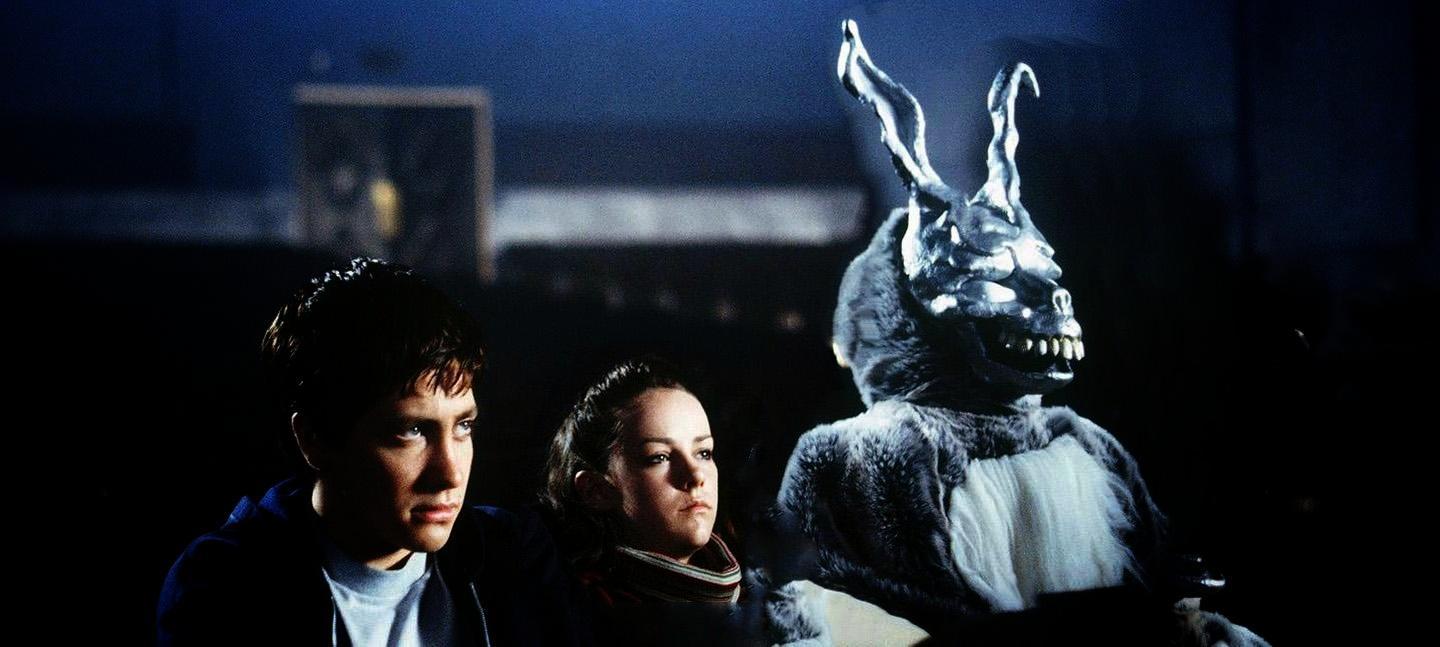
In 1988, troubled teenager Donnie Darko (Jaky Gyllenhaal) sleepwalks out of his house onto a local golf course and meets with a mysterious figure in a gruesome rabbit costume – “Frank”. Frank tells Donnie the world will end in 28 days, 6 hours, 42 minutes and 12 seconds. Donnie sleeps on the golf course overnight – and returns home to find a jet engine has crashed through his bedroom. Plagued by strange visions and hallucinations, and visitations from Frank, is Donnie suffering from schizophrenia or is he genuinely in a position to save the world? And is there a danger from the way Frank is starting to influence Donnie’s actions?

Richard Kelly’s film is a bizarre, inventive, dreamy, creepy oddball flick that deliberately never really explains what the hell is going on. Never mind the mystery of Donnie’s mental state – the film’s confusing structure, its unexplained elements of time-travel, mind-control and predestination, all of this is just left hanging out there. It’s actually a testament to how much restriction can sometimes be the mother of invention. Kelly was told that the film could not be longer than a couple of hours, meaning a lot of the more traditional explanation (reintroduced for the director’s cut) was removed to keep the run-time down. But the great thing is, this actually leaves it very open for the viewer to create their own idea of what the film is about and what is going on. It really works.

This is particularly because Kelly manages to marry the clever-clever weirdness with a real emotional investment in the characters. Not just in Donnie either: his family are all extremely well-drawn, who we grow to care for over the course of the film, from his cheery father to his loving but frustrated mother, brilliantly played by Mary McDonnell. Equally strong is Maggie Gyllenhaal as Donnie’s sister. These characters, along with dozens of other characters quickly established, but all feeling very real, are what keep you interested in the film. If it was just oddness and alienating weirdness, it would be hard to care. But this is a story that mixes science fiction oddness with genuine family drama heart.

There is a lot of oddness in there though. Frank is a character practically designed to be iconic, a twisted giant rabbit like a demonic Harvey. Combined with this are a series of curiously unsettling images and storylines. So we get Donnie with visions of streams of transparent liquid streaming out of people’s chests – possibly their future paths leading them forward. We get Donnie facing strange barriers, that seem to repel and reflect his world. Donnie is plagued with strange visions and increasingly unsettling instructions from Frank. He carries out a series of impossible feats under Frank’s direction. There are elliptical conversations about time travel and physics and while the film drops hints it never explains a damn thing. So when you finally get to the end – well lord alone knows what happens, but you’ll certainly have a hell of a lot of fun trying to work it out.

Around this, the film cuts rather a neat parody of teenage life in the 1980s and the 1980s Brat Pack films. Actors like Drew Barrymore and Noah Wyle have a lot of fun as closeted liberal teachers struggling in a school is run by an oppressive, fiercely religious set of governors. But not as much fun as Beth Grant as a PE cum civics teacher, both blinkered in her love of traditional education (and “safeguarding our youth” from the dangers of literature) while in love with Patrick Swayze’s smug self-help guru (whose bullshit “conquer your fear” videos and mantra are a superb spoof). The film has a nice eye for the politics of school classes, and placing this end-of-world fear into the all-consuming self-importance of teenage life works very well.

Throughout Kelly shoots with a confidence that belies his “first-time film director” status. Yes there is the occasional overly clever camera shot that you get from someone enjoying the toy set for the first time, but there is lots of terrific stuff. His assembly of events is brilliant, he works with actors very well indeed.

But the other factor that really makes the film work is Jake Gyllenhaal’s superb performance in the lead role. Gyllenhaal gets the balance between Darko’s vulnerability and his (possible) darkness absolutely spot-on. He manages to turn himself perfectly into a gangly, awkward, nervous kid – totally believable as the sort of young man unsure of where he stands in the world and angry. It feeds perfectly into the mystery of the film. Is Donnie a dangerous schizophrenic? Or is he right in thinking he might be important? Gyllenhaal captures all this, but also really makes us care for Donnie, turning him into someone truly sensitive and confused (helped as well by a very good Jena Malone as his awkward love interest). It’s a brilliantly distinctive performance that captures a true idea of teenage difficulties.

Any maybe that’s also why Donnie Darko works so well. Because it’s as much about teenage awkwardness and not knowing what you are doing here and why, as it is all the bizarre and unexplainable pseudo-science, time travel and predestination paradoxes that the film allows to play around the edges. It places at the centre of a brilliant science fiction drama, a real human and emotional story that feels very real and grounded and like something we have all experienced at one time in our lives. It’s a puzzle and mystery that also has a heart. It’s a difficult trick to pull off – so difficult Kelly has failed to pull it off again since.

Dances with Wolves (1990)

Kevin Costner finds his inner peace in Dances with Wolves

Director: Kevin Costner

Cast: Kevin Costner (John Dunbar/Dances With Wolves), Mary McDonnell (Stands With A Fist), Graham Greene (Kicking Bird), Rodney A. Grant (Wind In His Hair), Floyd Red Crow Westerman (Chief Ten Bears), Tantoo Cardinal (Black Shawl), Jimmy Herman (Stone Calf), Nathan Lee Chasing His Horse (Smiles A Lot), Michael Spears (Otter), Charles Rocket (Lt Elgin), Robert Pastorelli (Timmins), Tom Everett (Sgt Pepper), Wes Studi (Toughest Pawnee), Maury Chaykin (Major Fambrough)

At the end of the 1980s, Kevin Costner was the biggest film star in the world, with a string of hits behind him. So he did what Hollywood stars before and since have done: cashed in all his chips and made the film he had to make. It would be long, it would be mostly in a foreign language, it would have no stars (other than himself) and – most poisonous of all at the time – it would be a Western. When the funding started to dry up, Costner even paid for the overtime out of his own pocket. Not for no reason was the project dubbed “Kevin’s Gate” by the sceptical media, eagerly expecting Hollywood’s golden boy to land on his face.

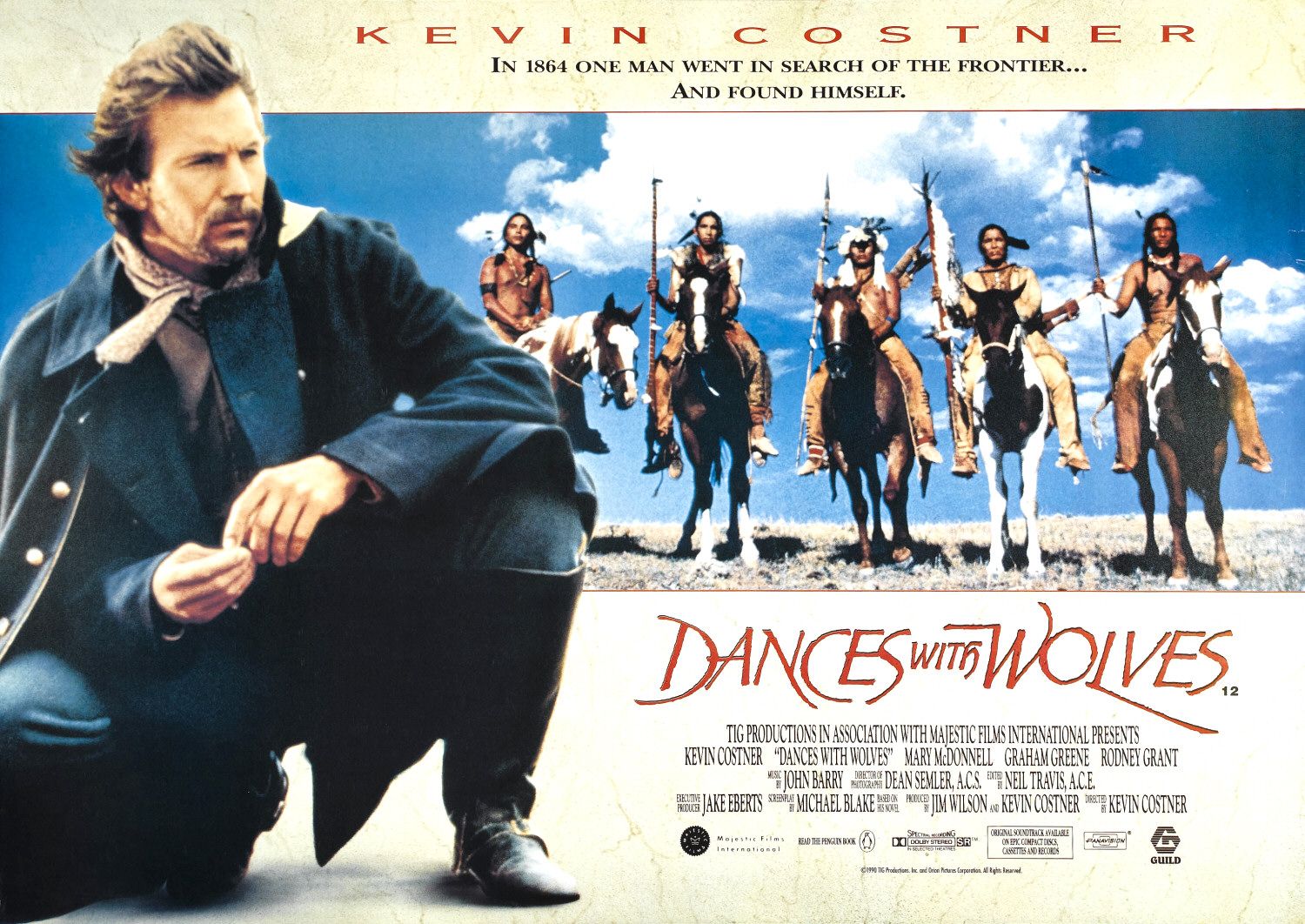
How wrong they were. Dances with Wolves not only made almost 20 times its budget at the box office, it changed many Americans’ perceptions of Native Americans – oh yes and it also won seven Oscars, including Best Director for Costner and Best Picture. Costner plays Lt. John Dunbar, a civil war veteran who (after an act of suicidal death-seeking foolishness to avoid having his leg amputated) chooses a posting to an abandoned fort in the middle of Sioux country. Forgotten by the army, Dunbar forages alone and comes to the attention of the Sioux. At first cautious around each other, Dunbar eventually befriends healing man Kicking Bird (Graham Greene) and finds himself cautiously welcomed into the Sioux tribe as a guest, finding love with Stands With A Fist (Mary McDonnell), a white woman raised by the Sioux. He begins to find the Sioux as kindred spirits.

Costner’s film is an expansive, heartfelt poem, a film in love with sweeping vistas and with an endearing, humanitarian view of the world, beautifully shot by Dean Semler and helped immensely by a wonderful, swelling lyrical score by John Barry – one of the best scores you are likely to hear. Costner dispels any doubts about his abilities to direct by throwing himself into a truly epic canvas – and some of the ideas here are reminiscent of Lean, in their beautiful use of the American plains. Within this large canvas, Costner tells an actually fairly simple, but also sweetly touching, story of the disillusioned man who finds himself in the wilderness.

If there is a flaw with Dances with Wolves it is that its story is so traditional and (in many ways) predictable. It’s understandable that the story introduces a white man to be our surrogate when encountering the Sioux. But it’s hard to shake the feeling of all that all-too familiar trope, the White Saviour. The primary good the Sioux serve in the film is to help Dunbar discover himself, to come to peace with himself. In turn, it’s Dunbar who increasingly becomes the tribe’s protector – helping them to find the buffalo, giving them guns and leading the defence against a Pawnee tribe attack, increasingly recognised as a “celebrity” in the tribe.

On top of that, Dunbar’s love interest becomes the only other prominent white character in the film. Again I understand that the film needed someone who was able to serve as a cultural and language bridge between Dunbar and the Sioux. But could there not have been some sort of narrative invention to make this female character a Sioux who had learned some English? It seems as if the film can only go so far – and showing a multi-racial relationship was probably that. Saying that, McDonnell is very good as the gentle Stands With A Fist, but it feels like a cop-out.

Costner’s own central performance gives everything the film requires. It’s a fairly simple role: the disillusioned soldier finding inner peace. The film plays very much into the attraction of the “noble savage” – the simplicity and honesty of the Sioux lifestyle being so much purer than the corruption of the “modern” world (needless to say, nearly all the white men in the film are truly awful people). But Costner brings his considerable charm to bear, delivering many of his lines with that slightly cocksure, shy grin he uses so well. The film suffers from its narration being delivered by Costner’s flat and unmodulated voice, but he’s perfectly fine in the role.

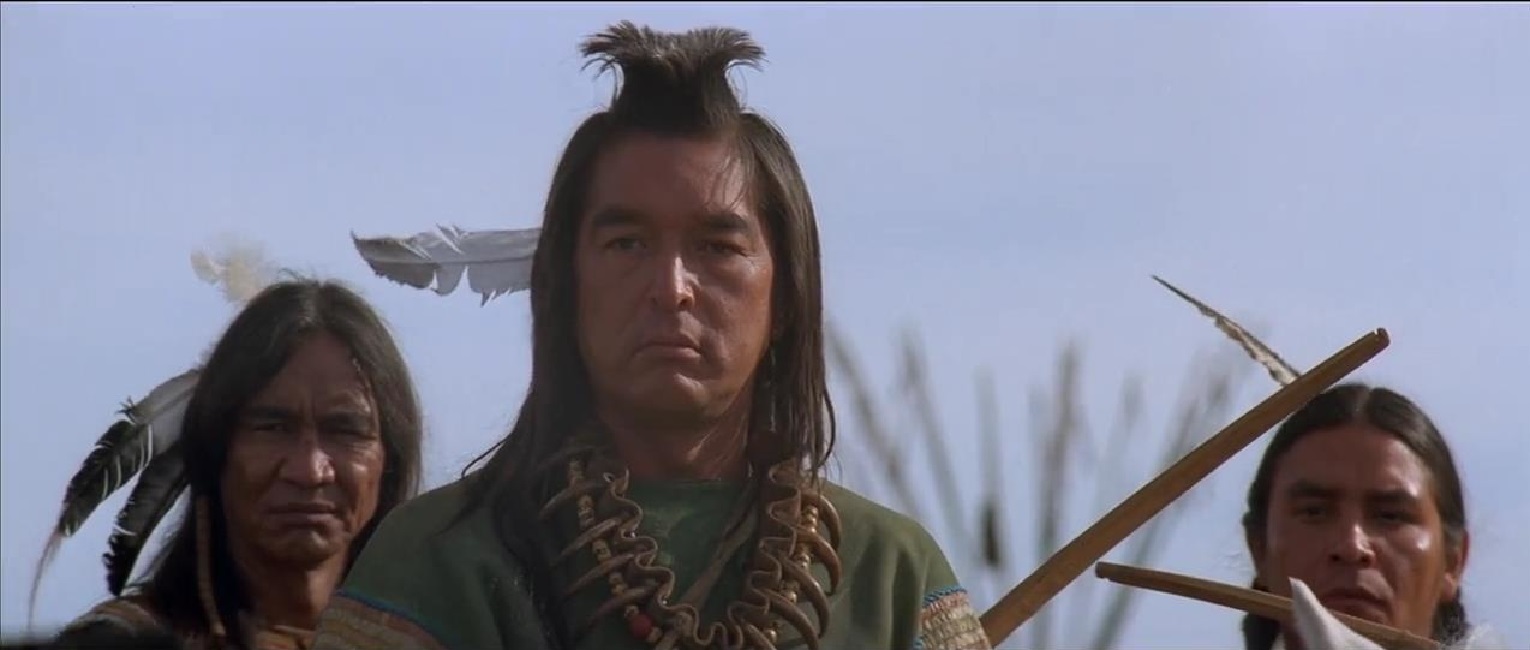
He plays it with an entirely straight honesty – and, for all its faults, this honesty makes the film work. The film goes overboard to humanise and provide empathy for the Sioux, as if wanting to correct generations of films that have cast Native Americans as dangerous savages. The Sioux are humane, generous, welcoming and dignified. Graham Greene has to carry much of this as medicine man Kicking Bird, and he gives a stirring, sympathetic performance, with equally fine performances from Rodney A. Grant and Tantoo Cardinal in particular.

The film delivers all its tropes and traditional structure with a straightforward, heart-warming simplicity – it really means that you go with the picture, and find yourself as drawn to the Sioux lifestyle as Dunbar is. Also, for all the criticism of the film’s narrative, it shouldn’t be forgotten what a warm reception it had from Native American groups, delighted to see their ancestors presented in such an empathetic light (the Sioux Nation later adopted Costner). And the film sensitively and brilliantly stages this way of life, with a series of beautifully done vignettes ranging from marriage to simple cooking and spending time around the fire.

The most stunningly filmed of these is the buffalo hunt, a soaring marvel of camera work, editing and horseback adventure. The film doesn’t let you forget the sequence before either, where the Sioux come across a series of buffalo killed for their hides by white hunters – in comparison to the complete use of the carcass (and limited numbers killed) by the Sioux. The buffalo hunt sequence is an exciting triumph – it’s probably responsible for several of the technical Oscars the film received – and it’s a tribute to Costner’s mastery of the visuals of the American West (even if, rumour has it, chunks of it were actually filmed by Kevin Reynolds).

Dances with Wolves is a very heartfelt and honest film – and its sincerity means it kind of gets away with its obvious flaws (and its great length). Costner wanted to make an important film and he does to a certain extent – but one which wears its importance fairly lightly, and makes a series of enriching humanitarian arguments that carry real weight. It’s in many ways an extremely accomplished retelling of a familiar story. But I found myself genuinely moved by the story it wanted to tell, and the questions it asks of its audiences. Is it a great film? Probably not, but it is a good one.