Tag: Matthew Broderick

Glory (1989)

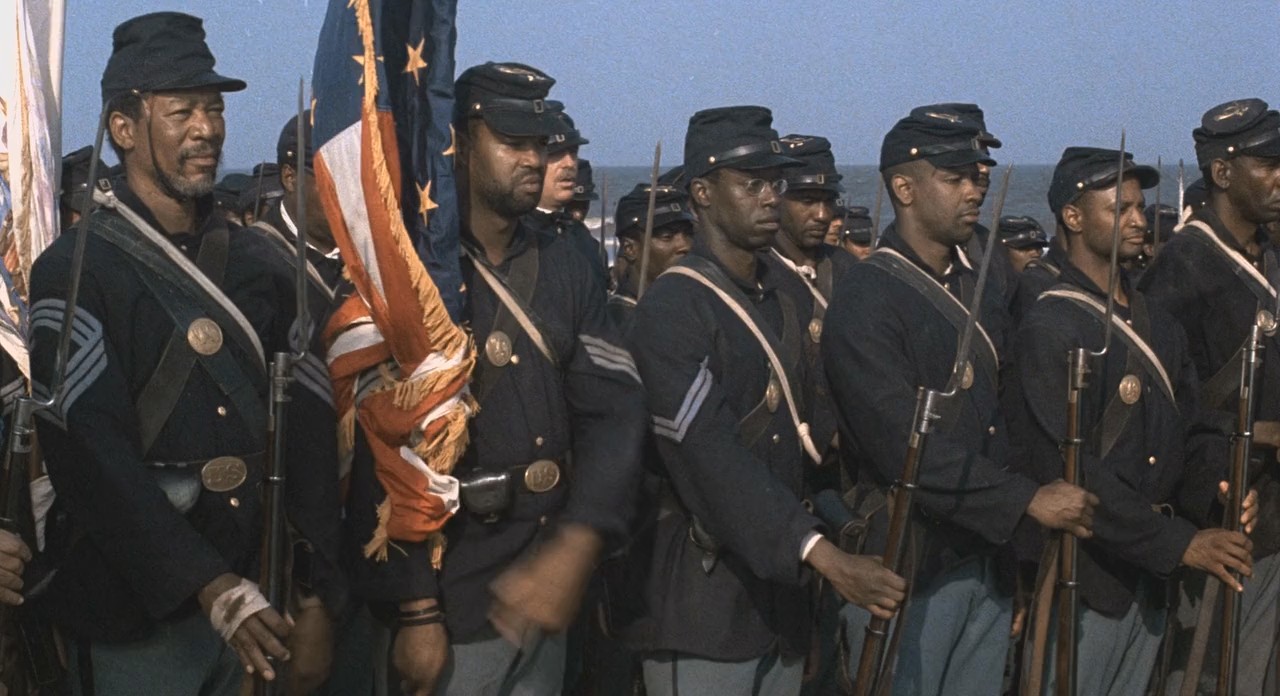
Morgan Freeman and Denzel Washington are among the first black American soldier in Glory

Director: Edward Zwick

Cast: Matthew Broderick (Colonel Robert Gould Shaw), Denzel Washington (Pvt Silas Trip), Cary Elwes (Major Cabot Forbes), Morgan Freeman (Sgt Major John Rawlins), Andre Braugher (Cpl Thomas Searles), Jihmi Kennedy (Pt Jupiter Sharts), Cliff De Young (Colonel James Montgomery), Alan North (Governor John Albion Andrew), John Finn (Sgt Mulcahy), Bob Gunton (General Charles Garrison Harker), Jay O Sanders (General George Crockett Strong)

The American Civil War started over slavery, but it took a long time for either side to admit it was a fight about slavery. Racism abounded on both sides, and it was a fight in which black Americans may have been the subject, but were rarely invited to join. Glory covers this point of history, and specifically the first all-black regiment and its struggle to be recognised as equal to the other regiments in the army. 

Wounded at the Battle of Antietam in September 1862, Robert Gould Shaw (Matthew Broderick) returns home to Massachusetts and accepts command of the first all-black regiment, which is currently being raised by abolitionists in the state. With his friend Cabot Forbes (Cary Elwes) as second-in-command (no one was progressive enough to actually allow black officers for the regiment), he recruits a wide range of black Americans, from free-man and bookish intellectual Thomas Searles (Andre Braugher) – an old friend of Robert and Cabot – to former slaves such as the wise John Rawlins (Morgan Freeman) and the resentful Silas Trip (Denzel Washington). Training is a struggle, with the army denying the regiment supplies and support, and it’s an equal struggle when they reach the front line to be recognised for duties other than looting and latrine digging. Will the Massachusetts 54th be given the chance to prove itself in the front line – and establish a black man can fight as hard and bravely as a white man can?

Edward Zwick’s beautifully filmed, carefully re-created historical epic set the tone for much of his future career. It’s an often overly-sentimental film straining for a very self-conscious sense of importance, weighed down by the pride at the “message” it is carrying. It often does hit the mark with presenting scenes that carry emotional force – but then seeing as it treats nearly every scene as being a “moment” that should move us (with James Horner’s choral manipulation working double time to get us experiencing feelings), it’s no wonder that it succeeds sometimes.

Which is not to say the message it presents isn’t an important one. Black Americans have often been pushed into the margins of American Civil War history. Or worst of all presented as the victims, reliant on the courage and bravery of the abolitionists of the North to save them from slavery in the South. Until Glory it was very rare for anything to push their stories front and centre – or to tell a story where former slaves were allowed to fight their own battles and choose their own destinies. 

It’s one of the strongest marks of the film: these are soldiers unlike any other, who enter battles with less concern about their own survival, and more about having the chance to live as freemen and to make a mark on the world. To show that they, and people like them, could do just as a white man could do. And if they had to die to do that, better to live a day on their feet as freemen then a lifetime on their knees. It’s the principle emotional message of the film, and something Zwick translates with some skill, even if he frequently overeggs the pudding while doing so.

However, with such a strong message, it’s a shame so much of the film is filtered through the experience of its white lead character. For many of the films of the 80s and 90s dealing with these issues – Cry Freedom, the Steve Biko biopic, with Biko as a supporting character to his white South African journalist friend, being perhaps the key example – it was essential to have a white man at the centre, as if worried that audiences couldn’t understand the story they were seeing unless they had it filtered through the perception of someone who looks a bit more like them.

Matthew Broderick takes on the lead role here of Shaw – with the film giving a significant slice of its running time to its coming-of-age theme of Shaw learning to become a leader of men – and while the character is meant to be callow and an unlikely Colonel, it doesn’t help that Broderick lacks the charisma for the part. Perhaps he is a little too lightweight an actor for such an enterprise, for a film that demands greater force of character (you can imagine Tom Cruise doing a much finer job in the role).  Similarly, the familiar beats of a young man learning how to lead feel trivial compared to the life-and-death issues facing his soldiers.

But too often Zwick’s film returns us to Shaw’s point-of-view, the narrative filtering so much of the action through his perceptions and decisions that the black soldiers become supporting actors in their own stories. Broderick is not helped by the soldiers being played by some of the finest American actors of the last 30 years. Braugher is fabulous in the thankless role of the bookish man who must grow a spine. Morgan Freeman established a persona – the wise and level headed older man, who will not let hate and fury define his life and his choices – that would last him for the rest of his career, and is superb (his Oscar nomination for Driving Miss Daisy is probably the only thing that led to him not getting a nod for this film).
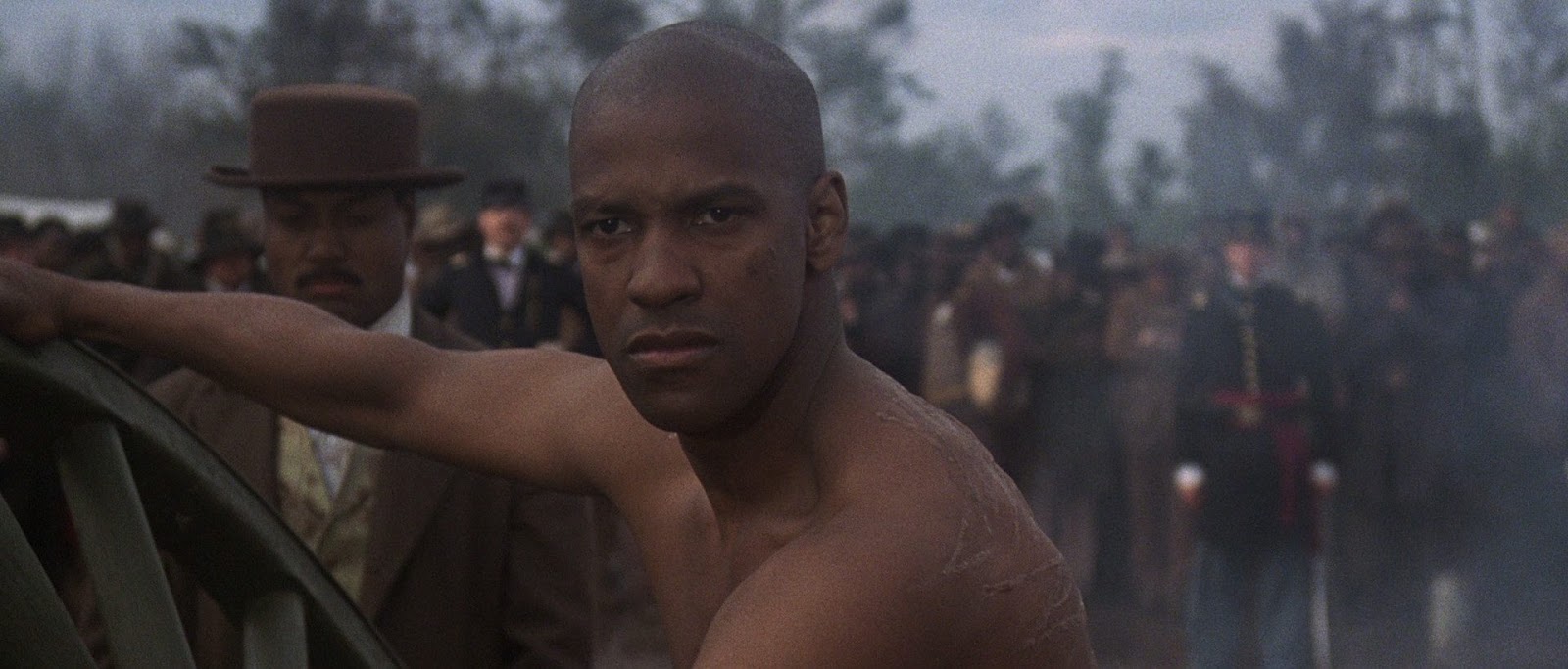
Denzel Washington took home an Oscar as the bitter, angry Trip – and it’s the sort of role an actor seizes with relish. Washington fills every frame with his rage at the system, his inarticulate, indiscriminate anger lashing out in every direction. It’s the fury of a man who has had all his choices taken from him in life, and would rather destroy things than run the risk of allowing himself to become committed to something, or form a bond. Washington probably won the Oscar alone for the astonishing scene where he silently, defiantly accepts a whipping (on a body covered with scars) for missing a curfew. He’s an elemental force of nature in the film.

There is plenty of strong stuff in Zwick’s work, but the film itself overplays its hand frequently. Moments of emotion are played so heavily to the hilt they sometimes fail to have an impact. It wants you to know at every turn that you are watching a film with an important social message – and the speechifying at points put into the mouths of the characters runs dry. While superbly made – veteran photographer Freddie Francis’ work is beautiful (and Oscar winning) – it’s a heavy-handed, overly pleased with itself film that knows all too well that it is about an important subject. While sometimes it lands – often in quieter moments, particularly those where Freeman and Washington are allowed to simply be human without overindulgent music cues hammering home the emotions – at others it comes across as too much.


Manchester By the Sea (2016)

Michelle Williams and Casey Affleck deal with terrible burdens in Manchester By the Sea

Director: Kenneth Lonergan

Cast: Casey Affleck (Lee Chandler), Lucas Hedges (Patrick Chandler), Michelle Williams (Randi), Kyle Chandler (Joe Chandler), Gretchen Mol (Elisa Chandler), CJ Wilson (George), Tate Donovan (Hockey coach), Kara Hayward (Silvie), Anna Baryshnikov (Sandy), Heather Burns (Jill), Matthew Broderick (Jeffrey)

There are many films that front and centre the catharsis of overcoming grief. You know the sort of thing: the feel-good story of someone dealing with the impact of crushing events to emerge renewed and with a certain level of acceptance for the hand that life has dealt them. It’s rare to have a film that takes a very different approach – for it to tackle grief and the impact it has as a never-ending burden on your life, like a companion that will stay with you forever but which you must accept will colour every moment for the rest of your life.

Lee Chandler (Casey Affleck) is a quiet, inexpressive handyman in Boston who seems to be barely keeping under control a temper that explodes in the odd unprovoked barfight. Content to let his life drift away in a dead-end, poorly paid, job, Lee is summoned back to his family’s home in Manchester by the Sea, a coastal town in Massachusetts, after the death of his brother Joe (Kyle Chandler) from a heart condition. Much to his surprise, he discovers that Joe has named him as the guardian of Joe’s teenage son Patrick (Lucas Hedges). But Lee has no intention of remaining in this forced parental role – or of staying in Manchester by the Sea, his former home until he suffered an unbearably tragic loss for which he blames himself.

Manchester by the Sea seems ripe for setting up as a conventional tale of grief. All the ingredients are there: the man who is thrown together with a young teenager, the terrible tragic background event that he can never forget, the bottled up emotions that seem to be crying out for a big “cathartic” moment where all those emotions can be let out, a possible father-son relationship developing that can lead to Lee re-engaging fully with the world… It’s a testament the film’s courage that it avoids nearly all of these completely. Instead it offers a picture of life’s tragedy that feels human, studied, earned and above all real.

For starters, Lee is consumed with grief – and is unable to move on from it. This becomes much easier for the viewer to understand once we are introduced to the reason for his tragic mood halfway through – although hints have been dropped in flashbacks that are brilliantly woven (seemingly at random, but in fact with great thought and planning) throughout the film, where he has a wife and three young children. Saying that, the horror of what actually happened – and the gut wrenching sense of personal responsibility that Lee feels – are truly chilling. Is it any wonder with all of this that Lee can’t or won’t (or both) allow himself to move on?  That he clearly believes grief is his “sentence” for his “crime”, which has so shaped his entire life? No it really isn’t.

Lonergan’s film (and his brilliant script, one of the sharpest, tenderest and most humane modern film scripts you will read, with all the depth of a fabulous novel) explores wonderfully the contours of this human situation. There are no easy answers, no real relief and no simple emotional release. Instead this film shows that grief and guilt – certainly on this scale – never go away, that although you allow yourself moments of happiness, the shadow of the past never really leaves.

This makes the story sound incredibly bleak, when in fact it really isn’t. Among the many triumphs of Lonergan’s film is how funny this is. This humour is not always black (though it is tinged in places) but comes from Lonergan’s Mike Leigh or Alan Bennettish ability to neatly observe some of the absurdities of human interaction and everyday conversation. He understands that the mundanity of the everyday can carry huge emotional and comedic force for people, because it stems from situations we can all (to certain degrees) experience and understand. It’s those moments of recognition as Lee and Patrick struggle to get on, or when Lee is brought low by sudden memories that really speak to the viewer, which make this such a profound and often engaging viewing experience. Not to mention that Lee’s often blunt plain speaking frequently raises a chuckle, not least due to Patrick’s often exasperated plea as to why he can’t be “normal”.

But then Lee isn’t normal – he’s carefully suppressed his inner feelings as a protection measure to stop him from exploding in self-destructive guilt. It’s a performance from Casey Affleck that might just be one for the ages: a surly, buttoned-down man of low-key aggression and impatience which covers a deep and abiding sense of guilt and shame that he can’t seem to put behind him. He’s superb, and the performance is all the more admirable for the bravery of how Affleck does not fall back on actorly tricks and emoting. Instead his performance throbs with unspoken pain.

Affleck is one of several superb performances. Lucas Hedges is a revelation as a son who can’t articulate his feelings about his father’s death and his resentment and pain around it. Hedges and Affleck spark off each other with great effect, with scenes that alternate between hilarity and raw pain. Michelle Williams is also sublime in a carefully underused part as Lee’s ex-wife. Williams shares one particular beautiful scene with Affleck – one tinged with fabulous notes of sadness and regret – that is nearly worth the price of admission alone. But no one puts a foot wrong here.

Lonergan’s film is a beautiful, heartfelt, funny and intensely moving piece of cinema. Beautifully filmed, with a sublime score (part classics, part new compositions by Lesley Barber) it never lies to the audience, never sentimentalises, but leaves you moved and enthralled. It’s so rare to see a film that feels so very trueto the difficulties and complexities of real life. A great film.

Election (1999)


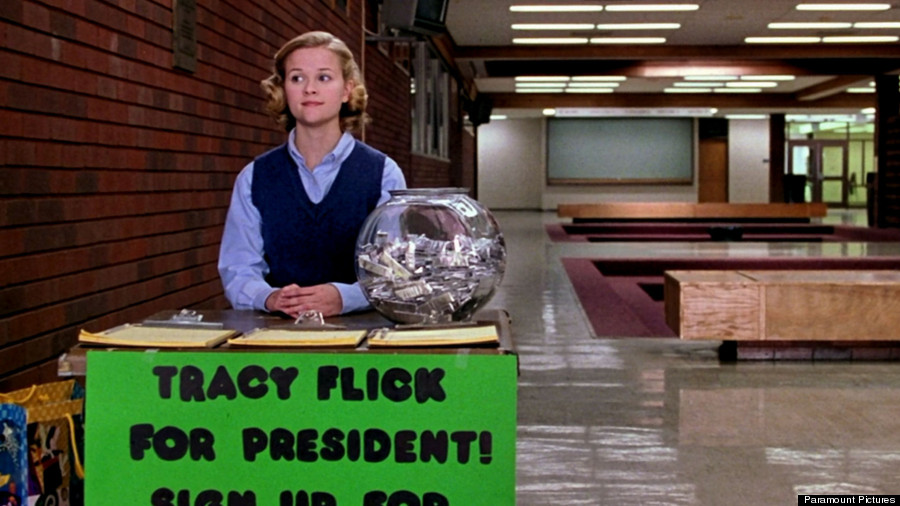
Reese Witherspoon runs for office in high-school satire Election

Director: Alexander Payne

Cast: Matthew Broderick (Jim McAllister), Reese Witherspoon (Tracy Flick), Chris Klein (Paul Metzler), Jessica Campbell (Tammy Metzler), Phil Reeves (Principal Walt Hendricks), Molly Hagen (Diane McAllister), Colleen Camp (Judith Flick), Delaney Driscoll (Linda Novotny), Mark Harelik (Dave Novotny)

High school can be a great setting for films that want to comment on our adult world, because they are such exact microcosms for society. Few films get this idea as effectively as Alexander Payne’s simply superb Election.

In an Illinois high school, Jim McAllister (Matthew Broderick) is a civics teacher who loves his job but is increasingly annoyed by high-achieving student Tracy Flick (Reese Witherspoon), who he also unconsciously blames for the dismissal of his friend Dave for having an affair with her. Tracy is a ruthless careerist, the sort of girl whose hand is always first up in class, and she wants more than anything to win the election to school president. Feeling it his duty to stop Tracy, McAllister persuades football star Paul Metzler (Chris Klein) to run against her – and slowly unleashes a hurricane of ruthless campaigning and dirty tricks that leads to disaster.

This sharp and brilliant satirical comedy avoids jumping to any easy conclusions: instead it ruthlessly skewers everyone involved. Other films would make McAllister a crushed victim, broken down by events and Tracy’s unstoppable force of will. Instead, Payne turns him into an increasingly self-deluding whiner whose impending mid-life crisis becomes more and more evident. There is a particularly sly decision to cast Broderick as this weak-willed, selfish, self-proclaimed victim. Who cannot think about Ferris Bueller now all grown up into a klutzy loser, ineptly trying to initiate an affair with his wife’s best friend and mentally super-imposing Tracy’s head onto his wife’s body during a routine pregnancy-focused coupling?

In fact, watching the film it’s fascinating to see how much it charts McAllister’s disintegration into bitterness and self-justification. By any measureable standard, everything he does is fairly indefensible, while his annoyance with Tracy is rooted in his barely self-acknowledged sexual fascination with her. By the end of the film, as his cheery voiceover recounts his failures and personal and professional disasters with a self-deceiving optimism, you can’t help but begin to wonder how much this manic cheerfulness infected everything McAllister has told us from the start.

It’s things like this that make the film so much more than a straight political satire. Tracy Flick may be a ruthlessly ambitious young woman, who believes she has a nearly divine right to win – but she’s also the child of an equally ruthless woman (using Tracy to relive her own life), who has been sexually exploited by one of her teachers, whose smiles and enforced cheerfulness and drive hide a volcanic anger and insecurity. She could have been simply a smiling force of political ambition – but instead she feels like a real person diverting her own problems into a domineering careerism.

All of which adds a rich hinterland to the film and helps make it even funnier than it could have been. This might be the best political satire ever made. It’s certainly one of the funniest. There are zinger lines every few minutes. The satire is pin-sharp. Tracy is the qualified political hack that the normal people can’t relate to. Paul the Bush-like jock who can speak the language of the common man but manifestly lacks all qualifications. Tammy represents the anarchic frustration and alienation so many feel for the political process. The entire election is a shrewd, subtle skewering of every campaign in politics you’ve ever seen. Even the jobsworth geeks who run these things get it in the neck – “Larry, we’re not electing the fucking Pope” McAllister snaps (at the end of his tether) as he has the ludicrously elaborate election rules explained to him again.

But the film doesn’t forget the humanity: McAllister is a deluded man, but he feels real. He’s so inept at everything from seduction to deception it’s hard not to feel a little sorry for him. (As if to visualise his uselessness, he spends the last third of the film mostly with a massive swollen eye from a bee sting). Tracy has her own problems. Paul, far from being a heartless jock, is the most sensitive and caring person in the film (even if he is as dim as a failing lightbulb). Tammy’s a touching combination of good natured cynicism and obsessive, vengeful stalker.

Of course, it also helps that the acting is outstanding, the comic timing (both in acting and direction) perfect. Reese Witherspoon might never have been better than as the ruthless Tracy, a hurricane of hilarious repeated concepts from political biographies. Chris Klein is very sweet as Paul, a guy it’s impossible not to like. Jessica Campbell is perfect. Broderick holds the entire film together with a superb schleppy moral weakness. Payne’s direction brings all these elements together brilliantly – and has a way with the freeze frame and quick edit that provides a series of striking visual gags.

Election is a classic film – a brilliant satire on politics and elections, but also human nature itself. The characters have depth and reality that makes the jokes hit home with force. The use of voiceover narration from all the main players helps bring us even closer to them, and helps expose their inner personalities even more. I think this might be the best film Payne has made – Sideways and The Descendantsreceive the greater plaudits and attention, but this is his sharpest, wittiest film, and the one that is perhaps the most rewarding of repeat viewing. It’s simply a brilliant, small scale classic.

WarGames (1983)


“Would you like to play a nice game of Chess” – if only he had said yes…

Director: John Badham

Cast: Matthew Broderick (David Lightman), Dabney Coleman (Dr John McKittrick), John Wood (Dr Stephen Falken), Ally Sheedy (Jennifer Mack), Barry Corbin (General Beringer)

If you worked in a nuclear launch centre and received orders to launch out of the blue, would you want to make a phone call to confirm? That’s the compelling idea that opens this tense but engagingly playful film on nuclear politics that successfully balances teen high-school drama with the possibility of Armageddon. For the record, the man who wants to make the call (played by Leo McGarry himself, John Spencer) outrages his subordinate so much with this breach in protocol that the subordinate pulls a gun on him and demands he follows the orders.

David (Matthew Broderick) is that staple of high-school drama, the geeky genius who coasts through school. He’s a computer genius and, attempting to impress cool girl Jennifer (Ally Sheedy), one-day he finds a back-door into NORAD’s weapons control system WOPR (aka JOSHUA). Thinking he’s found a computer games company, he accepts its invitation to play “Thermonuclear Global War”. Before he knows where he is, he’s in custody and bombs are fueling in their silos.

The opening of the film (a brilliantly self-contained mini-movie) perfectly encapsulates the swiftness of escalation in a nuclear war. At least three more times in the movie, we see how swiftly events can push on from DEFCON 5 to 1. This is a film that questions the very purpose of both the nuclear deterrent and nuclear war itself. There isn’t a single character who truly advocates the purpose of the weaponry, and none of them is anything but terrified at the prospect of pushing the button. But this questioning is handled lightly, and Badham’s direction never allows it to dominate proceedings. The film tackles such a big topic with such a sharp and fun script, and at such a rollicking, enjoyable pace with laughs and thrills, that it must count as a some sort of minor classic.

The film is also of course about computers and hacking. There is actually a lot of charm in watching, on my tablet, a film where a computer takes up the space of a room and an actual telephone is used to hack into an external network. This is probably one of the first films ever to demonstrate hacking and the potential influence of computers. Thrillingly, the film has both a warm acceptance of the advantages computers could bring, and a suitably sci-fi dread of what they may (unwittingly or not) unleash on the world if granted full power over us.

Because this film recognises, arguably ahead of its time, that the mechanisation and omnipresence of computers is terrifying. Like John Spencer in the film’s opening, most of us (I hope!) would want to speak to another human being before pressing the buttons. JOSHUA is scary because it is so benignly controlling – it believes that nuclear war is just another game, and has no understanding at all of the impact on the world its actions will have. JOSHUA isn’t a villain at all – it’s literally an ill-educated child that hasn’t learned its actions have consequences and can’t tell the difference between simulation and reality. It’s the nightmare scenario of having all the empathy and emotional intelligence removed from the world of decision-making.

This isn’t just a film about technology and nuclear politics though – far from it. It’s an engaging human story, told in a tight and streamlined way, and staffed by a very well written selection of characters who all feel tangible and real. Broderick and Sheedy are wonderfully engaging leads, with a great deal more depth than the cliché: David is far more assertive and determined than you might expect, while Jennifer has much more sense and humanity than a high-school Queen. This extends to our NORAD location: Dr McKittrick is far more empathetic and willing to listen than first impressions suggest, and General Beringer is a thoughtful, sensitive man at odds with his obstructive, gung-ho first impression. John Wood (a great stage actor who never quite got the film roles he deserved) plays Dr Falken with wit and a knowing wink, his disillusionment with the world sitting alongside a wry delight.

I was actually surprised how much I enjoyed this film and how well it stands up. It’s thought-provoking but it’s also a lot of fun and very well written, acted and directed. There is a very good mixture between “action” sequences – a wild drive and run to get into NORAD before it is locked down is particularly exciting – and conversation scenes that, due to their high stakes and impassioned acting, play like verbal action scenes. It’s superbly designed too, with the NORAD “war room” in particular setting the pattern for all such locations in future movies.

This is a perfect marriage between the blockbusting mindset of the 1980s and the cynicism of the 1970s. Because it’s a blockbuster and has kids in leading roles, it’s never got the credit it deserves – but this has as much merit as many political and conspiracy thrillers of the cynical 1970s.