Tag: Matthew McConaughey

The Wolf of Wall Street (2013)

The Wolf of Wall Street (2013)

Greed is Good? Scorsese’s masterpiece is a heady deconstruction of the excess of white collar criminals

Director: Martin Scorsese

Cast: Leonardo DiCaprio (Jordon Belfort), Jonah Hill (Donnie Azoff), Margot Robbie (Naomi Lapaglia), Kyle Chandler (FBI Agent Patrick Denham), Rob Reiner (Max Belfort), Jon Bernthal (Brad Brodnick), Matthew McConaughey (Mark Hanna), Jon Favreau (Manny Riskin), Jean Dujardin (Jean-Jacques Saurel), Joanna Lumley (Aunt Emma), Cristin Milioti (Teresa Patrillo), Christine Eberle (Leah Belfort), Kenneth Choi (Chester Ming), Brian Sacca (Robbie Feinberg), Henry Zebrowski (Alden Kupferberg)

All The Wolf of Wall Street is really missing is an early freeze frame of a coke-fuelled banker slamming the phone down on a closed deal and a wistful voiceover from Jordan Belfort: “As far back as I can remember, I always wanted to be Wall Street trader”. If Goodfellas was Scorsese’s exploration of the attractions – and dangers – of a life in blue collar crime, then The Wolf of Wall Street is its white collar companion piece. The fact that so many viewers find the behaviour of Belfort morally outrageous in a way that no one ever objects about Henry Hill is, for me, an indication of how much we loath these masters-of-the-universe. For all their faults, we’d still rather see a violent criminal as one of us.

Based on Jordan Belfort’s (Leonardo DiCaprio) autobiography, The Wolf of Wall Street follows his time building a dodgy trading empire and a large fortune. Not that he can remember most of it, as he seems to be on a permanent intoxicated binge of drinks, hookers and every drug you can ever imagine (and some you can’t). The FBI catches up with him eventually, but Belfort learns precious little from his experiences. Other than, perhaps, that so long as you are rich and white in America, you can basically get away with anything.

That’s perhaps the key to Wolf of Wall Street. Scorsese may not shy away from the delicious dark comedy of Belfort’s life of excess, but it doesn’t blind him to the shallow awfulness of the man or his unthinking, instinctive greed and self-obsession. You would need to be a pretty shallow person to look at Belfort’s greed, moral emptiness and self-destructive binges and want to ape him. If you think watching DiCaprio literally paralytic on quaaludes is the life you want, frankly there is something wrong with you.

What perhaps made some feel Wolf of Wall Street was oddly in love with Belfort is its electric pace. The film is a brilliant reminder of Scorsese’s faultless understanding of pace. Or one who matches unparalleled cinematic skill with the rambunctious energy of a first-timer allowed to play with his movie toys for the first time. Brilliantly assembled, this is a superb collection of cinematic techniques, from jump cuts to fluid transitions that power through a series of increasingly bacchanalian parties and isn’t afraid to admit that, in the moment, this stuff can be fun (rather like getting the best table in Goodfellas) but ultimately self-destructive. (After all, few know the dangers of drugs like Scorsese.)

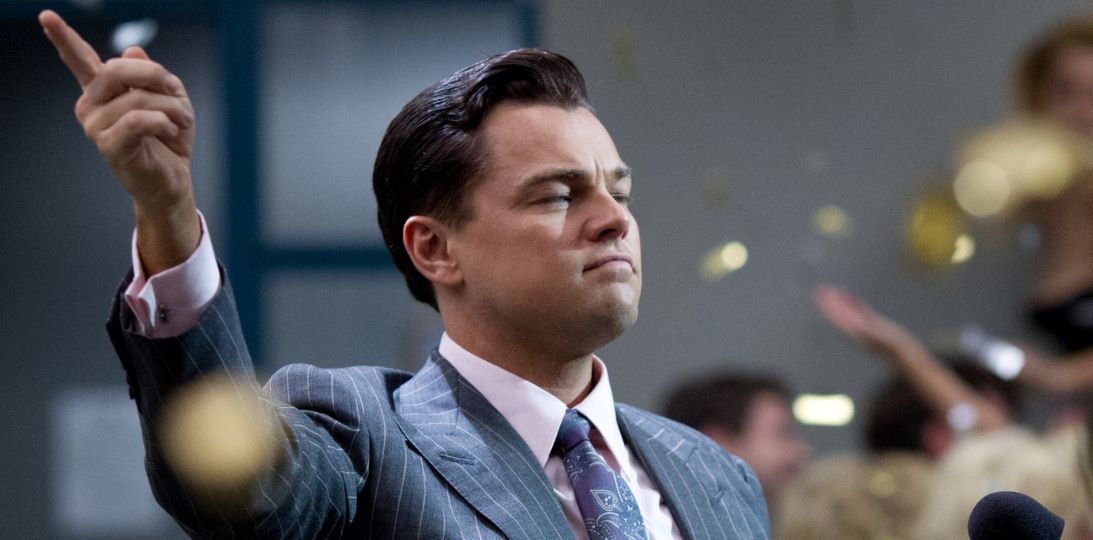
At the centre of this whirlwind is a stunning performance from Leonardo DiCaprio. With his still youthful, charismatic handsomeness, DiCaprio only needed to tweak his screen persona to provoke the sort of perverted idolatry Belfort receives from his co-workers. But he goes above and beyond in his transformation in this role. He makes Belfort simultaneously oddly childlike and revoltingly corrupted, someone whom we enjoy spending time with while finding repulsive. He rips through Belfort’s trademark, drug-fuelled motivational speeches, monologues of insanely eye-popping intensity, explosions of off-the-chain wildness. At other times he’ll sulk and whine like a spoilt child. DiCaprio struts across the screen with an unpredictable physicality – his embodying of the physical effects of mind-altering drugs is hilarious and horrifying –in possibly his finest ever performance.

DiCaprio is the raw energy source that helps power the rest of the film. Scorsese matches him blow-by-blow with this dynamic expose of white-collar corruption. Using Belfort as a narrator – which serves to further expose his shallowness, greed and utter inability to learn any sustained messages from the depths he plummets to – the entire film is all about how the flip side of the American Dream tacitly promotes and encourages this sort of behaviour.

Belfort is the rash the system has come out as. In a highly effective early cameo, McConaughey plays Belfort’s first mentor, a coke-fuelled hedonist hooked on the buzz of closing deals, who pushes Belfort towards a career of success (including introducing a brilliant breathing exercise – improvised by McConaughey based on his own warm-up exercises – that becomes a mantra in the film). DiCaprio’s eyes have already lit up at watching a deal closing. Drugs and sex are just an attempt for Belfort to replicate the buzz of the real addiction: money.

Scorsese recognises that we don’t need to know the details of Belfort’s illegal dealings. (In his voiceover Belfort literally tells us it doesn’t matter, all that does is the shitload of cash they were bringing in.) We learn enough about the huge mark-ups (50% of the deal’s value) he can make from selling penny stocks (trades of small public companies) and “pump and dump” tactics to know it’s wrong. I will admit the film does little to show the victims – but then Belfort never cares either, proudly stating at one point he has no guilt fleecing his clients out of cash, because he knows how to spend it, better than they do.

It all pours into a hedonistic, alpha-male environment where the air is as littered with fucks (the film held a record for most use of the word) as the floors and desks of Belfort’s offices are during his hooker-filled end-of-week parties. Wolf of Wall Street is also an expose of toxic alpha-maledom. Bullying, abuse and screaming are ripe, women are basically commodities traded as easily as shares. The only exceptions are those allowed into the boys’ club as either surrogate-male fellow traders or trophies to adorn the arm. Margot Robbie (superb in a star-making role) plays Belfort’s glamourous wife, who knows she needs to use her physical assets to make her way in this world.

The film rips along through a party-deal-party structure. Belfort goes from wowing his fellow penny stock traders by making $2k in two minutes to wrapping the trading floor of his fake-old-school Wall Street firm around his finger in excess filled speeches. He also goes from a charming party animal to an incoherent, rambling, deeply unpleasant and dangerous drunk and drug addict. But crucially, he learns nothing . There is no life-and-soul shattering payback like Henry Hill undergoes. Fault, guilt and consequences roll off his rich, spoilt back. He ends the film still winning the adulation of would-be millionaires, his conscience (if it exists) untroubled by any impact his actions have had on others.

Perhaps Scorsese could have allowed more space to victims – and to Kyle Chandler’s dutiful and dedicated FBI agent who brings him down (our final shot of this character stresses his humble, low-paid status – echoing back to his confession to at times regretting leaving a trading career for a law one). But that’s to criticise the film for not being obvious enough. Of course parties are fun. But each party becomes wilder, more orgiastic and uncomfortable as the film goes on. But if we didn’t understand the fun, we couldn’t understand how people get hooked on this adrenalin fuelled life.

Wolf of Wall Street though is a warning to the curious – if you are smart enough to look. Belfort’s soulless, horrible life is not one to aspire to, and his moral emptiness not one to wish to have. It’s a funny film, but it’s also a dark one. DiCaprio is brilliant beyond belief, Jonah Hill funny and pathetic as his best friend, Margot Robbie becomes a star and Scorsese rips through the film with the energy, passion and dynamism of a much younger director. An outstanding tentpole film in his CV.

Amistad (1997)

Djimon Hounsou excels as a slave longing for freedom in Amistad

Director: Steven Spielberg

Cast: Djimon Hounsou (Sengbe Pieh/Joseph Cinqué), Matthew McConaughey (Roger Sherman Baldwin), Anthony Hopkins (John Quincy Adams), Morgan Freeman (Theodore Joadson), Nigel Hawthorne (President Martin van Buren), David Paymer (John Forsythe), Pete Postlethwaite (William S Holabird), Stellan Skarsgård (Lewis Tappen), Razaaq Adoti (Yamba), Abu Bakaar Fofanah (Fala), Anna Paquin (Isabella II), Chiwetel Ejiofor (James Covey), Peter Firth (Captain Fitzgerald), Jeremy Northam (Judge Coglin), Xander Berkeley (Ledger Hammond), Arliss Howard (John C Calhoun)

After the American Revolution, independence left one issue in America that would profoundly split the country: slavery. This was a land divided, between abolitionists and plantation owners, the more emancipation-minded North and slave states of the South. Slavery was – and remains – the ugly stain on the American soul. Steven Spielberg’s film uses a significant court case of its day to shine a light on these contrasting and conflicting priorities in American society throughout much of the early 19th century, that would eventually lead to civil war.

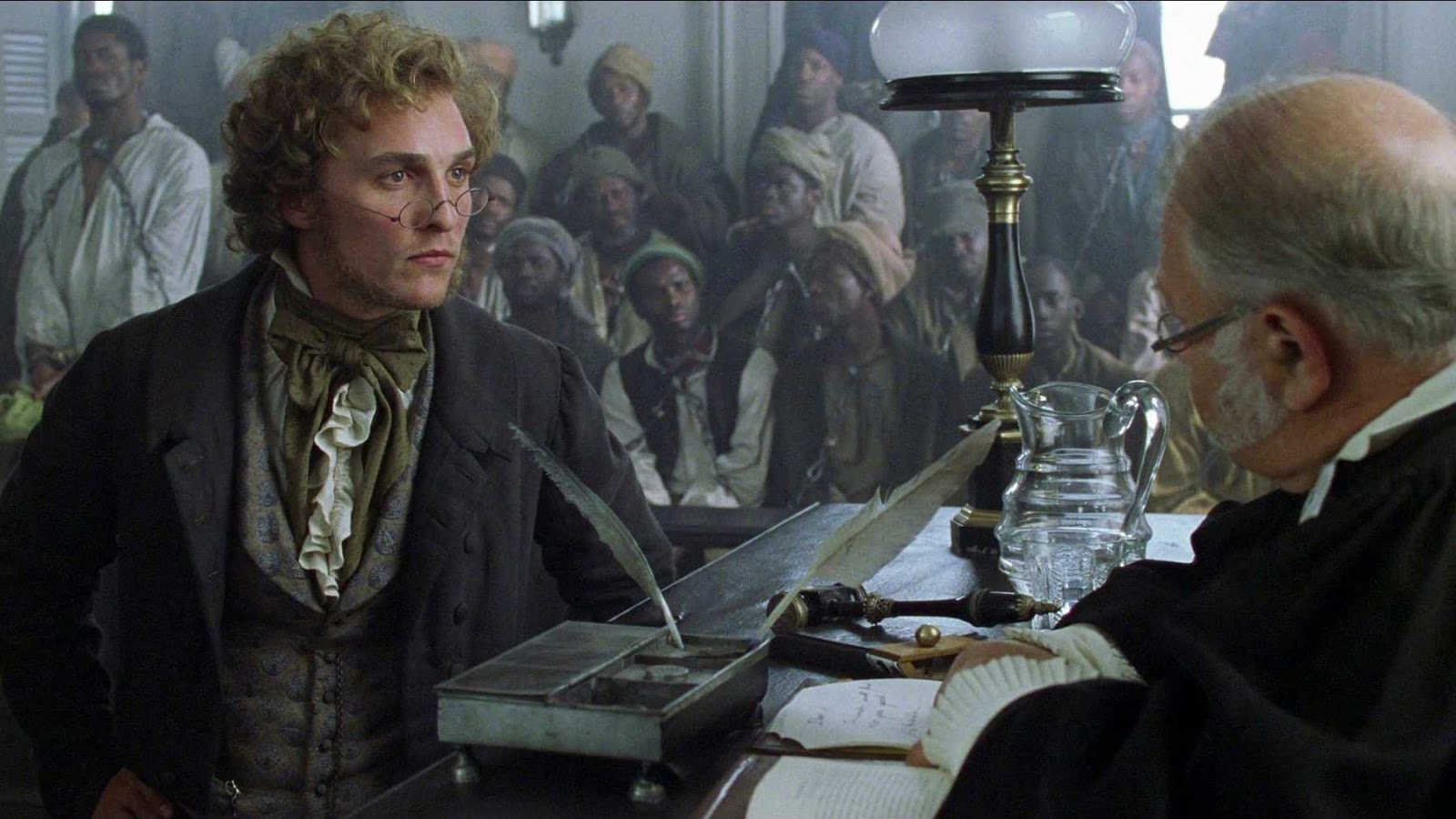
The film tells the true story of the slave revolt on the Spanish slaver ship Amistad. Here the slaves, led by Joseph Cinqué (Djimon Hounsou) escaped captivity, rose up and killed most of the crew (leaving just two men alive to sail the ship) and tried to return to their home in Sierra Leone. Arrested by an American naval ship while collecting fresh water, the slaves are transported to Connecticut where they find themselves on trial as escaped slaves, facing charges of piracy and murder. Their cause is taken up by Northern abolitionists Lewis Tappen (Stellan Skarsgård) and his black associate Theodore Joadson (Morgan Freeman), and their lawyer Roger Sherman Baldwin (Matthew McConaughey) a property lawyer. However, the case’s international implications for slavery attracts the concern of President Martin van Buren (Nigel Hawthorne), eager to support the prosecution, while former President John Quincy Adams (Anthony Hopkins), a lawyer and opponent of slavery, offers his advice to the defence.

Spielberg’s film has just the right balance of human interest and humanitarian concern to overcome its slight air of a civics lesson. Although largely a courtroom drama, what the film is really trying to do is capture in one moment the troubling contradiction of the land of the free built on slaves, and give a voice and empathy to the slaves themselves. 

Although some have criticised this as a “white saviour” film, I feel that’s unfair. This is a film that starts and ends with Cinqué’s story and filters America through his perception. We can well understand why he rages at his lack of comprehension of laws that can be adjusted, court decisions overturned or how words can be twisted to take on other meanings. A film front and centred, say, by Matthew McConaughey’s Baldwin and focusing on journey from seeing this as just another case into a crusade would be a white saviour film. Instead the white characters drop in and out of the story as the narrative requires, and it’s the struggles and courage of the black characters that form the heart of the narrative.

Spielberg also brings to life the cruelty and inhumanity of slavery and what it does to all of us. The film opens with the confined, appalling conditions of the slave ship while Cinqué (with hands running with blood) tries to release a nail from the wood which he will use to free himself from his chains. The film intriguingly opens without the African characters being translated – giving us a sense of their isolation and perhaps also stressing how different they are from the Western “civilisation” that has taken them from their homes. 

It isn’t until half way through the film, until a translator is found for Cinqué, that the film gives us the backstory that Cinqué has struggled to communicate. Spielberg spares no punches in showing the violence of abduction, the brutality and casual slaughter of the slavers, the starvations, the floggings that end in blood sprayed death, the cramped conditions practically designed to weed out the weak. A mother chooses drowning for herself and her child rather than life on the ship. Later the slavers chain unwanted slaves to a bag of rocks and cast them overboard to reduce their cargo load. If there was any doubt about the heart-rending evil behind slavery, it’s removed from your mind.

It also serves to hammer home the injustice of America’s own system. Under political pressure – van Buren is worried about the reaction of both Spain and the Southern States to the Africans being found innocent – the trial encounters interference and appeals every step of the way. It’s a system that prides itself on being the greatest in the world, but shows time and time again how it can be weighted against the weakest. The courtroom scenes – skilfully directed and played – show time and time lawyers valuing obscure property laws above right and wrong. And we are brought time and time again to the reactions and lack of understanding of the African characters, who come from a society where there is no equivocation and no words equivalent to “usually” or “perhaps”.

The film perhaps does take a little too long over its various legal machinations, and could do with losing a few minutes here and there. But that would be to sacrifice its many strengths. Looking wonderful, with a marvellous score by John Williams (riffing on the American pipes and African tribal influences), one of the strongest acting companies Spielberg ever assembled does outstanding work. Carrying much of the film is Djimon Hounsou, who makes Cinqué anything but a victim – he is a proud, defiant and intelligent man, humble enough about his qualities but quick to act to defend his rights. Uncowed but infuriated by the situation he finds himself in, he is never a passenger but at all times a key figure in his own liberation, even if his legal case must be fought by whites.

McConaughey enjoys himself under a bad wig, glasses and dirty teeth as the lawyer Baldwin, ambitious but with more than an air of decency. Postlethwaite is at his quietly authoritative best as his opposition counsel. Freeman lends the film a large part of his grace and dignity in a small, observant part of the freed-slave turned abolitionist, with Skarsgård more political as his white colleague. Hawthorne makes a van Buren a slightly flustered, impatient figure. Peter Firth demonstrates a great contempt for slavery behind an imperious exterior.

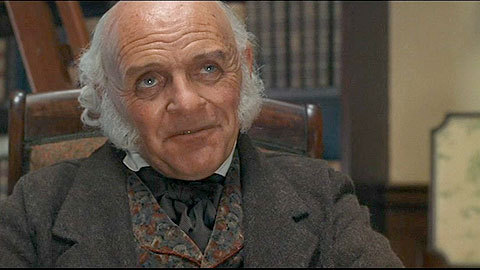
The film’s highlight performance though is Hopkins’ Oscar-nominated turn as John Quincy Adams. Adjusting his physicality to match the ageing ex-President, Hopkins captures his slightly nasal Massachusetts twang and adds a significant amount of twinkly charm and wry shrewdness to this adept political operator. A large chunk of the film’s final 20 minutes is given over to Hopkins, with the highlight a long monologue of Adams speech to the Supreme Court (in actuality a speech over eight hours in length!), that is a tour-de-force of skilled showmanship. It’s Hopkins’ last great performance of the 1990s. 

Spielberg’s Amistad is a superb courtroom drama but also a heartfelt condemnation of the inhumanity man can show to man. It never forgets either that while this was a victory, it was only a skirmish not the war. While the film at times overplays the inevitability of Civil War (which did not exactly start over this issue), it skilfully shows the divide in the American culture between abolition and slavery – and how many felt for the first cause, but feared the supporters of the second so much they would rather not address it. Either way, Amistad may at times be a little dry – but that gives its moments of emotion even more force.

Magic Mike (2012)

Magic Mike: there are rare moments with most of the clothes on

Director: Steven Soderbergh

Cast: Channing Tatum (“Magic” Mike Lane), Alex Pettyfer (Adam “The Kid”), Cody Horn (Brooke), Matt Bomer (Ken), Olivia Munn (Joanna), Joe Manganiello (Big Dick Richie), Matthew McConaughey (Dallas), Adam Rodriguez (Tito), Kevin Nash (Tarzan), Gabriel Iglesias (Tobias)

The formula for Magic Mike is basically an all-boys Coyote Ugly mixed with a 1970s blue-collar social drama. But a blue-collar social drama where collars might be all the men are wearing. Based on Channing Tatum’s own experiences as a stripper back in the day (I’d be fascinated to find out how many of the things in this film Tatum got up to when he was a lad), Magic Mike follows the story of Mike Like (Tatum), a brilliant stripper who dreams of setting up his own bespoke furniture company (if that’s not an insight into the sort of eccentric film this is, you’ve got it there!). Meeting young Adam (Alex Pettyfer), he takes the kid under his wing and inducts him in the world of strip clubs. Adam gets a taste for the life, while Mike gets a taste for the company of Adam’s disapproving sister Brooke (Cody Horn). So mentor and mentee gradually find themselves drifting towards trouble.

Magic Mike is good fun mixed with some pretty standard low-rent crapsack world problems, as small-time crime and drugs intrude on the otherwise gentle world of professional male stripping. Magic Mike is essentially a sort of fairy tale, which wants to enjoy the dynamism of performing on stage while also casting a disapproving eye on its hedonism and emptiness. It’s the sort of film which wants to show what a great time you can have living that lifestyle in the short term, while also praising its hero for realising he wants more. You might think (and it has been sold and partially recut) into a hot stripping film, but deep down it wants to be a 1970s social issues drama. It just never quite gets there, because it doesn’t have the depth and can’t escape the cliches of coming-of-age dramas.

So it’s not exactly the most revelatory film in the world. What’s most interesting is that often in these films it’s the mentor who leads the mentee astray. Here, it’s the mentor who finds his life gradually being damaged by the mentee. Mike is basically a kind, decent guy who just hasn’t really grown up. Adam, whom he brings into the stripping world, is basically a shallow, lazy, increasingly selfish person who is only interested in himself. While deep down Mike knows that stripping and all its hedonistic temptations are only a means to an end, for Alex it is the end, and he wants to lead this sort of life forever.

Mike’s basic charm works so well because it’s rooted in Channing Tatum’s own charm as a performer. He has a sweet, puppydog quality as well as a fundamental little-boy-lost innocence, which should seem strange for a bloke who rips his clothes off and gyrates semi-naked on a stage in the laps of cheering women. But it makes sense. The show is a brilliant showcase for Tatum, not only showing his acting and performing strengths but also showcasing his dancing and movement skills. As well as, of course, his chiselled torso. The film front and centres a rather sweet will-they-won’t-they with Mike and Alex’s sister Brooke, played with a sweet firmness by Cory Horn. And there are a host of other excellent performances, not least Matthew McConaughey stealing scenes as club owner Dallas, hiding his greed under a domineering bonhomie.

The film stops frequently for elaborate stripping scenes in manager Dallas’  club. These are put together with real wit and engagement, and while the film never really explores the issues in stripping (no touching from the guests, performance enhancing drugs, the hedonistic openness etc. etc.) it does make a change to see the men of the film being treated entirely as sex objects and not the women (or at least not as much, this still being a film that opens with a semi-nude Olivia Munn). Soderbergh though has always been a proficient technician rather than the sort of intelligent artiste he would like us to think he is, so it’s a not real surprise that most of the film is more flash than depth.

So that’s perhaps why the film largely settles for being a standard “man needs to grow up and leave his old life behind” and “young buck goes out of control” story. The structure of this, and its air of kitchen sink drama as we see Mike struggle to get a loan to start his business, or deal with a stripping event gone wrong as Alex brings drugs to a private party, is something that contrasts nicely with the more dynamic stuff in the club. All this is pretty standard arc material – and Soderbergh’s film dodges really drilling down into some of the issues it touches on. 

Magic Mike is a fun film with a touch of depth, that wants to combine a character study with a study of its stars’ characterful bodies. It only touches upon some of its themes, and tells a fairly traditional story under all that. But it’s got a sort of charm, and it delivers its cliches with aplomb. But then I’m not sure I’m quite the target market for it.

U-571 (2000)


Matthew McConaughey and Harvey Keitel crack the Engima Code. With lots of guns. And no maths at all.

Director: Jonathan Mostow

Cast: Matthew McConaughey (Lt. Andrew Tyler), Bill Paxton (Lt. Com. Mike Dahlgren), Harvey Keitel (Chief Henry Klough), Jon Bon Jovi (Lt. Peter Emmett), David Keith (Major Matthew Coonan), Jake Weber (Lt. Michael Hirsch), Jack Noseworth (Bill Wentz), Erik Palladino (Anthony Mazzola), Thomas Kretschmann (Capt. Gunther Wassner)


On its release, U-571 was something of a sensational scandal– and in fact gained far more attention than a fairly standard submarine movie probably deserved. Why is that? Because it epitomised the perception in this country of American films taking war achievements from us poor Brits and giving them to Yankee heroes. Was this annoying for a British people all to used (it seemed) to having their war contribution lost in the crush of American films? You betcha.

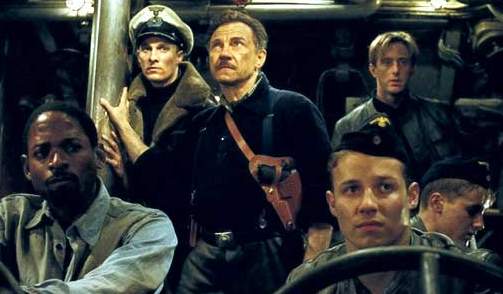
During World War 2, Lt. Andrew Tyler (Matthew McConaughey) is sent to lead a team of American sailors to capture an Enigma machine from a stranded German sub. The Enigma machine, and the inability of the Allies to break it, is losing America (whose involvement in the war has been moved forward for the purposes of this story) the war after all. However, the mission swiftly goes wrong and Tyler is left commanding a rogue bunch of terrified sailors on the captured German submarine, trying to get the Engima machine back to the US Navy before its loss is discovered. All that is missing is Alan Turing reinvented as a hard-boiled Brooklyner totting a machine gun and shouting “I gotta Bombe for ya, ya Kraut Bastards!”.

The movie itself is not too bad, to be honest. although nothing special. The expected clichés of the submarine are all there: the fears about water pressure, claustrophobia, a sequence where the boat sinks inexorably towards the bottom of the ocean, torpedoes in the water, depth charges, “right full rudder”, sonar pings, water gushing from pipes, someone having to undertake a vital repair underwater with limited air supply etc etc. – it’s all been done before, from Enemy Below to Crimson Tide. Saying that, Jonathan Mostow knows how to cut the heck out of a movie and as a result this charges forward with a relentless energy which works rather well and makes this a suitably tense film. Special mention also goes to the sound editing, which won an Oscar for its brilliant creation of the aural impact of everything from depth charges to torpedoes scraping hulls.

Of course the story itself is nothing unique: even the personal plot lines are largely recycled from other movies: will McConaughey’s young XO be placed in a situation where he has to prove his chops as a commander? You bet he will! Keitel is an Old Sea Dog, Paxton is a fatherly Captain, Kretschmann is a cold professional German – but the actors play these well shuffled stock characters with an admirable level of commitment. The film has a great “Dirty Dozen” vibe to it, and does manage to throw in a couple of surprises about character fates. For those of us who love the predictable trotted out with po-faced commitment and energy, it’s hard not to be entertained.

There are some well-done (if unsurprising) scenes as Tyler struggles with his authority over men who don’t have trust in him and are terrified of getting killed. It’s interesting how much the film asks us to invest in essentially willing Tyler (a decent performance by McConaughey) to have the guts to send a man to his death for the good of the ship. Centring this moral dilemma as a crucial qualification for leadership at least means the film does take a honest look at the complexities of command to counter the boys’-own heroics elsewhere. Saying that, the almost pathological mutinous rumblings of Seaman Mazzola against an officer we are told early in the film is “popular with the men” does seem rather sudden – possibly because making Tyler a distant stick-in-the-mud (which he would need to be for the level of rejection from the crew to really work) rather than a regular Joe might have made us less likely to root for him at the start.

Of course all of this seems pretty inconsequential next to the real issue of the film, which is its historical accuracy (or complete lack thereof). To be honest, the fury against the film’s appropriation of British Naval achievements is rather harder to sustain (a) nearly 20 years on and (b) when you see what an agenda-free, entertainment-only movie it is. Perhaps the real insult was that the crew of this mission contained actors like Jon Bon Jovi and the guy who played ER’s Dr Dave. But that doesn’t change the fact that this stuff didn’t happen, and the elements of the story that did certainly didn’t happen like this and were done by completely different people. It’s hard to shake the feeling, even while you enjoy the film, that it gives a false glory to the wrong people. If even a few people came out of it thinking the Americans cracked Engima (or that Engima was cracked like this rather than primarily by maths) it’s certainly a few people too many. 

As a side note, while reading up about the film before this review, I found that one of the screenwriters, David Ayer (now a purveyor of average WW2 films himself with Fury), had this to say about the controversy of the film’s re-writing of history: “[I do] not feel good…it was a distortion, a mercenary decision to create this parallel history in order to drive the movie for an American audience…Both my grandparents were officers in World War Two, and I would be personally offended if somebody distorted their achievements…I understand how important that event is to the UK, and I won’t do it again.”