
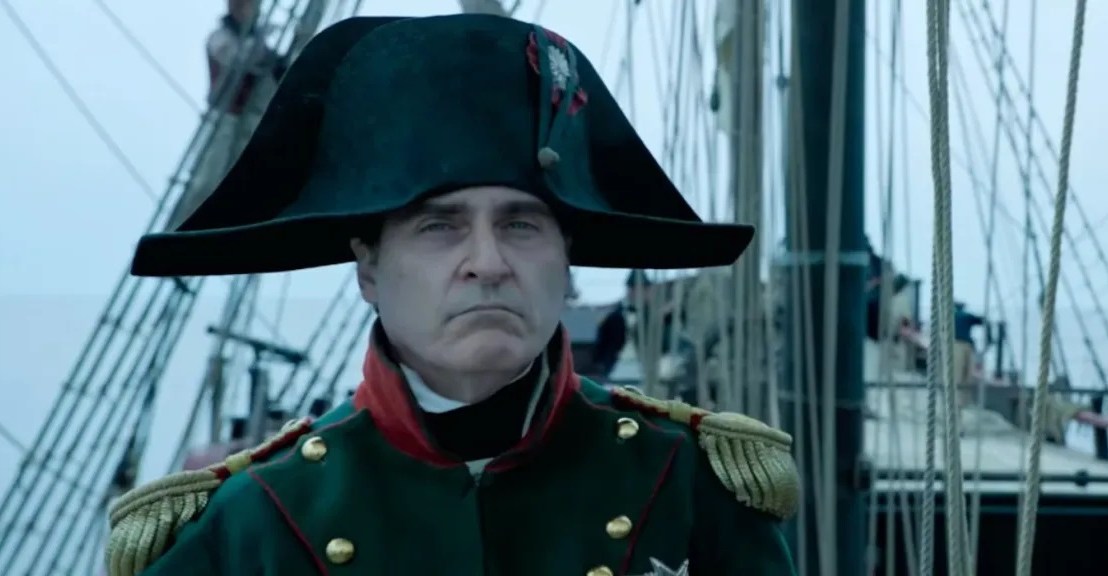
Scott’s epic of the most famous Frenchman of all time looks good but is empty at heart
Director: Ridley Scott
Cast: Joaquin Phoenix (Napoleon Bonaparte), Vanessa Kirby (Josephine Bonaparte), Tahar Rahim (Paul Barras), Ben Miles (Caulaincourt), Ludivine Sagnier (Thérésa Cabarrus), Matthew Needham (Lucien Bonaparte), Sinéad Cusack (Letizia Bonaparte), Édouard Philipponnat (Alexander I), Ian McNeice (Louis XVIII), Rupert Everett (Arthur Wellesley, Duke of Wellington), Paul Rhys (Talleyrand), Catherine Walker (Marie-Antoinette), Mark Bonnar (Jean-Andoche Junot)

Is Bonaparte cinema’s White Whale? Filmmakers have often tried and failed to bring this epic life – who else so dominated their era that’s its literally named after them? – to the screen. Abel Gance’s silent epic could only squeeze his early years into five-hours and the planned five sequels never materialised. Famously, Kubrick spent decades planning a Napoleon film (he had a veritable library of Napoleonic research) but could never deliver. Napoleon has popped up in films as wide ranging as Time Bandits and Waterloo, but the definitive film has never been made. Is Scott’s Napoleon it?
Napoleon takes a rather old-fashioned approach to the biopic. The fashion now is to focus on a single event that becomes a window into its subject’s life. Napoleon, in its two and a half hours, takes a far more cradle (or revolution) to grave approach. We join Napoleon Bonaparte (Joaquin Phoenix) as an anonymous artillery captain and leave him (via 13 Vendémiaire, Egypt, the 18 Brumaire coup, self-coronation, Austerlitz, Borodino, Moscow, St Elba, Waterloo and Helena) dying in exile. It’s as swift and pacey a run-down of his life and times as it sounds like, with the film’s main focus being on his complex, love-loath relationship with Josephine (Vanessa Kirby).
Scott’s film is a visual treat – don’t those uniform’s look gorgeous! – and it works best as a coffee-table book of the life-and-times of one of History’s most controversial figures. What it doesn’t work as is as film where you feel you gain any real understanding of what motivated Napoleon or where the charismatic energy that made millions of soldiers flock to him time-and-time again came from. Scott’s Napoleon emerges as a maladjusted, emotionally-stunted oddball, apt to glower and sulk who is never the master of events or people. It’s a revisionist view that doesn’t ring true.
It’s not helped by a surprisingly low-key performance by Joaquin Phoenix, bulked up and lumbering, playing up the “Corsican Brute” angle that so alienated the Emperors he negotiated with. Phoenix’s performance is all pout and emotionally inarticulate self-pity, with small flashes of domineering force that come across as childish sulks. But it’s never the performance of a man who looks like he could motivate a nation to march with him into a mincer (several times!). Nor a performance that brings a sense of the fierce-ambition of a man who wanted to control and reshape the world. It focuses instead on one small aspect of his personality and misses vast swathes of his rich, autodidact personality.
It doesn’t help that filtering Napoleon’s life through his relationship with his wife feels like a gossipy approach used because tackling Napoleon’s complex attitudes towards his Corsican ancestry, contradictory interests in instituting democratic systems in a dictatorship and desire to bring peace to Europe via a series of destructive wars would be too tricky. Instead, we get a Napoleon who plans his movements and campaigns to compensate for his sexual inadequacy at being cuckolded by his wife, rushes back from Egypt to confront his cheating wife and seemingly escapes from exile because he’s pissed at his wife flirting with the Tsar. It’s not helped that the most interesting mechanism in their relationship – she was older and more experienced than him, with two children already – is compromised by Vanessa Kirby clearly being far younger than Phoenix.

Saying that Kirby is good in the film, conveying a complex set of emotions towards a husband who sometimes amuses her but, just as often, repels her with his bullying possessiveness (not to mention his militaristic sexual technique). Napoleon uses their relationship as a constant frame to interpret events, not only as motivation but also as a narrative device, letters between them constantly updating us on events off-screen. But the film only lightly sketches what drew them together in the first place (basically his attraction and her use of her sexuality to win protection) and the film ends up stuck in the same cycle of fall-out followed by Napoleon’s desperation to possess her again.
The time given to sketching out the broad strokes of this relationship means we never get a sense of history behind events or where the qualities, that made Napoleon the guy who governed most of Europe, came from. Scott’s film is (which, with its stressing of the deaths caused in his wars, settles for an anti-Napoleon stance) plays up his negative qualities and gifts him few positive ones. Phoenix’ performance is almost perversely anti-charismatic: he never laughs, is constantly shown as a pompous windbag who only children are wowed by, loses all his raconteur charm and is frequently victim to events – be that panicking at his attempted coup (where he’s bailed out by his brother) or only at Austerlitz looking like he has any particular military skill.
Still the film bowls along, too fast to ever really engage with events. A host of strong British Actors pop-up (their character names and functions plastered on the screen), but their appearances and dialogue are often so truncated it’s hard to really understand why they are there. Julian Rhind-Tutt’s Sieyes pops up to announce he plans to seize power with Napoleon and is never heard of again. Ben Miles and Paul Rhys rush through exposition as Caulaincourt and Talleyrand. A host of actors playing Generals stand in the background and snatch lines when they can. There are a few inadvertently comic casting choices – I did snigger when former News Quiz host Miles Jupp pops up as Francis I.
This historical gallop means years frequently pass between scenes and we often get very little idea why developments are taking place: for example, Napoleon seems to become Emperor on the basis of a half-muttered suggestion from Talleyrand. Conquests of whole countries are skipped over in seconds. Josephine’s offspring appear as children and are next seen as adults. Other than them, no one ages at any point over the film’s near 20 year span, with Phoenix and Kirby in particular looking little different at the end as they did at the start. (The film also rewrites heavily the comparative ages of its two leads – Josephine was in fact several years older, partly why conceiving an heir became such a problem.)
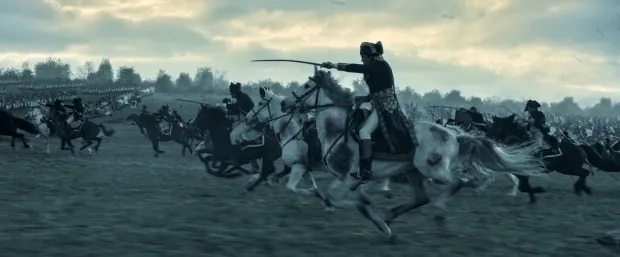
The battles are impressive though – even though they take up not quite as much screen time as you might think. The campaign in Egypt boils down to essentially a single cannon ball pot-shot at the Great Pyramid (never happened of course). Borodino is a cavalry charge. Austerlitz and Waterloo are the only battles that get real screen time, with both offering remixes of the actual history (Waterloo, incidentally, looks less impressive and smaller in scope than the Bondarchuk film managed). The photography is beautiful (as it is throughout) and the film doesn’t flinch on showing the impact of bullets and cannon balls. But it has no interest in understanding Napoleon’s actual strengths as a general (essentially, skilful movement of forces from a distance) substituting them with him leading not one but two cavalry charges – a suicidal risk he never took.
“At least it looks good” pretty much sums up the strengths and weaknesses of Napoleon. It’s enjoyable enough and buffs might enjoy the odd Historical Easter Eggs, but it never gets to the heart of understanding its subject and settles for a ticking off events and personalities rather than placing them into an informative context. You’d come out of this wondering how this guy got to where he was – and that makes you feel the film has failed to answer its implicit question in the tag line “He came from nothing. He conquered everything.” How, eh? How?
 Movie Musings