
Tag: Maud Adams

Rollerball (1975)

Rollerball (1975)

Violent science-fiction dystopia satire ends up making blunt, uncertain points

Director: Norman Jewison

Cast: James Caan (Jonathan E.), John Houseman (Mr. Bartholomew), Maud Adams (Ella), John Beck (‘Moonpie’), Moses Gunn (Cletus), Ralph Richardson (The Librarian), Pamela Hensley (Mackie), Barbara Trentham (Daphne), Shane Rimmer (Rusty), Richard LeParmentier (Bartholomew’s Aide)

It’s the future, but it might as well be Ancient Rome. The world is ruled by Corporate Caesars, holding supreme power, controlling information and plucking anyone they want for anything, be it for a job or as a partner in bed. The masses are kept pliant and happy by being fed Bread and Circuses. Namely Rollerball, the world’s most popular sport, a hyper-violent mix of American football and ice hockey played in a velodrome, with teams competing to score by thrusting a metal ball into their opponent’s goal, with rules to prevent only the most egregiously violent acts. It’s a game designed by with a simple message: the individual is powerless, the system is all.

Problem is, like any game, some players are better at it than others. And the best player there has ever been Jonathan E (James Caan) is a living legend for Houston, tougher and more passionate about the game than anyone else alive. He’s a living contradiction of the secret principle of the game: an individual can make a difference. Naturally the Corporation want him gone, offering him a generous package to retire. Problem is Jonathan doesn’t want to retire. What else is there to do, but to remove the few rules Rollerball has, and establish how futile individual effort is by killing Jonathan in the game. But Rollerball’s greatest ever player isn’t that easy to kill.

All of which makes Rollerball sound both cleverer and more exciting than it actually is. Because Rollerball is a deeply sombre, rather self-important film that makes obscure, slightly fumbled points about the war between the system and the individual, within a coldly Kubrickian framework that suggests Jewison and co misunderstood what made 2001 a sensation (it wasn’t just clean surfaces and classical music). It’s actually quite a problem that the only time Rollerball even remotely comes to exciting life for the viewer is during the game sequences: and seeing as the film is criticising our love of gladiatorial blood sports, that can hardly be what it’s aiming for.

Rollerball is shockingly po-faced and lacks even a hint of humour at any point (except perhaps a reliably eccentric cameo from Ralph Richardson as an only half-sane custodian of an all-seeing computer). There is little satirical spice that might provide a bit of lighter insight into the ruthless, business-driven world the film is set in, or that might demonstrate how concepts we are familiar with (sports and television) have been tweaked to manipulate and pander to the masses. Combined with that, every character in the film is sullen, serious and (whisper it) dull and hard to relate to.

This is best captured in Jonathan himself, played with a lack of an uneasy stoic quality by James Caan. Caan later commented he found the character lifeless and lacking depth, and you can see this in his performance. Caan never seems sure what angle to take: is Jonathan a defiant individualist or a guy utterly at sea in the system who can’t understand why he is being told to stop playing the game he loves? Rollerball wants to settle for both: it doesn’t really work. Jonathan spends his time outside the ring, moping and staring into the middle-distance. He holds a candle for the wife taken from him by an executive, but this is never channelled into a motivating grief or ever used as way to make the scales fall from his eyes about the nature of the system he’s working in.

In fact, Jonathan remains pretty much oblivious to the brutality and cruelty of the sport he’s playing – which, by the end of the film, regularly clocks up impressive body counts in every match. He’s still perfectly capable of throwing an opponent under the wheels of a motorbike, thrust a goal home and then bellow “I love this game!”. Never once does he, or the film, question this love. Not even an on-pitch assault on his best friend (which leaves him in a vegetative state) or watching his teammates being crushed, incinerated, battered and smashed seems to register with him intellectually or emotionally.

Rollerball needed a character with enough hinterland to grow into that or could denounce on some level (even privately) the violent spectacle he’s wrapped in, capable of a moral journey or making an imaginative leap. We don’t get either. Instead, Jonathan E feels like a care-free jock who wants to carry on doing his thing, because he has a good-old-fashioned dislike of being told what to do. In the end it fudges the whole film: Jonathan E is neither sympathetic or interesting enough to be a vehicle for the sort of satirical or political points the film wants to make.

Not that these ideas are really that interesting anyway, essentially boiling down to a mix of familiar “Big Business Bad” and “the proles will take any loss of freedom lying down, so long as they get some juicy violent action to watch”. None of this hasn’t been explored with more wit and wisdom elsewhere. Never-the-less Rollerball lets its points practically play trumpets to herald their arrival as they stumble towards the screen. There is nothing here Orwell didn’t cover better in a few paragraphs of 1984.

Norman Jewison does a decent job staging this though, in particular the violence of the Rollerball games, with bodies crushed, maimed and thrown-around. There is a fine performance of heartless corporate chill from John Houseman. But, when the film makes its points, I’m not sure what on earth it’s trying to say. Is it a tribute to the strength of one man’s character? Does it matter if Jonathan E acts out of a stubborn lack of knowledge or understanding? As the crowd watches a deadly match in stunned silence, have they finally had enough? As they praise Jonathan E rapturously is Rollerball suggesting we are just naturally inclined to love strong-men dictators? I’ve no idea what is happening here – and I’m not sure that Rollerball does either.
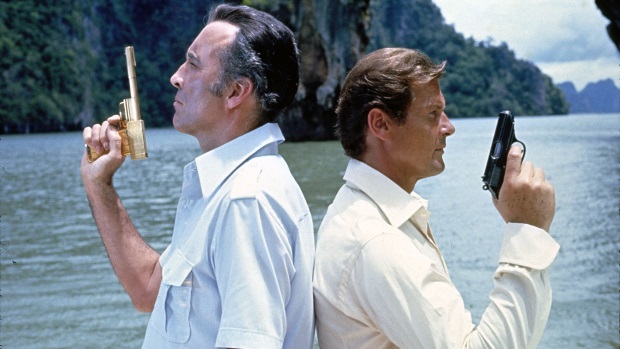
The Man with the Golden Gun (1974)


Christopher Lee and Roger Moore duel to the death in the confusing and strangely pointless The Man with the Golden Gun

Director: Guy Hamilton

Cast: Roger Moore (James Bond), Christopher Lee (Francisco Scaramanga), Britt Ekland (Mary Goodnight), Maud Adams (Andrea Anders), Bernard Lee (M), Hervé Villechaize (Nick Nack), Richard Loo (Hai Fat), Soon-Tek Oh (Lt Hip), Clifton James (JW Pepper), Desmond Llewelyn (Q)

I sat down to watch The Man with the Golden Gun having just heard the news of Roger Moore’s death. It seems an odd one to choose, as this was easily Moore’s least financially successful, and least fondly received, Bond film. But it had just been on TV, and I wanted to raise a glass (or eyebrow) to Britain’s finest.

MwtGG was very much the formula trying to find its way in a post-Connery world, with Moore’s performance an odd half way house between his later light persona and the harder edge of Connery. Anyway, the plot, such as it is: Bond is sent a bullet with his name literally on it from Francisco Scaramanga (Christopher Lee), the world’s greatest hitman who only uses golden bullets and charges a (now rather sweetly modest-sounding) $1million per hit.  Bond goes to Hong Kong to find out more and gets embroiled in some complex (and not particularly interesting) back-and-forth about hijacking the world’s solar energy supply, hindered by incompetent agent Mary Goodnight (Britt Ekland). It all culminates into a duel of guns on Scaramanga’s private island.

The problem with this film isn’t so much that it’s a bit dull – it’s that it’s not really about anything at all. Does anyone really understand Scaramanga’s scheme? Even he seems confused about it. As far as I can tell it’s something to do with controlling solar energy, but how the heck he’s going to control access to the sun I don’t know. Scaramanga seems far more interested in a silly heat gun he’s got as a side installation. Anyway, whatever the heck this is about, lots of other people seem interested in it. It’s powered by “the Solex”, which looks like some sort of robotic cigarette pack. This Solex changes hands even more regularly than Bond changes love interests, but its purpose and why it’s important are such a poorly explained macguffin it’s really hard to care.

What the film is nominally about (but turns out not to be) is the duel between Scaramanga and Bond. Turns out, of course, Scaramanga doesn’t have a clue about the bullet. His motivations towards Bond are as unclear as the plot, alternating between indifference, admiration and envy. On top of that, to make a duel like this work we need the feeling Scaramanga and Bond are two sides of the same coin – that with a push at the right time in his past, Bond could have turned into the ruthless hitman Scaramanga is. This could have worked with Connery’s early Bond – or Dalton and Craig – but never do you believe Moore’s Bond has a streak of black through his soul.

This is despite some ill-fitting moments in the film, created solely in an effort to show Moore’s Bond acting tough, moments that feel horrendously out of place and against character. In particular, early in the film Bond quite viciously roughs up Andrea Anders (he slaps her, nearly breaks her arm, spies on her with the shower and threatens her with a gun in a weirdly sexual manner). It feels totally wrong for Moore’s gentle suaveness. At other points in the film, Moore plays with a hardness and general prickishness that isn’t present in his other films, and doesn’t match his light style. Throughout the film he feels annoyed at Goodnight, he pushes a kid off a boat, he treats his colleagues dismissively – it feels all the time Moore is struggling to play a Bond way against his style.

To be fair, I can see why Bond is annoyed with Goodnight: Britt Ekland is probably the nadir of Bond girl stupidity. Literally nothing she does in this film is any use, and most of the rest of the time it actively helps the villains. She’s stupid, clumsy and not funny. She’s so incompetent you need to keep double checking she is actually meant to be an MI6 agent. Ekland has indignities heaped upon her on this film, from being locked in the boot of a car, to being hidden in a cupboard by Bond mid-coitus so that he can do the nasty with Scaramanga’s girlfriend. Late on, she nearly kills Bond by backing into a button with her bottom. Ekland’s main reason for being cast was of course her physical assets in a bikini – so it’s lucky that Scaramanga keeps her on his island dressed only in a bikini for the last third of the movie. Only way to make sure she doesn’t have a weapon, doncha know!

As the plot drifts around, going either in circles or nowhere at all, the producers land Bond in a kung-fu training school in Hong Kong. Bond films as a genre have always gently ripped off as much as possible whatever was popular at that time in Hollywood (Blaxploitation in Live and Let Die, Star Wars in Moonraker, Bourne in Quantum of Solace etc. ), and so it merrily climbs on the Bruce Lee bandwagon here. Unfortunately, it’s all highly stupid and adds nothing (Scaramanga even comments in the movieabout the ludicrousness of sending Bond to a school rather than just putting a bullet in him) and hits heights of ridiculousness when the entire school of elite trainers is bested by Bond’s sidekick and two teenage schoolgirls in school uniform.

That’s another thing wrong with this movie – the wildly varying tone. So at times we get Bond chasing down leads like Philip Marlowe. Next we have him roughing up a weeping woman. We’ve got Goodnight’s buffoonery, Scaramanga’s suave cruelty… It’s all over the shop. The comic moments of the film particularly grate. Was anyone waiting for Sherrif JW Pepper’s return from Live and Let Die? Didn’t think so, he’s as funny as a bout of gonhorrea. Even some of the good moments get undermined by bizarre tonal shifts: the classic car flip stunt (which is amazing, particularly because you know they did it for real after hours of careful calculations) is overlaid with a stupid “whoop” sound effect, like a Carry On film (even Guy Hamilton subsequently said this was a terrible idea).


However, it’s not all bad – no Bond film ever really is, such is the triumph of the formula. Christopher Lee is very good – you wish he was in a much better film than this one. The late duel in the film between Scaramanga and Bond is pretty good, even if it all ends a little too easily. Scaramanga’s funhouse seems totally bizarre (why the hell does he even have this on the island next to a power plant?) but its good fun. The MI6 base on a half sunk ship off the coast of Hong Kong, with all the corridors on the wonk is an absolute triumph of design. Bernard Lee gets lots more to do than he usually does – and delivers his exasperated boss lines with a sense of dry timing.

It doesn’t change the fact, though, that this is possibly one of the weakest Bonds around. It’s not a terrible film – I enjoyed watching it, though at least part of that comes from growing up with these films, making them as familiar as family members. But it’s way down there in the Bond list. It’s a slightly tired movie, in a franchise trying to find its feet under a new lead. Tonally it’s a complete mess for large chunks of it, and manages to make its plot seem inconsequential and dull. Nothing really seems that much at stake, and Scaramanga (despite Lee’s good performance) never feels like a villain we really understand. I’ve no idea what he wants, and no idea why he should be stopped.

The Man with the Golden Gun is only worth it for a doze in front of the television on a Sunday afternoon. Thank goodness that’s the only time it’s likely to appear on your TV. And putting all else aside, Moore was a terrific Bond and an even more terrific human being. Rest in Peace.