
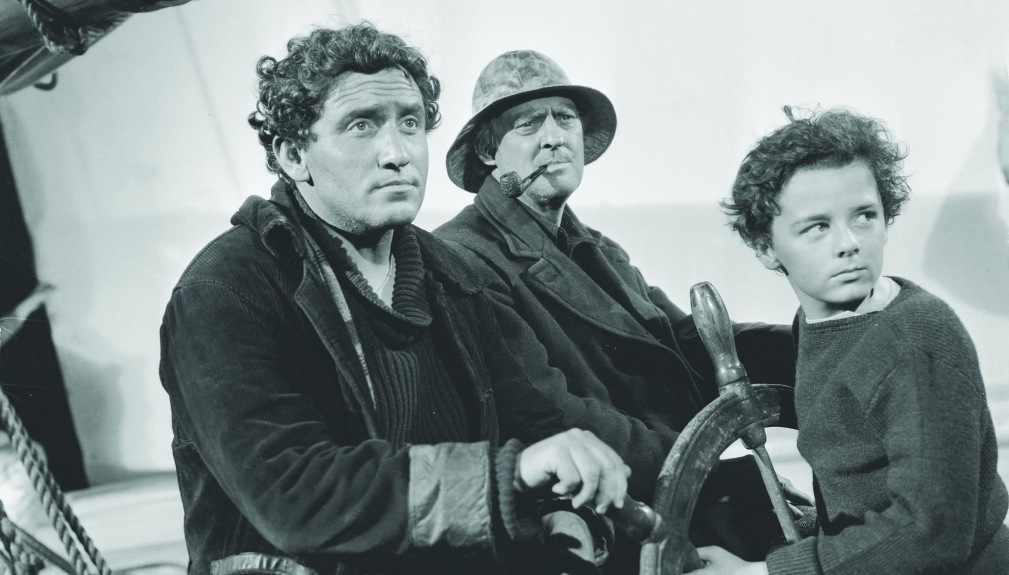
Well-made, coming-of-age story with two very fine leads and a heart-tugging ending
Director: Victor Fleming
Cast: Freddie Bartholomew (Harvey Cheyne), Spencer Tracy (Manuel Fidello), Lionel Barrymore (Captain Disko Troop), Melvyn Douglas (Frank Burton Cheyne), Charley Grapewin (Uncle Salters), Mickey Rooney (Dan Troop), John Carradine (‘Uncle Jack’), Oscar O’Shea (Captain Walt Cushman)

Harvey Cheyne (Freddie Bartholomew) is a hard kid to like. Scion of Henry Ford-like American tycoon Frank Burton Cheyne (Melvyn Douglas) he’s an arrogant, entitled snob who believes he is deserves anything he wants because Daddy has never-empty pockets. The servants in his father’s estate can’t stand him, his prep school classmates only pretend to like him and even his teachers think he needs to be taken down a peg or two. Suspended from school, his father (upset at what his son has become) hopes a trip to Europe will help Harvey grow-up. But, en route, Harvey is lost at sea and picked up by the fishing boat We’re Here. Despite his objections, they have no interest in cutting short fishing season by three months to take him straight back and slowly Harvey finds himself rather enjoying fishing life, helped by his growing bond with salt-of-the-Earth Portuguese fisherman Manuel (Spencer Tracy).
Adapted from a Rudyard Kipling novel – despite what you might think, Harvey and his father are also American in the original – Captains Courageous is a surprisingly sweet coming-of-age tale, mixed with a surrogate-father-son relationship, well-directed by Victor Fleming and strongly played by the cast. The cast spent months bobbing up-and-down in a giant water tank to bring the film to the screen, and it’s a tribute to Fleming’s direction and Harold Rossen’s sharp camerawork that it often genuinely feels like a film pulled in from the seas like Manuel’s fishes.
It also has some wonderful chemistry between its two leads. Freddie Bartholomew, one of the biggest (and most skilled) child stars of the 30s, had a hard task here: appearing in virtually every scene, he has to turn a character who most viewers would love to give a cuff around the ear too, into a kid we end up admiring. Captains Courageous doesn’t shirk at stressing Harvey’s arrogant, self-absorbed unpleasantness: he treats the servants like talking furniture, brags about his editorship of the school magazine (a position bought for him by his father’s purchasing of their printing press) which he feels with dull articles (essentially ‘what I did on my holidays’) and shamelessly uses his father’s money to bribe people (including his schoolmaster, who he loans $50 to then casually mentions it would be great if the history test could be made easier).
He is, in short, a total brat and that only starts to change on We’re Here. Bartholomew’s trick is to do just enough to suggest a decent kid buried under the surface here, even when he’s demanding the ship turn round to take him home or assuming his ship-mates will settle into playing servants for him. He and the film slowly reveal his childish enthusiasm waiting for an outlet. With a distant father, you get the feeling Harvey felt acting like the pampered, entitled wealthy man was the only way to impress him. Captains Courageous is rather endearing in showing how he flourishes when faced with pushback by someone (Manuel) who gives him genuine attention, teaches him things and won’t take his nonsense (in the way nearly every other employee in his life does).
Bartholomew’s thoughtfulness, vulnerability and eager-to-impress energy makes for a great combination with Spencer Tracy’s jovial warmth as Manuel. Tracy – who won an Oscar – was later rather self-critical of his curly-haired ‘liddle feesh’ accented-fisherman, generously claiming his success was partly due to Bartholomew. But Tracy’s work here is endearing, funny and unforced, making Manuel a mix of big brother and father, full of energy and joi d’vivre, with exactly the sort of easy-going happiness in small things (catching a big fish, playing music, even swabbing a deck) that Harvey never has. Tracy also brings out Manuel’s strong morals and his respect for others – it’s no surprise that he has no truck with Harvey’s cheating in a fishing competition.
In fact, Manuel’s response to this (deep disappointment, throwing the competition and firmly telling Harvey he’s no fisherman) is exactly the sort of firm-but-fair parenting, with a moral education, that Harvey needs. But Manuel is also a fierce defender of him when he admits his mistakes and also offers the sort of direct, in-person support and regard for Harvey that his own father failed to do. (There is a lovely reaction shot from Tracy – one of the best reactors in movies – of warm pride when Harvey admits blame). The two actors have a natural, easy bond which is genuinely endearing. Manuel even becomes as keen for the boy’s good opinion (bashfully clamming up when Harvey reacts with shock to his talk of ladies). Captains Courageous allows Tracy to be as playful, loose and fun as he ever has.
The staging and design of the fishing boat is marvellously done, the actors having clearly (and impressively) done their homework around the tying of knots, casting of lines and rowing of oars. Lionel Barrymore gives a fine salty sea-dog (with a hidden heart of gold) as the captain, with Mickey Rooney echoing him as his eager son and John Carradine scowling as Manuel’s rival fisherman. There is a genuine sense of energy and vibrancy in all the fishing and sailing scenes (despite some, at times, less than convincing back projection), with Captains Courageous more than holding its own with epics of the sea.
Of course, you are not perhaps surprised that the film is also heading towards a tragic end, as so many coming-of-age tales do. But it’s extremely well-done and, thanks to the playing of the cast carries real emotional impact, not least through Bartholomew’s and Tracy’s poignant performances. There is also a mature and tender coda to Captains Courageous about the nature (and difficulties) of fatherhood, adding further depth to a character study of a young boy that genuinely sees him grow and develop in a way that feels neither sickly sweet nor forced – and has a real warmth and joy to it. Full of impressive staging and with a wonderfully played relationship between Bartholomew and Tracy, it’s a fine, heart-warmer turned tear-jerker.


 Movie Musings