Tag: Michael Cera

The Phoenician Scheme (2025)

The Phoenician Scheme (2025)

Anderson marries heart, truth and a genuinely engaging and compelling plot with his unique quirk

Director: Wes Anderson

Cast: Benecio del Toro (Zsa-Zsa Korda), Mia Threapleton (Sister Liesl), Michael Cera (Bjorn Lund), Riz Ahmed (Prince Farouk), Tom Hanks (Leland), Bryan Cranston (Reagan), Mathieu Amalric (Marseilles Bob), Richard Ayoade (Sergio), Jeffrey Wright (Marty), Scarlett Johansson (Hilda Sussman), Benedict Cumberbatch (Uncle Nubar), Rupert Friend (Excalibur), Hope Davis (Mother Superior), Bill Murray (God), Charlotte Gainsbourg (Korda’s late wife), Willem Dafoe (Knave), F. Murray Abraham (Prophet), Stephen Park (Korda’s pilot), Alex Jennings (Broadcloth), Jason Watkins (Notary)
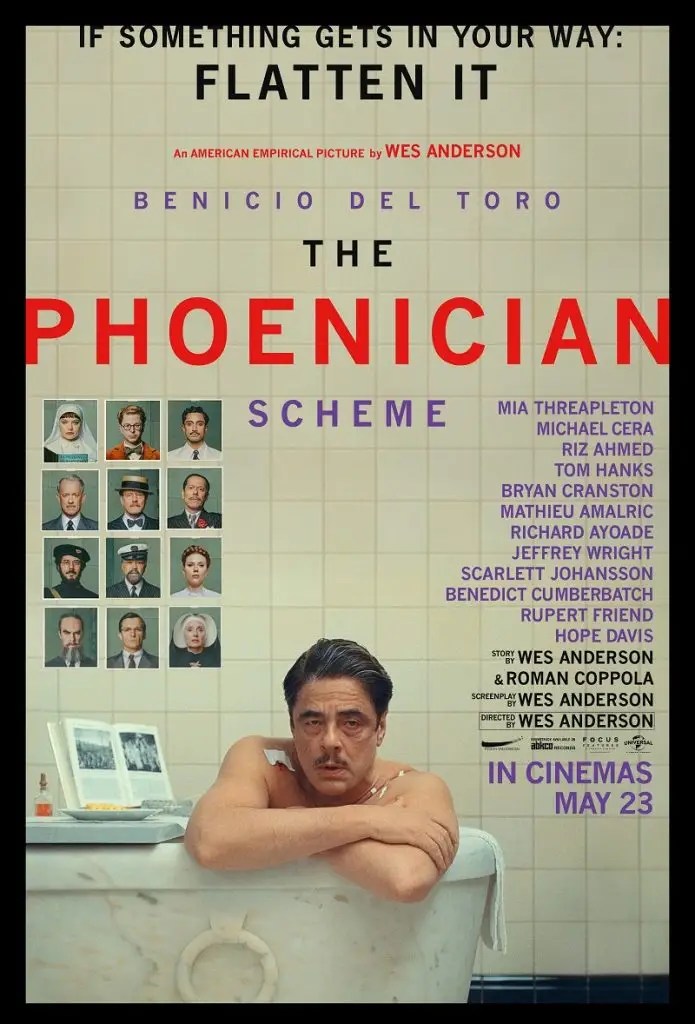
Wes Anderson is one of those directors I often sit on the fence about, with a style so distinctive it can in become overwhelming. But when it works, it works – and The Phoenician Scheme is (aside from his superb Netflix Dahl adaptations) his best work since his masterpiece The Grand Budapest Hotel. In this film, Anderson finds an emotional and story-telling engagement that adds depth to all the stylised invention. It’s a film I’ve found more rewarding the longer I’ve thought about it.

Set in an Anderson-esque 1950s (Andersonland?), notorious industrialist and arms trader Zsa-Zsa Korda (Benecio del Toro) spends his life dodging assassins. After one attempt gets close, he decides to try and repair his relationship with estranged daughter Liesl (Mia Threapleton), a novice nun who suspects her father might have had her mother murdered (he denies it). With governments, business competitors and others on his tail, Korda throws together a complex scheme for one last success in Phoenicia, a massive new development built with slave labour. As Korda juggles rivals and investors, will he repair his relationship with his daughter? And how will he fare in his recurrent visions of standing at the (noir) Gates of Heaven, being judged for entry?

Anderson’s film, of course, is another superb example of his visual style, constructed like an intricately layered work of art. Each shot could probably hang in an art gallery, framed to perfection with gorgeously sublime colours that soak off the screen. The elaborate set design and vintage costume work are striking as always, with every piece perfectly placed and every feature expertly judged. Within this, his carefully selected cast deliver the wry, dry and arch Anderson-dialogue with aplomb, embracing every moment (of many) where Anderson allows the characters to share a raised eyebrow or a pithy aside to the camera.

In other words, it might all be as you expect – a formula that started to feel a bit tired after intricate, insular films like The French Dispatch and Asteroid City, which felt so personal to Anderson that they were virtually impenetrable to everyone else. But what elevates The Phoenician Scheme is that Anderson embraces both a surprisingly tense plot-line – the closest he can probably get to a thriller, laced throughout with satire, humour and more than a fair share of the ridiculous – and gives a genuine emotional force to a father and daughter struggling to recognise what (if anything) could bring them together. Throw in questions around life, death and what constitutes making a life ‘worth living’ and you’ve got a rich, intriguing and rewarding film that could stand even without the Anderston scaffolding.

Perhaps only Anderson could mix an unscrupulous businessmen targeted by assassins (some of these are delightfully, blackly, comic – not least an opening plane bomb that sees Korda ejecting his pilot for refusing to attempt a crazy hail-Mary manoeuvre to survive an inevitable crash) with Korda closing vital deals (in a deliberately, impenetrably complex scheme) by shooting hoops with a pair of baseball-fanatic brothers (Tom Hanks and Bryan Cranston, both hilarious), taking a bullet for a fez-wearing gangster (Matheiu Almaric, wonderfully weasily) and forcing an eccentric naval captain (Jeffrey Wright, perfectly deadpan) during a blood donation to sign with a bomb. And spin out a joke where Korda hands over custom-made hand grenades to business associates like they are branded pens. All while dodging a shady government cabal (fronted by Rupert Friend’s Transatlantic Arthurian-nick-named Excalibur).

But The Phoenician Scheme works because under this comic twist on spy thrillers, it has a real heart. Anderson’s finest films are where he works with an actor who can bring depth and feeling to the quirk. And here, he might just have brought out the best from an actor prone to a little quirk himself. Benecio del Toro gives Korda a world-weary cynicism but also a subtle fragility. There is nothing that won’t flummox Korda, a guy tipped off on attempts on his life because he frequently recognises assassins he’s hired himself in the past. But he’s also quietly afraid his life has been for nothing: that he is, in fact, not a rogue but an out-and-out villain ruining countless lives. And that God (in the form of, who else, Bill Murray) isn’t going to be welcoming up there.

It motivates a careful dance of reconciliation and grooming to take over his business with his estranged daughter Liesl, delightfully played by Mia Threapleton (with just the right mix of dead-pan flair for the dialogue, while giving it an arch warmth). Liesl imagines herself as distant from Korda as can be – the novice (literally) to his expert manipulator – but she turns out to have far more talent for Korda’s mix of chutzpah, disregard for rules and ruthless improvisation. Watching the relationship – and recognition – between these two (beautifully played by both actors) is very funny and also surprisingly sweet (you know its Anderson when a nun suddenly pulling a small machete out of her wimple is both oddly endearing and absolutely hilarious).

This sense of emotional development and personal and dramatic stakes is improved further by the celestial semi-trial (cue Willem Dafoe as an advocate angel), in a black-and-white heaven that mixes Powell and Pressburger’s Matter of Life and Death (surely the name Korda is no coincidence) and the imagery of Luis Buñuel. This all leads into a surprisingly gentle but affecting tale of redemption and second-chances, including an ending that feels surprising but also somehow completely, wonderfully inevitable and fitting,

The Phoenician Scheme may even be slightly under-served by its Andersonesque framing and design: after all it’s become easy to overlook the depths when the display is as extraordinary as this. When Anderson unearths a deeper meaning, working with masterful performers who can imbue his quirky, witty dialogue with heft, he can be one of the best out there. And do all that without sacrificing an air of charming whimsy, and building towards the most hilarious fist fight since Bridget Jones’s Diary (between del Toro and Cumberbatch’s tyrannically awful Uncle Nubar). Not a lot of directors can pull that off – and it’s a lovely reminder that Anderson at his best is an absolutely unique, wonderful gem in film-making.
Barbie (2023)

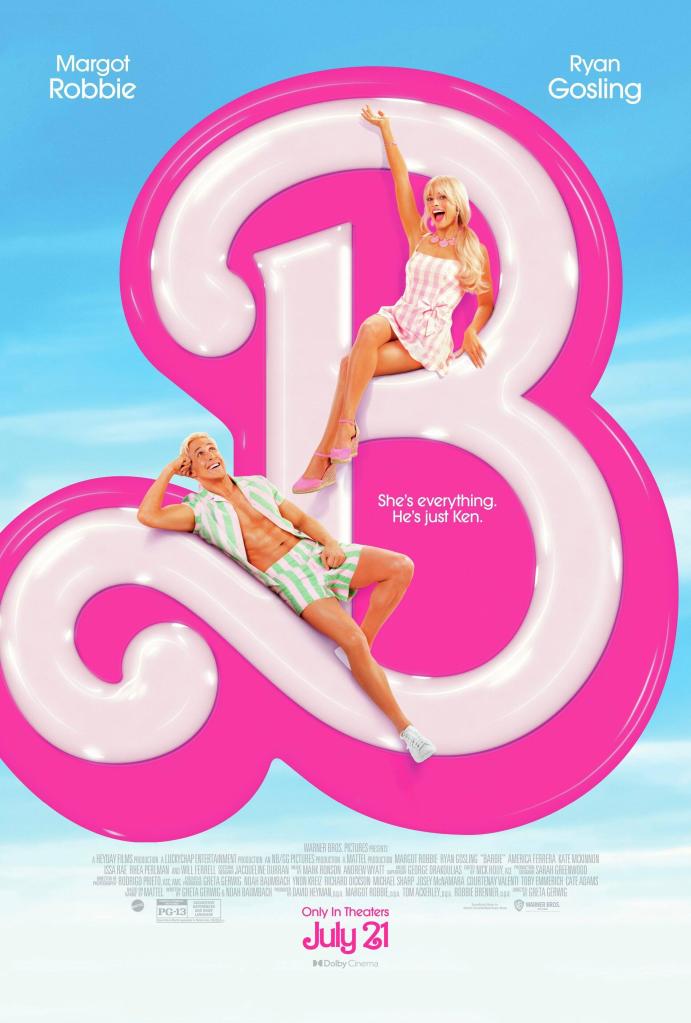
Barbie (2023)

Fabulously pink comedy with serious – and very earnest – things to say on sexism and gender

Director: Greta Gerwig

Cast: Margot Robbie (Barbie), Ryan Gosling (Ken), America Ferrera (Gloria), Will Ferrell (Mattel CEO), Ariana Greenblatt (Sasha), Kate McKinnon (Weird Barbie), Issa Rae (President Barbie), Alexandria Shipp (Writer Barbie), Emma Mackey (Physicist Barbie), Hari Nef (Dr Barbie), Sharon Rooney (Lawyer Barbie), Kingsley Ben-Adir (Basketball Ken), Simu Liu (Tourist Ken), Ncuti Gatwa (Artist Ken), Michael Cera (Alan), Rhea Pearlman (Ruth Handler), Helen Mirren (Narrator)

Who knew that the film which sparked the most conversation in 2023 about the roles of men and women would be one launched by a toy company, with the goal of selling toys? Barbie feels a little like a project happily hijacked. In another world this could have been a straight-forward, Adventures of Barbie flick, designed only to get kids crying out for that Margot Robbie Barbie to be appearing under the Christmas tree. Instead, thanks to the team of Gerwig and Robbie, this is a self-reverential, witty, smart and highly engaging look at gender politics which also manages to be a fun, gag-filled evening out at the cinema.

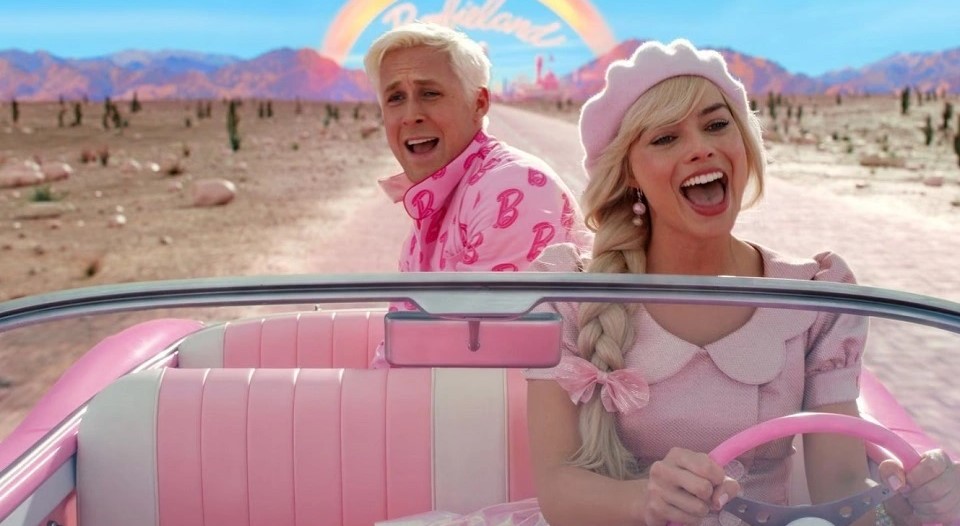
Stereotypical Barbie (Margot Robbie) leads a blissful life in Barbie-Land, where every day is the best day ever. Every Barbie knows they’ve inspired change for the better for women in the Real World. Everything is perfect until one day Barbie starts thinking about Death. Before she knows it, she has flat feet, cellulite and a crisis of confidence. The only way to fix this? A journey to that Real World to meet with the child who’s playing with her. But Barbie and Ken (Ryan Gosling) find the Real World very different from what they expected: all women’s problems are not solved and Ken discovers The Patriarchy, a wonder he is determined to bring back with him to Barbie-Land. Can Barbie save Barbie-Land and help rebuild a relationship between moody teenager Sasha (Ariana Greenblatt) and her mother Gloria (America Ferrera) in the real world?

Barbie’s sharp playfulness mixes heartfelt messages on gender politics with the sort of joyful fish-out-of-water stuff beloved of family films where a naïve figure from our childhoods finds the real world a much harsher, more cynical place than they expected. Barbie’s expects our world to reflect of the female-dominated  Barbie-Land is immediately exploded. Arriving in California, the reaction to an attractive woman roller-skating along a beach is remarkably different to what she’s used to. Wolf whistles, a parade of sexualised comments from construction workers (not a woman among them, to her shock) and a world where nearly all the top jobs are held by men.

Barbie addresses head-on whether a doll can really be an aspirational figure. In a surprisingly complex manner, Gerwig’s film looks at the pros and cons. Teenage Sasha doesn’t think Barbie has shown her world of possibilities, but instead sees her as a puppet of corporate America presenting a veneer of opportunity to women, while pushing them back into a box marked “pretty woman”. (This deadpan tirade provokes one the film’s many laugh-out loud lines as Barbie bemoans she can’t be a fascist as “I don’t control the railways!”.) Barbie may be able to do any job under the sun but this encourages attainment and also piles expectations on young women. If you can be almost anything at all, doesn’t that make it even the obligation to be something even more of a burden?

The real world is also a revelation – in a different way – to Ken. In our world, Ken discovers men (and possibly horses, Ken isn’t sure) rule though a marvellous thing called “the patriarchy”. Watching the Kens become infected by toxic masculinity, becoming high-fiveing bros who down beers, mansplain and call all the shots, is both funny and also a continuation of the film’s earnest exploration of gender politics. You can see, unpleasant as he becomes, that Ken might well want a piece of that action, coming from a world where men are so marginal they don’t even have homes (after all Mattel never made “Ken’s Dream House”). It’s also a neat gag that the other Barbies are easily brain-washed into accepting demeaning Stepfordish roles (dressed almost uniformly as French maids or in bikinis) because the confidence with which the Kens express their rightful place as masters-of-the-universe is literally mesmerising.

It’s also a neat part of Gerwig’s commentary here that the crucial factor to breaking out of this state is all about embracing the pressures of being expected to do it all: of being clever but not a know-it-all, ambitious but not a monster, raising a family but also having a career etc. If Barbie-Land in its beginning is a sort of vision of utopian feminism, then its salvation lies in accepting and embracing the struggle of marrying together a raft of contradictions and expectations. Sure, this isn’t exactly reimagining the wheel and its fairly easily digestible stuff – but it also rings true and you can’t argue with the connection its made with people.

All of which might make you think ­Barbie might be a po-faced political lecture. Fortunately, not the case when every point is filled with laugh-out-loud, irreverent humour expertly delivered by a cast clearly having the time of their lives. They are led by Margot Robbie, sensational in bringing to life a character who begins the film feeling like a doll made flesh and ends it as a three-dimensional character who embraces the contradictions of life. Robbie, who produced and set out much of the film’s agenda, is fabulous – funny, endearing, heartbreakingly vulnerable and extraordinarily sweet, mixing light comedy with genuine moments of pathos.

Equally good is Gosling playing the almost preternaturally stupid Ken with a winning sense of self-mockery, walking a brilliant line presenting a character who is (at times) the nominal villain but also a lost soul. Barbie also employs him and Robbie in some outstanding song-and-dance routines, deliciously performed and exquisitely funny. The other Barbies and Kens are uniformly excellent in their winning mix of initial shallowness and growing emotional depth while America Ferrera and Ariana Greenblatt are immensely winning as a mother and daughter overcoming a divide.

Barbie is also an explosion of delightful design and superb eye-for-detail, in its pitch-perfect recreation of a host of Barbie toys and props in real-life size, all thrown together with the perfect level of pink presentationalism. Drily narrated by an unseen Helen Mirren, every scene has a winning gag or laugh-inducing piece of business, especially when poking fun at the naïve optimism and artificiality of the Barbie world. Saying that, the film stumbles when it blurs the lines in the real world, which is half presented straight, half as a weirdly Wes-Andersonish oddity, particularly in the Mattel building and its corporate board, who are played as even more cartoonish than the actual toys populating Barbie-Land.

Barbie though generally works because it successfully mixes a heartfelt, earnest look at gender politics and the pressures on women with great gags, winning performances and a bouncy sense of off-the-wall fun that ensures nothing gets too serious. From its 2001 style opening, through its pink-led-primary colour settings, to its song-and-dance and larger-than-life-but-grounded performances, it’s a treat and in particular a triumph for its originator, producer and star Margot Robbie.

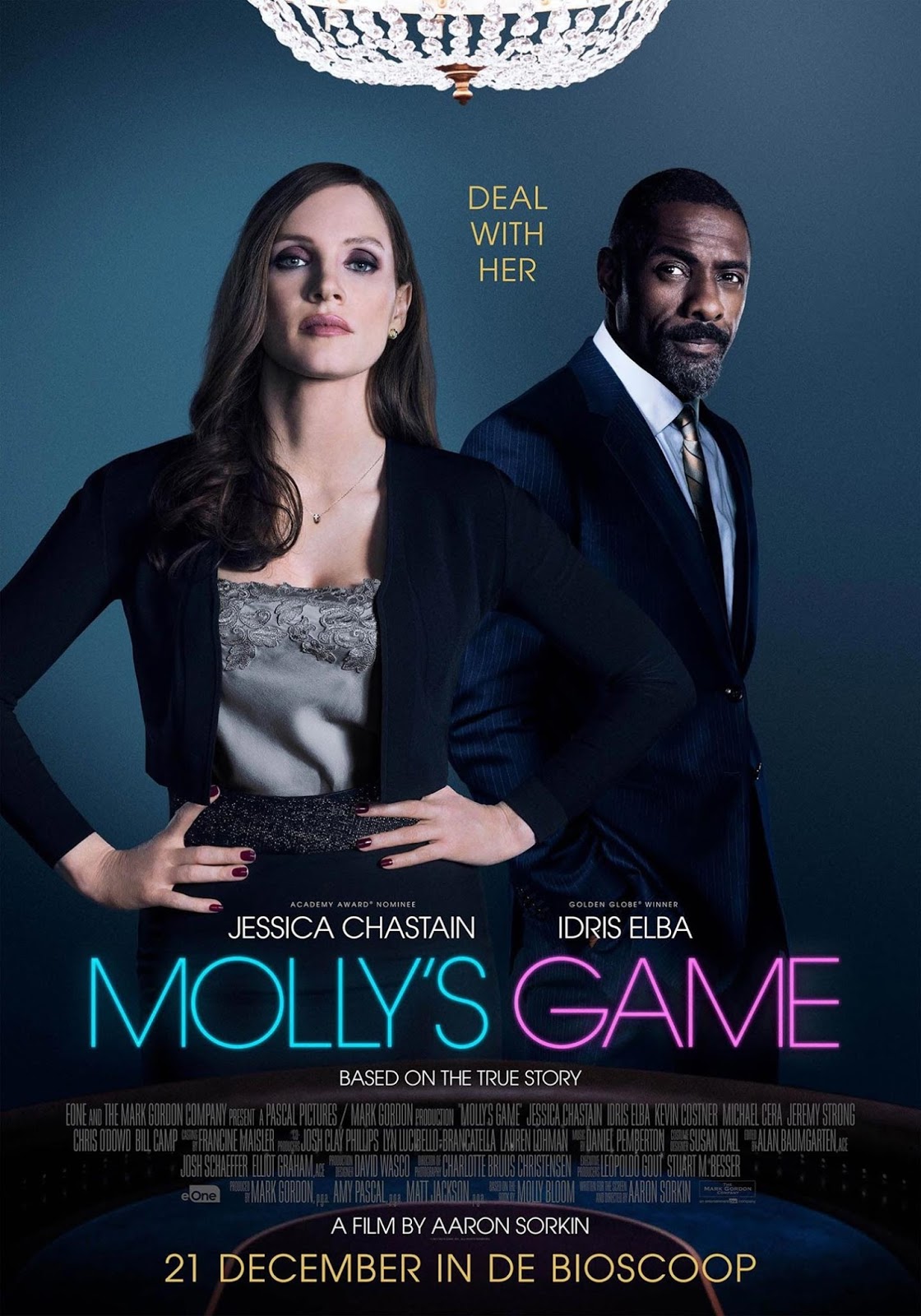
Molly's Game (2017)


Jessica Chastain and Idris Elba excel in Aaron Sorkin’s dynamically scripted Molly’s Game

Director: Aaron Sorkin

Cast: Jessica Chastain (Molly Bloom), Idris Elba (Charlie Jaffey), Kevin Costner (Larry Bloom), Michael Cera (Player X), Brian d’Arcy James (Brad), Chris O’Dowd (Douglas Downey), JC MacKenzie (Harrison Wellstone), Bill Camp (Harlan Eustace), Graham Greene (Judge Foxman), Jeremy Strong (Dean Keith), Angela Gots (B)

Molly Bloom (Jessica Chastain) is all set to join America’s Winter Olympics team, under the guidance of her ultra-demanding psychiatrist father Larry (Kevin Costner), when a freak accident ends her career. So she heads to LA and becomes embroiled in the world of high-stakes poker, eventually setting up and running her own high stakes games in LA and New York, earning millions. But, over a decade later (in a parallel plotline) she has had a millions seized and is battling against imprisonment for her connections to the mob, with only lawyer Charlie Jaffrey (Idris Elba) on her side.

Sorkin’s zippy new drama has plenty of sparkling dialogue – as you could expect! Sure this film probably also proves he’s not really a director (it’s over-long, a little flabby, and structurally not very clean) but the guy can certainly put a speech together. My main issue with Molly’s Game is I’m just not quite sure what its point is. Maybe it only exists to entertain, but it feels like it wants to put together a touching story about family, faith and the value of your word. I’m not sure it really manages to achieve any of this. 

The parallel plotlines don’t always do the film a lot of favours. The present-day plotline of Molly and Jaffey working to clear her from the various charges she has been accused of, continually hints at some serious gangsterism set-ups later on: largely these never really transpire. Actually, the film heads into pretty standard “my-Daddy-didn’t-love-me” territory. It shy’s away from being something different and interesting about excess and punishment into psychiatry solving our problems.

Sorkin doesn’t always get the structure right, as if he hasn’t got the patience to actually make sure the fundamental plot information was clear enough, so eager was he to get on with the verbal pyrotechnics. Time is spent carefully exploring several poker hands – but the exact nature of the illegality of what Molly does running her poker games gets glossed over in seconds. 

But then this is a film that isn’t really that interested in plot dynamics, or even in over-arching themes. What it’s interested in is sizzling dialogue, and letting actors deliver it. The camera sits back and watches. So it’s not a surprise the most memorable scenes feature Jessica Chastain and Idris Elba (both superb) in a room, talking (or arguing) with each other. It’s the moments like these where the film really works – and Sorkin the director basically stays out of the way, using a two-camera set-up to record the scenes, like a filming of a Broadway play. 

Those two actors dominate the film. Chastain is excellent as Molly – ambitious, driven, playful but also vulnerable and ever-so-slightly bitter, who gets where she is through her own intelligence and hard work. Chastain also embraces playing a character with such a strong moral code – she’s terrifically warm and human in the part. Elba is equally fine, a wry professional with his own strong moral code (yup, The West Wing writer still loves those liberals of great conscience), an articulate (of course!), passionate advocate who is far warmer than he first appears.

The rest of the film never quite lives up to this, maybe because the poker games are never really that interesting, or because the life Molly leads among the rich and famous seems ill-defined (she has possibly the least impactful drugs addiction seen on screen). For someone who remains loyal to the end to her clients, we are never really clear why other than a suggestion of her basic sense of honour. Her projects are all set-up with ease, and the film builds towards a solution buried in psychiatry speak that similarly feels a little too easy.

Because while it is great that Molly is not defined by a romantic relationship – she is defined by men in virtually every other way. Her entire career is based on pleasing rich, middle-aged men (from whom she frequently has to bat away expressions of devotion or sexual interest). Three times she falls victim to senior male partners in business relationships. Above all, she is defined by her relationship with her overbearing father (well-played by a low-key Kevin Costner). The scene where this comes to a head, a father-daughter exchange late at night on a snowy New York bench, is so well-written and played you almost overlook its pattness.

Sorkin’s script is the most important thing here – and the film is built around it. Like Scorsese’s Casino(a film he must have seen a couple of times!) most of its opening act is structured heavily around Chastain’s expertly delivered voiceover. The actors get to enjoy delivering his engaging rat-a-tat dialogue, the expert playing and sharp dialogue ends up carrying a lot of uplifting moments in the film. It’s a film that embraces Sorkin’s scripting, and doesn’t worry about being too filmic about it: the zippiest moments of editing are so because the dialogue or voice-over demands it.

Some of the roles aren’t quite so well drawn: Michael Cera is just plain miscast in a role that needed a young Rob Lowe as an absurdly glamourous Hollywood poker addict (I can’t imagine people crossing a street let alone a continent to play cards with Cera). The rest of the women in the script get short shrift – even Molly’s mother is little more than a walk-on part. 

Molly’s Game is a lot of fun, even if it’s probably about 15 minutes too long. It’s got some great dialogue and, if Sorkin turns out not to be the best interpreter of his own work, he’s certainly no dud as a director. Overall, the themes and plot don’t quite come together as well as they should. But it’s very well acted – Elba and above all Chastain are absolutely terrific – and it has more than enough sparkle to it for an enjoyable Friday night.