Tag: Michael Jeter

WaterWorld (1995)

WaterWorld (1995)

As the waters rise, the world sinks down – and WaterWorld went down with it in the very average mega-budget sci-fi

Director: Kevin Reynolds

Cast: Kevin Costner (The Mariner), Dennis Hopper (The Deacon), Jeanne Tripplehorn (Helen), Tina Marjorino (Enola), Michael Jeter (Old Gregor), Gerard Murphy (The Nord), RD Call (Atoll Enforcer), Kim Coates (Drifter #2), John Fleck (Smoker Doctor), Robert Joy (Smoker Ledger), Jack Black (Smoker Pilot), Zakes Mokae (Priam)

In 1995 they called it “Kevin’s Gate”. Costner cashed all – and I pretty much mean all – his superstar chips to make Waterworld, a sort of water-logged Mad Max crossed with a Leone Western, starring himself as a nameless mutant with gills behind his ears. You needed to be the Biggest Box Office Star in the World to get that one up and running. But then Costner’s last “all-in” bet had been Dances with Wolves – and that won seven Oscars. What could do wrong?

Waterworld has been pretty much defined – then and now – as the (at the time) most expensive film ever made, which went on to be a damp squip, a box-office stinker. It’s not that: it’s a solid, entertaining-enough B-movie with some neat Dystopian ideas. In 2500, the world has been completely flooded after the polar ice caps melted. Mankind exists in rusted boats and small floating camps on the ocean. Dry land is a myth and actual soil is worth a fortune. Costner’s Mariner ends up protecting Helen (Jeanne Tripplehorn) and her adopted daughter Enola (Tina Marjorino), as Enola has (handily tattooed on her back) a map to the last piece of dryland left in the world. But Enola’s map is hunted by the Smokers, and their maniacal leader The Deacon (Dennis Hopper), who want to claim Dry Land for themselves.

Waterworld largely lives on as a hugely successful stunt show at Universal Studios (I’ve seen it and it is amazing – all the exciting bits of the film, done in about fifteen minutes) that has been running non-stop since 1995 (other shows, based on more successful movies, have long since disappeared). It focuses on all the stuff that’s good about the film. Kevin Reynolds’ can shoot the heck out of action scenes and professional stuntmen really know their business. The best sequences in Waterworld involve pounding action – jet ski chases, the Mariner’s transforming trimaran, jet skis flying over walls and diving under water, stunning boat chases – and they are great.

They also exploit, in their rusted crap-sack props, one of the film’s other triumphs, it’s detailed world-building design. Sure, it owes a heavy-debt to the cobbled-together semi-steam-punk of Mad Max, with rust that covers everything, adapted wet-suits and rags (augmented with various pieces of fishing equipment and light fabrics) that characters wear, the bashed out colours contrasted with the glorious blue of the water. But the film never looks anything less than an outre mad-house. Throw in James Newton Howard’s very effective score – romantic and mournful when required, but then pounding with heroic action beat – and you’ve got elements of a decent movie.

But decent is all it ever is. Because, aside from the novelty of being set on water (a hugely time- and money-consuming expense, that partly explained why the film went zillions of dollars over budget), there isn’t anything that new about the story. A gruff outsider is roped into grudgingly protecting a mother and a daughter, but then his heart-is-melted – just as the villains turn up to snatch the daughter away. The villains are cartoonish monsters (Dennis Hopper seems to be on a mission to counter the water-logged misery of most of the rest of the performers by acting as much as possible), who are either ingenious or incompetent depending on the requirements of the script. The quest for the land-of-plenty is so familiar, you could scribble it down on a postcard in advance.

The question is, why did Costner want to make this? It’s not even a part that showcases him very well. I’ve always found Costner’s mega-stardom a bit of a mystery: once he graduated from more young, naïve parts (such as in The Untouchables), action films more and more exposed his slightly blank sulkiness as an actor. Perhaps due to the pressure of Waterworld (he worked non-stop, six day weeks, mostly on or in the water, for six months), perhaps due to his inability to find any warmth in a role he clearly sees as an Eastwoodish man-with-no-name, he largely comes across as sullen and hard-to-engage with. This is double hard for a film set in a dystopian future, where we really need to understand and relate to the hero in order to get into the world.

The rest of the cast follow his lead – no one, apart from maybe Hopper, really looks like they want to be there and most of them give of a sense of suffering under the constant threat of accidentally drowning. Tripplehorn isn’t helped by playing a dull, functionary, by-the-numbers character although Marjorino does get to have a bit of spark as plucky Enola. None of the characters step out of the formulaic surroundings of the film they have been trapped in.

You can have a bit of fun with the film’s wonky science. The Mariner is introduced pissing into a bucket and converting the piss into drinking water: cool character establishing moment, but since the salt quota of piss is higher than sea water, why not just convert the sea water? (I’m staggered at the idea that, in 500 years, no one has discovered a way to make sea water drinkable). If the polar ice caps melted, they would not flood the world as much as this. Would an oil tanker and fleet of jet skis really have managed to eek out the 235k cubic metres of oil it carried for 500 years? (How do they even convert it into petrol?) Where are all the fish? Why is the Mariner the only one with deep sea diving equipment – especially when he has flipping gills and doesn’t need it?

But hey, it’s only a movie. Waterworld eventually became profitable: but not till after it had cemented itself in the public perception as an uber-stinker. Really, it’s not that different from Avatar in its functional story, it just made a worse job of selling its big-budget effects as must-see moments. Costner’s alleged megalomania on set didn’t help (re-writing scenes, ordering special effects cover his receding hairline, falling out with Reynolds during editing – so much so Reynolds walked out), but really Waterworld isn’t terrible, just a huge lump of soggy okay. But that Universal Stunt Show? It’s the bee’s knees.
The Green Mile (1999)

Tom Hanks and Michael Clarke Duncan excel in the over-long but moving The Green Mile

Director: Frank Darabont

Cast: Tom Hanks (Paul Edgecomb), David Morse (Brutus Howell), Bonnie Hunt (Jan Edgecomb), Michael Clarke Duncan (John Coffey), James Cromwell (Warden Hal Moores), Michael Jeter (Edward Delacroix), Doug Hutchison (Percy Wetmore), Sam Rockwell (William “Wild Bill” Wharton), Barry Pepper (Dean Stanton), Jeffrey DeMunn (Harry Terwilliger), Graham Greene (Arlen Bitterbuck), Patricia Clarkson (Melinda Moores), Harry Dean Stanton (Toot-Toot), Dabs Greer (Old Paul)

Stephen King’s novels are often thought of solely as horror novels – but that’s to forget that he also carries with him a profound sense of the human condition and a sharp ability to create moving and surprising human stories. That’s why his works can inspire films as diverse as The Shining and The Shawshank Redemption. The Green Mile, the second King novel bought to the screen by Frank Darabont, definitely falls into the latter camp – probably why it has continued to be met with warmth and regard decades after its making.

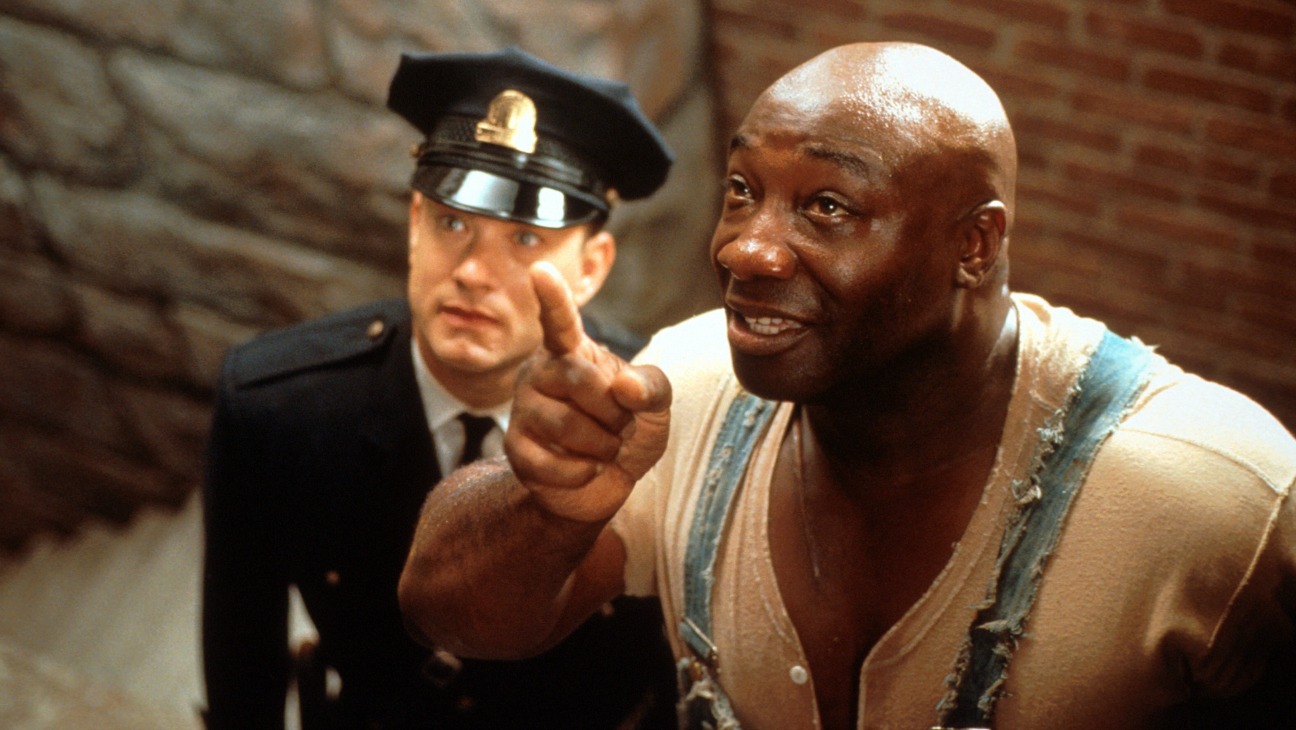
In present day Louisiana, Paul Edgecomb (Tom Hanks – played as an old man by Dabs Greer after Hanks’ make-up tests proved unconvincing) recounts his days in 1935, working as a prison guard on “the Green Mile”, the death row section of a prison. Paul’s life was changed forever with the arrival of a gentle giant, John Coffey (Michael Clarke Duncan), a seemingly simple-minded man found guilty of raping and murdering two young girls. However, John doesn’t match the personality Paul expects of a hardened criminal – and events soon prove he is far more than just an ordinary prisoner…

Frank Darabont’s adaptation of King’s novel – an adaptation King still lists as his favourite adaptation of his work – is long at almost three hours, and frequently takes its time. But it does so too carefully, and in detail, build the world it sits in – namely the prison – and the characters who live in it. Everything is carefully paced in order to create the sense of a real world, with (most of its) characters defying easy conventions or definitions. 

We know of course that the guards on this cell are largely decent, hard-working and respectful of the prisoners – not least because they are led by Tom Hanks at his most everyday, grounded and quietly moral. Darabont is very good at letting the world breathe – and, as a skilled scriptwriter, also in sketching character quickly and clearly. Both guards and prisoners are fully crafted characters, and while some of them do verge a bit more on the cartoonish villainy, their motivations and feelings feel real. 

You could criticise the film for the sentimental views built into this. All the guards are basically decent men – apart from Doug Hutchinson’s cowardly, whining bully Percy Whetmore, who owes his job to his family background, picks on the prisoners, reads porn and is motivated only by wanting to “see one cook”. While the film tries to give him some depth, a weakness of character, he’s basically easy for us to dislike. Similarly among the prisoners, all of them are polite, calm and resigned to the justice of their fate – minus an appalling, virulent racist hill-billy (played by Sam Rockwell with a manic intensity). There are very little doubts about who we are supposed to be rooting for here.

Racism as a whole gets only the barest of mentions. A few slurs are thrown at African-American John Coffey, but no real mention that in 1930s Louisiana there was little chance of a black man getting any form of justice at trial. Typically the only characters to espouse racist views fall squarely into the villain’s camp. Perhaps the intent is to show the prison as a melting pot of sorts – the final stop-off for people’s lives, where all men are basically equal, and the guards taking to heart their role as custodians for their final moments. But it’s also a bit of a cop-out.

We’re shown in detail the work Edgecomb and his team put into ensuring the prison is run smoothly and justly, and that the executions are committed as humanely as possible (frequent rehearsals – with Harry Dean Stanton rather funny as an eccentric stand-in condemned man – are called for). The good guards and good prisoners form bonds – and while this adds to the sentimentality, it perhaps makes sense in a system where the most extreme price is to be paid for their acts, and that any other judgement is unnecessary. We see three executions throughout the film, each carrying its own tone: one is a “how-it-should-be-done”, one is a horrifying, tortuous disaster, with Percy sabotaging the humane elements out of spite, the third sees Edgecomb finally questioning the role he has chosen for his life.

It’s not a film that touches a great deal on the morality – or otherwise – of legal executions, but it does use the setting to explore questions of faith and spirituality. Because what is going to put such things into your mind quicker than working in a place where life and death is literally your business? Some of this is more heavy handed than others – John Coffey’s initials should be a bit of a give-away – but the film does ask questions of what is important to us as people, and at what points should we question the decisions we take about how we live our lives.

These questions of faith don’t quite coalesce into something truly coherent, as it never quite feels if the film wants to deal with the implications of John Coffey’s gifts of healing. The possibilities of a wider world outside our understanding never really come together, and instead Coffey’s gift of healing by touch seems to be a blessed skill that he has developed rather than something more profound. There is also something troubling about the film’s sole black character (in 1930 a segregated Louisiana of all places) serving the purpose to heal white people and be sacrificed.

But when the film focuses on story and character rather than its rather unclear themes, it does well. Hanks is very good in the lead role – Darabont wrote the film specifically for him – with solid support from Morse, Pepper and DeMunn as the main “good” guard characters. Michael Jeter gives some heartfelt work as eccentric prisoner Delacroix. But the stand-out – in every way – is Michael Clarke Duncan, whose John Coffey is sweet, naïve, polite, gentle but also carries a suggestion of pain and guilt beneath his surface which is expertly sketched out.

The Green Mile may be overlong, but it’s hard to work out what you would cut as it’s a film that relies so strongly on mood, atmosphere and careful world creation. Well scripted and confidently directed by Darabont, it may be hard to work out exactly what it wants to say – but it has a richness and confidence to it, as well as an emotional force, that sometimes makes you feel that doesn’t really matter.

The Fisher King (1991)

Robin Williams and Jeff Bridges go on a quest in Terry Gilliam’s decent but overlong The Fisher King

Director: Terry Gilliam

Cast: Robin Williams (Parry), Jeff Bridges (Jack Lucas), Mercedes Ruehl (Anne Napolitano), Amanda Plummer (Lydia Sinclair), Michael Jeter (Homeless Cabaret Singer), David Hyde Pierce (Lou Rosen), Lara Harris (Sondra), Harry Shearer (Sitcom actor), John de Lancie (TV Executive), Tom Waits (Veteran)

In 1991 Terry Gilliam was seriously worried he might be unemployable. After the famous feud with his producers over the editing of Brazil, his follow-up The Adventures of Baron Munchausen had flown over budget and bombed at the box-office. For Hollywood Gilliam was the worst kind of maverick – trouble with no record of financial success to give him the licence to do what he wanted. So he was thrilled to be offered the chance to direct The Fisher King, his first ever “for hire” job, a sentimental but surreal romantic buddy movie. It’s financial and critical success almost certainly saved his career.

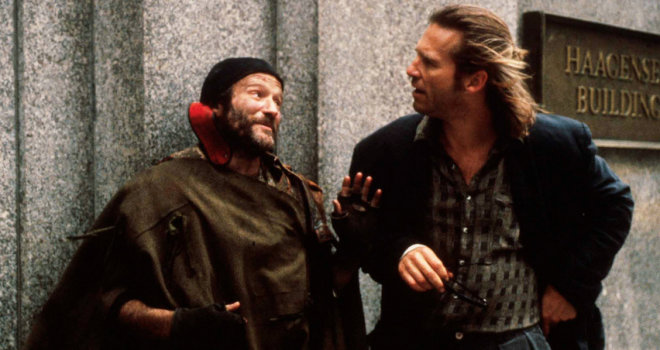
Jack Lucas (Jeff Bridges) is a New York radio shock jock, whose show accidentally provokes a lonely and confused man to massacre the customers at a late night bar. Three years later and Jack’s career is over and he is working as a co-owner of a video rental star (and live-in lover) with Anne Napolitano (Mercedes Ruehl). One day – drunken and suicidal – he is saved from a gang of young thugs by eccentric homeless man Parry (Robin Williams). Jack discovers three years ago that Parry was a respected professor of English literature, whose life fell apart after his wife was killed in the same bar massacre that ruined Jack’s career. The two men are drawn together – but can they save each other?

The film is based on the myth of the Fisher King, the king charged with finding the Holy Grail but could not find it for years – only for a fool to present it to the king full of water to drink, revealing it was there in the King’s possession the whole time. The fool helps because he is “purer” than those more worldly around him. The idea that Richard LaGravenese’s screenplay is leaning on is that these two characters – Jack and Parry – alternate between them the roles of Fisher King and Fool, both slowly doing things for each other that change their personalities and allow them to adjust back into the world and become comfortable with the people they are.

Reading that it should become clear that this is a sentimental film – and it certainly is. It’s also hellishly overlong for such a slight story of tragedy leading to overcoming personal crisis. We know watching the film from the start that Jack Lucas is a bad guy – and Gilliam shoots his opening scenes of Radio presenting with great skill, using high angles, extreme close-ups and shots that prevent us getting any real sight of Jack, making him as impersonal and contemptable as possible in his shallowness, pride and thoughtless cruelty. It’s not a mystery to expect that we are due to watch a triumph of the human spirit film, in which Jack becomes a better man. The film takes a very long time making this simplistic point.

The catalyst is Robin Williams, in a role tailor made for him as a hyper-active, manic personality mixed with tragedy and depression. To be honest Williams is frequently over indulged in the role – despite his Oscar nomination – heading over the top too often, and often over-egging the pudding both in Parry’s energetic enthusiasm and also in his moments of tragic depression. Parry is given a romantic sub plot with Amanda Plummer’s nervous office worker (a character who is little more than a collection of quirks than a personality, and it’s a shame it’s led to Plummer being typecast in such eccentric roles) that is almost insultingly slight and one-sided (he comes across a bit like a stalker) and lacks any of the charm needed for the story to work.

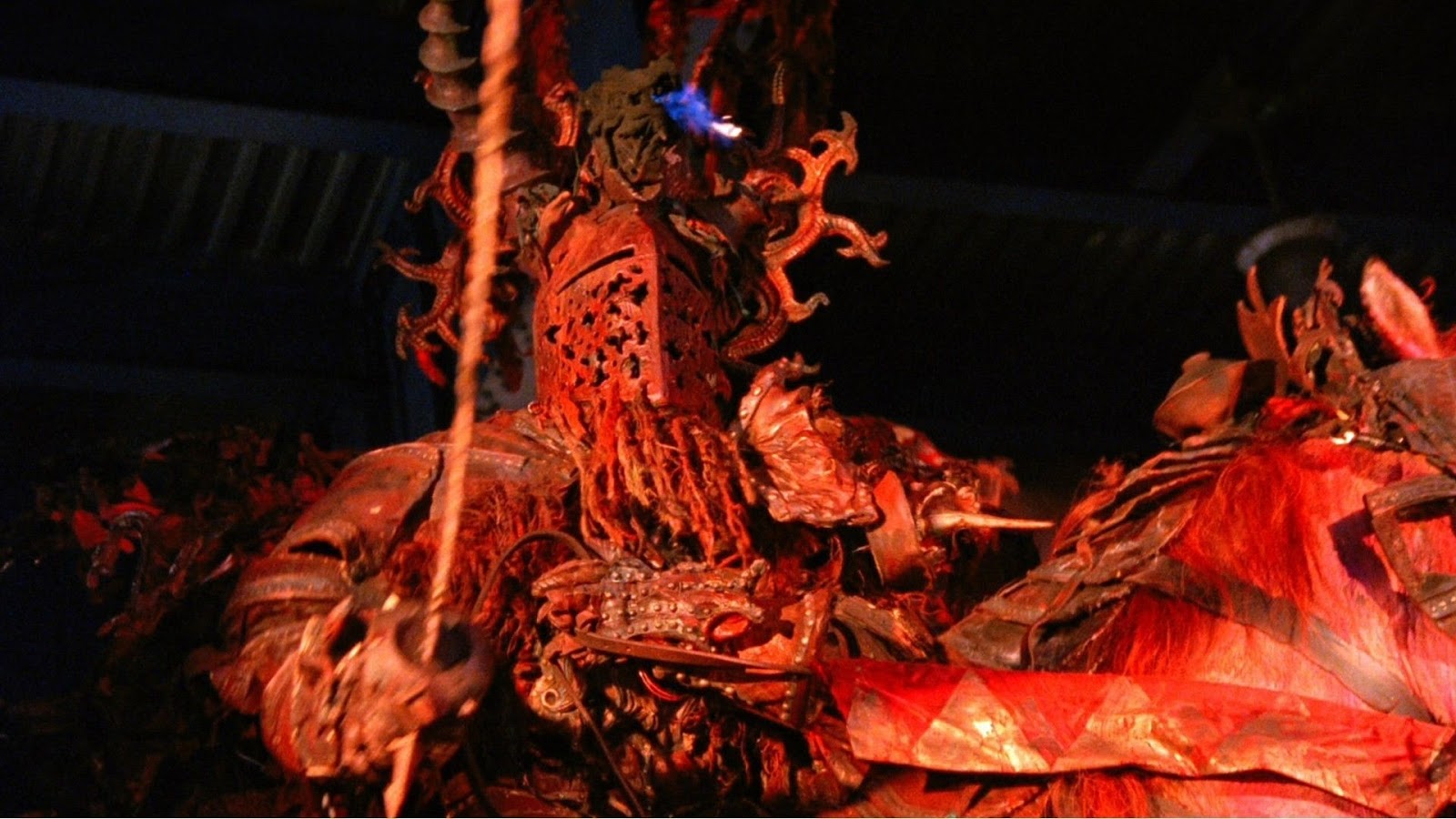
Parry is used to tie the film into further Arthurian flourishes with his obsessions with the legend. Parry visualises a sinister Red Knight – a mental expression of his grief and horror at his wife’s death, which takes the form of the appearance of his wife’s blood splattered face – which chases him through the city. Parry is also obsessed with the discovery of the Holy Grail, which he claims can be found in a millionaire’s faux medieval castle in the centre of Manhattan. This Arthurian stuff is often rather crow-barred in, but holds more interest than traditional plot-lines of people rediscovering their humanity and capability of bonding with others.

Jeff Bridges actually takes on the far harder role as Jack Lucas, a character who has to go on a firm development from start to finish. While Parry is a deliberately eccentric figure, Jack is the one who must journey from arrogance and pride to selflessness and humanity. Bridges does it very well, with a neat line in under playing and an ability to suggest the warmth, shame and self-disgust that Jack works hard to cover up. He’s also blessed to share scenes with Mercedes Ruehl who is outstanding (and Oscar winning) as his girlfriend, the most humane, engaging and real character in the film, a woman who seems at first blowsy and cheap (Jack clearly believes she is beneath him) but reveals more and more depths and capacity for honesty, love and generosity.

Gilliam has a sharp eye for the huge gap between wealth in poverty in 90’s New York, and how the two worlds are geographically only a width of a piece of paper, despite being worlds apart. His direction uses many of his flourishes with great effect. Fish eyed lens POV shots, low angles, stylistic dream sequences, a dream sequence where Grand Central station is full of dancing travellers like a mighty ballroom – many of the sort of things you see in his films are here. To be honest, I found some of the flourishes a bit overwhelming in a story that is so slight and so grounded in just four people’s interactions and quests for salvations. But it works, and Gilliam gets some moments of romantic and platonic love that really work. But it’s still a slight film that goes on far too long, and it eventually loses the viewer in its time-consuming journey towards expected heart-warming moments.