Tag: Michael Palin

Monty Python and the Holy Grail (1975)

Monty Python and the Holy Grail (1975)

The Python’s finest hour is a hit-a-minute medieval comedy that I never fail to laugh at

Director: Terry Gilliam, Terry Jones

Cast: Graham Chapman (King Arthur), John Cleese (Sir Lancelot/The Black Knight/French Taunter/Tim the Enchanter), Terry Gilliam (Patsy/ Soothsaying Bridgekeeper/The Green Knight/Sir Bors), Eric Idle (Sir Robin the-not-quite-so-brave-as-Sir-Lancelot/Concorde, Dead collector/Roger the Shrubber/Brother Maynard), Terry Jones (Sir Bedevere the Wise/Prince Herbert/Dennis’ mother), Michael Palin (Sir Galahad the Pure/Leader of the Knights Who Say Ni/Lord of Swamp Castle/Dennis), Connie Booth (Miss Islington), Carol Cleveland (Zoot/Dingo)

I’ve sometimes found the surreal, satirical and sometimes plain silly humour of the Monty Python troupe hit-and-miss. But when it lands, it really lands and Monty Python and the Holy Grail may well just be their finest hour. Essentially a series of sketches loosely worked together into a sort-of-plot, but never taking itself too seriously, it’s an often-inspired collection of highly influential gags delivered by a troupe of performers at the top-of-their-game (it’s hard to believe that they have all said shooting the film was a tough, punishing and exhausting process).

What Python got right here is how easy – and hilarious – it is to poke fun at something so very po-faced and serious as medievalism had a tendency to take itself back then. In fact, it’s perhaps a lasting tribute to the film that no-one has ever been able to take it quite as seriously since. Monty Python and the Holy Grail also lines up shots at the arthouse high-brow seriousness of films like Andrei Rublev and, most famously, The Seventh Seal (those hilarious, moose-obsessed, opening credits are a flawless take-down of Bergman’s portentous opening) but also a dismantling of the likes of Bresson’s Lancelot du Lac (no-one can watch that film’s opening now without picturing the Black Knight protesting ‘It’s a only a flesh wound!’ as crimson spray flows freely).

I love Holy Grail. It’s practically designed for undergraduates to sit around and watch, while getting slowly pissed and then spend ages quoting at each other. Many of its jokes lean into bizarre surrealism and funny sounding words – “shrubbery!” just sounds funny, even more so when it’s squeaked out by a giant Michael Palin in a ridiculous helmet affecting a rhotacism. And the Pythons knew how to turn problems into genre-defining gags: thank God they couldn’t afford horses, so instead came up with the frankly genius idea to just mime the knights riding horses to the sound of two coconut halves being visibly tapped together by their squires.

And then to have the comic presence of mind to riff on enforced ideas like this so much (just how did coconuts turn up in medieval Britain?) that for generations, fans will ram their tongues earnestly into their cheeks debating the migratory habits and air speeds of laden and unladen swallows. It’s all part of a superbly written script, which get just the right balance between Thomas Mallory-esque medieval rhythms laced with nonsese ( “The swallow may fly south with the sun or the house martin or the plover may seek warmer climes in winter, yet these are not strangers to our land”) and a mix of anachronistic casualism and simmering middle-class frustration. All the time in Monty Python and the Holy Grail there are traces of the sort of serious, played-dead-straight, medieval film this could be, making the constant punctuation of surreal, fourth-wall leaning, silliness all the more hilarious.

A lot of this also comes down the highly skilled comic playing of the troupe. Graham Chapman, in particular, has the seemingly dull job of playing the straight-man. But his ability to play, even the most ridiculous encounters, with complete earnestness is crucial to the film’s success. Arthur is, really, a ludicrous figure, but Chapman knows he can never acknowledge this for the joke to work. Hilariously, the legendary king here becomes a sort of put-upon middle-manager, constantly frustrated while going about his day job, dumb enough to be unaware of how absurd he is, but smart enough to get frustrated at the increasingly dim antics of his followers.

It also allows the rest of the troupe to let rip with broader comic performances, all of whom have a whale of a time. John Cleese’s pompous bossiness and control-freak mania is perfect for the psychotic Sir Lancelot while his latent comic cruelty, combined with a passion for silly accents and walking, is perfect for the famed French taunter (the funniest Frenchman on screen). Palin’s goodie-two-shoes decency is great for the tempted Sir Galahad while his brilliant capacity for deluded self-importance nails the Lord of Swamp Castle – and who else could have taken such an impish delight in the Trotskyist mantras of the socialist peasant Dennis? For the rest of the troupe, Eric Idle’s mix of cheek, dressed-up poshness and wimpy weakness is expertly used while Terry Jones mocks academia as Sir Bedevere and whines brilliantly as Herbert. And no-one does dirty better than Terry Gilliam.

Gilliam and Jones also directed, allegedly not always harmoniously neither quite agreeing if this was a film or whether it was a comic show. But the presence of Gilliam behind the camera probably accounts for why this is the most visually striking Monty Python film, with mists rolling over the hills and the Scottish locations given a mythic power which makes the silly jokes that happen all around them even funnier – while Jones’ medievalist background surely helped define the film’s surprisingly authentic (and therefore even funnier) feel. Holy Grail also very successfully disguises that it was effectively all shot in one or two locations (Doune Castle is shot from so many angles it becomes about a dozen different locations).

But what really makes Holy Grail work is the quality of the jokes. And it opens with a run of gags of such consistent quality they are perhaps unparalleled in Python’s work. The Swallow debate. Bring Out Your Dead. Peasants nailing the ‘self-perpetuating autocracy’. The flesh wounds of the Black Knight. The witch trial. The French Taunter (“Your mother was a hamster and your father smelled of elderberries!”). The Trojan Rabbit. Camelot being a silly place. The opening half of the film is one piece of solid comic gold and if the second half doesn’t have quite the same hit rate, it’s still more than funny enough.

And funny is what it is all about. You can say ‘it doesn’t have as good a plot as Life of Brian’. You can say it just ends, as if the troupe ran out of ideas. You can say it loses a steam. But it doesn’t matter when you laugh and laugh time and time again at its best bits. And you really do. And people who encounter it at the right age, will go on laughing at it for the rest of their lives., for decades to come.
The Missionary (1982)

Michael Palin sets up a failed mission for change in The Missionary

Director: Richard Loncraine

Cast: Michael Palin (Reverend Charles Fortescue), Maggie Smith (Lady Isabel Ames), Trevor Howard (Lord Henry Ames), Denholm Elliott (Bishop of London), Michael Hordern (Slatterthwaite/Narrator), Graham Crowden (Reverend Fitzbanks), David Suchet (Corbett), Phoebe Nicholls (Deborah Fitzbanks), Roland Culver (Lord Fermleigh), Rosamund Greenwood (Lady Fermleigh), Timothy Spall (Parswell)

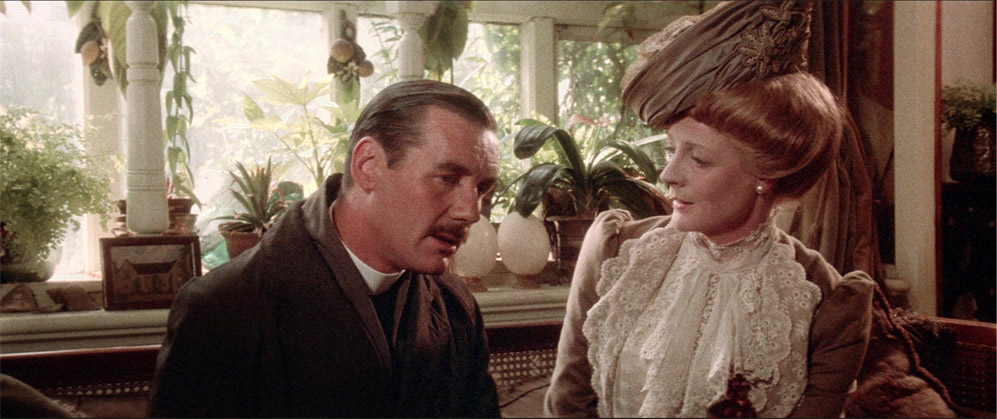
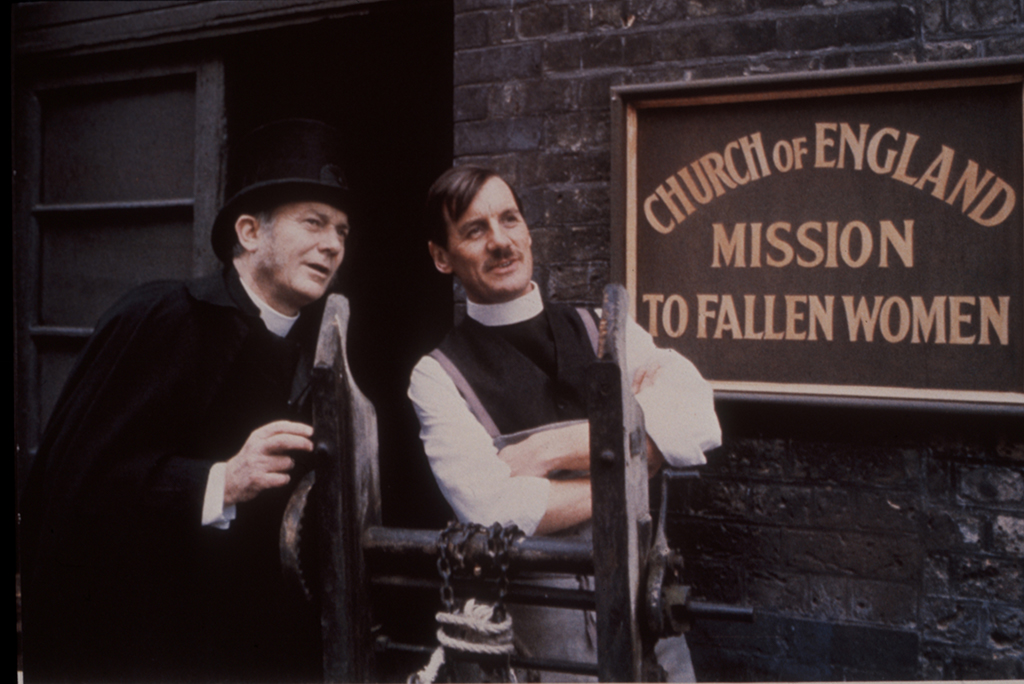
In the 1970s Michael Palin co-wrote (with Trevor Jones) a series called Ripping Yarns, affectionate half-hour spoofs of “Boys Own Adventures”, all starring Palin, told with a winning mix of affection, surreal gags and gentle humour. The Missionary is Palin expanding the concept into a full film, written by and starring the future Globe-Trotting Python. Palin plays the Reverend Charles Fortescue, who in 1902 returns from a mission in Africa (teaching the natives the date of composition of Magna Carta) to England and is asked by the Bishop of London to set up a mission in London to “save” prostitutes. Needless to say, things do not according to plan.

Palin’s script is full of some fabulous gags and a gentle, sometimes cheeky, sense of humour that gives you something truly entertaining every moment. If The Missionary does at times feel a collection of sketches and great comedic ideas and characters, rather than a fully formed filmic narrative, that matters slightly less when the jokes are as good as these. Sure, even Palin and Loncraine have said the final act of the film doesn’t completely work and largely fails to add actual narrative conclusion (it feels rather like the film required an ending, so this section was added to give it one), but it doesn’t really matter as much when the sense of fun is as strong as it is here.

Watching this on the recent re-mastered blu-ray from Indicator, this is also a beautifully made film, very well shot and framed by Loncraine with a cracking sense of pace. Visually the jokes work very well, and the push through from comic set-piece to comic set-piece that runs through the opening hour of the film is perfect. 

Palin also is perfect in the leading role, his sense of earnestness and decency, his slight air of a very-British innocence and bashfulness works in hilarious contrast to when (inexplicably to him) finds himself sexually irresistible to a host of ladies. Which sounds, when you write it, like a vanity project if ever I heard it, but never plays like it for a moment as there is a superb, slightly embarrassed, befuddled awkwardness about Palin (which I don’t think any other actor could have done as well) that makes the entire concept work an absolute treat.

It’s part of the extremely British atmosphere of the film, where sex is something deeply embarrassing and slightly shameful, something we are all far too polite to talk about or even acknowledge. Rather than the atmosphere of an end-of-the-pier show the film could have had, instead it has a very dry, rather touching attitude towards sex as something completely natural and everyday, that the repression of the English has elevated to something hugely awkward.

The only person who seems to be in touch with her true feelings and sexuality is Maggie Smith’s sexually liberal Lady Ames, a woman who knows what she wants and is determined to get it come what may. Smith is superbly funny in the role, a part she keeps just the right side of parody, making it very funny but also ring very true. This makes her a complete contrast to Fortescue’s intended (played expertly by Phoebe Nicholls) so repressed she cannot bear to be touched and obsessed with a complex filing system for storing and cross-referencing her fiancée’s letters.

All this happens within a series of sketches that are worth the price of admission themselves. Denholm Elliott has a few excellent scenes as a bullish Bishop, obsessed with sport who seems unable to speak in anything but sporting metaphors. Roland Culver plays a Lord who dies in the middle of an impassioned Fortescue’s pitch for funding, to the intense social embarrassment of his wife (Rosamund Greenwood, very funny). Best of all on the cameo front is Michael Hordern, who practically steals the entire movie as a butler utterly unable to successfully navigate around the gigantic house he works in.

Through this all rides Fortescue, a man with a barely acknowledged sexual drive, who bumbles from escapade to sexcapade with a bright-eyed innocence and determination to do the right thing, but constantly landing himself in trouble. It’s a charming, playful and very British movie and Loncraine and Palin get the tone just right. It’s perhaps a little too close to Ripping Yarns, a fabulous parody of a particular era (and type) of Britishness and British attitudes, and you feel it would be comfortable as a single 45 minute episode. But when the jokes are as cracking as they can be here – and Hordern apologetically leading Fortescue from room to room unable to work out where he is or how he can get to where they want to go, is a pleasure I could watch again and again – then you’ll cut it a lot of slack.

The Death of Stalin (2017)


Hilarious hi-jinks in Soviet Russia as the politburo struggle to deal with The Death of Stalin

Director: Armando Iannucci

Cast: Steve Buscemi (Nikita Khrushchev), Simon Russell Beale (Lavrenti Beria), Paddy Considine (Comrade Andreyev), Dermot Crowley (Lazar Kaganovich), Rupert Friend (Vasily Stalin), Jason Isaacs (Georgy Zhukov), Olga Kurylenko (Maria Yudina), Michael Palin (Vyacheslav Molotov), Andrea Riseborough (Svetlana Stalin), Jeffrey Tambor (Georgy Malenkov), Paul Whitehouse (Anastas Mikoyan), Paul Chahidi (Nikolai Bulganin), Adrian Mcloughlin (Joseph Stalin)

Armando Iannucci is a brilliant television satirist, who spring to wider fame with the success of foul mouthed political satire The Thick of It (re-imagined as Veep in the USA). His sweaty, sweary, fly-on-the-wall style, and characters who embody the panicked agitation of the nakedly ambitious but not-too-bright, was a perfect match for our modern world. Does the style work for the past? You betcha.

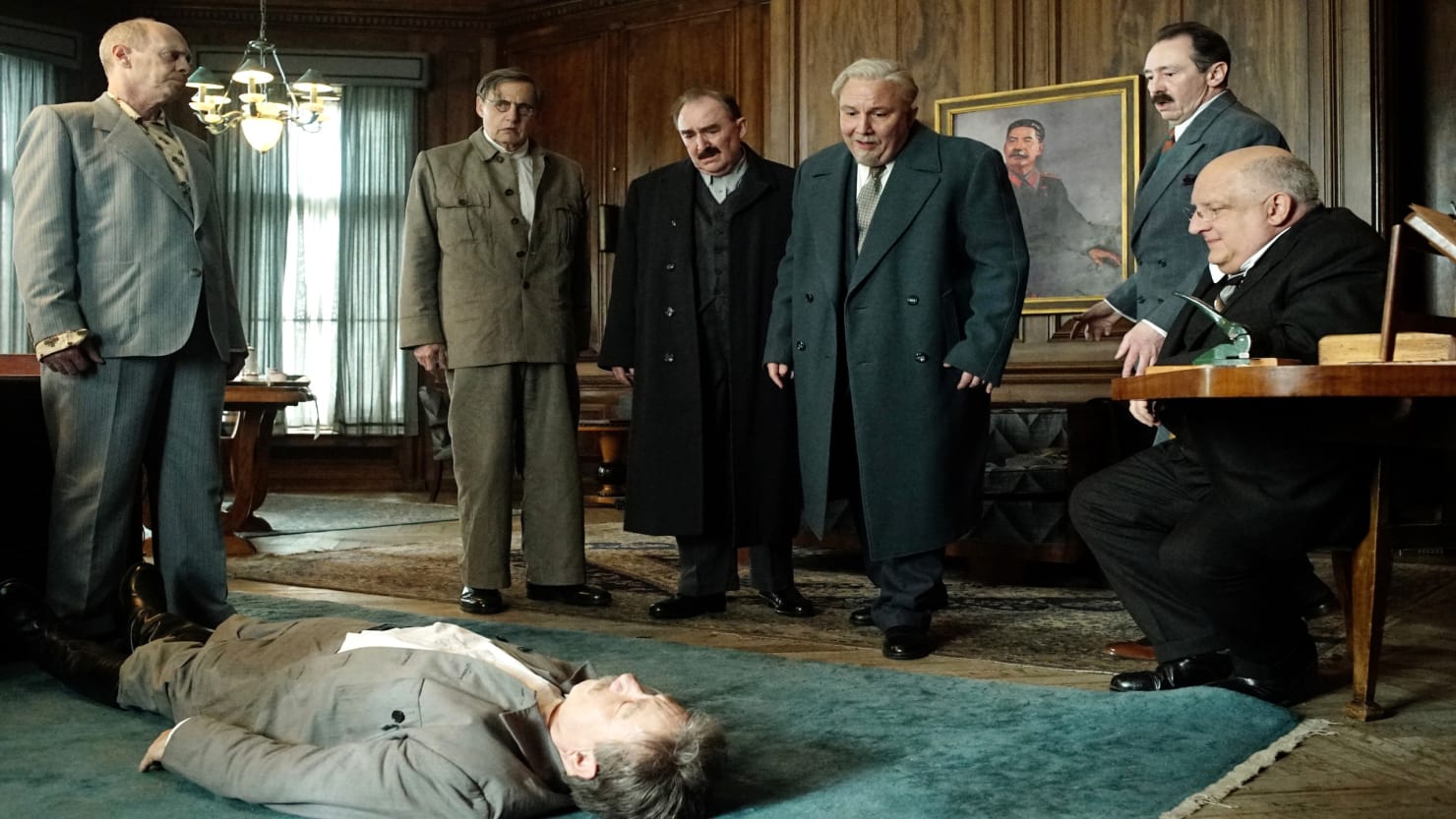
In Soviet Russia, a country near paralysed with terror, the ruthless dictator Stalin dies. This starts an immediate scramble to succeed him, with the leading candidates being weak-willed, vain and foolish deputy Malenkov (Jeffrey Tambor), vaguely principled but fiercely ambitious opportunist Khrushchev (Steve Buscemi) and sinisterly sadistic police chief Beria (Simon Russell Beale). Soviet Russia though is a pretty ruthless place for political manoeuvring, with retirement usually coming in the form of a single bullet to the back of the head.

First off the bat, The Death of Stalin is a blisteringly funny film, a real laugh-out loud riot. Why does it work so well? Because it understands that, hand-in-hand with the horror, Stalinist Russia was so completely barking mad that it lends itself completely to black comedy. Imagine The Thick of It, but with Malcolm Tucker executing rather than dismissing terrified ministers. Welcome to the madness. Events that seem crazy are pretty much true: although time has been telescoped, the struggle for the succession did more or less play out like this (with less swearing).

Every scene of this dark farce has a memorable, stand-out line or moment. The sweaty panic of these over-promoted yes-men is brilliantly reminiscent of the sort of panic you can imagine seeing in your office, with the exception that it probably isn’t literally life-and-death. Iannucci completely understands the wild improvisation of the fiercely ambitious in high-stress situations. If you think the ministers of The Thick of It were adrift when confronted with parliamentary enquiries, imagine how their counterparts struggle when faced with the threats of a bullet in the head.

Because that’s the great thing about this film – while still being hilariously foul-mouthed, it actually gives a pretty good idea of what it might have been like to live in Soviet Russia. The characters are constantly having to adjust to who is in favour and who isn’t, what it is permissible to think and say and what isn’t, who is “dead and who isn’t”. Iannucci totally understands human nature doesn’t change – those left alive around Stalin are just the sort of shallow, selfish, weaklings he’s been lampooning in The Thick of It. Most of the ordinary people we see are just desperate to keep their heads down – getting noticed for regular joes in this film is basically a death sentence. 

The opening sequence really gets this idea across. Paddy Considine is hilariously nervy and terrified as a radio producer ordered to send a recording of the live concert they’ve just broadcast (unrecorded) to Stalin. The frantic rush to reassemble the orchestra, fill the audience up again with people from the street, replace the conductor (the original having passed out in terror at the possibility that he may have been bugged questioning Stalin’s musical knowledge) is brilliantly funny – but works because the genuine expectation that doing the slightest thing wrong could lead to immediate execution is completely clear. Especially as the scene is intercut with Beria’s heavies rounding up innocent civilians to disappear into a gulag. 

Iannucci doesn’t dodge the ruthlessness. The film is punctured throughout by executions, often carried out with a black farcical desperation. It doesn’t shy away from the brutality of Beria, whose violence, sadism and pathological rape addiction we are constantly reminded of (and which are even more effectively sinister as he’s played by the cuddly Simon Russell Beale). In turn, a frantic Beria berates the rest of the politburo for their participation in the orgy of killings and show trials Stalin organised. We see people about to be taken to their deaths hurriedly offering terrified goodbyes to their loved ones. The final sequence of the film, as the battle for the succession reaches its end-game, tones down the jokes to give us an alarmingly realistic picture of a coup. Black farce ending in death: it’s as legitimate a picture as any of living in Stalinist Russia.

All of this is presented in a razor-sharp and witty script, and the cast who deliver it are brilliant. In a fantastic touch, the actors (with the exception of Isaacs) use their own accents, which only adds to the crazy fun. The acting is, across the board, fabulous. Russell Beale gives his greatest ever film performance as a grubby, ambitious, not-quite-as-smart-as-he-thinks Beria, with bonhomie only lightly hiding his chilling sadism and cruelty. Buscemi is equally brilliant as Khrushchev, who has the ego and self-delusion to convince himself that he is the only hope for a reformed USSR, while actually being a weaselly political player with naked ambition.

Around these two central players there is a gallery of supporting roles. Tambor gives a brilliant moral and intellectual shallowness to the hapless Malenkov. Friend is hysterical as Stalin’s drunken son, a deluded man-child barely tolerated by those around him. Palin’s cuddliness works perfectly as fanatical Stalinist Molotov. Whitehouse, Crowley and Chadihi are also excellent, while Riseborough does well with a thankless role as Stalin’s daughter. The film may be hijacked though by Isaacs as a swaggeringly blunt General Zhukov, re-imagined as a bombastic, plain spoken Yorkshireman, literally entering the film with a bang half-way through and bagging most of the best lines.

The Death of Stalin is not just a brilliantly hilarious comedy, it also feels like a film that completely understands both the terror and the confused ineptitude of dictatorship. In a world where it is death to question the supreme leader, is it any surprise that his underlings are all such clueless, ambitious idiots? Has anyone else understood the black comedy of dictatorship before? I’m not sure they have. You’ll laugh dozens and dozens of times in this film. And then you’ll remember at the end that when this shit happens, people die. This might be the best thing Iannucci has ever made.

Time Bandits (1981)


Time travelling roguery in Time Bandits 

Director: Terry Gilliam

Cast: Craig Warnock (Kevin), David Rappaport (Randall), Kenny Baker (Fidgit), Malcolm Dixon (Strutter), Mike Edmonds (Og), Jack Purvis (Wally), Tiny Ross (Vermin), John Cleese (Robin Hood), Sean Connery (Agamemnon), Shelley Duvall (Pansy), Katherine Helmond (Mrs Ogre), Ian Holm (Napoleon), Michael Palin (Vincent), Ralph Richardson (Supreme Being), Peter Vaughan (Winston), David Warner (Evil), Jim Broadbent (Compere)

After leaving Monty Python, each Python went their own way. Terry Gilliam had been the slightly odd one, the eccentric animator who played the weirdos at the edge of the frame. Time Bandits would be pivotal in repositioning him as an ambitious, visionary director with a striking visual sense. It would also allow him (and co-writer Michael Palin) to create a fairytale fable with something for all ages, a film about a child’s view of the world which adults could embrace.

Kevin (Craig Warnock) is a dreamer, a young kid adrift in his parent’s materialistic world. Until one night a gang of dwarves calling themselves “Time Bandits” emerge out of his bedroom cupboard. They have a map that allows them to travel through time and use it to commit crimes and then escape to different centuries. Kevin joins them in their adventures, but none of them know they have attracted the attention of the Evil Genius (David Warner) who wants to use the map to escape his prison and recreate the world in his own image.

I still remember watching this film when I was younger and really enjoying (I must have watched it dozens of times). I have to say it holds up extremely well. Sure Craig Warnock isn’t the most inspired child actor of all time, but he has a wide eyed innocence and enthusiasm that anchors the film really well. Gilliam’s direction is brilliantly good – wild and inventive, like a punk-rock fairytale. The dwarfs make an inspired grouping, each embracing the once-in-a-lifetime chance of playing leading roles.

The main reason for the film’s success is Gilliam. His work is extraordinarily detailed and imaginative, while his visual sense makes shots that cost hundreds of pounds look like millions. Huge swathes of the film are shot with a low-angle lens that allows us to see everything from the perspective of our heroes, and also makes each of these larger-than-life events seem even more awe-inspiring. The design of the film is extraordinary, with striking images confronting you at every turn, either a recreation of events or the bizarre visuals of the “time of wonder”.

And those visuals are outstanding. Can you think of any other film where a knight on horseback bursts out of a bedroom cupboard, charges around the room in medium shot, and then gallops off through a field that has suddenly replaced the bedroom wall? How about an ogre who lives on a ship that is then revealed to be a hat for a giant who lives underwater? Evil’s Fortress is a swaggeringly brilliant triumph of production design, while his goat skulled, tall, hooded monsters must surely have been playing in JK Rowling’s mind when she came up with the Dementors.

The design also echoes the possibility that this is all a child’s fantasy. A careful look at Kevin’s bedroom shows pictures of everything we encounter. The final confrontation with Evil takes place on a set clearly inspired by the Lego bricks, chess board and toys that litter Kevin’s bedroom. 

The playful tone is also reflected in its lampooning of the “adult” world of technology for its dull materialism: Kevin’s parents watch a bullying gameshow (compered by a demonic Jim Broadbent) while sitting on armchairs still in their plastic wrapping. Evil’s obsessions all revolve around lasers and the microchip.

Away from all this, the film has a simple structure. It’s basically a series of really rather fun historical sketches, linked together by an engaging fantasy narrative. These scenes attracted guest star performers, all of whom excel (though it is odd to see them get top billing – Cleese is on screen for about three minutes, but gets top-billing!). 

The guest stars are terrific – Holm is hilarious as a chippy, height-obsessed Napoleon; Cleese very funny as a visiting-Royal-inspired Robin Hood, treating all around him with condescension; Ralph Richardson brings an absent-minded imperiousness and dry wit to his role as God; Connery sprinkles a touch of movie-star bravado as a kindly, gentle Agamemnon (the uncommented on joke being the movie’s ideal father figure is most famous for sacrificing his daughter…). 

If any performer high-jacks the film it’s David Warner as a dry-witted, viciously ego-maniacal Evil Being, getting most of the best lines. A sequence where he obliterates several underlings for minor transgressions hums with dark humour (and punchlines with the accidental obliteration of another minion off screen, met with a sheepish “Sorry”). On top of that, Warner brings just the right level of sinister child’s-nightmareish quality to the role, helped by a striking costume design that makes him look the love-child of a crocodile and a car engine.

The leads of the film (Kevin and the bandits) are extremely well drawn by Palin’s script, each of them with sharply distinctive personalities. David Rappaport (allegedly incredibly unpopular with the others due to his haughty disregard for them) is perfect as the arrogant self-appointed leader, but Jack Purvis is a stand-out as the warmly brave Wally. More than a few commentators have pointed out that the Bandits all serve as representatives of the members of the Monty Python troop, which adds another level of fun watching the film.

Time Bandits is electric good fun. I have no doubt I might find more to criticise without the memory of enjoying it so much when I was younger. Some of the sketches work less well than others – the scene with the ogre doesn’t quite work, and the ending, twistedly funny as it is, does feel slightly abrupt is. But the film never outstays its welcome, and it’s put together with such glee and accomplishment that there is always a line or an image that sticks with you. It’s a dark fairytale for children of all ages – and making something the whole family can enjoy is really quite a feat. Palin and Gilliam would have put together a sensational series of Doctor Who.