Tag: Michael Potts

Rustin (2023)

Rustin (2023)

Solid biopic tells an inspiring story in a straightforward way with a Domingo star turn

Director: George C Wolfe

Cast: Colman Domingo (Bayard Rustin), Aml Ameen (Martin Luther King Jnr), Glynn Turman (A Philip Randolph), Chris Rock (Roy Wilkins), Gus Halper (Tom Kahn), Johnny Ramey (Elias Taylor), CCH Pounder (Dr Anna Hedgeman), Michael Potts (Cleve Robinson), Audra McDonald (Ella Baker), Jeffrey Wright (Adam Clayton Powell Jnr), Lilli Kay (Rachell), Jordan-Amanda Hall (Charlene), Bill Irwin (AJ Muste)
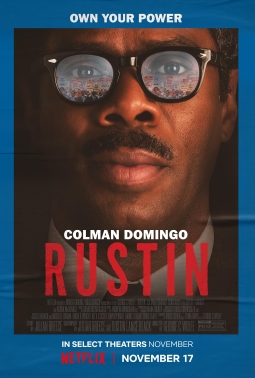
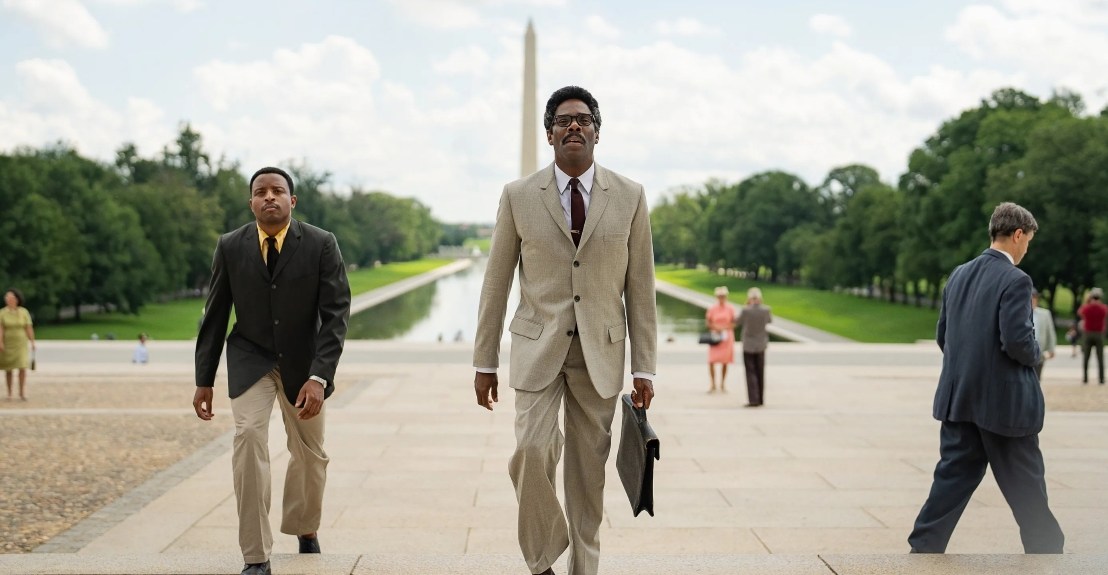
Bayard Rustin was on of crucial the civil rights activists in conceiving, planning and organising the 1963 March on Washington. A proponent of nonviolence and equal rights for all, regardless of race, gender or sexuality, he was a close friend and colleague of Martin Luther King and a key figure in innumerable campaigns. Rustin partly exists to bring his life more to public notice, focusing on the build-up to the March on Washington and exploring Rustin’s struggles as both a Black man and a gay man.

At its heart is Colman Domingo, who delivers a sensational performance as Rustin, bursting with energy and emotional compassion. Domingo brilliantly captures Rustin’s loud-and-proud nature, his overwhelming commitment to being who he is, and his passionate commitment to social justice. This is a force-of-nature turn dominating the movie, breathing passion and fire into Rustin’s compulsive desire to speak out.

Domingo matches this with a neat sense of comic timing (Rustin is frequently very funny) and a raw emotion. The emotional impact nearly all comes from Domingo. He’s genuinely moving when he misjudges the level of loyalty to him in the film’s opening act and has an offer of resignation accepted by the NAACP (after press reports suggesting he has seduced King). Even more so later in his emotional outpouring when the same NAACP members finally back him up. More focus on Rustin gaining full, unquestioning, acceptance from his colleagues could have offered a beating heart to the film.

Domingo’s performance elevates an otherwise, to be honest, fairly middle-of-the-road biopic that frequently wears its research heavily. It has an air of competent professionalism, with George C Wolfe’s direction lacking emotional or visual spark. Much of the dialogue – given a brush by Dustin Lance Black – frequently (and rather painfully) has the actors fill in historical context or clumsily shoehorns in real dialogue. There is very little spark to Rustin, as it dutifully ticks off events, building towards sign-posted emotional payoffs (and, admittedly, there are fewer payoffs more inspiring than a quarter of a million people gathering in Washington to cry for freedom).

This is not to say there aren’t fine moments and its recreation of the Washington March (some tight angles, well-chosen archive footage and subtle effects) works very well. There are some fine actors giving their all. Glynn Turman is a stand-out as the inspiring Randolph, savvy enough to play the game in a way Rustin isn’t. Aml Ameen’s capturing of King’s voice and mannerisms is perfect. Pounder, Rock, McDonald and others compellingly bring to life leading activists while Jeffrey Wright sportingly plays the closest thing to a heel as jealous congressman Clayton Powell.

However skilful reconstructions only take us so far. Often personal stakes are presented vaguely. The film avoids depicting Rustin encountering much personal homophobia – no member of the movement expresses negative views, with white pacifist campaigner AJ Muste (Bill Irwin) the only person to express openly homophobic opinions. The threat of someone discovering his past arrest (for a 1953 encounter with two men in Pasadena) is played as a core fear for Rustin, but the film is vague about the likely impact this revelation would have (since it seems to already be widely know). It’s astonishing that Rustin was so open when being so was a crime, but the film (aside from a brief moment when he considers a casual pick-up) risks underplaying the era’s prejudice and dangers.

To cover issues on homophobia and self-loathing guilt, the film invents a closeted reverend, well played with a tortured sense of shame and self-loathing by Johnny Ramey, who initiates a secretive relationship with Rustin. This fictional character absorbs all the fear and self-denial that many gay people felt at the time, allowing Rustin to show us what life was like for the many, many people who, for whatever reason, were not as outspoken as Rustin. But it does feel like somewhat of a compromise, and a character who feels a little too convenient, drifting to and from the story whenever it’s themes need a bit more of a personal touch.

It’s hard not to think the film could have gained more interest from exploring Rustin’s relationship with Tom Kahn (Gus Halper) – or even being clearer on the very nature of this relationship. An initial familiar intimacy indicates an established romantic relationship, but later scenes suggest instead a more casual flatmates-with-benefits set-up. Then we suddenly hit the inevitable moment when Kahn walks in on Rustin and Elias kissing and reacts like a betrayed partner. It finally decides Kahn is in love with Rustin, but Rustin hasn’t time for a relationship with so much work to be done. Despite this thought, the film wants to also say Rustin and Elias are profoundly in love, tragically only kept apart by social pressures. It’s trying to have its cake and eat it too. The cost to your personal life of being fully committed to a cause, or the awful pressures of loving someone in the face of prejudice, are both powerful stories. Settling on one and exploring it fully would have been more emotionally rewarding.

Rustin is a solid, well-handled, decent biopic. Bringing the life of a lesser-known civil rights activist to a bigger audience is a worthy aim, and Black and queer audiences (historically underserved) deserve to see films that centre their stories.  It’s also refreshing to see a film zero in on the importance of logistics for major events (what other film has a scene where the fillings of thousands of sandwiches to be kept in the warm sunshine becomes a heated debate?) and its focus on the work recruiting attendees, buses and resources for the March is great.

But the real success in this sometimes workmanlike film is Domingo, who lifts the entire thing with an emotionally committed performance that is perhaps better than it deserves.

Ma Rainey's Black Bottom (2020)

Chadwick Boseman excels in his final performance in the stagy Ma Rainey’s Black Bottom

Director: George C Wolfe

Cast: Viola Davis (Ma Rainey), Chadwick Boseman (Levee Green), Glynn Turman (Toledo), Colman Domingo (Cutler), Michael Potts (Slow Drag), Jonny Coyne (Mel Sturdyvant), Taylor Paige (Dussie Mae), Jeremy Shamod (Irvin), Dusan Brown (Sylvester)

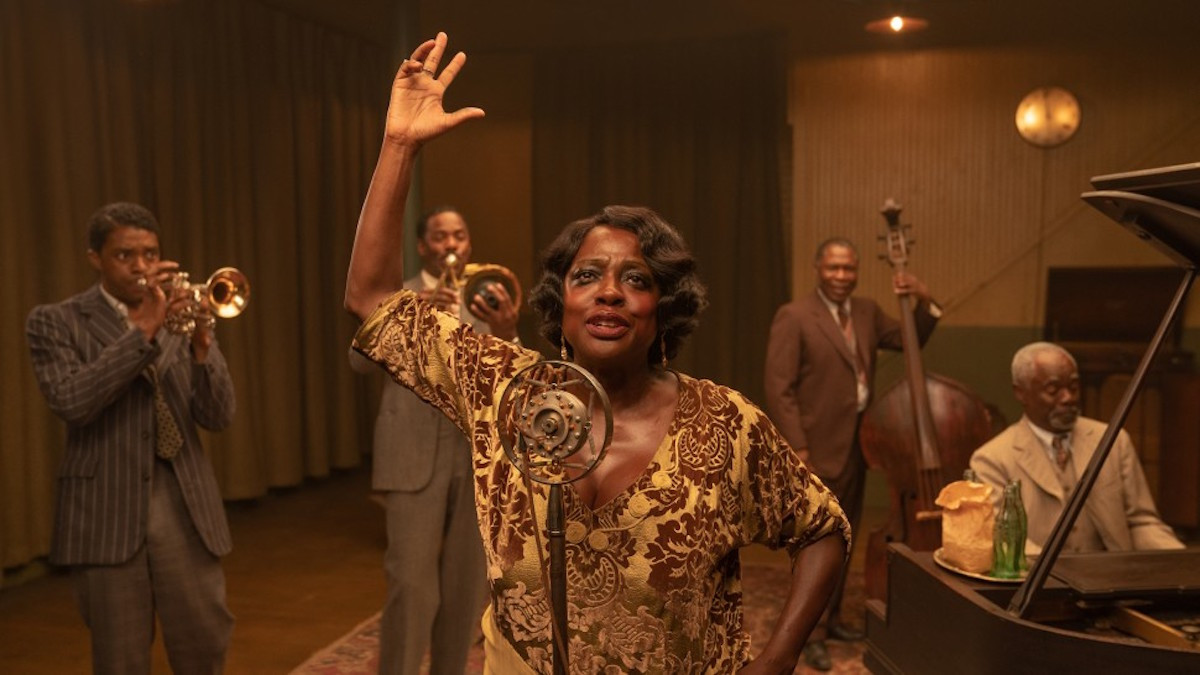
In a Chicago recording studio in July 1927, while the sun beats down outside, blues singer Ma Rainey (Viola Davis) is due to record some of her greatest hits. But she’s almost an hour late. The people who made it on time are her backing jazz band. Cutler (Colman Domingo), Toledo (Glynn Turman) and Slow Drag (Michael Potts) are seasoned pros. But trumpet player Levee Green (Chadwick Boseman) is something else, an ambitious and electric young man who feels he knows what the new sound is in a way that Ma doesn’t. Over an afternoon, as Ma flexes her power upstairs, the white agent and recording studio owner fret, and tensions between the band members slowly simmer towards and explosion.

It’s impossible to watch Ma Rainey’s Black Bottom right now without being very aware of the tragic early death of Chadwick Boseman. Boseman passed away while the film was in post-production, and it’s hard not to guiltily wonder if Boseman was aware this was to be his final performance. Either way, this was a stunning way for this electric, James Dean-like talent to sign off – a scintillating, passionate performance as a man carrying huge burdens and deeply repressed griefs and guilt. August Wilson’s play provides several key set-piece speeches for Levee – and Boseman burns through them with an intensity that will leave its mark on you.

Bright-eyed, with a wiry body of elastic tension that shifts from loose, jazzy movements to rigid bursts of fury, Boseman is extraordinary. Starting the film as seemingly an irresponsible, easy-going young man frustrated at the concessions of his elders, Boseman establishes a deep psychological pain at his core. He’s a young man who has seen his parents vilely mistreated by oppressive white men, who smiles to get what he wants but never forgets that the white bosses he works with see him as little better than a slave, ripe for exploiting. It’s a brilliant performance, one for the ages.

It dominates a film that is told with dynamism but never escapes its theatrical roots. Its set-piece speeches are virtuoso moments for the actors, but the silent observance with which they are watched by other actors feels more suited to theatre rather than the realism of film. The build towards the film’s tragic end, hinging on a moment of violence, is the sort of character breakdown that we accept in the theatre, but seems forced on film – especially when met with the sort of visual tableaux that seems to invite the curtain to come down. Wolfe directs what is very much a conversation piece in two locations with a great deal of energy and imagination – but it remains very much a theatrical venture at heart, where long speeches and elements of Greek tragedy (hubris, nemesis and character flaws) shape the plot.

But it doesn’t altogether matter when the ideas the film tackles are so vibrant and presented with such passion. It’s a film that sharply outlines the racial divide in America. Wilson’s play is all about how master/servant exploitation continues in America. Its early shots establish the only work black people in Chicago can find (all of it manual or secretarial), while the musicians are paid cash-in-hand, even Ma, because no bank will believe a black man hasn’t stolen a cheque.

“All they want is my voice” says Ma, and she’s right. A difficult prima-donna, unafraid of expressing her desires both musical and sexual, Davis is larger-than-life but impressive as the domineering Ma. But Ma behaves badly because it’s the only way she has of exerting some control in this environment. She won’t see the profits from this recording work (it will be the white men running the studio). So, just for a few hours, she wants to remind them that they rely on her. So, she’ll be late. She’ll demand a cold coke. And she’ll insist her stammering nephew speaks the opening monologue of the song, even if that does mean burning through several recording albums to get it right. Because Ma may be an artist, but she’s also a tool to these people – something they will use while she can earn them money, and will then cast aside the second she is done.

It’s the same with the band. And the older hands have accepted it. Sure, they have their resentments and their sadnesses – old pro Toledo even remembers when he had the fire like Levee has – but they understand the game. They are props in the white man’s game, and they are content to earn a decent living from something they like doing, knowing that they are still living a better life than many. Cutler even has his faith to bolster him, a faith Leveee rejects in Boseman’s most electric scene, with a speech that angrily denounces God for his unfairness towards black people.

Levee is another thing again to the rest of them. He has plans and ambitions and wants to form his own band. He’s written his own songs, which have far more of the zip that we know jazz is heading towards. He’ll play nice to get what he wants, but he’s not willing for a second to forget how racist the world is. And he won’t let go of his anger for a moment. Compromise for him only serves a purpose. His youthful defiance and lack of deference spark resentment in the others – who either can’t or won’t understand him – and even Ma, perhaps seeing him as a threat, can’t stand him.

It of course leads to tragedy – and a coda that grimly reminds us all that in this world there may be winners but the thing that unites them all is that they are white. Jazz music may be on the cusp of change – and Ma will pay that price in a few years – but America isn’t. You only need to look at how the musicians are treated to know that equality is a million miles away.

The cast are faultless. Turman carries a quiet sadness and resignation as the ageing Toledo. Colman Domingo is relaxed then taut as Cutler. Taylor Paige has a dangerously selfish energy as Ma’s younger lover Dussie. But it’s still more of a play than a film, even if it is told with pace and energy, acted with such flourish and passion. It leaves you with effective and engaging arguments, but it still feels like it work best in the theatre.