Tag: Michael Rooker

Mississippi Burning (1988)

Mississippi Burning (1988)

Earnest drama about racism, whose narrative perhaps focuses on less important issues and people

Director: Alan Parker

Cast: Gene Hackman (Agent Rupert Anderson), Willem Dafoe (Special Agent Alan Ward), Frances McDormand (Mrs Pell), Brad Dourif (Deputy Sheriff Clinton Pell), R. Lee Ermey (Mayor Tilman), Gailard Sartain (Sheriff Ray Stuckey), Stephen Tobolowsky (Clayton Townley), Michael Rooker (Frank Bailey), Pruitt Taylor Vince (Lester Cowans), Kevin Dunn (Agent Bird), Badja Djola (Agent Monk)

In June 1964 three civil rights workers – two white New Yorkers Andrew Goorman and Michael Schwerner and a black Mississippian James Chaney – were arrested, released and then murdered by Neshoba County law officials working alongside KKK white supremacists. An FBI investigation (codenamed Mississippi Burning) revealed the crime, arrested the criminals and managed to convict several (but not all) of them on the federal charge of violating civil rights (convinced the state charge of murder would lead to acquittal from racist juries). Mississippi Burning fictionalises this true-life atrocity into a hard-hitting thriller, mixed with the conventions of crime drama.

It’s directed by Alan Parker in the style of Midnight Express, pulling no punches in chucking the vileness of the KKK up on screen. During the course of Mississippi Burning we see Black people chased, beaten, flung out of moving cars onto the street, lynched and a praying child kicked in the face by a KKK thug. Rightly, the murderers are a vile parade of bullies, cowards and knuckle-dragging monsters portrayed by a group of actors (Dourif, Rooker, Sartain and Vince among them) used to going all-in on portraits of the scum of humanity. It’s a tightly directed, intense film – with a repetitively pounding score by Terry Jones – with Oscar-winning photography by Peter Biziou capturing the flame-lit night-time atrocities these repulsive people execute on innocents.

Mississippi Burning is undoubtedly well-made, with a very earnest message behind it. It’s impossible to fault its rightful disgust at the appalling injustice and racism, but you can’t help but feel it’s focusing its heroic lens on the wrong part of the story. It drew fire at the time for its fictionalisation of almost every element – wisely so in its portrayal of the initial crime, where their names and exact nature of their murder are altered – and the way this pushed the FBI (an organisation that had in many cases actively worked against civil rights) into a traditional heroic role, while reducing the Black people to passive recipients of beatings or kind words from whites. It’s hard not to feel today that, for all the skill of the film, the impact of those decisions have magnified the film’s flaws over time.

At heart, Mississippi Burning uses the conventions of a mis-matched buddy-cop investigative drama to add narrative drive to a social issues film. The two FBI agents are played so well by Gene Hackman and Willem Dafoe, you barely notice both are stock roles straight out of central casting. Hackman gives such energy and life (with a lovely touch of shame that his own past conduct, as a Southern sheriff was presumably only a degree better than the people he’s investigating) to his role as no-nonsense, veteran maverick who understands the streets, that he transforms this cliché into a real person. Similarly, Dafoe plays the by-the-book, stuffy superior who has too learn rules-bending sometimes break the case, with such commitment you forget how role familiar it is.

The personal narrative of the film revolves around whether these chalk-and-cheese investigators will overcome their initial iciness – they address each other formally throughout the film and butt-heads frequently on the conduct of the investigation – to become a team which feels odd for a film where the other stakes (violent institutional racism) are so large. In many ways an alternative cliché – two disconnected investigators investing more in a case based on the injustice they see and the witnesses they talk to – might well have served it better and also reflected contemporary complaints that the FBI was more interested in the letter than the spirit of the law. Mississippi Burning does, at times, address this by having characters explicitly ask if the FBI would even lift a finger if two of the victims weren’t white. But seeing as the film generally considers raising the question the same as engaging with it, it doesn’t go anywhere.

The film requires the agents to undertake mis-steps in order to educate the audience (would Dafoe’s character really be as ignorant about the nuances of segregation as he frequently is here?) and blunder about for much of the early acts, most notably Dafoe’s public conversation with a Black man in a diner, that inevitably leads to the poor man kidnapped and beaten by the KKK. But on the whole, the FBI are presented as noble straight-shooters, aghast at the state of affairs in the South, rather than a body run by the morally-ambiguous J Edgar Hoover.

It also means Mississippi Burning relegates its Black characters to passengers and passive victims, reliant on white people for protection and vindication. While it would be false to claim the system in the South didn’t leave Black people largely powerless, the film’s failure to introduce a single memorable character giving voice to the Black perspective of a series of crimes that happened to them feels more and more uncomfortable as the film ages (particularly as the film’s hopeful ending very much places racism as a problem in the past, not a dilemma America continues to face).

The film’s real conscience (and the victim given most development) is instead Frances McDormand as the wife of Dourif’s vile racist sheriff. Parker’s film subtly indicating her lack of racism early (she consoling touches the arm of a Black man), and McDormand (who is excellent) brings real force to her pained, frightened longing to do the right thing. She contrasts neatly with the committed vile cowardice of Dourif, Rooker’s swaggering bullying and Stephen Tobolowsky’s Hiterlian racism as a KKK Grand Wizard. Parker successfully makes these guys so repulsive, that when Hackman’s Anderson gets free reign to intimidate, rough-up and bully them back it carries real satisfaction. But the film making the most developed victim of the film’s KKK a white, gentile feels more like filmmaker concerns that otherwise the bulk of the likely audience may otherwise have trouble relating to the bulk of the victims.

Mississippi Burning tries to be hopeful. This extends to some slightly forced moralising – the suicide of one character is attributed to guilt at the crime, rather than the more likely guilt at having ‘betrayed’ his fellow KKK – and a general sense that Mississippi is on the road to peace, feels a bit of a stretch for a region that had decades of continued unrest ahead. Saying that, in its sometimes clumsy way, you can’t doubt its power and its righteous disgust at racism. It’s well directed and has some excellent performances – Hackman and McDormand were both Oscar nominated – but it feels like a film that only focuses on part of an overall picture and not always the right part.
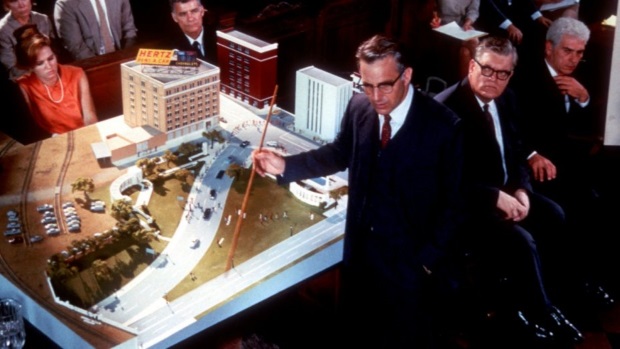
JFK (1991)

Kevin Costner goes on a quest for the truth in Oliver Stone’s crazy but brilliant JFK

Director: Oliver Stone

Cast: Kevin Costner (Jim Garrison), Sissy Spacek (Liz Garrison), Kevin Bacon (Willie O’Keefe), Tommy Lee Jones (Clay Shaw), Jack Lemmon (Jack Martin), Walter Matthau (Senator Russell B Long), Gary Oldman (Lee Harvey Oswald), Joe Pesci (David Ferrie), Donald Sutherland (Colonel X), Laurie Metcalf (Susie Cox), Michael Rooker (Bill Broussard), Jay O. Sanders (Lou Ivan), Edward Asner (Guy Banister), Brian Doyle-Murray (Guy Banister), John Candy (Dean Andrews), Sally Kirkland (Rose Cheramie), Wayne Knight (Numa Bertel), Priutt Taylor Vince (Lee Bowers), Tony Plana (Carlos Bringuier)

When great events happen, it’s hard for us to accept they might take place for random reasons. Rather than freak occurrences or boring individuals, we’d rather see them taking place due to an impenetrable web of shadowy figures. There is something in us that rejects randomness and embraces order. Conspiracy theories are the (ironic) result of these, with their exponents often the most passionate believers in the all-pervading genius of big government. Events like the death of President Kennedy can’t be because some nobody shot him. Instead it must be part of a wider junta of baddies, with every man you see merely a front for a cabal of the wicked. It’s hard not to be swept up by the lure of the conspiracy theories (they invariably have the best stories after all) – and Oliver Stone’s JFK is perhaps the definitive mainstream conspiracy theory essay.

Taking the campaign of Louisiana DA Jim Garrison (Kevin Costner) to find out the “truth” about the murder of President Kennedy, Stone’s film is part a fascinating presentation of half-truths and “might-have-beens” and part a sprawling mess of irresponsible nonsense. Either way it’s assembled with astonishing panache, a level of filmic skill that makes it (literally) almost impossible to tell whether what you are seeing is true and what is invention. Stone’s film superbly interweaves a variety of film stocks and effects to seamlessly splice together newsreel footage, Zapruder film and his own reconstructions so brilliantly it frequently becomes hard to tell which is which.

The same logic also applies to the script. JFK is frequently engaging and fascinating. But you have to remember that it is the equivalent of meeting the most literate and articulate street corner “End-of-the-Worlder”. Such is Stone’s skill he could, I am sure, have created an equally compelling film which would have you questioning the Moon Landings or the shape of the Earth. JFK throws an army of questions, objections and theories at the screen. And while it rarely provides much in the way of answers, only points that it wants you to think about, these theories frequently fascinate. Imagine JFK as a sort of video essay, linked together with dramatic scenes, with its points delivered by authoritative and trusted actors like Donald Sutherland, Jack Lemmon and Walter Matthau.

There is absolutely no doubting the technique of Stone here, or his mastery of the language of cinema. The work of Robert Richardson’s photography, with its myriad styles, and of Joe Hutshing and Pietro Scalia’s editing, pulling together a host of images, snapshots and flash cuts into an insidiously convincing whole, is breathtaking. Light in particular is superbly used, casting some characters in shadow, flaring up to (literally) blind others – light frequently plays across Garrison’s glasses, a visual metaphor for his own struggle to see the light. The speeches he writes for his characters are superbly done, and make their points with great skill – Sutherland (superb) has a hugely convincing story of military black ops action (and inaction) before and after the assassination that fills almost 20 minutes of screentime.

There are compelling arguments made about the ability of Oswald to fire the shots, the triangulation of fire, the spurning of an easier shot before the fateful turn, Oswald’s seemingly illogical movements after the shooting etc. etc. There is decent reasoning behind all of this, and the points are marshalled very well. But, like all extremist theories, suddenly it will turn into something just a little batshit (Lyndon B Johnson ordering the hit or some sort of cabal of Cubans, CIA, FBI and Secret Service working together to conduct a coup).

Much of Stone’s passion for finding the truth (the film’s mantra) is rooted in his own romantic view of Kennedy, as some sort of lost “Prince Who Was Promised”. To Stone, Kennedy would have withdrawn us from Vietnam (news I am sure to the President who started and escalated America’s involvement in it), ended the military industrial complex (contrary to his platform when elected of a stronger US military), bought the Cold War to an end (again, running against his sustained opposition to the Soviet Union) and introduced full Civil Rights (a cause he was lukewarm on at best – unlike his brother or his successor Johnson).

But Kennedy was a romantic figure who had the ability to invite people to invest him with whatever qualities they wanted (both good and bad), a magic cemented forever by his untimely murder. In reality there is no indication that JFK would do (or want to do) any of the things JFK argues he was assassinated for. But that’s all part of the magic of the conspiracy. Facts and events can be marshalled into whatever you want them to be. (Tellingly the only member of Garrison’s investigative team who questions these theories is shown to be a creep in the pay of the conspirators.)

So Kennedy can be a saint, and the film can outline (with no evidence at all beyond a series of coincidences and unlikely or random events) a grand vision of master schemers reshaping America over the body of a dead President. Does it really stand up? Well no of course not. But I will say it is compelling viewing – even if it is essential to keep an open mind about it. Stone later wished he had made clearer that much of the work here was pure fiction (and speculative at best). Certainly it’s a point to keep in mind.

Perhaps Stone should also have looked again at some of the other beats in the film. The film’s version of Jim Garrison as a kind of saintly campaigner for justice flies in the face of many (then and later) who believed the Louisiana DA a shameless self-promoter – an argument made easier to believe by the real Garrison’s cheeky cameo in the film as his ‘nemesis’ Earl Warren. No mention is made in the film that the case he brings against Clay Shaw was dismissed by the jury after less than an hour, and the film avoids explicitly showing his lack of evidence. Costner delivers the final speech, with its famous “back and to the left” commentary on what seems like Kennedy’s unnatural movement after being hit by a bullet and breakdown of the “magic bullet” (both theories now largely discredited), with aplomb, but the film puts a halo on Garrison which doesn’t really stand up.

But again at least it’s entertaining. Other parts of the film don’t even manage that: the baseline narrative that links up the various compelling conspiracy lectures is frequently dull, insipid and lamely written. Sissy Spacek has perhaps the most thankless role in film history as Garrison’s wife whose nearly every line is a variation on “Honey please stop reading the Warren Report and come to bed”. Even that though pales against the exploration of the 1960s gay scene in Louisiana (which Clay Shaw and his “fellow conspirators” were leading members of) which has an unpleasant stink of homophobia, playing into a host of deeply unpleasant (and false) stereotypes of gay people as perverted, promiscuous and preying on the straight. One suspects there was more than a little truth in the idea that Garrison’s fury at Shaw was at least partly motivated by homophobia.

These sequences work considerably less well today – and frequently go on far too long – but when the film focuses on its Kennedy theories it is at least compelling, even if it’s all rubbish. The film made it mainstream to believe Kennedy was killed by a conspiracy in which Oswald was, if he was involved at all, only a patsy. How different would the world have been if Oswald had lived and been made to explain why and how he killed Kennedy? But then chances are, being such an average an unremarkable man, people wouldn’t have believed him anyway.

Stone’s film is a triumph of agenda-led fantasy. Stuffed with faults it makes you at least ask questions – even if you wisely use those questions to affirm many of its points are questionable at best. But any film buff will love the skill it’s told with and the beauty of its technical assembly. Costner was perhaps a little too bland to drive the thing along (although the film uses his innate morality very well), but there are several good performances not least from Gary Oldman who is brilliant as put-upon, used but unknowable Oswald. Nuts, crazy and packed with compelling nonsense, it at least always encourages you to find out more about the actual history.

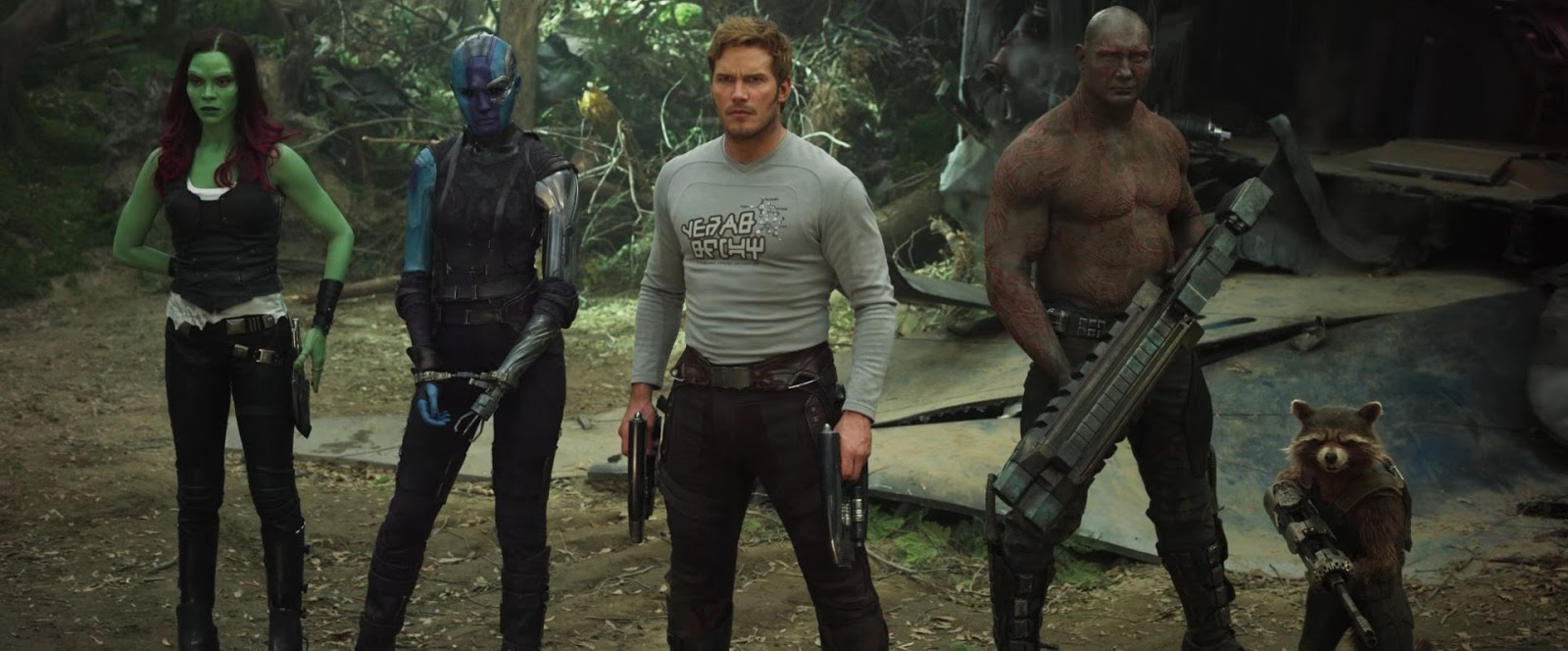
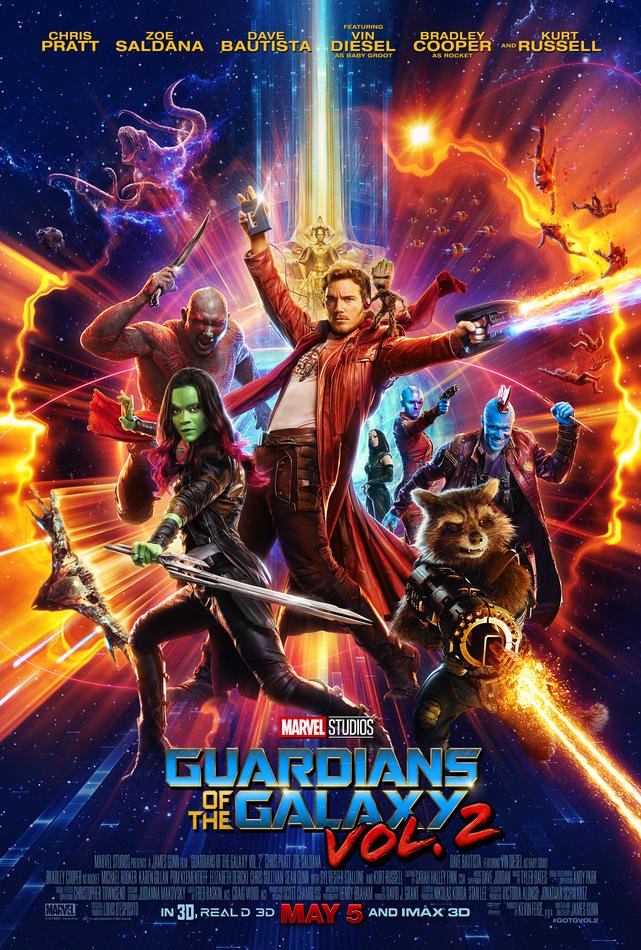
Guardians of the Galaxy Vol. 2 (2017)

Our heroes line up for action in a fun follow-up to a more fun movie

Director: James Gunn

Cast: Chris Pratt (Peter Quill), Zoe Saldana (Gamora), Dave Bautista (Drax), Bradley Cooper (Rocket), Vin Diesel (Baby Groot), Michael Rooker (Yondo Udonta), Karen Gillan (Nebula), Pom Klementieff (Mantis), Kurt Russell (Ego), Elizabeth Debicki (Ayesha), Sean Gunn (Kraglin), Sylvester Stallone (Stakar Ogord)

In 2014, Guardians of the Galaxy was expected to be Marvel’s first flop: an odd collection of ridiculous looking characters, from a comic book few had ever heard of. Instead, its oddball charm and wit made it one of the most popular in the franchise. This is the tricky second album, which has to deliver more of the same while trying to build on the first film.

Set a few months after the first film, the Guardians are left stranded on an alien planet after a job for elitist race The Sovereign (led by a drily witty Elizabeth Debecki) goes badly wrong. They are saved by Ego (Kurt Russell) who reveals himself as Peter Quill’s long-lost father. Quill (Chris Pratt), Gamora (Zoe Saldana) and Drax (Dave Bautista) follow Ego to his homeworld, while Rocket (Bradley Cooper) stays to repair the ship with their captive Nebula (Karen Gillan). While Ego’s world hides a range of dangers, Rocket and Nebula come under attack from Peter’s former guardian Yondo (Michael Rooker), whose pirates have been hired to capture the Guardians.

First the good things: this is a very entertaining film, packed full of funny lines and entertaining moments, solidly acted (with some stand-outs) by a cast who are able to communicate their enjoyment with the audience watching. Like the best of the Marvel films, it focuses on a core cast and establishes an audience bond with their characters very swiftly, and care about their fate. The focus of the film is actually skewed in favour of character over plot and action, which makes a nice change from many of these films (the action quotient is actually fairly low for a Marvel movie, and a large chunk of the film largely involves spending time with our heroes). It’s also admirable that the film doesn’t shy away from the fact that, to varying degrees, all of our heroes are in some way anti-heroes, or perfectly willing to perform selfish, dangerous or questionable acts for their own immediate gain (even if on the bigger issues their hearts in the right place).

It’s clear what type of movie you can expect right from the opening credits, where the camera focuses on (adorable) Baby Groot dancing to music in close-up, while (out of focus) our heroes combat a space monster in the background, each of them at key moments interacting with Groot in a way that demonstrates their character. It’s a lovely, witty way of opening the movie (perfectly scored to ELO’s Mr. Blue Sky) and firmly states that character and personality will be central. Baby Groot is, by the way, possibly the star of the movie, Gunn making sure the character isn’t overused or becomes wearing. The film gets the tone more or less right: it would be easy for this to feel like a private party we’ve been invited to watch, but it just about feels inclusive enough (and avoids smugness or self-satisfaction at its own wit) to remain charming and fun.

The focus is so much on jokes and fun that the actual plot of the movie is a little bit weak: a (predictable) villain reveal is made late-on, seemingly to give the film an antagonist. The actual plot content of the film is pretty lightweight. What plot there is, is nothing new (Daddy issues, spliced with Universe-in-peril) I’d also say that the films length is probably a bit too much – considering not a lot really happens, the film takes a long time to do it – it could do with a bit more discipline in the editing room, and a bit more willingness to trim out some of the material. This is, however, not a major problem –– and the film just gets away with it because it gets the character moments so right you simply enjoy spending time with this group, even if what they are getting up to is little more than a second-rate episode of Star Trek.

Where Guardians 2 falls a little bit flat is the wearily on-the-nose “emotional” sections of the script. While in the first film much of this goes unspoken, here several scenes are featured where the characters carefully spell out their feelings. The most egregious examples are an almost laughably overplayed game of catch between Peter and his Dad, and a terrible “everything spelled out” conversation between feuding sisters Gamora and Nebula. Whenever this film goes near this emotional content, its points land with heavy punches, while coating the content with sticky sentiment that gets “bad laughs” from the audience. The film has plenty of well-crafted and funny impact lines, but its script rushes through the areas where depth is needed, and doesn’t seem to trust the audience to understand the emotions that underlie the bickering between the characters, or that some of them may be tempted to do terrible things to fulfil their emotional needs. Only the final sacrifice of a character really works – and that’s because it is the only emotional connection that is quietly built in the background of the movie, rather than in the foreground.

But that’s probably a movie trying too hard for good reasons, rather than bad. There is more than enough here to recommend the film. Interestingly, Pratt’s Peter Quill is largely sidelined for chunks of the film (the fact that its nominal plot is all about Quill and he feels like a supporting role tells you how weak the plot is) so other members of the cast really stand out. Saldana has a slightly thankless role as the “Big Sister” of the group, but manages to bring a lot of unspoken depth to her role. Bautista provides excellent comic relief as Drax (though his lines are such gifts, it would be hard to screw them up), Baby Groot is very funny, Cooper’s Rocket has a juvenile, rebellious attitude that  that deserves a more interesting subplot. Surprisingly though, the film is repositioned more as a redemption journey for Michael Rooker’s space rogue Yondo, and Rooker delivers a surprisingly emotional performance as a confirmed killer and thief struggling with his conscience. Gunn allows him contemplative moments that really ring true within the chaos of most of the rest of the film, and this feels like one of the best displays of simple “acting” you’ll see in the MCU.

Guardians 2 is not a perfect film, and I suspect its weak plot, predictable and uninteresting villain, and often ham-fisted emotional moments will grate more and more once the exuberance of the ride has worn off on the second or third viewing. But it’s got a lot going for it: genuinely funny jokes, an intention to entertain which it largely succeeds in, some charming performances and enough action in it without letting that overwhelm the film. It’s a roller-coaster rather than a gift that will keep giving, and it lacks the first film’s well balanced plotting and world-building, but it’s entertaining and a great deal of fun (if 20 minutes too long) and the final reel’s sad events do carry an emotional weight (because they are based on largely unspoken feelings) that will stay with you after the film wraps. Not as fun as the first one – but still better than many others.