Tag: Michael York

The Taming of the Shrew (1967)

The Taming of the Shrew (1967)

Burton and Taylor are perfect casting in this rollicking adaptation of Shakespeare’s most difficult comedy

Director: Franco Zeffirelli

Cast: Elizabeth Taylor (Kate), Richard Burton (Petruchio), Cyril Cusack (Grumio), Michael Hordern (Baptista Minola), Alfred Lynch (Tranio), Alan Webb (Gremio), Michael York (Lucentio), Natasha Pyne (Bianca), Victor Spinetti (Hortensio), Roy Holder (Biondello), Mark Dignam (Vincentio), Vernon Dobtcheff (Pedant), Bice Valori (Widow)
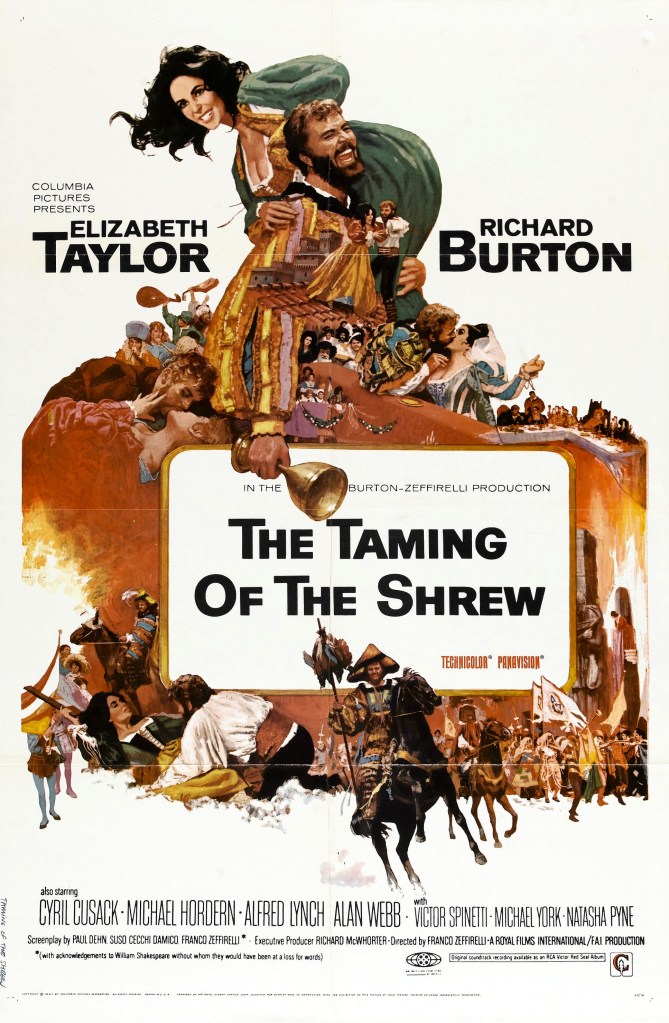
There’s a reason why the poster screamed “The motion picture they were made for!” Who else could play literature’s most tempestuous couple, than the world’s most tempestuous couple? After all, they rolled into this straight off the success of Who’s Afraid of Virginia Woolf? and, say what you like, a knock-about piece of Shakespearean farce is certainly more fun than two hours of Edward Albee. So, Burton and Taylor turned up in Italy, entourage in hand, to bring The Taming of the Shrew to life in a gorgeous explosion of grand sets and wonderfully detailed costumes.

The Taming of the Shrew actually translates well to the screen – and Zeffirelli’s high-octane style. Odd to think now, for a film soaked in elaborate period setting, that in the 60s Zeffirelli’s style was seen as border-line sacrilegious to the Bard. He actually escaped with less opprobrium from the critics than he faced for cutting two-thirds of Romeo and Juliet a year later, since most seemed to think Shrew was less of a holy text. Not that it stopped a lot of critics reckoning Zeffirelli should focus more on executing every pentameter to perfection and less on gags and visual story-telling.

But actually, that’s perfect for a story that was always a raucous farce at heart – so much so, even the original play presents it as a play-within-a-play told to a drunken Christopher Sly (cut here). The bawdiness feels fresh out of Chaucer and Boccaccio, a parade of people in period costumes slapping thighs, roaring with laughter, double taking and enjoying a series of cheeky jokes (did Pasolini watch this before making his lusty adaptations?). Padua is a city of sin, with prostitutes openly advertising their wares (and later, clearly, invited to Bianca’s wedding) and a wife-stealer is in the stocks.

Zeffirelli’s Shrew is full of rowdy wildness – in a nod to the cut Sly framing device, Padua is in the midst of a feast of fools, students turning a choral sing-along into a drunken celebration. Kate and Petruchio’s high-octane gunning for each other, feels fitting for a location where everyone is careering wildly towards the target of their immediate emotions, either horny beyond belief, desperate to marry off daughters or furious at supposed crimes or betrayals.

The age-old question you have when staging Shrew is what to do about its fundamental misogyny (and it’s hard not to argue, much as the bard’s defenders have tried, not to see it as a play deeply rooted in the patriarchy). Zeffirelli’s solution is an intriguing one: his Shrew is enigmatic, with Kate’s motivations, feelings and reasonings often left cleverly open to interpretation. It’s also helped, of course, by the natural chemistry between the two leads. If there is one thing we all know, it’s that Burton and Taylor were really into each other and drove each other up the wall. What Shrew does here is take that sexual force and exuberance of its leads and balances that with a subtle unreadable quality to Kate that leaves the relationship’s power-balance just open enough to interpretation.

In addition, the film makes clear Kate’s behaviour is unacceptable, introduced screaming abuse from a window and smashing up all the furniture in a room in a fit of furious pique. There’s a lovely touch where Petruchio stares into his own reflection, while planning his campaign – a nice suggestion that he will mirror her behaviour to show its unacceptability (indeed, on returning to their marriage home, he’ll also twice smash up a room’s contents in a pointless display of adolescent petulance). Kate has, to put it bluntly, anger management issues and if Petruchio’s methods are extreme you can see the twisted logic.

Their first meeting sets a pacey tone that will run through the whole film. It’s a wild chase through the Baptista home, through a connected wool barn, over a roof and back again. One in which they will bellow at each other, Kate will rip up planks and bannisters to throw at him, they’ll roll in the wool (hard not to see a sexual charge here) and eventually collapse through the roof to land back in the wool. Petruchio will then announce her consent to marry with an arm twisted round her back, just as he will cut off her refusal at the altar with a kiss (the wedding scene is a neat interpolation, showing something the Bard only reports). They are in a constant pursuit of sorts from here, from the back-and-forth at Petruchio’s house, to the journey to Padua and then finally through a crowd of women at the film’s end. But where does the power lie: pursued or pursuer?

At first, of course, with the pursuer. Burton’s Petruchio is a wild-eyed force-of-nature, permanently partly sozzled (Burton spends most of the film with a pale, damp drinking sweat that was probably not acting), his tights full of holes, his manners rude (he’s basically Christopher Sly in the lead role), focused on the money he’ll get from wooing Kate. But, while he’s a powerful alpha male, it’s remarkable how the balance slowly shifts to Kate. After their arrival at his home (she, soaking wet after falling in a puddle to Petruchio’s laughter), she puts her drunken husband to bed, has the house redecorated, the servants redressed and everything arranged to her liking.

Taylor’s performance here adds to the effect. It’s an intelligent, camera-wise performance which uses looks to convey Kate’s loneliness and pain. Locked in a room before the wedding, she glances out of a window with aching sadness. She looks with gentle envy at warm friendship in others. Taylor gives a wonderfully calm, genuine delivery of the famous closing speech of wifely piety. But it’s words are undermined in two ways: firstly by the suspicion it’s partly done to show-up the jokes against her throughout the wedding, and then by Taylor’s immediate departure after kissing a finally flabbergasted Petruchio, leaving our macho hero wading through a pile of laughing women in a desperate attempt to catch-up. Who might just rule here, long term?

Zeffirelli’s film moves the Lucentio (a wide-eyed Michael York) sub-plot even further to the margins – in a neat invention, Petruchio during the first chase, keeps barging in on rooms where different sub-plot scenes are all going on at the same time. As a result, this does mean a number of first-rate actors get very little to do: Cyril Cusack’s Grumio becomes a grinning observer of the chaos, Alfred Lynch’s Tranio (after some initial fourth-wall breaking) fades into the background, Michael Hordern has little to do but look aghast as a desperate Minola, Alan Webb barely registers as a rejected suitor while after an initial sight gag (his minstrel player disguise making him look like the fifth Beatle) Victor Spinetti gets similarly fades away.

But then audiences were here for the Burton-Taylor show, and they get that in spades: framed within a medieval setting inspired by classical painting (and which features an obviously fake backdrop for its countryside exteriors). And The Taming of the Shrew is rollicking good fun, which manages to work an interesting line on the play’s troublesome sexual politics, suggesting that all but not always be as it seems. And it nails the atmosphere of rollicking fun in this ribald Shakespeare yarn.
Cabaret (1972)

Cabaret (1972)

Fosse’s influential adaptation reinvents the musical into a superb exploration of sexuality and wilful blindness

Director: Bob Fosse

Cast: Liza Minnelli (Sally Bowles), Michael York (Brian Roberts), Helmut Griem (Baron Maximilian von Heune), Joel Grey (MC), Fritz Wepper (Fritz Wendel), Marisa Berenson (Natalia Landauer), Elisabeth Neumann-Viertel (Fräulein Schneider)

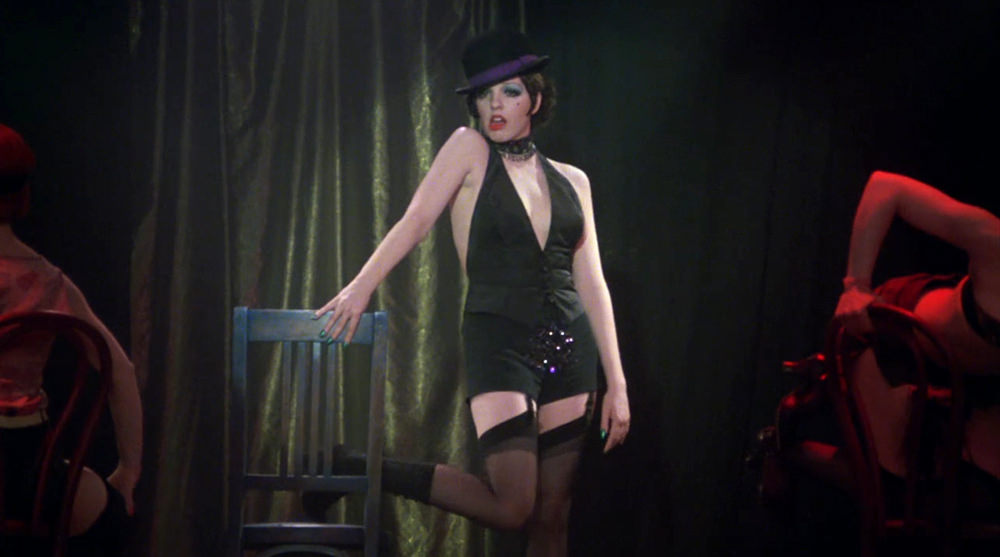
Some say Life is a Cabaret (old chum) – but they may well be closing their eyes to what’s really going on around them. Much harder to do that in Cabaret, a dark study of Weimar Germany, the quintessential time-period where everyone was so wrapped up in having a good time they failed to notice the world was beginning to burn down around them. Fosse’s version is a musical, but song and dance fills just over a quarter of the runtime. At its heart, it’s a character study of two young people in a particular time and place with very different perceptions of the dangers around them. It makes for a dark, inventive re-working of the Broadway original with Fosse stretching his wings into the sort of complex work culminating in the forensic self-examination of All That Jazz – and make Cabaret one of the most unique and exceptional of musicals.

Our Babes in 1931 Weimar Berlin are Sally Bowles (Liza Minnelli) and Brian Roberts (Michael York). Sally is a would-be superstar, plying her trade singing and dancing at the Kit Kat Klub. The host of erotic and blackly comic numbers there is the unsettling MC (Joel Grey). Brian is an academic, a reserved and very English young man with a preference for other men. Housemates in the same boarding house, the two become very close – and both very close indeed to happy-go-lucky Baron Maximilian von Heune (Helmet Griem). Sexual, romantic and emotional feelings ebb and flow while in the background the Nazis march relentlessly towards power along a path of violence.

Fosse was desperate to direct Cabaret, a film he felt certain would be a hit– and producer Cy Feuer was keen to bring his raunchy, dynamic choreography to the seamy world of the Kit Kat Klub. But Fosse also wanted to do something very different to the original musical. He wanted to return more to it literary roots, the semi-autobiographical works of Christopher Isherwood. He also felt, based on his experience directing Sweet Charity, that realism and bursting into song didn’t work. So the original script was jettisoned in favour of a new story junking most of the musicals plot (and several key characters), change its male lead from a straight American back to a queer Brit and cut all but one song not inside the Kit Kat Klub, making them a commentary on the action.

It’s a master-stroke, making Cabaret both a compellingly staged musical, but also a dark social issues piece and exploration of sexuality. In fact, you could watch Cabaret and wonder if Fosse didn’t really want to direct a musical at all. His heart, I feel, lies in the increasingly sexually charged and fluidic relationship between the three lovers at its heart: Sally’s vivacious enthusiasm, Brian’s careful guardedness and Maximilian’s shallow glee. It’scaptured beautifully in a late-night drinking scene in Maximilian’s palatial house, with the camera sensually close as the three dance together, their lips inches away from each other, the desire bubbling between them.

There’s a striking comfort with sexual freedom in Cabaret. Brian’s homosexuality – or bisexuality after he and Sally together discover his previous disastrous liaisons were clearly with “the wrong three girls” – is treated unremarkably by all: after all the Kit Kat Klub has its share of drag queens (one of them sharing a telling look with Brian after they surprise each other at the urinal). It’s all part of a wider bohemian lifestyle, exemplified by Sally who is always dreaming that a big break is just around the corner. This is the decent, brave and accepting side of Weimar Germany.

But Cabaret is also about the danger all around the characters, which too many of them ignore. Brian is the most conscious and politically aware, for all his English reserve. But Sally’s major flaw is that she chooses to pretend it’s not happening. Minnelli’s gorgeous rendition of ‘Cabaret’ at the end is so often seen as a triumphant embracing of life on her own terms, that its overlooked Sally performs it having decided to turn her back on broadening her own life outside her comfort zone and is singing to a room increasingly full of Nazis who will stamp out the very life she’s dreaming about.

Sally is bought to life in a superb, Oscar-winning performance by Liza Minnelli. Minnelli’s singing is of course extraordinary – her rendition of ‘Maybe This Time’ is one for the ages – but she’s also superb at bringing to life Sally’s bubbly naivety and kindness while also suggesting the fragility and desperation to be liked under the surface. There’s something very innocent about her, for all her hedonism: her attempted seduction of Brian has the clumsy brashness of an over-eager virgin, and while instinctively keen to help others she’s clueless at dealing with real emotional problems (there’s a wonderful moment when Minnelli looks sideways in panic as Maria Berenson pours her heart out to her, as if trying to find a way to escape). It’s a gorgeous, endearingly sweet performance – and perfectly counterpointed by Michael York’s career-best turn as the sharp, gentle, thoroughly decent Brian, with his own unique moral code.

Around them, Fosse uses the musical numbers to darkly comment on the action, helped by the demonic feel of Joel Grey’s sinister MC (the first real shot of the film is Grey’s face looming up from below to flash a Lucifer grin), whose manner becomes increasingly cruel, Fosse cutting to brief shots of him knowingly grinning as the dangers of Nazism become increasingly hard to avoid. Grey (who originated the part on stage) has a look of Joseph Goebbels about him, and it’s hard not to feel he’s some sort of manic sprite given even more life and energy as the world fills with horrors around him.

The musical numbers are extraordinary, brilliantly assembled by Fosse and full of seedy glamour – there is a gorgeous shot in ‘Willkommen’ when the camera whips around the high-kicking chorus line that’s like a shot of adrenaline. They mix between the darkly funny – the troubling romantic longing of ‘If You Could See Her’ – and the gorgeously inventive, with the tightly choreographed movements of ‘Money, Money’. Grey is a crucial part of this, his charismatic singing and dancing burning through the celluloid – who can forget his cruel glee under the comic interplay of ‘Two Ladies’ – and the use of him as a cryptic chorus who never speaks except on stage is a master stroke.

From its early scenes, we are left in no doubt of the violence many are choosing to ignore. From a street lined with ripped up election posters which Sally and Brian stroll down, to cut aways to stormtroopers brutally beating opponents, we can’t escape the inevitable death of this happy-go-lucky world. It’s also Fosse’s masterstroke to make the only musical ‘number’ outside the Klub not only goose-bumpingly powerful but also a skin-crawling piece of Riefenstahl-framed Nazi triumphalism.

Cabaret superbly captures in this one moment the seductive power of Nazism. As an Aryan boy sings ‘Tomorrow Belongs to Me’ (a slow camera pan reveals his SA uniform) at a beer garden, gradually the crowd joins in. The song builds into a resounding crescendo, people’s faces beaming with pride, full of fixed fanaticism, all of them sharing a special, powerful moment of belonging. Fosse’s unbelievable nerve is to present this utterly straight (someone with no knowledge of Nazism would be deeply moved watching it), making its seductive power even more chilling: because you can’t watch without also feeling a nausea inducing feeling of goose-bumps.

Hard not to agree with Brian when he wryly asks the smug Max whether he’s still sure the Nazis can be controlled. (Max parrots the upper class view that the Nazis are useful tools for getting rid of the socialists). It’s much easier for us to understand why Fritz Webber’s scruffy charmer Fritz (hiding his scuffed shirt cuffs) is scared of revealingly his Jewish heritage, even if it’s all he needs to do to win the love of Marisa Berenson’s shopping mall heiress. You don’t want to pop your head over the parapet in this world.

What’s clear in this superb film, is we can applaud the characters only so far: after all they decide to avoid the obvious that hedonism must be put aside to see the world for what it really is. There is a tragedy, in Sally in particular, that she can’t or won’t do this. As beautiful as her optimism is, it eventually becomes wilful blindness. This is part of what makes Fosse’s extraordinary film one that transcends its source material to become something truly unique. It’s a calling-card of a great director.

The Three Musketeers (1973) / The Four Musketeers (1974)

The Three Musketeers (1973) / The Four Musketeers (1974)

A film of two halves, in more ways than one: the swashbuckling original and its dark sequel

Director: Richard Lester

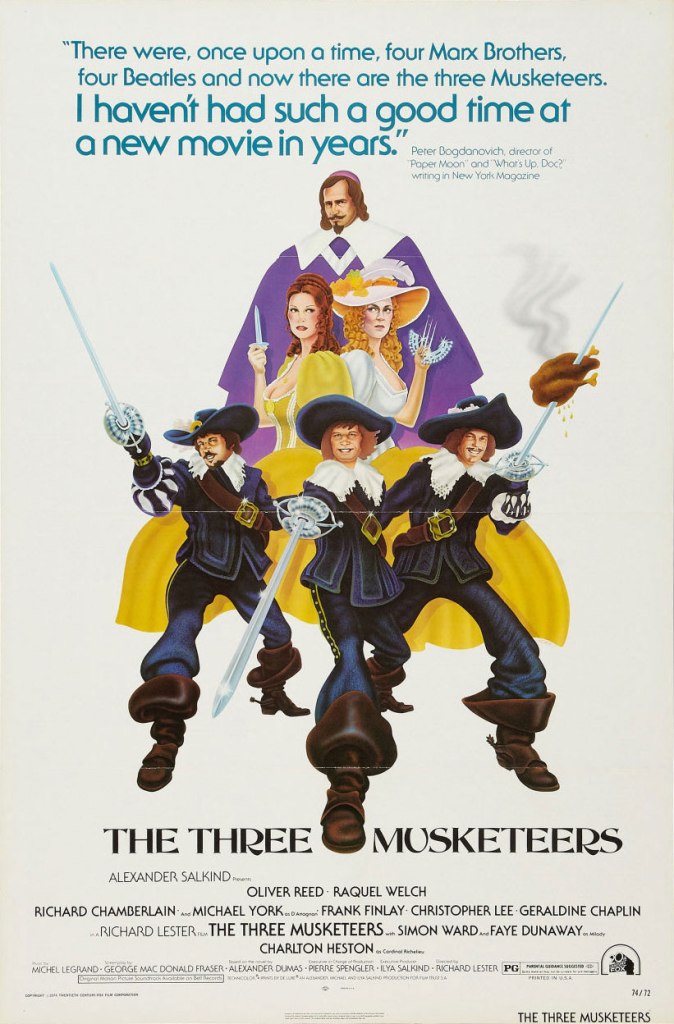
Cast: Michael York (d’Artagnan), Oliver Reed (Athos), Frank Finlay (Porthos/O’Reilly), Richard Chamberlain (Aramis), Raquel Welch (Constance Bonacieux), Jean-Pierre Cassel (Louis XIII), Geraldine Chaplin (Anne of Austria), Charlton Heston (Cardinal Richelieu), Faye Dunaway (Milady de Winter), Christopher Lee (Count de Rochefort), Simon Ward (Duke of Buckingham), Spike Milligan (Bonacieux), Roy Kinnear (Planchet), Georges Wilson (Captain de Treville)

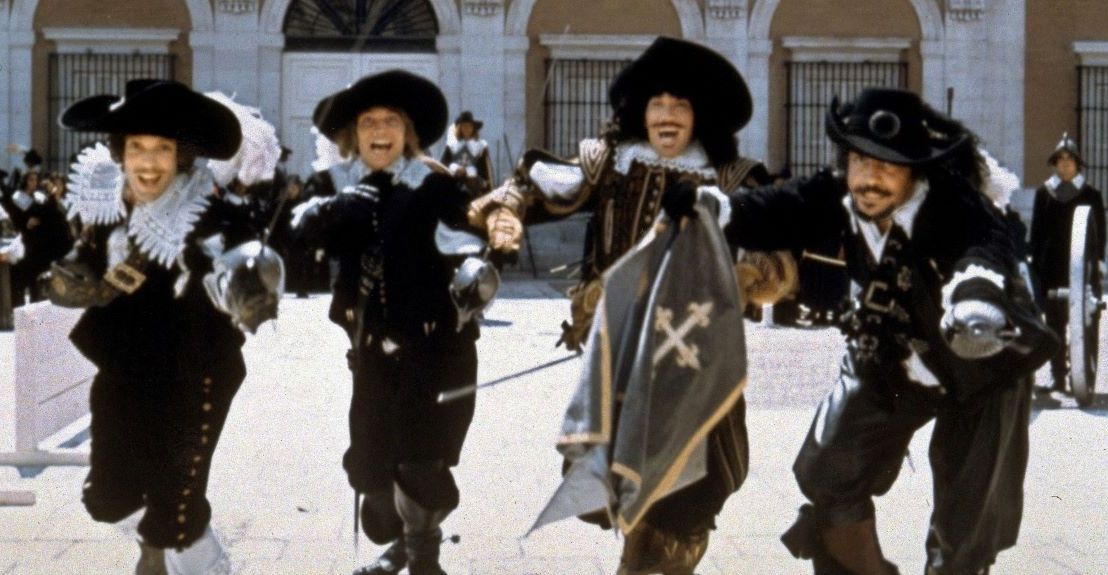
All for one and one for all! The Three Musketeers is probably the greatest adaptation of Dumas’ rollicking classic, a wonderful mix of swashbuckler, romance and Hellzapoppin comedy, that never takes itself particularly seriously and is crammed with actors having a whale of a time. It’s not quite a send-up, but it’s also not quite a straight re-telling either. Instead, it’s gunning all-out for entertainment – and it succeeds most of the time.

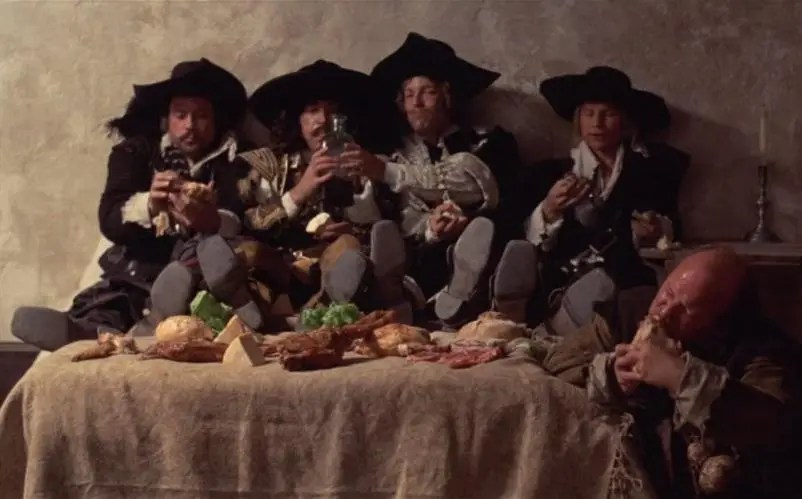
d’Artagnan (Michael York) arrives in Paris in 1625 desperate to join the musketeers. After various adventures along the way – including a rivalry with suavely villainious Rochefort (Christopher Lee) – the impulsive young man forms a friendship (after bumps in the road) with the famed musketeers Athos (Oliver Reed), Porthos (Frank Finlay) and Aramis (Richard Chamberlain). Falling in love with the unhappily married Constance (Raquel Welch), maid to Queen Anne (Geraldine Chaplin), d’Artagnan and his friends are dragged into foiling a plot by the ambitious Cardinal Richelieu (Charlton Heston) to use the ingenious Milady de Winter (Faye Dunaway) to expose the Queen’s infidelity with the Duke of Buckingham (Simon Ward). Will our heroes manage to foil the scheme in time?

The Three Musketeers adapts the first third or so – the most famous and by far the most enjoyable part – of Dumas’ novel. With an irreverent script by Flashman author George MacDonald Fraser, its framed as a rollicking romp with a tongue-in-cheek humour. Richard Lester, famed for his cheeky Beatles comedies (and the film was originally envisaged as a vehicle for the Fab Four), added his trademark scruffy, opportunistic comedy.

The film is awash with muttered asides – many of them well delivered by Roy Kinnear’s exasperated servant Planchet – that are only just picked up by the sound mix. My favourite? d’Artagnan bursting into a room full of guards, yanking a rug with a yell in an attempt to upend them, succeeding only in tearing the corner off it, then immediately jumping out of a window, leaving the bemused guards one of whom plaintively mutters “He’s torn our carpet” – I find this funny on multiple levels, from York’s all-in energy to the stillness of the shot, to the underplayed sadness of the punchline.

Lester’s film is full of long-shot gags – passengers in litters being dropped in a lake, d’Artagnan swinging on a rope to knock someone off a horse, missing and falling in the mud or his jump from a third storey window only to immediately reappear having landed on a (anachronistic) window cleaner cart. While the film does have its moments of drama, danger and intensity, it doesn’t ease up on visual humour, or gags (“This ticket is for one man” “I am one man. This is a servant”). It’s all part of Lester’s plan to make a fast-paced, pantomimic entertainment in which nothing is intended to ever be too serious.

It’s all played with maximum commitment by the cast, all of whom buy into the films’ tone. Michael York leaves very little in the locker-room with a performance full of youthful bravado, lusty hurrahs and naïve, winning eagerness. It’s a very hard balance to get right but he is never overbearing, but provides a relatable, likeable lead. He’s physical commitment to a series of Buster Keaton style gags is also commendable. He sparks a rather sweet romance with Raquel Welch, who is not the world’s strongest actress, but gamely delivers a series of pratfalls as the eternally clumsy Constance.

Around these two, a series of experienced actors delight in larger-than-life roles. Reed brings a surly intensity to Athos, a reminder of how great a career this charisma laden actor could have had. Finlay gives a Falstaffian joie de vivre to Porthos. Chamberlain (with little to do) strikes a gamely romantic figure as Aramis. As the baddies, Heston clearly enjoys subverting his grandiosity as the scheming Cardinal, Dunaway has a kittenish sensuality as Milady and Christopher Lee is so perfect as the debonair Rochefort that his eye patch (unmentioned in Dumas) has become de rigour for every Rochefort performance afterwards.

The Three Musketeers is crammed with swashes being buckled. The sword fights come thick and fast and are all shot in a series of impressive locations (the camera work of David Watkin, design of Brian Eatwell and costumes of Yvonne Blake do a wonderful job creating a sumptuous period setting). At times they do look a little ragged today – producers the Salkinds ran a tight budget, and there are multiple reports of the slightly-under-rehearsed fights leading to near-serious injury (this slapdash preparation would lead to tragic consequences when Roy Kinnear was killed on the belated second sequel 15 years later). But the actors enter into them with a firey commitment (a little too much so in Reed’s case according to the terrified stuntmen) and rumbunctious energy that really sells these as gripping action. They are also give a certain air of peril that gives just enough weight to the film.

The Three Musketeers has moments of dated clumsiness – the bizarely arty slow-mo opening with blurred motion feels totally out-of-keeping with the rest of the film – and not all the jokes land (Spike Milligan in particular is completely over-indulged in the film’s least successful comic moments). Not every performance works – Chaplain in particular is weak as Anne of Austria – and not all the jokes pay off. The musical score by Michael Legrand, catchy as it is, sometimes overeggs the “isn’t this all such fast-paced fun” angle. But the stuff that lands, really does well and there is more than enough fun, action, adventure and rollicking good humour to keep you entertained on a weekend afternoon.

And then there were two (or rather four)

There is always a twist in the tale. At some point while making The Three Musketeers the Salkinds realised they would never get it ready for the Paris premiere. But they could get half the film ready. So, they released that and cheerily announced at the end a sequel was already in the can. Problem was no one had mentioned it to the cast, who discovered they had shot an entire movie for free. A court case exploded, which the Salkinds lost, settling with actors and leading to a new clause being inserted into all contracts for actors preventing such a dodge happening again.

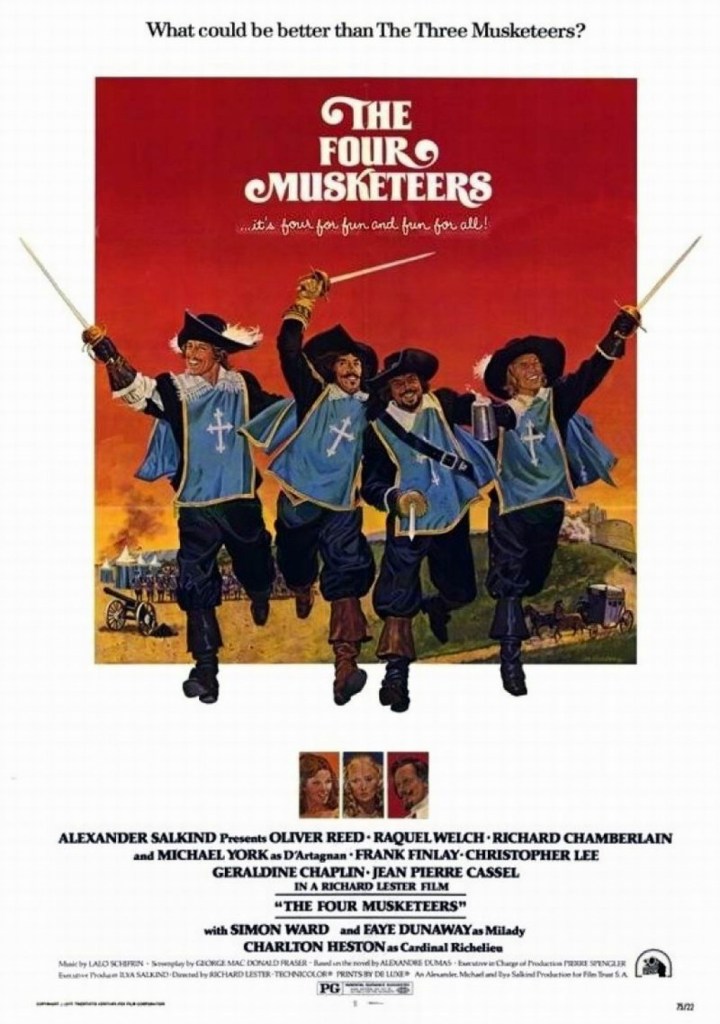
The Four Musketeers covers the second, less famous, much less fun part of Dumas’ novel. Rather like novel, it’s a rambling affair that lacks the compelling narrative thrust (We’ve got to get those diamonds and save the Queen!) which made The Three Musketeers so entertaining. It doesn’t help that its also considerably darker, serious and bleaker as bodies pile up and things get serious.

This makes the sequel a very different beast to the first. Energetic heroism prevented villainy in the first film, but here it often fails . Milady (Faye Dunaway) has sworn revenge and is ordered by Cardinal Richelieu (Charlton Heston) to assassinate Buckingham (Simon Ward). Along the way she kidnaps Constance (Raquel Welch) and seduces d’Artagnan (Michael York) seduced. The Musketeers rescue Constance, fight at La Rochelle and do their best to defend Buckingham – but nothing goes to plan, especially after Athos (Oliver Reed) realises Milady and his criminal ex-wife (thought dead) are one-and-the-same.

The Four Musketeers keeps up the humour, but it is frequently at odds with the darker film it sits in. Gone is the high-paced musical score of Michel Legrand, replaced with a lyrical series of melodies by Lalo Schifrin. It’s telling that Welch – whose comic clumsiness was a large part of the first movie – appears only briefly here. Similarly, Cassell’s shallow monarch (dubbed by Richard Briers) pops up just once, Roy Kinnear’s Planchet isn’t in the first hour and Spike Milligan’s free-wheeling improvisation is missing completely (in that case, no bad thing).

The film feels tonally at odds with the first film and even, at times, with itself. The Three Musketeers was full of sword fights but no deaths – here sword strokes are lethal. As the Musketeers comically bounce around at La Rochelle sight gags abound – but it feels at odds with a film where the death is very real. The more realistic feel means some set pieces – such as Rochefort and d’Artagnan fighting on an inexplicably frozen lake in the height of Summer – become harder to swallow.

Some performers do flourish. Oliver Reed comes into his own as an increasingly dark and vengeful Athos, giving into temptations of shocking revenge. Faye Dunaway laces her role with cold, murderous fury. They have most of the film’s most compelling scenes – but the incredibly dark ending (which involves our heroes actively perpetrating judicial murder with a terrified victim) while loyal to the book, feels far too heavy for a pair of films that started with Buster Keatonish comedy.

The loyalty to the book and the commitment to follow it is partly to blame. There is a reason why most adaptations chuck away this section of the book. It lacks a clear narrative line for emotional connection and is highly episodic. d’Artagnan, in the book, does indeed sleep around after Constance disappears – but when the film requires their relationship to be the emotional heartbeat, is it a good idea to have him jump into bed with two women within days of her disappearance?

Lester announces the more sombre parts by filming them in a very framed, artful way inspired by the old masters, with a static camera and medium shot, reliant on Schifrin’s maudlin music. He’s far more at home with the comic business delivered by Finlay (very good) and Chamberlain (still with nothing to do). At other points he surrenders initiative to legends like Heston (suavely menacing), Lee (whose Rochefort steps up a level in lip-curling contempt) and Dunaway.

The finest thing on display are the sets and the sword fights, which are even more desperate, ragged and violently dramatic than last time (when Rochefort and d’Artagnan stop in one to take a breath, you are not remotely surprised given the total commitment we’ve seen). The action set pieces all look really impressive and staged with confidence and brio. It’s just a shame that much of the rest of the story feels like its being told by a natural comic trying hard to be King Lear, but not able to resist throwing a few gags in. It makes for an entertaining, but tonally messy film that feels it has come from a totally different place than its flawed but fun predecessor.

Romeo and Juliet (1968)

Romeo and Juliet (1968)

Zeffirelli helps to reinvent Shakespeare on film as vibrant, urgent, young and sexy

Director: Franco Zeffirelli

Cast: Leonard Whiting (Romeo), Olivia Hussey (Juliet), John McEnery (Mercutio), Milo O’Shea (Friar Laurence), Pat Heywood (Nurse), Paul Hardwick (Lord Capulet), Natasha Perry (Lady Capulet), Robert Stephens (Prince), Michael York (Tybalt), Bruce Robinson (Benvolio)

When Romeo and Juliet was released in 1968, it was like a shot of adrenalin into the heart of Shakespeare. It was a play where audiences were used to middle-aged classical actors posing as teenage lovers (not just on stage: the last Hollywood version cast Leslie Howard and Norma Shearer with a combined age of 76). It was a play of wispy poetry, light breaking from yonder windows and stately tragedy. What it definitely wasn’t, was a young play. A play full of vibrant energy, youthful abandon and plenty of sex and violence. Zeffirelli’s film changed that: it was fast, sexy and above all young. It was unlike any Romeo and Juliet many cinema goers had seen before.

Everything new is eventually old of course. So influential was Zeffirelli’s film, it came to be remembered as a “tights and poetry” epic. Its traditional Renaissance Italian setting and well-spoken cast came 30 years later to represent the very same stuffy traditionalism it was kicking in the shins. When Baz Luhrmann released his William Shakespeare’s Romeo + Juliet, full of fast-paced editing, MTV tunes, gunplay and horny, Verona Beach teenagers, it was biting its thumb at the revolutionary style of Shakespeare Zeffirelli had introduced.

But, such is the richness of Shakespeare, there is more than enough room for both visions. Watching the film today is still to be struck by its pace and energy. This is a grimy, immediate film which Zeffirelli frequently shoots with a handheld intensity (particularly in the film’s sequences of violence). The costumes may have a primary-coloured sheen to them, but the emotions are raw and dangerous. There is a comedic zip and energy to its first half, which gives way to a grim sense of inevitable tragedy, that always seems just a few adjusted decisions away from being averted.

To pull the film together, Zeffirelli made some tough decisions. Almost 65% of the dialogue was jettisoned, most notably the whole of Juliet’s speech prior to taking the sleeping drug. Everything was cut and arranged to play to the strengths of his cast. His young lovers were great at the physical and emotional teenage energy, so that’s what Zeffirelli focused on. He cast two unknowns: 17-year-old Leonard Whiting and 15-year-old Olivia Hussey. Both had exactly the sort of unfussy naturalism he was looking for, playing the roles with a breathless, energetic genuineness.

They are, of course, not the greatest performers of the roles you will ever see. But Whiting’s Romeo is passionate, naïve and utterly believable as the sort of love-struck teenager who will choose oblivion when he’s lost his true love. Hussey (who, unlike Whiting, continued as an actor) has a wonderful innocent quality and a forceful determination underneath it. The two of them throw themselves into every scene (and each other) with gusto, rolling on the floor in despair or bounding into fights and arguments as if every word or blow will be their last.

It’s a youthful energy that the whole film bottles up and sells to the audience. Its opening scene takes the “I bite my thumb at you sir” classicism of the initial Montague-Capulet clash, and throws it into a dusty street brawl that sucks in most of the city. The camera weaves among this action, as people fly at each other, onlookers run in panic and extras’ bodies pile into the scuffle.

It’s an effective entrée for the film’s most effective sequence: the plot-turning fight that leads to the death of Mercutio and Tybalt. Zeffirelli brilliantly stages this as youthful bravado and hot-headedness that gets out of hand. Mercutio and Tybalt’s fight is initially more performative than deadly (so much so Mercutio’s friends don’t realise he’s been wounded until he dies) – only Romeo’s attempts to stop it cause it to escalate. Tybalt is horrified at the possibility he has harmed Mercutio and flees in terror. Mercutio maintains a front of all-good-fun that turns more and more into bitterness. Romeo’s revenge on Tybalt starts as an out-matched sword fight but turns into a brutal, dusty scrabble on the ground, with fists and daggers flying. All shot and staged with an improvisational wildness, people in the crowd ducking out of the way. It still carries real immediacy.

It’s particularly effecting as, until then, the film is arguably a romantic comedy. The first half not only surrenders itself to the youthful abandon and passion of the lovers, it’s also not adverse to a bit of knock-about farce with the Nurse (a fine performance of gruff affection from Pat Heywood). The Capulets’ ball is staged as another immersive scene, Nina Rota’s music helping to create one of the best renaissance courtly dances on film. With Romeo blanked by an austere Rosalind (who seems to barely know who he is), it zeroes in on the intense, can’t-take-my-eyes-off-you bond between the two lovers. All of it shot with a dreamy romantic intensity.

That carries across to the balcony scene, that again stresses the dynamism and sexual longing that revolutionises the poetry-and-posing the scene had become in people’s minds. This is after all a young couple who can’t keep their hands off each other to such an extent, they have to be physically separated by Friar Laurence (a cuddly Irish Milo O’Shea, over-confident and ineffective) before their marriage.

It makes it all the more striking then when the second half tips into melancholy and heartbreak. Zeffirelli brings the focus even more intensely onto the lovers. As well as Juliet’s speech, the Apothecary and Romeo’s killing of Paris (shot but cut as there were worries it would make the hero less sympathetic) are ditched, and the action is streamlined and runs inexorably to Romeo’s decease and the camera’s focus on Juliet’s hand as she begins to come back to life.

It’s a film full of interesting little side notes and character interpretations. John McEnery’s energetically manic and witty Mercutio (he, along with O’Shea handles much of the actual Shakespeare) is excellent, with more than a hint of a repressed homoerotic longing for Romeo. Natasha Perry’s austere Lady Capulet flirts openly with Michael York’s fiery Tybalt (their secret affair now a popular interpretation) while Paul Hardwick’s bluster as Capulet carries an air of desperation, with Zeffirelli capturing sad glances at his wife. To bolster its Shakespeare credentials, Olivier speaks the prologue (as well as dubbing multiple members of the Italian cast) for no pay or credit (though he must have known there was zero chance of his famous voice not being recognised!).

Zeffirelli’s film may just be, in its way, one of the most important Shakespeare films in history. If Olivier had shown Shakespeare could work as spectacle and Welles that it could be art, Zeffirelli showed it could be exciting and cinematic. That energy and filmic motion didn’t need to serve the poetry. It became so influential, that it eventually came to be seen decades later as “classical Shakespeare”. But it helped lay the groundwork for a series of films and productions that would leave posing, poetical renditions of the Bard behind.