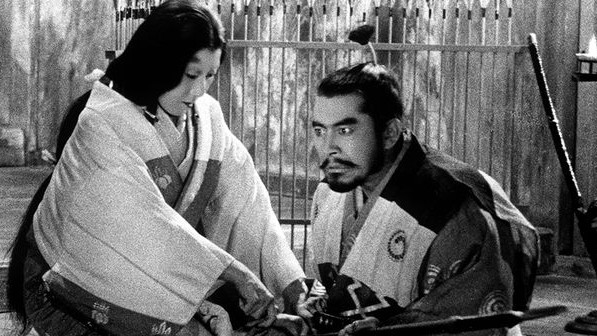
Tag: Minoru Chiaki

The Hidden Fortress (1958)

The Hidden Fortress (1958)

Kurosawa’s samurai entertainment is overlong but has just enough action and adventure

Director: Akira Kurosawa

Cast: Toshiro Mifune (General Rokurota Makabe), Minoru Chiaki (Tahei), Kamatari Fujiwara (Matashichi), Susumu Fujita (General Hyoe Tadokoro), Takashi Shimura (General Izumi Nagakura), Misa Uehara (Princess Yuki), Eiko Miyoshi (Yuki’s lady-in-waiting), Toshiko Higuchi (Prostitute)
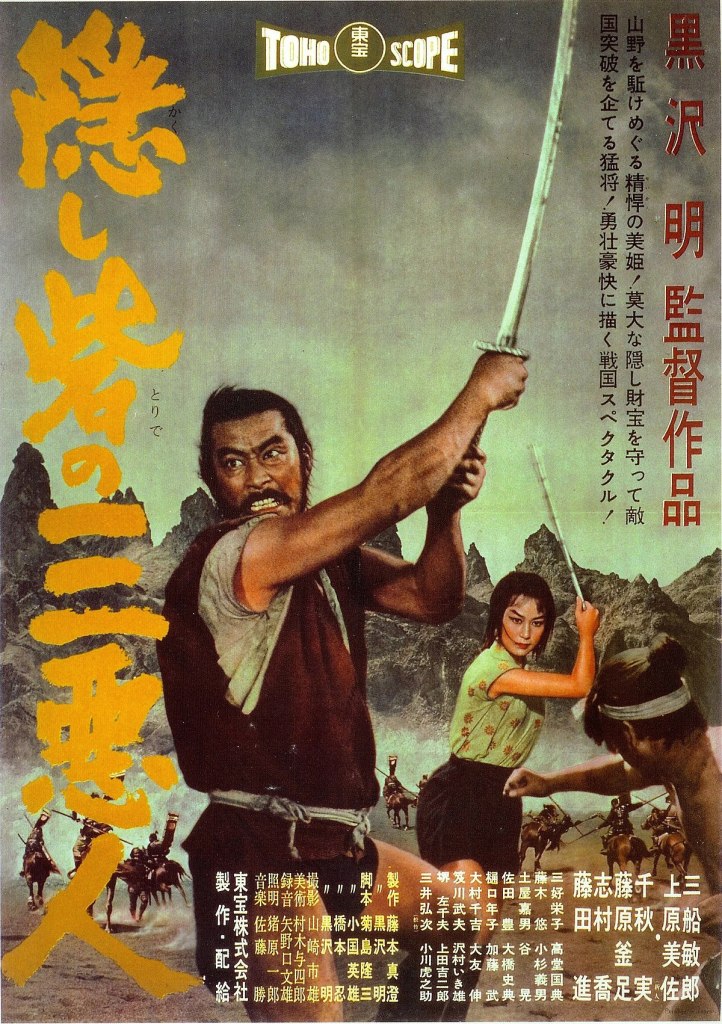
A princess hides in a castle from the wicked forces who have captured her kingdom. Her only hope is a noble general who has concealed the kingdom’s gold in bundles of wood, hidden in a lake at a mysterious castle. The general needs to get the gold and the princess through miles of hostile territory, with only a pair of greedy, incompetent peasants to help. This fairy tale structure is spun by Kurosawa into a samurai action-adventure with Mifune (inevitably) as the general, Misa Uehara as the Princess and Minoru Chiaki and Kamatari Fujiwara as the peasants. It’s good fun, overlong, but an entertaining ride – and one now best known now for its influence over Star Wars.

Kurosawa, after pouring his heart and soul into Throne of Blood, needed to relax. He decided it was time for an entertainment, something to please the crowds. The Hidden Fortress is certainly that, Kurosawa’s first film shot on impressive widescreen Tohoscope, with plenty of horse-bound action and swordplay. It’s really a Kurosawa Westerns, with heroes on the trail on a mission with bad guys to foil. But, as is sometimes the case with Kurosawa, it’s length and scope frequently makes it feel slightly indulgent, while it’s mix of comedy and drama doesn’t always sit comfortably together.

The Hidden Fortress is though highly cinematic. As well as Kurosawa’s enjoyment of the wide-angle lens – soaking up the slopes of Mount Fuji, often rolling in a beautiful mist – it frequently employs Kurosawa’s love of fast-editing tricks, in particular fast wipes to move us seamlessly from one place and time to another (one of many flourishes that influenced George Lucas who made these Kurosawa wipes internationally famous). A horse charge, where General Makabe chases down the samurai hunting them, is a grippingly frenetic with its pace and energy.

Kurosawa mixes this with comedy, though his unusual POV characters. In another move cited by Lucas’ as the inspiration for C3PO and R2D2, much of The Hidden Fortress takes place from the perspective of its peasant sidekicks. But, unlike the genial droids, Tahei and Matashichi are greedy, cowardly and selfish, frequently proving themselves untrustworthy. But, then in a touch of social commentary, perhaps they don’t owe anything to a general who treats them as slaves and (initially) plans to kill them once they are no longer useful. They are played with energetic larger-than-life force by Minoru Chiaki and Kamatari Fujiwara that contrasts neatly with the gruff authority of Mifune.  

It’s them we follow from the start, feuding over robbing the body of a slain samurai before being flung into the slave mines of the Princess’ former kingdom. One of Hidden Fortress’ gently played themes is the class difference between these two sons-of-the-soil and the upper-classes they (reluctantly) serve. For starters, that service comes with no choice – it never occurs to Makabe that they have a say in the matter – and they are told almost nothing about the purpose of their journey. They are instead tools for a higher purpose, just as the Princess’ similar-looking maid is sent to town to be captured and executed, to help protect the bloodline of the royal family.

It’s an attitude the Princess – well played by Misa Uehara as a stubborn young woman, full of righteous indignation at her restrictive office – comes to deplore. She, unlike anyone else among the elite, questions the idea of the poor as unimportant puppets for their betters, and it is she who is drawn to protect people, including a mis-treated prostitute who she insists Makabe buys the freedom of. It’s also she – more than anyone else, including the two peasants – drawn towards the anarchic Fire Festival they encounter, with its dismissal of worldly goods and embracing of enjoying life. But, perhaps Kurosawa’s point is it’s only the wealthy who can afford to indulge themselves with such thoughts: peasants have far fewer options and no choice but to scrabble in the dirt for coins.

This social commentary would perhaps be more widely discussed if the film had kept Kurosawa’s original title, Three Bad Men in a Hidden Fortress: a title that tips Tahei, Matashichi and Makabe into the same morally ambiguous pot, all obsessed with worldly needs (money or the continuation of the royal house) over any concerns about those around them. But, somehow, it’s easier to focus on the wheedling greed of the peasants, and overlook the lofty cold distance of the general, because he’s a noble guy, brave and daring who spares his opponent after a fair duel.

It’s also because The Hidden Fortress is less focused on these elements – Seven Samurai did the snobbery of the samurai class and the mixed motives of the working classes more effectively in any case – and more on being a rollicking, road-movie entertainment. It’s Western-style (in both ways) misfit band adventures, features expertly filmed action set-pieces. Best of all the previously mentioned chase, and a gripping one-on-one duel between Rakabe and his rival General Tadokoro (a fine performance of quiet dignity from Susumu Fujita), that is edge-of-the-seat in its mix of graceful camera work and exciting sword play.

The Hidden Fortress is entertaining, but it’s hard to escape the feeling there is too much of it. Despite not being as long as Seven Samurai, it feels less forceful narratively, largely features less compelling characters and is less well balanced between depth and action. Its plot feels almost deliberately lightweight and the resolution feels rushed. The film’s fairy-tale simplicity really needs a relatable hero at its heart – but the focus on the sometimes irritating peasants means we don’t get that. Fundamentally, The Hidden Fortress is an adventure story from a director, taking a rest from more complex work. It entertains, but feels like it lives in the shadow of other films, even before its connection to Star Wars turned it into a footnote in another film’s story.
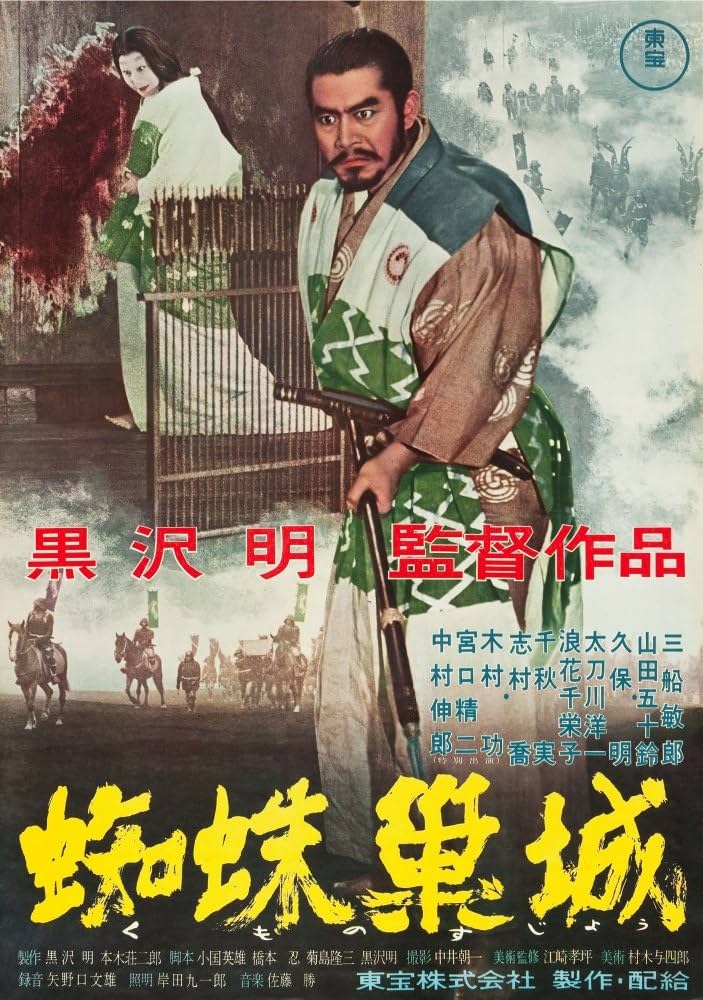
Throne of Blood (1957)

Throne of Blood (1957)

Kurosawa’s Macbeth adaptation beautifully captures much of the spirit of Shakespeare

Director: Akira Kurosawa

Cast: Toshiro Mifune (Taketoki Washizu), Isuzu Yamada (Lady Asaji Washizu), Minoru Chiaki (Yoshiaki Miki), Takashi Shimura (Noriyasu Odagura), Akira Kubo (Yoshiteru Miki), Yōichi Tachikawa (Kunimaru Tsuzuki), Takamaru Sasaki (Lord Kuniharu Tsuzuki), Chieko Naniwa (Forest witch)

Shakespeare is universal. What more proof do you need, than to see Macbeth very much present in Throne of Blood, Kurosawa’s samurai epic version of the Bard’s Scottish play. Kurosawa’s film takes the plot of Shakespeare’s tragedy, with touches of Japanese Noh theatre, told with his distinctive visual eye. It makes for truly great cinema, one of Kurosawa’s undisputed masterpieces – even if it loses some of the greatness of Shakespeare along the way.

You can though see Shakespeare from the beginning in Kurosawa’s mist filled epic (bringing back memories of the Scottish Highlands). A badly-wounded soldier brings news to Lord Tsuzuki (Takamaru Sasaki) of the defeat of his traitorous former friend thanks to the brilliant generalship of Washizu (Toshiro Mifune). Meanwhile, in the forest, Washizu and his fellow general Miki (Minoru Chiaki) encounter a witch (Chieko Naniwa) who prophesies that Washizu will one day be the Lord. When other prophesies proof true, Washizu starts to think how he could make the last true as well. His ambitions are encouraged by his wife Lady Asaji (Isuzu Yamada), who persuades him murder is the best tool for succession. But can they live with the consequences of their crime?

So much, so Shakespeare right? Throne of Blood ingeniously translates Shakespeare’s plot to an entirely different setting, one of feudal Japan. It also translates some of the Bard’s most striking verbal imagery into visuals: the strange mixture of rain and sunshine (‘so foul and fair a day’) that Washizu and Miki wade through before they meet the witch; Miki’s horse thrashing wildly through the courtyard like Duncan’s; the lamps that light the way to Tsuzuki’s chamber (like Macbeth’s dagger). Kurosawa’s visual transformation of the play’s imagery is breathtakingly original.

On its release Throne of Blood was savaged by Western critics for its cheek, before critical consensus shifted to proclaim it one of the greatest of all Shakespeare adaptations. But do you still have Shakespeare without the language (and by that, I don’t mean from English into translation, but its complete removal). Kurosawa’s film makes no attempt to replicate the poetry of Shakespeare (most strikingly, its equivalent of the “Tomorrow and tomorrow and tomorrow” speech is Washizu shrieking “Fool! Fool” as he sits in frustration, a neat image but one where you’d wish Mifune had been given more to play). But Throne of Blood may not be a complete Shakespeare adaptation, but it’s possibly one of the greatest adaptations ever made of a Shakespeare story.

This is because Throne of Blood captures so many of the core thematic concepts of Macbeth, not least its destructive, nihilistic force and the terrible, crushing burden self-imposed destiny and ambition sets. Toshiro Mifune’s Washizu may more of a brute than Macbeth, but his blustering, aggressive exterior hides a weak man, insecure and dependent on others. His weakness is in fact a lack of imagination, his inability to picture a life outside of the tracks laid down before him by the witch. His lack of independent thought is recognised by his wife, Asaji who nudges and pushes Washizu in the direction she (and he, deep down) wishes at every opportunity.

Washizu is soon trapped in a cycle of murder and disgrace he can’t escape. The walls of the room where he and Asaji plot the murder of Lord Tsuzuki is still smeared with the blood from the seppuku of its former owner who also betrayed Tsuzuki. Whenever he enters the forest, Washizu seems almost wrapped inside its branches, unable to find his way. Before a dinner to host the murdered Miki, Washizu listens (like Claudius) to a noh actor recount details of a crime all too similar to his own. As Lord, Washizu cowers powerlessly in it just as its previous owner did. Even the film itself is a grim cycle of the inevitability of destruction: Kurosawa’s open mist rolls away to reveal a monument to the castle before the castle itself emerges to take its place, the film returning at its end to the same mist-covered monument. These bookends also stress how transient (and pointless) this grappling for power is – nature will eventually claim all.

But it also suggests a world where death is so inevitable, that you might as well seize what power you can when you can. Even Miki – the film’s finest performance from Minoru Chiaki, full of subtle reactions of resignation and disgust – turns a blind eye (despite his sideways glances of disgust at key moments) to Washizu’s crimes, to further his son’s promised hopes for the throne. Asaji is motivated by her belief that there is no sin in seizing what you can from our brief time in this world, firmly telling Washizu that not only is it his duty to deliver the prophecy but – in a world where Tsuzaki gained power by murdering the lord before him – he would hardly be the first and that no previous killer trusts a potential new rival in any case.

Asaji is strikingly played by Isuzu Yamada, a quiet, scheming figure who sees everything and has an inner strength her husband lacks. Like Mifune, she uses the striking poses of Noh theatre to fabulous effect – Asaji herself moves, on the night of the murder, in a noh dance craze – and to communicate the dance of power between them throughout that long night. Kurosawa also uses silence beautifully with Asaji, most strikingly of all her silent, almost supernatural, collecting of drugged saki for Tsuzaki’s guards: as she walks into, disappears into darkness, then reappears carrying the drink all that is heard is the squeak of her robes across the floor. Yamada’s controlled, Noh-chill makes her brief collapse into futile hand-washing madness all the more striking.

After the long night of the murder, Kurosawa presents a world that grows more and more uncontrolled. In a brilliant innovation, Asaji provokes the murder of Miki by lying (perhaps?) about being pregnant, making Washizu desperate to protect the chance of a royal line. Miki’s murder leads to his terrifying pale ghost silently challenging an increasingly wild Washizu, who thrashs weakly around the room seemingly without any control. Mifune’s powerfully gruff Washizu becomes increasingly petulant and desperate, lambasting his troops and clinging to the letter of the prophecies rather than their more detailed meaning. Mifune’s striking poses – inspired by noh theatre – seems to trap him even more as hyper-real passengers in a pre-determined story. If Kurosawa’s adaptation has rinsed much of their complexity out, he firmly establishes the couple at its centre as trapped souls in an inescapable cycle.

Kurosawa innovates further by introducing a sort of Greek chorus of regular soldiers, ordinary warriors under Washizu’s command whose faith in their commander (they clearly know he murdered Tsuzaki) shrinks as Washizu’s grip on the situation fails. Washizu clings to belief in his invulnerablity – even after the prophecy about the impossible circumstances needed for his defeat (as if a forest can ever move!) is told to him in a fit of mocking laughter by the androgynous witch and a string of suspicious woodland spirits.

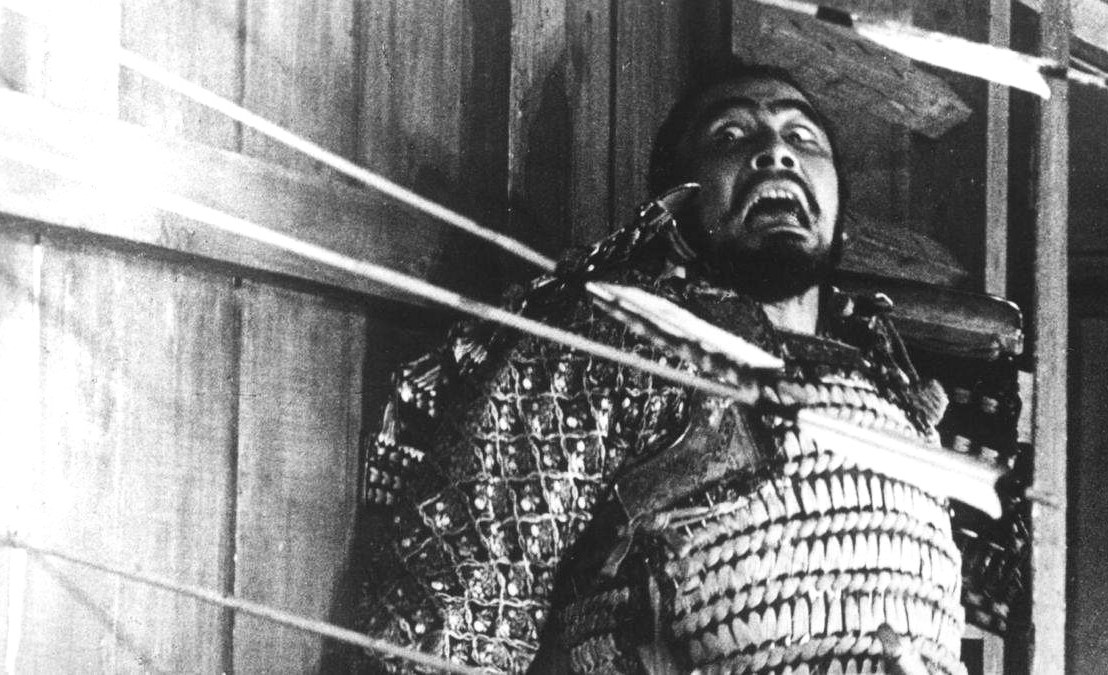
It culminates in Washizu instigating his own destruction, bragging to his men about the obscure circumstances that will lead to his defeat – leading to his own disillusioned men fragging the panicked lord the second the situation comes to pass. Kurosawa’s ending is visually extraordinary, Washizu pierced with so many arrows he resembles a human porcupine (Mifune’s terror was real, the actor dodging real arrows). Just as Asaji collapses into madness, Washizu’s fate is ignoble – Kurosawa doesn’t even afford him Macbeth’s brave duel against Macduff, this great warrior instead going down without so much as inflicting a scratch on Throne of Blood’s Malcolm and his forces.

Throne of Blood focuses beautifully on some (not all) of the key themes in Macbeth. It presents a fatalistic world where choices are few and the deadly cycle of death never seems to stop. Kurosawa interprets this all beautifully, transferring Shakespeare’s verbal imagery into intelligent, dynamic imagery. Sure, in removing the text it removes the core thing that makes Shakespeare Shakespeare – and also leads to the simplifying of its characters, in particular its leads who lose much of their depth and shade. But as a visual presentation reinvention of one of Shakespeare’s stories, this is almost with parallel, a triumphant and gripping film that constantly rewards.

Seven Samurai (1954)

Seven Samurai (1954)

Superb, archetypal action-adventure men-on-a-mission film: Kurosawa’s masterpiece, brave, bold and thrilling film-making

Director: Akira Kurosawa

Cast: Toshiro Mifune (Kikuchiyo), Takashi Shimura (Kambei Shimada), Daisuke Katō (Shichirōji), Isao Kimura (Katsushirō Okamoto), Minoru Chiaki (Heihachi Hayashida), Seiji Miyaguchi (Kyūzō), Yoshio Inaba (Gorōbei Katayama), Yoshio Tsuchiya (Rikichi), Bokuzen Hidari (Yohei), Yukiko Shimazaki (Rikichi’s wife), Kamatari Fujiwara (Manzō), Keiko Tsushima (Shino), Kokuten Kōdō (Gisaku)

I’ve often been a Kurosawa sceptic. But it’s hard to stay critical, when he made a masterpiece as near perfect as Seven Samurai. It’s one of those films that is long (the favoured cut is nearly three and a half hours) but never once drags. Kurosawa directs with such intelligence, skill and pace, you can’t help but be swept up in it. It’s one of the finest action epics ever made, but also has a rich vein of sadness and melancholy. After all, the samurai may fight the good fight, but they always lose.

In the sixteenth century, a farming village is under-threat from a bandits, rogue samurai turned ronin, who plan to steal the harvest. To protect themselves, the village elder (Kokuten Kōdō) declares they need samurai of their own (and since the farmers have little to offer, they better “hire hungry samurai”). They recruit a team of seven, led by experienced Kambei (Takashi Shimura), who accepts out of nobility. Among the team is wild-card peasant-turned-wannabe-Samurai Kikuchiyo (Toshiro Mifune). The seven arrive in the village and prepare for battle: but, even when working together, no one ever completely forgets the rigid societal boundaries of Japanese culture.

Seven Samurai is a wonderful character study, a sublime action film and complex and engaging exploration of Japanese history and society. It also has a perfect three act structure, it’s run time expertly divided into the samurai’s recruitment, preparation and defence of the village. This careful construction counters that epic run time – each act tells an almost self-contained story, meaning the film’s momentum never slackens.

It’s bought together by a director making a perfect fusion between Japanese cinema and his American and European influences. Kurosawa had never been shy about his admiration for directors like Ford and Hawks. You see elements of cowboy flicks throughout: from the set-up of the villagers as homesteaders, the samurai as the cavalry and the rogue ronin as the Indians, down to sweeping camera shots and vistas straight from Ford (the kinetic energy of Stagecoach is surely an influence). His Western influences always made Kurosawa more digestible than (for example) Ozu.

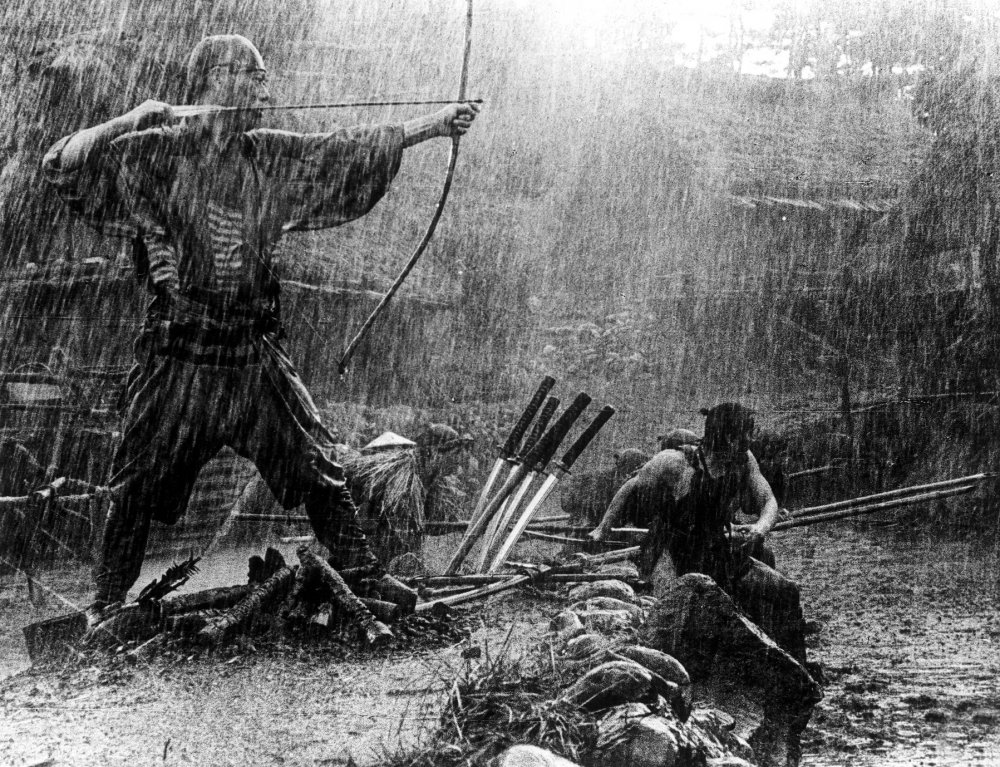
Seven Samurai is an also electric employment of Eisenstein style techniques of skilful editing, dissolves, fast cutting and an embracing of the language of cinema. Kurosawa accentuates action with slow motion: when Kambei dispatches a bandit (in his superb introduction scene), the body falls seemingly forever, death building in impact. Zoom cuts introduce locations, bringing us closer and closer to events. Kurosawa shot the battles with three cameras (a master and two roving cameras) allowing him to capture the kinetic action of his rain-soaked finale. Brilliant montages introduce concepts, characters and themes. It’s a masterclass.

It’s also masterful at quickly sketching character. We know from his first introduction – a brilliant cold-open fifteen minutes or so into the film – that Kambei is a man of both shrewd tactical awareness and puts duty before superficial pride, by his willingness to shave his hair so he can pass as a monk to rescue a child. (The gasps of those watching say it all at this willing acceptance of a cultural mark of shame). Kyūzō is introduced duelling with wooden swords. Why don’t we swop to real blades says his opponent: because you’ll die, Kyūzō matter-of-factly describes, his matter-of-fact bluntness and lack of bragging backed up by his immense skill when the chap dies seconds later. Gorōbei’s shrewdness is shown by the ease he dodges Kambei’s ambush test, just as Kikuchiyo’s rawness is when he blunders straight into it (and promptly loses his temper). Little moments like this abound, in a film stuffed with clever character beats.

The film presents a Japanese culture where concepts of honour and self-sacrifice sit awkwardly alongside regimented hierarchical and societal rules. The samurai can’t help but look down on the peasants – even while they see it as their duty to protect the weak. The villagers, in turn, look at the samurai as barely-to-be-trusted potential oppressors or dangerous parasites who steal their land and daughters (or both). Much of the film’s second act, as the samurai train the villagers to resist the attack, is about these two communities learning to respect each other. But it’s a tenuous alliance, held together by circumstance: when the dust settles, the surviving samurai are no longer welcome.

The samurai are a dying breed. Kambei knows the future belongs to people who provide industry and food. Samurai principles of honour and duty, pride in their skill, is also increasingly irrelevant in a world where the gun decides conflict. The ronin have three rifles and these deadly weapons are no respecter of skill or honour (none of the seven are bested in conflict, but all who fall do so to a bullet). Perhaps this is why the samurai cling to their principles and their honour. They know the world they knew is dying away and that there may be no place for them in the new.

This conflict is given a human shape by Kikuchiyo. Played with an electric, charismatic wildness by Toshiro Mifune (allowed to let rip, he’s a breath-taking explosion of jagged movements, eccentric line deliveries and unbound energy), Kikuchiyo is neither peasant nor samurai. Bought up from working stock – carrying stolen papers of nobility to try and pass himself off as samurai – he’s also rejected by his farmer peers for his warrior status. This makes him a character who can expose hypocrisies on both sides: denouncing the farmers pleading for help but cowering from the samurai; then angrily arguing samurai selfishness and pride have left the peasants with little choice but to horde food and riches to survive.

Not that Kurosawa is shy of admiration for the samurai. Yes, the flaws of their class are exposed – and we see more than enough their potential for arrogance, pride and violence. But the seven also contain a collection of their best traits. Takashi Shimura is brilliant as Kambei: selfless and honourable who takes on the task to honour the peasant’s offering all they can (however little that be). Heihachi (played by an ebullient Minoru Chiaki) represents generosity and warmth. Kyūzō (an enigmatic Seiji Miyaguchi) is awash with self-effacing warrior skill, shrugging off his feats with simple matter-of-fact statements. Shichirōji and Gorōbei are loyal and thoughtful warriors, Katsushirō (a charming Isao Kimura) a decent man eager to prove his worth. These are the best of their class.

They’ll need to be to win in this desperate action. Their preparation carefully outlines the obstacles facing to defence of this village – and to corral the villagers to defend their property. Houses outside the village walls are abandoned (Kambei seeing down a near rebellion on this, with threats of immediate justice), a raid on the ronin’s base aims to reduce their numerical advantage, the difficulty of turning the terrain against superior numbers repeatedly made plain. Kurosawa’s visual storytelling means the action when it comes is not only captivating, but completely understandable.

And what action. Seven Samurai can take its place on any list of the greatest war films ever made. The final hour features attack-after-attack on the village, interspersed with raids, skirmishes and derring-do. Both Kyūzō and Kikuchiyo take solo missions out of the village, though Kikuchiyo’s hunt for glory, even while he captures a rifle, leaves part of the wall undefended and leads to tragedy (Kambei is furious at this failure in discipline). It culminates in a rain-soaked final stand, shot with an all-absorbing power and engrossing kinetic energy.

The samurai sacrifice much for the village. But for what thanks? A peasant disguises his daughter as a boy, because he assumes, if discovered, the samurai will instinctively rape her. When the ronin don’t arrive as expected, the peasants grumble that the samurai are eating more than their fair share. As the samurai fall, their deaths are marked with a decreasing lack of notice (the final deaths don’t even gain on-screen funerals). With victory assured, the peasants return to their crop and don’t even lift a hand to wave the samurai goodbye.

It seems like poor reward for people who have sacrificed so much. But then that’s part of the point Kurosawa is making. Some samurai chose honour. Some choose the opposite. But they are always relics of a feudal system that is being left behind by events and the modern world. Its not just guns that will take them eventually. It’s a sadness that adds an even richer vein to this gripping, superb action drama. Kurosawa’s films may have flaws – but he doesn’t put a foot wrong in Seven Samurai.