
Tag: Missi Pyle

The Artist (2011)

Jean Dujardin and Bérénice Bejo delight in the light, frothy, charming Best Picture winner The Artist

Director: Michel Hazanavicius

Cast: Jean Dujardin (George Valentin), Bérénice Bejo (Peppy Miller), John Goodman (Al Zimmer), James Cromwell (Clifton), Missi Pyle (Constance), Penelope Ann Miller (Doris Valentin), Malcolm McDowell (Butler)
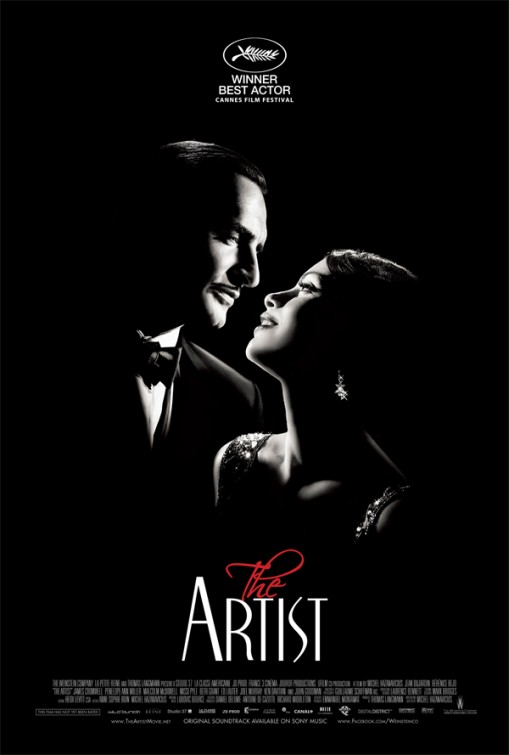
In 1920s Hollywood George Valentin (Jean Dujardin) is King of the Silver Screen. Why would he want anything to change? Surely these ‘Talkies’ are just a passing fad, right? Ooops. Before he knows what has happened, Valentin has gone from top of the world to the very bottom, left behind (like so many real-life silent stars) by change. Meanwhile, Peppy Miller (Bérénice Bejo), the young extra from his glory days whom Valentin briefly mentored, become a star of the Talkies. But Peppy still loves Valentin – and maybe he loves her – even while Hollywood pulls them apart.

Plot-wise, The Artist is pretty conventional. What really makes it stand out is that it’s a silent film about silent film. Perhaps that’s why the whole world went gaga for it (gifting it five Oscars, including wins for Hazanavicius, Dujardin and the Big One) – it was a genuine burst of nostalgia-tinged novelty. Everything old is eventually new again: I remember the novelty myself – sitting in a cinema and suddenly, after the music stops, hearing nothing but silence. Match that with the undeniable charm and energy the story is told with and, boom, you had a hit.

Does The Artist survive repeated viewings? Just about – though it looks increasingly like a slight film, that raises warm feelings but makes little lasting impact (I was surprised how much of it I had forgotten). Hazanvicius’ study of silent cinema has clearly been thorough, and this is undeniably a wonderful love letter to Hollywood’s history. Every technical detail is carefully reproduced, and the pastiche Fairbanks-style adventure stories Valentin stars in is spot on. The actors fully embrace the slightly exaggerated mannerisms of silent acting, telegraphing emotions with urgency.

Hazanvicius uses sound, when it comes, brilliantly. The opening of the film is bathed in music as we watch the premiere of one of Valentin’s films – only for all the sound to drop out the second the film-within-a-film ends. (We even see a “Silence behind the screen” sign before it does). We only hear everyday sounds twice – once in a hilariously haunting dream of Valentin’s where objects make noise but he cannot – and at the end of the film as Valentin finally finds a place in Talking Hollywood. Other than that, it’s scores, speaking cards (some of them witty, like Valentin’s wife’s question “Why do you refuse to talk?”) and all the style of silent cinema.

It’s a sweet and gentle film. There is no trace of the ruthless business Hollywood is, and not a trace of the darkness that touched many of this era. There is never any prospect of Valentin turning into, say, Sunset Boulevard’s Norma Desmond or any of the other washed-up waxworks in her house of broken dreams. Valentin loses everything, but remains a generous and decent guy, firing the loyal chauffer he hasn’t paid in a year (and giving him his car for free!) because otherwise he’ll never leave him. And of course, his dog loves him, so he must be a great guy. (The dog by the way was the break-out star, this charming, brave canine even getting a campaign for best supporting actor).

The film centres a love story between Valentin and Peppy. The two of them have an instant connection – but Valentin is the star, with Peppy the ingenue. This bond can survive nearly everything, even while Valentin resents her success. Hazanavicius manages to make this very sweet, even though Peppy is sometimes tediously saintly in her devotion. Valentin may have mixed feelings about his protégé – but in a housefire, the only thing he saves is footage of the two of them messing around in outtakes from one of his old films.

The film seems unbothered as well by the fact that Valentin is married. The wife (a thankless role for Penelope Ann Miller) doesn’t get a name, let alone any sense of a personality other than (it seems) being some sort of shrew.

You could also see Peppy, if you wanted to be uncharitable, as a bit of a stalker. She buys up (by proxy) all of Valentin’s goods when he goes broke, practically abducts him from the hospital after he is caught in a fire, hires his staff. Tip your head to one side and you can see her boiling a few bunnies. The Artist though sees her as more of a “Guardian Angel” (as per the title of one of Peppy’s movies) – and you can argue that there is something old-fashioned (not always in a good way) about a film where the female lead defines her success only by how it can help the man she loves.

The tinge of creepy to the Valentin-Peppy relationship isn’t helped by using a huge chunk of the Bernard Herrmann Vertigo score to underscore the film’s conclusion, not to mention the left-field melodrama of Peppy racing across town to prevent Valentin from committing suicide (motivated it seems by realising Peppy is his Guardian Angel). It’s an odd mis-step – and the sequence not only feels radically different from the rest of the film, it also seems to heavy for such a light confection.

But, negatives aside, it’s a decent little film. Jean Dujardin is the epitome of charm and old-school Hollywood wit as Valentin – it’s a master-class in physicality and he oozes matinee idol cool, and a certain boyishness. Bejo is very good as the well-meaning, kindly Peppy. The film is a puff of air, and once you get over the novelty, you’ll be amazed how little there is to it. But it’s told with such energy, charm and nostalgic wit (and ends with a lovely dance routine) as well as affectionate nods to old-school Hollywood, you won’t mind too much, even if you’re surprised it won as many awards as it did.
Gone Girl (2014)

Rosamund Pike is the Gone Girl leaving husband Ben Affleck in a difficult mess

Director: David Fincher

Cast: Ben Affleck (Nick Dunne), Rosamund Pike (Amy Elliott Dunne), Neil Patrick Harris (Desi Collings), Tyler Perry (Tanner Bolt), Carrie Coon (Margo Dunne), Kim Dickens (Detective Rhonda Boney), Patrick Fugit (Officer James Gilpin), Missi Pyle (Ellen Abbott), Emily Ratajkowski (Andie Fitzgerald), Casey Wilson (Noelle Hawthorne), Lola Kirke (Greta), Boyd Holbrook (Jeff), Sela Ward (Sharon Schieber), Lisa Banes (Marybeth Elliott), David Clennon (Rand Elliott)

In our modern media age, we’ve got massive expectations for how people are meant to behave. With so much of our perception of life filtered through the internet and films we’ve seen, we are reassured when we see behaviours we expect to see, and disconcerted when we see those we haven’t been trained to see. Not distraught enough at your wife going missing? Well you must have done it then!

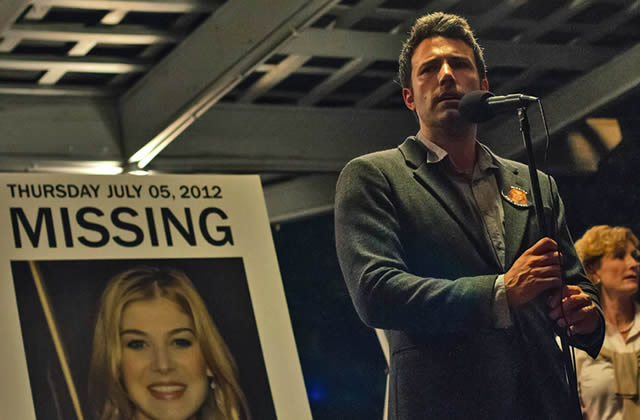
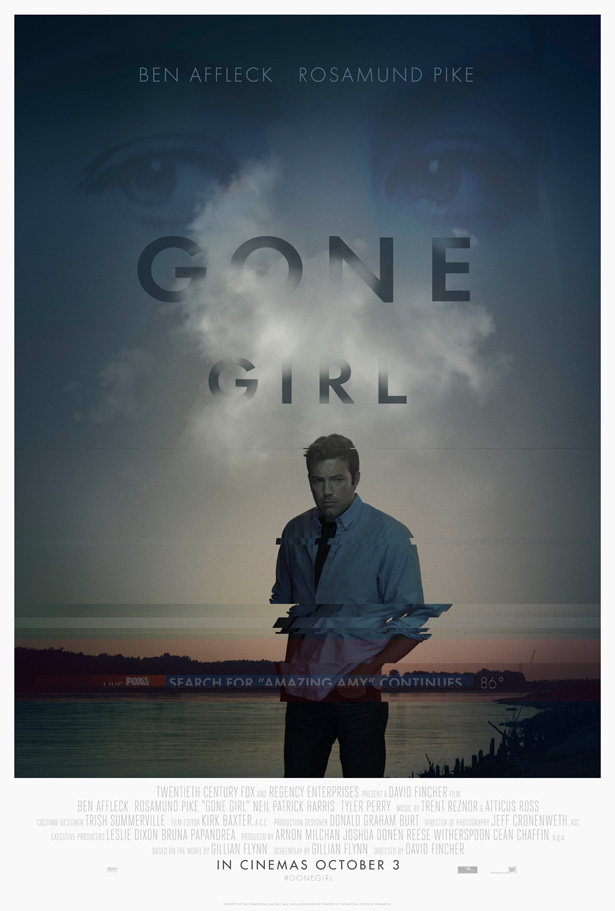
That’s the problem that faces Nick Dunne (Ben Affleck) in this chilling, intricate adaptation of Gillian Flynn’s best-selling book. Nick’s wife Amy (Rosamund Pike) goes missing in mysterious circumstances, possibly a kidnap, possibly a kidnapping gone wrong. The case becomes a media sensation, but the problem is Nick just isn’t expressive enough, won’t play the role of weeping husband. Instead he’s calm, distant and polite. So naturally rumour swirls that he did it – particularly after more and more manufactured evidence rears up to suggest he might have done. But does Amy have darker secrets than anyone might even suspect? Well to say any more would be a spoiler.

Fincher’s film is a tour-de-force of deliberately cold, polished looking perfection – which is designed to reflect back the surface perfection of the Dunnes’ deeply flawed marriage. Fincher’s film is in many ways a jet black social satire, using its almost outlandish shocks and twists to involve the audience in that “oh-no-they-didn’t!” way, in the same way that the Dunne media story fascinates the people in the movie.

“What have we done to each other?” Nick asks in voiceover early in the film, and it’s the question the film tackles obliquely: how much of the flashbacks to the relationship we see between Amy and Nick is real and how much springs from unreliable narration from Amy’s diary? Two handsome people living the American dream, but how much of it is an invented or projected narrative? Is their whole life a performance they are living for themselves and for others? Poor old Amy is even already semi-fictionalised person, a parents using her life as inspiration for a beloved children’s book character Amazing Amy.

So when Amy goes missing, the strain on Nick is very different from what you might expect. Rather than being consumed with grief, he feels wearied and dutiful about continuing a performance of a marriage which has long since ended. Nick’s actually too honest for this world – he won’t put on a show of how he is supposed to feel, he can only try not to make too much of a show of what he really feels. The mystery that builds around his and Amy’s marriage is born in this blunt honesty, of someone who won’t be what people want him to be. Of course that doesn’t stop Nick from being selfish or even a whiner.

Fincher mixes this intelligent commentary on society with, to be honest, the sort of bizarre extremism and bunny-boiling antics that make you unsurprised to hear he was inspired by Paul Verhoeven while making the film. It’s a film that shifts gears notably in the second half to become an increasingly gothic horror-thriller. A lot of this is powered also by Rosamund Pike’s excellent performance as Amy, a woman who seems almost completely cryptically unknowable, whose whole life has been a performance, and for whom taking on a series of roles and personalities is clearly not a challenge. Needless to say the person she turns out to be, and what she is capable of, is completely different from what the film leads you to expect.

It’s no surprise that a relationship featuring a person like Amy could go as south as the Dunnes’ has, but then Nick is hardly a saint either. Ben Affleck is just about perfect casting as a sort of All-American charmer gone to seed, a prickly fellow who wants privacy but also partly grows to enjoy the drama that surrounds him, once he works out the game he is playing. Fincher’s deliberately distant, smoothly clean-surfaced film frames modern day aesthetic perfection all round this seemingly dream couple.

The whole film is a nightmare vision of a love match gone wrong, of the after-effects of a beautiful story that has spiralled out into disappointment and everyday mundane life. And that struggle to keep the romance going in the familiar is at least something many of us can understand right? So it’s enjoyable to see that matched up with the freaky, semi-gothic blood and guts the film serves up in the second half, and the almost surreal Grand Guignol plot developments that power that half of the film (shot and scripted by Fincher and Flynn with a brilliant mixture of tension, horror and black comic delight at its extremity).

Like many Fincher films, there are several delightful performances. Pike is a revelation in a gift of a role, Affleck very good channelling his life lived in the spotlight. Carrie Coon is a stand-out as Nick’s exasperated, down-to-earth and loving twin sister. Kim Dickens is authorative and questioning as the police detective investigating the case, and Tyler Perry assured and cool as a hot-shot lawyer. Playing way against type, Neil Patrick Harris is pretty unforgettable as a slightly self-satisfied rich kid still holding a candle for Amy after all these years.

But the main success of the film is the whipper-sharp coldness of its execution, the cool tension Fincher ekes out of every moment, and the violent, Vertigo-ish obsession he gets out of every moment. Gone Girl works because it’s at first a chilling what-if story of a man in a media storm, which becomes a sort of black comedy so extreme that it pulls a delighted audience in to gasp at audacious characters getting away with outrageous things. As a black comic thriller it’s delightful.rela