
Engaging but traditional biopic, very well-made and full of knock out performances
Director: James Mangold
Cast: Timothée Chalamet (Bob Dylan), Edward Norton (Pete Seeger), Elle Fanning (Sylvie Russo), Monica Barbaro (Joan Baez), Boyd Holbrook (Johnny Cash), Scoot McNairy (Woody Guthrie), Dan Fogler (Albert Grossman), Norbert Leo Butz (Alan Lomax), PJ Byrne (Harold Leventhal), Will Harrison (Bob Neuwirth), Eriko Hatsune (Toshi Seeger), Charlie Tahan (Al Kooper)

In 1961 Bob Dylan seemed to emerge from nowhere – or, if you like, from being A Complete Unknown – to become the big star of American music and the centre of a battle for the soul of American folk music. On one side, were the traditionalists – they loved Dylan’s thoughtful, lyrical ballads and use of guitar, harpsichord and other instruments. They believed Dylan could lead a whole new generation to traditional American music. On the other side were the modernists, inspired by rock and roll, and the new (electric) sound. A Complete Unknown is about Dylan’s – inevitable – journey towards exploring new music sounds, culminating in his strum-heard-around-the-world as he played an electric set at the Newport Folk Festival (to a mixed reaction to say the least).
That’s the meat of James Mangold’s traditional, but very well-made and enjoyable musical biography, a spiritual sequel to Walk the Line (with a decent, but drink-addled Cash here played by Boyd Holbrook). Much like that film, this tweaks and amends some historical facts, but manages to get close to the spirit of its subject all within a familiar biography set-up of early success, mid-way struggles and triumphant (of a sort) resolution. There is nothing in A Complete Unknown to surprise you but it’s still a highly enjoyable, very professionally assembled journey.
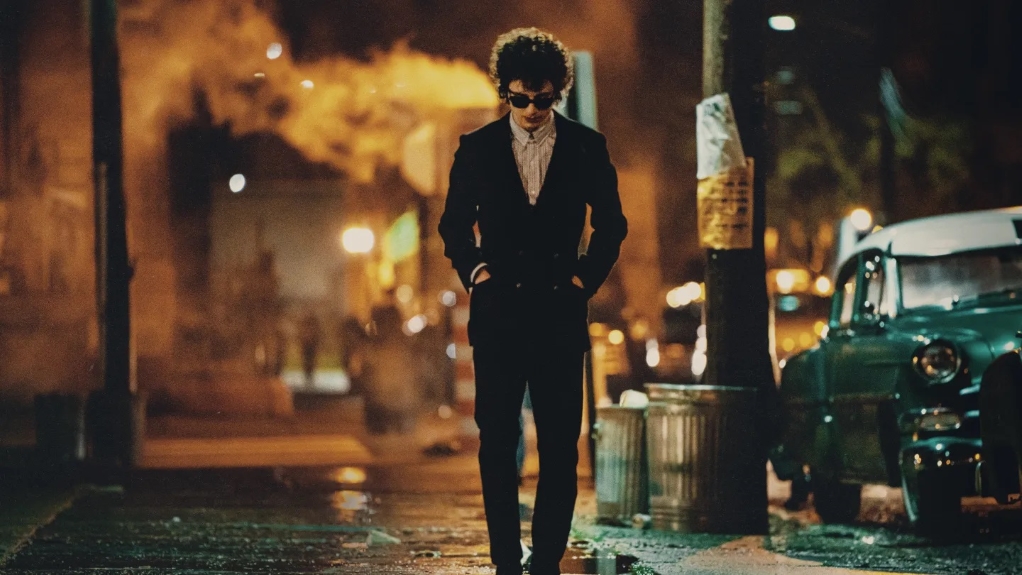
Its main success is the depth and insight with which it penetrates Dylan’s character. A Complete Unknown embraces Dylan’s enigmatic quality, not to mention his stubborn, relentless and obsessive focus on his music and the austere distance he can treat the world. This all comes across beautifully in Timothée Chalamet’s superb performance – not only a pin-point physical and vocal and impersonation, but also a soulful rendering of a poet who constantly pushed against being classified and categorised, bristling against ideas he should play certain songs certain ways.
The roots of the culture clash that will dominate the film are clear from the start when Dylan and Pete Seeger (Edward Norton) drive from visiting visited Dylan’s hospitalised idol Woody Guthrie (Scoot McNairy) and Dylan flicks through radio channels. Dylan finds interest in all the different music they encounter; Seeger smiles pleasantly and nods his head, but clearly can’t hide his patient disregard for the electric beats of rock and roll. It’s the platform for the surly discontent Chalamet so perfectly embodies as Dylan is expected to pigeon hole himself as a folk singer, who (as he puts it) stands with his acoustic guitar at a mic and sings Blowin’ In the Wind for the rest of his life. A Complete Unknown falls in love with Dylan’s passionate self-expression, his search for his own sound.
That search frequently makes Dylan a difficult person to spend time with. Awkward and hesitant with other people – Chalamet’s Dylan is constantly cautious about exposing too much of his inner thoughts and feelings – the poetic writer mumbles in monosyllables and responds to fame with a grudging disdain that seems him rarely remove his sunglass shield between him and the world. He has no interest in fame and is positively alarmed at adulation from strangers (there is a neat line when he is unrecognised by a street vendor and asked if he has kids to which he wearily replies ‘Yeah, thousands’). Match that with his ruthless determination to put his artistic calling above anything else, and you’ve got a man who verges on using other people.
It feeds into Dylan’s relationships. At his request, his girlfriend Suzie Rotolo is very-lightly disguised as Sylvie Russo, played with an emotional richness by Elle Fanning. The film skips the more difficult parts of their break-up – Dylan stated the only song he regrated was one he wrote about Rotolo’s abortion, calling himself a shmuck for doing so. But in doing so, the film steams off Rotolo’s contribution to Dylan’s writing and much of her own dynamic and interesting qualities. The original Rotolo, an artist, was an important sounding board: we don’t see a jot of that here, as she is repackaged into offering Dylan much-needed stability and security, dealing with movie-girlfriend insecurity about Dylan’s attraction to collaborator Joan Baez.
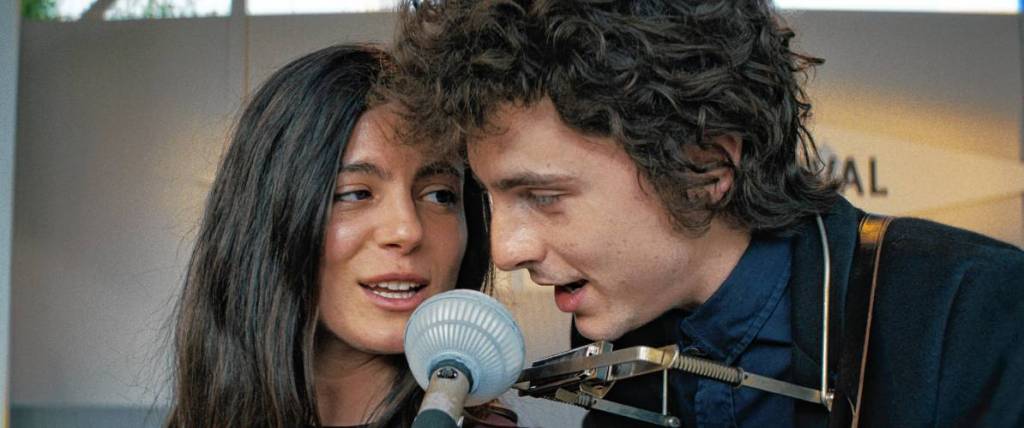
Dylan returns to Russo when he needs comfort at times of stress (from dropping in on her apartment – and waking her new boyfriend – late at night, to bringing her with him to the folk festival when he intends to turn electric) but Chalamet’s simmering self-focus makes clear Dylan at this stage can’t settle into a mutual relationship. It also comes between him and Joan Baez, played with dynamic charisma by Monica Barbaro, Despite their attraction and musical synchronicity, Dylan never sees her as a true artistic partner, even calling round one night for a booty call followed by private song writing using her guitar (she throws him out). On tour together, Dylan archly points out he writes the song and he leaves Baez hanging at a concert when he flat-out refuses to play the advertised favourites. The chemistry however is still there, within when it tips into aggression.
Dylan goes his own way, and if that means turning against surrogate fathers Peter Seeger and Woody Guthrie, then he will. A Complete Unknown features one of Edward Norton’s finest performances as a warm, tender and heartbreaking Pete Seeger (matched with a wonderful performance from Eriko Hatsune as Pete’s wife Toshi). Norton is brilliant at making Seeger – an environmentalist and gentle, accommodating advocate of folk music – a portrait of inevitable disappointment-in-waiting. There is a heart-rending moment where Norton beams as if all his dreams have come true as Dylan plays his first Newport festival: heart-breaking because we know Dylan’s next performance (where a guilty Dylan brusquely shrugs off Seeger’s gentle pleading to stay acoustic for just one more day) will see these dreams left in shattered pieces.
A Complete Unknown is a handsome, very well-mounted film from James Mangold, who has proved time-and-again that he can explore classic Americana with a freshness and energy few other directors can match. The film is perhaps overlong – probably due to the innumerable recreations of performances from Dylan, Seeger and Baez, all excellent but there are far too many – and it’s biopic approach is relentless traditional. But it’s filled with a parade of rich performances (with Chalamet outstanding), rolls along with energy, carries an emotional impact and will leave you engaged and entertained throughout.


 Movie Musings