
Tag: Morena Baccarin

Deadpool & Wolverine (2024)

Deadpool & Wolverine (2024)

Smug, tiresome gags underpin a shallow piece of fan-pandering that mocks fan-pandering

Director: Shawn Levy

Cast: Ryan Reynolds (Deadpool), Hugh Jackman (Wolverine), Emma Corrin (Cassandra Nova), Matthew Macfadyen (Mr Paradox), Morena Baccarin (Vanessa Carlysle), Rob Delaney (Peter Wisdom), Leslie Uggams (Blind Al), Aaron Stanford (Pyro), Dafne Keen (Laura), Jon Favreau (Happy Hogan)

Deadpool is Marvel Jesus. It’s a joke in the film, but it’s also kinda true. The MCU has struggled in the past few years and it’s hoping the raw-and-ready sociopathic, fourth-wall-breaking merc-with-the-mouth can give its fortunes a jolt. In terms of money take, Deadpool & Wolverine is, I guess, going to do that. In terms of creativity and imagination, we’re still circling the toilet bowl, but hey at least Feige and co are doing it while clutching a wadge of greenbacks.

You say Deadpool’s constant fourth-wall leaning jokes ain’t really funny and that all they do is point out (and neutralising criticism in advance) weaknesses in plot and writing: but that toilet bowl gag was a bit of a turd right?

Wade Wilson aka Deadpool (Ryan Reynolds) has been rejected by the Avengers on Earth-616 “The Sacred Timeline” (otherwise known as the one the MCU happens in) and returns to his friends on Earth-10005 (otherwise known as the 20th Century Fox X-Men Franchise timeline) to retire and work as a used-car salesman. Until he is grabbed by the Time Variance Authority and informed by Mr Paradox (Matthew MacFadyen) his universe is being erased, due to the death of its Anchor Being Wolverine (Hugh Jackman) in Logan. Deadpool’s only chance to save his universe is to find a new Wolverine, eventually pulling in “the worst Wolverine” who failed to save his world. Both are banished to “The Void”, a resting place for “erased” heroes from earlier timelines (aka cancelled movie franchises) run by Cassandra Nova (Emma Corrin), the insane sister of Charles Xavier.

You made that tough to follow on purpose, you absolute bell-end. Ain’t you funny!

Flipping heck. If you think that sounds like a lot going on, don’t worry: it hardly matters. For Deadpool & Wolverine the story is just a very loose framework for a series of slightly smug in-jokes about nineties and noughties nostalgia, and gags about corporate mergers. (In case you missed it, Disney bought 20th Century Fox and swallowed its comic book franchises like a money-Moloch). This matters an awful lot to some. Many others won’t care less. Deadpool & Wolverine very much tailors to the first group. If telling gags about Disney’s caution about jokes on drugs and anal sex, or riffing on the X-Men movies being less-and-less good over many years, sounds like your idea of comedy gold then this is for you.

Moloch and anal sex in the same paragraph – well-read show-off who wants to look cool ain’t ya?

Deadpool & Wolverine prunes a lot of comic mileage (or tries to) from mocking the “special sock” longings of geeks and fanboys, those who wile away hours debating who’s costume looked best or who could beat who in a fight. But this is a film mocking shallow, fanservice wank while itself being a massively shallow, fanservice piece of wank. If the only thing you felt was missing from Hugh Jackman’s previous Wolverine career was that he never wore the yellow-and-blue uniform, then this is the movie for you.

You were so pleased with that fanservice comment I saw you use it several times in Whatsapp hot takes. Twat.

Deadpool & Wolverine mocks fans for their shallow love for the obvious easy hit of seeing Deadpool and Wolverine fight, or a cameo from a well-known actor from an old movie or a celebrity playing a different version of a familiar character, then fills the film with almost literally nothing but this. Am I really meant to get excited seeing an actor revive a comic book role from a noughties superhero film we’ve forgotten and everyone at the time thought was rubbish? For all Deadpool & Wolverine wants to feel like something cheeky and dirty, it’s the safest slab of product out there. Every single thing in it feels like it has been cribbed from a fan’s wishlist on a Reddit thread. It feigns cocking a snook at Disney, but Deadpool is just an in-house jester: tweaking his master’s nose while taking a pay cheque and avoiding anything really pointed in his barbs. After a while you just get tired of it and the film’s embrace of cliché and retreads isn’t justified by Deadpool turning to the camera and pointing it out.

Getting up a head of righteous steam there ain’t you? Still paid to see it didn’t you! Sucker!

Still at least it’s better than when the film tries to have a heart. I’d respect it more if it was willing to make Deadpool a flat-out psychopath with no real sense of morals. Instead, he’s really all (very tiresome) talk, because Deadpool & Wolverine is desperate to turn him into someone the masses can find sympathetic by mixing his mook slaughter with emotive mooning over a group polaroid of the friends he’s trying to save from erasure from existence. Much like Ryan Reynolds’ performance, it often feels like filmmakers enjoying the shock quality of shrieking “FUCK” in a park, before running home to an early bedtime with their families.

Chickened out of writing the C-word there? Guess you don’t want to get blocked.

Deadpool & Wolverine opens with assurance it won’t ‘desecrate’ the legacy of Logan (an actual, good film with a proper story and emotional arc) – before, in one of the film’s better jokes, it has Deadpool dig up the skeleton of the dead Wolverine and use the bones to bloodily slaughter an army of TVA mooks. But then it desecrates it in a different, deliberate, even worse, way by ripping Logan off with shameless abandon. It gives Wolverine pretty much exactly the same plotline, including restaging almost identical emotional conversations, in almost identical locations. In fact, my overwhelming emotion watching Hugh Jackman snooze through this film with a growl was sadness that he came back after his perfect sign-off. But then I guess he get over a dozen million reasons to come back and prostitute himself here for one last runaround.

Like Deadpool doesn’t make that joke himself in the film – if you’re going to knock it, don’t rip it off!

Maybe he thought it was funny. It does feel like a home movie put together by a series of actors in their forties or fifties desperate to show their kids they can do something cool. Is there anything good in Deadpool & Wolverine? There are some good fights, even if Shawn Levy isn’t the best at staging them, but it does spray claret marvellously all over the place to well-chosen Madonna tunes. Matthew MacFadyen, essaying a cartoonish version of Succession’s Tom Wambsgans, is good fun, Emma Corrin makes an effective if under-used villain. There are some good jokes.

Because you gotta give some sugar right?

But the overwhelming air is smugness. None of the fourth-wall, franchise-teasing, corporate digs are that funny and very few of the asides carry any bite (several are about how handsome or muscular its stars are – the only remotely sharp comment is on Hugh Jackman’s divorce). Aside from that it offers nothing new or familiar, its setting is reminiscent of several other films, and it rips off plot galore from Logan and TV’s Loki show. Perhaps worst of all, in a year where an actually original and daring film Mad Max: Fury Road has fatally tanked at the box office, this openly rips off its location and style for The Void and it’s going to make millions.

It’s not as if you were even wild about Furiosa, but like the sanctimonious prick you are, you’ll give a pass to a film from an auteur but then knock a Marvel film. What makes you such a smug, humourless prick eh? Go with the fun!

Look for the last time, it’s not big, clever or funny to just milk some cheap gags out of anticipating the criticism. That’s enough. Fuck off now.

Touchy!

No seriously. Fuck off.
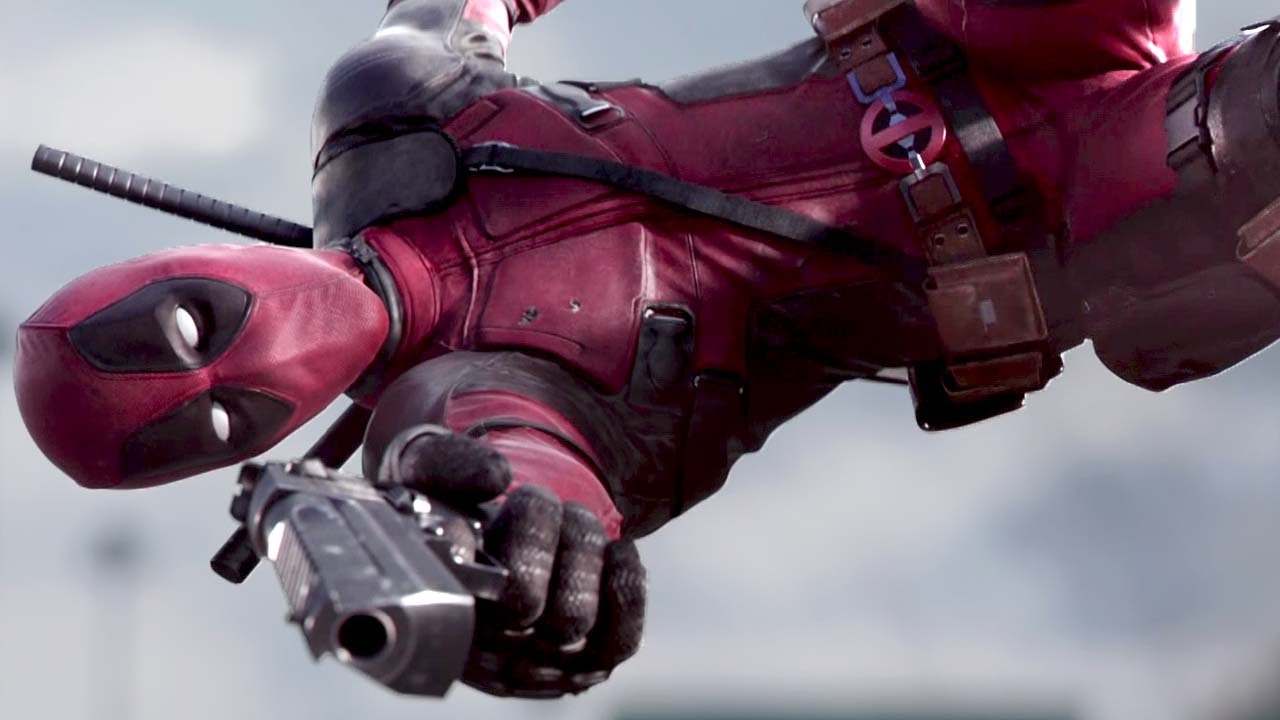
Deadpool (2016)

Ryan Reynold swings into action in slightly-pleased-with-itself comicbook satire Deadpool

Director: Tim Miller

Cast: Ryan Reynolds (Wade Wilson/Deadpool), Morena Baccarin (Vanessa), Ed Skrein (Francis Freeman/Ajax), TJ Miller (Weasel), Gina Carano (Angel Dust), Brianna Hildebrand (Negasonic Teenager Warhead), Stefan Kapičić (Colossus), Leslie Uggams (Blind Al)

One day (soon?) we’ll reach critical mass with comic book films. Eventually, when every single character who’s ever appeared in a frame of a DC or Marvel comic has appeared on the screen, we’ll surely wonder if we will ever see anything new again. Some may already feel this, so perhaps that explains why Deadpool, which, for all its faults, is a comic book film doing something different, made such a big impact.

Wade Wilson (Ryan Reynolds) is a mercenary who meets and falls in love with Vanessa (Morena Baccarin). Discovering he has terminal cancer, he leaves her so she does not have to watch him die, and signs up to a gruesome medical procedure designed to bring out dormant mutant genes that may cure him. It works but leaves him hideously deformed. Wanting revenge, he names himself Deadpool and hunts for a cure to his deformity – scared Vanessa would reject him without it.

What Deadpool does well is wittily flag up the familiar tropes of comic book movies. The film in fact follows each trope to the letter – but at least it has a foul-mouthed cheeky commentary. The big question you have to ask is, can a film really be that smart and different if it basically does something very traditional? If I tell you I’m going to perform a tired magic trick you’ve seen before, but I’ll do it while pointing up every single cliché of delivery, with panache, does it matter the magic trick is still as tired as I said it was at the start?

That’s what Deadpool is – the same old ideas, re-packaged in a different way, so juvenile and cheeky that for a beat or two it feels like something new, which it manifestly isn’t. It might not take itself seriously, but it also doesn’t really develop into something unique. The film opens with a neat comic riff on credits, listing not the actors but their generic character traits (“Love Interest”, “Brit Baddie”, “Comic relief” etc. etc.) – sure this is funny and smart, but doesn’t change the fact that the characters themselves are exactly that. 

Deadpool is a faux-clever film. It’s a cheeky piece of college humour: an X-Men film with swearing, sex, fourth wall breaking and gags about other films. There is a sort of witty enjoyment from Deadpool reminding us he knows he is in a movie. But most of the time, he basically behaves exactly like dozens of other lead characters in dozens of other films: he has an emotional arc of fear of rejection and embracing who he is that you’ve seen so many times before.

But the market is so saturated with films like this that the difference of presentation makes you feel for a moment you are seeing something new or clever – rather than essentially a very high budget, end-of-the-pier routine full of cheeky humour. Much of this is pretty funny by the way, but don’t kid yourself that it’s anything clever. And I don’t really think many of the gags here would stand up to repeated viewing – it’s basically just swearing and shocks. The writing is not great, its punchlines and shock beats giving the illusion of intelligent scripting.

Most of its success (in more ways than one) comes down to Ryan Reynolds. Reynolds campaigned for the film to be made for nearly a decade, and he totally nails the character. He thought up many of the best gags, and delivers the entire thing with whipper-snapper quickness and likeability. He gets the balance generally just right, and lands all the film’s big laughs. He’s very good.

But it’s an elevation of material that plays at being clever, while really just being an effective repackaging of the same-old, same-old. Remove the jokes and everything you would expect from a superhero origins story is present and correct. 

So maybe everyone was a little tired of the same old, same old from Marvel et al and wanted something different. That’s the explanation I can think of for why a pretty average film ended up so damn popular. The action when we get it is pretty good, there is some imagination behind the cameras, but it’s basically a teenager’s idea of the best film, like, ever rather than an actually very good film. It’s not reinventing the wheel, but it puts a nice shiny new tyre on it.

Spy (2015)


Melissa McCarthy takes on the bad guys in actually rather funny comedy Spy

Director: Paul Feig

Cast: Melissa McCarthy (Susan Cooper), Jason Statham (Rick Ford), Rose Byrne (Rayna Boyanov), Jude Law (Bradley Fine), Miranda Hart (Nancy B. Artingstall), Bobby Cannavale (Sergio De Luca), Allison Janney (Elaine Crocker), Peter Serafinowicz (Aldo), Morena Baccarin (Karen Walker)

Comedy is an unusual thing to write about, I often find. Unlike any other film genre, you know immediately whether it works or not, ‘cos if you ain’t laughing it probably ain’t working. Well the good thing is that Spy does work, as I certainly laughed. It’s actually a fairly well structured comedy, a smart parody of Bondish action films matched with the foul-mouthed crudity you get in the films from the Feig/Apatow stable.

Susan Cooper (Melissa McCarthy) is the cheery deskbound analyst who provides real-time data and intel to would-be 007 Bradley Fine (Jude Law). But after disaster strikes, Susan volunteers to go into the field to find out as much as she can about Rayna Boyanov (Rose Byrne), the daughter of a rogue arms dealer who is taking over the family business. Despite the concerns of her boss – and super-macho fellow agent Rick Ford (Jason Statham) – Susan proves surprisingly adept at espionage, disguise and above all action.

What Spy does well is that it feels like it’s been written and shot with a bit of discipline, rather than the over-indulged and forced “improvisation” that so often blights these sort of comedies. It feels more controlled, and therefore easier to engage with – we are watching a group of good actors tell a story, rather than a gang of comedians showing off. I think this is helped by the fact that most of the cast are not natural comedians, but instead actors delivering gags with skill. Feig also shoots the film with zip and punch – most scenes don’t drag on indulging forced banter.

Melissa McCarthy is very  good as the rather sweet lead, torn between the role she has given herself in life, and her own desire to use her capabilities. Her character delivers many of the comic moments of the film, but she’s not the joke – instead she is shown to be brilliantly proficient both as the “eyes and ears” of Jude Law’s suave Bond-spoof role, and also as the woman in the field. McCarthy’s comic timing is matched with an affection for her character that makes her likeable and easy to empathise with. What she creates here is a genuine character who grows and develops as the film progresses.

The film’s real weapon is the strong cast of proper actors giving expert comic turns. Rose Byrne is hilarious as an imperiously bitchy, foul-mouthed villain who makes every line into a thinly veiled (and often not veiled at all) insult. Jason Statham gives probably a career-best performance as a ludicrously macho secret agent bragging incessantly about a string of unlikely sounding exploits, while being barely competent in the field. Who knew The Transporter could do such a neat line in self-parody? Allison Janney’s foul-mouthed, impatient CIA boss and Miranda Hart’s ditzy surveillance expert offer similarly rich comic roles. These actors know that the trick of real comedy is to deliver well prepared punchlines with controlled efficiency rather than crummy flights of fancy.

Spy also works because it has an actual story, and mixes this effectively with action and hi-jinks that feel like solid spoofs of Bondish films but are also genuinely entertaining in themselves. It’s a plot that stands (more or less) on its own, rather than feeling like a shoddy framework to hang rude jokes on. As such, the rude jokes complement by the plot (rather than crushing it) and most land with a genuine chuckle. It’s also lovely to have a film that places female characters so front-and-centre, not as props or as “sexy fighting women” (I’m looking at you Pride and Prejudice and Zombies) but as confident individuals who know who they are and are not defined by their relationship to a man. McCarthy is terrific, as are the rest of the cast. This is a film you will definitely enjoy.