Tag: Natalie Wood

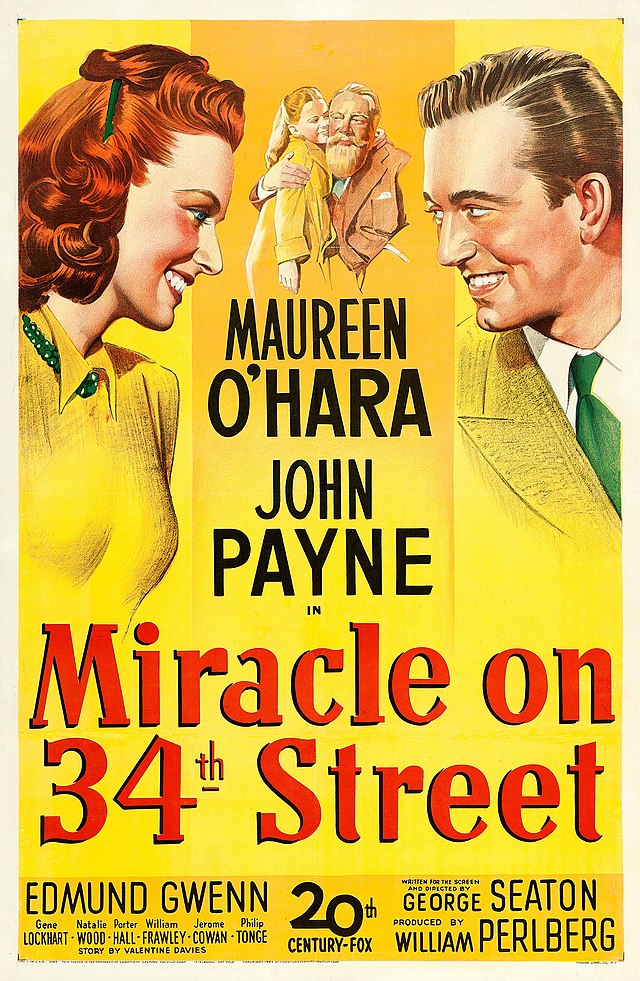
Miracle on 34th Street (1947)

Miracle on 34th Street (1947)

Warm Christmas fable will make you want to believe in Santa all over again

Director: George Seaton

Cast: Maureen O’Hara (Doris Walker), John Payne (Fred Gailey), Edmund Gwenn (Kris Kringle), Natalie Wood (Susan Walker), Gene Lockhart (Judge Henry X Harper), Porter Hall (Granville Sawyer), William Frawley (Charlie Halloran), Jerome Cowan (DA Thomas Mara), Philip Tonge (Julian Shellhammer), Henry Antrim (RH Macy), Thelma Ritter (Peter’s mother)
Santa Claus is a sweet little story we were told as kids, all part of buying into the magic of Christmas. How can we have been so silly as to think a jolly fat man with a red coat and flying reindeer delivered our Christmas presents? It’s the sort of fantasy adults are primed to burst like an over-inflated balloon. As a tribute to the earnest joy of believing in childish things, Miracle on 34th Street should also be the sort of thing the adult in us can’t wait to mock. Instead, its warmth and good-natured sweetness carries you along and makes you want to believe.

It’s the build-up to Christmas, and Macy’s in New York is working overtime to bring the magic to its customers (and turn a tidy profit). Macy’s Day Parade director Doris Walker (Maureen O’Hara) is relieved when Kris Kringle (Edmund Gwenn) takes the place of a drunken parade Santa and then occupies Santa’s Grotto in the store. Kringle is exactly the sort of guy you picture when you think of Santa – and, on top of that, claims to be Santa himself, much to the discomfort of Doris who doesn’t believe in all that stuff and certainly doesn’t want her daughter Susan (Natalie Wood) to. But when Kringle finds himself in court, fighting against being committed to an institution, with only Doris’ boyfriend Fred Gailey (John Payne) to defend him, can he prove there is a Santa Claus and it’s him?

Seaton’s film is an adorable delight which is funny and good-natured enough to avoid the trapdoor of sickly sentimentality. It’s a film about adults getting back in touch with the giddy delight of believing childish things. It flags up every cynical objection – and then gently suggests we’d be happier forgetting them. After all, what’s the harm in allowing ourselves in a few harmless flights of fancy – why should everything be measurable? Kris Kringle comes up against the hard-headed: harried mothers, businessmen, judges and lawyers and wins them over with his genuineness and warmth. He makes people want to believe – and doesn’t that, in a way, make him Santa?

It helps a huge amount that Edmund Gwenn is perfectly cast. Piling on the pounds and facial hair, Gwenn looks the part but also is the part. His performance is kind, considerate and bursting with warmth and good cheer. In a performance full of light, unforced playfulness, Gwenn gets the level of sweetness just right. A squeeze or two more and you would choke on the schmaltz of the whole conceit: but Gwenn is so adorable the audience wants to believe in him as much as the characters.

Especially as this Santa melts some of the cold commercialism of our modern Christmas. Miracle on 34th Street has a lot of good-natured fun at how Kris confounds the latent money-making of Christmas. On hire he’s instructed to memorise a list of preferred products to push on children. Instead he points mothers towards competing stores where they can get the exact gift they want or pick up better quality goods than at Macy’s. Of course, the concept proves so popular with customers that RH Macy is confounded by the goodwill it creates in his customers (and the huge sales it will lead to from their loyalty). Even other department stores start doing the same.

It’s one of the recurrent themes of the film: Kris brings out the best in people. Maybe not always for the right reasons: the shop-owners who want money, the judge who wants re-election. But it shows what benefit a little bit of good can have in the world. Kris also shows how little touches of consideration can change lives. There is a truly heart-warming moment where Kringle meets a Dutch orphan who simply wanted to meet Santa – although her adopted mother warned her Santa can’t speak Dutch. Much to her surprise, Kris launches into fluent Dutch, to the delight of the child. Miracle on 34 Street has several moments where the unstudied delight of children is captured to great effect, not least Natalie Wood’s delighted response to discovering the reality of Kringle’s beard (it also, to be fair, has several fairly cloying child actors).

Eventually the forces of darkness – led by Porter Hall’s twitch-laden store “psychologist”, whose bullying self-importance makes him the only person Kringle dislikes – insist we all put away childish things and chuck Kringle in an asylum. Miracle on 34th Street segues into a Capra-esque court-room drama (it’s hard not to detect touches of Mr Deeds Goes to Town) which pits Kringle’s home-spun honesty against legal cold professionalism. The clash becomes a delightful headache, as both the Judge and DA confront outraged children at home who can’t believe they are putting Santa on trial. It’s a great gag: who wants to be the judge who rules categorically Santa does not exist?

Alongside these gently amusing courtroom shenanigans (with John Payne doing an excellent job as Kris’ inventive lawyer) the film balances an endearing domestic plot. There is the inevitable will-they-won’t-they between Payne and O’Hara (if there is a bit of slack you need to cut the film today, it’s in Fred’s pushy wooing of Doris, including corralling Susan). But also, can O’Hara’s all-business professional, who’s raised her daughter with a Gradgrindish obsession with facts, melt her heart and allow both of them to believe a little bit? O’Hara handles this softening with all the consummate skill of a gifted light-comedian, while Gwenn’s delightful interaction with Wood’s precocious Susan, keen to access a world of imagination she’s never really known, is perfectly done.

it becomes a film about the power of believing. In our modern age we become expected to only base decisions on cold hard facts. Doris has taught her daughter to doubt imagination as a weakness to protect her from disappointment in the world (she is after all divorced, quite daring for a 40s family drama). But its also made Susan less likely to invest in faith, to open herself up to hopes and dreams. Its recapturing the ability to believe in something and be enriched by it that becomes one of the film’s richest messages.

It would be incredibly easy to poke fun at the good-natured naivety of Miracle on 34th Street, where businessmen are money-focused-but-decent and lawyers are amiably ready to indulge Kris with a smile. But it’s a film that zeroes in on an in-built nostalgia for simpler times in all of us. We’ve all been little Susan, sitting in a car desperately wanting to believe in the magical. It’s a film that demonstrates the eventual emptiness of cynicism, encouraging the audience to just put all that aside for 90 minutes and remember what it was like to be a child again. Throw in with that Edmund Gwenn as the definitive Santa and it might just be one of the greatest Christmas films ever made.
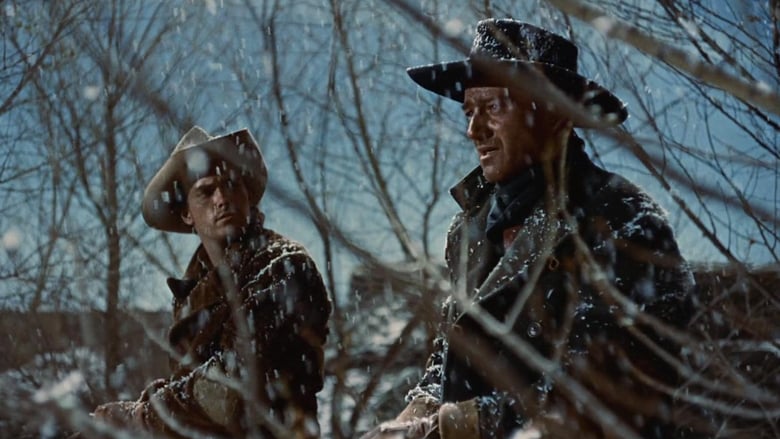
The Searchers (1956)

Searchers header
Jeffrey Hunter and John Wayne on a long search, in John Ford’s exploration of racism in the West The Searchers

Director: John Ford

Cast: John Wayne (Ethan Edwards), Jeffrey Hunter (Martin Pawley), Vera Miles (Laurie Jorgensen), Ward Bond (Reverend Captain Samuel Johnson Clayton), Natalie Wood (Debbie Edwards), John Qualen (Lars Jorgensen), Olive Carey (Mrs Jorgensen), Henry Brandon (Scar), Beulah Archuletta (Look), Ken Curtis (Charlie McCorry), Harry Carey Jnr (Brad Jorgensen), Hank Warden (Mose Harper), Dorothy Jordan (Martha Edwards), Walter Coy (Aaron Edwards), Pippa Scott (Lucy Edwards)

John Ford’s career was a long tribute to the decency of the regular American. How fascinating then that one of his greatest films is in fact a dark investigation into the dangers of obsession, vengeance and prejudice in ordinary Americans. Working with his regular leading man, John Wayne, together they created a character who shared many qualities with Ford’s other leading men – a rugged, determined, taciturn man of the wilderness – but laced him with deeply negative attitudes and a horrendously damaged psyche. The Searchers becomes a masterpiece, presenting how narrow the line between hero and villain can be while – in an admittedly very gentle way – posing questions about the claims of the settlers to moral superiority.

Ethan Edwards (John Wayne) returns to his brother’s homestead from an unspecified (though clearly morally questionable) career as a gun for hire after fighting for the confederacy (a cause he sees no reason to disavow). He’s an awkward presence, with an unspoken love for his brother Aaron’s (Walter Coy) wife Martha (Dorothy Jordan) and a racial hostility towards their adopted son Martin (Jeffrey Hunter) who is one-eighth Cherokee. Shortly after his arrival, an Indian raid draws him and most of the local men on a futile chase. While they are gone, the Edwards’ homestead is destroyed, with the family all murdered except daughter Debbie. Ethan and Martin begin what becomes a five-year quest to find her and bring her home – although as he discovers Debbie has become wife to her kidnapper, the war chief Scar (Henry Brandon), Ethan’s aim shifts from rescue to executing Debbie for racial disloyalty.

Racism is what lies at the heart of The Searchers and around discussions of the film today. Firstly, let’s acknowledge how brave the film is in presenting Ethan’s racially motivated rage without excuse. This was after all John Wayne, the straightest shooter of the lot. Here, in no doubt his greatest ever performance, Wayne’s Mount Rushmore-like qualities are inverted into a bitter, lonely man whose murderous rage against the Native Americans is extreme, even within an environment which sees the tribes as a dangerous “other”.

Edwards’ racism tips into everything and is there right from the start: “I could mistake you for a half breed” he scowls at Martin. Later he will prevent Martin drinking alcohol – a clear reference to the belief among settlers that one drop of alcohol turns Indians into savage beasts. One of his first actions on the trail is to desecrate the buried corpse of an Indian, shooting out his eyes (condemning him to walk sightless in the afterlife). In a gunfight he has to be stopped from shooting retreating Indians in the back. Later, in a crazed fury, he guns down buffalo simply to deny them as food to the tribes. That’s not to mention his disgust with every trace of indigenous culture.

What’s striking watching the film is that, even though he’s the central character and is played by John Wayne, Ethan may well actually be the villain of the piece – or at best an anti-hero wild card. Our actual hero is the kindly, decent and brave Martin Pawley, played with a slight nervousness by Jeffrey Hunter. Martin is appalled by Ethan’s violence, his anger and above all by his plan for enforcing racial harmony by exterminating the niece he sees as a race traitor. It’s not just the fact he has Cherokee blood that makes Martin appalled by the danger in Ethan. It’s the simple fact that he’s just a decent guy, who recognises that good and bad isn’t a question of race but a question of people. And his presence on the quest, it’s made clear, is as much about protecting Debbie from Ethan as it is finding and rescuing her.

You can see these attitudes quite clearly late in the film, where the pair encounter white women who have been recovered from Indian kidnappers. These women are confused and traumatised. But while Martin attempts to communicate with and comfort them, to Ethan they are worse than nothing now. “They ain’t white anymore” he scowls at a soldier. Leaving them, Ford holds the shot on Wayne who turns to look back at them with a face dripping with such disgust and loathing, it sears into the memory.

Does the film condemn these attitudes? You can argue that the film plays into a racial nightmare – white women kidnapped and violated by savage tribesmen. But Ford is, I’d suggest, presenting racism here – and going as far as he could in the 1950s to attack it. Ethan and Martin encounter an Indian settlement that has been attacked by the cavalry. The settlement is a burnt-out husk, with Indian women and children among those indiscriminately slain – visually it is immediately reminiscent of the burnt-out Edwards homestead. Another later cavalry charge against the Indians will again see panicked women and children flee in terror. Even Scar, the villain of the piece, is motivated just like Ethan by anger – his actions are a response to the murder of two of his children. And his scalping, rape and murder don’t look so different from Ethan, who shoots people in the back, plans to murder his niece and later scalps a dead man.

The Searchers takes a slightly nihilistic view that the West was a violent place – for all the beauty Ford discovers in his crisply sublime shots of monument valley – and that many of the people in it had questionable motives and principles. A ”hero” for this time might well be Ethan, a sullen and violent man under a veneer of gentlemanly politeness, clearly motivated from the start far more by a desire for revenge for the murder of the woman he loves. Ford, Wayne and Jordan establish this love between Ethan and Martha subtly but unmistakably – the opening scenes are littered with moments of the two of them sharing glances and a hesitant but unmistakeable physical intimacy.

Again, a lot of the quality of this comes back to the wonderful work Ford draws from Wayne, helping the actor to find the cracks and flaws in this marble bust of Americanism. Wayne’s Ethan is awkward, angry, distant, difficult, cruel – a natural outsider, who has grown bitter against the world. Discovering Martha’s body, Wayne also allows Ethan to crumple into the sort of grief that translates within seconds into an iron loathing for the world and everything in it. He talks of the certainty of finding Debbie – but it’s a certainty born more of his idea of his own superior (white) determination rather than any faith (for all the language could suggest that). Ethan is in fact hostile and contemptuous of faith of any sort.

Ford frames Ethan frequently as an outsider, often framed uncomfortably in doorways, darkened walls seeming to close around him. Nowhere is this more beautifully done than in the film’s final shot which finds Ethan alone and forgotten outside the Jorgensen homestead, a man who has no place in the civilised world of family and friends, but an outsider with no place anywhere who must return to the wilderness. Wayne does this with a quiet, deflating gentleness – a beautiful suggestion of Ethan’s knowledge that the world is leaving him behind. Ford frames this beautifully in mid-shot to create one of the iconic images of cinema.

The Searchers isn’t perfect. There is a prolonged, slightly comic, sub-plot around Martin’s marriage to Laurie Jorgensen (Vera Miles in a thankless part), which culminates in the sort of fisticuff based comic stuff that looks more suited to The Quiet Man than here. The beautiful shots of monument valley are brilliantly done – but they also serve to point out the odd decision to shoot many of the exteriors on such obviously fake soundstages. While the film questions the attitudes and assumptions made about the Native American people in Hollywood films, the violent figure of Scar is the only Native American character given any real screen time (Martin’s accidental “wife” Look is treated as a joke, right up to her surprisingly tragic fate), making it easier to still see the tribes as an existential threat to civilisation, for all that Ford tries to contrast their suffering with the death of the settlers.

But Ford was trying to sneak something in here under the wire, at a time when people would only accept straight-forward stories of goodies and baddies in the West. He did this by turning Wayne for a pillar of taciturn goodness into someone who is almost a mirror image of his nemesis Scar, both men motivated by racial hatred. He parallels the violence of the Indians with the cavalry. He suggests in fact that there was good and bad on both sides. And I can’t think of another film where the viewer is convinced for a huge portion of the runtime that our hero intends to carry out an honour killing. The Searchers presents a man who holds racist views and trusts that we are smart enough to see the danger in Ethan’s extremism. Thankfully most of us are.

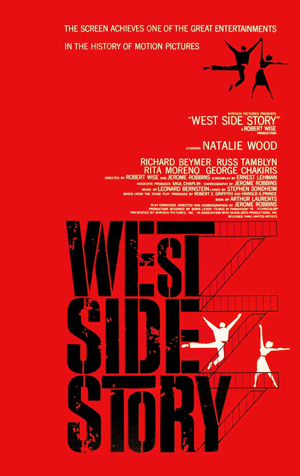
West Side Story (1961)


Dancers defy gravity and physics in the triumphant West Side Story

Director: Jerome Robbins, Robert Wise

Cast: Natalie Wood (Maria Nunez), Richard Beymer (Tony Wyzek), Russ Tamblyn (Riff Lorton), Rita Moreno (Anita Palacio), George Chakiris (Bernardo Nunez), Simon Oakland (Lieutenant Schrank), Ned Glass (Doc), William Bramley (Officer Krupke)

It’s strange to think now, but when it debuted on Broadway, West Side Story failed to win the Tony for Best New Musical (it went to The Music Man). Today, Bernstein and Sondheim’s masterpiece is a touchstone of musical theatre. Part of that surely must be connected to the fact that it’s so well known as a film – and that this triumphant movie production took 10 Oscars as well as holding a place in any list of Greatest Musicals on Film.

The story is of course Romeo and Juliet crossed with intricate ballet and light opera. On the streets of New York, the Jets (working-class white boys) and the Sharks (Puerto Rican immigrants) are two rival gangs fighting a street battle to control their district (via the medium of dance). But danger is about to explode when former leader of the Jets Tony (Richard Beymer) falls in love with Maria (Natalie Wood), the sister of Sharks leader Bernardo (George Chakaris). Will it end well? Surely not with these star-crossed lovers…

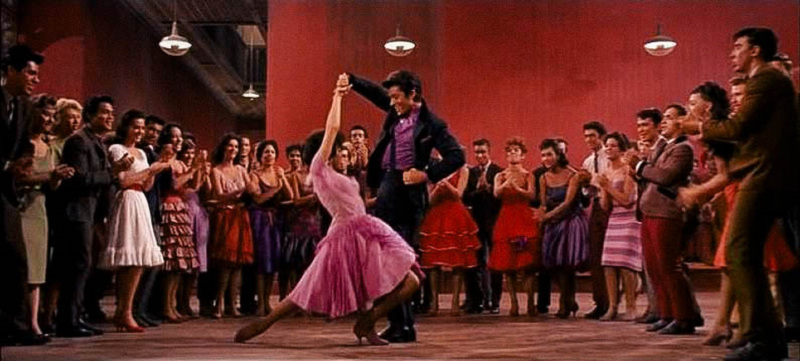
You can’t really begin to talk about West Side Story without first talking about the dancing. Not since Astaire and Rogers has a movie been defined so much by its physical grace and rhythmic control of movement. It’s awe-inspiring. Honestly, show-stoppingly, jaw-droppingly impressive. As the dancers defy gravity, physics and the limitations of a normal person’s body, you can’t help but want to spring to your feet and join in (don’t – I guarantee you are not as good). It’s simply amazingly good.

The opening Prologue sets the scene perfectly. It’s not easy to make a film about tough street gangs, where every fight scene is largely expressed through dance – the Prologue, however, does this perfectly, a stylised slow build of increasing musical tempo. From the simple device of clicking fingers, we build continually into an explosion of carefully controlled group choreography, where each of the twenty-odd dancers feels like an individual.

The camera choices are sublime: some shots hover in dramatic aerial shots. Tracking shots highlight the skill of the dancers. The crew dug pits into the tarmac to bury the cameras in so that they could stare straight up at the dancers at some points – during one brilliant sequence Chakiris and the Sharks seem to loom, God-like, over the viewer while moving in perfect synchronicity. It’s beyond a tour-de-force, it’s simply unlike anything else you’ve ever seen on film. The film would’ve deserved Oscars even if it had ended after ten minutes, it’s probably one of the best openings ever.

Fortunately it doesn’t, because there is more exquisite stuff to come. Moreno and Chakiris probably won their Oscars off the back of the scintillatingly “America”, a beautiful whirlygig, part debate, part argument, high-kicking joy of twirling dresses and pirouettes. It’s possibly the most exciting number in the whole film. “Cool” is an unbelievably wild and challenging dance number in a garage, that seems to throw in half a dozen different styles – the set itself seems to be struggling to survive under the rampant pace and passion of the dancers. It’s a deliriously giddy, passionate, dirty number with the actors clearly pushed way beyond their natural ease.

Famous Broadway choreographer Jerome Robbins directed the original production, and was the logical choice for the studio to choreograph the film. Robbins insisted he would only do so if he was also allowed to direct the entire film. A deal was eventually done where Robbins would direct everything involving music and dance, and seasoned professional Robert Wise would handle the rest. Robbins carries most of the credit for why this film really is unique – everything special and different about it is connected to his mastery of choreography.

As it happened, Robbins’ search for perfection was so great he ended up leaving the film running weeks behind and far over budget. After months of rehearsal, when the time came to film, Robbins would dramatically re-work the choreography to exploit locations. This was particularly expensive for the location. As take after take on expensive 65mm film mounted up, the producers eventually dismissed Robbins from the project after filming four numbers (“Prologue”, “Cool”, “America” and “I Feel Pretty”). Although the rest of the numbers used his choreography (and were directed by his assistants) they lack the inspired genius of the other four stand-out numbers. Wise, a skilled hired gun, took care of the rest of the filming.

It’s the weakness of West Side Story that very few things in the rest of the film live up to the heady, exhilarating joy of those core numbers. Both Beymer and Wood are uninspiring as the two leads. Wood is not remotely convincingly Puerto Rican, while Beymer is too clean-cut and nice-guy for a kid who was running a street gang not so long ago. The scenes focusing on these two drag– and are rather flatly shot considering the dynamism around anything involving dancing. Wood’s songs are at least memorable – largely because an uncredited Marnie Nixon supplies the singing – but Beymer’s voice replacement isn’t particularly inspiring and both “Maria” and “Tonight” get a bit lost here (he’s no Michael Ball, put it like that).

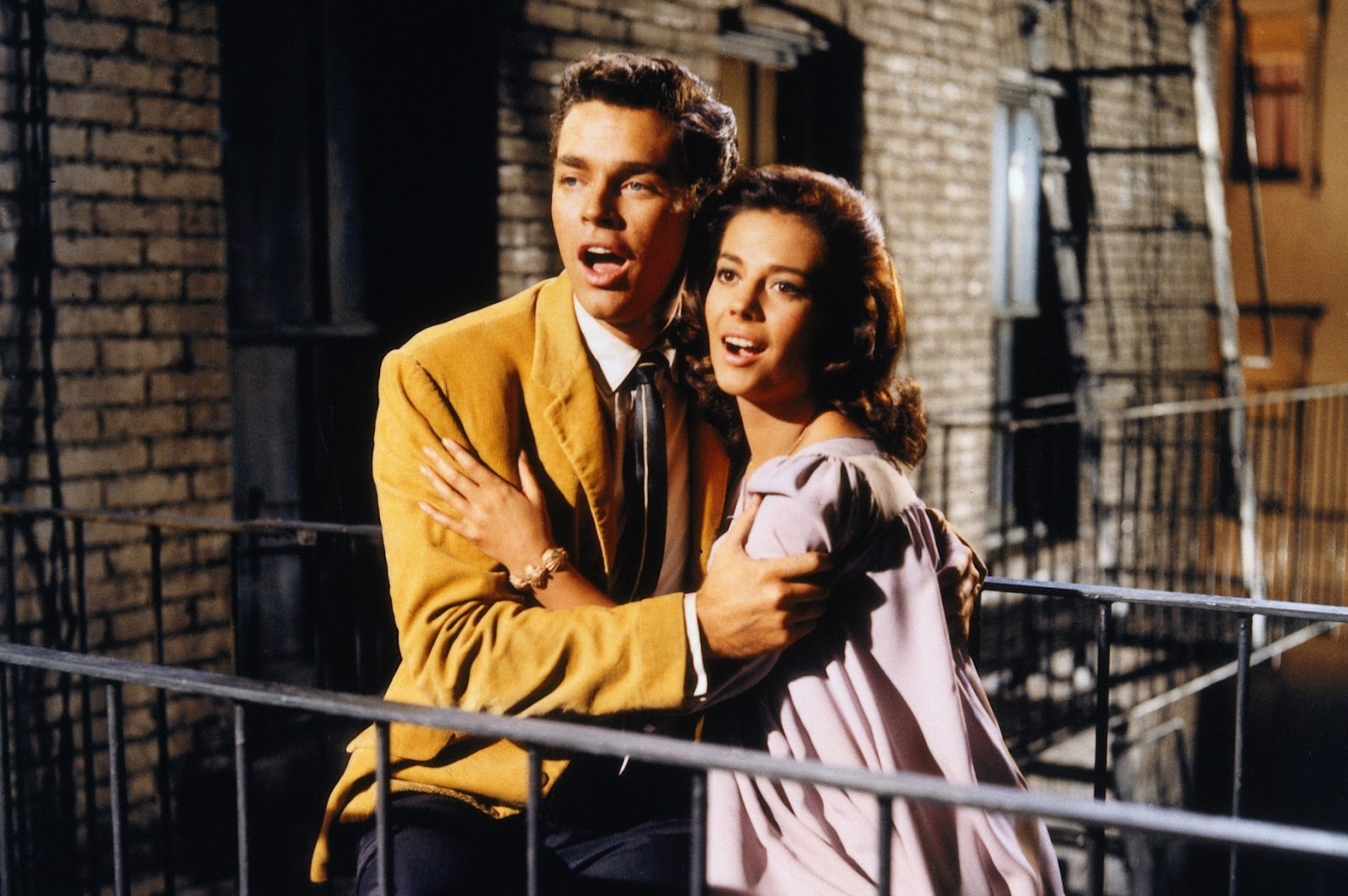
The script and storyline aren’t always the strongest. It’s a difficult to really remember any of the purely dramatic sequences. Tony and Maria’s meeting on the balcony summons up very little in the way of romantic frisson, let alone any favourable comparisons to Romeo and Juliet. (Truth be told, there is very little chemistry at all between the two performers). You get the feeling the film is reaching for a big socio-political message – hey kids, why don’t we all get along? – but never really quite gets there. It’s not quite got enough thematic weight behind it for the cultural acceptance angle it’s trying to push. But heck, Romeo and Juliet is a tough act to follow, so it’s not a surprise that the film works best as just a romance.

The big exception to the rule that the dramatic moments don’t hold a candle to the dance sequences is Anita’s assault by the Jets late on in the film – an unsettlingly visceral near gang-rape, which isn’t easy to watch, but works brilliantly. In fact any dramatic scene involving Rita Moreno stands out – she burns up the screen as the fiery Anita, a woman bubbling with passion but also with an emotional intelligence and sensitivity that nearly helps our heroes avoid disaster. Moreno’s dancing and singing are first class, but her acting throughout is similarly outstanding – any scene featuring her, your eyes are immediately drawn to her. She’s well matched as well by George Chakiris, another Oscar-winner, who’s a magnetic dancer and singer but also gives Bernardo a brilliant kindly pride laced with arrogance.

All this takes places in a regular technicolour wonderland of a setting. Daniel L. Fapp’s photography is marvellous, creating a rich palette that soaks up colour. Shots of a blood red sky at night set just the right ominous tone. He makes masterful use of colour and shade throughout. I’ve already talked about how the photography brilliantly helps build the impact of the dancers. But every scene is really carefully framed and presented, with the cages and barriers of the playground the gang fights over helping to hammer home the feeling of our heroes being trapped by fate. As you’d expect from Wise (the editor of Citizen Kane) the film is also brilliantly assembled in the editing room.

Parts of West Side Story are of course a bit dated. The dancers, for all their undeniable brilliance, are a little camp for rough and tumble street kids. The film’s costumes and settings look undeniably clean to modern eyes. The casting of Wood in particular as a Puerto Rican is odd today. It’s also probably too long a film – while the musical numbers could happily go on forever, other scenes drag a little. Most of the really strong, memorable material happens in the first half of the film. And like all brilliant works of art, it’s so distinctive it’s almost a little too ripe for parody. Some of the visual flourishes used to indicate fantasy sequences look slightly dated.

But these are niggles in a way, because even if parts of the film are a little bit below par, the overall impact of the film is quite extraordinary. There has never been – and I think never will be – a musical quite like this. I simply can’t imagine such a triumph of group choreography being made, or a film-maker spending such time and money to push the envelope of what it is possible for the human body to do in dance scenes. Despite its faults, I can’t imagine a viewer not being electrified by several sequences in this movie. And at the end of the day, what else is cinema for if not to bring our emotions and feelings to life in vibrant flashes?