Tag: Nicholas Hoult

Superman (2025)

Superman (2025)

A fun, character-led, engaging film that makes a better stab at starting a massive franchise

Director: James Gunn

Cast: David Corenswet (Clark Kent/Superman), Rachel Brosnahan (Lois Lane), Nicholas Hoult (Lex Luthor), Edi Gathegi (Mister Terrific), María Gabriela de Faría (The Engineer), Anthony Carrigan (Metamorpho), Nathan Fillion (Guy Gardner), Isabela Merced (Hawkgirl), Skyler Gisondo (Jimmy Olsen), Sara Sampaio (Eve Teschmacher), Wendell Pierce (Perry White), Pruitt Taylor Vince (Jonathan Kent), Neva Howell (Martha Kent), Zlatko Burić (President of Boravia), Frank Grillo (Rick Flagg), Bradley Cooper (Jor-El)

In 1978 Hollywood promised to make us believe a man could fly. In 2025 it just wants us to believe a franchise can be reborn. Superman, again, hopes the man of steel can launching a DCU franchise to compete with Marvel (in some ways, hilarious that this is just at the point when the world seems tired of interconnected monolith Comic Book worlds). Has it learned the lesson of the first attempt? I’d say yes: under the experienced hand of James Gunn, Superman is light, fun, exciting and engaging. It may all be (inevitably) heading towards a city-sized smackdown to save the world, but at least it does it with a bit of charm and character work along the way.

What it also definitely isn’t is an origins story. And, in many ways, thank God: is there anyone under this yellow sun that doesn’t know Superman is from Krypton, his alias is mild-mannered reporter Clark Kent at the Daily Planet, he’s got the hots for Lois Lane, his enemy is balding super-genius Lex Luther and he’s got a deadly fear of Kryptonite? Gunn is totally spot-on that we didn’t another hour plus on film laboriously putting all those pieces in place again.

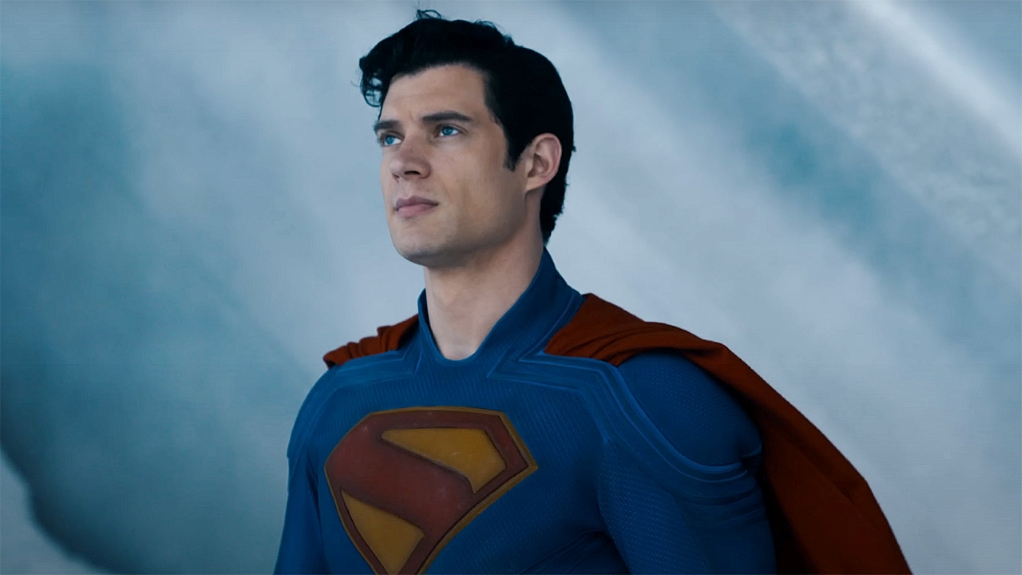
Superman instead throws us straight into the second act: the invulnerable hero (David Corenswet) getting beaten for the first time, outmatched by Lex Luthor’s (Nicholas Hoult) Ultraman who has all of Superman’s powers and none of his personality. It’s part of a doom spiral where Superman’s decisions to unilaterally intercede in a war are condemned for overstepping, painful revelations about his past leave him ostracised by the world and he winds up imprisoned by Luthor who wants to reshape the world as he sees fit. Can reporting (and romantic) partner Lois Lane (Rachel Brosnahan) rope in the Justice Gang (a group of meta-human heroes) to help?

That probably doesn’t give quite a clear enough picture of what a barmy, primary-colour spectacle Superman is. To say it throws in everything including the kitchen-sink at your would be an understatement. Gunn’s film is soaks in love for the scatter-gun, heightened reality of comic books. If the first wave of DCU films were about trying to ground superheroes in the real world, this throws us into a nutsy world where: the Justice Gang are celebrities and their members include a half-hawk woman and a cocky dickhead with a magic ring; the villain has a private pocket universe he’s using as a personal Guantanamo Bay; and battles with giant space monsters are such a regular sight people whip out their phones to film it rather than runaway.

In fact, in this world, Superman facing off against his super-powered foe in a city collapsing into a giant rip in space-and-time actually feels strangely grounded. Compared to floating around on flying platforms through a purple pocket universe or swimming through a river of anti-matter to save a meta-human baby who can change his form into any material on earth, it’s pretty normal. But Gunn’s film embraces its madness with a tongue-in-cheek joie d’vivre: in fact, it’s refreshing that the film acknowledges there is no point trying (once again) to Nolanise this stuff.

In fact, Gunn works hard to make sure any real-world commentary is delivered with a soft-touch. A key sub-plot about the invasion of Jarhanpur (a stand-in for both Ukraine and Gaza) by its neighbour Boravia (blatantly Russia) gets funnelled into a black-and-white moral issue. A Trump stand-in is Boravia’s blow-hard leader, with a thick Russian accent (distancing him from the real thing). Social media gets a kicking (not surprising considering the director’s personal experience on it), but with off-the-wall gags like Luthor owning a legion of engineered monkeys endlessly typing angry comments into the ether to drive algorithms. Metropolis is the only city where a daily paper not only drives discussion, but is the most trusted source of news.

The colourful barmyness also works, because Superman grounds itself in warm and relatable characters. Bought to life with a great deal of humility and relatability (the one area the film plays it completely genuinely) by David Corenswet, this version of Superman embodies the virtues of kindness. He’s endlessly polite and attentive, from his robot servants in the fortress of solitude to his hardest language being “gosh”. He’s dedicated to preserving life (from humane subduing of giant monsters to saving a squirrel mid-fight) and putting others first. He’ll go to great lengths to protect his pet dog Krypto (possibly the most genuinely endearing dog on screen since The Artist).

And it makes a great framework for a film that deconstructs Superman by stripping him of his certainties. Dramatically it’s always difficult to fear for an invulnerable hero, so Gunn’s decision to open with our hero having had the crap beaten out of him (not for the last time in the film) is a good touch. But Gunn also challenges Superman’s moral certainties, in particular with a unique reveal in Superman-lore leaving him questioning everything he thinks he knows about his past. It’s refreshing to see a film challenge superheroes for taking unilateral decisions on behalf of everyone, with even Lois criticising him for a power-grab. Sure, it’s a strawman – there is no doubt Superman’s decision to stop Boravia is the right thing to do – but it’s good to see it discussed and questioned.
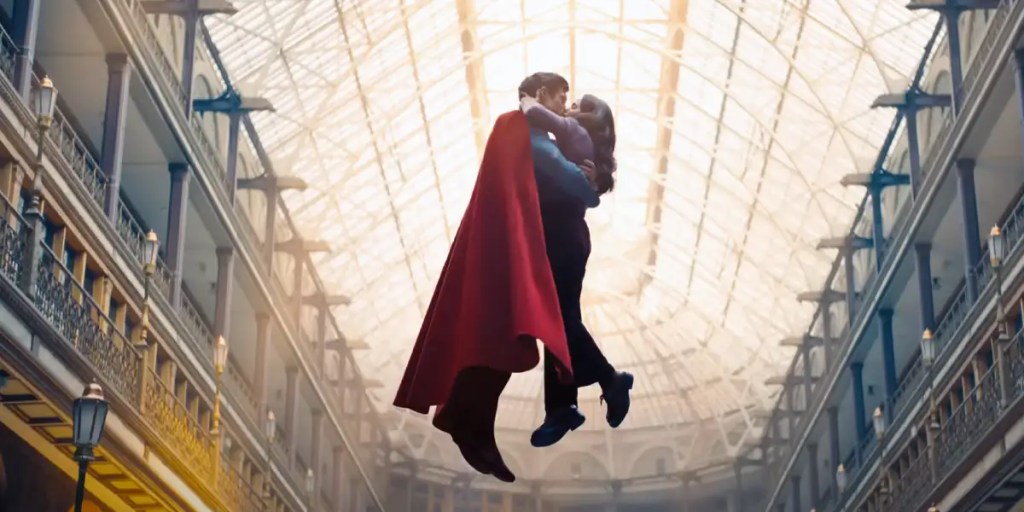
Superman uses this to explore characters, in particular the emotional vulnerability of Clark Kent and the bond between him and Lois. There is a refreshing scene where Corenswet and Brosnahan simply sit and talk about his turmoil, while outside the window in the distance a bizarre intergalactic-eye monster is fought by the Justice Gang. (Both a good gag, and a sign of the film’s focus on character). But, unlike other Superman films, Corenswet’s Man of Steel confronts him with the possibility of physical and moral failure on every level. Throw in a Luthor who, for all his man-child antics, carries out some of the darkest, most brutal acts any version of the character has before and this leads to some genuinely affecting moments of grief and guilt.

Gunn combines this genuine interest in character with some engaging use of obscure comic book characters, about him the general viewer has no pre-viewing expectations. Krypto is a genuinely funny addition as a hyper-active chaos pet. Nathan Fillion is good fun as a dickish blow-hard with super-powers. Edi Gathegi is wonderfully droll as the wearily frustrated Mr Terrific. And the three leads make a very effective combo: Corenswet’s selflessness and kindness very well contrasted with Hoult’s petulant arrogance while Brosnahan gives Lane gallons of determination and can-do attitude.

It’s not perfect. A sub-plot about Luthor’s girlfriend is presented as a victim of an controlling relationship and a source of comedy for a desperate neediness. It’s resort to a big-city smackdown is overly familiar, while a few reveals can be seen coming far off. Hoult’s Luthor is a big-swing of a performance that doesn’t always hit. But when it works, it’s a bubbly ball of super-hero-fun that celebrates basic decency, kindness and looking after each other. And maybe that’s the hero we need right now.
Nosferatu (2024)

Nosferatu (2024)

Eggers’ wonderfully atmospheric remake is creepy, haunting and quite extraordinary

Director: Robert Eggers

Cast: Bill Skarsgård (Count Orlock), Lily-Rose Depp (Ellen Hutter), Nicholas Hoult (Thomas Hutter), Aaron Taylor-Johnson (Friedrich Harding), Willem Dafoe (Professor Albin Eberhart von Franz), Emma Corrin (Anna Harding), Ralph Ineson (Dr Wilhelm Sievers), Simon McBurney (Herr Knock)

Robert Eggers dreamed so long of his own version of FW Murnau’s seminal vampire film (and Bram Stoker copyright infringement) Nosferatu, it was originally announced as his second film. We had to wait a bit longer, but it was well worth it. Eggers’ experience helped him create a film infinitely richer than I suspect he would have made ten years earlier. Nosferatu is an astonishing, darkly gothic, richly rewarding film, glorious to look at and a fiercely sharp exploration of the subtexts of both sources. It can never match the original’s seminal impact, but celebrates and elaborates it.

The story hasn’t changed dramatically from the one Murnau ripped off from Stoker. In Wisborg, junior solicitor Thomas Hutter (Nicholas Hoult) leaves his beloved wife Ellen (Lily-Rose Depp) for Transylvania and a lucrative land deal with the mysterious Orlock (Bill Skarsgård) that could lead to a comfortable life for him and his new wife. Unfortunately, there are three things he doesn’t know: firstly, the Orlock is a ravenously cruel vampire, with extraordinary supernatural powers; second his employer Knock (Simon McBurney) is an occultist worshiper of Orlock; thirdly, Orlock has used his mental powers for years to terrorise and groom Ellen from afar and Hutter’s presence is the final step in his scheme to control her. It won’t be long until a deadly curse plagues Wisborg.

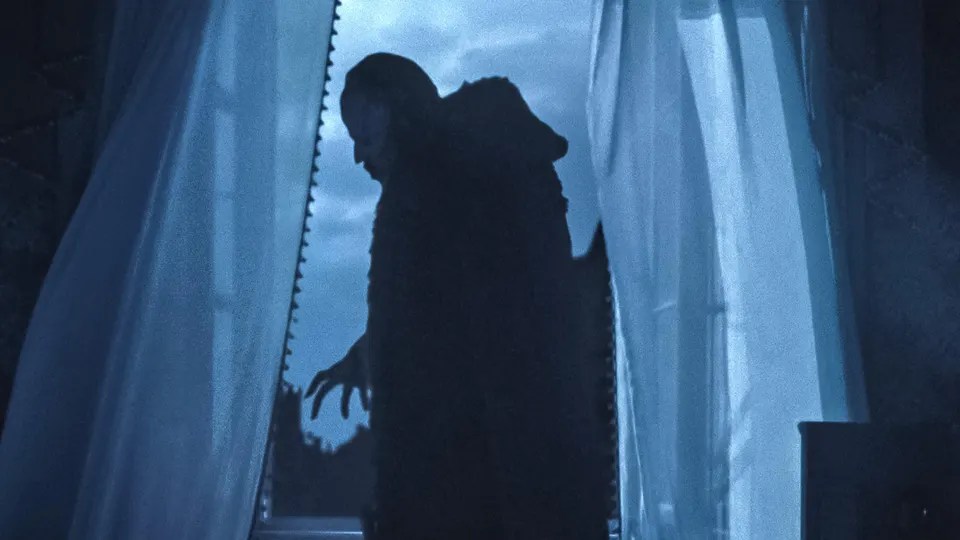
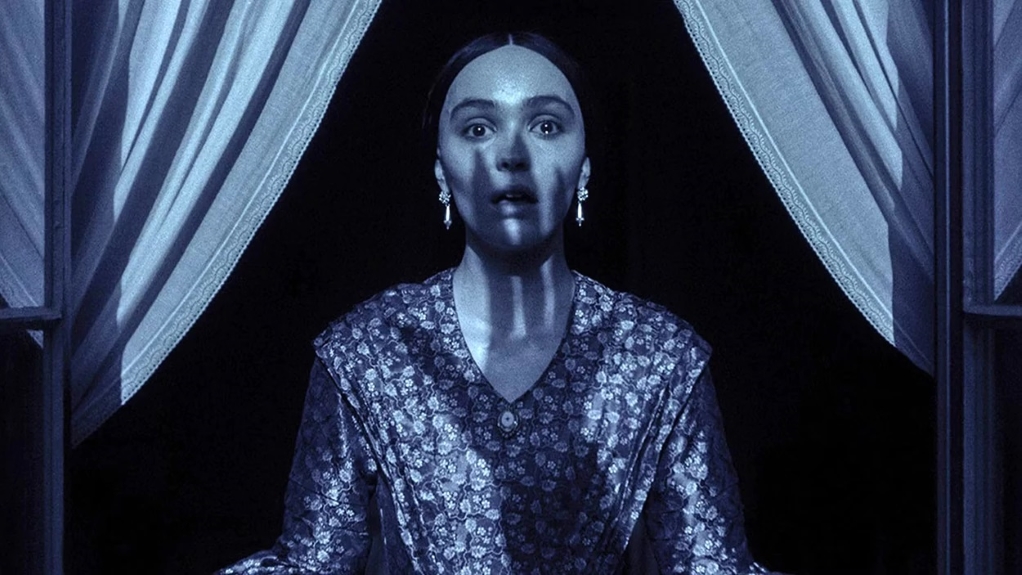
Egger’s dark (but extremely beautiful) gothic film drips with atmosphere, gloomy shadows rolling over its elaborate sets, the drained out night-time shots reminiscent of the tinted black-and-white beauty of the original. The entire film is soaked in love for silent-era horror, with homages to Murnau, Dreyer, Sjöström and so many others I couldn’t begin to spot them all – though I loved Orlock’s gigantic shadowy hand creeping Murnau’s Faustus-like over Wisborg. The film drowns in folk horror, from its snow-capped Transylvanian countryside dripping in unspeakable hidden evils to the unreadable motives of a mysterious Transylvanian village.

At its heart is an exploration of the sexual undertones of the vampire legend. Orlock’s assaults leave his victims are overwhelmingly sexual, with Orlock’s body thrusting forward while he drains the blood of his groaning victims. That’s not to mention Orlock’s revolting sexual manipulation of Ellen. Nosferatu leans heavily into Stoker’s dark sexual awakening subtext. Orlock’s psychological manipulation has left Ellen traumatised, torn between dark sexual desires and romance with Hutter. Nosferatu opens with a dark (dream?) sequence, as Ellen rises with sensual sighs from sleep, drawn towards Orlock’s seductive shadow in sheet curtains, before joining him outside for something that looks an awful lot like sex before Eggers cuts with a jump scare shot, our first glimpse of Orlock.

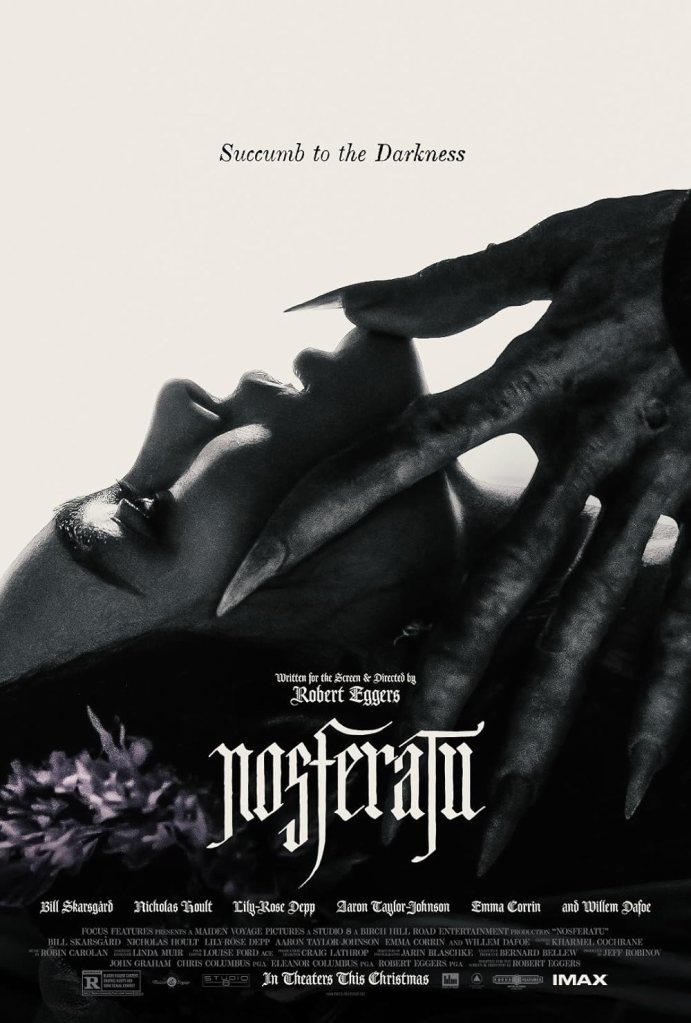
This is an Orlock radically different from Max Schreck’s original. While he shares his long nails and angular posture, here he is no-more-or-less than a decayed, rotting corpse. His body is covered in sores of decayed skin, with everything (including his penis) halfway to the compost heap, his bony legs and hips positively skeletal. There are homages to his Vlad the Impaler roots, from his fur-lined uniform coat (that like the rest of him has seen better days) to his surprisingly well-groomed moustache. But there isn’t a trace of the handsomeness of so many Draculas – this Orlock is possibly even more repulsive to look at than the rat-faced monstrosity of the original.

Skarsgård’s make Orlock a truly ruthless figure, delighting in his natural cruelty. With Hutter his looming, shadowy menace offers not a jot of home comforts, working to terrify a man who he sees as a perverse romantic rival. (His hallucinatory blood-sucking assault on Hutter is filmed in a manner reminiscent of rape). Throughout, he treats almost everyone he encounters with contempt and lofty disgust and takes a sadistic delight in torturing Ellen’s friend Emma Harding’s family, culminating in a truly shocking scene of grizzly horror. While the original Orlock was almost feral, like his rats, this one is a monstrous decayed sorcerer with a never-ending hunger and sadistic desire to play with his food.

He also has something the original never had: a voice. Skarsgård spent weeks in training to develop this (digitally unaltered) vocal range, a rolling bass-rumble which wraps itself around a raft of Dacian dialogue. Eggers’ gives him immense supernatural skills, in a film dripping with occult magic. Simon McBurney’s Knock (a remarkable performance) is a lunatic drowning in it: covered with dark markings, biting the heads of pigeons and communicating with Orlock by sitting naked in a Pentecostal star. His brain has been flushed out by Orlock’s mental power (who treats him like dirt) and the vampire’s hypnotic voice overwhelms the senses: just a few sentences drains Hutter of willpower (Nicholas Hoult’s fear is so palpable here you could almost touch it). Orlock’s malign influence can twist people or make them suddenly ‘wake’ with no idea of where they’ve been.

The power of his influence twists and distorts emotionally and physically. Lily-Rose Depp captures all this in a remarkable physical and vocal performance, as Ellen falls victim to Orlock’s mental manipulations. Depp throws herself into the most violent fits since Linda Blair: her body spasming, her voice distorted into an Orlock-mirroring gurgle, her eyes rolling back, her inhibitions falling away and blood weeping from deeply disgusting places, especially her eyes. Depp’s performance is extraordinarily committed, her fear and self-disgust at her manipulated sexuality (eekily from childhood) by the Count as tender as he hatred of him is sharp and all-consuming.

It’s never clear how far the vampire wants to screw Ellen, and how far he wants to consume her (Eggers even suggests, towards the end, that Orlock may even welcome his own destruction – perhaps the rapacious hunger is too much?). What is different from the original is Orlock and the plague he brings with him are different. While the original was a destructive force of dark nature, this Orlock is focused exclusively on punishing Ellen, with a literal plague striking down Wisborg.

In the face of this beast, the powers of science and reason are powerless (as Aaron Taylor-Johnson’s delicately performed Harding discovers, refusing to believe until its far too late). Like Murnau’s original, the powers of science and reason (such a key weapon against the vampire in Stoker) are useless. Even rationalist Dr Sievers (a fine performance by Ralph Ineson, channeling Peter Cushing and Michael Hordern) – a man so calm even the insanity of Knock can’t flap him – chucks in the towel and calls in Willem Dafoe’s barnstorming Professor von Franz (here considerably more effective than his counterpart), a scientist turned alchemist with deep occult knowledge.

But it can’t change the fact this is not a war between two sides, but a deeply personal struggle between Orlock and Ellen, with Hutter torn between them. Eggers’ focus on this personal story at the heart of a dark twisted legend adds a genuine freshness – and makes a superb counter-balance to the lashings of gothic horror the film soaks in. It makes for a superb remake that contrasts and comments on the original while telling its own story of dark, corrupted manipulation. Eggers’ direction is faultless in its atmospheric unease and there are superb performances from Skarsgård, Depp, Hoult and the rest. It’s a powerful work, overflowing with silent horror atmosphere while also feeling very modern that has the potential to haunt our nightmares as much as the original.

The Menu (2022)

The Menu (2022)

Dark satire is mixed with intelligent character work and a challenge to our assumptions in this intriguing film

Director: Mark Mylod

Cast: Ralph Fiennes (Julian Slowik), Anya Taylor-Joy (Margot Mills), Nicholas Hoult (Tyler Ledford), Hong Chau (Elsa), Janet McTeer (Lilian Bloom), John Leguizamo (Famous Actor), Reed Birney (Richard Liebbrandt), Judith Light (Anne Leibbrandt), Paul Adelstein (Ted), Aimee Carrero (Felicity), Arturo Castro (Soren), Rob Yang (Bryce), Mark St Cyr (Dave)

A dash of Succession. A soupcon of Hannibal Lector. Lashings of The Most Dangerous Game. All these ingredients are mixed to delightfully dark comic effect in The Menu, a sharp and tangy assault on class and modern society which leaves an unusual but satisfying taste in the mouth.

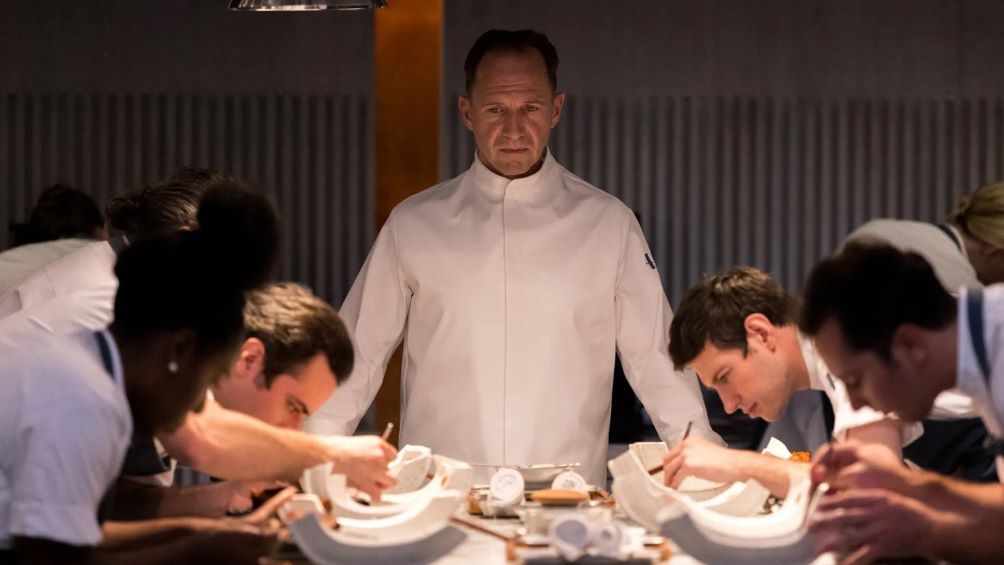
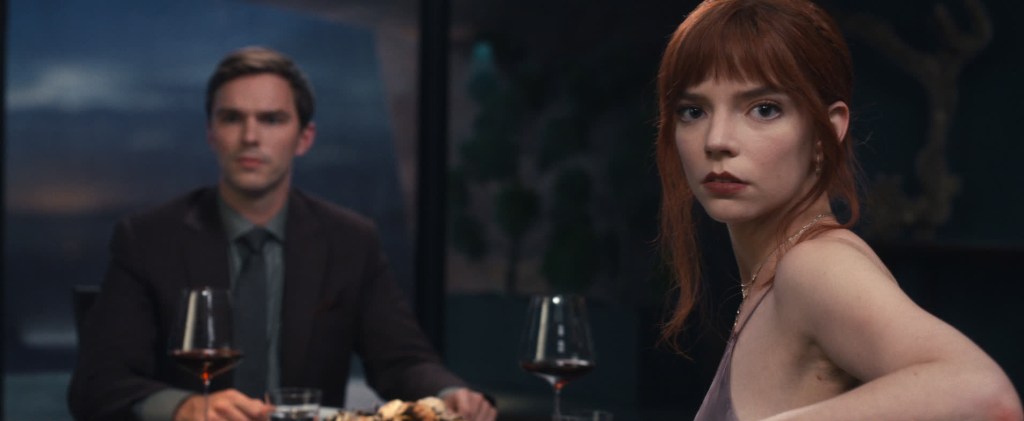
First those touches of The Most Dangerous Game. Julian Slowick (Ralph Fiennes) is a restauranteur so exclusive, his restaurant is based on a private island. Each course, of each menu is part of an overall story that forms the meal. For the story of the meal he is currently preparing, Slowick has selected an exclusive guest list of the rich and famous: businessmen, the rich, movie stars, food critics – the elite, the snobbish, the 1%. And the story he is serving up is one of increasingly grim retribution for this table-load of takers not givers. The only unexpected figure there is Margot (Anya Taylor-Joy), last-minute guest of obsessive food purist Tyler (Nicholas Hoult). How will this unexpected fly in the soup affect Slowick’s plans for the evening?

The Menu in many ways is a revenge satire. Slowick does not hold back in his increasing fury and bitterness at the people he serves without appreciation or gratitude in return. His customers are interested only in food if it costs a lot and is exclusive. They have no interest in his actual skills, in the staff (whose names they do not remember), the food itself or anything beyond their own desires. Many of the customers – most hideously a trio of “bro” investors (played with slapable smugness by Castro, Yang and St Cyr) – flash their jobs and cash expecting these to ensure their every whim is met. To them the world is like dough to be shaped into whatever bread they want it to be.

The film – with glee – exposes the hideous selfishness of the rich customers. A rich couple (Birney and Light) who have attended Slowick’s restaurants several times yet remember nothing about the food or the staff. Janet McTeer’s elite food critic, who practically scratches marks into her pen to mark the restaurants she has closed (she’s accompanied by a fawningly obsequious editor, played by Adelstein). A famous actor (John Leguizamo) who has long-since sold-out and treats his fans with contempt, joined by his spoilt rich-girl assistant/girlfriend (Aimee Carrero). Each of them is deconstructed in turns by Slowick over a series of courses parodying the snobbish bizarreness of high-class dining.

And here is where those touches of Succession make themselves known in the flavour. That series – and Mylod is a veteran (and its finest director) – also presents the ghastly shallowness and greed of the super-rich to expert comic effect. But what that show also does – and what Mylod brilliantly manages here – is make what could be two dimensional monsters sympathetic. The Menu presents these dreadful people with honesty; but, as the punishments – cruelly personal reveals, psychological torture, a finger cut off here, a man hunt there – pile up, you start to wonder if the punishment is too much?

The “bro” investors may be dreadful selfish, arrogant, dick-swinging morons: but they are also immature idiots who have never really grown up. The rich couple might treat places like this elite restaurant as a God-given right, but does that really deserve death? The food critic is harsh and arrogant, but is writing cruel words a mortal sin? The actor loathes himself for selling out his talent to make money and his girlfriend has simply been born into money and never wanted for anything. Do these people really deserve the monstrous ends Slowick has planned for them?

It’s the smartness of The Menu which could easily have invited us to just enjoy the rich and powerful being exposed, humiliated and punished. Instead, this is a smarter, more intelligent dish. The lower-class restaurant staff should be the people we are rooting for. But Slowick runs the restaurant like a cult, the staff near-robotic automatons that follow Slowick’s orders without question, intone their “Yes, Chef!” answers like a religious chant and snap to attention as one. Slowick’s number two Elsa – superbly played by Hong Chau – sums them up: all of them are desperate to become her boss and will follow Slowick to hell and back without a murmour and their heartless, personality free cruelty makes them very hard to root for.

As does Slowick himself. Here comes that sprinkling of Lector. Played with a superb, chilling intensity by Ralph Fiennes at his most coldly austere, Slowick could have been a character who swept us up in his intelligent superiority. But there is not a hint of joy in Slowick, only a vast, bubbling anger and resentment under a coldly precise exterior. Who on earth could look at this near-psychopath and think “I’d love to be him”? Slowick’s service is dryly, terrifyingly funny but you’d certainly not be left wanting to leave him a tip (unless it was your only way of getting out alive).

Instead, we gravitate towards the odd one-out. Anya Taylor-Joy is excellent as Margot, the unexpected guest who finds herself the only person unprepared for by Slowick, who is neither a member of the super-rich, but too free-spirited and independent minded to join the Slowick cult. Dragged along by Tyler – a hilarious performance of over-eagerness, snobbish elitism and stroppy self-entitlement by Nicholas Hoult – The Menu revolves more and more around the dance of death between her and Slowick. Like the audience, Margot is invited to pick a side to sympathise with.

It makes for a rich, lingering dish with an intriguing after taste, far more developed and better cooked than the sloppy revenge saga or re-heated leftovers it could have been. It left me wanting a second course.

A Single Man (2009)

A Single Man (2009)

Grief is at the heart of this moving, beautifully made debut from Tom Ford

Director: Tom Ford

Cast: Colin Firth (George Falconer), Julianne Moore (Charley Roberts), Nicholas Hoult (Kenny Potter), Matthew Goode (Jim), Jon Kortajarena (Carlos), Paulette Lamori (Alva), Ryan Simpkins (Jennifer Strunk), Ginnifer Goodwin (Mrs Strunk), Teddy Sears (Mr Strunk), Lee Pace (Grant Lefanu)

Grief is like a gaping wound that never heals. It’s an unbearable burden LA-based English professor George Falconer (Colin Firth) can’t bear any longer. Distraught after the death of his partner of sixteen years Jim (Matthew Goode), George decides November 30th 1962 will be the last day of his life. He will spend the day putting his affairs in order, soaking up the isolated intensity of moments, have dinner at his oldest friend Charley’s (Julianne Moore) house, then take his life. Adapted from Christopher Isherwood’s novel, A Single Man follows that one day.

The universal pain of grief and vibrancy of love shines out of one of the most tender gay-love stories ever made (strikingly shot and acted by a straight director and leads). A Single Man is a film that aches in every frame with the desolation of loss and the agony of moments that can never be claimed, touches that can never be made and conversations that can never be had. It studies how empty and overbearing life can feel when we know we must face it alone, without the person who made the world make sense to us.

It is of course a double burden when that loss cannot be acknowledged. George learns of the death of Jim via an awkward phone call from Jim’s brother (a vocal cameo from Jon Hamm) who can’t bring himself to openly acknowledge the love between the two men and tells him it’s a “family only” funeral. George himself can only convey repressed English regret during the phone call, before collapsing into lurching emotional hysteria after it. His loneliness and cool distance from others is all a side effect of man who must always hide his true feelings and who and what he is.

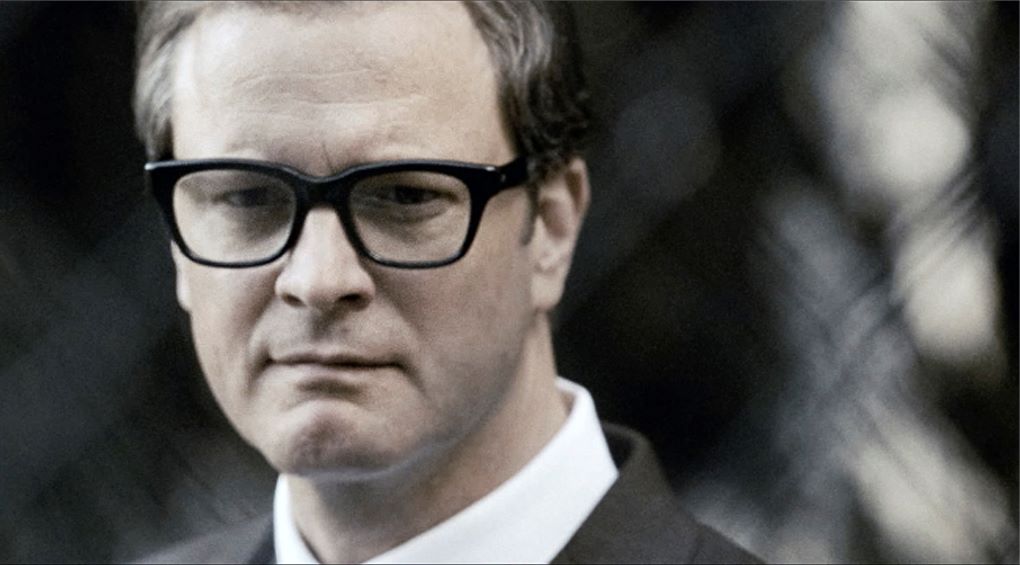
The film gains a huge amount from Colin Firth’s extraordinary performance in the lead role, hiding a seething, raw pain under a genteel and refined exterior. This seemingly cold, precise man – who dresses like a fashion model and is polite to a fault – is a tempest below the surface of loss that cannot be expressed. It’s as much the burden of putting on one face to the world, knowing there is another below the surface, that has crushed George’s spirit over the past years, as the loss of Jim. All of this is captured by Firth with exquisite sensitivity, in a perfectly judged performance.

Even George’s closest confidante Charley – his best friend, and one-time experimental romantic fling, now a depressed divorcee – can’t quite understand George’s feelings for Jim. Played with a wonderful air of domestic, middle-aged tragedy by Julianne Moore, Charley still can’t quite believe a homosexual love can ever really be the “equal” of a heterosexual one – that some part of George would have been happier if he had accepted a ‘normal’ relationship and family with her rather than the more ‘exotic’ relationship he chose. If even those closest to George can’t really see his relationship as legitimate, what chance does his apple-pie neighbourhood have of doing so?

It’s the intense loneliness – no one to share his pain with, no way to really mourn his love – that has finally beaten the will to carry on for George. Ford’s direction reflects his sense of ennui by presenting the world as coldly drained out, rich colours replaced with greyscale-tinged greys and blues. Warm colours only intrude in those moments where George consciously decides to engage, one final time, with the wonders the world has to offer, the frame filling with warmth and colour.

Ford’s elegiac film doesn’t shy away from the coldness of pain and loss. Opening with a (literally) chilling scene, as George imagines encountering Jim’s dead body in the snows, it conveys the functional distance the world can seem to have when we are dealing with life changing internal feelings. George is entrapped into tired conversations about university politics (his gaze drifts to two male tennis players, the screen momentarily filling with colour). Reflecting his fastidious nature, he carefully puts his affairs in order at the bank and catalogues keys, account details and suicide notes on his desk. All of it feels irrelevant compared to the pain within.

But A Single Man is also a hopeful film. Even when the world seems at its bleakest – when we have decided we can’t go on – there is still hope. It’s represented here by Nicholas Hoult, warm, open and honest as George’s student Kenny who intuitively identifies something is wrong with George and goes to huge lengths to try and find out what. The tenderness between the two – and the protectiveness as well as genuine smiles Kenny can promote in George – is a beat that suggests there may still be some chance of happiness in this world where we least expect it.

It’s part of the same warmth and humanity that underlies Ford’s heartfelt film, wonderfully directed. If it was a parade of bleakness, it would have far less effect. But flashbacks to George and Jim together show the joy and comfort of their lives, while the small moments of warmth and humanity in the present constantly remind us of what George’s decision will cost him.

The film’s final dark splash of irony may well be a little too on the nose, sign posted as a possibility a little too heavily earlier in the film. But, in its exploration of grief and intelligent, intense character study it’s a wonderful debut from Ford. And Firth’s extraordinary, career defining role (a year later, after winning the Oscar for The King’s Speech he thanked Tom Ford as being someone who owed a piece of the award to) is one for the ages that speaks to anyone who has ever known loss.

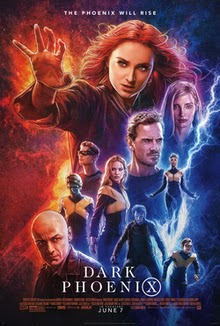
X-Men: Dark Phoenix (2019)

Sophie Turner does her best with a franchise that has finally seen better days in Dark Phoenix

Director: Simon Kinberg

Cast: James McAvoy (Charles Xavier), Michael Fassbender (Erik Lensherr/Magneto), Jennifer Lawrence (Raven Darkholme/Mystique), Nicholas Hoult (Hank McCoy/Beast), Sophie Turner (Jean Grey), Tye Sheridan (Scott Summers/Cyclops), Alexandra Shipp (Ororo Monroe/Storm), Kodi Smit-McPhee (Kurt Wagner/Nightcrawler), Evan Peters (Peter Maximoff/Quicksilver), Jessica Chastain (Vuk), Ato Essandoh (Jones)

As Dark Phoenix limps out of a cinema near you, losing the studio almost $100 million and finally consigning to oblivion for evermore an X-Men franchise that has lasted almost twenty years, it would be easy to think this must be one of the worst films in comic book history. It’s not. But then again it’s not the best. Dark Phoenix’s main problem is not really that it’s bad, more that it’s a bit meh. After umpteen films, I’m not sure there was anything new to show or tell about these mutant superheroes – and this film certainly failed to find it.

It’s 1992 and the X-Men are international heroes – something that may be going to the head of Charles Xavier (James McAvoy) who gets feted at major events and has a direct hotline to the President. On a mission into space to save a stranded space shuttle crew, powerful telepath Jean Grey (Sophie Turner) is hit by a strange cloud of glowing space power – and when she returns to Earth she finds herself struggling with a split personality, with a dangerous darker side of her personality taking control of her actions. It’s encouraged by a mysterious alien Vuk (Jessica Chastain) who wants the power in Jean Grey for her own ends. Can the X-men overcome conflict and tragedy to come together once again and save the world and Jean Grey herself from her demons?

Simon Kinberg finally takes the helm after producing and writing several other films in the series – although his promotion feels more like a failure to find anyone else interested in doing the job. General lack of real interest permeates the film, as if most of the stars only came on board because they felt an obligation to put a cap on the series. Jennifer Lawrence presumably came back in order to be killed off (no spoilers, it’s in all the trailers) while Michael Fassbender gives off the air of a man who’d rather be anywhere else. 

It’s not a huge surprise since the script goes through the motions, retelling a comic book storyline around Jean Grey’s “Dark Phoenix” personae that had already been done once (disastrously) already in X-Men: The Last Stand. Retreading the action here, this is certainly a better film (at least Simon Kinberg understands the characters and what makes them tick in a way Brett Ratner on that film didn’t) but it’s still a lot of the same story beats, similar types of location and brings it all together into a series of set pieces and moral conundrums that quite frankly we’ve seen before.

On top of which, Kinberg is not an imaginative enough visual stylist to make any of it look new. He’s not a bad director by any shot, but he’s a thoroughly middle brow one and he puts together a film that echoes and repeats stuff from the previous films in a way that never really feels fresh. Instead every single action beat or emotional moment feels like a quote from a previous film in the series, and never does the film really take fire and become its own thing.

This needed something special or new to bring the franchise roaring out in a blaze of glory. Instead it sort of meanders towards a resolution most people watching can probably already guess. Kinberg’s version of the story here also throws in several mistreads, most notably a plot line involving aliens and mystical clouds from space. Now I’m reliably told this fits with comic book lore. But much like in Spider Man 3 (remember that?!) when a blob of black alien space goo infected Peter Parker, introducing aliens into this series that has always seem grounded on Earth seems a bit – well – silly if I’m honest. Again it reminds you how slowly and carefully Marvel built up its universe stretching sand box. This ham-fistedly throws aliens of uncertain provenance into its world and somehow, despite this film featuring a hero who can shoot lasers out of his eyes, it feels a bit silly. 

It’s not helped that the aliens plot line is confused and their aims unclear or that Jessica Chastain looks non-plussed to be in the thing at all, as if she lost a bet or something. It does mean that we get a (reasonably) happy ending of our heroes coming together to fight an external threat – but even this feels like a tacked on reason to throw into the mix a clear antagonist, instead of dealing with the sort of shade-of-grey (no pun intended) antagonist who is also still sort of one of the good guys.

It’s telling that the film works best when it focuses more on character. Sophie Turner does a pretty decent job as Jean Grey, despite not being given masses to work with. James McAvoy enjoys the best storyline, of a Charles who has lost his way slightly and been seduced by fame – but deep down is still the humane, caring and loving character he has always been. It’s a new light to see the character in.

I think the main problem with this film is its lack of anything really original other than the odd beat like that. Everything as been seen before and, like X-Men Apocalypse despite the world-shaking events everything feels a bit rushed and lacking impact. Dark Phoenix is a decent enough entry into a long-running franchise and doesn’t short change you of the sort of thing you’d expect from an X-Men film. But that’s really it’s a problem. It’s a solid, average, okay entry into a long-running franchise but not the final hurrah the series needed to go out on an earth-shattering high.

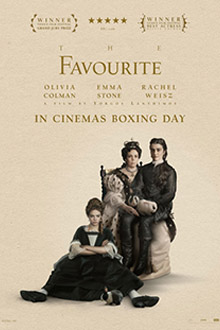
The Favourite (2018)

Olivia Colman is at the centre of a complex rivalry in The Favourite

Director: Yorgos Lanthimos

Cast: Olivia Colman (Queen Anne), Emma Stone (Abigail Hill), Rachel Weisz (Sarah Churchill, Duchess of Marlborough), Nicholas Hoult (Lord Robert Harley), Joe Alwyn (Colonel Lord Masham), Mark Gatiss (Lord Marlborough), James Smith (Lord Godolphin)

Looking around the cinema, I couldn’t help but wonder how many of the audience were expecting The Favourite to be a Sunday night-style costume drama about Queen Anne. Goodness only knows what they made of this skittishly filmed, acidic, sharp-tongued, very rude drama about squabbles in the court of Queen Anne. The Crown it ain’t.

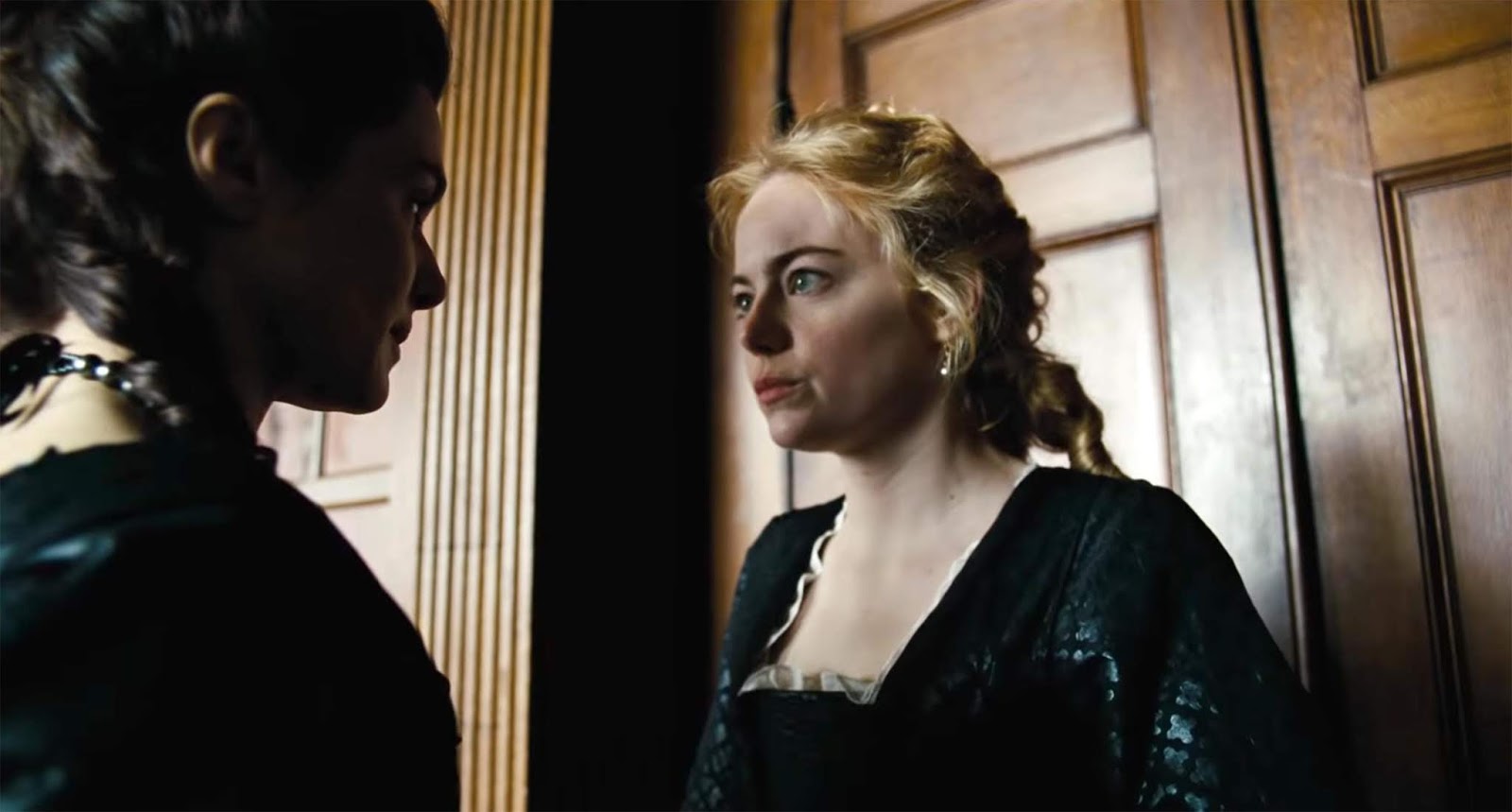
In 1708, the court of Queen Anne (Olivia Colman) is dominated completely by her head of household, chief advisor, secret lover and domineering best friend Sarah Churchill, Duchess of Marlborough (Rachel Weisz). But Sarah’s control over Queen Anne is set to be challenged by the arrival in court of seemingly charming, but in fact ruthlessly ambitious, cousin Abigail Hill (Emma Stone), a former aristocrat who has fallen on hard times. Soon Sarah and Abigail find themselves in the middle of a bitter, ruthless clash for control over Anne – who, seemingly weak-willed and disinterested in government, in fact takes an eager pleasure from the rivalry of the two women.

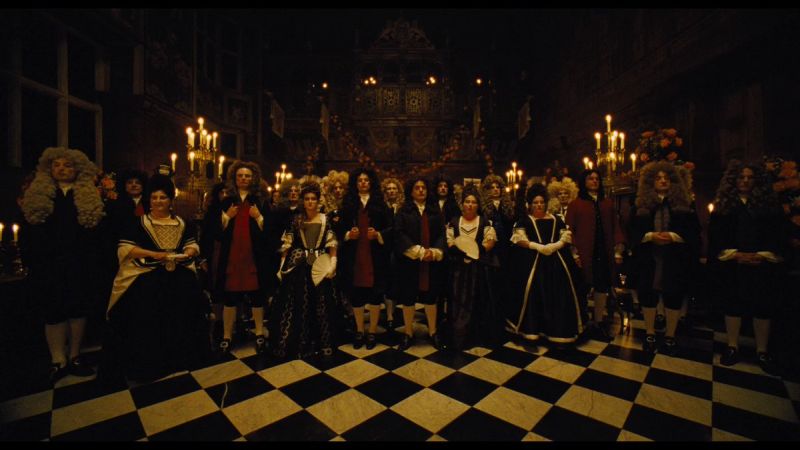
The Favourite is a brilliant, acerbic, very dark comedy that treats its period setting with a hilarious lack of reverence. It’s a frequently laugh-out loud comedy, with its often foul-mouthed dialogue just on the edge of being anachronistic (a trait that also comes into the hilarious non-period dancing). It takes a moment to tune up, but leans just enough on the fourth wall to work. Lanthimos’ film doubles down on the insane pressure bowl of Anne’s courts, turning the court of the 1700s into a bizarre, semi-surreal state where you have no idea what insanity you might see around the corner – from racing ducks, to rabbits roaming free, to a naked man being pelted with oranges. 

But then this is the sort of bizarreness that stems from the top, and Olivia Colman’s Queen Anne is a domineering eccentric. In a film-career-making performance from Colman, her Queen Anne is part infantalised puppet, part needy insecure lover, part bitter control freak. Anne will change from scene to scene from a furious, knee-jerk rage to a weeping vulnerability. Her interest in actually ruling the kingdom has been largely beaten out of her, but she still needs to feel that she holds the power. With her body raddled with gout, Anne alternates between demanding independence and being wheeled from place to place. Colman’s performance bravely skits between temper tantrums and a desperate, panicked loneliness and sadness – it’s a terrific performance.

A woman as uncertain and unhappy in herself as Anne is basically pretty ripe for control and manipulation. History has not been kind to Sarah Churchill, who is often seen as a ruthless, power-hungry manipulator only out for what she can get, obsessed with the power her role brings her. This film takes a different, more interesting slant, thanks in part to Rachel Weisz’s superb performance. Weisz plays Churchill as a strong-minded, hard to like woman, who has a genuine bond with Anne, but honestly believes she is better suited to execute the powers of royalty than her lover. But that doesn’t stop her having feelings for her – or priding herself on refusing to lie to Anne about anything (from her appearance to her behaviour). But this doesn’t stop Sarah from ruthlessly bullying Anne or threatening her – though she’s equally happy to climb into bed with her when required.

But Sarah Churchill here is doing the things she is doing because she honestly believes that it is what is best for the kingdom and (by extension) Anne, and the moments of shared remembrance between Anne and Sarah have a genuine warmth and feeling to them. Which makes her totally different from the ruthless Abigail, played with a stunning brilliance by Emma Stone. Abigail doesn’t give a damn about anything or anyone but herself: something the rest of the servants in the household seem to recognise instinctively as soon as she arrives, but a danger Sarah doesn’t detect until too late. Abigail’s every action is to promote her own wealth and prestige, and she’ll do whatever it takes to do that, from crawling through the mud for herbs to crawling between the sheets to pleasure Anne at night. Stone’s Abigail is ruthless, self-obsessed, uncaring and on the make in another terrific performance.

The film focuses in large part on the see-sawing fortunes of these two rivals for the role of favourite – with Anne as the fulcrum in the middle. The film is split into eight chapters, each of which is opened by a quirky quote from the chapter itself. It neatly structures the film, and also gives it a slight off-the-wall quality. The film is packed with electric scenes, as the women wear the trousers in the court (often literally, in Sarah Churchill’s case), riding and shooting in their spare time and slapping down the assorted politicians and lords desperately trying to promote their interests on the edge of the court. This battle of wits and wills is a fabulous, increasingly no-holds barred, rivalry that motors the film brilliantly.

Lanthimos loves every moment of scheming and double crossing the film supplies. He shoots the film with a selection of low-angle and fisheye lenses, which make the palace settings seem as imposing, large and domineering as possible – and also distorts the world just as the feud between the two women is doing. The film looks fabulous, with its intricate design and it’s candle lit lighting. Lanthimos’ court always looks gloomy and secretive, with only a few spots of orange warmth.

Lanthimos also understands that there is very little room for sentiment or feeling here, and the flashes of it we get are never allowed time to really grow. That’s not a negative of course, as this sharp comic drama is also an arch commentary on some of the selfishness and distortion of events that lies under politics (sound familiar?), with the interests of the ordinary people of the realm raising very little interest from any side on the political divide. And Anne is such a bizarre character, so pulled between pillar and post, so desperately unhappy so much of the time, so utterly spoilt the rest, that you understand how she has become such a chew toy for court faction, and why she is happy to tacitly encourage this world where her every whim is played to for advantage.

I laughed out loud several times during The Favourite. It’s obvious to say that it feels like a film for the #metoo era – but it certainly has three fabulous, brilliant, hilarious and strangely heartfelt performances from its three female leads, three of the best actresses in the business. Wonderfully directed, beautifully written and fabulously designed, this is properly fantastic cinema.

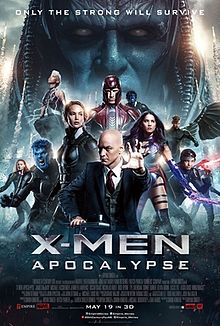
X-Men Apocalypse (2016)

Oscar Isaac destroys something else (again) in misfire X-Men Apocalypse

Director: Bryan Singer

Cast: James McAvoy (Charles Xavier/Professor X), Michael Fassbender (Erik Lehnsherr/Magneto), Jennifer Lawrence (Raven/Mystique), Oscar Isaac (Apocalypse), Nicholas Hoult (Hank McCoy/Beast), Rose Byrne (Moira MacTaggert), Evan Peters (Peter Maximoff/Quicksilver), Tye Sheridan (Scott Summers/Cyclops), Sophie Turner (Jean Grey), Olivia Munn (Psylocke), Kodi Smit-McPhee (Kurt Wagner/Nightcrawler), Alexander Shipp (Ororo Monroe/Storm), Lucas Till (Alex Summers/Havoc), Josh Helman (Colonel William Stryker), Ben Hardy (Angel)

Where do you go with a franchise when you are on at least your second timeline (maybe more, who knows?) and earth-shattering destruction has been done so many times before? At one point in this movie, our young heroes head to the cinema to watch Return of the Jedi – with a genre savvy conversation following on whether the third film in a franchise is always the worst. You’d like to think if you were going to pop such a hostage to fortune in the third film of your franchise, then you’d be busting guts to make this film as stand-out as possible. Doesn’t happen.

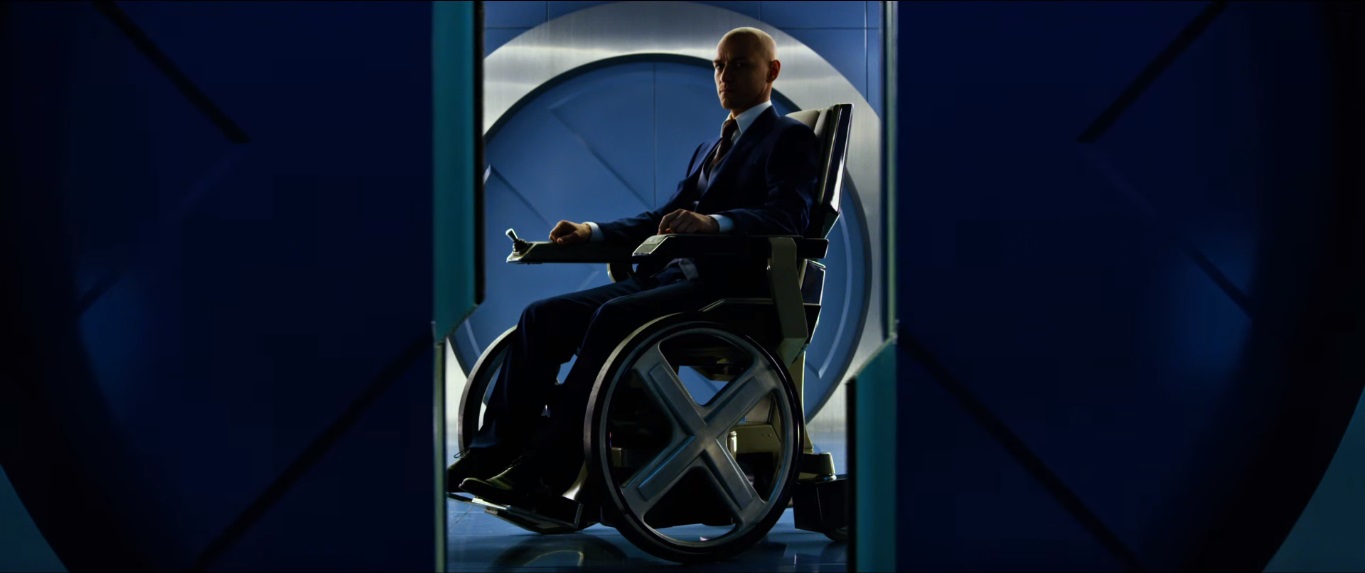
It’s 1983. Charles (James McAvoy) is still running his school with Hank (Nicholas Hoult). Raven/Mystique (Jennifer Lawrence – looking for every single second as if she is only there by contractual obligation) is saving mutants left, right and centre on the underground. Magneto (Michael Fassbender) is living incognito in Germany with a wife and daughter. All that is about to be thrown into chaos when Apocalypse (Oscar Isaac, trying his very best to make an impression under piles of make-up), the very first mutant, rises from imprisonment after thousands of years. The most powerful mutant in history, he decides the world is ripe and ready for the taking.

In X-Men: Apocalypse, not only is more not more, but the film churns out emotional character and relationship beats, covered to exhaustion in other movies. One glance at Magneto’s family and anyone who has ever seen a movie is going to know they are not long for this world. Raven and Charles no sooner appear in the same frame than you know the two of them are going to struggle to reconcile their past with their different viewpoints. We’ve seen it all before – and you feel, in the slightly disengaged performances, that the cast have had enough as well. Even Apocalypse, for all his world-altering power, basically has the same agenda as every mutant villain this franchise has ever had before: Mutant Superiority. 

Around these familiar plot beats, we get action that also feels culled from before. The film culminates in such earth-shattering destruction you really feel it should be more exciting, but instead it feels tediously familiar. How many times have we seen cities devastated like this? It’s such a cliché that the millions of people who must have died in the planet-wide obliteration that consumes the final third of the film don’t even merit a mention. It’s like the world treats this global destruction with the same meh that you feel a number of the film’s viewers do. 

But then the whole film has a weary sense of inevitability about it, of going through the motions. The plot makes little or no sense. Apocalypse is awoken by a cult we never hear from again, the whole film takes place in a few days, barely enough time to build up any sense of peril – but also somehow too short a time for the vast number of comings-together of different characters to feel natural. Characters from past films are thrown in willy-nilly, often for no real reason. So from the first scene we have Moira MacTaggert and Havoc back from the first film, then Quicksilver is back to repeat his bullet-time action from Days of Future Past (saying that, this sequence, as Quicksilver rushes to save people from an exploding mansion to the tune of Sweet Dreams, is the most vibrantly enjoyable moment in the film). We even get Stryker back, a character who becomes more and more of a cartoony villainous idiot each time he appears.

In between these points, the film frequently misses its beats. Apocalypse’s assembled group of mutant followers are assembled with such casual indifference (Apocalypse basically seems to pick up the first four mutants he meets) that their characters and motivations barely register. Obviously we know Storm is destined to be a goodie, so we get a few seconds of establishment that she is basically a goodie. Magneto gets his painfully predictable backstory (Michael Fassbender is by the way totally wasted in this movie, forced to repeat the same notes over and over again from the last two films). The other two barely make an impression – other than perhaps Olivia Munn’s unbelievably fanservice costume.

But it also makes more serious errors. A hideously distasteful moment sees Magneto destroy the whole of Auschwitz in a rage. There is, quite frankly, something more than a little stomach turning about the site of a real atrocity – where millions died – being blown away on screen like any other major landmark. Even more disgusting to have it serve as a shallow, over-exploited “he feels pain because he was in the Holocaust” moment. Other times in this series this link has worked – here it manifestly doesn’t.

About the only thing that really works here is the darker interpretation of Charles – McAvoy making it clear that events have made Xavier far more willing to go to dangerous ends to protect his family – and there is a neat replay of the first conversation between Xavier and Magneto from the very first film in the franchise, with the stresses all changed to show that their positions have developed in a far different way in this new timeline. But that’s the only real moment that feels new.

But I’ve still got a certain affection for these X-Men movies, and this isn’t the worst one they’ve ever made (that’s always going to be X-Men Origins: Wolverine), but it’s up there. It somehow doesn’t feel special, more like a film that had to be made for legal and financial reasons, rather than because there seemed like a decent story to be told, or something unique to be said. The rushed plot and lack of engaging characters make more sense when you think about it like that. It’s nothing special at all, and seems to pass in front of your eyes and then just as quickly out of your memory.

Mad Max: Fury Road (2015)


George Miller’s Mad Max: Fury Road – a crazy car chase film

Director: George Miller

Cast: Tom Hardy (Max Rockatansky), Charlize Theron (Imperator Furiosa), Nicholas Hoult (Nux), Hugh Keays-Byrne (Immortan Joe), Rosie Huntington-Whiteley (The Splendid Angharad), Nathan Jones (Rictus Erectus), Riley Keough (Capable), Zoë Kravitz (Toast the Knowing), Abbey Lee (The Dag), Courtney Eaton (Cheedo the Fragile), Josh Helman (Slit)

Sometimes films seem designed to give you a visceral thrill, to throw you into an experience and see whether you sink or swim. To pull off that sort of hard-edged momentum, you need a film-maker skilful enough to create an addictive energy that never slackens and never gives you a second to question the film while it’s going on. Mad Max: Fury Road has such a director in George Miller, and its demented, high-octane excess, married with a film-making style that felt modern, vibrant and grounded in reality, surprisingly made it one of the most acclaimed films of 2015.

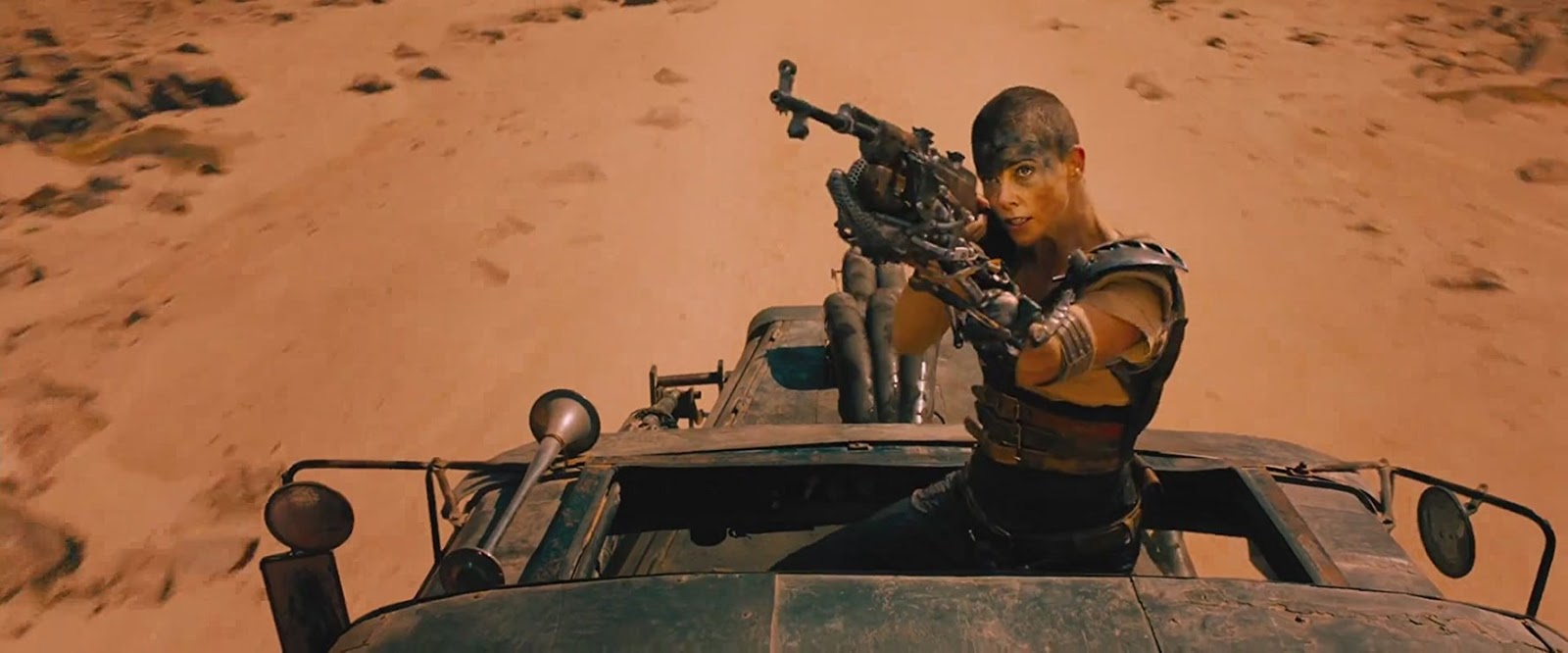
In a post-apocalyptic future Australia, the world is a ruined desert and basic requirements like water, greenery and fuel are more valuable than anything. In a rocky outcrop, cult-leader Immortan Joe (Hugh Keays-Byrne) rules one of the few populations by controlling access to the water. “Road warrior” Max Rockatansky (Tom Hardy) is captured by Immortan Joe’s warriors and put to work as a “blood bag” to transfuse into Immortan Joe’s warriors. However, this coincides with a planned escape by Immortan Joe’s wives (the few remaining women capable of conceiving children). Led by road warrior Imperator Furiosa (Charlize Theron), the women flee to find a mysterious paradise in the wilderness. Cue an almighty chase and running battle between Furiosa’s road carrier and Immortan Joe’s forces, desperate to reclaim the wives.

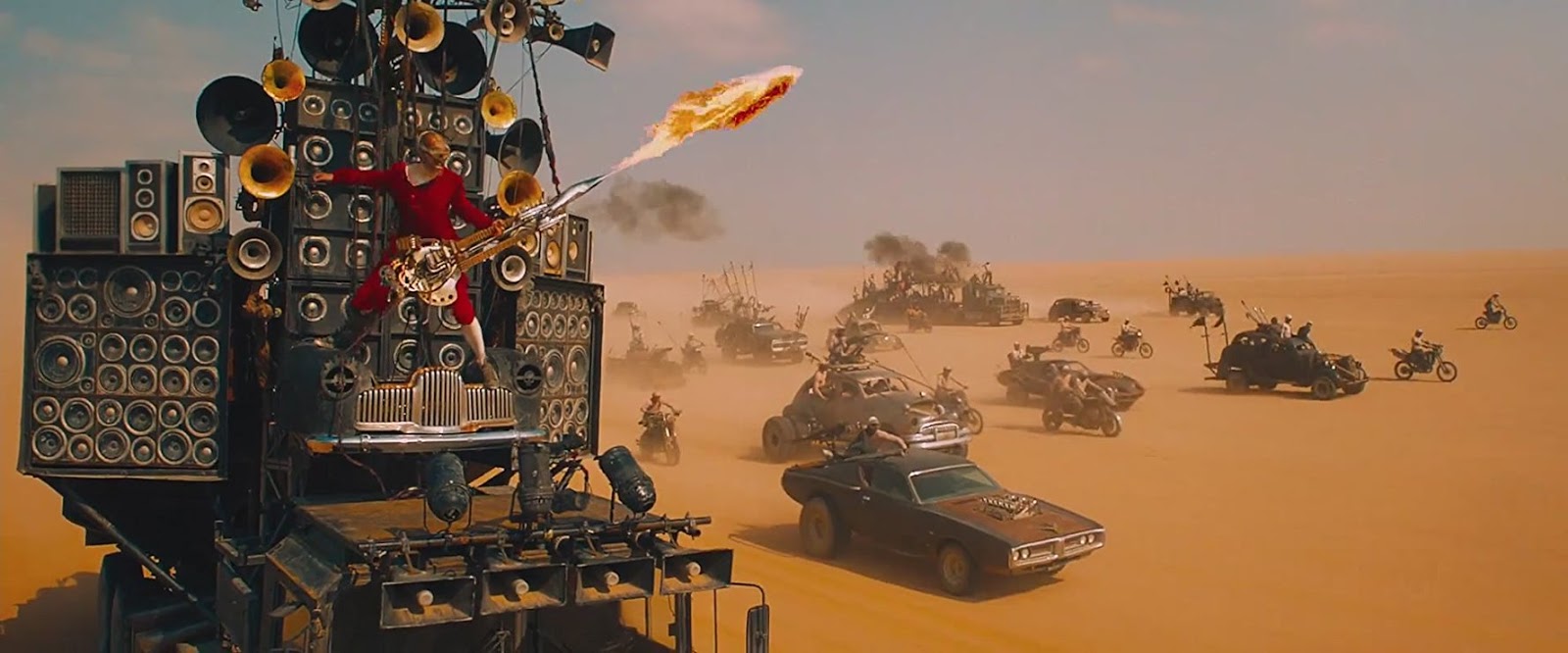
Mad Max: Fury Road is a bizarre, extreme, surreal thrill ride, a high-octane road chase, crammed with action, thrills and dynamism. It’s directed with extraordinary vibrancy by George Miller, who makes it fresh and scintillating. Miller crams the action and design with an explosion of style. Everything is amped up to 11, from the look to the characterisations and motivations. But what makes this such a well-directed film is that Miller shoots much of it with careful, professional clarity: so many other films would be cut with a frantic craziness, but this has a polished traditionalism to it. Basically Miller knows the actual content of the story is “insane” enough that he doesn’t need to gild the lily with bizarre, swooping camera angles or choppy editing. 

That’s partly why this film has had such a strong positive reaction. While being insanely OTT, it’s actually quite an old-fashioned piece of film-making, and it looks like a lot of it was shot for real on location, using real practical stunts. This may or may not be the case, but it certainly looks like this. And in an era where so many action films are about superheroes, and crammed with special effects, to have a world where things feel grimy and real, where the objects we are watching feel like they exist, is like a breath of fresh air. The design throughout the film accentuates this sense of reality. It makes things feel like they have depth and force. It immediately adds stakes to the action.

That action takes place in a unique looking world. The visuals in this film are crazy. The design of Immortan Joe’s half-nude soldiers, with their silver paint aerosol and petrol smeared faces, is terrifyingly cultish. The look of the many different vehicles is immediately striking, with each being clearly of the same world, but each distinctive in look, like some Wacky Races. The steampunkish mix of cobbled-together remains of technology to create the cars and trucks is brilliantly done. It’s a film that looks like nothing else, and shot with radiant streaks of yellows and blues, mixed with scenes shot in almost painterly black and white. It’s an explosion of style, but not straining too hard to force itself upon you like so many films do. 

The film also has a simple structure and storyline, that allows it to focus on the action. It’s slick, steamlined and very focused. The villains are clear, and their motivations easy to understand. They are presented with a certain depth, but their essential villainy is easy to have a gut instinct against. This also helps us bond with our heroes – despite the fact that most of the wives have only the most briefly sketched of characters. But we totally understand their position, fear and desire for freedom. Just as the film is a primal explosion of “fight or flight”, so are the feelings our heroes carry. Everyone can relate to them.

It’s also great that this is an action film where the women largely drive (literally!) much of the action. The film may have the Mad Max name on it, but the true lead of the film is Furiosa. It’s her actions that drive the film, it’s her conflicts that are at its heart, the film is her journey and Max is largely along for the ride (again literally!). Charlize Theron is very impressive in the lead, a strong warrior woman, but also someone with a buried poetic soul and a clear emotional arc. Tom Hardy delivers as the grizzled Max, but this is very much Theron’s film.

Mad Max: Fury Road is an exciting and engrossing film. But it’s made with such professional inspiration on the visuals that it invites people to read into it a lot more depth than I think is actually there. It’s got such old-fashioned control and brilliance to it, while being so explosive and vibrant, that it’s tempting to read into it a thematic complexity. Let’s be honest, this is a chase movie. It’s a hell of a chase movie, but it’s a chase movie.

It may be set in a world of post-apocalyptic totalitarianism, but it’s not trying to tell us anything hugely original about what such a world may be like. It creates such a world with huge inventiveness, but it’s not an enlightening film. Similarly, this is a film that places women at the centre of its action, but I’m not sure you could call it a film that has much to say about feminism. Most of the women in this film are still defined primarily by their breeding abilities. Furiosa may be the leader, but most of the rest of the women are under her protection. The film does something different with gender, but it also does a lot of quite traditional things. 

It’s really tempting to see great symbolism in such a dynamic and striking piece of film-making. But thematically there isn’t much there. Miller directs a film that is brilliant too experience, so brilliant you expect there to be more at its heart. In truth there isn’t really – it’s largely what it appears to be on the tin. There’s nothing wrong with that though. You just need to know what you are going to get. This is not some great game changer of a motion picture, that will reinvent and reposition the genre. It is a skilfully made and compelling chase movie, where a group of people run to a point, turn around and head back, being chased all the way. It’s shot with a near poetic, old-school brilliance – but it’s still just a chase movie. Accept it as that – a high-octane action thriller – and you will be swept away. Look to it for the thematic depth some have claimed it carries and you will be disappointed.