
Tag: Nick Offerman

Mission: Impossible: The Final Reckoning (2025)

Mission: Impossible: The Final Reckoning (2025)

Cruise’s final mission is really a tribute to the star himself and his never-ending force of will

Director: Christopher McQuarrie

Cast: Tom Cruise (Ethan Hunt), Hayley Atwell (Grace), Ving Rhames (Luther Stickell), Simon Pegg (Benji Dunn), Esai Morales (Gabriel), Pom Klementieff (Paris), Henry Czerny (Eugene Kittridge), Angela Bassett (President Erika Sloane), Holt McCallany (Serling Bernstein), Janet McTeer (Secretary Walters), Nick Offerman (General Sidney), Hannah Waddingham (Rear Admiral Neely), Tramell Tillman (Captain Bledsoe), Shea Whigham (Briggs), Greg Tarzan Davies (Theo Degas), Charles Parnell (Richards), Mark Gatiss (Angstrom), Rolf Saxon (William Donloe), Lucy Tulugarjuk (Tapeesa)
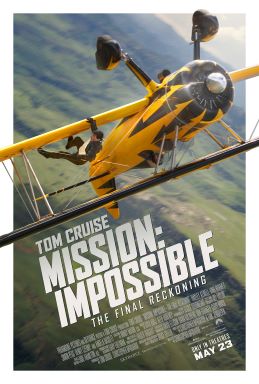
Almost thirty years after the first film trotted into the cinema, Tom Cruise signs off (he claims) his franchise of death-defying stunts with a final entry that dials the global threat up so far you can almost hear the desperate whirring as the doomsday clock tries to keep up. Mission: Impossible: The Final Reckoning is big in every single way, packed with set-pieces, dense procedural plot mechanics that require reams of exposition, global annihilation round every corner and at the centre the towering, chosen-one aura of Ethan Hunt himself, the only man who can save the world.

The Final Reckoning takes off a few weeks after the now-rechristened Dead Reckoning (after it under-performed they didn’t want to scare people off with a Part 2 subtitle). AI demigod The Entity is hellbent on gaining control of the world’s nuclear arsenals so that, having presumably binged Terminator, it can SkyNet-like wipe out humanity. Ethan (Tom Cruise) is on the run, but he has a plan. Dig out the sunken Russian sub where the Entity was ‘born’, fish out its source code, hook it up to an Entity-killing virus and trap the AI would-be-overlord in what’s essentially a glowing USB drive. This mission will involve lots of running, fighting, defusing of nukes, diving to the bottom of the ocean, jumping between bi-planes mid-flight… he might as well chuck the kitchen sink as well.

Mission: Impossible: Final Reckoning has plenty of fun, even if it is hellishly overlong. It’s the sort of crowd-pleaser that gets people clapping at the end (as several people in my packed-out screening did). When the stunts come, they’re hugely well-staged. As always the Tom Cruise USP is front-and-centre: if you see him do it, he did it. Yes, Tom really did jump out of a naval helicopter into the raging Atlantic. Yes, that really is Tom, climbing over a speeding bi-plane thousands of feet-up with only a pair of goggles to keep him safe. It’s no-coincidence the villain is an AI who creates an artificial digital reality. The Mission: Impossible films are all about it keeping it solidly real.

But, once the initial adrenaline rush subsides, I’m wondering if its pumped-up thrills are going to be a bit more wearing second-time around. What struck me about The Final Reckoning is, that for all the huge amount of stuff going on, there is precious little heart in it. More than any other M:I film since the little-loved M:I:2 (practically the only film in the franchise not to get a shout-out here), the act of saving-the-world here is a job for one never-wrong superhuman. Cruise does almost everything, his team’s main role being getting into the right place to send him a message or wire up a computer. On top of that, the best of the series set-pieces had flashes of Ethan’s stress, fear and sense of ‘I cant believe I have to do this’ humour – all of that is mostly missing here.

The Final Reckoning loses a lot of the heart of what made the earlier films so rewarding. It loses the moments of friendship or sparky interplay between the team. Cruise and Pegg, the series main comic relief, share almost no scenes together. Klementoff and Davies do virtually nothing as new team members, other than shoot guns and get captured. Cruise shares more time with Atwell, but the bizarre is-it-a-romance-or-not between them is as oddly undefined as Ethan’s relationship with Rebecca Ferguson’s Elsa was (in fact it makes you realise the most sexual thing Ethan has done since film three is hold someone’s hand). Cruise is so often on solo missions, that the film could probably have dispensed with the team altogether with only a small plot impact.

The film only affords to slow down to give Ving Rhames (the only other guy to appear in every film) a moment of genuine emotion – though special mention must go to Rolf Saxon and Lucy Tulugarjuk who from small moments craft characters I genuinely grew attached to and worried about. Otherwise, the bonds of friendship that powered the franchises most successful non-stunt moments are absent. In fact, also missing are the heist caper set-pieces – even the famous face-masks are only employed very briefly.

The Final Reckoning dials the stakes up so much, they are effectively meaningless. In previous films, high-stakes were mixed with personal ones: we were always more invested in whether Ethan save his friends rather than the word. The film also struggles without a real antagonist. Its nominal human opponent, Esai Morales’ Gabriel, little more than a smirk and an obstacle. Shorn of the most-interesting element of his character – his fanatical loyalty to his AI master – Gabriel is neither particularly interesting or a threat. In its vast runtime, Final Reckoning has no time to actually explore what the personal link between Ethan and Gabriel actually was, making you wonder why on earth they bothered to put it in both films in the first place.

It’s not helped by the fact that the film is so constantly in motion, that virtually every single scene of dialogue is about communicating what’s going to happen next. There are constantly (admittedly skilfully batted around) conversations explaining why Ethan has to go there, get this, bring it here, do this to it, put it in that all within a ridiculously small window of time. Sometimes, to shake it up, we cut across to the US bunker where a gang of over-qualified actors (Bassett, Offerman, McCallany, McTeer and Gatiss) similarly explain what the Entity is doing to each other. (Although, like Rhames, Bassett gets the most interesting stuff to actually act as a President facing a Fail Safe like terrible choice).

What you realise is that The Final Reckoning is pretty confident that what really pulls the audience in is Tom Cruise doing crazy stunts, so that’s what it gives us. In fact, rather than a tribute to the series (despite closing plot points from Missions 1 and 3) what the film really feels like is a tribute to Cruise, the last man-standing among the old-fashioned superstars. Most of the dialogue puffs up Cruise’s Ethan into Godlike status (it’s not quite “living manifestation of destiny” like Rogue Nation put it, but close). Cruise carries out two extended fight scenes in his pants (though if I looked like that at 61 so would I). No other actors intrude on his stunts or messianic sense of purpose.

Which is amazingly done of course. Literally no-one does it better than Cruise. The fact that the movie feels like Cruise effectively shot most of it alone with just the crew, means it almost doesn’t matter that its plot is merely to link together set-pieces. And if someone deserves a victory lap – which is what this is – then that guy is Cruise. I’d have wanted more of the fun, humour and warmth that made most of the other films such massively rewarding hits. But The Final Reckoning gives more of what the series does that no other series does. And I guess that’s a fitting finale.

Civil War (2024)

Civil War (2024)

An eye-catching concept disguises a film more about journalistic ethics than politics

Director: Alex Garland

Cast: Kirsten Dunst (Lee Smith), Wagner Moura (Joel), Cailee Spaeny (Jessie Cullen), Stephen McKinley Henderson (Sammy), Nick Offerman (President of the United States), Sonoya Mizuno (Anya), Jefferson White (Dave), Nelson Lee (Tony), Evan Lai (Bohai), Jesse Plemons (Militant)

A third-term President (Nick Offerman) speaks to an America torn apart by Civil War. It’s an attention-grabbing opening but actually, in many ways, politics is not the primary focus of Civil War. Rather than a state-of-the-nation piece, Garland’s punchy work is a study of journalism ethics. Should journalists have any moral restraint around the news they report? Civil War covers the final days of its fictional civil war, as four journalists – celebrated photo-journalist Lee Smith (Kirsten Dunst) and her reporter colleague Joel (Wagner Moura), veteran correspondent Sammy (Stephen McKinley Henderson) and would-be war photography who idealises Lee, Jessie (Cailee Spaeny) – travel to Washington in the hopes of capturing the photo (and interview) with the President before his defeat.

Perhaps worried about accusations of political bias, Civil War keeps the causes of its war – and, often, even which sides we are interacting with at any given moment – deliberately vague. There is a throwaway reference to Lee having gained fame for a photo of “the Antifa massacre”, phrasing which doesn’t tell us if Antifa were victims or perpetrators. California and Texas – unlikely bedfellows to say the least – have allied to form the Western Federation. We learn nothing about the President, other than casual name-checks comparing him to Gaddafi (he does vaguely resemble vocally, in his brief appearances, Trump). But so universal are the politics of Civil War it could, without changing a thing (other than wifi access) be as easily set in the time of Clinton or Reagan as Trump and Biden.

Instead, Garland’s point seems to be more if there was a civil war in the Land of the Free, the chaos we could expect to see would be no different than the chaos that has occurred in any number of other locations. On their journey, the journalists encounter UN-run refugee camps, lynch mobs, summary executions, street-by-street fighting, mass graves of civilians and a collapse of anything resembling normal life. We’ve seen the same sort of images countless times on TV, and it matters not a jot that the backdrop now are the streets of DC rather than, say, Mogadishu.

Instead, Civil War becomes the sort of ethical discussion you could imagine in a journalism school seminar. Lee is plagued with troubling memories of conflicts passed, where we see her photographing at intimate range, war crimes, atrocities and shootings without a flicker of emotion. It doesn’t take long for the viewer to find this passive observation of death uncomfortable. It’s something I already felt, watching Lee in the film’s opening photograph a riot over a water truck, camera clicking mere centimetres from civilians laid low by truncheons. When an explosion occurs, her first instinct (after pushing Jessie down to avoid the blast) is to reach for her camera, not to help.

Although showing journalists as brave – putting themselves in harm’s way to bring the readers and viewers at home the truth – Civil War subtly questions the profession of war reporter, people often excitedly pounding the streets alongside killers. Lee’s mentoring of Jessie seems focused less on camera skills, and more on drilling into her the need to disconnect with the world around her. To see herself an observer, whose duty is to record events not to intercede. This boils down to a central idea that Civil War will repeat: if I was killed, Jessie asks, would Lee take the photo? This question becomes the dark heart of Civil War.

We increasingly realise many of the journalists are adrenalin junkies, hooked on the buzz from following in soldier immediate footsteps. “What a rush!” screams Joel after they drive away from a battle that ended with a series of summary executions. Many of the journalists don’t consider they hold any moral connection at all for what happens in front of them. It never occurs to them to attempt to prevent an act of violence or argue against something they see. You start to get the chilling feeling that some of them would as unprotestingly followed the Wehrmacht through the Eastern Front and recorded mass executions with the same emotional disconnection.

The journalists also have a cast-iron belief in their own inviolability, believing the simple waving of their press badge will be guarantee them safety. This delusion is seriously shaken by an encounter with a terrifying, mass-grave filling soldier played by a dead-eyed chill by Jesse Plemons. Even in the tragic aftermath of this, Joel’s grief at the loss of friends and colleagues is also tinged with regret that their potential missing of a crucial story means it was also all for nothing.

Only Lee – an excellently subtle performance by Kirsten Dunst, with the flowering of doubt and regret behind her eyes growing in every scene – shows any growing sense of the ghastly moral compromises (and even collaboration with the grisly things they witness) the journalists have made. It makes an excellent contrast with the increasingly gung-ho and risk-taking Jessie (an equally fine Cailee Spaeny), who becomes as hooked on the adrenalin rush of combat as Joel is.

Garland explores all this rather well under his flashy eye-catching concept. The film is shot with a grimy, visceral intensity – punctuated frequently with black-and-white freeze frames showing Lee and Jessie’s photos, which reaches a heart-wrenching climax for one pivotal scene. Interestingly it’s the dialogue and plotting that sometimes lets Civil War down: its character arcs verge on the predictable and the characters have a tendency to fill themselves in on events with on-the-nose journalism speak.

Civil War culminates in a well-staged gun battle towards the White House in Washington that, like much of Civil War’s America-based concept is about the shock of seeing these things “happening here” rather than in a land far away “of which we know nothing”. But this teasing of a political comment disguises the film’s real intent, a careful study of the moral complexities of reporting horrors rather than stopping them, of becoming so deadened to violence a friend’s death becomes a photo op. Civil War might be one of the most subtle questioning of journalistic ethics ever made, presenting it not as an unquestionably noble profession but one of moral compromise and dark excitement-by-proxy at death and slaughter.

The Founder (2016)


Michael Keaton accepts the praise as Founder of the McDonalds Business Empire

Director: John Lee Hancock

Cast: Michael Keaton (Ray Kroc), Nick Offerman (Richard McDonald), John Carroll Lynch (Maurice McDonald), Linda Cardellini (Joan Smith), B.J. Novak (Harry J. Sonneborn), Laura Dern (Ethel Kroc), Justin Randell Brooke (Fred Turner), Kate Kneeland (June Martino), Patrick Wilson (Rollie Smith)

McDonalds. The Golden Arches are ubiquitous, not just in America but across the whole world. But how did this happen? How did a small business – just one stand in a small town in America – suddenly become a global monolith?

Ray Kroc (Michael Keaton) is a luckless travelling salesman, selling supplies to drive-in diners. In California he encounters a diner the likes of which he has never seen before: a walk-up restaurant serving high quality food in disposable packaging, instantly. The business is McDonalds, run by brothers Dick (Nick Offernan) and Maurice (John Carroll Lynch). Kroc instantly recognises the potential of the business, and strikes a deal to franchise the formula across America, although the McDonald brothers will maintain control over all changes. Kroc, however, has the drive and ambition the McDonald brothers lack – and he slowly begins to stretch and expand the deal, taking on more and more power. Eventually he will become “The Founder” of the business that bears his original partners’ names.

What’s interesting about The Founder is that it has a certain element of wanting to have its cake and eat it. It’s simultaneously a semi-celebration of American entrepreneurship and a condemnation of big business crushing the little guy. This sounds like it should make for a confusing film but actually it kinda works. It fits the complex world of major business successes – someone like Kroc had the skills and the ruthlessness to actually make McDonalds into a global super-company in a way the McDonald brothers never did. At the same time, Kroc is clearly incapable of creating anything himself (even most of his business-building ideas come from other people) and the McDonald brothers have the real “American” entrepreneurial invention to create something new.

So the film becomes an engaging story of how businesses grow and develop, which largely manages to remove Hollywood sentiment from the equation. Kroc isn’t exactly a hero – he’s selfish, ruthless and places himself first constantly – but he’s not exactly a villain either. He’s a downtrodden striver, who has too continually push to be accepted by those who look down on him. He has a sense of loyalty and love for his brand – even while he begins to shut the McDonald brothers out of their own business. Similarly the McDonald brothers have a homespun honesty to them, but they are also naïve and unrealistic in their demands and desires for the business.

The film relies a lot for its success on Keaton’s slightly tragic desperation in the lead role, his yearning to improve and better himself. The first half of the movie shows his charm but also demonstrates his business acumen, his genius in recognising that what the McDonald brothers have invented could work on a huge scale. He’s hard-working and initially luckless, and the snobbish knock-backs he receives from banks and investors when peddling an idea get us on his side – after all we know it’ll be worth billions. It’s a Capraesque spin: he’s the little guy bucking against the system who becomes the very monolithic monsterous system himself. We can’t even be certain where we see the flip.

What becomes clear is that Kroc himself is somehow empty, somehow slightly devoid of depth, a man able to move smoothly from concept to concept with no lingering sense of guilt. He discards the McDonald brothers (after copyrighting their name) with as much calmness as he drops his wife (Laura Dern, in a thankless part as The Loyal Wife). Despite this though, the film never brings itself to condemn Kroc. It’s a little in love with the chutzpah of Kroc’s success and his persistent positivism, while seeing those he has had to drop on the way as tragic victims of the monolithic American business success Kroc has created.

We are invited to have similar sympathetic feelings about the hapless McDonald brothers: innocents in a world of business, able to create something that can change the world but hopelessly incapable of translating it into the type of scale that it could achieve. The film doesn’t forget that the McDonald brothers are the victims here, and Offerman and Lynch are both superb as two brothers with a deep personal bond and a love for their business and each other. But it also partly follows Kroc’s line – these two do not have the vision and ambition to take their idea to the next level. They are innovators but they are small-scale ones. The film daringly doesn’t just take their side as the little guys crushed by the system; it also allows itself to consider if they to a certain extent failed themselves. They never learn either, accepting Kroc’s handshake agreement for future royalties at the end of the film, an agreement we are all too aware even when it is happening will probably never be met.

The film has a certain love for the Americana of McDonalds and fast food joints, and it’s both an advert for the triumph of the business (the customers are all uniformly happy, and the ordinary employees in Kroc’s empire are all wonderfully warm) and a sad testament to the small businessman being swept aside by the big company. It’s quite a feat for the film to manage both at the same time and remain coherent. It’s both an advert for and attack on McDonalds, but it holds both these ideas simultaneously at the same time really well. Well worth a watch.