
Tag: Nigel Patrick

The League of Gentlemen (1960)

The League of Gentlemen (1960)

Gentlemen don’t get mad: they get even in this fun, well-structured heist movie

Director: Basil Dearden

Cast: Jack Hawkins (Lt Col Norman Hyde), Nigel Patrick (Major Peter Race), Roger Livesey (Captain “Padre” Mycroft), Richard Attenborough (Lt Edward Lexy), Bryan Forbes (Captain Martin Porthill), Kieron Moore (Captain Stevens), Terence Alexander (Major Rupert Rutland-Smith), Norman Bird (Captain Frank Weaver), Robert Coote (Brigadier “Bunny” Weaver), Nanette Newman (Elizabeth Rutland-Smith)

You throw a gentleman on the scrap heap at your peril. After a lifetime of service, Lt Colonel Norman Hyde (Jack Hawkins) has been made redundant – and, to put it bluntly, he’s pissed off. However, a gentleman doesn’t get mad, he gets even. And what better way to do that than using your army training to mastermind the finest bank heist Britain has ever seen? To pull it off, Hyde recruits a team of similarly disgruntled Army officers (all cashiered from the army for a range of offences, from theft to implied sexual demeanours) all of them highly trained specialists. What could possibly go wrong?

The League of Gentlemen was the first film from a short-lived British production company Allied Films. The company was a partnership between Dearden, Hawkins, Attenborough (who did a lot of the producing) and Forbes (who wrote the film’s witty, playful script). The film is a delight, a wonderfully executed heist movie, told with an archness that turns its criminals into sympathetic rogues. It’s really a sort of dry comedy and gets a lot of fun out of British attitudes at the time.

For starters, who would think that gentlemen like this (war heroes for goodness sake!) would ever be involved in anything so naughty as armed robbery? Especially in a country so deferential that – in a cunning raid to pinch guns from a military base – conman “Padre” (Roger Livesey, riffing delightfully on his Blimpish persona, as a conman with a shady past) simply turns up dressed as a superior officer and is instantly accepted as such. Just to complete the satire of prejudices at the time, the members of the team lifting the guns are ordered to speak with Irish accents as after all “We British never give the Irish the benefit of the doubt”, and even the a whiff of an Irish accent will whack the blame straight onto the IRA.

But this also a film having a bit of fun with demobilised fellows who have never quite found their place in civvie street – and may even miss the glamour and excitement of the war. Most of the team are clearly veterans of WW2, and many of them are struggling with demanding landlords, unfaithful wives or dismally dull jobs. How could they resist saddling up for one more grand adventure? Especially when there is a huge suitcase of money waiting for them at the end of it.

Dearden’s direction is taut, sharp but also gives more than enough room for the character comedy. He stages the heists with a briskness and efficiency that you can imagine Michael Mann being quite pleased with (the gas mask wearing, gun totting soldiers have more than a passing resemblance to the robbers in Heat – enough to make you think Mann may have watched this film somewhere along the line). Dearden’s storytelling is clear, well staged and inventive (the raid on the army base is shown to us without briefing, meaning we work out the plan as it progresses).
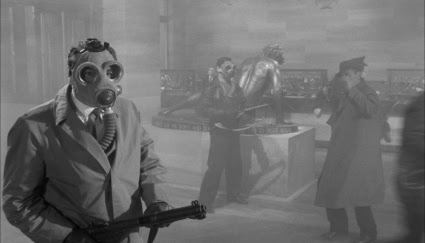
He’s helped enormously by Bryan Forbes’ fun and quotable script, that swiftly but skilfully distinguishes the characteristics of each man and their motivations and makes a perfect balance between affectionate comedy and the sharpness of danger (the group make clear they will “do what’s necessary” if pushed, even if they aim is no bloodshed). The film is built around several wonderful set pieces – and has a classic, almost pre-James Bond parody opening as Hawkins emerges from a manhole cover dressed in a dinner suit and climbs into a car.

Hawkins is great here, spoofing the troubled war heroes and authority figures he spent his whole career playing. Here he inverts all this straight-shooting, “Queen and country first” attitude into a man with the outside trappings of decency, but with a bitter heart and cynicism towards the world. He carries most of the film with a deceptive effortlessness, but nails the tone exactly between fun and genuine frustration at the world.

The whole cast follow his lead. Nigel Patrick is very good as a cashiered Major who enjoys mockingly parroting all the eccentric mannerisms of upper-class gentlemen. Livesey enjoys the self-parody almost as much as Hawkins (he spends nearly every seen looking like he’s only a few degrees away from giggling). Attenborough is fun as a chippy junior officer while Terence Alexander is great as a frustrated cuckold lost on civvie street. There isn’t a weak link in the whole cast.

The film is a delight, fun but with more than enough tension. It brilliantly captures a sense of the camaraderie and loyalty between these ex-soldiers, as well as their delight at being used able to use their skills one final time. It’s a film squarely on the side of these criminals thumbing their noses at the system (and who are planning as close as they can get to a victimless crime, albeit at gun point). The film has to give them some sort of comeuppance at the end – but you’ll be sorry to see it, as by then you’ll be invested at pulling off the heist as they are. Well directed, acted and written it’s a perfect entertainment.

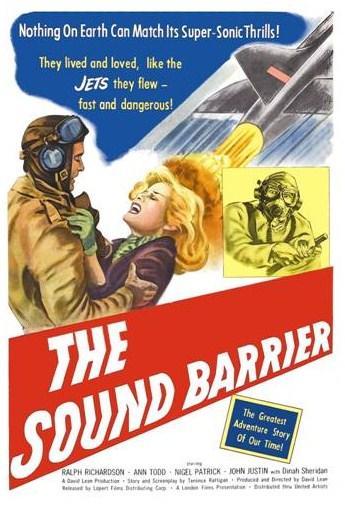
The Sound Barrier (1952)

Sound barrier header
Ann Todd and Nigel Patrick on a dangerous mission to break The Sound Barrier

Director: David Lean

Cast: Ralph Richardson (John Ridgefield), Ann Todd (Susan Garthwaite), Nigel Patrick (Tony Garthwaite), John Justin (Philip Peel), Dinah Sheridan (Jess Peel), Joseph Tomelty (Will Sparks), Denholm Elliott (Christopher Ridgefield), Jack Allen (‘Windy’ Williams), Ralph Michael (Fletcher)

David Lean’s film career can be divided into two eras: his early films are British-based literary adaptations and family dramas, many of them front-and-centring the experiences and tribulations of women. The later era are the jaw-dropping epics he became best known for. The Sound Barrier is towards the end of the first era – and it’s almost a bridge between the two, an impressively filmed story of man’s triumph over nature, that sneaks under the wire an emotional family-in-crisis storyline, with a daughter suffering the damaging impact of her father’s obsession.

That father is John Ridgefield (Ralph Richardson), a famous aeronautical engineer and airline entrepreneur who, with the end of the war, returns to his fixation: discovering a way to make a plane fly so fast it breaks the sound barrier. It’s a vision that has dominated his life, but which his daughter Susan (Ann Todd) finds hard to understand. John is a domineering, demanding father, whose son Christopher (Denholm Elliott) gets himself killed trying to qualify as a pilot to win his father’s respect. In his place, Susan’s husband Tony (Nigel Patrick), a test pilot, is claimed by John as a surrogate son and equally pushed to risk all to try and fly faster than sound.

Lean’s film is a wonderful mix of post-war military-based exploits and stiff-upper lip exploration of family dynamics, where resentments and passions go unspoken but shape everything. With a superb script by Terence Rattigan, whose work is filled with monomaniacs like Ridgefield and sympathetic and emotionally intelligent women like Susan, The Sound Barrier might seem like a celebration of British pluck (it hardly matters that we Brits didn’t actually break the sound barrier first – no mention of Chuck Yaeger here…), with some stunning aerial photography. But it’s a lot more than that.

What’s fascinating about The Sound Barrier – and what makes it such a rewarding watch – is how much it questions the value of these sort of quests. The film’s focus is less on the engineering struggles and the bravery of the pilots (compare and contrast this film with the more straightforwardly triumphant The Dam Busters), and more on the human cost of obsession and this sort of adrenalin-fuelled airborne machismo.

The Ridgefield family has been damaged almost beyond repair – under their wealth and comfort – by their father’s demanding perfectionism. Ralph Richardson is superb as this bluntly-spoken man who sees no reason to sugar coat anything or hide any disappointment. The character has more than a hint of a Gradgrind of engineering – and just like Hard Times patriarch, his well-intentioned but misguided parenting has distorted both his children.

His hero-worshipping son Christopher (a wonderfully fragile and charming Denholm Elliott) pushes himself through chronic air-sickness to lay down his life trying to follow in his father’s footsteps (John greets his death with a sad criticism of his flying skills and goes back to work with his jet-plane models straight after the funeral). Susan has a cold relationship with her father (strikingly she calls him Father while everyone else – even her husband Tony – calls him Dad), and can’t understand why all this goal is worth sacrificing lives and any chance of simple domestic happiness. Her father’s coldness and distance from his children – not to mention his obvious and continual disappointment that she was born a girl – has led her to treat him with respect but not love.

It’s a dynamic completely missed by her husband Tony, played here with a bluff simplicity by Nigel Patrick. But then it’s pretty clear that this risk-taking pilot is quite simply not that bright. His lack of independent thinking is even identified by engineer Will Sparks (a ‘sparkling’ performance of avuncular surrogate fatherdom by Joseph Tomelty) as his major weakness as a test pilot. Tony has no idea of his wife’s concerns or emotional problems with her father, and instead quickly gets sucked into filling the role of “son I never had” for John. But then Tony has everything John wants – the flying skills Christopher never had without the questioning independence of Susan. He’s exactly the sort of weak-willed would-be-hero who can be quickly sucked into taking huge risks.

The film’s sympathies though are with Susan, played with a real warmth tinged with a sad expectation for disaster by Ann Todd, whose presence slowly grows to dominate the film. She can’t understand why it is necessary to risk all for this nebulous goal: it’s a refrain she repeats throughout the film “I wish I knew, I really wish I knew”. We’ve just gone through a second calamitous war – why are we throwing our lives away for a concept? Why should her husband put himself at huge risk like this for a brief mention in the history books and nothing else? Why not be content with a happy family life and living to see his son? Not to mention that the film proves her right – the nice-but-dim Tony isn’t good test pilot material and Susan’s new family is destroyed just like her old one.

At first it might seem that Todd’s character is the stay-at-home “don’t go Darling” type, but the film increasingly shows the validity of her doubts. There is a slightly toxic “carry on” Englishness about Tony and her father. Obsession is shown to drive out all over considerations – and Richardson has a late scene that carefully but brilliantly demonstrates how it has left him isolated and alone. It’s telling the barrier is finally broken by devoted husband and father Philip (a very decent John Justin), who is aware of the danger and has the most settled family life of the lot (and who greets his triumph with tears of relief rather than cheers).

The Sound Barrier could have easily been a “Britain triumphs in the skies!” with soaring music and heroic filming. Instead, it demonstrates the danger of obsession and the damaging impact it can have on people and their families. It concentrates not on the men in the sky, but increasingly the potential widows on the ground, forced to acknowledge that life with the family is less important than the chance of glory. It’s a rich and emotionally intelligent film, very well directed by Lean with warmth and humanity and with three terrific actors leading from the front.