Tag: Nigel Stock

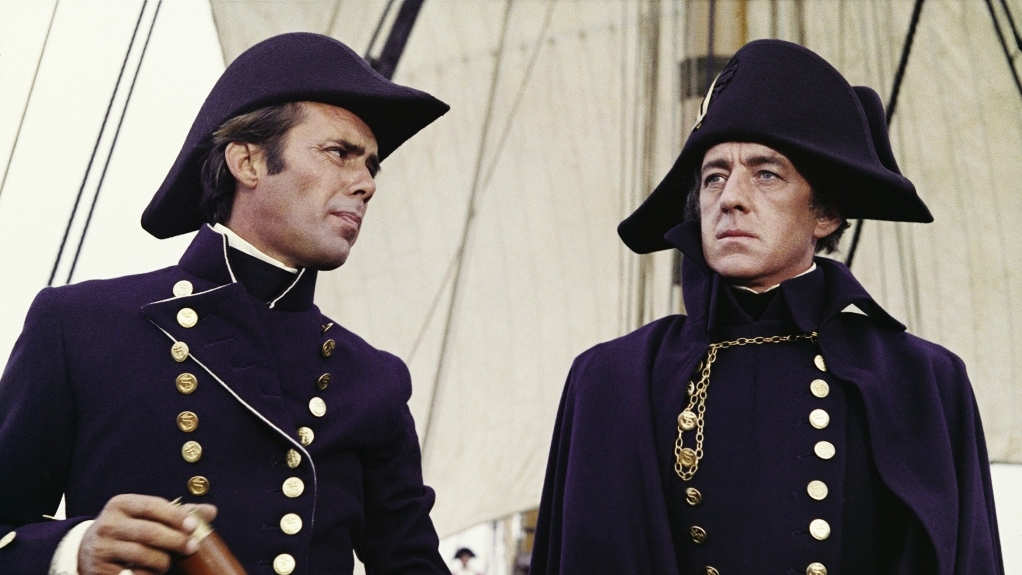
HMS Defiant (1962)

HMS Defiant (1962)

Interpersonal conflict on the high seas, in this serviceable romp upon the high seas

Director: Lewis Gilbert

Cast: Alec Guinness (Captain Henry Crawford), Dirk Bogarde (Lt Scott-Padgett), Anthony Quayle (Vizard), Tom Bell (Evans), Murray Melvin (Wagstaffe), Maurice Denham (Dr Goss), Nigel Stock (Mdspman Kilpatrick), David Robinson (Mdspman Crawford), Bryan Pringle (Sgt Kneebone), Richard Carpenter (Lt Ponsonby), Peter Gill (Lt D’Arbly)
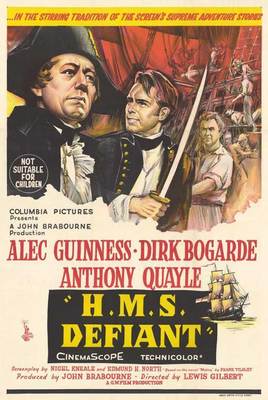
HMS Defiant, despite what its poster suggests, isn’t really non-stop rollicking adventures on the high seas. Instead, it’s about internal conflict: between officers and crew, between captain and first officer, between sailors and admiralty. In 1797, Britain is sailing into war with Napoleon and the press gang is seizing sailors off the streets. But no-one is getting paid fairly, something a proto-trade union of sailors led by Vizard (Anthony Quayle) is determined to sort out even if that involves mutiny. Mutinous thoughts abound on his ship Defiant, as stoic Captain Crawford (Alec Guinness) is engaged in a battle of wills with his ambitious and vicious first officer Lt Scott-Padgett (Dirk Bogarde), with Crawford’s son (a young midshipman on board) caught in the middle and paying a heavy price.

Interestingly, both of its two leads would probably have preferred it if the film had sunk to the bottom with trace. Guinness considered it one of the worst films he was involved in, while Bogarde saw it as little more than a pay cheque with sails, the sort of box-office he needed to do to pay for films like Victim. That’s harsh on a perfectly serviceable slice of Forrester-inspired nonsense, the sort of film that has become a staple of Bank Holiday TV. There is nothing wrong with HMS Defiant (God knows you’ll see a lot worse) and if it’s not inspired, it’s also not a disgrace.

It’s competently assembled by Lewis Gilbert, who ticks off the various nautical boxes with aplomb. Over the course of the film we get multiple floggings, a man falling from the yardarm (an all-too-obvious dummy), sails puffed with wind, cannon-firing action against the French, an amputation, cutlass-shivering feuds, grumbling below decks and a parade of fists slammed into hands behind backs. Everything you have grown to expect from Hornblower is here, all put together with an assured professionalism that means you are never anything less than entertained.

The action, when it comes, as ship goes against ship, is actually less interesting than the complex inter-personal dynamics on board. It’s perhaps one of the most interesting films in presenting a Naval ship as an insular little world, a sort of boarding school on the seas, with head boys and scroungers. At its heart is the clash between two potential headmasters: Alec Guinness’ decent Crawford, who leads through a sort of unimpeachable example of British reserve, and Bogarde’s Scott-Padgett a charismatic bully who is basically a sort of Flashman of the Seas.

They both have very different ideas of what the boat should be. Crawford sees it as a tool to deliver the Admiralties orders, with everyone fitting perfectly into their assigned role and never for a moment thinking outside it. Scott-Padgett sees it as an opportunity for social climbing, who feels since he’s uniquely special the rules shouldn’t apply to him and will go to all manner of petty ends to get what he wants, not giving a damn who gets hurt. Crawford would govern with a firm but fair hand, letting a cross word communicate his displeasure. Scott-Padgett walks around deck with a coiled rope in his hand to literally whip the sailors on, handing out thrashings like their going out of business.

He’ll also pick on the vulnerable, roping bullies like Nigel Stock’s ageing senior midshipman (a man who reeks of failure) to hand out beatings to those who can’t protect themselves. And, like the sort of unpleasant reader of men he is, Scott-Padgett works out the Captain’s pressure point is to line up Crawford’s son for as many beating as possible and subtly threaten more unless he basically gets his way on the ship. It’s a sort of under-hand dealing that the decent Crawford is totally unprepared for, a complete disregard for form and rules of conduct that’s outside of his experience.

It’s telling that Crawford has more in common with Vizard. Anthony Quayle, in the film’s finest performance, is cut from the same cloth: a reasonable man with a sense of fair play who feels a petition and a careful argument placed to the Admiralty will get everything he wants with no chance of violence rearing his head. It’s not that much of a stretch for the audience to guess he might be wrong, not least because his number two is the increasingly bitter, class-conscious Evans, played with a surly mean streak by Tom Bell. Not least since the quick to anger Evans is also happy for other men to take the rap for his actions and never considers anyone’s needs but himself. Vizard’s number two shares more than a few characteristics with his bête noire Scott-Padgett (one of many ways Vizard and Crawford are alike).

It leads to an inexorable show-down, with Bogarde’s patrician contempt and self-satisfied assurance like a red rag to everyone he encounters. (You could say HMS Defiant is an interesting warm-up for Bogarde before he tackled the satanic butler in The Servant). Guinness fares less well, probably because he has a much less delicious part, all to clearly struggling to raise any interest in the character he’s playing (HMS Defiant is one of the best examples of Guinness on terminally-bored autopilot, rarely stirring himself to do anything other than go through the motions).

But it’s still an entertaining film, in a Sunday afternoon sort of way (the exact time I watched it). There is something endearing about the sailors’ naïve plans to win their rights, just as there is something wonderfully pantomimically hissable in Bogarde’s odious lieutenant, a lovely embodiment of upper-class entitlement that literally makes every situation worse. Sure, nothing is re-invented, but as a vessel for some interesting character beats and some serviceable naval action, it more than holds water.
The Great Escape (1963)

Steve McQueen is the Cooler King (King of Cool?) in The Great Escape

Director: John Sturges

Cast: Steve McQueen (Captain Virgil Hilts), James Garner (Flight Lt Bob Hendley), Richard Attenborough (Sqd Leader Roger Bartlett), James Donald (Group Captain Ramsey), Charles Bronson (Ft Lt Danny Welinski), Donald Pleasance (Flt Lt Colin Blythe), James Coburn (FO Sedgwick), Hannes Messemer (Oberst von Luger), David McCallum (Lt-Commander Eric Ashley-Pitt), Gordon Jackson (Ft Lt Andy MacDonald), John Leyton (Ft Lt Willie Dickes), Angus Lennie (FO Archie Ives), Nigel Stock (Ft Lt Dennis Cavendish), Robert Graf (Werner)

Is there a film in Britain more associated with holidays than The Great Escape? While I was growing up it felt like a day-off wasn’t complete unless the BBC screened it as part of their afternoon schedule. In Britain is has a status as a sort of cosy uncle, a part of the furniture of many people’s filmic lives. There is always something comforting and reassuring about The Great Escape. So much so, people forget it ends with a large bodycount and the majority of our heroes further away from freedom than when they started.

But it doesn’t really matter, because The Great Escape is one of the last hurrahs of effective, nostalgic war-films. The sort of hugely enjoyable caper that recognises the cost of war, but also celebrates the pluck, ingenuity and guts of Allied servicemen, running rings around those dastardly cheating Nazis. Where we would all like to look back and remember those days when men-were-men and worked together towards a common goal. Sturges has created a marvellous tapestry of a movie, that pulls together several striking scenes, characters and snippets of dialogue into a true ensemble piece that reflects the camaraderie and unity that exists between the prisoners as they work towards their escape.

In some ways, The Great Escape is such good fun, such well-packaged entertainment and telling such an exciting, uplifting and (in the end) moving story that it’s almost immune to criticism. You’d have to have a pretty hard heart not to enjoy it. And you’d have to be pretty cynical not to enjoy the way it presents a series of obstacles and then carefully demonstrates the fascinating and rewarding ways the prisoners resolve these. It’s also notable that, aside from the shadowy Gestapo types, the film doesn’t really have an antagonist. The enemy is that fence. Most of the Germans are just regular soldiers doing a job – it’s only the brutal final-act Gestapo who are aren’t playing this eccentric game. But this helps us sit back and enjoy the film as a caper – just as it makes the burst of machine-gun fire that (nearly) ends the film even more impactful and shocking.

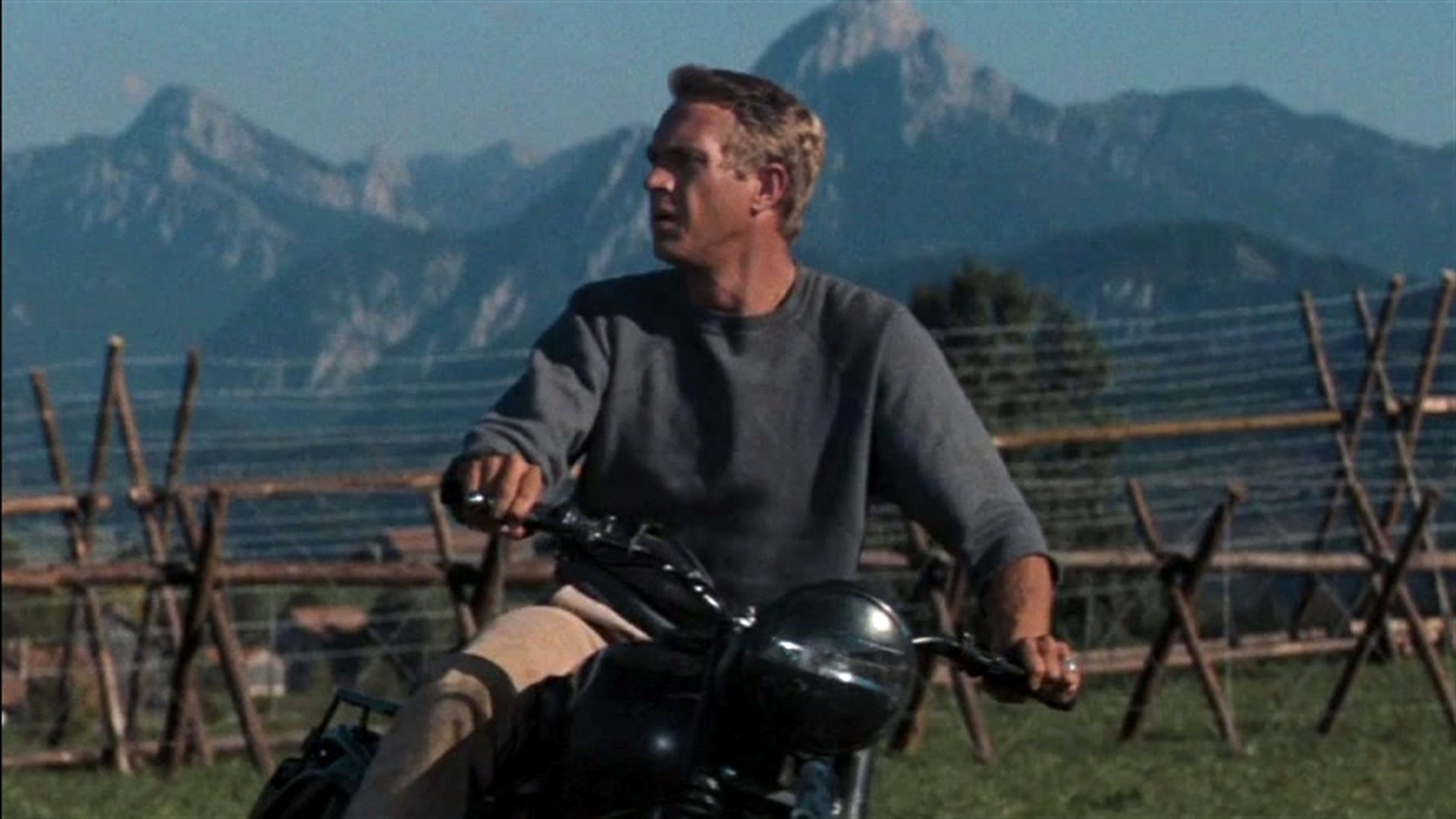
Sturges’ gets the tone of the film spot-on, and also draws a series of perfectly balanced performances from his all-star cast. I think it’s fair to say a lot of the film’s success was connected to Steve McQueen’s casting in the crucial role of Hilts. McQueen channels a sense of 1960s anti-establishment cool into the film (unlike the rest of the POWs, he seems to be wearing basically his own clothes in t-shirt, chinos and bomber jacket). Iconically bouncing his ball against the wall in a cooler, a natural loner (who of course still does his bit), with a cocky sense of defiance and some exceptional motor-bike skills, Hilts is undeniably cool. He’s the face of the film – and the one you walk away wanting to be.

He also gets the film’s definitive claim to fame, with a series of daring motorbike stunts as he races across Germany to escape. Mostly performed by McQueen himself (although not the most famous fence jump, done by a stuntman) this last act chase is a gripping, action counter-point to the more cagey, paranoid runs of the other escapees. It’s so exciting and feel-good, it’s a surprise to remember that Hilts actually gets caught. But then, if he hadn’t, we’d have lost McQueen’s cool, wry shrug of acceptance as he and his mitt were sent back to the cooler in the camp for another 20 days.

The film tees up plenty of sub-plots for the rest of the cast, with Sturges’ spreading the love very effectively. Charles Bronson gets perhaps the best plot as “tunnel king” Danny Welinski who holds back his crippling claustrophobia almost long enough. I think this might be Bronson’s finest hour, giving a real vulnerability to Danny, with genuinely quite affecting whimpers and fear at confronting the tunnel – making his struggle all the more moving. Bronson makes a wonderful double-act with John Leyton as fellow tunneller Willie Dickes, the two of them forging an affecting bond of loyalty.

A similar bond also forms between James Garner’s suave and playful scrounger Jack Hedley and Donald Pleasance’s professorial forger Colin Blythe (has there ever been a more “Colin” Colin on film than Pleasance?). The final moments between this pair carry perhaps the biggest gut-punch of a film that has a surprising large number of them. Pleasance’s sad attempts to hide and combat growing blindness are genuinely affecting, while Garner is a master at conveying depth beneath a light surface. Sturges’ film taps into the nostalgic memories most of us have (or have picked up) of this war being one where life-long friendships were formed against horror and adversity.

Attenborough does most of the thankless heavy-lifting as Big X, but the film uses his Blimpish authority well. Gordon Jackson has a memorial role as the number #2 famously caught out by his own vocal trap (the sort of irony films like this love). Fans of the TV show Colditz can enjoy seeing David McCallum in a very similar role as a daring young escapee. James Donald channels British reserve as the senior officer. The film’s single truly bizarre performance is from James Coburn, with an Australian accent from the Dick van-Dyke school of ineptitude, so terrible even Sturges surely noticed it when cutting the film.

The Great Escape marshals all these cards extremely well. Any combination of any of these actors produces fireworks. It’s one of the best boys own adventure you can imagine. It in fact gets the perfect balance: you can spend a large chunk of the film thinking that being locked up in a German POW camp looks like the best time ever – and then it chillingly reminds you with its sad coda of the terrible cost of war. But it’s that first hour and half and its celebration of grit, guts, determination and ingenuity that really works – and it’s so entertaining that it solves immediately any mystery as to why any public holiday you’re 10-1 to find this popping up on your afternoon TV listings.

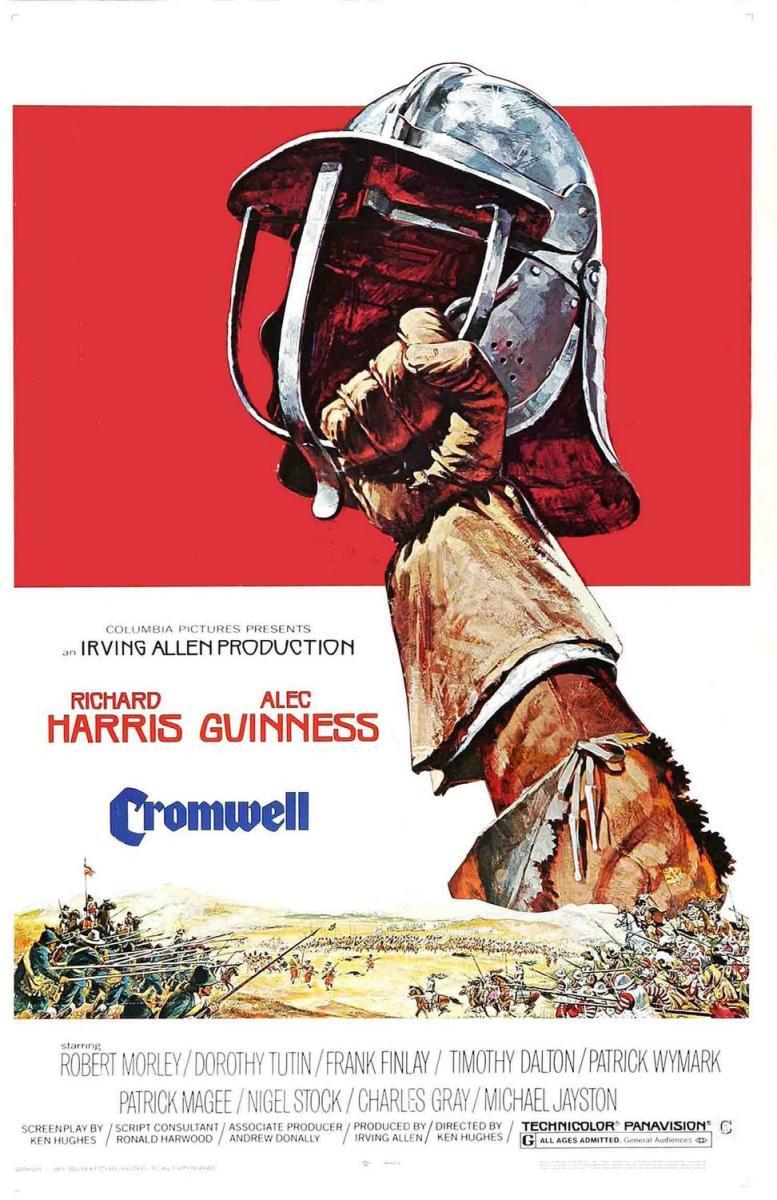
Cromwell (1970)

Cromwell image
Richard Harris let loose the revolution in Cromwell

Director: Ken Hughes

Cast: Richard Harris (Oliver Cromwell), Alec Guinness (King Charles I), Robert Morley (Earl of Manchester), Dorothy Tutin (Queen Henrietta Maria), Frank Finlay (John Carter), Timothy Dalton (Prince Rupert), Patrick Wymark (Earl of Strafford), Patrick Magee (Hugh Peters), Nigel Stock (Sir Edward Hyde), Charles Gray (Earl of Essex), Michael Jayston (Henry Ireton), Douglas Wilmer (Sir Thomas Fairfax), Geoffrey Keen (John Pym), Stratford Johns (President Bradshaw)

How much does history actually matter when you watch a historical film? We all know we aren’t watching a documentary don’t we? It’s worth bearing in mind when watching Cromwell a film which would probably be in the running for “least historically accurate film of all time”. But despite that, it’s entertaining and gets quite close to some of the spirit of the times – even if it changes most of the facts. It probably as well deserves notice for being one of the very few films to offer a sympathetic portrait of Oliver Cromwell – not a guy it’s easy to like.

It’s the 1640s, and England is a mess. Charles I (Alec Guinness) has been ruling the country directly, without involving Parliament, for over ten years. But now the money is gone and he needs Parliament to raise some more cash. Problem is, Parliament is more interested in pushing a defence of its own prerogatives rather than simply putting more money into the King’s pocket. Among the leaders of the Parliamentary campaign is Oliver Cromwell (Richard Harris), and he is not the man to take any false promises from the king. Before we know it, the country has tipped into civil war – and now it’s up to Cromwell to create a Parliamentarian army that is capable of defeating the King and bring democracy to the nation.

Ken Hughes film offers some plenty of scope and drama, even if is old-fashioned (even a little Victorian) in its Wrong-but-Wromantic Cavaliers and Right-but-Repulsive Roundheads (to mis-quote 1066 And All That). It’s a strange topic for a historical epic (it took years to get the funding) – but it looks fabulous and has a wonderful score that really embraces the religious music of the time.

What it gets right is the passion and the fire that people felt at the time for questions of politics and religion. The film frequently features heated debates (even if the dialogue is often more ticking boxes than inspired) that the actors invest with real force. Its view of events is of course truncated and at times simple (it is, after all, trying to cover around ten of the most tumultuous years in British history in about two hours), but it focuses on trying to get the spirit of things right.

A large part of this is Richard Harris’ firey performance in the lead role. There is, it has to be said, a cosmic irony in Cromwell, the least popular British leader in Irish history, winds up being played so sympathetically by one of the most famous Irish actors of all time. Sure, the real Cromwell would have hated being played by an Irishman and a Catholic (Cromwell was surprisingly inclusive at the time, but had no truck with either group). But then Cromwell would also have loved being portrayed as a mixture of George Washington and Cincinnatus (the Roman general who left his plough to assume supreme command when the nation needed him, only to retire again to obscurity). This Cromwell is bullheaded, but determined to do what’s best for the nation, with personal ambition not even a consideration. He’s the one true, selfless man in a revolution of violence.

In fact, Cromwell was sorely tempted by the eventual offer to be King (something he laughs off here). He also undoubtedly was touched heavily by ambition, while his attempt to turn the Protectorate into a hereditary office was a disaster that doomed the Republic (surely George Washington learned a few lessons from him). But, deep down, Cromwell was sincere – a guy who largely said, and did, what he meant. It’s that sense of morality that Harris gets very well here. And, while its easy to poke fun at those hoarse tirades Harris is frequently called on to deliver, this sort of intemperate ranting (laced with Biblical language and a strong sense of moral superiority) were pretty much central to Cromwell’s personality.

It makes for a very different hero, even if the film is determined to turn Cromwell into the only decent man in the Kingdom. Cromwell, in real life, never retreated from politics to return to his farm as he does in the latter part of the film (he actually spent this time on brutal campaign in Ireland, something the film mentions only vaguely in passing). But there is no doubt Cromwell would have believed he was the guy selected by providence to save the nation – and that idea the film channels very well. In fact, Cromwell gives you a pretty decent idea of what Cromwell might have been like – and a pretty accurate picture of who Cromwell wanted to be – even if the things it shows you only have a passing resemblance to what happened.

It’s a key directive throughout Ken Hughes’ film, which feels free to distort historical events willy-nilly (see more below). But there is a sort of truth in spirit, if not in fact – from the heated debate in Parliament, to the mixture of frantic panic and regimented order in the battles (one particularly good shot positions the camera under a charging horse, which makes a cavalry charge suddenly feel horrifyingly visceral). Sure it’s arranged into a much more simple black-and-white story, but it works.

A similar trick also works for its portrayal of Charles I. This is probably one of Guinness’ most over-looked performances. His Charles is a weak, indecisive man who confuses stubbornness and pride for moral strength. Softly spoken when calm, he collapses into heavily Scots accented rage when riled and his politeness is a only a shield for bitterness and vexation. He routinely shirks responsibility for his actions and spreads the blame around everyone but himself. Again, it might not all be accurate, but you can’t imagine this is far off from the actual King.

Historically though, so much of the film is wildly inaccurate. Many of these changes are done to increase the importance of Oliver Cromwell early in the Parliamentarian campaign. To scratch the surface: Cromwell – a minor figure until quite late into the war – was not one of the five members Charles marched to Parliament to arrest (neither was Henry Ireton). He certainly didn’t – and neither did anyone else – remain sitting when the troops arrived and set a motion in place protecting MPs. He never met the King before the war. Cromwell is later made C-in-C of the Parliamentarian army – an office actually given to Fairfax. The film’s depiction of the Battle of Naseby flips the numerical advantage exactly to favour Charles rather than Cromwell. Far from providing the key damning evidence at Charles’ trial, Hyde fled the country with Prince Charles.

But this is a fiction, rather than drama. Even if the facts it presents are largely nonsense, it gets a lovely sense of the divided loyalties and tensions that existed during this period. The performances are often quite broad – Robert Morley simpers and sneers as an opportunistic Manchester, Patrick Wymark growls and splutters as Strafford while Timothy Dalton goes way over the top as a foppish Prince Rupert – but some, such as Michael Jayston’s firebrand Ireton or Nigel Stock’s tortured Hyde (historical nonsense as his storyline is) are rather good.

And it’s hard not to like a film where the lead actor is going at it such great guns that you can actually hear his voice disappearing into a rasp. Cromwell doesn’t have much relation to the facts, but deep down it does seem to understand the man Cromwell wanted to be. And, on that level, it feels truthful and heartfelt – and that’s partly why it remains entertaining and why I remain rather fond of it.

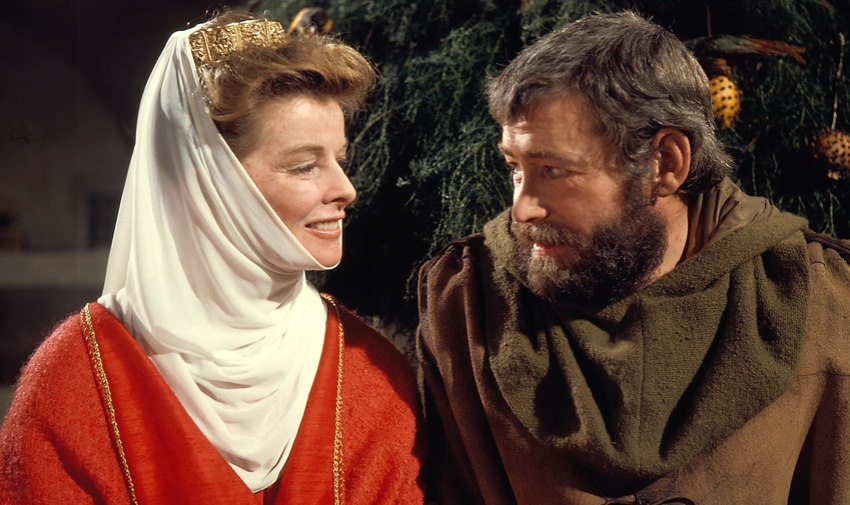
The Lion in Winter (1968)

Katharine Hepburn and Peter O’Toole are the feuding royals in The Lion in Winter

Director: Anthony Harvey

Cast: Peter O’Toole (Henry II), Katharine Hepburn (Eleanor of Aquitaine), Anthony Hopkins (Richard the Lionhard), John Castle (Prince Geoffrey), Nigel Terry (Prince John), Timothy Dalton (Philip II), Jane Merrow (Alais), Nigel Stock (Captain William Marshall)

James Goldman’s play The Lion in Winter did solid but not spectacular business on Broadway. But when it came to film, it surfed a wave of popularity for stories about British history and became one of the most financially successful films of its year, winning three Oscars (including for Goldman). Even more than that, it went on to be West Wing President Jed Bartlett’s favourite movie of all time. I think we know which prize is the most treasured.

Christmas 1183 (including an ahistorical Christmas tree and gift wrapped presents and all) and Henry II (Peter O’Toole), king of England and huge chunks of France, wants nothing more than family around him to mark the occasion. Problem is, this is possibly the more dysfunctional family ever. His Queen Eleanor of Aquitaine (Katharine Hepburn) has been under “home arrest” for ten years in her castle, and his children Richard (Anthony Hopkins), Geoffrey (John Castle) and John (Nigel Terry) seem to take it in turns to conspire against their father, their allegiances shifting faster than even they can sometimes follow. For added complexity, Henry is living with his late eldest son’s intended Alais (Jane Merrow) as husband and wife and her half-brother the new King of France Philip II (Timothy Dalton) is joining the family for Christmas. Over one night, this family will fight, feud and change pacts and allegiances until hardly anyone knows where the games end and the hate begins.

Anthony Harvey’s film is a stately, often wordy, faithful reconstruction of Goldman’s script that gives front-and-centre to the often scintillating dialogue between the family members, that leans just the right side of ahistorical (sample line: “Hush dear, Mummy’s fighting”) but frequently allows it’s top-of-the-line cast to let rip on some glorious speeches and dialogue duets crammed with ideas, wordplay, character and wit. Harvey therefore basically decides to sit back as much as possible and allow the actors do the work, using a mixture of medium shots and close-ups to bring the focus as much as possible to the Broadway-style staging or into the actor’s faces. He also uses the strength of the performers to allow for a series of long takes as they burn through pages of Goldman’s dialogue. The fact that there is hardly an interesting shot in the film, and its visual language never matches it’s verbal fire is a shame, but a price the film thinks worth paying.

And it matters little when Harvey is able to work as well with actors as he does here. All the performers are at the top of their game. Katharine Hepburn (winning her fourth Oscar, in a tie with Barbra Streisand in Funny Girl) has the perfect level of acute intelligence and imperious arrogance for Eleanor. But Harvey encourages from her a softness at crucial moments, that in-between the barn-storming speeches and verbal putdowns, Hepburn finds moments of quiet sadness and loneliness – a sense that sometimes ten years of imprisonment means she has had enough of all this – that are some of her most affecting work on screen. She’s hilarious but deeply moving – and totally believable as one of the most powerful women of the middle ages. 

She also is matched perfectly with O’Toole. Playing a 50-year old King at 35, O’Toole brings all the fire and charisma of his personality to the part, in a film where he perfectly balances the larger-than-life gusto of Henry II with his own personal disappointments, guilt and sorrow. O’Toole had already triumphed once as the charismatically brilliant king in Becket (for which he was also Oscar nominated, as he was here), but this performance is even better. Not only is his facility with the dialogue faultless, he also utterly convinces as the sort of awe-inspiring figure who dominates every room he’s in not just with force of character but the acuity and sharpness of his intellect. This might be his finest screen performance – and the one where he was most cheated of the Oscar (losing to a highly active campaign, criticised at the time, from Cliff Robertson in Charly).

To fill the cast out around these pros at the top of their game, Harvey raided British theatre to pluck some promising gems from British Theatre, more or less all of them here in their film debut. Anthony Hopkins is marvellously proud, forceful but just a few beats behind most of the others as a Richard who says what he means and sticks to it. Timothy Dalton is his polar opposite (and equally brilliant) as a Philip II who never says what he means and manipulates with a playful ease everyone he meets. John Castle (an actor who never had the career he should have had) is smugly unlikeable and coldly superior as the unliked middle-brother Geoffrey, while Nigel Terry is a snivelling punching bag as two-faced coward John. Jane Merrow is heartfelt and earnest as Alais, the only unquestionably kind and good person in this bunch.

These characters rotate sides and allegiances over the course of one evening, raging at each other like a medieval Who’s Afraid of Virginia Woolf? The brilliance of the dialogue never stops entertaining – although towards the end the film loses a bit of energy (it probably peaks with Henry’s loud double bluff of dragging the family in the middle of the night to a wedding he has no intention of seeing performed), perhaps partly because the film itself never really comes to flight as something cinematic. This is despite the decision to downplay the glamour – costumes are simple and look lived in (the cast wore them for hours off set to make them look lived in) and sets are far from pristine. It perhaps contributes to the slightly mundane feel of the filmmaking.

But the tricks are all in the dialogue and perhaps the film works best with an interval and a chance to take stock. There are several marvellous scenes, even if the constant feuding and side changing does wear you out after a while. But it’s a treat for the acting. Hepburn and O’Toole are simply at the top of their game, and the rest of the cast more than keep up with them. With an excellently imposing score from John Barry (also Oscar-winning), it’s a shame the film itself is a little too flatly and uninspiringly filmed with a murky lack of visual interest, but there are more than enough qualities for you to issue a pardon.

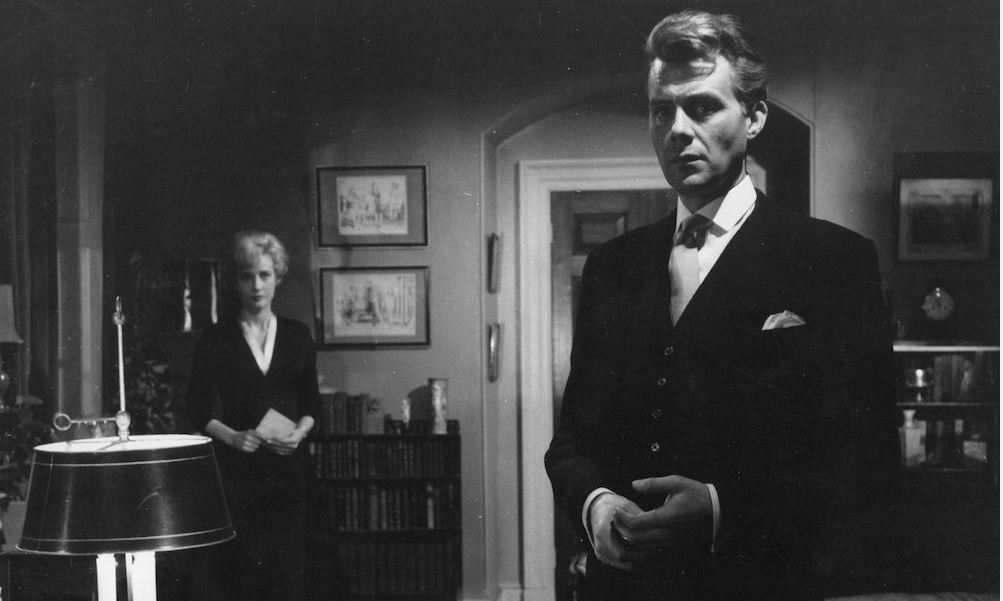
Victim (1961)


Dirk Bogarde takes on both blackmailers and the vilest of laws in Victim

Director: Basil Dearden

Cast: Dirk Bogarde (Melville Farr), Sylvia Sims (Laura Farr), Dennis Price (Calloway), Nigel Stock (Phip), Peter McEnery (Boy Barrett), Donald Churchill (Eddy Stone), Anthony Nicholls (Lord Fullbrook), Hilton Edwards (P.H.) Norman Bird (Harold Doe), Darren Nesbitt (Sandy Youth), Alan MacNaughton (Scott Hankin), Noel Howlett (Patterson), Charles Lloyd-Pack (Henry)

Victim is both a film of its time and hugely daring. It was released in 1961, six years before homosexuality was decriminalised. It feels slightly old-fashioned and coy in its language and style – but at the time would have been almost unbelievably daring. It not only presented gay people as normal people (and not limp-wristed comic figures) but sensitively and sympathetically argues that the law (or “blackmailer’s charter” as the Chief Inspector calls it) was morally wrong.

Melville Farr (Dirk Bogarde) is a married lawyer, about to be offered the position of Queen’s Counsel. One day he rebuffs the entreaties of a young man named Barrett (Peter McEnery). The man later hangs himself in police custody, the victim of blackmail. Farr held deep feelings for Barrett – but cut himself off from contact, having been haunted by his consciously suppressed homosexual feelings. Heartbroken and angered by Barrett’s death, Farr decides to take on the blackmailers – even if it means destroying his career and endangering his marriage to Laura (Sylvia Sims).

In 1961 Dirk Bogarde was one of the most popular actors in the country, a romantic leading man, best known for a series of light British comedies. He was also a gay man, who lived for decades with his manager and partner Anthony Forwood. It’s almost impossible to understand today how brave it was, how much of his career he put on the line, to play Farr. At a time when many people (including characters in this film) considered the very idea of homosexuality a revolting aberration, for Bogarde to play this role could have been career suicide. When even today Hollywood actors are afraid to come out for fear of damaging their careers, here in 1961 was an actor who was actually gay, playing a gay lawyer, at a time when that part of his life was a crime.

What’s particularly impressive about Bogarde’s performance is its calmness, its control. Farr rarely raises his voice, and never hectors us or the characters about the morality of the law. Only once does he show real rage – punching another man after a comment too far about a university “friend” who committed suicide. Bogarde’s Farr is a man, who (the movie implies) has constantly denied that part of himself (much to his pain and of those closest to him). His decision to take a stand is as much accepting a part of himself, as it is doing the right thing.

It’s the scenes with his wife where Bogarde excels. These are deeply, searingly painful scenes of a man struggling to express to his wife his own feelings. Farr makes it clear he ended contact with Barrett because he desired him, because he loved him – more (or rather in a different way) than he loves his wife. Bogarde allegedly wrote his own lines for this key scene, effectively Farr’s coming out. It’s a powerful scene of a man letting a burden fall from his shoulders, of finally saying something he could barely admit to himself. 

The relationship with his wife is one of the central points of interest in the film, the story developing in a way that feels natural and unforced. Sylvia Sims is equally good as a woman who is sympathetic, but can’t completely comprehend the depth of Farr’s feelings. There’s no condemnation or recrimination – but there is a low-key feeling of something being broken, of the two of them realising that they have companionship and a platonic love – but not the passion that marriage should have. It’s a testament to the un-showy realism of the film, that it avoids outbursts and fury in these scenes in favour of a quietly powerful, mutually supportive uncertainty.

The rest of the film treads a fine line between polemic and procedural. It’s a well-written, heartfelt piece that wears its research lightly. It’s crazy to think this is first film to actually use the word “homosexual”. The characters are a neat snapshot of the personalities of the time. Some of the straight characters are violently opposed to the “degenerates”. Others, such as the lead Inspector, enforce the law because they must. The homosexual characters are similarly wide-ranging: some are dignified, many are deeply scared, some have a patrician smugness and arrogance (it’s telling Farr gets more angry at these than anyone else in the movie). 

There are wonderful opportunities for a host of character actors. Charles Lloyd-Pack (as barber Henry) in particular suddenly unleashes a heartfelt, achingly sad speech of defiance in which he says he has been to prison twice for what he is, and will not go again. Norman Bird’s bookshop owner Harold is a mix of guilt, frustrated feeling and fear – a man deeply confused by his feelings. Nigel Stock is also marvellous as a car dealer terrified of losing out on an inheritance from his father-in-law should the truth be known. 

I also loved Noel Howlett’s quiet dignity as Farr’s assistant – and his matter-of-fact statement (after learning the truth) that he has never doubted Farr’s integrity and sees no reason to do so now has a brilliant stiff-upper lip emotion to it. The film contrasts this subtly with Alan MacNaughton’s thinly veiled disgust as Farr’s brother-in-law when he learns the truth.

The film wraps its careful research into the issues of the homosexuality laws – and the dangers of blackmail they expose people to – within an engaging whodunit mystery, set in a very real-feeling London of the sixties. The film has a wonderful eye and ear for the social life of the time, and it throws enough red-herrings and police detective tropes in there to keep the film entertaining. Despite its constant references back to the laws of the time, and the criticisms it makes, it never feels like a polemic – it’s first and foremost a human story.

Yes it is a little dated – very much of its time, and it’s shot with a careful conservatism by Basil Dearden, though he has an expert control of pace and there is no doubting his passionate commitment to this film and its subject matter. That’s what you need to remembe: how daringly, unbelievably controversial this film would have been to make. All the major players put their careers on the line here: and it pays off. It would be six years before the revolting laws were repealed, and this happened for many, many reasons – but this film was a genuine help for making people see the wrongheadedness of these laws.