Tag: Nigel Terry

The Lion in Winter (1968)

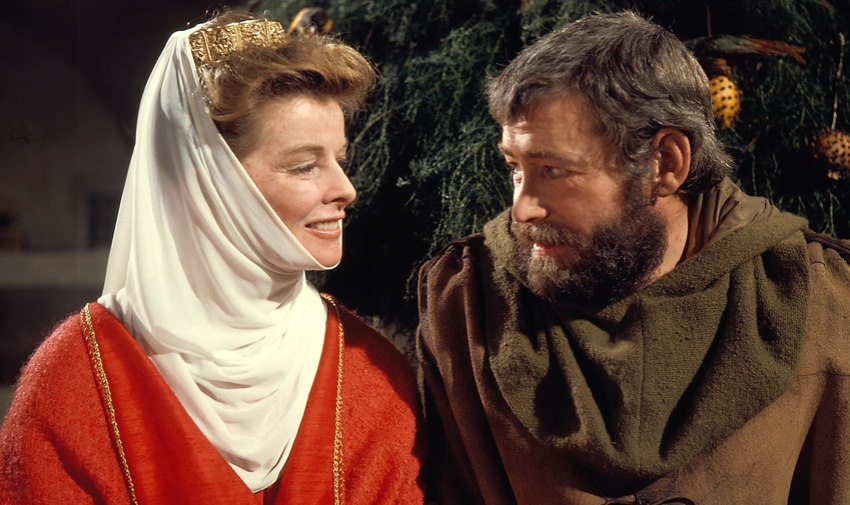
Katharine Hepburn and Peter O’Toole are the feuding royals in The Lion in Winter

Director: Anthony Harvey

Cast: Peter O’Toole (Henry II), Katharine Hepburn (Eleanor of Aquitaine), Anthony Hopkins (Richard the Lionhard), John Castle (Prince Geoffrey), Nigel Terry (Prince John), Timothy Dalton (Philip II), Jane Merrow (Alais), Nigel Stock (Captain William Marshall)

James Goldman’s play The Lion in Winter did solid but not spectacular business on Broadway. But when it came to film, it surfed a wave of popularity for stories about British history and became one of the most financially successful films of its year, winning three Oscars (including for Goldman). Even more than that, it went on to be West Wing President Jed Bartlett’s favourite movie of all time. I think we know which prize is the most treasured.

Christmas 1183 (including an ahistorical Christmas tree and gift wrapped presents and all) and Henry II (Peter O’Toole), king of England and huge chunks of France, wants nothing more than family around him to mark the occasion. Problem is, this is possibly the more dysfunctional family ever. His Queen Eleanor of Aquitaine (Katharine Hepburn) has been under “home arrest” for ten years in her castle, and his children Richard (Anthony Hopkins), Geoffrey (John Castle) and John (Nigel Terry) seem to take it in turns to conspire against their father, their allegiances shifting faster than even they can sometimes follow. For added complexity, Henry is living with his late eldest son’s intended Alais (Jane Merrow) as husband and wife and her half-brother the new King of France Philip II (Timothy Dalton) is joining the family for Christmas. Over one night, this family will fight, feud and change pacts and allegiances until hardly anyone knows where the games end and the hate begins.

Anthony Harvey’s film is a stately, often wordy, faithful reconstruction of Goldman’s script that gives front-and-centre to the often scintillating dialogue between the family members, that leans just the right side of ahistorical (sample line: “Hush dear, Mummy’s fighting”) but frequently allows it’s top-of-the-line cast to let rip on some glorious speeches and dialogue duets crammed with ideas, wordplay, character and wit. Harvey therefore basically decides to sit back as much as possible and allow the actors do the work, using a mixture of medium shots and close-ups to bring the focus as much as possible to the Broadway-style staging or into the actor’s faces. He also uses the strength of the performers to allow for a series of long takes as they burn through pages of Goldman’s dialogue. The fact that there is hardly an interesting shot in the film, and its visual language never matches it’s verbal fire is a shame, but a price the film thinks worth paying.

And it matters little when Harvey is able to work as well with actors as he does here. All the performers are at the top of their game. Katharine Hepburn (winning her fourth Oscar, in a tie with Barbra Streisand in Funny Girl) has the perfect level of acute intelligence and imperious arrogance for Eleanor. But Harvey encourages from her a softness at crucial moments, that in-between the barn-storming speeches and verbal putdowns, Hepburn finds moments of quiet sadness and loneliness – a sense that sometimes ten years of imprisonment means she has had enough of all this – that are some of her most affecting work on screen. She’s hilarious but deeply moving – and totally believable as one of the most powerful women of the middle ages. 

She also is matched perfectly with O’Toole. Playing a 50-year old King at 35, O’Toole brings all the fire and charisma of his personality to the part, in a film where he perfectly balances the larger-than-life gusto of Henry II with his own personal disappointments, guilt and sorrow. O’Toole had already triumphed once as the charismatically brilliant king in Becket (for which he was also Oscar nominated, as he was here), but this performance is even better. Not only is his facility with the dialogue faultless, he also utterly convinces as the sort of awe-inspiring figure who dominates every room he’s in not just with force of character but the acuity and sharpness of his intellect. This might be his finest screen performance – and the one where he was most cheated of the Oscar (losing to a highly active campaign, criticised at the time, from Cliff Robertson in Charly).

To fill the cast out around these pros at the top of their game, Harvey raided British theatre to pluck some promising gems from British Theatre, more or less all of them here in their film debut. Anthony Hopkins is marvellously proud, forceful but just a few beats behind most of the others as a Richard who says what he means and sticks to it. Timothy Dalton is his polar opposite (and equally brilliant) as a Philip II who never says what he means and manipulates with a playful ease everyone he meets. John Castle (an actor who never had the career he should have had) is smugly unlikeable and coldly superior as the unliked middle-brother Geoffrey, while Nigel Terry is a snivelling punching bag as two-faced coward John. Jane Merrow is heartfelt and earnest as Alais, the only unquestionably kind and good person in this bunch.

These characters rotate sides and allegiances over the course of one evening, raging at each other like a medieval Who’s Afraid of Virginia Woolf? The brilliance of the dialogue never stops entertaining – although towards the end the film loses a bit of energy (it probably peaks with Henry’s loud double bluff of dragging the family in the middle of the night to a wedding he has no intention of seeing performed), perhaps partly because the film itself never really comes to flight as something cinematic. This is despite the decision to downplay the glamour – costumes are simple and look lived in (the cast wore them for hours off set to make them look lived in) and sets are far from pristine. It perhaps contributes to the slightly mundane feel of the filmmaking.

But the tricks are all in the dialogue and perhaps the film works best with an interval and a chance to take stock. There are several marvellous scenes, even if the constant feuding and side changing does wear you out after a while. But it’s a treat for the acting. Hepburn and O’Toole are simply at the top of their game, and the rest of the cast more than keep up with them. With an excellently imposing score from John Barry (also Oscar-winning), it’s a shame the film itself is a little too flatly and uninspiringly filmed with a murky lack of visual interest, but there are more than enough qualities for you to issue a pardon.
Excalibur (1981)


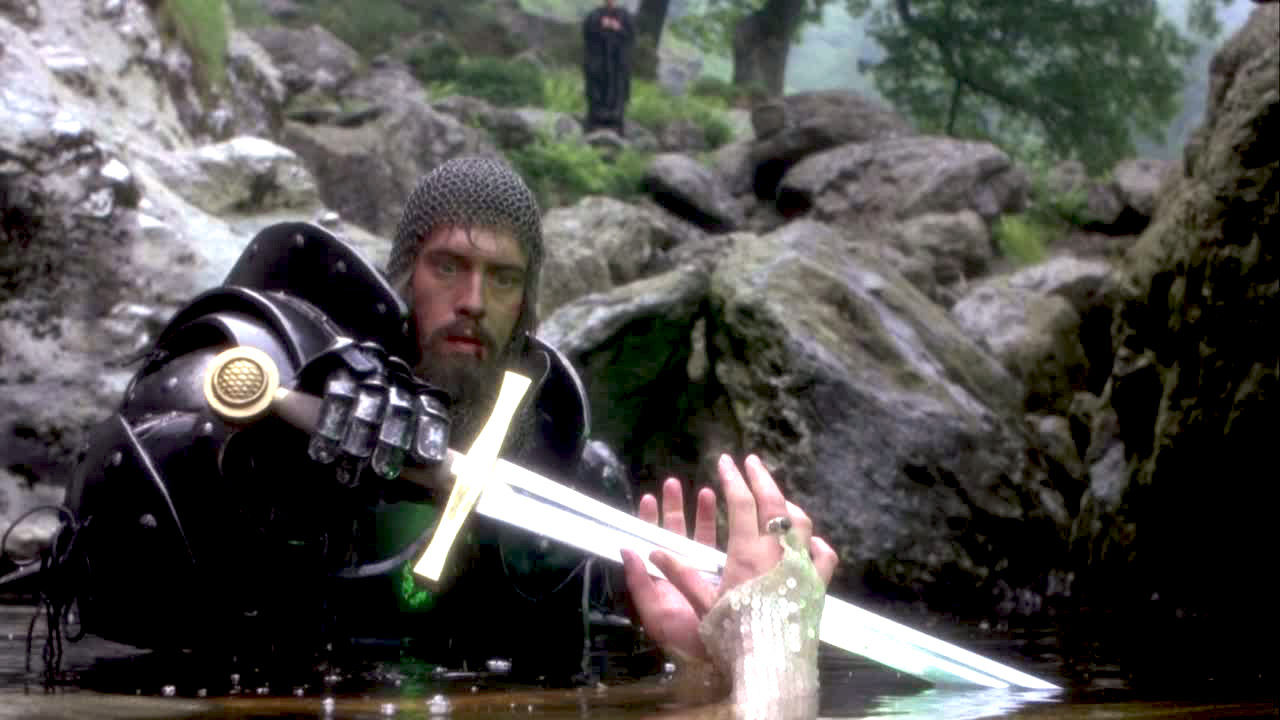
Nigel Terry gets a special gift in John Boorman’s crazily OTT Arthurian epic Excalibur

Director: John Boorman

Cast: Nigel Terry (King Arthur), Nicol Williamson (Merlin), Helen Mirren (Morgana Le Fay), Nicholas Clay (Sir Lancelot), Cherie Lunghi (Guenevere), Paul Geoffrey (Sir Perceval), Gabriel Byrne (King Uther Pendragon), Corin Redgrave (Duke of Cornwall), Patrick Stewart (King Leondegrance), Keith Buckley (Sir Uryens), Clive Swift (Sir Ector), Liam Neeson (Sir Gawain), Robert Addie (Mordred), Niall O’Brien (Sir Kay), Ciarán Hinds (King Lot), Charley Boorman (Young Mordred), Katrine Boorman (Igrayne)

John Boorman had wanted to make a film about King Arthur for over a decade, but it only came into being after his plans for an adaptation of The Lord of the Rings fell through (the suits were convinced the film couldn’t be a hit – good call). So, with a lot of prep work for Tolkien in place, Boorman moved a lot of his ideas for LOTR over to Excalibur. In doing so he created something probably truly unique – a bonkers version of the Arthurian legend, so consistently Wagnerian (often literally), high-falutin’ and overblown that it has a strange integrity in its operatic silliness.

The film begins with Arthur’s conception, a result of King Uther’s (Gabriel Byrne) lust for his ally’s wife, Igrayne (the director’s daughter Katrine). Merlin (Nicol Williamson) agrees to magically disguise Uther as Igrayne’s husband for one night, and in return spirits away the resulting child to be reared ignorant of his heritage. Years later, with a leaderless kingdom in chaos, Arthur (Nigel Terry) draws the magical sword Excalibur from the stone, and proves himself as king. He marries Guenevere (Cherie Lunghi) and brings Sir Lancelot (Nicholas Clay) to Camelot – oblivious of their love for each other. Slowly this love destroys the peace of the land – encouraged by the schemes of Arthur’s vengeful half-sister Morgana (Helen Mirren).

Excalibur is a film set in a completely heightened middle-ages dreamworld, as if it’s a series of drawings from an illustrated edition of King Arthur brought to life. The design of the film is dialled up to eleven: the armour the characters wear is ridiculously elaborate, shiny and eye catching. The characters never seem to take it off: Uther even has sex wearing it (poor Igrayne is completely naked – that can’t have been comfortable for her). Full armour is worn at meals, wedding, social events, everything: at the same time it’s brilliantly ineffective, punctured with ease by axes and spears.

The rest of the design of the film is equally overblown. Camelot seems to have been literally made from silver and gold. Lancelot kips in the forest and sleeps in the nude. Battle scenes are filmed on moody, misty nights, with horses and knights riding with insane riskiness at each other. Excalibur itself is almost impossibly shiny and unblemished and occasionally glows green. Everything has a high-artistic feel to it, like a Romantic painting. Nothing looks real – it uses a “rule of cool” aesthetic, anything that looks good from anything approaching medievalism is used.

The acting itself follows this operatic style. Half the dialogue is delivered shouting: Patrick Stewart in particular must have lost his voice while filming this one. Filmed in Ireland (it practically kickstarted the Irish film industry), many Irish actors got their first film break here, not least Gabriel Byrne (a furiously lusty Uther), Liam Neeson (a drunken oafish Gawain) and Ciarán Hinds (growling in the background). Each roars through their dialogue, perhaps none more so than Corin Redgrave who screams his with such flemmy passion it’s often hard to work out what exactly he’s saying. 

There are quieter moments from the three leads, even if all three of them don’t really have the charisma to impose themselves on sketchily drawn characters. Cherie Lunghi adopts an odd, part-time Irish accent as a bland Guenevere. Nicholas Clay is an upright Lancelot who simmers with guilt but is just a wee bit dull. Nigel Terry’s performance as Arthur (from young yokel to tortured king) gets better the more times I see it, but it lacks a certain star quality. But then in Boorman’s design, these three characters are just tools of fate rather than real characters – and the film has so much story to cover it often has very little time for character development.

The real stars of this film are Nicol Williamson and Helen Mirren. The two actors had a long-standing animosity – Boorman deliberately cast them to get an extra spark out of their scenes. But both actors seize their colourful characters – and have the time to add some depth to their bombastic, larger-than-life moments. Mirren gets to express bitterness and fury under simmering sexuality, as well as a genuine love for her son. Williamson is fantastic: playful, half nutty professor, half vengeful force of mystic power, he turns Merlin into an eccentric but somehow sinister old man. Williamson finds bizarro and unique line readings of even the simplest lines, stretching the material in the way only a really great actor can. He’s such an electric and interesting character, that he makes a performance that’s basically well over the top, hugely enjoyable and also even rather sweet.

As such, Williamson is perfect for Boorman’s overblown, crazy film. The score uses Wagner and Carmina Burana to great effect, and the closing moments are shot before a giant blood red sky. Boorman’s shiny, colourful world effectively melts down in the second half of the film into musty, moody greys: his concept of Arthur losing his way and the kingdom disintegrating works extremely well, and means we get a real sense of things falling apart. The Grail Quest is like a creepy fever dream – with knights we have known dying in gruesome ways, freezing in chapels or hanging in a tree with their corpses picked clean by crows (of course one crow eats an eye!). 

In many ways Excalibur is a very silly film: it’s hard to believe it was made six years after Monty Python and the Holy Grail, as much of its design and action is more than a little reminiscent of that film (it’s probably the only parody you could argue was made before the film it best sends-up). You probably need to see it at a certain age or enter into it with the right mindset for something that walks a difficult line between fairy tale and earthy campness. But I still love it.

Because Boorman really goes for it here. You know from the early sequence of Uther and Igrayne having sex against a background of actual fire, in full plate armour, intercut with a lingering death of Cornwall impaled on a series of spears in Uther’s camp (his death and Uther’s climax are of course cut together) what sort of film you are going to get. Everything is OTT. The drama leaves nothing behind, and Boorman wisely removes any sense of restraint from this telling of the legend. It looks gorgeous – even if dated moments like the Lady of the Lake are more likely to raise sniggers than not – and it really, really goes for it. Not many other films could get away with something so over-the-top and bizarre: but this sort of does.

Troy (2004)


Brad Pitt sails into history and legend as Achilles in the misunderstood Troy

Director: Wolfgang Petersen

Cast: Brad Pitt (Achilles), Eric Bana (Hector), Orlando Bloom (Paris), Diane Kruger (Helen), Brian Cox (Agamemnon), Peter O’Toole (Priam), Rose Byrne (Briseis), Saffron Burrows (Andromache), Brendan Gleeson (Menelaus), Sean Bean (Odysseus), Julian Glover (Triopas), James Cosmo (Glaucus), John Shrapnel (Nestor), Julie Christie (Thetis), Garrett Hedlund (Patroclus), Vincent Regan (Eudorus), Nigel Terry (Archeptolemus), Trevor Eve (Velior), Tyler Mane (Ajax)

VERSION CONTROL: Some films are just vastly superior as Director’s Cuts. Troy is one. The longer cut of Troy,I can assure you, is a richer, deeper, more enjoyable film. So watch that one. I’m also spoiling The Illiad. For those who worry about such things.

When I was younger I loved the Greek myths. I had two or three books of them and I read them over and over again. I practically grew up knowing the whole story of the siege of Troy in intimate detail. This helped feed my love for sweeping epic films, with big casts, spectacle and themes. So it probably won’t surprise you to hear I love Troy. That I’ve seen it dozens of times. It’s the film I wish had existed when I was a kid, because I would have watched it again and again. I know it’s not perfect, but I can forgive it almost anything. 

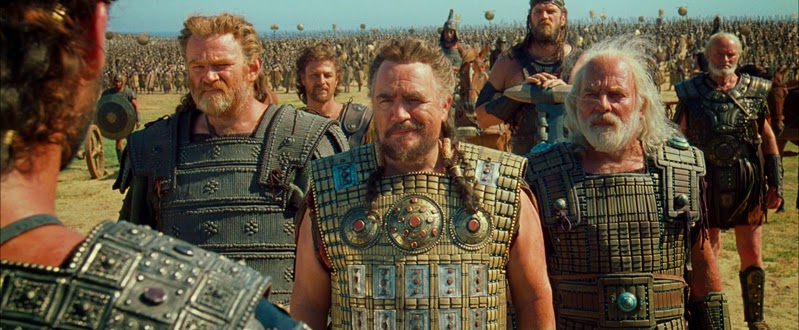
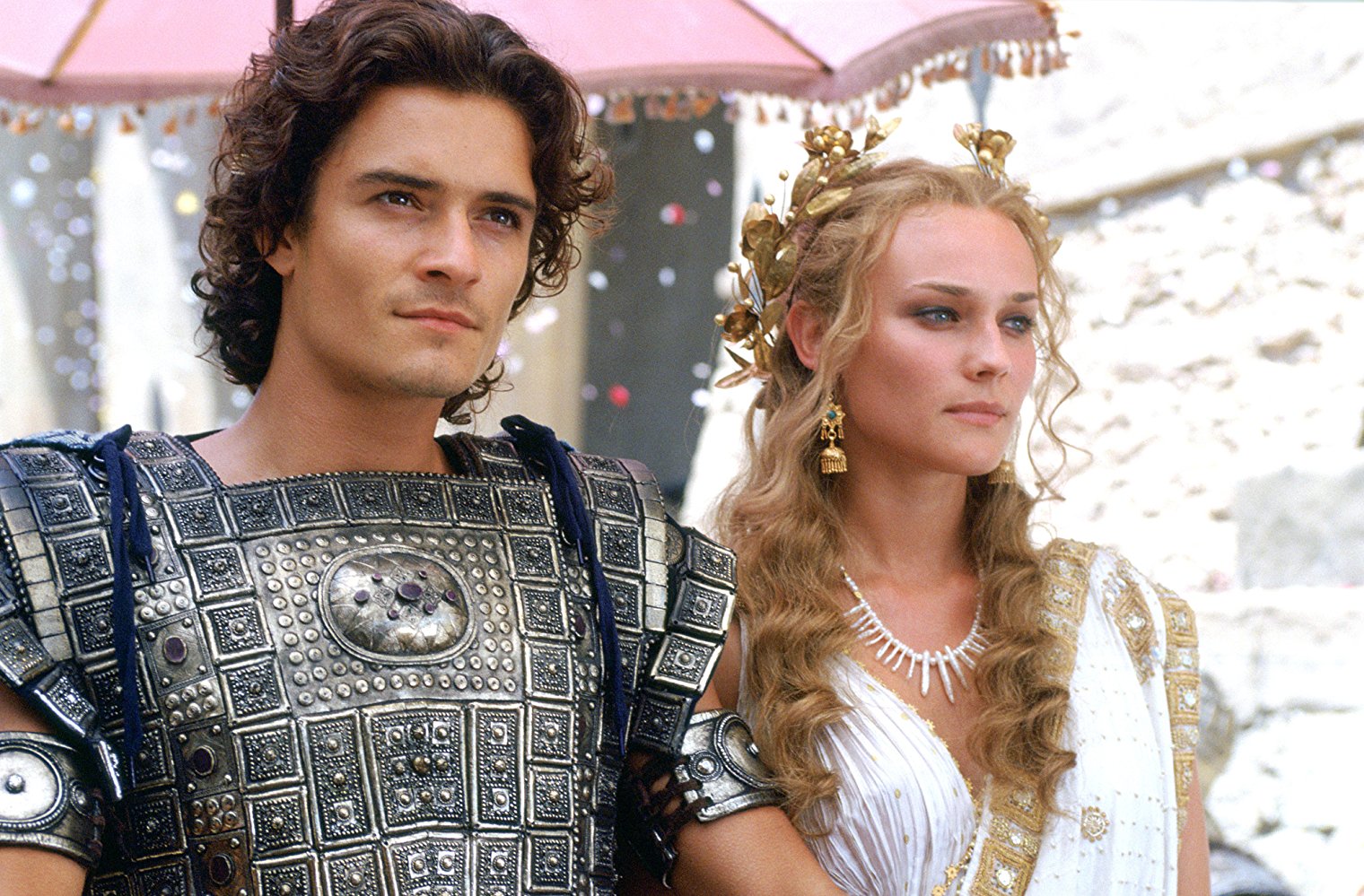
In Ancient Greece, a peace treaty has finally been agreed between Sparta’s King Menelaus (Brendan Gleeson) and Priam (Peter O’Toole) of Troy. Priam’s sons Hector (Eric Bana) and Paris (Orlando Bloom) are in Sparta to seal the treaty – only for Paris to fall in love with Menelaus’ unloved wife Helen (Diane Kruger). When they elope – despite Hector’s fears for the harm it will cause Troy’s people – Menelaus’ ambitious brother Agamemnon (Brian Cox) sees his chance to cement his hold over the last corner of the Mediterranean by conquering Troy. But to do so he’ll need the help of the greatest warrior in Greece, Achilles (Brad Pitt), who cares only for his legend and hates Agamemnon. 

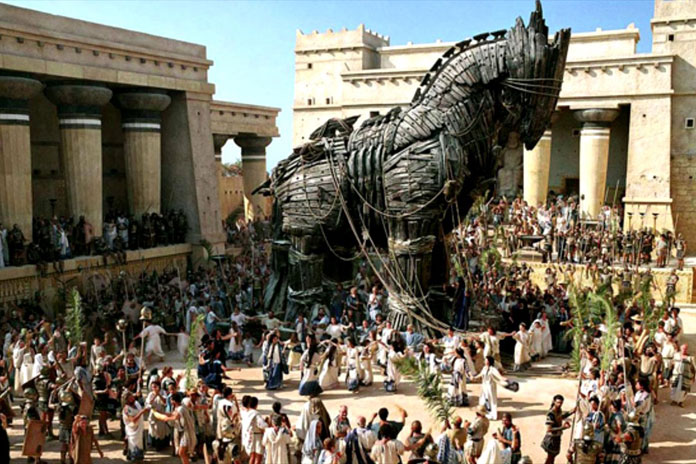
Directed with an old-fashioned grandeur by Wolfgang Petersen, mixed with an unflinching look at the blood and guts of war, Troy is a grand, cinematic epic that looks fantastic. The production and costume design are spot-on, and there is a great mixture of the “real” and the “special effect” in what you see on screen. It’s also got some cracking battle and fight choreography. The sword fight choreographers worked overtime on this one. The film embraces the grace and style of Achilles – he’s not the largest or strongest, but he has a pace, speed, intelligence and ruthlessness that allows him to duck, sway and constantly be one step ahead of his opponents. It doesn’t shy away from the brutality of his violence, and the camera never forgets the fallen.

It’s a film that understands the impact of war. It makes us care about many of the characters – and frequently shocks us with senseless, sudden deaths, or devotes time to the grief of those they leave behind. Our hero Hector has an almost tortuous-to-watch lengthy build up to his final fight – and then the camera gives us a moment or two when he is fatally wounded to see the light start to go from his eyes before Achilles delivers the killer blow. It’s a film that moves the viewer, that excites us with action while letting us grieve the cost of war.

The script is also a reasonably decent adaptation of elements of Homer, remixed with a modern (God-free) twist – as if this was the “true” story legend has been spun from. The script is put together by Game of Thrones’ David Benioff, and has his recognisable mix of epic scope and noble principles, clashing with realpolitik.

So why was Troy rejected by so many people? Why was it so misunderstood on release? It’s a mis-sold and partly mis-cut story struggling to embrace its own implications. Maybe I’m reading stuff into it, but I feel like this is a different film than the marketing or filmmakers seem to have understood. 

Firstly, Achilles is (at least for the first two thirds) effectively the film’s villain. He has no interest in people, only a sociopathic wish to be remembered as a great warrior. He’s ruthless in combat and slaughters indiscriminately. He’s temperamental and emotionally stunted. Contrast him with Eric Bana’s Hector: a devoted family man, who values the lives of the people of Troy first and foremost. Hector is effectively reimagined from the source material as a very modern man – the audience surrogate, the hero we can relate to, compared to the greedy, rapacious Greeks.

The struggle the film has is its biggest star plays Achilles – and it doesn’t want to compromise his box office appeal. So it tries not to draw too much attention to this contrast, and avoids passing too much judgement on Achilles. So we struggle when Achilles and Hector fight – anyone with any sense is surely rooting for the guy with a wife who just wants to see his kid grow up, rather than the sociopath, even if he is played by a super-star. All the characters hammer home our distress at Hector fighting Achilles, by the fact all of them reckon he’s got no chance. There are moving farewells for Hector with his father, wife and son. Hard to sympathise with Achilles when he slays the film’s most sympathetic character and drags him in the dirt right?

Achilles only starts to develop humanity (and become a modern hero) when he hits rock bottom after killing Hector – and is shamed first by Priam’s humbling, controlled pain (a tour-de-force from Peter O’Toole) then by his slowly developing love for Briseis. From this point , Achilles fights specifically to protect others – and finally puts aside his longing for immortal fame to try and save Briseis from the slaughter of the sack of Troy. The film’s slightly muddled unwillingness to condemn Achilles earlier, and its desire to celebrate him at the end, muddies the water. But there is a clear character arc slowly developing of Achilles becoming a humbler, more humane man.

As Achilles doesn’t look that good opposite Hector, the film turns Agamemnon into a ruthlessly ambitious, vain and greedy tyrant (played with a lip-smacking, roaringly enjoyable style by Brian Cox). Agamemnon (like many of the Greeks) is a modern politician – he wants to fashion the Greek city states into a single nation (sure one under his control, but it’s a more modern idea). The film, however, uses him to make Achilles desire for lasting fame feel more sympathetic. We all hate hypocritical politicians and cowardly bullies, right? And we all prefer the romance of the individual fighter uninterested in worldly affairs, right? Ergo, says the film, if we don’t like Achilles because we prefer Hector, we can also like Achilles a bit more if we don’t like Agamemnon. It’s clever structure in a way – but because the film doesn’t completely commit to it, it gets a bit lost in the telling.

The film’s attitude to Agamemnon is reflected in its favouring of Trojans over Greeks. While the Greek commanders squabble, or engage in political chicanery, the Trojans have an old school nobility. The film is enamoured with Priam. He’s played by Peter O’Toole in his grandest style (and O’Toole, though he can’t resist a bit of ham here and there, is very good). But Priam is in fact a naïve idiot, who makes a mess of everything. He’s incapable of accepting the realities of the world – his decisions lead to disaster at every turn. He may be overtly noble, honest and full of integrity – but like Ned Stark in Game of Throneshe’s completely out of his depth in Agamemnon’s ruthless world. Achilles may call him a “far better king”, but by any modern standard, Priam is in fact a terrible king, who makes all his decisions based on his regard for the Gods, rather than a claim appraisal of the situation.

These two reasons are why the film struggles. The film despises the Greeks but wants us to love Achilles – while at the same time having him kill without compassion, including our main audience surrogate character. It wants us to aspire to the romantic ideals of Priam and the Trojans – even while it demonstrates time and again that these ideas are hopelessly misguided, and completely wrong. It goes part of the way to accepting these contradictions, but it can never quite bring itself to villainise Brad Pitt, or condemn the noble Peter O’Toole.

I like to watch it my own way, balancing these contradictions – and I think if you do that (like watching the TV show The Tudors if you accept what the show can’t: that Henry VIII is the villain) then the film is really rewarding, full of interesting ideas and packed with cracking scenes.

It also allows some wonderful performances. Brad Pitt is, I suppose, an odd choice for Achilles in many ways – and he seems a bit bound in by his 1950s-Hollywood-Epic-Transatlantic accent. But he really looks the part, and I don’t think he’s afraid to let Achilles look bad – and he sells his conversion into a more heroic figure. Eric Bana is terrific as Hector – warm, engaging, hugely admirable. He has a world-weary tiredness to him – while Pitt’s Achilles is as cold as marble, Bana’s Hector looks like he has the cares of the world on his shoulders, tired already of the violence and horror he has had to endure.

There are tonnes of excellent supporting performances. Sean Bean in particular is so good as the wry and infinitely wise Odysseus you will be wishing they had made an Odyssey sequel so you can see more of him. Cox and O’Toole are rather good (bless, they are clearly enjoying themselves) as flip sides of the same coin. Byrne is affecting as gentle Briseis. Brendan Gleeson makes a fiercely bullying Menelaus. I’m not sure Saffron Burrows has ever been better than here. James Cosmo and Nigel Terry shine in smaller roles.

Poor Orlando Bloom struggles with a part that is hugely difficult – Paris is basically a spoilt coward. The film makes great play of Helen (a pretty good Diane Kruger in a near impossible part as the most beautiful woman, like, ever) being attracted to Paris precisely because he’s more of a romantic, and not interested in violence – but he tends to come across more as a thoughtless playboy, who lands everyone in trouble. It’s tricky for Bloom as this is the purpose of the film – and in many ways he’s very good casting for it – but that’s partly because he’s not the most persuasive of actors. He has a slight redemption arc – but I’m not sure Bloom as the presence to really sell it. 

I can’t believe how much I’ve actually written about this– but, for all its faults and its confused structure  I actually rather deeply love it. Maybe it’s tied in too much with my love for Greek myths. Maybe I love these all-star character actor epics. But I think it’s a film that puts a lot at stake for its characters – and really makes you invest in them – and that draws some fine performances from its cast and frames them all in a brilliant vista. It’s crammed with some terrific scenes. It never fails to entertain me. It’s almost a go-to film. I’ve seen it dozens of times and yet it never tires for me. I love it. In many ways it’s one of my filmic (forgive me) Achilles’ heels.

Caravaggio (1986)

Nigel Terry is Caravaggio in Derek Jarman’s extraordinary meditation on art Caravaggio

Director: Derek Jarman

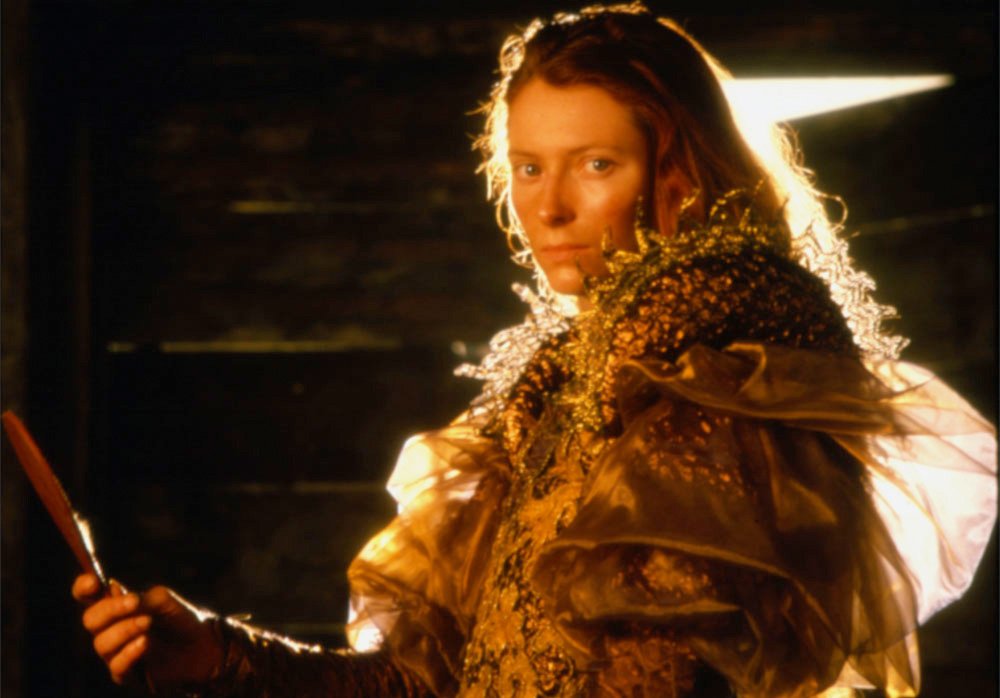
Cast: Nigel Terry (Michelangelo de Caravaggio), Sean Bean (Ranuccio Thomasoni), Tilda Swinton (Lena), Garry Cooper (Davide), Dexter Fletcher (Young Caravaggio), Spencer Leigh (Jerusaleme), Michael Gough (Cardinal del Monte), Nigel Davenport (Giustinani), Robbie Coltrane (Cardinal Scipione Borghese), Dawn Archibald (Pipo), Jonathan Hyde (Baglione), Jack Birkett (Pope)

Derek Jarman started his career as a painter, before he began making his own eccentric, art-house films, shot through with a fascination with visual imagery, colliding time periods, abuse of power and homosexuality. For years, Jarman had sought funding to make a biographical film about Caravaggio – one of his (and my) favourite artists. The film he eventually produced, Caravaggio, is quite simply not like anything you’ve really seen before – partly a masterpiece of striking imagery and inventiveness, partly a groaningly semi-pretentious, self-conscious piece of art cinema. What it never is though is dull.

Told in a disjointed series of flashbacks, in which not every scene necessarily connects with the scenes preceding and following it, Caravaggio as a young boy (Dexter Fletcher) is taken under the wing of Cardinal del Monte (an imperiously controlling Michael Gough): creepy part art patron, part pervert. Caravaggio (Nigel Terry) becomes a successful painter, while never losing his taste for the wildness and violence of the streets of Rome. He becomes fascinated by street fighter Ranuccio Thomasoni (Sean Bean) and Thomasoni’s lover Lena (Tilda Swinton), the three of them forming a sensually suggestive menage-a-trois, which eventually leads to tragedy. All this is framed with the dying Caravaggio, remembering in a semi-poetic voiceover feelings and moments from his life.

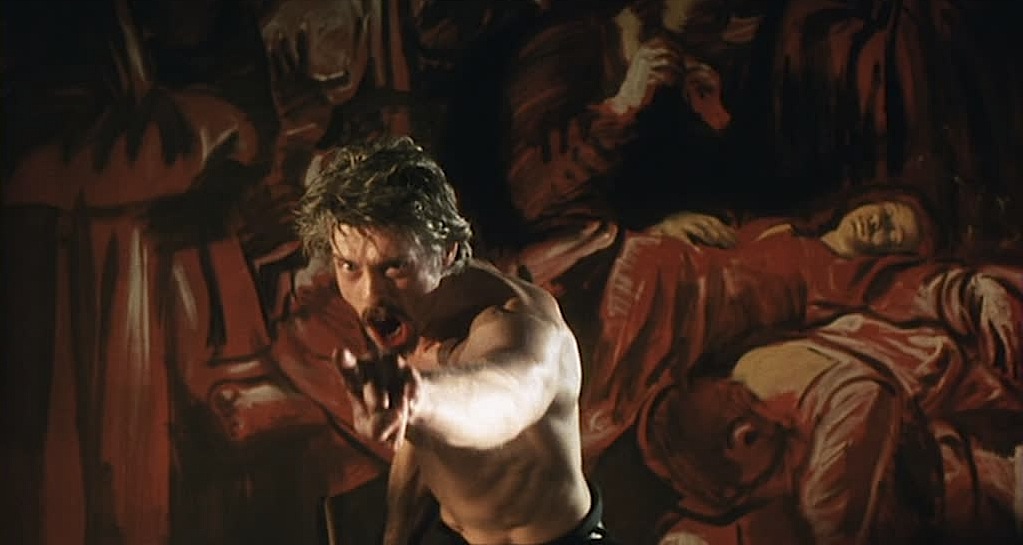
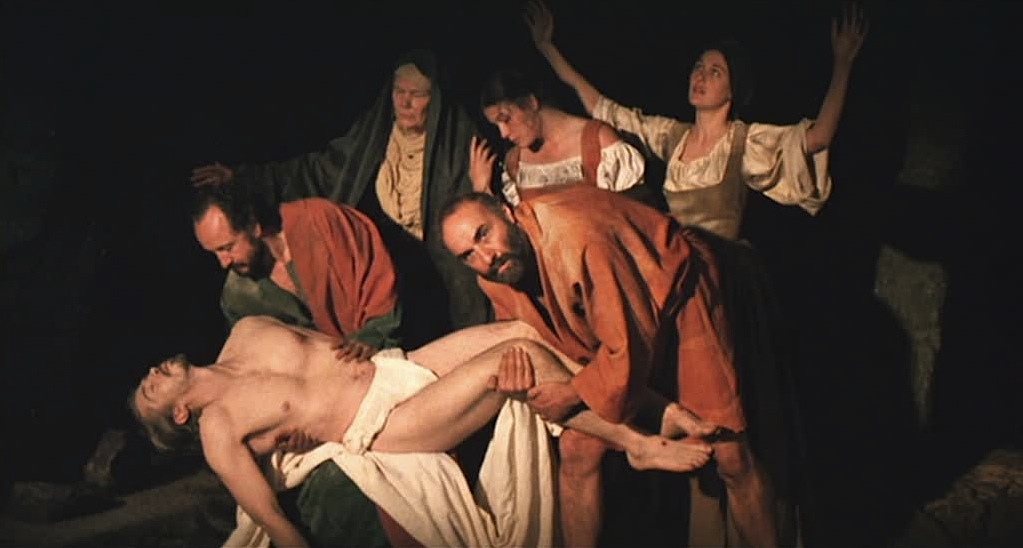
Firstly, for any fan of Caravaggio, this film is a visual treat. Every frame is lit and framed to be as reminiscent as possible of the style of the master. Many scenes are framed either in bare, stone rooms with single windows, or in sets emerging out of an inky blackness. Lighting often strikes diagonally across the frame, just as in Caravaggio’s best work. A number of scenes seem lit from a single source, such as a candle. On top of this, a number of scenes feature either the creation of, or inspiration for, a number of Caravaggio’s most memorable artworks: for those familiar with his work, it’s a delight to see these either recreated in the studio by models, or suggestively composed out of scenes. For an art lover, it’s a visual treat.

Jarman also has an intricate understanding of the creation of art, and when we watch Caravaggio at work it genuinely feels like watching a real artist, engaging with the world, recording images in his mind’s eye, and preparing his next work. The scenes watching Caravaggio create his masterpieces are fascinating in their detail and the careful build-up of paint to create an effect. The effort of models to stay still for the painter is constantly stressed. It’s a tribute to the work that goes into creation, even if the film succumbs to a few pretentious clichés (at one point Caravaggio and Ranuccio fight playfully with knives and Ranuccio cuts Caravaggio: of course Caravaggio smears the blood over Ranucci’s face. That tends to be what artists in films do). 

Jarman, however, makes a film that is deeper and more suggestive than that. This is a fascinating meditation on power and patronage in the world of art. Caravaggio is a genius, but also a tool of the people above him in the pecking order. One of the first things we see is the teenage Caravaggio selling first a painting, then his body, to a pervy art collector. The patrons call the shots here, and if they want to put your work on their wall, or their hands down your pants, the artist just needs to fall into line. Caravaggio himself is little different – the models he works with are treated with a certain warmth, but there is a clear hierarchy here. His relationship with Ranuccio and Lena is rooted initially in power – he can effectively buy them or their bodies, because he controls the money available to them. The renaissance was not a time of equality: everyone is in hock to someone else, and everyone is defined by what they can trade, be that their art, their body or both.

The film has a clear sensual charge to it in every frame, despite not containing a single scene of sex. There are highly suggestive moments of sexual abuse and desire throughout. It’s heavily implied Cardinal del Monte’s interest in the young Caravaggio is not completely innocent, as del Monte sits with him in bed teaching him to read. During their first modelling session, Caravaggio tosses a series of coins at Ranuccio, each of which the man inserts suggestively into his mouth. Every scene with Lena tingles with sensuality – either with Caravaggio, Ranuccio or the mysteriously powerful Cardinal Borghese (a corrupt looking Robbie Coltrane). 

Perhaps the most striking feature of the film though is its highly unique look. Taking his cue from Caravaggio himself – who painted the subjects of his historical pictures in contemporary dress and locations – Jarman and costume designer Sandy Powell dress the cast in a series of shabby, 1940s-1970s clothing (with the exception of a scene in the Vatican, which is established as a fancy dress party). Caravaggio is barely seen without a cigarette in his mouth, and dresses like a bohemian from Montmartre. Plenty of modern props are introduced – a banker fiddles with a pocket calculator, the writer Baglione hammers his criticisms into a typewriter while flicking through a luscious magazine of Caravaggio prints. Ranuccio cleans a motorbike.

All this manages to not only make the film continually visually striking, but also playfully reminds the audience all the time that they are watching a version of a reality – not a true story but a fictionalisation of the painter’s life. It gives Jarman an artistic licence that he exploits to the full, and makes this a film that really sticks in the memory. It’s an inventiveness you wish you saw more in films rather than slavish historical recreation.

Caravaggio is not a masterpiece – it’s a little too self-consciously arty for that. It almost delights at times in being disjointed and hard to follow. Some scenes leap over what seems like years of events. There is no real narrative through-line. The poetic voiceover can start to wear you down – I searched it for meaning, but I’m not sure if there was much there. Saying that, although this is very much a director’s film, there are some fine performances. Terry does a very good job as the artist himself, capturing a sense of the creative spark behind the eyes. Bean is excellent in one of his first roles as the earthy, insecure Ranuccio. Tilda Swinton however steals the film (it’s easy to see why she became Jarman’s muse) as the beguiling and mysterious Lena.

Caravaggio is that rare thing: a film about an artist that seems to understand art, and feel like a work of art itself. It’s unique and eye-catching and memorable as well as having a neat eye for the tragic. I was strangely mesmerised by it throughout. It’s not a perfect film, but it’s a very good one.