Tag: Nina Foch

The Ten Commandments (1956)

The Ten Commandments (1956)

DeMille’s massive, camp epic sets the table for what we expect from Biblical epics

Director: Cecil B. DeMille

Cast: Charlton Heston (Moses), Yul Brynner (Rameses II), Anne Baxter (Nefretiri), Edward G. Robinson (Dathan), Yvonne De Carlo (Sephora), Debra Paget (Lilia), John Derek (Joshua), Cedric Hardwicke (Seti I), Nina Foch (Bithiah), Martha Scott (Yochabel), Judith Anderson (Memnet), Vincent Price (Baka), John Carradine (Aaron), Olive Deering (Miriam), Douglass Dumbrille (Jannes)

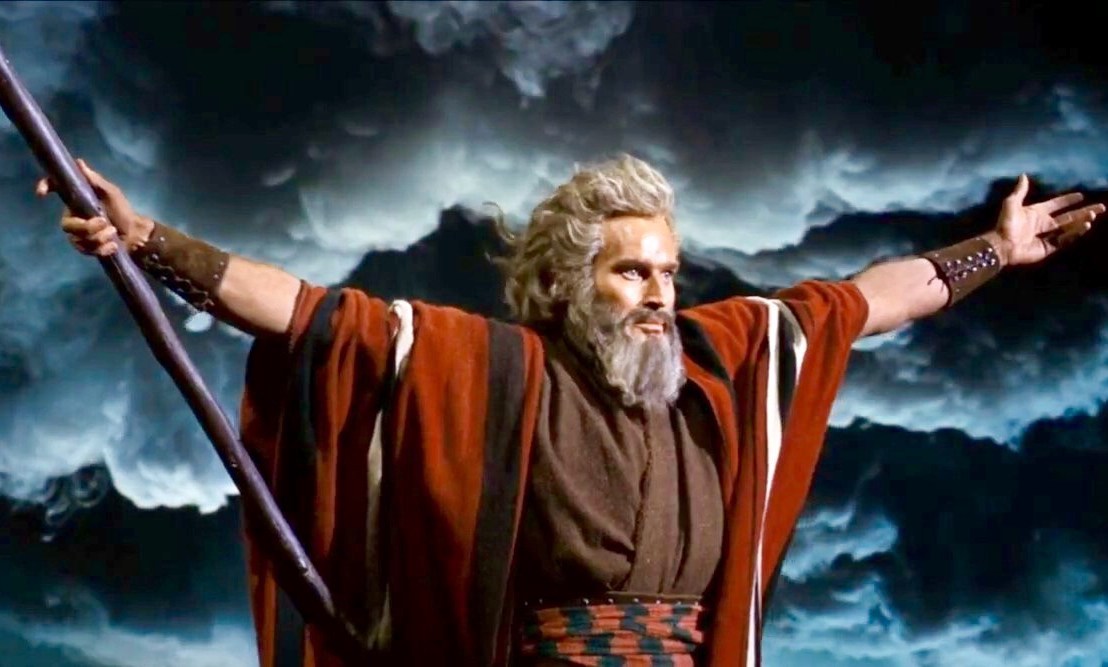
“Let my people go!” Close your eyes and think of Moses. Chances are you’ll see an image of Charlton Heston, arms spread wide, parting the waves to lead his people to freedom. Heston had been partly chosen for his resemblance to Michelangelo’s sculpture of the famous law-giver. It’s also a tribute to how Cecil B DeMille’s slightly ponderous, very-very-serious Biblical epic pretty much defined what we expect from Bible stories.

The Ten Commandments would be DeMille’s final movie (and for all its many flaws, it’s way more deserving of the Best Picture Oscar than the valedictory pat-on-the-back his penultimate film got). It’s basically a triumphal capturing of his self-important style, with sonorously devout voiceover and a faultless hero chiselled from marble an excuse to fill the screen with action, campy scheming and lots of sexiness. The Ten Commandments became a massive hit because it’s a rollicking pile of nonsense and something you could persuade yourself was “good for you” because it’s about the Exodus.

It’s a BIG film. DeMille delivers an opening direct-to-camera address, dripping with pompous self-satisfaction, where he piously tells us about the level of historical and Biblical research he’s carried out. The credits list a stack of professors, historians, religious experts and, last of all, the Holy Gospels as sources (presumably the Gospels’ writers got no cut of the vast profits). DeMille, as per his style, marshals thousands of extras and some huge (and distinctly sound-stage looking) sets to play out a series of tableaux, many of them rooted in classic silent-movie framing and techniques. Special effects abound to create plagues (disappointingly the film skips seven of them) and parting of the Red Sea. DeMille narrates with the grandiose aloofness of a Sunday School teacher.

It’s almost enough grandeur to make you overlook this pageantry covers a rather camp, frequently silly piece of entertainment. The film is ripe with buff actors striking poses: Heston does a lot of this during the first half, matched by Brynner (who worked out at length so as not to be shown-up). Opposite them, gorgeous Israelite and Egyptian babes fawn and flirt. The film is at least as interested in the love/hate relationship between Moses and Nefretiri as it is in the Word of God, not least because DeMille knows that this soapy stuff really sells.

Perhaps that’s why Anne Baxter plays Nefretiri with a level of campy purring that would be almost laughable, if you weren’t sure that she’s in on the joke. Relishing the chance to play a sex bomb – in costumes designed to stress her assets – Baxter simpers, flirts, drapes herself across Heston’s ram-rod (in every way but one of course – he’s righteous man of God) Moses and gets to utter lines like “Oh Moses, Moses, you stubborn, splendid adorable fool”. She mocks and cajoles Rameses into rejecting Moses’ demands, partly because she can’t stand Moses is immune to her charms, partly because she can’t bear the idea of Moses leaving Egypt (and her) behind forever.

Ten Commandments elevated Heston to the rank of the immortals. Few actors could carry the weight of films like this as well as he. His performance is in two acts. The first is the visionary, egalitarian adopted son of the Pharoah: the guy who builds the best cities, turns rival kingdoms into allies, gives the stuffy priests’ grain to the slaves (even before he finds out he’s one of them) and whom Seti (a haughtily British Cedric Hardwicke) would rather took over the kingdom than Rameses. Discovering his roots, he morphs over a (long) time into the white-haired, broad-shouldered prophet, speaking most of his lines in sonorous block capitals (“BEHOLD. THE POWER. OF GOD” that sort of thing). Very easy to mock, but only Heston could have played such woodenly written silliness with such skilful conviction.

He generously said he believed Brynner gave the better performance. Brynner does have the more interesting material. A playboy monarch who is true to his word and seems (at first) torn with how he feels about this adopted brother who overshadows him at every turn, Brynner adds a lot of light and shade to a character written as a pretty much straight villain. Moses is presented as such an imperious stick-in-the-mud, it’s a little tricky not to feel a bit sorry for the put-upon, inadequate Rameses, for all he’s a tyrant.

Heston was the only actor who went on location for a few key shots (the others all perform on sound stages or in front of green screens). Keeping things sound stage based allowed DeMille to have complete visual control over the set-ups. This suited his conservative camera movements and editing – most of the scenes take place in a few carefully extended mid-shots, that allow us to soak up the pretty costumes and the theatrical acting. The Ten Commandments is partly a flick-book of devotional pictures – so much so that a tracking shot into Seti’s face when he banishes Moses stands out for the amount of camera movement.

That doesn’t stop DeMille throwing in plenty to look at in frame. With Heston spending half the movie as (in some cases literally) the voice of God, John Derek’s Joshua carries the action torch: chiselled of chest, he’s introduced zip wiring to save Moses’ mother from being crushed by a mighty stone. Like most of the “good” characters he gets very little to actually work with: the decent Jews are either excessively pure or aged men of physical weakness who commentate on the wonders around us. Still, it’s better than the hilariously cheesy dialogue of the regular Israelites (“We’re going to the land of milk and honey – anyone know the way?”) that contrasts laughably with the Biblical pastiche Moses and the other principals speak in.

DeMille has plenty of fun with the doubters and naughty among the Israelites. Edward G Robinson goes gloriously over-the-top as quisling Dathan, blackmailing Joshua’s girl Lilia (a timid Debra Paget) into years of servitude and taking every single opportunity to undermine Moses’ leadership. It works as well: no wonder Moses gets so peeved – the slightest set-back and the Israelites seem ready to stone him. Dathan leads the final act Golden Calf orgy (DeMille’s voiceover tuts constantly, while letting us see as much of the action as the censor would allow) while Moses is up the mountain picking up the Word of God.

Robinson has the tone right though: the cast is stuffed full of OTT actors. Vincent Price plays a perverted Egyptian architect with lip-smacking glee. Judith Anderson jumps over the top as Nefretiri’s nursemaid. Nina Foch (one year younger than Heston!) plays Moses’ adopted mother with grandiose gentleness. They know this is a big, silly, pose-striking pantomime passing itself off as a piece of devotional work.

But that’s why its popular. DeMille knows that people don’t want to see a devotional lecture – or even really have to think that much about the rights and wrongs of an Old Testament story that sees the Lord strike down a load of kids with a murderous cloud (even Moses is torn by this for a minute). The Ten Commandments is huge in every sense, full of campy nonsense, pose-striking acting and a mix of stuff it’s taking very-very-seriously and campy ahistorical nonsense. It’s a winning cocktail that doesn’t make for a great film (or even, possibly, a good one) but cemented it as a landmark everyone recognises even if they haven’t seen it. In a way, making it one of Hollywood’s most magic epics.
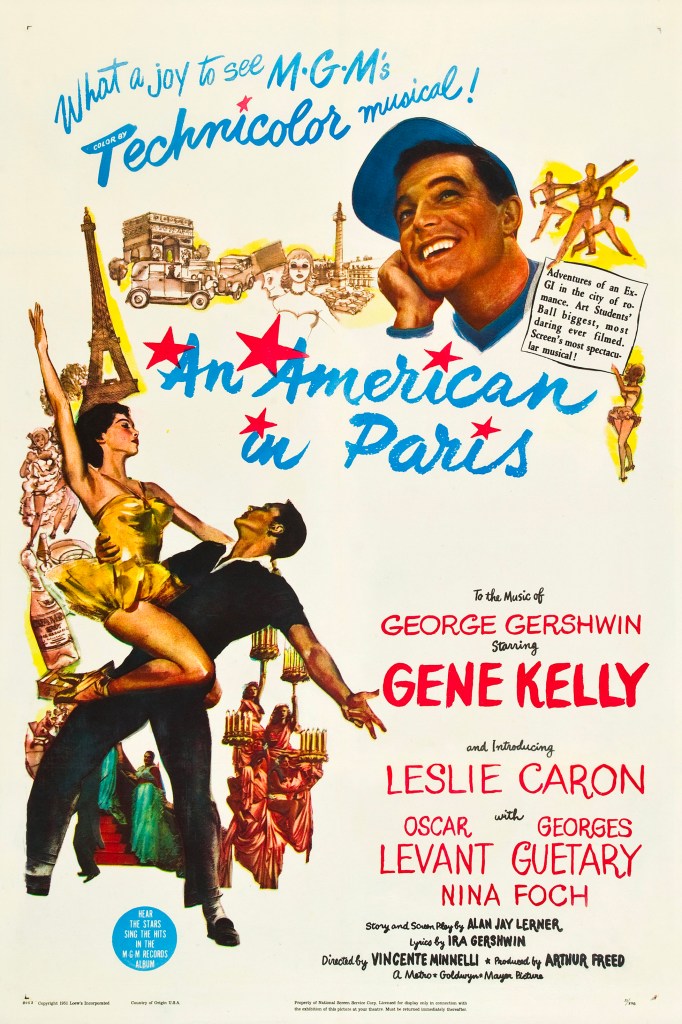
An American in Paris (1951)

An American in Paris (1951)

Romance, love and a lot of dancing in this charming Best Picture winning musical

Director: Vincente Minnelli

Cast: Gene Kelly (Jerry Mulligan), Leslie Caron (Lise Bouvier), Oscar Levant (Adam Cook), Georges Guétary (Henri Baurel), Nina Foch (Milo Roberts), Eugene Borden (Georges Mattieu)

“This is Paris. And I’m an American who lives here!” Those are almost the first words you hear in this charming but light and frothy Best Picture winner. They are pretty much an indicator of the loosely constructed, lightly plotted film that unspools. With the rights to the back catalogue of Gershwin, a story was swiftly thrown together to give us a reason to watch Gene Kelly and friends dance and sing their way through them. Tapping into a post-war romanticism about the delights of Old Europe, An American in Paris is a hugely entertaining technicolour delight that blew audiences away.

That American is Jerry Mulligan (Gene Kelly), an ex-GI hanging around in Paris to try and make his dreams of being an artist like Renoir and Toulouse-Lautrec come true (one glance at his paintings is enough to know he has no chance). His best friend is fellow ex-pat, ageing ‘child prodigy’ pianist Adam (Oscar Levant). Adam’s friend is Henri (Georges Guétary), a famous French singer (and war hero!). Henri is engaged to Lise (Leslie Caron), who meets Jerry by chance, neither knowing who the other is. Doncha-know-it Jerry and Lise fall in love. All this while Milo (Nina Foch), a wealthy would-be patron, longs to make Jerry her companion. How will these romantic complexities play out?

The story is by Alan Jay Lerner, but it can’t have taken him more than a long afternoon to come up with it: two friends unknowingly love the same woman, which will she choose? There is the odd sparkling piece of dialogue, but really this is a showcase for three things: Gershwin, Kelly’s dancing and Paris. Pretty much in that order, since the film is almost completely shot on a Studio backlot  (there are some brief second unit shots of the actual locations). Kelly objected at first to the lack of location shooting (“Ever tried dancing on cobble stones?” a producer pointed out), but actually it works for a film that is basically a fantasia on the city of romance, at points literally taking place in dream-like Parisian streets.

Constructed on a huge set (with some ingenious technical effects to expand the heights of the buildings, like Jerry’s apartment) the film is basically one delightful dance sequence after another, shot with a technicolour richness by Minnelli. We get introduced to our three male leads – Jerry, Adam and Henri – in overlapping voiceover, their faces unseen, as the camera roams over their Parisian locale. (We also get a neat repetition three times of the same joke as a camera settles on someone who nearly fits their description only to be told “no that’s not me”).

From there they meet each other and burst into a richly dynamic all-singing, all-dancing rendition of By Strauss in a classic Parisian café, that uses every prop going.  (It later gets mirrored with an equally amusing ‘S Wonderful where, unknowingly, Jerry and Henri sing of their love for the same woman, while a stressed Adam who knows the truth puffs seemingly a whole pack of cigarettes at once). Not to be out down, as Henri describes his fiancée to the boys, we see Caron perform a series of ballet steps each of them styled differently to reflect the different facets of her personality.

Kelly took on much of the choreography work and the film is a tribute to his grace. The man could move like almost no one else. One of the best bits of choreography in the film isn’t even a musical number: after his introduction Jerry gets out of bed in his tiny apartment and, with a stunningly witty musical grace, rearranges all the furniture from ‘night-time’ (bed) to ‘day-time’ (table and chairs). It’s just about a perfect bit of physical choreography, one of my favourite in the movies and at least as beautiful in its way (if not more so than) Jerry and Lise ballet stepping to Love is Here to Stay under a Parisian bridge. Not to complain about this number, which is a hugely influential routine of two dancers moving increasingly in rhythm with each other, shot with a luscious romantic beauty by Minnelli.

The numbers are so good, you give a pass to the fact that Jerry behaves like a bit of shit. His paintings are hilariously – and I believe intentionally – third-rate rubbish (he’d barely manage to land a job as a postcard painter), so its clear his aspirations to art are a fantasy. It’s also clear that Milo can’t seriously be interested him as an artistic prospect, as opposed to a bed one. Jerry of course knows this, but he still blows hard and cold on her with a slightly shabby selfishness. He’ll take her money for an apartment and whisk her away to a masked ball when he’s feeling low. But he’ll also flirt shamelessly with Lise right in front of Milo and her friends, and then act with a churlish “what’s the problem” harshness in the car with a tear-stained Milo on the way home.

I’m not sure how sorry the film wants us to feel for Milo, but one look at Nina Foch’s fragile face and her wobbling voice a few seconds away from tears as she deals with humiliation from her possible-boyfriend, always puts me on her side (at least at that moment). Jerry is borderline stalker in his pursuit of Lise, chasing her down in the café he has been bought to by Milo (after spending large chunks of the evening starring uncomfortably at Lise), dragging her into a dance and then pestering her later at her workplace into a late night meal. Just as well she loves him. Honestly if Kelly wasn’t so charming, you’d give Jerry a slap. Or a restraining order.

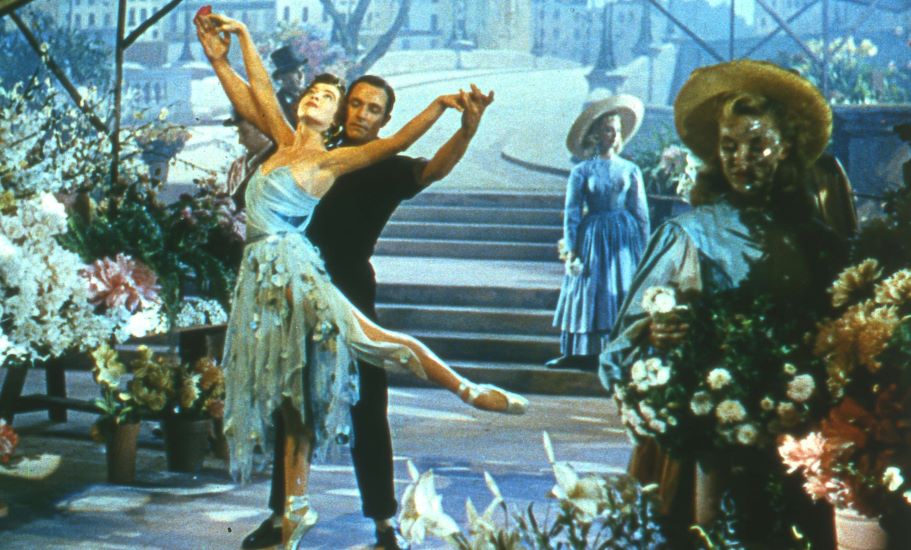
An American in Paris saves its final flourish for its last act: a seventeen minute ballet, taking place in a mix Jerry’s memories and wishes after it seems he and Lise will be kept apart for ever. Choreographed by Kelly, there isn’t anything else really like this in the movies (until La La Land stole the idea). Minnelli and Kelly sit in the ballet in a deliberately artificial Paris, essentially Jerry’s paintings bought to life and mixed with those of his artist heroes. This sequence is at times a little indulgent (some reviewers have unkindly compared Kelly’s desire to dance a ballet to a clown gracing us with his Hamlet) but it’s beauty and dynamism means it rewards investing in it.

Because Kelly and Caron (who is admittedly incredibly raw here as an actor) are wonderful dancers and the choreography here showcases them to perfection. Partially retelling the events of the film, partially telling its own romantic fantasia of a couple bought together and pulled apart, it’s a perfect mixture of several dancing styles and emotions and looks stunning, in its hyper-realistic design.

It makes for a unique ending to a classic musical that gets a bit overlooked – possibly because of the brilliance of Singin’ In the Rain that followed a year later, but was a flop compared to this mega-hit – but is an explosion of superb musical entertainment. Sure, the story is slight – only Nina Foch gets anything approach a hard-hitting role – but the joy is grand. Kelly is charm itself, Levant and Guétary very good in roles that riff on their personas and the whole thing will have you tapping toes and clicking fingers.

Spartacus (1960)

Kirk Douglas leads the campaign for freedom in Spartacus

Director: Stanley Kubrick

Cast: Kirk Douglas (Spartacus), Laurence Olivier (Crassus), Jean Simmons (Varinia), Charles Laughton (Gracchus), Peter Ustinov (Batiatus), Tony Curtis (Antoninus), John Gavin (Julius Caesar), John Dall (Marcus Glabrus), Nina Foch (Helena Glabrus), John Ireland (Crixus), Herbert Lom (Tigranes Levantus), Charles McGraw (Marcellus), Joanna Barnes (Claudia Marius), Woody Strode (Draba), Paul Lambert (Gannicus)

You can’t talk about Spartacus without saying it can you? Did the team working on the film realise that, for all the big names, spectacles and sweeping that the film’s definitive contribution to popular culture would be the sound of a hundred men all claiming to be the slave leader? But it’s the moment you think of more than any other when the film comes up – and there’s not many films that can claim to have contributed such an instantly recognisable moment to our cultural heritage. It’s not the film’s only merit though: this is grand, entertaining, old-school Hollywood epic-film making.

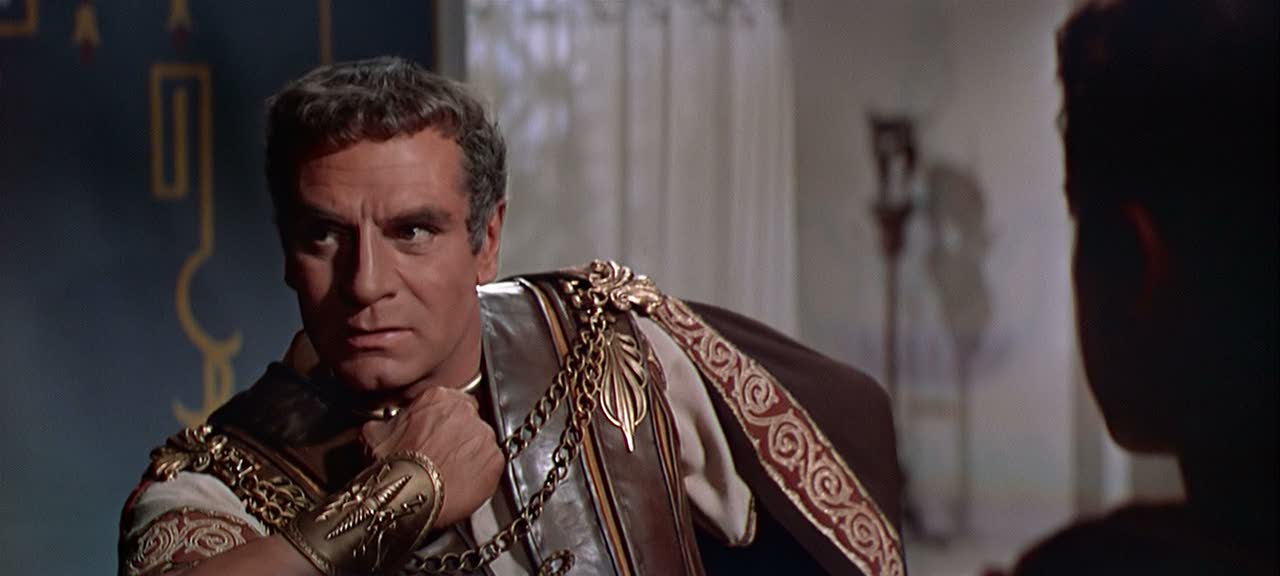
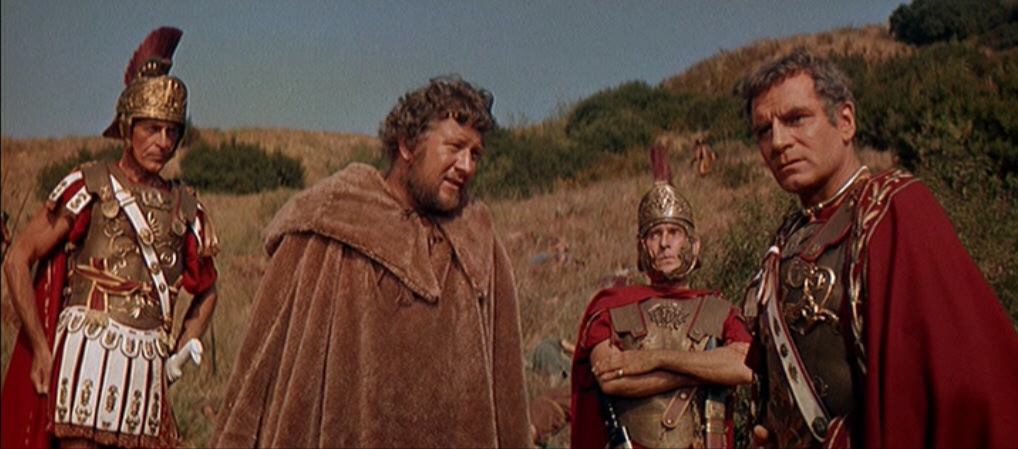
In the last decades of the Roman Republic, Spartacus (Kirk Douglas) is a young man born a slave, purchased by gladiator trainer Batiatus (Peter Ustinov) to learn how to thrill the crowds and kill his opponents. There he falls in love with slave-girl Varinia (Jean Simmons) and clashes with the regime of the training school. Revolt however stirs when rich nobleman Crassus (Laurence Olivier) arrives at the school and demands a fight to the death of his entertainment – as well as purchasing Varinia. In the aftermath, Spartacus leads a revolt – which grows into a huge army that soons puts all of Rome at risk. But a risk is also an opportunity: certainly it is for Crassus, who sees this as his chance to bring the Republic under his control.

Spartacus is a grand piece of film-making, shot on a huge scale, a labour of love for Kirk Douglas as producer. Upset at being denied the lead role in Ben-Hur, Douglas decided to make his own Roman epic – and to make something even grander than that Oscar-winning epic. Everything was thrown at the screen: grand locations, huge sets, star actors and a sweeping epic score. Alex North’s classically tinged score – with it’s distinctive employment of Roman instruments and echoing of both the intimidating splendour of Rome and the bucolic happiness of the liberated slaves – is proper old-school Hollywood score-making, that helps set the scene for the film’s epic sweep.

And Spartacus is epic – and epic entertainment. While it’s possibly a little too long, it knows when to spice up events with a battle, love scene or bit of political skulduggery. There are multiple story lines going on in this film, and interestingly they don’t all intersect. It’s easy to see Spartacus – and his struggle for freedom – as the real story of the film. But for most of the Roman characters, this is an embarrassment or sub-plot. There is a whole other story happening around the struggle to preserve Roman Republicanism – with Crassus as the face of oppression and his opponent Gracchus the slightly soiled but still vaguely democratic face of the old system. Both plots only rarely come together, and while that of Spartacus captures the heart strings, a lot of the film’s narrative drive is in the Roman conspiracies.

Perhaps this is because in the entire rebellion only Spartacus and Varinia qualify as really having personalities. And those personalities are basically flawless. Spartacus is almost saint-like in his nobility, a guy who never does anything wrong and whose only mistake is trusting others in a shifting world. Douglas does a great job of performing a character who is practically a living legend – and he completely convinces as the sort of leader his people would follow to the end. His relationship with Jean Simmons is also touchingly sweet and innocent – the film is very good at capturing the sense of how stunted the emotional lives of slaves have been, and the powerful joy they can find in the freedom of simple intimacies so many of us take for granted.

But the slaves themselves are frequently (whisper it) rather dull. Many of them might as well be sitting around the camp fires singing Kumbaya. Bar a brief moment at the start, no suggestion of taking vengeance raises its head. The liberated slaves sing, clap hands and gaze with joy. Children play and people frolic in the fields. Tony Curtis – good value as Crassus’ ex-bodyman, a learned man and entertainer of children – stages a magic show, with patter that could have come straight out of a Brooklyn street. Other than him, none of the slaves register as personalities. A tint of darkness, or moments of fury or even dangerous rage against their oppressors would have made a world of difference. But this is a simple film, where the slaves are building a utopia.

That’s probably why the film is more interested in the politics of the Romans. It’s certainly where the big name actors end up. Olivier is at his prowling, imperialist best – a heartless slice of ambition determined to bend events to his will. Against him, Charles Laughton with an impish cheek, a slightly corrupted air, as the man-of-the-people. These two conduct their own political battle of cut-and-thrust that Spartacus barely realises is happening. This manoeuvring is the real dramatic heart of the film, powered by these actors strengths (John Gavin and John Dall as their lieutenants look and sound very plodding against the playful archness of Olivier and Laughton).

That’s partly the point of Dalton Trumbo’s script (Douglas famously broke the Hollywood Blacklist by crediting Trumbo for his work on the film). While Rome plays politics, real people are fighting and dying for liberty – and will eventually find themselves crucified with nothing left but their pride and sense of freedom. It’s that feeling that probably lies behind the enduring love for this film.

It is perhaps Kubrick’s most universally beloved film. Interestingly though, it’s also the one Kubrick was least proud of. It’s true the film lacks much of his personal touch. While directed with flair and skill, parts of it could really have been made by any number of directors (not something you could say, for example, about The Shining or Barry Lyndon). Kubrick often quietly, albeit gently, disowned the film (he said he never knew what to say when people asked him about it). It’s the only Kubrick film where he was a “gun for hire”, subservient to the vision of the producer. His interest you feel is in the smaller moments – moments such as Woody Strode’s excellent cameo as a Gladiator (many of the strongest moments with the slaves in the tyranny of the Gladiator school, where life is meaningless and cheap). Really, it’s Douglas’ film – it’s similarities to The Vikings for example is striking – and while a poor advert for auteurism, it’s still a great advert for entertainment.

Kubrick’s greater interest in human failings and shades of grey perhaps explains why the Romans emerge as the more interesting characters. Spartacus’ lack of flaws were an intense frustration to him. Perhaps that’s why Peter Ustinov (who won an Oscar) is the films stand-out character. As gladiator owner Batiatus, Ustinov is devious, playful, amoral, ambitious, without principle, dryly witty but somehow still has touches of decency. The most colourful character in the piece is also the one most coated with shades of grey.

*It’s an advert for what makes Spartacus lastingly engaging and interesting whenever you watch it – even if the cry of “I’m Spartacus!” and the decency and honour of the slaves is always going to be what stirs the emotions and tugs the heartstrings. Douglas set out to make one of the greatest “sword and sandal” epics. He succeeded.