
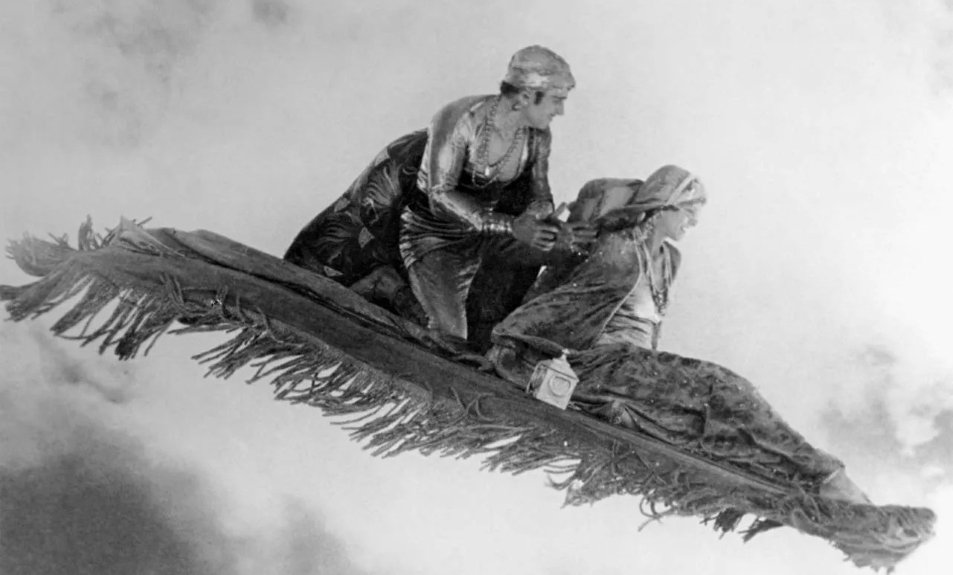
Fairbanks swings into action in this grand-scale epic that’s still gloriously entertaining
Director: Raoul Walsh
Cast: Douglas Fairbanks (Ahmed), Snitz Edwards (His associate), Charles Belcher (Holy man), Julanne Johnston (Princess), Anna May Wong (Mongol slave), Sôjin Kamiyama (Mongol prince), Brandon Hurst (Caliph), Tote du Crow (Soothsayer), Noble Johnson (Indian prince)
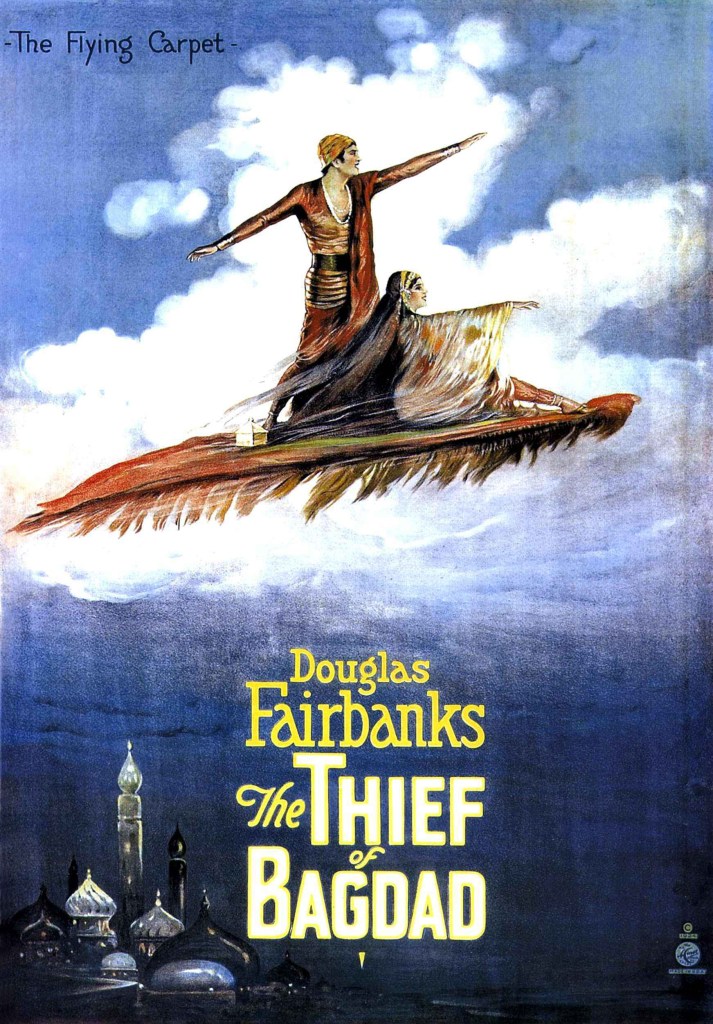
There was perhaps no bigger star of the silent screen than Douglas Fairbanks. The Thief of Bagdad was his Magnum Opus, lushly filmed (over a year in the making) adaptation of the Arabian Nights into a swashbuckling epic where our bare-chested hero leaps and bounds over every obstacle on his way to heroic glory. It remains wildly entertaining, a pacey thrill ride crammed with excellent stunts and impressive special effects.
Fairbanks is Ahmed, a good-for-nothing thief who disdains the rules, saying ‘What I want, I take’. How can this guy learn a little humility? Perhaps from the sight of a beautiful woman. Ahmed sneaks into the palace (via a magic gravity-defying rope) to filch treasure, falling instantly in love with the Princess (Julanne Johnston). Ahmed passes himself as a Prince to join the suitors looking to win her hand. Among them is the villainous Prince of the Mongols (Sôjin Kamiyama) who plans to conquer Bagdad, with the aide of the Princess’ treacherous slave (Anna May Wong). After he reveals his identity, and is banished, will Ahmed still do everything he can to save the city?
Of course he will! Along the way he’ll perform a parade of stunts and fits of athletic derring-do that helped make Fairbanks a beloved household name. Fairbanks is larger-than-life; in more ways than one, he’s a master of the gesticulating school of silent cinema, throwing his arms up and twisting his body into a series of emotional poses. Here he has the chiselled frame (on display for virtually the whole film) that comes from over a year of running, jumping, climbing and throwing himself through things.
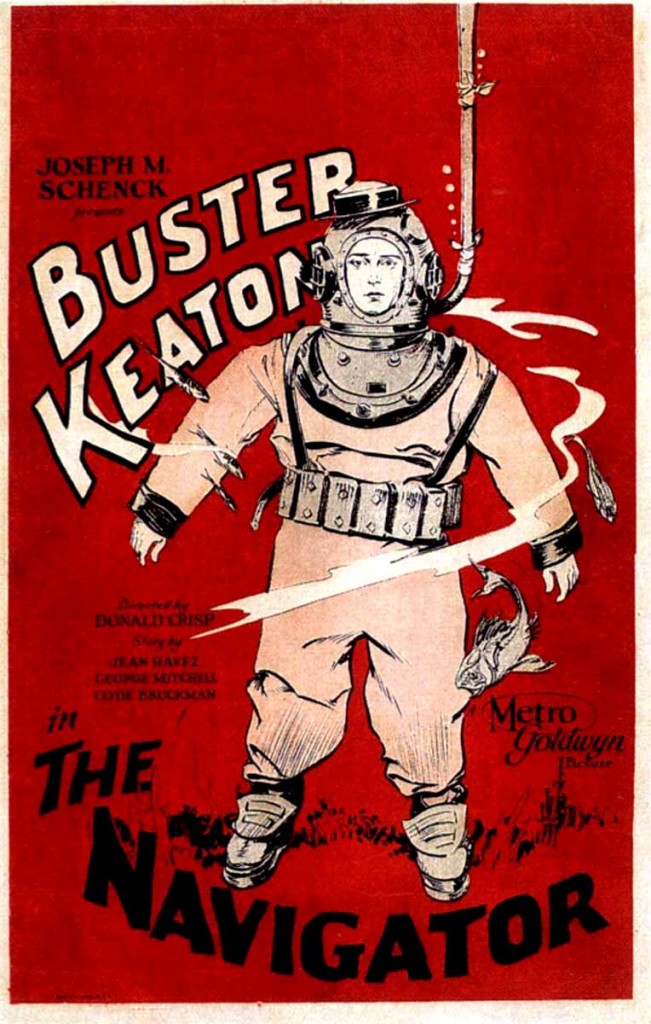
A large part of the fun of The Thief of Bagdad is soaking in Fairbanks’ natural charisma, from his introduction feigning drowsiness at a water fountain to pick pockets, to the magic carpet riding athleticism that ends the film. The film offers a parade of stunts carefully worked out to the minutest detail. A bounds in and out of giant pots. He climbs up ropes and launches himself through windows. He fights monsters and jumps from walls in athletic leaps. He balances precariously on high ledges. Only Buster Keaton rivalled his obsession with showstopping stunts.
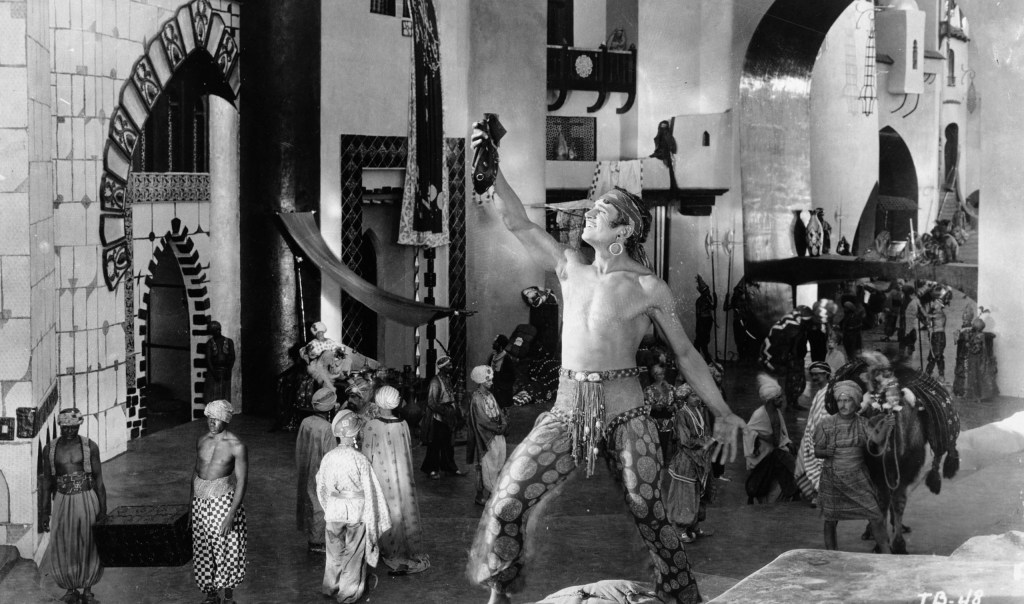
It’s not surprising Raoul Walsh’s film sits back and keeps the camera largely in mid-shot so we can soak up all the action. This is massively to the benefit of the enormous sets, brilliantly designed by William Cameron Menzies, which tower up several stories. The mighty buildings and city walls of Bagdad, with its gate looking like a giant gaping maw, are particularly impressive. The city walls constantly have people walking them to confirm what we are looking at is real. The frame stretches to the mighty scope of the film (and of course, Fairbanks’ was hardly designed for the intimacy of the close-up).
The set-piece special effects and sets also bring the more magical Arabian Nights moments to life. A rope, charmed to spring up and suspend itself in mid-air (in actuality an illusion captured by filming upside down, which is almost more impressive when you think of Fairbanks clinging upside down to a rope). A collapsing pot, a cloak of invisibility thrown around Ahmed, magic dust that brings to life your heart’s desire. And, of course, the impressive flying carpet (a steel platform on intricate wires, dangerous enough that it was the last thing filmed). There is a real magic about these practical effects, just as there is something impressive about the real tigers guarding the palace.
The Thief of Bagdad arguably starts slow: our introduction to the thief takes up much of the first thirty minutes and it is nearly an hour before the real meat of the story takes off. Much of the final act sees the thief engaged on an epic quest via a host of locations – caves of fire! An underwater kingdom! A palace in the clouds! – that doesn’t always make a lot of narrative sense, but looks impressive. Of course the real focus is less on the story and more the thrills of Fairbanks jumping through cavernous flames or duelling a series of fierce creatures (which, to be honest, look like the sort of rubbery abominations Doctor Who would spend the 80s tackling).
The story frequently flies by with very little sense. The machinations of the Prince of Mongols (an effectively sinister Sôjin Kamiyama) are not always clear, but certainly threatening enough. The Thief of Bagdad sees this wicked prince’s schemes come to fruition in a surprisingly terrifying palace siege (though it also features such laugh-out-loud ridiculousness as a villainous sidekick stirring boiling oil in a jar the size of a swimming pool). The he film’s most interesting performers are on the side of the villain – Anna May Wong is particularly fine as the duplicitous servant – making their dastardly deeds engaging, even if they are not always logical.
It’s perhaps not surprising that the real villains are played by actual Asian actors, while the heroes are all white Americans playing Asians. But that’s par for Hollywood’s course – and one of those is Noble Johnson virtually ‘whited-up’ as the Prince of India (interestingly the other potential suitor is played by a woman, Mathilde Comont in a fine comedic performance). Julanne Johnstone’s Princess, on the other hand, makes little impact (there must have been very little left to play with when sharing the scene with Fairbanks), with the same true for the rest of the court while Snitz Edwards is a rather uncomfortable stereotype as the thief’s assistant.
There are other dated moments – it’s hard not to imagine that no film today would have its lead character storm into a mosque and announce all its teaching bunkum – while a call to prayer sequence, obeyed by all mid-chase, is awkwardly played for comedy. Other parts must have looked silly at the time, not least Fairbanks’ awkward slow-motion walking when fighting under the sea (no idea how the thief breathes down there). But then you’ll get a daring climb of a giant statue or Fairbanks leaping on a horse and riding through some gorgeously filmed desert at breakneck speed and it’s all fine.
The Thief of Bagdad isn’t trying to be more than entertainment – and its careful ‘show the money’ framing and filming offers very little in the way of cinematic invention (unlike its stunts and cutting-edge special effects). But it’s extremely impressively mounted and very good fun, exactly the sort of rip-roaring entertainment its star made his stock-in-trade.



 Movie Musings