Tag: Oliver Reed

The Three Musketeers (1973) / The Four Musketeers (1974)

The Three Musketeers (1973) / The Four Musketeers (1974)

A film of two halves, in more ways than one: the swashbuckling original and its dark sequel

Director: Richard Lester

Cast: Michael York (d’Artagnan), Oliver Reed (Athos), Frank Finlay (Porthos/O’Reilly), Richard Chamberlain (Aramis), Raquel Welch (Constance Bonacieux), Jean-Pierre Cassel (Louis XIII), Geraldine Chaplin (Anne of Austria), Charlton Heston (Cardinal Richelieu), Faye Dunaway (Milady de Winter), Christopher Lee (Count de Rochefort), Simon Ward (Duke of Buckingham), Spike Milligan (Bonacieux), Roy Kinnear (Planchet), Georges Wilson (Captain de Treville)
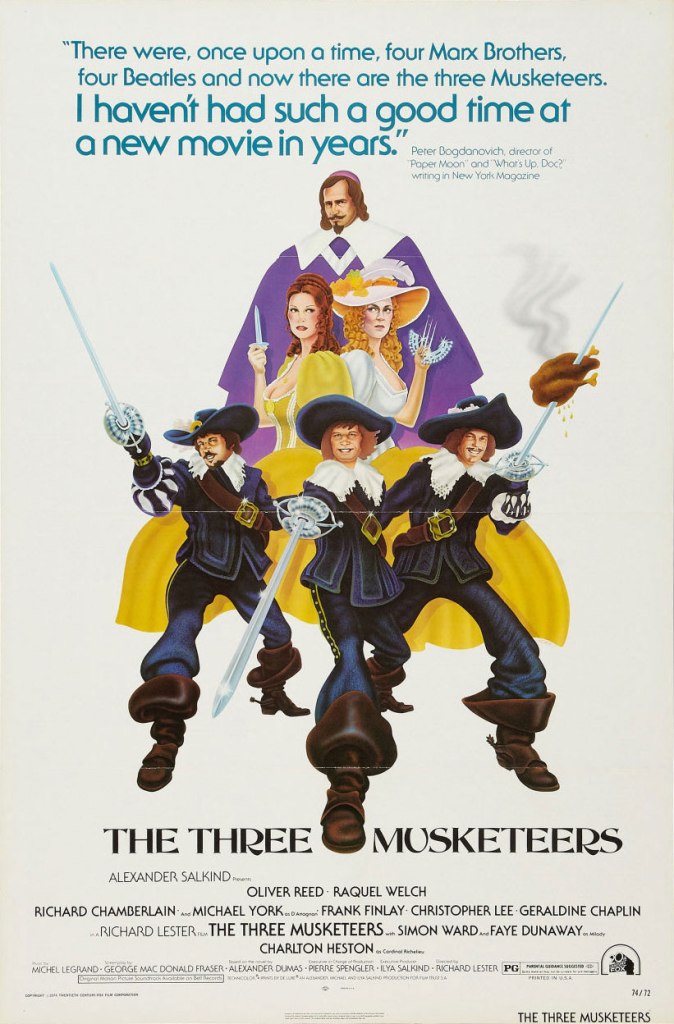
All for one and one for all! The Three Musketeers is probably the greatest adaptation of Dumas’ rollicking classic, a wonderful mix of swashbuckler, romance and Hellzapoppin comedy, that never takes itself particularly seriously and is crammed with actors having a whale of a time. It’s not quite a send-up, but it’s also not quite a straight re-telling either. Instead, it’s gunning all-out for entertainment – and it succeeds most of the time.

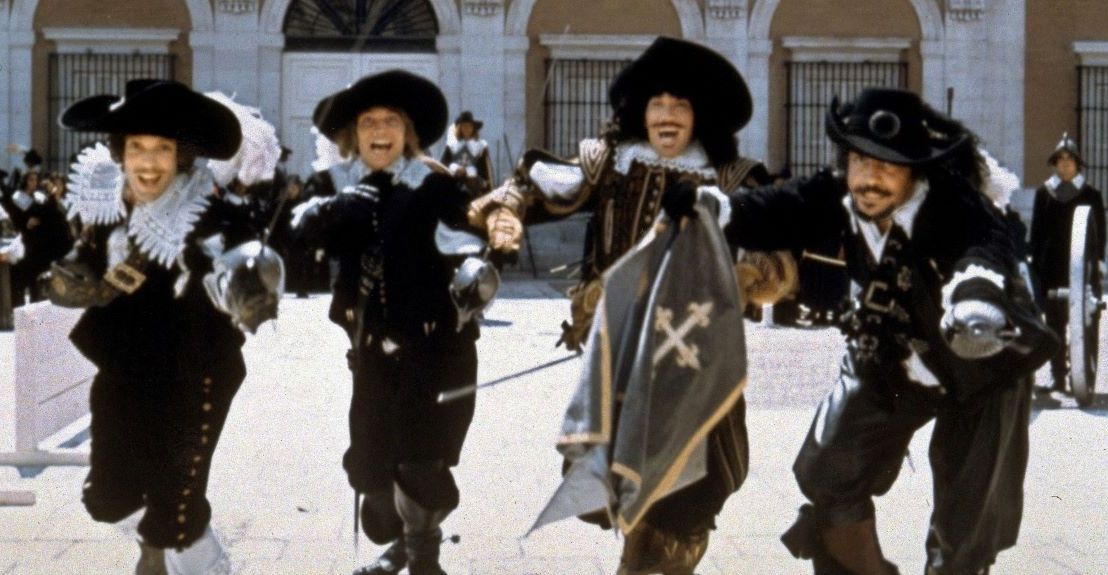
d’Artagnan (Michael York) arrives in Paris in 1625 desperate to join the musketeers. After various adventures along the way – including a rivalry with suavely villainious Rochefort (Christopher Lee) – the impulsive young man forms a friendship (after bumps in the road) with the famed musketeers Athos (Oliver Reed), Porthos (Frank Finlay) and Aramis (Richard Chamberlain). Falling in love with the unhappily married Constance (Raquel Welch), maid to Queen Anne (Geraldine Chaplin), d’Artagnan and his friends are dragged into foiling a plot by the ambitious Cardinal Richelieu (Charlton Heston) to use the ingenious Milady de Winter (Faye Dunaway) to expose the Queen’s infidelity with the Duke of Buckingham (Simon Ward). Will our heroes manage to foil the scheme in time?

The Three Musketeers adapts the first third or so – the most famous and by far the most enjoyable part – of Dumas’ novel. With an irreverent script by Flashman author George MacDonald Fraser, its framed as a rollicking romp with a tongue-in-cheek humour. Richard Lester, famed for his cheeky Beatles comedies (and the film was originally envisaged as a vehicle for the Fab Four), added his trademark scruffy, opportunistic comedy.

The film is awash with muttered asides – many of them well delivered by Roy Kinnear’s exasperated servant Planchet – that are only just picked up by the sound mix. My favourite? d’Artagnan bursting into a room full of guards, yanking a rug with a yell in an attempt to upend them, succeeding only in tearing the corner off it, then immediately jumping out of a window, leaving the bemused guards one of whom plaintively mutters “He’s torn our carpet” – I find this funny on multiple levels, from York’s all-in energy to the stillness of the shot, to the underplayed sadness of the punchline.
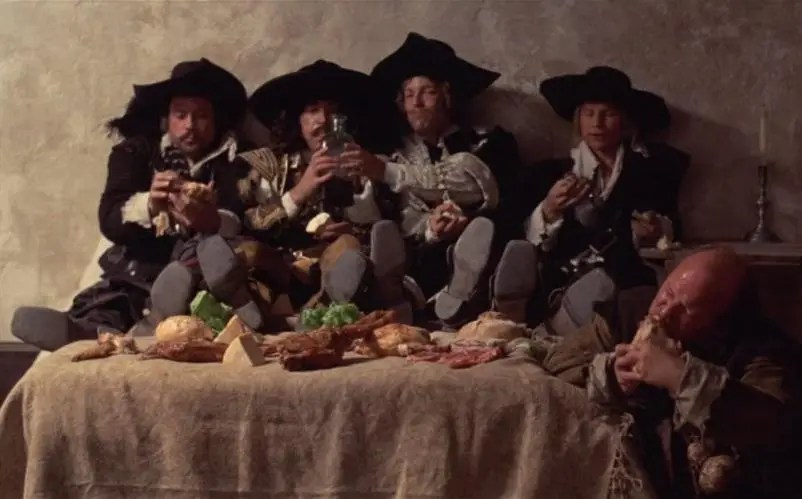
Lester’s film is full of long-shot gags – passengers in litters being dropped in a lake, d’Artagnan swinging on a rope to knock someone off a horse, missing and falling in the mud or his jump from a third storey window only to immediately reappear having landed on a (anachronistic) window cleaner cart. While the film does have its moments of drama, danger and intensity, it doesn’t ease up on visual humour, or gags (“This ticket is for one man” “I am one man. This is a servant”). It’s all part of Lester’s plan to make a fast-paced, pantomimic entertainment in which nothing is intended to ever be too serious.

It’s all played with maximum commitment by the cast, all of whom buy into the films’ tone. Michael York leaves very little in the locker-room with a performance full of youthful bravado, lusty hurrahs and naïve, winning eagerness. It’s a very hard balance to get right but he is never overbearing, but provides a relatable, likeable lead. He’s physical commitment to a series of Buster Keaton style gags is also commendable. He sparks a rather sweet romance with Raquel Welch, who is not the world’s strongest actress, but gamely delivers a series of pratfalls as the eternally clumsy Constance.

Around these two, a series of experienced actors delight in larger-than-life roles. Reed brings a surly intensity to Athos, a reminder of how great a career this charisma laden actor could have had. Finlay gives a Falstaffian joie de vivre to Porthos. Chamberlain (with little to do) strikes a gamely romantic figure as Aramis. As the baddies, Heston clearly enjoys subverting his grandiosity as the scheming Cardinal, Dunaway has a kittenish sensuality as Milady and Christopher Lee is so perfect as the debonair Rochefort that his eye patch (unmentioned in Dumas) has become de rigour for every Rochefort performance afterwards.

The Three Musketeers is crammed with swashes being buckled. The sword fights come thick and fast and are all shot in a series of impressive locations (the camera work of David Watkin, design of Brian Eatwell and costumes of Yvonne Blake do a wonderful job creating a sumptuous period setting). At times they do look a little ragged today – producers the Salkinds ran a tight budget, and there are multiple reports of the slightly-under-rehearsed fights leading to near-serious injury (this slapdash preparation would lead to tragic consequences when Roy Kinnear was killed on the belated second sequel 15 years later). But the actors enter into them with a firey commitment (a little too much so in Reed’s case according to the terrified stuntmen) and rumbunctious energy that really sells these as gripping action. They are also give a certain air of peril that gives just enough weight to the film.

The Three Musketeers has moments of dated clumsiness – the bizarely arty slow-mo opening with blurred motion feels totally out-of-keeping with the rest of the film – and not all the jokes land (Spike Milligan in particular is completely over-indulged in the film’s least successful comic moments). Not every performance works – Chaplain in particular is weak as Anne of Austria – and not all the jokes pay off. The musical score by Michael Legrand, catchy as it is, sometimes overeggs the “isn’t this all such fast-paced fun” angle. But the stuff that lands, really does well and there is more than enough fun, action, adventure and rollicking good humour to keep you entertained on a weekend afternoon.

And then there were two (or rather four)
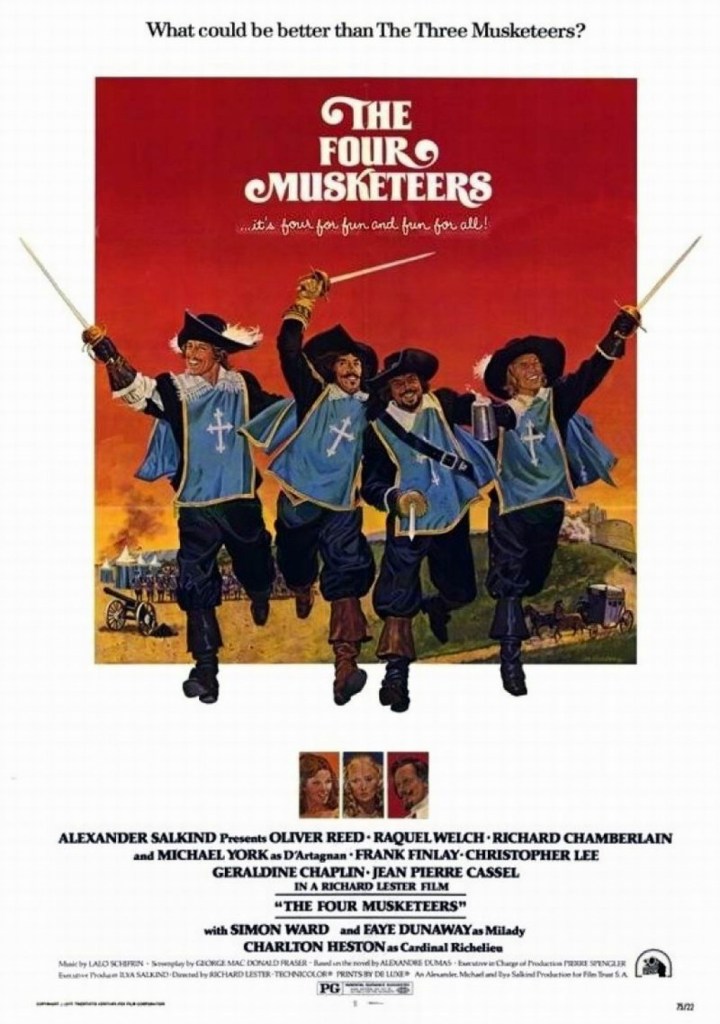
There is always a twist in the tale. At some point while making The Three Musketeers the Salkinds realised they would never get it ready for the Paris premiere. But they could get half the film ready. So, they released that and cheerily announced at the end a sequel was already in the can. Problem was no one had mentioned it to the cast, who discovered they had shot an entire movie for free. A court case exploded, which the Salkinds lost, settling with actors and leading to a new clause being inserted into all contracts for actors preventing such a dodge happening again.

The Four Musketeers covers the second, less famous, much less fun part of Dumas’ novel. Rather like novel, it’s a rambling affair that lacks the compelling narrative thrust (We’ve got to get those diamonds and save the Queen!) which made The Three Musketeers so entertaining. It doesn’t help that its also considerably darker, serious and bleaker as bodies pile up and things get serious.

This makes the sequel a very different beast to the first. Energetic heroism prevented villainy in the first film, but here it often fails . Milady (Faye Dunaway) has sworn revenge and is ordered by Cardinal Richelieu (Charlton Heston) to assassinate Buckingham (Simon Ward). Along the way she kidnaps Constance (Raquel Welch) and seduces d’Artagnan (Michael York) seduced. The Musketeers rescue Constance, fight at La Rochelle and do their best to defend Buckingham – but nothing goes to plan, especially after Athos (Oliver Reed) realises Milady and his criminal ex-wife (thought dead) are one-and-the-same.

The Four Musketeers keeps up the humour, but it is frequently at odds with the darker film it sits in. Gone is the high-paced musical score of Michel Legrand, replaced with a lyrical series of melodies by Lalo Schifrin. It’s telling that Welch – whose comic clumsiness was a large part of the first movie – appears only briefly here. Similarly, Cassell’s shallow monarch (dubbed by Richard Briers) pops up just once, Roy Kinnear’s Planchet isn’t in the first hour and Spike Milligan’s free-wheeling improvisation is missing completely (in that case, no bad thing).

The film feels tonally at odds with the first film and even, at times, with itself. The Three Musketeers was full of sword fights but no deaths – here sword strokes are lethal. As the Musketeers comically bounce around at La Rochelle sight gags abound – but it feels at odds with a film where the death is very real. The more realistic feel means some set pieces – such as Rochefort and d’Artagnan fighting on an inexplicably frozen lake in the height of Summer – become harder to swallow.

Some performers do flourish. Oliver Reed comes into his own as an increasingly dark and vengeful Athos, giving into temptations of shocking revenge. Faye Dunaway laces her role with cold, murderous fury. They have most of the film’s most compelling scenes – but the incredibly dark ending (which involves our heroes actively perpetrating judicial murder with a terrified victim) while loyal to the book, feels far too heavy for a pair of films that started with Buster Keatonish comedy.

The loyalty to the book and the commitment to follow it is partly to blame. There is a reason why most adaptations chuck away this section of the book. It lacks a clear narrative line for emotional connection and is highly episodic. d’Artagnan, in the book, does indeed sleep around after Constance disappears – but when the film requires their relationship to be the emotional heartbeat, is it a good idea to have him jump into bed with two women within days of her disappearance?

Lester announces the more sombre parts by filming them in a very framed, artful way inspired by the old masters, with a static camera and medium shot, reliant on Schifrin’s maudlin music. He’s far more at home with the comic business delivered by Finlay (very good) and Chamberlain (still with nothing to do). At other points he surrenders initiative to legends like Heston (suavely menacing), Lee (whose Rochefort steps up a level in lip-curling contempt) and Dunaway.

The finest thing on display are the sets and the sword fights, which are even more desperate, ragged and violently dramatic than last time (when Rochefort and d’Artagnan stop in one to take a breath, you are not remotely surprised given the total commitment we’ve seen). The action set pieces all look really impressive and staged with confidence and brio. It’s just a shame that much of the rest of the story feels like its being told by a natural comic trying hard to be King Lear, but not able to resist throwing a few gags in. It makes for an entertaining, but tonally messy film that feels it has come from a totally different place than its flawed but fun predecessor.
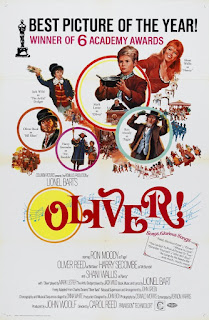
Oliver! (1968)

Oliver! header
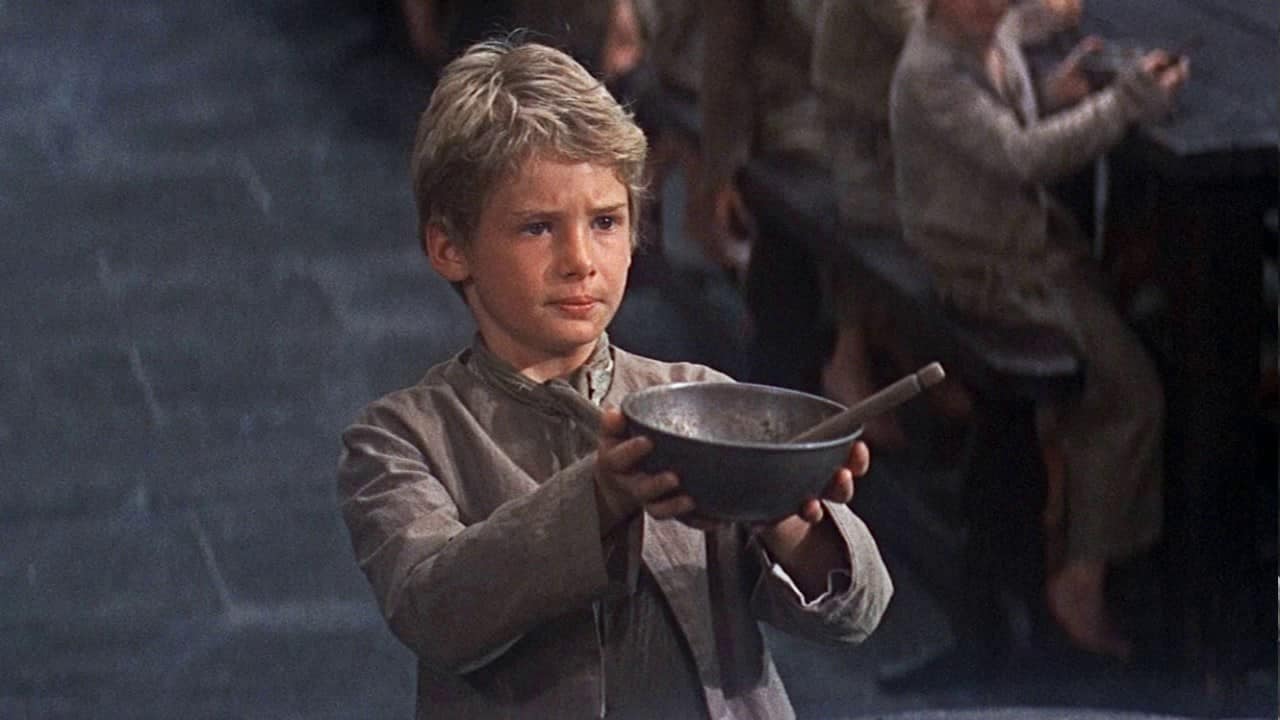
Mark Lester asks for More. You may not share his sentiments in the Oscar winning Oliver!

Director: Carol Reed

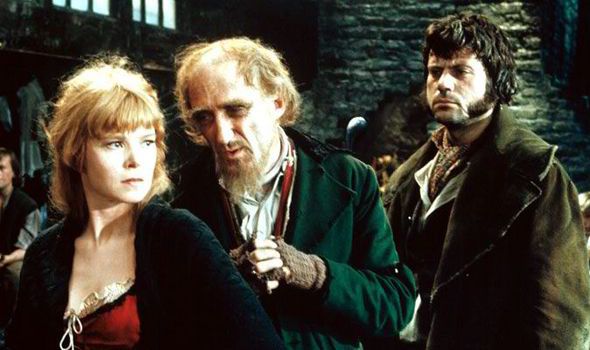
Cast: Ron Moody (Fagin), Mark Lester (Oliver Twist), Jack Wild (The Artful Dodger), Oliver Reed (Bill Sikes), Shani Wallis (Nancy), Harry Secombe (Mr Bumble), Joseph O’Conor (Mr Brownlow), Hugh Griffith (Magistrate), Peggy Mount (Mrs Bumble), Leonard Rossiter (Mr Sowerberry), Hylda Baker (Mrs Sowerberry), Kenneth Cranham (Noah Claypool), Megs Jenkins (Mrs Bedwin)

1968. The Vietnam War gets worse. The My Lai Massacre is a low-point in America’s global reputation. MLK is assassinated. Student protests rip through campuses, culminating in Chicago riots at the Democratic convention. RFK is assassinated. In the UK, Enoch Powell talks about “Rivers of Blood”. A flu pandemic sweeps the world. The USSR ends the “Prague Spring” with tanks. It was a year of horrific global turmoil. Perhaps it’s not a surprise the Oscars chose as Best Picture something as blandly comfortable and utterly disconnected from all this mayhem as Oliver! A personality-free re-tread of a successful stage musical, with a few good tunes bolstering a lobotomised adaptation of Dickens’ novel, Oliver! is so coated with sugar it must have helped the medicine of 1968 go down.

Young Oliver (Mark Lester with his singing voice dubbed) is an angelic orphan, thrown out of the workhouse for asking for “more” (Never before has such an event occurred), eventually escaping to London (Where is Love eh?). There he finds the Big Smoke to be nothing less than a wretched hive of scum and villainy. Invited by pickpocket The Artful Dodger (Jack Wild) to consider himself part of the family, he’s soon learning how to pick a pocket or two from Fagin (Ron Moody). It’s not all fun and games though: violent criminal Bill Sikes (Oliver Reed) is a wildcard, although his devoted girlfriend Nancy (Shani Wallis), the sort of girl the boys will do anything for, remains loyal to Bill for as long as he needs her. But there’s a secret in Oliver’s past – who are his parents?

Carol Reed could once make a claim for being the greatest director in the world. You couldn’t make a case for that based on this cosily chocolate-box, unimaginative trudge through a musical that has little other than a couple of catchy tunes to really recommend it in the first place. The real MVP here is Onna White, whose choreography is very impressive. White takes everyday acts and, with a little bit of jazz and a dollop of musicality, turns them into dance movements. It gives the dance numbers a heightened reality that kind of works and provides nearly everything worth looking at it in the film. Reed certainly leaves her to it, carefully setting the camera up with simple wide and medium shots to capture as much of it as possible.

And you could argue that’s his job. But he brings nothing to the other parts of the production. Of course, Lionel Bart’s musical is a much lighter affair than Dickens’ original (although, in actual fact, this is much more of a musical remake of Lean’s Oliver Twist, making many identical cuts and sharing nearly all the same dialogue), but you’d think the director who gave us Odd Man Out and The Third Man could give some drama and character to London’s underbelly. Not a jot. They have the same muted technicolour cleanliness of everything else, and any hint of ruthlessness, criminality or moral conundrums are well and truly left at the door. What we get is a world where everyone – apart from Bill – is fundamentally nice and decent, and rapacious old men using children as criminals is basically not a lot different from running an after-school club.

It isn’t helped that Oliver!, like Bart’s stage original, has a weak book that offers little light or shade for its characters other than to typecast them into simplified “goodies and baddies”. Reed and the film either can’t or won’t stretch this much further – although the film does rearrange some events of the original production to give a bit more motivational heft to actions and introduce Bill earlier to at least add a bit more tension. The film is as quickly bored with the angelic Oliver as the original is – fair enough since he’s a tediously saintly chap – with Mark Lester alternating between looking winsome and shocked at the company he finds himself amongst.

Nothing can interrupt the overflowing “niceness” of what we are seeing. Ron Moody’s Fagin had been honed from performing it on stage so often (and he is very good). But his Fagin is a cuddly uncle, the sort of grown-up scamp you would invite over for a drink, only keeping an eye on the silverware when you did. This is, let’s not forget, a bloke who colludes in murder (though the film reduces his responsibility), kidnapping, grooms kids for a life of crime and willingly lets them die for him. Not a whiff of this is allowed onto the screen. The Artful Dodger (played with a cheeky but tellingly amoral charm by Jack Wild, who tragically never hit these heights again) is given more light and shade than Fagin.

Like the musical, the film downplays the abusive relationship at its heart. Nancy is little more than a walking embodiment of the cliched “tart with a heart” trope, and the film adaptation chooses to praise her for not just sticking with her abuser, but slavishly devoting herself to him. In fact, beyond being casually kind to a child once in a while, this devotion is pretty much Nancy’s entire personality – and the film approves of it. This isn’t a dark picture of a violent man victimising a young woman, folks, it’s love! See, there’s a ballad about it and everything!

It’s a family drama so her murder takes place off screen (just her death spasm legs are seen), but you’d like to think the film could have taken a few moments to put a bit of light and shade on just why this character feels the way she does and does the things she does. In fact, the film is quite dependent on Oliver Reed, the only actor in it who dares to touch some sort of psychological depth – it’s quite telling that, even though he was a famed drunk, he’s the only member of the cast to have had any success after the film was released.

Instead, this is a great big, colourful, empty pantomime of a musical, devoid of character and (outside of its choreography) inspiration. It’s a great big explosion of tasteful sets, mugging actors, pretty colours, prancing and the odd catchy tune. It’s got no idea what the original novel was about at all, and no interest in even touching some of the themes of poverty and criminality Dickens was aiming at. Reed directs the entire thing with the indifference of a gun-for-hire.

Its syrupy sweetness and hammering tweeness leaves you punch-drunk rather than sugar-rushed. Oliver is such an insipid fella you’ll be delighted when he shuts up and sits in the background for most of the second half. It clumsily unveils a mystery and then drifts towards a conclusion that lacks any real drama. It studiously avoids anything that could remotely stretch the viewer. It’s trying so hard to charm you and hug you, it comes across like a lecherous stranger offering you sweets. Oliver! wasn’t even the best musical of 1968, let alone the best film. But in a year when the world was going to hell in a handcart, perhaps a kid-friendly fable bending over backwards to charm and reassure you was what the world needed. Doesn’t mean I need to stomach it now.

Gladiator (2000)

Russell Crowe dominates in Ridley Scott’s Oscar-winning Gladiator

Director: Ridley Scott

Cast: Russell Crowe (Maximus Decimus Meridius), Joaquin Phoenix (Emperor Commodus), Connie Nielsen (Lucilla), Richard Harris (Emperor Marcus Aurelius), Oliver Reed (Proximo), Derek Jacobi (Senator Gracchus), Djimon Hounsou (Juba), Tomas Arana (General Quintus), Spencer Treat Clark (Lucius Verus), David Schofield (Senator Falco), John Shrapnel (Senator Gaius), Rolf Moller (Hagen), Tommy Flanagan (Cicero), David Hemmings (Cassius)

When Gladiator hit the big-screen the swords-and-sandals epic genre was dead. A relic of the early days of technicolour Hollywood, where the widest possible screens were designed to tempt audiences away from the television and into the movie theatre, Roman epics were often seen as stodgy things, usually carrying heavy-handed Christian themes while gleefully throwing as much of the decadence of the empire on the screen as possible. Gladiator changed all that, bringing an emotional and psychological complexity to the genre, as well as a rollicking good story and some brilliant film-making. An Oscar for Best Picture confirmed the genre was back.

In 180 AD General Maximus Decimus Meridius (Russell Crowe) commands the final battle of the Roman forces to conquer the German tribes and bring them under the control of the Emperor Marcus Aurelius (Richard Harris). The humble, dutiful and principled Maximus is a natural leader and the son Marcus Aurelius wishes he had, rather than the son he has the insecure and ambitious Commodus (Joaquin Phoenix). When the Emperor decides that Maximus not Commodus will succeed him – with the brief to restore the Roman republic – Commodus murders the Emperor. When Maximus refuses to give Commodus his loyalty, the new Emperor sentences him and his family to death. Maximus escapes, although he is badly injured, but arrives too late at his home to save his wife and son from death. Collapsing, the General is taken by slavers, healed by fellow slave Juba (Djimon Hounsou) and sold to the North African Gladiator school of Proximo (Oliver Reed). Maximus will play the Gladiator game – because he longs to have his revenge on Commodus.

Gladiator is superbly directed by Ridley Scott, who perfectly mixes the epic scale of the drama with the intimate, human story at its heart. The film looks absolutely fantastic from start to finish, with the superb visuals backed by a breathtakingly beautiful score by Hans Zimmer and Lisa Gerrard that skilfully uses refrains and themes to instantly identify the core emotions in the audiences mind. These themes are associated with emotional beats that immediately plug us into the interior thoughts and emotions of the characters. 

It works because of the emotional truth at its heart. Basically it’s a love story between a man and his dead wife, and isn’t afraid to explore the depths of love that we feel for those closest to us and our pain of their loss. Maximus’ wife and child are represented in silent flashbacks and by two small icons Maximus carries with him on campaign. When, late in the film, he is reunited with these items his raw, tearfully quiet joy carry as much force as any real reunion would do. What drives the film is less a drive for revenge – although there is no doubt this is a motivator for Maximus – but of a continued sense that he must fulfil all his duties (in this case restore the Republic as his surrogate father wished) before he can return to his wife and son (i.e. die).

It’s that which makes the film so easy to invest in emotionally, and which makes Maximus (a hardened killer) so easy to relate to. If he was just a raging man out for revenge, the film would carry a leaner harsher look. But he is instead a man motivated by love, who yearns to be with his family again. Mortality hangs over the entire film – the first shot of the film, famously of the hands in the wheat, have buried themselves in the consciousness because we can all relate to a man who longs to lay down his labours and be with the people he loves. Christianity doesn’t appear too much in Gladiator (unlike older Hollywood Roman epics) but faith is there in spades. And Maximus will do nothing that will jeopardise a reunion with his family in heaven.

This deeply involving story of a man who remains faithful to the memory of his wife – and Scott wisely removed any love plot with Lucilla, which would have felt like cheatingso strongly does the film build Maximus’ love for his wife – that audiences are happy to go with the film through all the violence that follows. Gladiator hit the sweetspot of having something for everyone, from emotion to action. And the action is brilliant. The opening battles is hugely impressive, from its scale to the imaginative interpretation of Roman tactics. It’s trumped by the more raw and ragged action that comes in the Gladiatorial ring, as Maximus transfers his brutal efficiency at war into the ring for the amusement of the crowd.

Like all Gladiator films and series the film successfully has its cake and eats it – so we get a sense of the horror of people fighting to the death for our entertainment, while also heartily enjoying watching our heroes kick ass. The sequence that uses this most effectively, as Proximo’s outmatched Gladiators follow Maximus’ strategic experience and military training to defeat a group of deadly chariot fighters, would-be a stand out in any movie.

The film further works due to the assured brilliance of the Oscar-winning Russell Crowe in the lead role. Crowe exudes natural authority as a general – he genuinely feels like the sort of man that first his soldiers and then his fellow Gladiators will follow to the bitter end. Crowe also dives deep into the soulful sadness at the heart of Maximus, the romantic longing and the searing pain of the betrayal and murder of his family. It’s a performance of immense, small-scale intimacy that also never once gets over-shadowed by the huge spectacle around him. I’m not sure many other actors could have pulled it off.

But the whole cast is extremely strong, Scott encouraging great work across the board. Joaquin Phoenix in particular takes the villain role to a bravely unusual place. His Commodus, far from a sneering Caligula, is in fact a weak, anxious, jealous even strangely pitiable man, so insecure and riven with envy for others that he becomes twisted by it. But we never lose a sense of the humanity at his heart, the sense of a little boy lost, scared by the world around him. It makes sense the Connie Nielsen’s Lucilla – walking a difficult line as a character who has to play both sides – could both fear and hate him but still love the fragile little brother she still senses in him.

Scott’s trusting of experienced pros – many you feel hungry for an opportunity like this – is clear throughout the whole cast. Richard Harris was pulled out of a career slump and reinvented here as an elder statesman, with a wry, playful and eventually moving performance as Marcus Aurelius. Scott’s biggest risk was pulling Oliver Reed from a life better known for drinking bouts to play Proximo. Playing his best role for almost thirty years, Reed reminded us all for one last time that as well as a chat-show joke he was also a powerful and dominant performer, his Proximo a snarling scene stealer. Reed’s death – his final scenes completed with special effects – made this a better tribute than he could have ever imagined.

There are few feet placed wrong in Gladiator. As an action spectacular it’s faultless, but this works because of the truth and love at its heart. It creates an epic that is emotionally involving as it is exciting to watch. The reconstruction of Rome is hugely impressive and Scott paces the film perfectly, letting its force grow along. You never once feel thrown by its scope, and so completely does it wrap you up that, as it becomes more operatic in the final act, the film is never at risk of losing you. It deserves to be remembered with the best of the Hollywood epics.

Women in Love (1969)

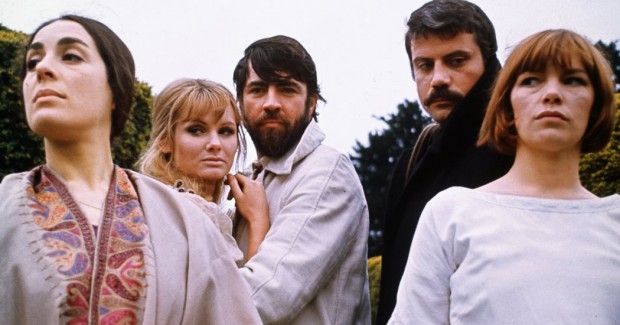
The stars of Women in Love: this publicity still gives only a hint of the simmering (and slightly strange) heightened passions you find therein

Director: Ken Russell

Cast: Alan Bates (Rupert Birkin), Oliver Reed (Gerald Crich), Glenda Jackson (Gudrun Brangwen), Jennie Linden (Ursula Brangwen), Eleanor Bron (Hermione Roddice), Alan Webb (Thomas Crich), Vladek Sheybal (Loerke), Catherine Wilmer (Christina Crich), Phoebe Nicholls (Winifred Crich), Sharon Gurney (Laura Crich), Christopher Gable (Tibby), Michael Gough (Tom Brangwen), Norma Shebbeare (Mrs Brangwen)

DH Lawrence is an acquired taste. While his writing is undoubtedly brilliant, reading his novels today it’s hard to shake off their sometimes histrionic melodrama – their revelling in all that (at the time) shockingly frank discussion of sex and all that Freudian analysis of fractured personalities against an alien industrial world. So perhaps there is a reason why one of the best interpreters of his work for the screen has been someone as melodramatic and envelope-pushing as Ken Russell.

Women in Love is Russell and Lawrence to the max. In a 1920s mining town, two sisters, Gudrun (an Oscar-winning Glenda Jackson) and Ursula (Jennie Linden) want to make their own way in the world. Local school inspector Robert Birkin (Alan Bates) wants to find perfect love and fulfilment. Alpha-male son-of-the-local-mine-owner Gerald Crich (Oliver Reed) isn’t quite sure what he wants, other than to reinvigorate his father’s business. Naturally all four of these characters come together in romantic, intellectual and sexual tangles that lead to a lot more misery than happiness.

Wow this is a difficult picture to write about. How so? Because it is about two-thirds masterpiece to one-third pretentious, hyperbolical nonsense. That’s quite some tight-rope. Russell walks it pretty well, but his problem has always been he loves being a sort of enfant terrible of British cinema too much. Too often he succumbs to temptation and pushes things a little further, to go for the demented camera or editing trick, or to push the sexual content a little bit further. The whole film has a hint of a cocky teenager, jumping up and down to look cool and catch your attention. 

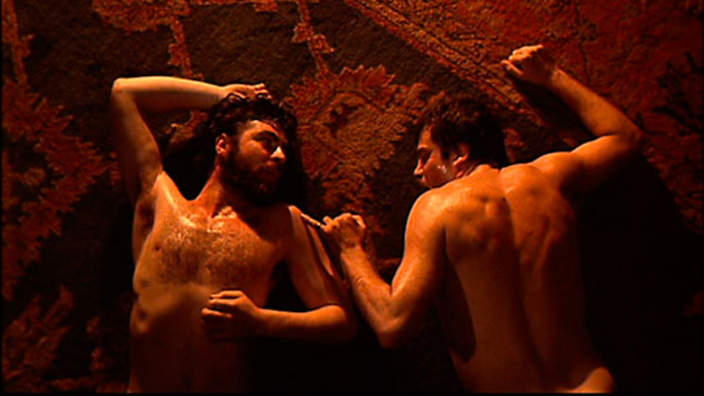
But then on the flipside, sometimes this excess really works (or if you like, sometimes more really is more). Nowhere is this clearer than in the famous naked wrestling scene between Oliver Reed and Alan Bates. It’s a high-blown, tightly edited, single-camera, increasingly artistic sequence that leaves little to the imagination as we wonder how far this nude, willy-waggling, sweaty wrestling turned intimate clinch will go (the final shot sees the characters roll off each other and lie exhausted on a carpet, breathless, in front of a roaring fire). But it works so well because the amped up shooting and content really tells us something about these two characters, their relationship, feelings, viewpoints on life, sexuality – everything. It’s a great scene and it’s a sign of how good this film can be.

And then you get other moments where you sigh and roll your eyes and almost want to say “yeah Ken we get it…”.  As Robert and Ursula roll off each other after an intense sexual encounter in the woods, we cut immediately to two bodies found drowned in a lake, their bodies locked together in exactly the same position. Yup sex ‘n’ death. Gerald and Gudrun have sex, intercut with shots of Gerald’s mother. Other moments ape up stuff that was already pretty ridiculous in the book to the max: Birkin, after a bash on the head, runs naked into the countryside and smears himself with grass and mud and rolls in the dirt. For about three minutes.

But then this is the sort of film where Glenda Jackson tames some bulls by performing a bizarre dance. Why does she do this? Who knows (certainly not the characters). But then the film is full of moments like this. But what kind of makes it work, even when it is so ridiculously over-the-top and dated in its filming, is that there is a smartness in it. It is a film that does, underneath it all, have some profound thoughts about love and relationships.

It manages to bring together the themes that intrigued Lawrence with a bit of coherence. What do we want from life? It focuses overwhelmingly on the men of the story, and in particular Alan Bates (excellent) as Birkin. Made up to look like Lawrence, Birkin also carries a lot of the prose of the novel debating what makes us happy, whether we need equally strong bonds in our life with men and women, and what constitutes our completeness as human beings. 

The film does this to a certain extent with the female characters as well – although we see them almost completely from the perspective of the men (which is interesting – maybe they were worried about making a film called Men in Love…). That’s possibly why Gudrun’s confused desires for Gerald never quite come into focus. Marvellous as Glenda Jackson is – surely an actress born to play this sort of part, marvellously passionate but strangely unknowable, vulnerable but harsh and even a little cruel – it’s hard to understand how Gudrun’s feelings change for Gerald. Maybe she doesn’t know herself. 

Gerald and Gudrun seem to be characters who don’t understand what they want (Gerald even expressly says it). That’s part of the point of the film (and Lawrence’s book) – a yearning, like both these characters have, for freedom and something different from previous generations, but unable to really put their finger on what this is. Gudrun wants a strong, dynamic man – but she also wants freedom and artistic fulfilment, and can’t find this with Gerald.

The film juggles these themes, of people struggling to reach an expression of (or to understand) their desires. Russell understands this – and for all the highblown eccentricity of some of the shooting, he sticks with a brilliant understanding of these personalities and themes. It remains a very caring movie that understands and relates to its characters. It has a lot of heart under the madness of Russell’s shooting.

And it’s superbly acted. Bates and Jackson are both marvellous, as is Jennie Linden in a (to be honest) rather thankless part as the second sister. But it’s a revelation of what a fine actor Oliver Reed could have been, if he had not decided to become a professional drunk. Reed drips charisma and intensity and he gives Gerald a real frustrated, sensual depth – a confused sexual fear mixed with a determined machismo. It’s a brilliant performance. The rest of the cast are also good, even if Eleanor Bron is (partly deliberately) overdone as Birkin’s first lover.

Women in Love is very dated in its style, but still a fascinating and intelligent piece of filmmaking that engages with and juggles with ideas. Despite all its overblown Russell excess, I actually really liked it, it stuck with me and I’ve been thinking about it since it finished. I’d actually like to see it again and see if it unlocks even more for me – and blimey it even makes me want to read Lawrence again, which after The Rainbow I never thought I’d say…