Tag: Orson Welles

Chimes at Midnight (1965)

Chimes at Midnight (1965)

Welles reimagines Shakespeare’s Henry IV as a melancholic tribute to lost glories

Director: Orson Welles

Cast: Orson Welles (Sir John Falstaff), Keith Baxter (Prince Hal), John Gielgud (King Henry IV), Margaret Rutherford (Mistress Quickly), Jeanne Moreau (Doll Tearsheet), Alan Webb (Justice Shallow), Norman Rodway (Henry Percy “Hotspur”), Walter Chiari (Justice Silence), Michael Aldridge (Pistol), Tony Beckley (Poins), Charles Farrell (Bardolph), Patrick Bedford (Nym), José Nieto (Northumberland), Fernando Rey (Worcester), Keith Pyott (Lord Chief Justice), Andrew Faulds (Westmoreland), Mariana Vlady (Lady Percy), Ralph Richardson (Narrator)
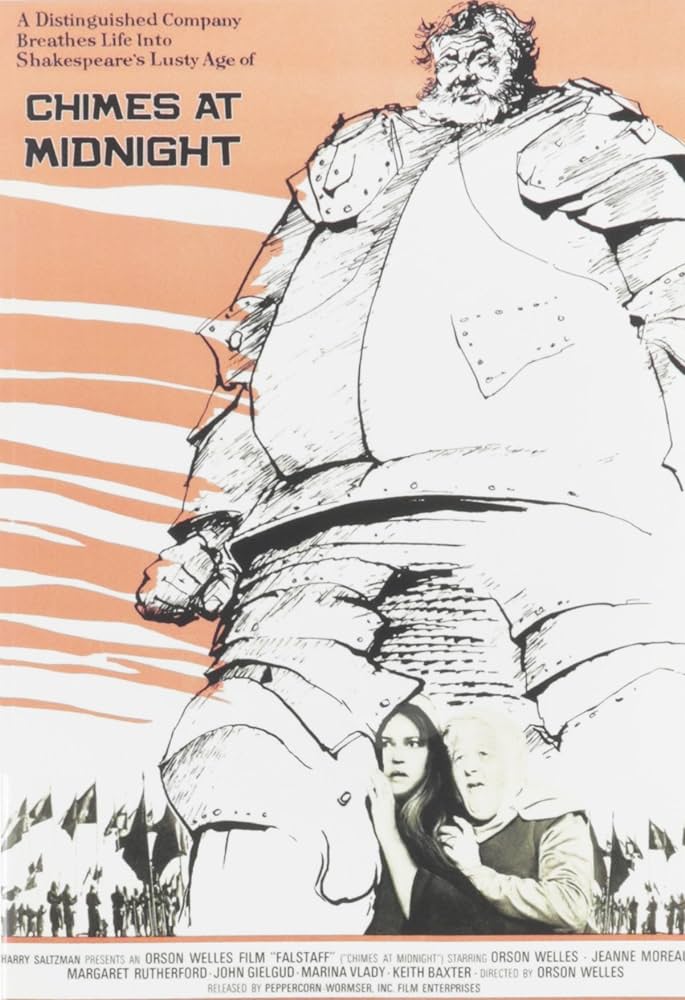
For decades Sir John Falstaff was the part Welles couldn’t get out of his head. He’d already made two attempts at re-working the first Henried for the stage, with Age of Kings in the 30s (where Welles played Falstaff in his twenties) and Chimes at Midnight in 60’s Dublin with Welles again as Falstaff and Keith Baxter as Hal in what would be Welles final stage performance. Welles was fascinated with the roistering knight so when he was offered a film of Treasure Island by a Spanish producer, he agreed on condition he could make Chimes at Midnight at the same time with the same cast. Naturally, this being Welles, not a frame of Treasure Island was made, but with Chimes at Midnight he created possibly his most influential Shakespearean work.

Surely, it’s no coincidence the two literary characters Welles felt the closest affinity to was the windmill-tilting wandering fantasist Don Quixote and the mountain of rogueish humour and memories of Golden Years long-gone, Sir John Falstaff. Welles arguably altered the interpretation of the Fat Knight for generations. Before Welles, he was a “Hail Fellow, Well Met” comic, the exuberant force-of-nature Prince Hal must sadly cast aside for the throne. But Welles knew, like few others, what a wasteland missed opportunities, lost glories and achievements-that-never-were lay behind the raconteur. His Falstaff might be cheeky and sometimes jolly, but he’s also a mountain of melancholy, a playboy with no achievements, his glory days long gone. Even without the rejection, there is no future for Falstaff, only hazy memories of a past long gone.

Chimes at Midnight brilliantly repackages, recuts and recombines several Shakespeare plays (not just Henry IV Parts 1 and 2 but also Merry Wives of Windsor, Henry V and touches of Richard II) to reframe this story around Prince Hal and Falstaff and away from both Henry IV and the politics of rebellion (not embodied by Norman Rodway’s bombastic Hotspur). Structure is imaginatively reworked, with Part 2’s recruiting scenes appearing before Part 1’s Battle of Shrewsbury and ingenious touches such as Henry V’s decision to “enlarge that man who railed against our person” retroactively applied to Falstaff rather than a nameless offender.

Welles makes Falstaff a mix of terrible influence and proud parent – no coincidence that a half-smile of pride crosses his face when Hal finally dismisses him. They banter and bounce off each other, but there is a world-weariness. Baxter’s Hal is beginning to focus his mind on the responsibilities that come with the throne. Falstaff alternates between awareness and denial that their salad days are on borrowed time. Strikingly, both of their most prominent soliloquies are overheard by the other. Hal’s secret plans to reform as King is delivered with steely regret by Baxter, while Falstaff stands a short distance behind him; later Falstaff’s mocking of honour in the aftermath of Shrewsbury is impatiently half-listened to by a Hal already starring towards the future. These are two characters who know each other, their flaws and their ruthlessness, more than they might like.

Chimes at Midnight is Welles’ lament not just for Falstaff but for the whole idea of a Merrie England. The film is a set in a wintery land, covered in cold snow and deeply unwelcoming. Mistress Quickly’s inn is a run-down building in farmland, Henry IV’s breath can be seen in his chilly castle, Silence and Falstaff huddle around a flickering fire after a wintery walk. There is a tiredness around the antics of Falstaff’s gang. Falstaff responds to Doll Tearsheet’s attentions with an impossibly weary “I am old Doll, I am old”. We are living in the winter of a whole way of life, which Hal will comprehensively kill off in favour of realpolitik. The days of dreamers like Welles-Falstaff are numbered.

Welles stresses these differences by shooting events in various locations in strikingly different ways. The Boar’s Head Tavern uses more fluidic camera-work, with events frequently happening in multiple plains – characters appear above others on balconies or at the head of stairs – with the action filled with raucous, swiftly choreographed interplay. This contrasts with the Cathedral-like classicism of Henry IV’s court. Where the Boar’s Head is confined and intimate, Henry IV’s medieval palace has towering stone walls, beams of light flowing down from large windows, courtiers still and quiet while Henry effectively speaks to himself, the exact opposite of the boisterous egalitarianism of The Boar’s Head. Justice Shallow’s ramshackle home of bittersweet memories sits somewhere between the two, where the melancholy Falstaff is closest to Henry’s regrets.

Chimes at Midnight is filled with this sort of superb visual language. The film’s centrepiece is a truly impressive set-piece of cinematic flourish, the Battle of Shrewsbury. A masterclass in fast editing, quick cuts and brilliant framing (that makes 200 extras look like a thousand) this scene captures in microcosm the film’s theme of the death of old-fashioned principles. It starts with a knightly charge and degenerates into mud-strewn, brutal hand-to-hand combat with death agonising and swift. You can see the roots here of Saving Private Ryan, with Welles not using cutting, adjusted film stock and montage to create something really visceral and even shocking, as bodies are forced into the mud or cry out in agony – and our fat ‘hero’ trembles and hides to avoid the barbarity.

This is certainly Welles’ finest acting performance in his Shakespeare films. While always a more limited actor than remembered (a combination of laziness and stage fight), Welles was born for this role. His Falstaff builds off an element of self-portrait: a man still capable of lighting up a room with humour (as seen in his delightful ‘mock trial’ of Hal) but who knows he has achieved only a fraction of what might have been (never before have references to Falstaff’s past glories felt more sad) and that only the march towards death awaits. No wonder Keith Baxter’s excellent Hal, clinging to the last chance to let his hair down, is torn somewhere between love, pity and good-natured contempt for this man. The interplay between the two is perfectly pitched.

Chimes at Midnight is filled with rich performances. It may also be Gielgud’s finest Shakespeare performance on film, his rich, fruity tones turning monologues into musings on self-doubt and regret, distancing the coldly austere king even more from the boisterous knight. (That voice is also a gift for the other actors: Welles, Baxter and Rodway all showcase impersonations of Gielgud’s distinctive voice.) This Henry is so full of doubt, bordering on contempt, for his son he may even believe Falstaff’s claims to be the true killer of Hotspur. Rutherford is wonderful as Quickly, earthy and caring; Rodway, from charging across the battle to impulsively springing out of his bath to meet a messenger clutching only a towel makes a superb contrast with Baxter’s calculating prince. Webb’s disappointed Shallow and Moreau’s kindly Doll also make an impact.

Chimes at Midnight’s main impact though is to reimagine these plays in a highly influential way – just look at the BBC’s more recent The Hollow Crown where the Henry IV productions are so indebted to Chimes it might as well be a remake, while Branagh’s Henry V is virtually a tonal sequel. Rarely again would these be plays seen as near-comedies with a sad-but-necessary final act. Instead, they became sadness-tinged meditations of lost chances and missed opportunities, with productions set not in Olivier-style pageantry, but Wellesian chill.

It’s a film tinged with melancholy, so it’s also fitting that as well as a swansong for a lost time, a “Merrie England” past where everything was possible and the future was golden, it’s also the last narrative film completed by Welles (all others would be either documentaries or filmed lectures). When Falstaff, thanked but coldly dispatched, exits clinging to the fantasy of a glorious return but heading towards death, it’s hard not to see Welles himself shuffling away, never again to persuade a young prince (or film producer) to give him a chance again. It’s a moving metatextual ending to a film that reinvents Shakespeare and expertly exploits the tools of cinema.
The Trial (1962)

The Trial (1962)

Welles exploration of paranoia and guilt is an easier film to admire than like (or enjoy)

Director: Orson Welles

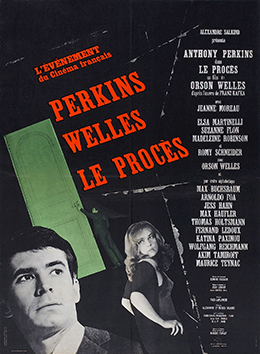
Cast: Anthony Perkins (Josef K), Jeanne Moreau (Marika Burstner), Romy Schneider (Leni), Elsa Martinelli (Hilda), Suzanne Flon (Miss Pittl), Orson Welles (The Advocate), Akim Tamiroff (Bloch), Madeline Robinson (Mrs Grubach), Paolo Mori (Court archivist), Michael Lonsdale (Priest), Arnoldo Foa (Inspector A), Fernard Ledoux (Chief Clerk of the Court)

It had never happened to Welles before: in 1960 producer Alexander Salkind shoved a series of literary works at him and said “make one of these into a film! Money no object and complete creative control!”. Welles wasn’t going to say no. It hardly mattered that he’d barely even let Kafka cross his mind before: he could see a way to do The Trial and, by God, he wasn’t going to pass up this chance. To purists, The Trial is one of the few “pure Welles” flicks – the one Welles shepherded from start to finish and more-or-less ended up with what he wanted at the end of it (no wonder he called it “his best picture” – although he said that about all his pictures at one time or another).

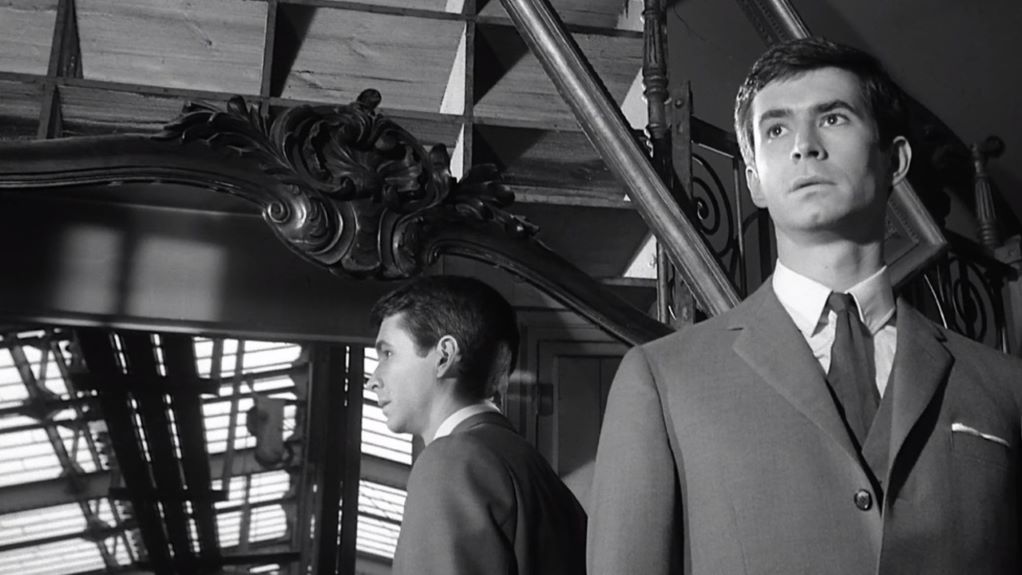
The Trial adapts, fairly faithfully, Kafka’s surrealist novel. Josef K (Anthony Perkins), a middle-management pen-pusher, is accused of a terrible crime without being told what it is. He stumbles from encounter to encounter, law court to law court, never given the ability to defend himself, spiralling down the rabbit hole with no sunlight. Welles’ The Trial captures this by turning Kafka’s work into a fever dream. Scenes link together with all the structural logic of a dream – locations seem randomly connected, with Josef turning corners and finding himself in courtrooms or opening cupboards to find surrealist sequences like his prosecutors being whipped by an angry functionary.

Welles shot much of the film on location in a single abandoned Parisian railway station, with the abandoned, decaying rooms redressed into a series of locations from the Advocate’s rooms, to a church to a law court. This was mixed with sequences shot in Zagreb industrial estates and a factory set made up of 850 extras banging typewriters in unison and all rising to end their working day at the same time. There is a horrible un-reality reality to The Trial, a deeply unsettling realisation you are watching something both set in a world real and impossible.

In fact, The Trial may be one of the most uncomfortable films to watch ever made in its innate understanding of the domineering terror of paranoia. Welles used a series of low angles and wide lenses to stress the oppressiveness nearness of walls and ceilings. Rooms always seem to loom in and crush the characters, with K himself frequently framed hemmed in by objects, walls and people. There is a sense of being “watched” in every scene – either from the oppressive bodies that surround K, or the prowling tracking cameras that follow him from location to location.

The Trial is a sort of paranoid’s wet-dream, a nightmare world where logic is gone, our lead character has no control over his movements or destiny and the entire world seems to be constantly bearing down on him and us. Who better to play the twitch-laden centre of this than Anthony Perkins. Awkward, uncomfortable and never anything-less than tense, Perkins features in almost every scene but always feels buffeted by events rather than controlling them. He makes K hugely uncomfortable with others – the many women who throw themselves at K he treats with suspicion mixed with terror. His self-loathing bubbles up whenever confronted with mirror images (such as Akim Tamiroff’s timorous Bloch), invariably reacting with barely disguised contempt.

What’s also interesting in The Trial is the possible insight into Welles’ character. The easy interpretation is to see K as Welles, the court standing in for the Hollywood machine that had shoved Welles from pillar to post and never given him a chance. But, if so, why did Welles urge Perkins to play the role as shiftily and uncomfortably as he does? There is an air of guilt around K throughout – as if The Trial was his nightmare about getting caught for whatever he did. Is this how Welles saw himself? How fascinating that this artistic behemoth read The Trial and seemed to see it as the paranoia of a guilty man. Did the film speak to a deep self-loathing in Welles himself? Did he, in the dark when the demons come, think he’d inflicted his destruction on himself?

It’s a fascinating idea and makes it even more interesting that Welles is all over the film. He plays the corpulent, arrogant advocate, meeting supplicants whole luxuriating in bed with his accustomed bombast. But he also speaks the film’s woodcut-illustrated opening parable (a story of a man waiting at a gate, that he moved from the books Priest to his faceless narrator). Welles’ tones are heard coming from a range of mouths as he overdubbed many of his Euro actors. He even speaks the credits. Everywhere you turn you see and hear Welles and it’s hard not to start to feel perhaps we are stumbling inside his own terrible fantasies. Perhaps The Trial is what Welles’ dreams (or nightmares) were like?

The feel of a nightmare often makes The Trial an uncomfortable and, if I’m honest, less than enjoyable watch for all the undoubted panache it’s made with. In fact, since the panache is partly designed to illicit that response, it’s almost a tribute to the film’s success. The Trial is masterful, but in its unsettling sense of paranoia also uncomfortable, although it’s fascinating to see Welles layering some (perhaps inner) guilt on top of Kafka’s tale of an innocent crushed in the system. Either way, there is plenty to admire if not love about The Trial.

Othello (1952)

Othello (1952)

Welles distinctive Shakespeare epic is a masterpiece of turning the Bard into film

Director: Orson Welles

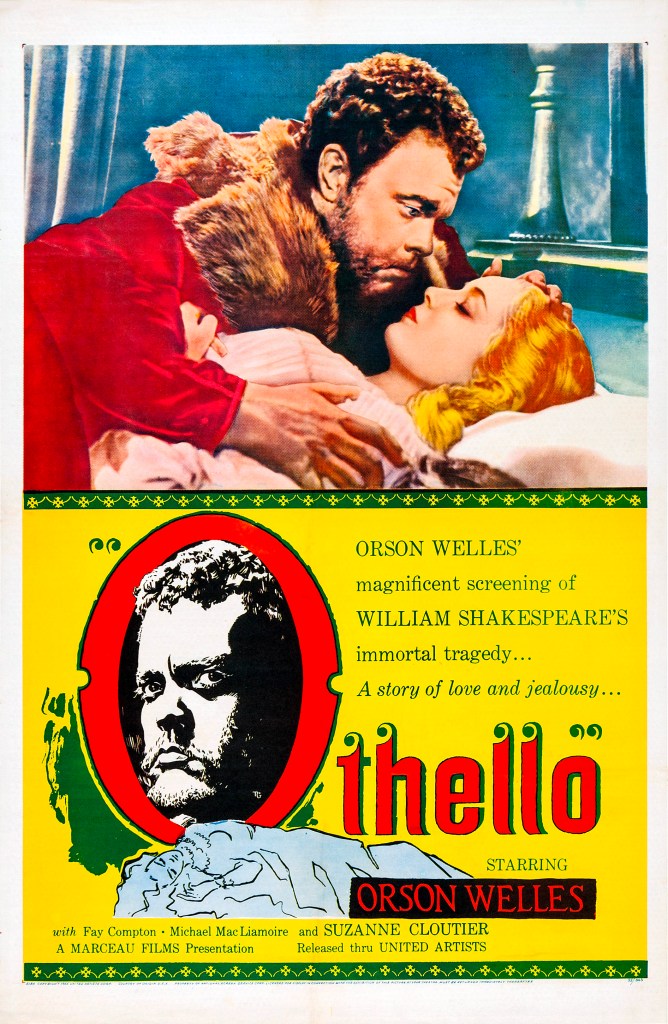
Cast: Orson Welles (Othello), Michéal Mac Liammóir (Iago), Robert Coote (Roderigo), Suzanne Cloultier (Desdemona), Hilton Edwards (Brabantio), Nicholas Bruce (Ludovico), Michael Laurence (Cassio), Fay Compton (Emilia)

In the early 1950s Orson Welles was in the wilderness. After the implosion of his career in Hollywood, he was grifting a living in Europe, juggling multiple ventures and paying for things (or not) with cheques from quick film cameos. But the fire was still there. Welles wanted a project which he would have complete control over. Shakespeare was the ideal collaborator: both free and dead, here was a man who offered an ocean of ideas and not a word of criticism, who would make no demands he re-cut the picture. A marriage of convenience but it led to cinematic triumph.

Othello would be an Welles production from top-to-bottom. Largely self-funded, a few investors chucked in liras for a share of profits (you can imagine Welles as Shakespeare in Love’s Fennyman grinning that was fine because “there never are any”) it became a labour of love over years. Welles begged, borrowed and flat-out stole film stock and camera equipment from assorted productions, kept costumes from for-the-money roles he did to keep the operation flowing (famously his Othello coat was a costume which he’d requested a fur-lining added to, that went unseen in the film it was made for but came rolling out in Othello). Actors were summoned, sometimes months apart, to shoot. Scenes would start filming in one location and finish filming months later somewhere completely different. Welles sat in the middle holding the entire film in his head.

It’s extraordinary that Othello is even coherent. The fact that it’s also a masterpiece of film Shakespeare is a miracle. But, cut loose from the bonds of Hollywood studio execs and not giving a damn about the bills (he had the cheek of genius so never picked up a tab) allowed Welles the scope to experiment and do things “his way”. Othello is the most purely “Welles film” since Citizen Kane, and a tour-de-force of cinematic inventiveness with poverty and lack of resources drawing the best out of a director who marshalled all his gifts of editing and lighting to make resourceful use of limited resources. It’s guerrilla film-making that looks like an epic.

What you could argue Othello is not is a truly original look at Shakespeare’s play – or really an actor’s piece. Welles’ passions for Shakespeare always felt as much about having a grand canvas of poetic language to impose his own vision on, cutting and changing as needed. Thematically, Othello is pretty much what you would expect. Welles’ Othello is the noble Moor pushed into a spiral of jealousy. Michéal Mac Liammóir’s (the finest performance) Iago is a dastardly liar, with faint hints of sexually motived envy. Desdemona is as pure as the driven snow, Emilia a faithful servant, Rodrigo a simpering idiot, Cassio a pretty boy. Our sympathies lie firmly where Shakespeare would expect.

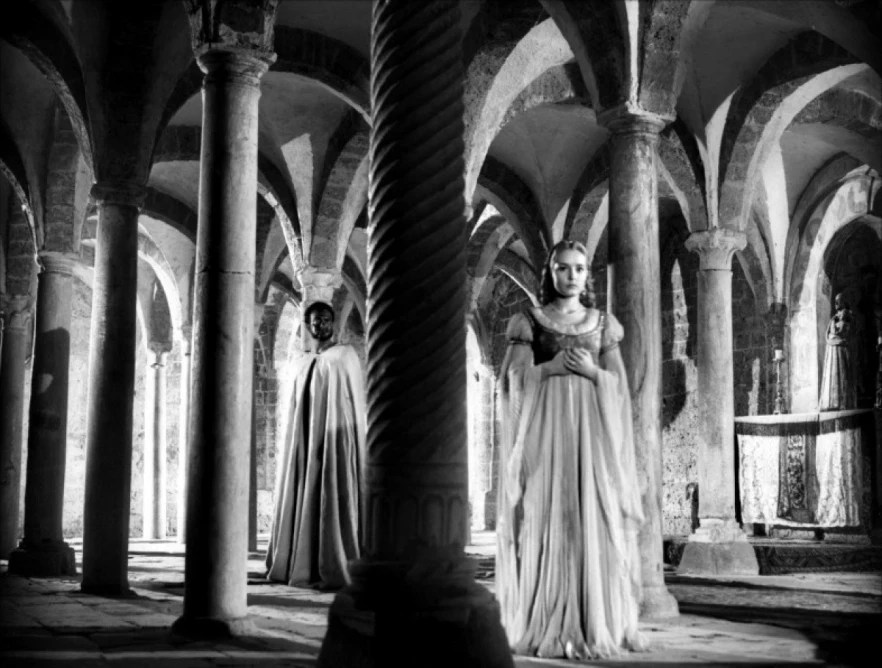
Everything that is unique about the film lies in its telling. Othello is a breath-takingly beautiful film, which uses its locations to astonishing effect. Column lined castle rooms and towering walls create caverns of light and shadow. Welles uses the fixed points of columns to add a dizzying level of speed to camera movements that see these columns whip past the frame. The shadows of grills are frequently cast across faces and light creates looming shadows across the floor. Welles plays into this with the creation of light pools, concentrating it on single fixed points, often faces, with the surroundings bathed in black. The film presents real locations in defiantly expressionistic ways, giving each of them an elemental power that heightens the tragedy.

It’s a film made up of stunning set-pieces. It’s opening funeral cortege – like Citizen Kane, Othello starts at the end with Othello and Desdemona dead and Iago in chains – follows a march over city walls, playing out in striking shadow against the brightness of the sun, with booming, Gothic music giving the sequence an imposing sense of inevitability. Iago is paraded by a mob and placed in a cage, lifted above the city wall (this same cage frequently appears throughout the movie – including, once, having Iago walk nonchalantly under it – as a grim reminder of where this is heading). It’s a perfect marriage of sound and music, disguising the small scale with cinematic force.

Taking advantage of limitations time-and-again makes Othello great. Another striking sequence was born from necessity. With most of the costumes impounded for non-payment of shipping bills, the attempted murder of Cassio is re-staged in a Turkish bath (who needs costumes when we have towels!) a decision that turns the sequence into a masterpiece of light through steam, increased by the frenetic energy Welles shoots the sequence with culminating in its Lang-inspired super-imposing as Iago thrusts his sword down into the floorboards to dispatch Rodrigo.

Othello is frequently filled with imaginative camera angles. Often characters observe others from great heights – twice through sky lights, starring down at conflicts, murders and suicides. Iago and Rodrigo spy on Othello’s gondola romance with Desdemona from a distant bridge. The ramparts of Cyprus provide towering angles, over soldiers or wave-crashed rocks below. The camera also takes a number of low-angle positions, making characters (often Othello) tower over us. Clever angles and perspective work create whole ships out of sheets of fabric and basic models.

It’s also a triumph of editing. Welles assembled the film from a never-ending supply of fragments. Frequently actors appear with their backs to the camera while we hear them speak – as Welles said, a sure sign the actual actor wasn’t there. Like few other films, Othello feels like a film excavated from its shooting. It’s a film almost constantly in motion, rarely stopping to focus on an actor delivering a line (Othello’s first speech, parts of Iago’s speeches and Emilia’s speech to Desdemona being the main moments the film focuses on actor’s delivery – no doubt connected to those three actors being the ones Welles trusted).

Away from that, the camera often fast cuts and delivers scenes in motion, with actors speaking off camera as we focus on the events around them. This means the dialogue is repeatedly chopped, changed and trimmed to meet the needs of the scene. It helps make the film even more pacey and frighteningly interior – conversations become snatched and fast, words flung from angles we cannot see, ramping up the paranoia. Large chunks of it is redubbed by Welles himself – a light version of his distinctive tones clearly emerges from Robert Coote’s mouth and Michael Laurence’s Cassio has a familiar cadence. In some cuts, Welles also replaced Suzanne Cloultier’s voice with Gudron Ure (with whom he played the role on stage).

If there is a major flaw in Othello it’s probably the acting, frequently looking under rehearsed, with Welles himself a leading culprit. His Othello is underpowered and feels under-defined. There is little sense of an interior to his mind and Welles’ surprisingly somnolent delivery tends to crush much of the emotion. It’s hard not to think Welles was so focused on juggling every other factor, that he compromised on his acting. Only Mac Liammóir, Compton and Edwards look truly comfortable with their roles – and even they offer traditional readings.

But Othello is about turning Shakespeare to cinema and if Shakespeare himself is slightly sacrificed in the push, it doesn’t detract from the stunning theatrical beauty we get instead. Othello becomes a lean, pacey thriller, crammed with stunning imagery and imaginative flourishes (Rodrigo’s faithful dog, following sadly after his master, is a gorgeously little playful touch). It’s a film where light and shadow are major plays, where footsteps in subterranean water pools create ripples of motion and echoes of noise, that shows the greatness that can be born from necessity. It’s one of the greatest Shakespeare films.

Macbeth (1948)

Macbeth (1948)

Welles first Shakespeare film is a bizarre mix of inspiration and amateurishness

Director: Orson Welles

Cast: Orson Welles (Macbeth), Jeanette Nolan (Lady Macbeth), Dan O’Herlihy (Macduff), Roddy McDowell (Malcolm), Edgar Barrier (Banquo), Alan Napier (Holy Father), Erskine Sanford (Duncan), John Dierkes (Ross), Keene Curtis (Lennox), Peggy Weber (Lady Macduff), Lionel Braham (Siward)

Macbeth was Welles’ last hurrah in Hollywood before decades of self-imposed banishment and exile. He arrived at Republic Pictures – proud creator of B-movie Westerns, although also the home of a few John Ford classics most notably The Quiet Man – who were delighted to sign up a deal for a literary classic directed by America’s leading man of the theatre. What they ended up with was a film that’s such a bizarre mish-mash of brilliance, originality and amateurishness nonsense, that they were basically befuddled.

Welles shot the film, as contracted, within 23 days on old Westerns sets, with a budget od spit and boot polish. Welles was focused, more than any other film he’d worked on to that point, on visual imagery and total control of sound and audio. So much so he wasn’t fussed about recording any sound on set. All the actors pre-recorded their dialogue, under Welles’ strict instructions, and then silently lip synched while shooting the scenes. This gave Welles the freedom for a host of expressionistic, shadow-filled shots where the actors faces and mouths were frequently unseen – or longer shots where it was impossible to clearly see lips moving. It also made some truly rigid, uncomfortable performances (Jeannette Nolan was granted permission to record her sleepwalking scene ‘live’ so she could perform it with some semblance of conviction).

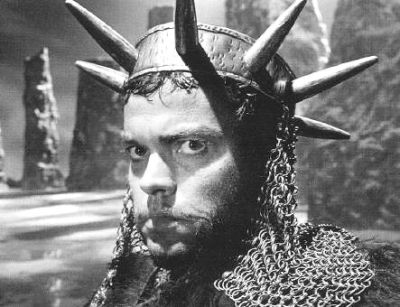
Macbeth was set in a Scotland somewhere between a fiercely traditional high-school production and a hodge-podge of influences from Celtic wizardry to Mongolian hordes. It’s shot on a dust-lined, cavern-filled panorama that frequently looks like a giant theatrical set or an empty multi-purpose wall-lined amphitheatre, with only a few scenes exchanging this for mist-filled heaths or low-ceilinged caves. The costuming and design is an eclectic mix: the murderers look like cavemen, some thanes wear kilts, Malcolm and his soldiers dress in medieval armour, Macbeth and Banquo look like fur-coated renegades from Genghis Khan. Welles himself would regret a bizarre crown which made him look like the Statue of Liberty.

There is a feeling that every idea was grabbed and thrown at the wall, in the expectation (hope?) that some of them would stick and lead to cinematic magic. There is a vague attempt to suggest Scotland is at war between Christianity and Paganism. A composite character, the ‘Holy Father’ parades around – chasing away witches, leading prayers for Duncan, taking dictation for Macbeth, warning Lady Macduff, rousing Malcolm – but with very little real sense that this ever adds up to anything logical or thematically clear. Welles merrily re-writes and transposes dialogue. Some works well – Banquo here seems far more of a potential partner than usual – others less so (Lady Macbeth turns up at the murder of the Macduffs for no clear reason).

But the stuff that works really works – and most of it is visual. The witches are shadowy figures, whose voices alter in cadence and pattern from scene to scenes (Welles had mixed male and female voices together to create an unsettling rhythm), their faces never seen. Inspired by his famous “Voodoo Macbeth” stage production, they craft muddy statues of Macbeth which they crown with a crude coronet. In one of the encounters with Macbeth, the camera pulls away to isolate Macbeth, lit in misty isolation. More Voodoo touches are seen in the hammering drum beats that greet Duncan to Macbeth’s castle.

Mist and expressionistic images dominate. Malcolm’s army urges from among the fog, carrying their branches from Birnam wood. The final battle is a series of isolated shots of characters, often the camera craning up to them or seeing them march towards it. Macbeth is frequently shot from below, to heighten his sense of being almost an ogre. When first seen as king, he sits, isolated and drunk at the top of a flight of stairs, making him seem less imposing and more weak from the start of his reign. He is haunted not only by Banquo’s ghost, but Duncan’s as well, Welles camera cutting to reveal his cavern dining room empty of everyone but the Macbeth and the ghosts of murdered friends, the camera tracking the shadow of his fingers along the wall to reveal the bleeding Banquo.

The entire production becomes like a drug-induced fantasy, something a near-catatonic Macbeth might just be imagining as his dreams are crushed by the cruel fate he feels destined to follow. Welles establishes a now popular idea of the play being a huge cycle: at this death, the witches announce “Peace, the charm’s wound up” the camera catching a sight of Fleance who seems destined to repeat the chaos. (“The charm’s wound up” not indicating an end, as often mis-interpretated, but a readiness to be enacted.)

The camera, freed of the need to capture dialogue on set, flies around roams around or moves with swiftness. Characters walk into shadows. Sequences – such as the murder of the Macduffs – are met with a parade of fast cuts and actors charging towards the camera. Music cues are carefully repeated, and lines carry across transitions. There are plenty of striking images, from a mass crowd praying for Duncan to a low-angle camera tracking a worried Macbeth in the aftermath of the murder.

But yet… this is also a curious dog’s dinner of a film. For every great idea, others (like the Holy Father) either don’t land or make no sense. Macbeth’s seduction of the murderers, interestingly shot over his shoulder at an imposing distance from his servants, is followed by a laughably badly acted and staged murder of Banquo. The actors all perform in, pretty much across the board, dreadful cliched Scottish accents. This accentuates the problem of lip synching on set, which renders nearly everyone in the film flat and strangely lifeless, stuck to replicating a performance from days ago.

This includes Welles himself. Macbeth is, by some distance, his least interesting film Shakespeare performance. His Thane is all surface and no depth and Welles’ decision to play him as a slave to destiny, frequently renders him catatonic, reading the lines with a Scottish lilt that travels by way of Dublin, with plenty of pace but no depth. Jeannette Nolan struggles slightly with Lady Macbeth, a decent match with Welles but lacking presence. There is barely a performance of merit among the rest of the cast: McDowell is dreadful, O’Herlihy all at sea, Barrier out of his depth. The bulk of the cast look and sound – in their traditional costumes and awkward, unconvincing accents – like high school students staging “the Scottish play” in the most “Scottish” way possible.

Welles, naturally, having shot the film promptly disappeared to Europe leaving notes and memos from a distance about how it should be assembled, some of which were promptly ignored by a supportive studio turn exasperated. Those in Europe were more respecting of the results, praising Welles for re-imagining the text and its expressionistic, fluid shooting style. In America, these elements were condemned a mess. Macbeth is a bit of both: good ideas sitting alongside amateurishness and nonsense. It’s most interesting by far as a silent film: there are images here that linger, from the witches mud statue to Lady Macbeth’s plumet to death. But as an overall package Welles would dwarf it with Othello and Chimes at Midnight, which combined good Shakespeare and good film-making. Macbeth is a struggle to marry expressionist film-making and literary grace that doesn’t always succeed.

Further reading:

Citizen Kane (1941)

Orson Welles changes film history as Citizen Kane

Director: Orson Welles

Cast: Orson Welles (Charles Foster Kane), Joseph Cotton (Jedediah Leland), Dorothy Comingore (Susan Alexander Kane), Agnes Moorehead (Mary Kane), Ruth Warwick (Emily Monroe Norton Kane), Ray Collins (Jim W Gettys), Erskine Sanford (Herbert Carter), Everett Sloane (Mr Bernstein), William Alland (Jerry Thompson), Paul Stewart (Raymond), George Coulouris (Walter Parks Thatcher), Fortunio Bonanova (Signor Matiste), Harry Shannon (Kane’s father)

Writing about Citizen Kane is rather like writing about the Mona Lisa. Both are works of art so famous and influential that you are intimately familiar with them even if you’ve never seen them. But what makes them such constant delights is that, leaving everything else aside, the Mona Lisa is beautiful to look at – and Citizen Kane is hugely enjoyable to watch. Welles’ masterpiece – frequently hailed as the greatest film ever made – is about as close to perfection as you can get.

Entire books have been written about seemingly every aspect of the film’s creation. Welles’ original intention was to call the film American. It’s a fitting title. Citizen Kane is perhaps the finest film ever made on the corruption that ambition, money and power bring to the American spirit. Kane starts out as a pioneering idealist, but his fatal flaw his is need for power. That need to seize control of everything extends from buying all the art he can find in Europe to controlling the lives of all around him. It’s the mentality that will force his second wife into an opera career she is hopelessly unsuited for. It will eventually leave him sitting alone in his huge mansion, surrounded by wealth but bereft of friends. A large part of the American Dream is about “making it big” – and few make it bigger than Kane, and have so little to show for it at the end.

The film is a character study of ambition and power, using a framing device of the late Kane’s final word: “Rosebud”. What did he mean? Will finding out provide the key to understanding this powerful, elliptical man? A reporter (William Alland) aims to find out by interviewing key people from Kane’s life. From their recollections, the story of Kane’s life slowly comes together in a non-linear style. Charles Foster Kane (Orson Welles) as a young child inherits one of the world’s largest gold mines. Coming of age, Kane decides to use his wealth to become a press baron. He builds a news empire and runs for Governor – but the public revelation of his affair with amateur singer Susan (Dorothy Comingore) ruins his campaign. He builds a mansion on a man-made mountain, Xanadu, but is isolated and friendless in the echoing rooms of his own mausoleum.

You can argue the same thing happened to Welles himself. Citizen Kane is his own mausoleum, the only time in his life when everything went right. Also, probably the only time Welles’ attention stuck to something long enough to deliver. Welles memorably called working on a film set “the biggest electric train set any boy ever had”, and the entire film is saturated in his creative glee at trying so many new tricks. Citizen Kane bought to the forefront so many methods of film-making, its influence has been so pervasive on film today, that it’s hard to see how revolutionary it appeared at the time.

Welles worked with cameraman Gregg Toland to push the film into a whole new visual language, deeply influenced by German expressionistic film. It’s a beautiful film to look at, and each shot is covered with meaning, Welles’ eye for the theatrical image matched with Toland’s genius for visual language.

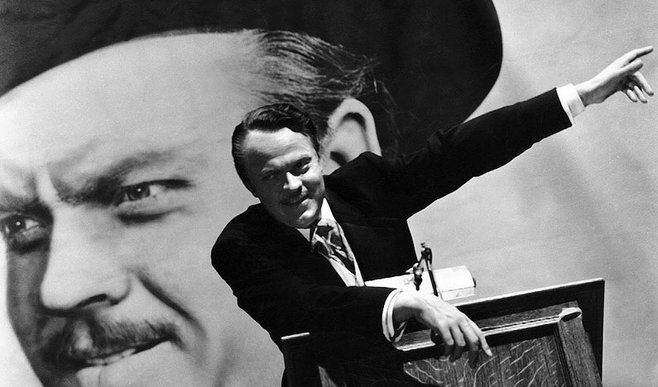
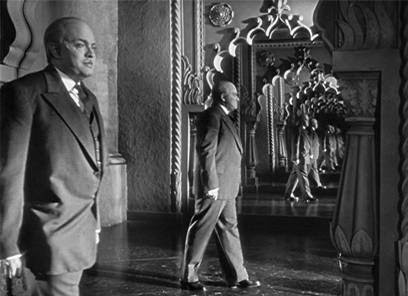
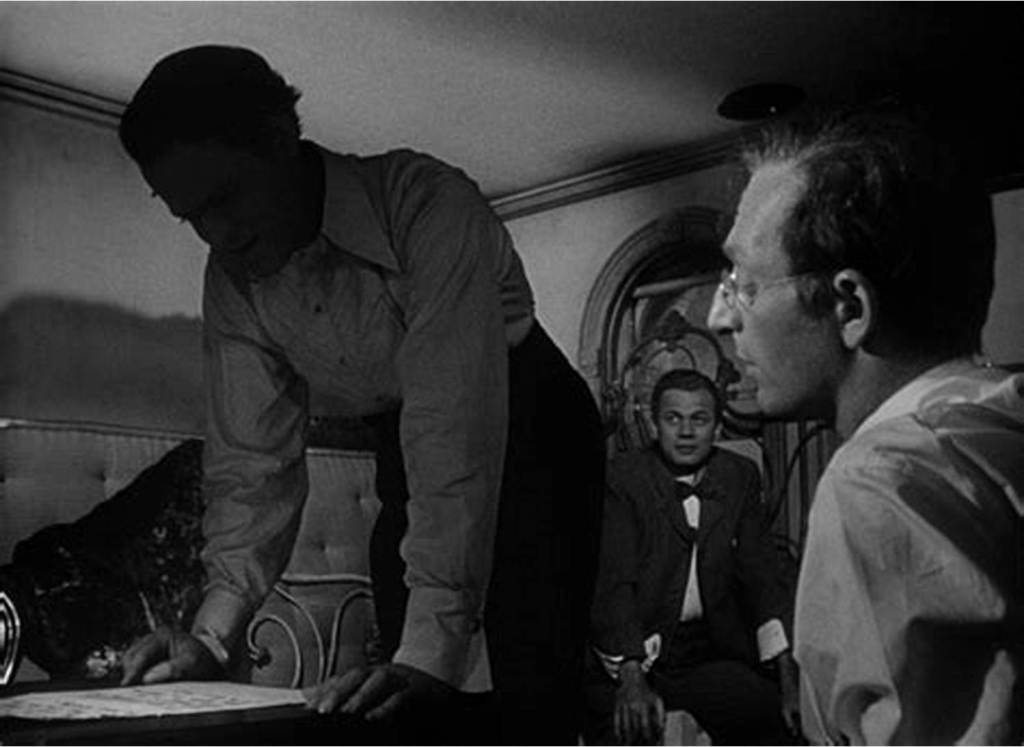
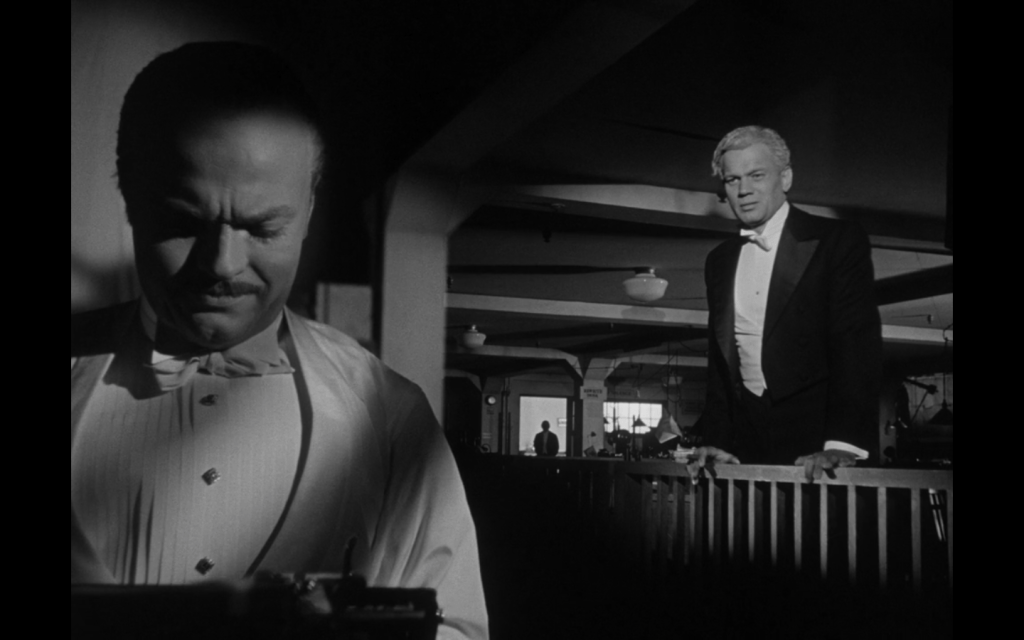
Citizen Kane is rarely thought of as a noir film, but it’s possibly the most noirish film you’ll ever see. Watching it again I was struck with how often shadows dominate the screen. Faces are frequently obscured, most famously in the projection room scene, where Thompson receives his instructions to find out what “Rosebud” means. But at key moments, faces disappear into black – while preparing his “Statement of principles” that will fill the front page of Kane’s first edition at the Inquirer, his face is lost in murky darkness. We hear what he is saying, but what is he thinking at this moment? It’s impossible to tell. Long shadows and inky black segments fill the frame frequently – it’s a film that gives a true feeling of darkness and unknowability at its heart.

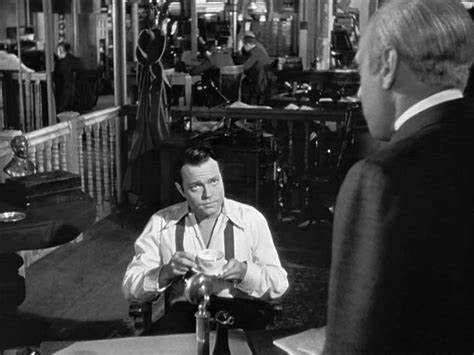
This is mixed with the theatrical flourish of its constant deep focus. Almost unheard of at the time, every shot of Kane is in perfect focus. It makes for visual compositions inspired by theatre, and ripe with dramatic meaning. Kane’s parents and his guardian William Parks Thatcher (George Coulouris) organise the future of the young Kane in the foreground, while we see the child playing outside in the show through a window. The deep focus turns Xanadu into a museum of lost chances and dreams, and the Inquirer newspaper office into an increasingly dark corridor of ambition, with people’s fates decided in foreground while we see them trapped in the background.

If that wasn’t enough, Toland uses angles Hollywood films hadn’t dreamed of. For some scenes, trenches were dug into the set and the camera placed in it, allowing the camera to stare up, with the actors towering over us. Citizen Kane is often claimed to be the first film where ceilings needed to build for the sets, as Toland’s angles and camerawork frequently made them visible. It’s not completely true, but it speaks to the visual impact of the film. Nothing really like this had been widely seen before. And I’ve not even mentioned the soaring, swooping tracking shots that pass through signs and buildings, the sort of inspired movement of the camera so many directors before had avoided in favour of stationary recording of the story. It’s visionary stuff.

The same was true for the film’s sound and music. Welles used his experience from radio to turn the soundscape of the film into something truly different. In radio, all cuts are managed by sound, but film had traditionally used only visuals to mark edits. Here, sound is used as often as visuals. When Kane runs for Governor, the sound and vision cut seamlessly from Leland on the stump for Kane to Kane finishing the same speech at a cavernous rally. Early in the film, the words “Happy Christmas” are skilfully cut together to leap forward years. Bernard Herrmann’s spare but perfect score, rather than laid over every scene, only comes in (as on radio) where emotional or transitional change is needed.

But then this is a film that uses editing as a way to tell story that few films before had tried. The sequence showing the collapse of Kane’s marriage to President’s niece Emily Monroe Norton (Ruth Warwick) is the perfect example. Over about two minutes of screen time we see several short scenes, all set at the breakfast table. Each scene shows a progressive step in their relationship collapsing, from loving exasperation to annoyance to anger to mute loathing. The scenes are no more than 20-30 seconds each, but the film perfectly moves from one to the other. The music slowly changes from a romantic waltz to a cold discordant rhythm. Transitions are marked by wipes. In each scene the actors move further apart at their breakfast table, the dialogue becomes harsher, sharper and more confrontational as the room they sit in becomes grander. In a few moments, an entire marriage story is told. It’s quite simply marvellous. The sequence is bookended by matching camera movements, gliding in and then out from the room.

You could speak for pages and pages (as indeed people have) about what a marvel Kane is. Welles’ vision and willingness to push the boundaries created an environment where all his collaborators worked to achieve their best, set free from the restrictions of more traditional moviemaking to stretch themselves as artists in a way rarely allowed. But it’s easy to forget what a marvellous story Citizen Kane is, what an entertaining and brilliantly constructed film it is and how every scene has something that delights and enthrals.

There’s controversy over who wrote the script. Welles and Herman J Mankiewicz are credited – although arguments have been made that each deserved the lion’s share. Whoever did create it, the script is quite simply superb. Economic, but packed with wonderful lines and some extraordinary speeches (Mr Bernstein’s speech about a powerful memory of a young woman he saw once from a distance is quite simply one of the best small-scale speeches you’ll see). Every scene is brilliantly assembled, and gives fabulous material to an extraordinary cast of actors.

It makes for a compelling character study, wrapped into a series of brilliantly done vignettes. Each set of recollections – from Thatcher, business manager Mr Bernstein (Everett Sloane), old friend Jedidah (Joseph Cotton) and ex-wife Susan (Dorothy Comingore) – makes for a fabulous series of self-contained scenes, each gaining richer and deeper meaning with every subsequent reflection that follows. There are so many sensational scenes I hardly know where to begin: you could write an essay about each one. Thatcher’s serio-comic reflections of the roguishly cheeky Kane are wonderful. Bernstein’s memories of the chancer coming good – with a brilliantly playful celebration scene – wonderfully entertaining. Jedidah and Susan’s far more tainted reflections of the man’s flaws make for wonderfully constructed drama, presenting a corrupted and bullying Kane. In every scene there is a beautiful moment of dialogue or drama which sticks in the memory.

The acting is equally good. Cotton settles into the groove many of his finest roles would fit into – the never-quite-grew-up schoolboy, who slowly realises his hero has feet of clay. Comingore is wonderfully fragile and then increasingly bitter as Kane’s ill-used second wife, forced into a humiliating career because Kane won’t be married to a failure. Sloane is charmingly loyal, with beautiful moments of profound sadness, as Bernstein. Coulouris is brilliantly funny as the exasperated Thatcher. Ray Collins’ is smooth and unabashed as Kane’s political rival. Agnes Moorehead is tinged with sadness and ambition for her son as Kane‘s mother.

But at the heart of Citizen Kane – in every sense – is Welles. His handpicked crew was some of the best in the business – but it was Welles’ inspiration, his willingness to imagine techniques and approaches un-attempted before, that encouraged them to their finest work here. With the magnetic force of personality that was his hallmark, he inspired everyone to give their very best. And he led from the front. The film is a triumph of drama, tragedy and comedy, directed with sublime grace. Welles the actor is perfectly cast, the part almost a riff on his own cult of personality, the mix of pride and overweening ambition and little-boy cheek crossed with self-destructive laziness. Welles’ performance is faultless in the film, taking Kane from the smirking chap happy to lose a million dollars a year (“at the rate of a million dollars a year I’ll need to close this place…in 60 years”) to the bloated old man, trashing his wife’s room after she walks out. Perfect.

The only tragic note about Citizen Kane is that this wasn’t the first in a career of non-stop genius from Welles. Instead, flaws in his own personality, combined with his ability to make enemies and lack of ability to focus on the task in hand, increasingly consumed Welles, making him eventually a lost great, a man wandering from film set to film set, taking on small roles for cheques that might one day help him make a film. But he’ll always have Kane, the sort of film that is a marvel which can never, ever disappoint. With every scene a classic, every moment compelling, every beat in it perfectly judged, its influence stretching to almost every film made since the late 1940s – it deserves its place as the greatest film of all time.

Waterloo (1970)

Rod Steiger chews the scenery as Napoleon in this epic restaging of Waterloo

Director: Sergei Bondarchuk

Cast: Rod Steiger (Napoleon Bonaparte), Christopher Plummer (Duke of Wellington), Orson Welles (Louis XVIII), Jack Hawkins (Lt-General Thomas Picton), Virginia McKenna (Duchess of Richmond), Dan O’Herlihy (Marshal Michel Ney), Rupert Davies (Colonel Gordon), Philippe Forquet (Brigadier-General Bédoyère), Ian Ogilvy (Colonel De Lancey)

In 1970 there was no CGI. Want to stage a battle scene? Well you’re going to have to use real people, rather than populating your screen with pixel soldiers. I’ve always had a fondness for epic films of this era, where you look at the screen and know everything is real. And one of the best examples of this battle-heavy genre is this 1970’s chronicle of the Battle of Waterloo in 1815. Because in 1970 the only way to recapture the battle on camera was effectively to re-fight it with a cast of tens of thousands of extras and horses, across a film set the size of the original battlefield. Can you imagine anyone attempting that today?

An international co-production, the film throws together an eccentric hodgepodge of actors. No more than you would expect of a film co-financed by Italy and the Soviet Union, shot in English, directed by a Ukrainian (with a team of four translators) with a lead actor from New York and the cast stuffed with dubbed actors from across Europe. In fact the slight air of Euro-tackiness about the film is one of the things I sort of love about it.

Rod Steiger as Napoleon delivers the sort of OTT performance he loved to give, capturing the self-aggrandising, larger-than-life nature of the Emperor while frequently chewing the scenery and oscillating between whispers and shouting. It’s perhaps no more than you would expect when playing a man whose entire life was a stage-managed performance of dangerous charisma. It does though make a nice contrast with Christopher Plummer who, perhaps aware of who he was working with, goes for an archly low-key, even wry touch, as the more austere Wellington.

The film covers the time period of Napoleon’s Hundred Days, from his arrival from Elba to the final defeat at Waterloo (with a neat prologue showing an exhausted Napoleon accepting he must abdicate and head into exile in 1814). Much of the first half hour is a showpiece for Steiger’s bombastic Napoleon. Few other characters get a look in (Welles cashes another of his cheques for one-scene cameos, as a bloated Louis XVIII fleeing into exile). To be honest, much of the first half of the film is a slightly stodgy (more-or-less) faithful trot through historical events leading to the battle.

But this is really to set the table for the film’s central appeal, which is that astonishing recreation of the battle itself. Shot in the Ukraine, the Soviet Union (as their part of the deal) effectively recreated the landscape of Waterloo, bulldozing hills, planting thousands of trees, sowing fields and laying over six miles of drainage to help create the muddy fields. On top of which, the USSR threw in 17,000 troops to serve as extras (insanely impressive, even considering it’s only a fraction of the nearly 191,000 troops involved at various stages in the battle).

Marshalling all this was Soviet director Sergei Bondarchuk. Used to commanding film sets like this – he had previously directed a four-part version of War and Peace, where similar number of Soviet troops had recreated Austerlitz and Borodino – Bondarchuk certainly knows how to show the money is all on screen. Aerial shots and long tracking shots take in regiments of soldiers taking up position. Cavalry charges of hundreds of horses are brilliantly shot. The French cavalry charge against the British infantry squares is stunning in its scale and size. Everywhere you look, wide-angled shots demonstrate the depth of extras, the vast scope of the battle and the huge numbers of soldiers marching across screen. If nothing else it’s a superb marshalling of resources.

Bondarchuk brings a number of stylistic flourishes from his War and Peace to the film here. Sadly many of these choices have dated badly – and even at the time, looked a little silly. Interior monologues are demonstrated with close-ups and the sound of actors whispering over the soundtrack (although Bondarchuk also mixes this up with a prowling Napoleon addressing the camera directly). The film loves crash-zooms and fast wipes – one crash zoom generates giggles as it zooms in on Napoleon as he turns fast to face the camera after particularly bad news. Bondarchuk at times drains out the noise of the battle to focus on small details, most notably in the British cavalry charge. It gives moments of the film an odd dreamy film, particularly striking because most of it is so baked in realism.

To be honest the film is workmanlike, rather than inspired, with all the focus on marshalling the thousands of extras. There are moments of character for both Napoleon and Wellington – flashes of doubt, insecurity, fear are mixed in with supreme confidence. The film also hits a neat line in the horrors of war. The camera tracks along the mangled bodies after the battle, while at the peak of the clash a British soldier has a mental collapse, breaking from his square to bemoan “Why are we killing each other?” Not exactly subtle, but it works.

But the film’s main appeal is that scope – and its breath taking. The film itself is more to look at than think about, but with the detail of its recreation of the battle makes it a must for any Napoleonic history buff. Peter Jackson has said his own cavalry charges in Lord of the Rings were inspired by this film – the difference being Jackson’s horses were CGI, while Bondarchuk literally charged hundreds of horses direct at the camera. And you won’t see scope like that anywhere else.

And that’s partly because the film was a bomb, putting an end to such huge scale films as this and also leading to Stanley Kubrick’s plans for a Napoleon biopic being cancelled. Perhaps the worst part of its legacy.

The Vikings (1958)

Kirk Douglas has a whale of a time as one of The Vikings

Director: Richard Fleischer

Cast: Kirk Douglas (Einar), Tony Curtiz (Eric), Ernest Borgnine (Ragnar Lodbrok), Janet Leigh (Morgana), James Donald (Egbert), Alexander Knox (Father Godwin), Maxine Audley (Enid), Frank Thring (Aella of Northumbria), Eileen Way (Kitala), Dandy Nichols (Bridget), Edric Conner (Sandpiper), Orson Welles (Narrator)

There’s a big market for stories about Vikings. Perhaps there is something attractive in our more staid world for a “noble savage” culture, with warriors romantically travelling far and wide. Perhaps a race of brave warriors just seems rather cool. Either way, despite their reputation for ravishing and raiding, Vikings often get a decent deal from films, usually positioned as a race of anti-heroes. That’s definitely what we get from Richard Fleischer’s enjoyable swashbuckler, which has a nodding acquaintance with history.

After the King of Northumbria is killed by fearsome Viking Ragnar Lodbrok (Ernest Borgnine), his queen is raped by Ragnar. Northumbria name a new King, the corrupt Aella (Frank Thring), while the queen sends her baby son (who she knows is Ragnar’s son) to Italy for his protection. Jump forward twenty odd years and, wouldn’t you know it, that young boy turns up as Eric (Tony Curtis) a slave of Ragnar’s, loathed by his unknown half-brother Einar (Kirk Doouglas), Ragnar’s son. The only person who knows who Eric is, is exiled Northumbrian load Egbert (James Donald). Things get even more complex when Aella’s intended Morgana (Janet Leigh) is kidnapped in a raid, and both Eric and Einar fall in love with her….

The Vikings is a great deal of fun, its tongue stuck firmly in its cheek. The plot veers from scene-to-scene from being too dense (various complexities around the rightful king of Northumbria get so confusing the film eventually abandons them) too being shunted off to the sides in favour of the action. But then it’s more about broad, brightly coloured action (very handsomely filmed by Jack Cardiff) with its stars having a good time fighting and shouting.

It’s interesting watching the film as almost a dry run for Spartacus, where Douglas and Curtis would re-unite. Here the film revolves around a rivalry between the two that turns into an alliance of mutual self-interest. Douglas clearly has a whale of a time playing a semi-baddie with depth, his Einar a typical “Viking’s Viking” who drinks hard, fights hard and wants a life of adventure on the high seas. But he’s also got a strange sense of nobility about home and – even though he makes a half-hearted attempt to rape her – he seems to fall genuinely in love with Morgana. Even his eventual comeuppance comes from a moment of decency. It makes for a villain more complex than normal, while Douglas roars through the movie.

Curtis is left with the duller part as the noble son-of-a-king. Looking rather too pampered for a life of serfdom, Curtis feels like a slightly too modern, New Yorkish presence for period pieces (Spartacus would use his pampered prissiness to better effect) but he charges into the sword swinging, high romance of the story with relish, while also shining during Eric’s several moments of brave principle. Morgana, very well played by his real-life wife Janet Leigh, sees a character who could have been a victimised love-interest turn into an independent and strong-minded woman, brave enough to take a stand on the things she believes in.

But the film’s real interest is in the world of the Vikings. There has been some very impressive historical research into their culture and shipping, while the battles and scenes of drunken merriment are well staged and carry a lot of boozy buzz. Most of the cast enter into relish, following Douglas and Ernest Borgnine’s lead (Borgnine, playing Douglas’ father, was at best a few months older) with plenty of shouting, ale swallowing and axe throwing. While the film’s score makes a number of odd choices – this really needed a Goldsmith or Morricone rather than the odd mix we get here – Fleischer’s direction is crisp and adept and keeps things charging forward.

The politics at the Northumbrian court gets a bit forgotten about, with Alan Thring turning Aella into a sneering, unprincipled villain who barely gets much of a look-in. However, the savage punishments that Aella meets out to his rivals – and his ruthless condemnation of anyone seen as being against him – makes a neat contrast with the Vikings who, for all their blood-curdling violence, do at least have some sort of nominal sense of justice and some willingness to compromise.

But the film’s heart is in the action. Douglas, acting as producer, jumped at the chance to take on as many of the stunts as possible – including famously walking across the oars of a Viking longboat while it is at sea (he nearly falls in twice, but it has the sort of excitement of seeing the star doing something for real that you still get with Tom Cruise). He and Curtis eagerly take part in assorted sword battles, while balancing a love/hate relationship (well probably mostly hate) that keeps the film powering forward. All in it makes for some really enjoyable B-movie shenanigans.

Moby Dick (1956)

Gregory Peck on a voyage of obsession as Ahab hunting Moby Dick

Director: John Huston

Cast: Gregory Peck (Captain Ahab), Richard Basehart (Ishmael), Leo Genn (Starbuck), Orson Welles (Father Mapple), Friedrich von Ledebur (Queequeg), James Robertson Justice (Captain Boomer), Harry Andrews (Stubb), Bernard Miles (The Manxman), Noel Purcell (Carpennter), Edric Connor (Daggoo), Meryn Johns (Pelog), Joseph Tomelty (Peter Coffin), Francis de Wolff (Captain Gardiner)

There might be fewer books that lend themselves less to being turned into a film than Herman Melville’s monumental Moby Dick. Perhaps the greatest of all American novels, its’ the story of New England whaler the Pequod’s Captain Ahab’s obsessive quest to kill Moby Dick, the great white whale that took his leg. But it’s also an intense intellectual and spiritual journey into the nature of humanity, which has thrown the book open to multiple interpretations, even more tempting with a book that defies explanation. Try capturing that on film.

John Huston’s Moby Dick is a noble attempt, more criticised at the time than it probably deserves, with the visual language of film unable to ever capture the metaphorical weight of the original novel. What Huston needed to do is to try and capture some of the spirit of the novel, bring its central story to life and make a film that ideally makes you want to search the book out. I would say Moby Dick succeeds on that score.

Reducing the monumental novel (often described as one of the great “unread” books in people’s homes) to under two hours, brings out the narrative, stressing the surface story as an adventure on the high seas, a doomed quest under an obsessive captain. The detail of the reconstruction of the whaling ship, its operations on the sea (including some graphic slaughter of some, fortunately, fake whales) and the atmosphere of the time is brilliantly reconstructed. The film is staffed by an extraordinary collection of actors, whose faces speak of lives led in salt-spray. 

So, starting with the idea that no film could ever capture the depth and richness of the book, Moby Dick is a decent, smart enough attempt. The key themes are there in strength. It captures obsession and the idea of the ship being a sort of microcosm of society, led astray by a leader who has his own passions at heart, over and above the well-being of the crew, but has enough magnetism to pull the crew with him nevertheless. 

Huston laboured long and hard to bring the film to life, in a wrestle with Melville. Even adapter Ray Bradbury claimed he had “never been able to read the damn thing”, with Huston and Bradbury clashing constantly during the writing process. It works, and Bradbury’s adaptation is beautifully done, but in a way John Huston himself was a sort of Ahab with the book as his whale. 

In fact you could argue – as many have – that Huston himself was the natural casting for Ahab (take a look at Chinatown to see what I mean). A charismatic raconteur, ruthless and fixated on his goals, that’s an Ahab we could buy into. Perhaps in that world, Orson Welles – here giving a neat little cameo that avoids bombast as Father Mapple – would have been the perfect director, marrying mastery of cinema with a wonderful understanding of transforming literature into film.

Gregory Peck is the Ahab we do get. At the time the casting was strongly criticised – people just couldn’t buy the straight-as-an-arrow Peck as the destructively bullying Ahab. Peck himself remained strongly critical of his performance here all his life. Separated from the time, Peck’s performance is stronger than you anticipate, capturing a gruff fixation and magnetic charisma that you can believe pulls people in. Peck may strain a little too hard for the elemental anger, but Peck’s Ahab has a bass richness, a sort of inverted Lincolnish (he even looks a little like Lincoln) self-righteousness that makes you believe he could rouse a ship to choose its own destruction. Peck also brings a spiritually dead look to Ahab, a man turned from hope to destruction. Huston teasingly keeps Ahab in reserve for almost a quarter of the film until his first appearance, allowing the build in the audience’s expectations.

The casting of the crew uses a fine selection of British and Irish actors (the film was shot in Ireland), with Harry Andrews particularly strong as jolly but non boat-rocking first mate Stubb. Leo Genn gets the meatiest material as Starbuck, a decent, working man with a firm sense of principle but who lacks any sense of the charisma needed to swing people to his point of view. The film bumps up Starbuck’s role, centralising his growing unease at Ahab’s madness, opportunities which Genn (nearly underplaying to contrast with Peck’s theatricality) works a treat. Richard Basehart – a good voice for narration but much less of a presence – gets a bit lost as Ishmael. There is an intriguing bit of casting – something that would never happen today – that sees Austrian aristocrat turned actor Friedrich von Ledebur play the Maori-inspired Queequeg, a visual disconnect that is more than a little distracting for a while.

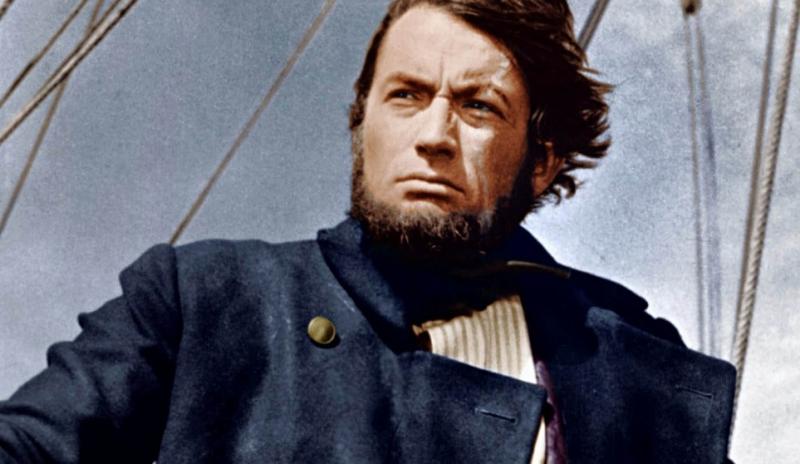
Moby Dick is beautifully filmed and assembled, even if Huston throws in the odd obvious shot – sun beating down on the ship, a close up of the whale’s eye. It has a unique look – on the remastered blu-ray – with the image reflecting the faded, bleached look of whale prints (an effect achieved by superimposing a black-and-white negative over a colour one, draining most of the colours our), which gives it a great deal of visual interest. It’s never going to replace the book – but honestly what could? As an exploration of the ideas at its heart it’s wonderful – and a great prompt to pick it up – but with a marvellous sense of life on sea, a stirring score and a wonderful sense of intelligent construction it more than works.

The Magnificent Ambersons (1942)

Tim Holt can’t understand how the world is changing in The Magnificent Ambersons

Director: Orson Welles

Cast: Joseph Cotton (Eugene Morgan), Dolores Costello (Isabel Amberson Minafer), Anne Baxter (Lucy Morgan), Tim Holt (George Amberson Minafer), Agnes Moorehead (Fanny Minafer), Ray Collins (Jack Amberson), Erskine Sanford (Roger Bronson), Richard Bennett (Major Amberson), Don Dillaway (Wilbur Minafor), Orson Welles (Narrator)

In early 1940s, Orson Welles was given the sort of contract by RKO directors normally only dream of. The freedom to write, direct and star in films of his choice and, most of all, the power of “Final Cut” – the dream of all his contemporaries. All this for a 25-year-old who had never made a film. It was unheard of – and it was never heard of again. The reaction to Citizen Kane had been full of praise from the critics but that hadn’t saved it from box office disappointment – nor the savages of the Hearst press or the jealousy of his peers. The chickens would well and truly come home to roost on The Magnificent Ambersons, the second picture in Welles’ deal.

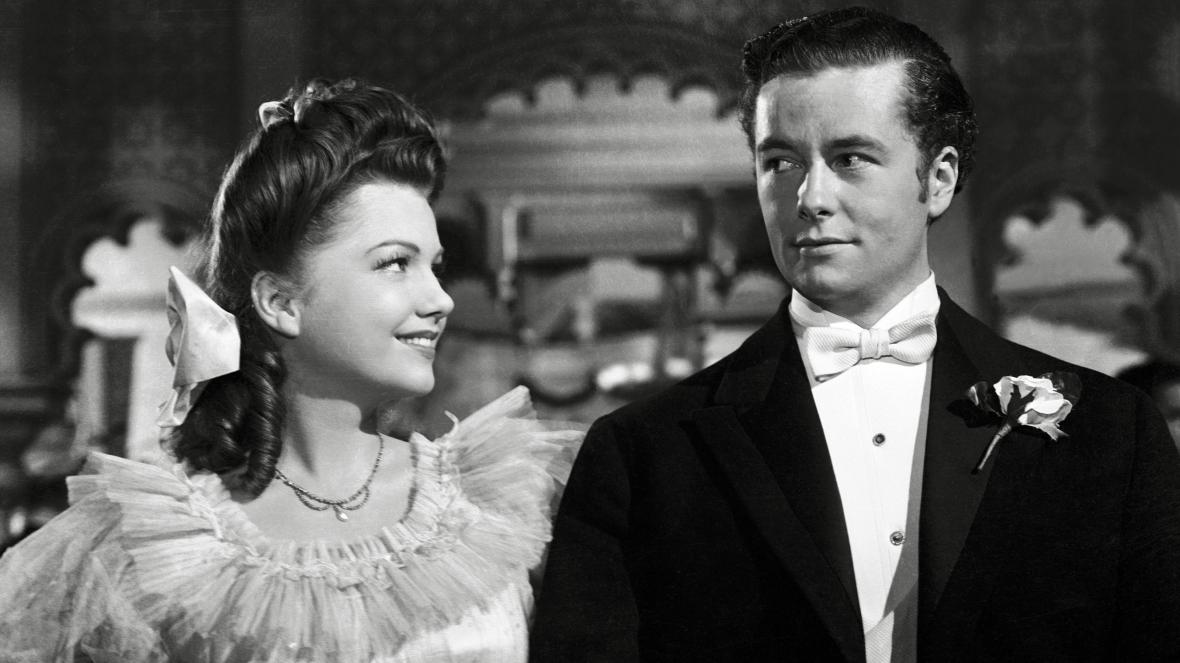
The film itself is an adaptation of Booth Tarkington’s Pulitzer prize-winning novel. The Ambersons are a powerful and rich Midwestern family at the turn of the century – but the film charts their decline and fall as the modern age (represented by the motor car) slowly leads their world of genteel wealth and entitlement to a close. It’s a particularly challenging concept for the youngest member of the clan, George Amberson Minafer (Tim Holt) to come to term with, the spoilt young son of Isabel (Dolores Costello), who has grown up expecting his every whim to be met without question. His hostility focuses on Eugene Morgan (Joseph Cotton), his mother’s rejected suitor (now renewing his interest with her widowhood) and inventor who has patented a new form of motorcar. Things are complicated by George’s own love for Eugene’s daughter Lucy (Anne Baxter), a young woman who expects George to want more from life than just to live off his family’s wealth.

It’s impossible to discuss The Magnificent Ambersons without mentioning its status as perhaps the greatest “lost film” ever. Welles’ original cut of the film was a little over two hours long. He completed the cut and then flew to Brazil to begin collecting footage for his next project, It’s All True a part-documentary, part-fiction film (which in the end was abandoned). While he was out of the country, the film was roundly rubbished at a test screening. RKO panicked and demanded cuts. Welles had foolishly surrounded his right to final cut for the film and sent back a list of suggested changes (some have argued the list was deliberately bad to force the studio to make no changes), but refused to fly back to supervise things. 

So his editor Robert Wise (later a two-time Academy award winning director) cut the film down to just over an hour and twenty minutes. Cotton and Moorehead were corralled into filming some new scenes to hurriedly wrap the story up and give it the studio mandated “happy ending”. Welles wasn’t happy, but still wouldn’t come back to fight his corner. His notes were destroyed and eventually the remaining negative of the deleted scenes were burnt. So the truncated shadow is all we have.

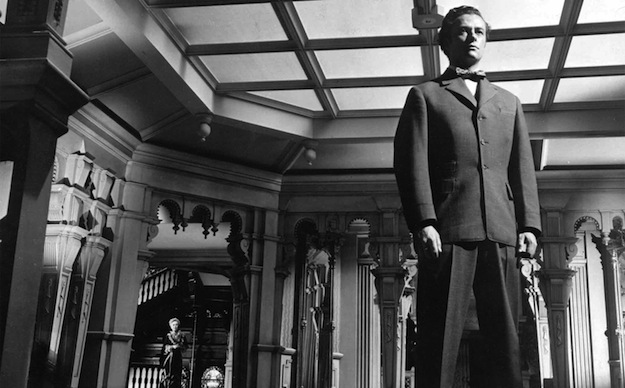
I call it a shadow, because that is what the film feels like – an afterimage of a true masterpiece, like a dream you can almost completely remember. In some ways it’s an even more confident and controlled piece of film-making than Kane, a wonderfully assured and graceful piece of film-making that mixes luscious long-takes with a triumph of techniques and little details (both of performance and technical work). Welles captures this all within a triumphantly impressive set, an elephantine house of at least three stories with a winding grand staircase, that allows him to film from different, heights and angles as well as indulge a series of graceful tracking shots that all proceed and accompany the actors through the house.

Welles matches this with a storyline that captures a sense of a country in a state of change – a tipping point of modern America as the Henry Jamesian Old Americans, with their wealth and inherited English-class system, gave way to industrialist new money. These two worlds sit awkwardly against each other, constantly compared and contrasted – Eugene’s car factory is a noisy, piston filled Ford-ist church, a world away from the formal gentility of the Amberson home. 

Welles also captures this in a series of wonderful vignettes, not least an early scene featuring Morgan driving Isabel and her siblings through the snow bound countryside in his prototype motor car, at first passed by an arrogant George with Lucy in a horse and sleigh, then having to bail George out when the sleigh turns leaving him and Lucy stranded. George is reduced to pushing the car to getting it started – getting a face full of fumes for good measure – a humiliation that hardens his stance against the modern world (and Eugene) all the more.

Because for George – superbly played with a fragile ego and utter lack of self-awareness by a preeningly weak Tim Holt – the world has a certain order that places Ambersons at the top and the rest of the world at various levels on the way down. And anything that might threaten to change that is rejected at all costs. George expects the world to march to his tune without him putting in the faintest effort – and when it doesn’t, his whole life is a desperate raging of petty attempts to assert his control.

This focuses above all on exerting a bullying moral force on his mother, a woman who loves her son but also wants to explore the romantic feelings she has for Eugene (and by extension her understanding that the world is changing). George makes this choice stark – him or Eugene – a choice no mother can be expected to make. Dolores Costello is superb as a woman who has spent her life shutting her eyes to her son’s selfish nature until it’s too late to change, who sacrifices her own desires for the good of her family.

The whole film is a feast of sublime acting, a reminder of how Welles could get the best out of actors (all regular collaborators of his). Joseph Cotton’s earnestness is perfect for the upright and decent Eugene, too proud to let his resentment and anger show. Ray Collins is wonderfully sweet and endearing as Jack, George’s generous and open-minded uncle. Anne Baxter has a radiant honesty that hides a determined spine of moral certainty as Eugene’s daughter Lucy. Perhaps finest of all is Agnes Moorehead (Oscar nominated) as Aunt Fanny, George’s spinster aunt, who has worn a mask of contentment over her own frustrations and resentments for so long she only slowly begins to work out what she actually feels about anything at all. Moorehead’s performance walks a brilliant line between careful underplaying and explosive dynamics – she has at least three striking emotional breakdown scenes of such brittle honesty that it’s enough to move you to tears.

All of this comes together into a superb package of sublime film-making and intelligent story telling. The problem is it’s too short. The later scenes really bear the brunt, with Wise’s cutting trimming much of the connecting meat between the key scenes. Events towards the end seem to happen with no build up – characters suddenly die, fortunes are swiftly lost, years disappear from one scene to the next. As the film accelerates through its final half hour, narratively it begins to make less and less sense. Then the studio caps on a functionally filmed happy ending (Wise does at least ape Welles’ tracking shot techniques – he was a very capable director) which rings utterly untrue with the sadly elegiac story we’ve been watching (superbly narrated by the way by Welles).

It makes The Magnificent Ambersons a wonderful, incomplete masterpiece. It’s the filmic equivalent to those parts cut off from The Night Watch or Ucello’s Battle of San Romano. What we are left with is still awe inspiring. But it could have been even more.

The Third Man (1949)

Orson Welles is the dark heart of The Third Man

Director: Carol Reed

Cast: Joseph Cotton (Holly Martins), Alida Valli (Anna Schmidt), Orson Welles (Harry Lime), Trevor Howard (Major Calloway), Paul Hörbiger (Karl the porter), Ernst Deustch (“Baron” Kurtz), Erich Ponto (Dr Winkel), Siegried Breuer (Anna), Bernard Lee (Sergeant Paine),Wilfrid Hyde-White (Crabbin)

It’s regularly held up as one of the cornerstones of classic 1940s film-making – and it has frequently won polls of the Greatest British Films of all time. Does The Third Man live up to expectations? No it excels them. I doubt there has been a film more perfectly assembled than this, one where all the component parts click together to make one perfect whole. No matter how many times you see The Third Man, it weaves its spell every time.

In immediate post-war Vienna, the city is divided into four zones, each run by a different great power (the UK, US, France and USSR). The black market is rife between the zones. Into this city arrives pulp Western writer Holly Martins (Joseph Cotton), here to visit his old school friend Harry Lime (Orson Welles) – only to find on arriving that Lime died in a traffic accident, with British policeman Major Calloway (Trevor Howard) insisting that he was a black marketeer. Holly can’t believe Harry was a crook, and decides to investigate himself – on the way falling in love with Harry’s girlfriend Anna (Alida Valli) and finding that nobody’s story on what happened to Harry matches up. Could the accident actually be a murder?

Carol Reed’s atmospheric film is beautifully, perhaps flawlessly directed – so well made that for years there were fevered efforts to assign its brilliance to Welles himself. Which was studiously unfair to Reed, a director at the top of his game in the 40s.  The Third Man was the crowning glory of a run of superbly stylish thrillers that matched thought provoking themes with striking film-making. The film is soaked in the atmosphere of post-war Vienna, a city half shelled out of existence. The film was shot on location, and Reed’s camera captures the “bombed about a bit” shambles of the city, its long shadows, cobbled streets and mysterious alleys.

The Third Man’s filming style also plays into this truly distinctive look. Working with (Oscar-winning) cinematographer Robert Krasker, the film is shot with a luscious almost German impressionistic style, with murky shadows and noirish lighting. Reed uses huge numbers of Dutch Angles to constantly present both this shattered city, and it mysterious story, from disconcerting angles. This visually represents the uncertainty and mystery that drip from every scene, making Vienna look like some sort of sinking ship, disappearing into a mire of crime and guilt. Reed’s camera fills the edges of the frames with tramps, beggars, the dispossessed and the plain scared – a brilliant snapshot of post-war Europe unsure about the future and ripe for exploitation.

The film looks simply stunning, with Reed’s visuals throwing up images that have stuck in film heritage, from fingers poking through a sewer grill, to the iconic entrance of Harry Lime itself (possibly the most famous entry ever). Shadows loom with gigantic proportions over the streets. A final sewer chase seems to take place in a nightmare world of water, false turns and foreboding architecture. And that final shot! Sublime cinema, the stillest shot in the film, and also a superb capturing of the film’s themes of loyalty, duty and betrayal.

The film was scripted by Graham Greene, and occupies a wonderful corner of Greene-land. His original concept was for Holly (or Rollo in the original script) and Harry to be British public schoolboys – a plan rejected when Hollywood co-funding came to call – but it did allow Holly to be transformed into a naïve American, lost in the cold realities of post-war Europe. Holly believes in the world of black and white, and writes stories where good triumphs over evil in the Wild West. He’s adrift in a Europe where everyone lies habitually, morality is flexible, and nothing is as it seems.

Holly is bound by old chains of loyalty to Harry – but how far does that loyalty stretch? What price personal loyalty when confronted with the impact of what a person has done? Joseph Cotton’s performance is pitch perfect, a middle-ranker who has orbited his whole life around brighter stars like Harry. How one-way was the relationship? Can Holly ever think for himself? 

And is the right thing to do to walk away or try and correct the wrongs done by another?This divide is shown in the relationship between Cotton’s Holly and Alidi Valli’s sensational turn as Harry’s ex-girlfriend. A woman who has seen the harshness of the world, and been through a war-torn life that Holly would struggle to even comprehend, she’s a woman to whom personal loyalty trumps all things. Should you be loyal to the man you know, your experience of him – or do you have a higher loyalty that trumps that? Anna is firmly of the belief that she knows all that she needs to know of Harry and she needs to learn no more. It’s the sort of European post-war compromise that Holly can’t adapt to, the ideas of morality becoming mired in shades of grey.

It’s a world he struggles to adapt to, but is a cold hard reality for Trevor Howard’s Major Calloway – a superb performance of cool reserve that hides a strong sense of justice. Howard’s wry half-smile and control is perfect for the film, and his disgust at the actions of black marketeers is subtly and brilliantly conveyed by both the actor and Reed’s restrained direction – a visit to a children’s ward full of victims of Lime’s penicillin, is notable for leaving everything to our imagination and communicating another loss by showing a Teddy bear being dropped into a box.

And the cause of all this suffering? Why it’s none other than Harry Lime himself. No film ever captured Orson Welles’ impish charm as well as this, his shy grin and air of an enfant terrible turned terrible are brilliantly captured in the boyishly young but demonic Harry. A Mephistopheles placed on earth to tempt men like Holly, Lime argues what do a few people (or dots) here and there really matter in the long run? After all governments sacrifice them all the time – look at Vienna! – why shouldn’t we? What’s the problem? Lime grins and casually outlines a demonic view of the world, casually uses a cheap historical justification or two, and then saunters off never suspecting that he could lose the argument. Like Welles himself, he has all the glamour and magnetism that we could never have, and to live a few moments in his shadow, as Holly and Anna do, is to live a lifetime.

So Holly has to make a choice – the friend he knew, or the strangers he has seen harmed. The film charts the slow passage to making this hard choice, presenting us with a man who refuses to believe his friend could be anything other than the victim of persecution, to the man who is destined to turn him in. With the framework of Carol Reed’s superb filmmaking, it’s still an absolute treat.

And finally, The Third Man is blessed with perhaps the most perfect film score of all time. Recorded by Anton Karas – literally discovered playing the zither on the streets of Vienna – the score is jaunty, lyrical, schoolboyish even but can switch subtly to something quite disconcerting. It perfectly captures the schoolboy bravado of Holly and the childish lack of morals of Lime. As a match with the bombed out Vienna and its rundown, cynical citizens, it’s perfect. Like all things with The Third Man, it just works better than you could ever have hoped.