Tag: Park Chan-wook

No Other Choice (2025)

No Other Choice (2025)

Jet black comedy, that makes strong, entertaining political points while testing our sympathies

Director: Park Chan-wook

Cast: Lee Byung-hun (Yoo Man-su), Son Ye-jin (Lee Mi-ri), Park Hee-soon (Choi Seon-chul), Lee Sung-min (Goo Beom-mo), Yeom Hye-ran (Lee A-ra), Cha Seung-won (Ko Si-jo), Yoo Yeon-seok (Oh Jin-ho)

Technology changes the world, sometimes so much it leaves people behind. That’s the starting point of Park Chan-wook’s dark (very dark!) comic drama, No Other Choice, which looks at the surreally bleak ends sudden unemployment in a changing labour market has on a regular joe who prides himself on being his family’s provider. It takes Parasite and mixes it with Kind Hearts and Coronets, but with the mood dyed jet black and a complex anti-hero who becomes darker the more we learn about him.

That anti-hero is Yoo Man-su (Lee Byung-hun), a hard-working paper industry supervisor, right up until his new employers follow-up a 25-year loyalty reward with a P45. Because who needs so humans when your factory can be run by a machine? Flash-forward a year later and Man-su is desperate: he can’t land a new job in the reduced paper industry and his wife Lee Mi-ri (Son Ye-jin) is suggesting it’s time to sell the home he spent a decade working to buy. Man-su decides on a desperate new plan: identify his more qualified rivals for a possible vacancy, murder them, then murder paper plant manager Choi Seon-chul (Park Hee-soon) and apply for his job. What could wrong?

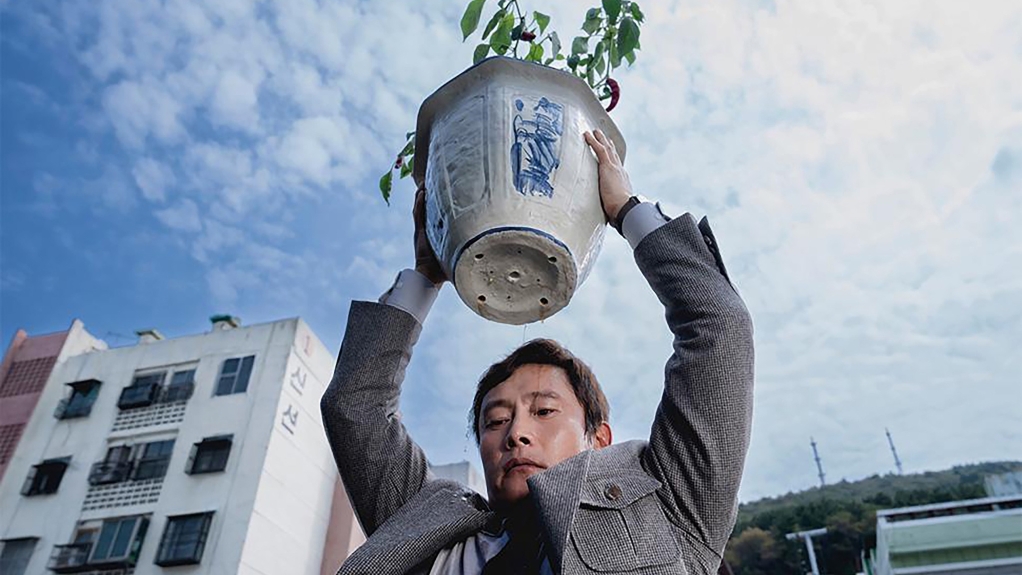
This extreme response to feeling irrelevant in a changing world becomes the heart of Park Chan-wook’s black comedy, directed with his customary sharp-edged beauty with images and camera angles that make you want to swoon. It also walks a tight line between portraying Man-su as sympathetic, an (at first) laughably incompetent killer and, increasingly, a deeply flawed, bitterly resentful man, who resolutely refuses to adapt himself in any way to a changing world.

At first of course it’s hard not to feel sorry for Man-su, cast aside like a dirty off-cut from a company he has given his whole life too. No Other Choice takes its title from the cringe-worthy, rent-a-therapy mantra a jaw-droppingly shallow careers advisor pushes a roomful of redundant staff to repeat over and over again. It’s a mantra that stresses their lack of power and also bluntly sums up how they feel about their future: there are sod all real choices out there, only to adapt or die.

That’s certainly what Man-su, a hard-working supervisor respected by his staff, finds a year later. In a beautiful static shot of grinding irrelevance, a year flashes by of Man-su humiliatingly stacking shelves having failed time-and-time again at applications. A parade of humiliation follows: Man-su stripping out of his overalls in front of his unsympathetic (much younger) manager to attend an interview (shot in security camera distance long-shot); Man-su flunking an interview with clumsy answers to obvious questions, squinting at his interviewers sitting in front of a sun-bathed window; the smug father of his adopted son’s best friend offering to buy a house Man-su has poured his heart and soul into, while constantly disparaging it; literally begging outside a bathroom for Seon-chul to read his CV….

Is it any wonder he is overcome with something between resentment and despair? All that hard-earned respect, years of experience and mastery of the intricate details of paper production means nothing. All those promises of working hard and getting your due reward exposed as a puff of bullshit.

Maybe murder is a fair way to deal with this. After all, it’s not really his choice, right? Advertising a job vacancy at a fake company, he collects his rival’s CVs and carefully selects the better qualified to remove them from the jobs market. He then embarks on a life of crime which Park depicts with a haphazard chaos. Man-su is no expert: he needs multiple attempts to even take a pop at his first target, leaves key evidence behind at crime scenes (only chance saves from arrest) and makes a mess of hiding his tracks.

Lee Byung-hun has a gloriously disbelieving look to him, constantly unable to fully process what’s happening to him. Instead, he’s trying desperately to keep up a front that slowly collapses. It’s a brilliant performance, one that keeps us liking Man-su, even as his previously well-hidden dark side bubbles to the surface. Man-su prides himself as a careful, methodical gardener and he applies the same to his family, who he wants to protect and nurture. Each murder sees him crush more and more of this quality in himself: the man who tries to shelter his first victim from his wife’s infidelity, later finds himself comfortable dispatching others with cold-faced, determined ruthlessness.

It’s part of what makes No Other Choice such a genuinely surprising film. It would have been very easy for Park to embrace the dark comedy of Man-su’s Kind Hearts removal of obstacles. You could well imagine a Hitchcockian black comedy version. But what Park does is make us question our sympathies with Man-su. Pride is shown as his major flaw. Despite a multitude of transferable skills, he never considers new careers (something he even berates one of his targets for not doing, a rant clearly aimed as much at himself). He refuses free treatment for his tooth infection from Mi-ri’s charming dentist boss. He doesn’t attempt to change his lifestyle – or outgoings – during unemployment, burning through his redundancy package. He can’t imagine anything other than stepping back into an identical position to the one he has left.

On top of this, he’s an insecure, fragile man. A recovering alcoholic, Mi-ri makes clear when on the booze he was short-tempered, even striking their son. He becomes consumed with jealousy at her friendship with her boss (even, pathetically, asking to smell her underwear to check she has remained faithful). He’s very aware of his poor background and limited academic achievements. It becomes clear his job had grown to define him as a man of worth: without it he’s terrified that he is nothing, for all Mi-ri makes clear she doesn’t feel like this (much like the wife of his first victim makes clear its not her husband’s unemployment that’s the problem, more his drunken, self-destructive, self-pity).

Park doesn’t make it easy with Man-su’s victims. These aren’t comic portraits, but deeply human figures, both of whom are eerie self-reflections of Man-su. Goo Beuom is a tragically self-pitying alcoholic. Ko Si-jo is a devoted father of a young daughter, working over time to try and provide his family. These aren’t comic caricatures we can enjoy watching get bumped off (like multiple Alec Guinnesses) but living-breathing people, touched by tragedy. That’s why Man-su can barely bring himself to look at them when the moment comes.

It’s a darkness that starts running more and more through No Other Choice as Man-su’s determination to regain his status starts to destroy the very things he claims to value most: his family, principles and peace of mind. No Other Choice is fiercely critical of a world of AI-powered industrialisation where human workers are irrelevant: but Chan-wook refuses to romanticise the bitter realities of the people left enraged and resentful at the impact on their lives. It makes for an uncomfortable and challenging comedy, full of moral quandaries and sharp political statements.

Decision to Leave (2022)

Decision to Leave (2022)

Obsession, murder and romance combine in this stunningly made inventive romantic film noir

Director: Park Chan-wook

Cast: Tang Wei (Song Seo-rae), Park Hae-il (Detective Jang Hae-jun), Lee Jung-hyun (Jung-an), Go Kyung-pyo (Soo-wan), Park Yong-woo (Im Ho-shin), Kim Shin-young (Yeon-su), Jung Yi-seo (Yoo Mi-ji), Jung Young-Sook (Granny Hae Dong), Yoo Seung-mok (Ki Do-soo), Park Jeong-min (San-oh), Seo Hyun-woo (Sa Cheol-seong “Slappy”)

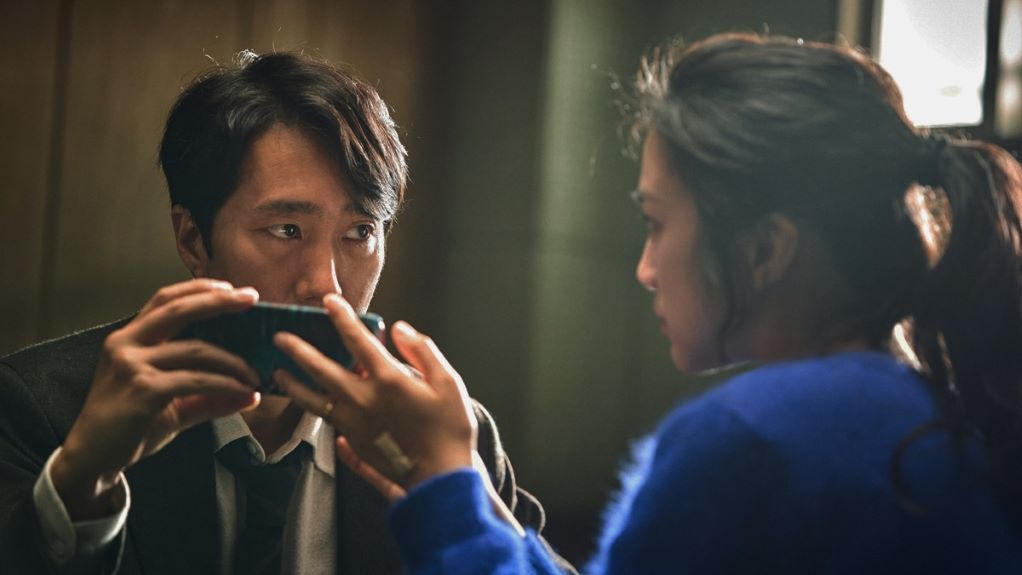
Death from dizzying heights, a mysterious femme fatale and a detective who tips into unhealthy, romantic obsession. Sound familiar? Park Chan-wook’s Decision to Leave is an enticing spin on Vertigo, but also a beautifully made marriage of Park’s visually dynamic style with classic Hollywood film noir. Decision to Leave is soaked in the sort of atmosphere you’d find in Laura or Double Indemnity and is a breath-taking marriage of half-a-dozen genres, from noir to romance to tragedy. It rotates continuously, no matter how much we observe and watch people, on how little we understand them – and how little we understand ourselves. It’s a stunning piece of film-making.

Jang Hae-jun (Park Hae-il) is a high-flying Busan murder detective, the youngest senior investigator on the force. He’s also a reserved man, crippled with insomnia and weighed down with guilt over cases he failed to solve, conducting a long-distance marriage with Jung-an (Lee Jung-hyun) a scientist at the nuclear plant in distant Ipo. He’s called into investigate the death of a civil servant and keen climbing enthusiast, who fell to his death from his favourite climbing spot. His much younger Chinese wife Song Seo-rae (Tang Wei) is strangely unmoved by his death and becomes the investigation’s focus. She also becomes the focus of Hae-jun’s sleep-deprived obsession as he stakes out her home. Gradually Seo-rae and Hae-jun form an intimate but unromantic relationship as they discover a deep bond between them. But does that mean that Seo-rae isn’t a murderer?

Questions of motivation and the reasoning behind decisions is central to Park’s film. At its heart is Seo-rae, a woman constantly unreadable, as hard to distinguish as her turquoise-tinged clothes are between blue or green (depending on who you talk to). A Chinese woman in South Korea, her Korean is formal and perfectly phrased but she relies on Google Translate to render more emotive sentences into Korean. She nurses ageing women in their homes, showing them care and attention. She might also be a murderer several times over, for motives that are impossibly unreadable.

It must be particularly unreadable for a detective whose mind is clouded by lack of sleep. Hae-jun’s eyes in his lined, weary face are frequently blurred by eye drops (the same eye drops covering POV camera shots). As a detective he’s prepared for everything. He wears trainers, constantly prepared for sudden sprints after criminals (one of these sees him pounding up the side of Busan’s mountain – both he and the suspect collapsing, wheezing for breath, at the top), he has specially tailored coats filled with any object he might need, from tissues to aspirin to a knife glove for hand-to-hand combat. He is calm, unruffled and ready for anything. He’s also a man who struggles with knowing who or what he wants and has placed such pressure on himself that insomnia feels like his body telling him sleeping is irresponsible in a world where there is so much to fix.

Decision to Leave revolves around the fascinating dance between these two characters, a Sherlock Holmes and Irene Adler, who recognise on some-level they are kindred spirits. Both are quiet, dedicated observers of people. Both have the ability to zero in on details – its telling that Seo-rae is the only one who can help Hae-jun begin to crack his old cases and that Hae-jun is the only one who delights in every detail of Seo-rae’s careful, formal Korean. Neither are exhibitionists, both quest obsessively because they feel they must for others: Hae-jun for the victims of crimes, Seo-rae to reclaim the Korean land her grandfather had been forced to leave behind when he fled to China.

But yet… these are also people seemingly determined to manipulate and entrap each other. Sae-jae’s growing closeness with Hae-jun is also a way to get closer to the case, to follow Hae-jun’s progress and to nudge (or outright shove) it in certain directions. Her motives and decisions remain unclear. When they go on a tenderly chaste date to a Buddhist temple, is their connection and intimacy genuine for her, or is she ruthlessly playing a lonely man for advantage?

Because Hae-jun defines himself as a detective – after all, he will chase cases to the end long-after his bosses have demanded he file it. Decision to Leave explores how far this will affect Hae-jun: how far will he go to protect someone he suspects might be a killer? If he helps Seo-rae, how much would he grow to hate himself for doing it? Or to put it another way – is there a greater expression of love that a Holmes is capable of, than to help his Irene Adler get away with it?

These dizzying themes interweave with fascinatingly oblique motivations in this endlessly rewarding puzzle-box of a movie. It’s also clear to see the Vertigo parallels, as manipulators fall in love and stalkers try to shape people and events to meet their desires. It’s second act, set in Ipo, as the characters come back together after a time-jump is a brilliantly engaging dance between two people who might be deeply in love and might be doing their very best to manipulate each other. Here acts of love include reading seized phone call transcripts or draining a swimming pool of bloody water.

It’s extraordinarily shot by Park chan-wook – this is the sort of film that makes you want to run out and see everything else he’s ever made straight away. Decision to Leave is more classical and reserved than his other ‘cinema of cruelty’ films. But that isn’t to say it’s not crammed with endless inventive flair. Camera angles plumb every depth of imagination – from vertigo-inducing heights to shots that seem to place the camera inside phones, their graphics superimposed across the screen.

As Hae-jun imagines Seo-rae’s actions or stakes out her home, he is visually inserted into her memories or placed in the scene as a witness as he deduces how she may have killed her husband. As this dedicated, obsessive watcher – who can’t leave his fascination with the case alone – watches her home, Park suddenly places Hae-jun inside Seo-rae’s home, sitting alongside her on a sofa. Scenes replay from multiple angles to show us new perspectives, and the characters blur and switch roles as Seo-rae stakes out Hae-jun in Ipo, noticing how his smart shoes (not suitable for running) are in fact a sign of his collapse in confidence.

Decision to Leave gains hugely from Tang Wei and Park Hae-il’s superb performances. Tang Wei is utterly unreadable, her motives and emotions discernible moment-by-moment only in micro-clues – but by the film’s conclusion you feel you finally have an understanding of her tortured, confused emotions. Park Hae-il drips crumpled loneliness and sadness under a professional demeanour, his emotional vulnerability becoming more and more apparent, his job a fig leaf to give his life definition. The chastely, strangely innocent, intimacy between the two of them has profound emotional impact – this is a classic romance, about two people far closer than sex could make them.

Park’s direction of all this is perfectly paced – for a slight plot and an extended run-time, this feels like a film where not a moment is wasted. Like Vertigo every moment fits together into a complete whole which might only be understandable when you step back and look at. Visually, it’s a treat – inventive but not flashy, unique but not overbearing. And it builds a carefully modulated and deeply moving spiritual romance at its heart. It’s a beautiful slice of film noir, rung through with poetry. It’s a marvellous film.