Tag: Patrick Stewart

Star Trek: Insurrection (1998)

Star Trek: Insurrection (1998)

Playing like a double-length TV episode with some embarrassing humour, not enough special about Insurrection

Director: Jonathan Frakes

Cast: Patrick Stewart (Captain Jean-Luc Picard), Jonathan Frakes (Commander William Riker), Brent Spiner (Lt Commander Data), LeVar Burton (Lt Commander Geordi LaForge), Michael Dorn (Lt Commander Worf), Gates McFadden (Dr Beverly Crusher), Marina Sirtis (Counsellor Deanna Troi), F. Murray Abraham (Ru’afo), Donna Murphy (Anji), Anthony Zerbe (Admiral Doherty), Gregg Henry (Gallatin), Daniel Hugh Kelly (Sojef), Michael Welch (Artim)
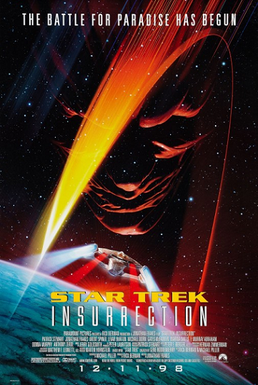
After the smash-hit success of Star Trek: First Contact, the Next Generation franchise had a golden opportunity. Like never before, Paramount put the cash up (almost twice what it did for First Contact) and geared up to make Insurrection a smash-hit. But then it all went a little wrong. There’s nothing particularly offensive about Star Trek: Insurrection – apart from that fact that there is nothing particularly outstanding about it either.

The Enterprise crew are called to a secluded planet in the middle of a nebula after Data (Brent Spiner), on secondment to an undercover mission observing the peaceful pre-Warp Ba’ku people, suddenly goes berserk and holds the rest of the mission hostage. Picard (Patrick Stewart) and the crew recapture and repair Data – only to find that the android flipped out after being injured discovering a secret conspiracy. Misguided Starfleet Admiral Doherty (Anthony Zerbe) is working with the shady Son’a, led by the clearly maniacal Ru’afo (F. Murray Abraham), to force the Ba’ku to leave the planet so the Federation and Son’a can mine (aka steal) the planet’s atmospheric particles which can regenerate humanoid bodies (the whole planet is basically the fountain of youth). Outraged, Picard and his crew decide this will not stand and rebel to stop it.

Now I love Star Trek: The Next Generation. If I had seen Star Trek: Insurrection in two parts, with a year-long cliff-hanger in the middle after Picard chucked in his com badge and went rogue, I’d probably think this was one of the best episodes ever. But as a film? It feels like an episode unwisely moved to the big screen. I can totally see why this failed to be the same breakout hit First Contact was. That dialled the stakes up to the Nth degree and felt cinematic: Insurrection feels like it could have sat quite nicely in two 45 minute, 4:3 chunks.

Even worse, despite the money lavished upon it, it actually looks cheaper than First Contact. This is partly because a large chunk of the money was poured into location shooting. While it must have felt very different to the cast and crew – used to sound stages and the odd trip out to the Californian valleys for an exterior – to suddenly be out in Sierra Nevada, honestly it doesn’t look that different to a host of other planets the crew visited in the show. Neither does the Ba’ku village look that different from the homespun, pre-Warp villages the crew visited at least a few times a season.

It doesn’t help that the Ba’ku are exactly the sort of new-age windbags the franchise has always had an inexplicable fondness for. In their cream robes, mouthing new-age mantras about putting self-discovery first and the beauty of self-improvement, they come across like a gang of smug hippies, rubbing their perpetual youth in the viewer’s face. Throw in the fact that they contribute little to their own defence, other than patronising shakes-of-the-head towards the Son’a, and it’s rather hard not to feel they deserve to be taken down a peg or two. And really, hoarding these life-changing regenerative particles so that only an elite few (happy to expel dissenters from their world) benefit rather than the billions in the galaxy, is a harder-sell the more you think about it.

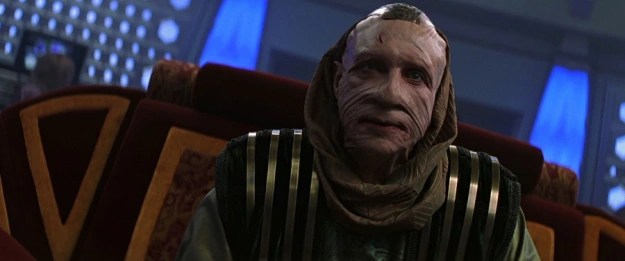
Mind you, it doesn’t help that the Son’a are a gang of less-than-compelling heavies, clinging to what’s left of their youth by constantly subjecting their bodies to a series of bang-on-the-nose cosmetic surgeries (nothing in Insurrection is remotely subtle). Blatantly untrustworthy villains from the start – it’s inexplicable to me why anyone would even consider working with these transparent gangsters from the get-go – their characterisation is one-note with Ru’afo, our villain, played in lip-smackingly precise tones by a slumming-it F. Murray Abraham. The more interesting by far villain is the deeply conflicted Admiral Doherty, a decent performance of “trying-to-do-the-right-thing” desperation that sees him edging towards damnation one tiny step at a time.
While some riffs land better than others, Insurrection unwisely plays the comedy card heavily. Picard, Worf and Data singing HMS Pinafore during their capture of the confused android is pretty droll (not least Michael Dorn’s excellent line in stunned reluctance), while Marina Sirtis and Jonathan Frakes actually manage to inject the re-discovered romantic spark between Riker and Troi with genuine playfulness that is rather sweet. But other stuff is the sort of gag-work that makes fans like me place fists in our mouths and hope no one catches us watching this. Beverly and Deanna talking about their boobs firming up anyone? Worf getting a pimple? Data playing in a haystack? Jesus Christ, no wonder I never told girls I liked Star Trek.

The comedy – and an awkwardly unconvincing romance between Picard and the frankly deeply annoying Anji, played with an irritating Earth-mother purity by Donna Murphy – often undermines the action and lowers the stakes. Although there is a noble attempt to engage with the moral complexities here – a classic “good of the many” situation – the film boils most of this down into a single crucial scene, which relies a lot on Patrick Stewart’s unmatched ability with a speech (Picard here is more like the character in the TV series then he is elsewhere in the film series) but the film isn’t deft enough to centre its moral dilemma. You end up wondering why the crew take such a radical stand. Its uncinematic stakes don’t help – it all feels similar to the sort of situation our heroes waded into exactly 175 times before over seven years. Why take it so much to heart now?

When action does kick-in, Jonathan Frakes does a decent job of directing it. Some of the Sierra Nevada-set action as Picard and his crew march the Ba’ku to the hills to prevent them being picked off the planet by the Son’a has a decent Western feel to it (including a Leone-homage series of frowning forehead shots). There is a decent space battle between the Enterprise – helmed by Riker – and the Son’a. I’ll even admit that the ridiculous “manual steering column” (essentially a joystick Riker uses to fly the Enterprise) is fairly entertaining. Like First Contact – and Nemesis would finally peak in this regard – the ending involves a Die Hard style smack-down between a trigger-happy, shirt-clad Picard and the villain on an utterly unconvincing set (which looks like they didn’t bother to finish the blue-screen work). But all this stuff never feels different from anything we’ve seen before.

So used, it seems, to making less stretch to more, I think the crew – and Frakes – didn’t know what to do when actually given more. They focused instead on all the wrong things: huge sets we almost never see, location shoots that don’t look that different from dozens of other films, more extras. Match that up with a bland story, unconvincing and plain irritating guest characters, and a tonal mess that slipstreams between half-hearted comments on ethnic cleansing to awkward pratfalls and Star Trek: Insurrection is the worst thing a Trek movie can be: a double-length episode which, if you missed, it wouldn’t really matter.

The Prince of Egypt (1998)

Animated DeMille epics in the rather brilliant The Prince of Egypt

Director: Brenda Chapman, Steve Hickner, Simon Wells

Cast: Val Kilmer (Moses), Ralph Fiennes (Ramesses II), Michelle Pfeiffer (Tzipporah), Sandra Bullock (Miriam), Jeff Goldblum (Aaron), Danny Glover (Jethro), Patrick Stewart (Pharaoh Seti), Helen Mirren (Queen Tuya), Steve Martin (Hotep), Martin Short (Huy), Ofra Haza (Yocheved)

When Dreamworks Studio was put together by three Hollywood mega hotshots (Katzenberg, Spielberg and David Geffen), Jeffrey Katzenberg, former head of Disney, finally got the chance to make his animated version of The Ten Commandments. The Prince of Egypt was the first project under the Dreamworks animation label – and it was intended to beat Disney at its own game. It succeeded – so well that many people think it actually is a Disney film. Is that a good thing?

Anyway, the story should be familiar. In Ancient Egypt, Moses (Val Kilmer), the child of Jewish slaves, is adopted by Pharaoh (Patrick Stewart) as a baby after being found in the bulrushes. Moses grows up as brother to Ramesses (Ralph Fiennes) the future Pharaoh – until the shock of finding out his heritage leads him to flee Egypt. But an encounter with the burning bush (voiced again by Kilmer) gives him a new mission – back to Egypt to demand of Ramesses “Let My People Go”. Will he succeed? Well: There Can Be Miracles (When You Believe).

It helps you to believe in miracles when a film looks as gorgeous as this one does. The animation is amazing, not just because of its quality and richness, but the imagination of its images. From the framing of Pharaoh and later Rameses around the Egyptian architecture around them, to an extraordinary dynamic shot of Moses throwing his sandals from the room when encountering the burning bush, to the haunting interpretation of the killing of the firstborn, it’s brilliant. 

It doesn’t stop there either, with the final parting of the Red Sea awe-inspiring in its scale. But the film does equally beautiful work with the smaller, more intimate moments: each character feels real and lived in, and the film perfectly captures smaller moments of affection, love and hurt with genuine emotional force. It’s a terrifically well-made film.

And of course it has a classic story – it’s literally stood the test of time. So imaginative are the visuals – and so impressive is its scope and scale – that it almost dwarfs the DeMille style it’s quietly apeing. In fact, I’d worry whether it is a film that will have greater appeal to movie-lovers and parents than perhaps it does to children. There isn’t much in the way of humour – even the film’s nominal comic characters, a pair of cynical Egyptian priests (and near con artists) voiced by Steve Martin and Martin Short, are on the side of the oppressive baddies. There are a few decent songs in there – I rather like the Les Miserables style oomph of “Deliver Us” – and the film makes great use of the beautiful voice of the late Israeli singer Ofra Haza. But there is no getting around that this is a serious piece of film-making, with nary a comic camel in sight.

But this is no bad thing at all, and I think it stands The Prince of Egypt in good stead as it’s a film you’ll like more the older and more mature you are watching it. Not least the wonderfully complex relationship it explores between Moses and Ramesses – these two wild young men start as carefree kids (the first thing we see them do is smash up a temple building site in the film’s most cartoonish sequence, a sort of Wacky Races chariot drag race), and each become dramatically changed by responsibilities. Moses ascends to a higher plane of responsibility and humanity – but Ramesses finds himself forced into defending to the death a system of government he seemed at best disinterested in as a young man.

The film actually carries a great deal of sympathy for Ramesses. It’s in many ways a tragedy of the brother relationship between these two princes of Egypt getting shattered by events. But Ramesses is a lonely, almost needy figure, who needs Moses’ affection and respect. Ralph Fiennes mines a lot of vulnerability for this man struggling to fill his father’s shoes, who just wants Moses to chuck this whole prophet business in and go back to being his only friend. Ramesses becomes a complex, vulnerable and rather sad man – unable to deal with the pressure of his role and desperate to revitalise a lost connection with Moses, the hatred he eventually feels for his former brother born almost exclusively from rejection. 

Moses isn’t quite as interesting a character – he’s more of a waster who becomes a stand-up guy – but the film successfully builds an aura about him. It struggles a bit more with those Old Testament morals: we are meant to condemn Pharaoh’s slaughter of the Jewish firstborn that opens the film, but God’s massacring of the the Egyptian firstborn (for all Moses’ discomfort with it) is presented as being primarily the fault of the Egyptians’ stubbornness.

But then that steers us into theological territory, which no animated epic for kids can really manage to set new ground with. Instead, let’s focus on the many things the film does right. First and foremost that striking visual imagery and beautiful animation, and the depth and shading it gives to the characters. The all-star cast do extremely well – even Jeff Goldblum is fairly restrained – and it’s got some great songs. It deserves to be shown as often as The Ten Commandments on the television.

Excalibur (1981)


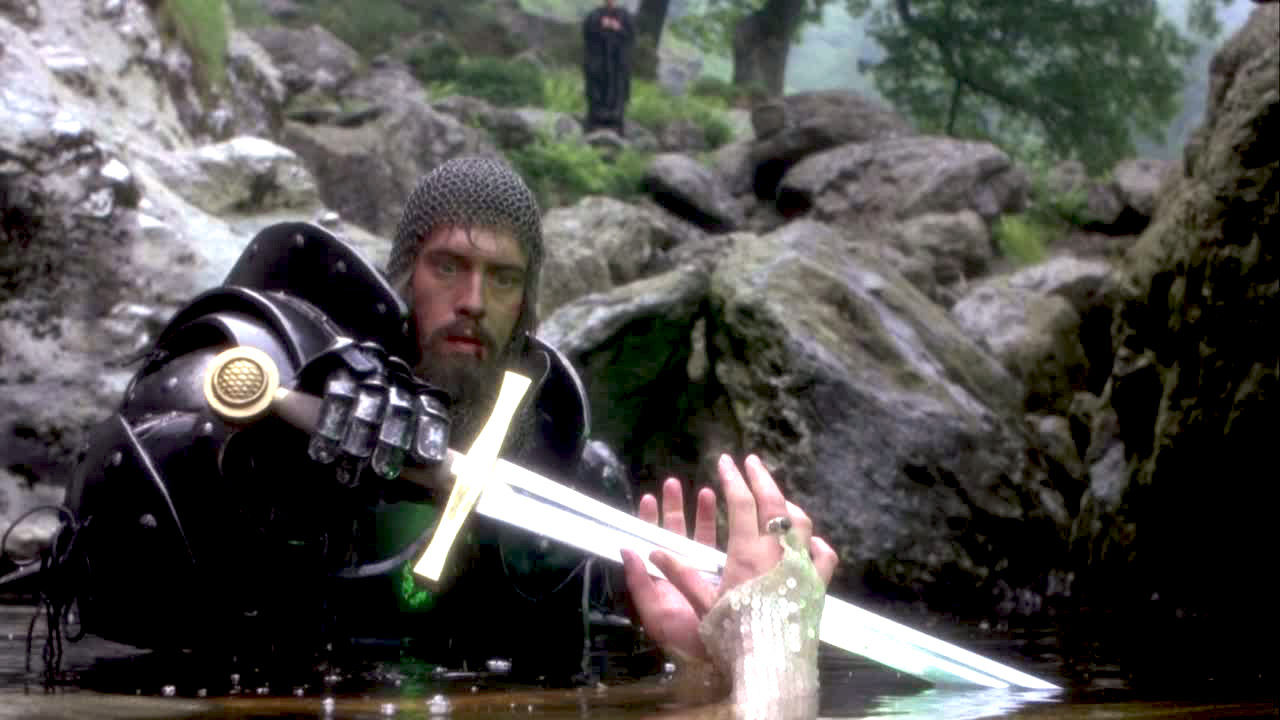
Nigel Terry gets a special gift in John Boorman’s crazily OTT Arthurian epic Excalibur

Director: John Boorman

Cast: Nigel Terry (King Arthur), Nicol Williamson (Merlin), Helen Mirren (Morgana Le Fay), Nicholas Clay (Sir Lancelot), Cherie Lunghi (Guenevere), Paul Geoffrey (Sir Perceval), Gabriel Byrne (King Uther Pendragon), Corin Redgrave (Duke of Cornwall), Patrick Stewart (King Leondegrance), Keith Buckley (Sir Uryens), Clive Swift (Sir Ector), Liam Neeson (Sir Gawain), Robert Addie (Mordred), Niall O’Brien (Sir Kay), Ciarán Hinds (King Lot), Charley Boorman (Young Mordred), Katrine Boorman (Igrayne)

John Boorman had wanted to make a film about King Arthur for over a decade, but it only came into being after his plans for an adaptation of The Lord of the Rings fell through (the suits were convinced the film couldn’t be a hit – good call). So, with a lot of prep work for Tolkien in place, Boorman moved a lot of his ideas for LOTR over to Excalibur. In doing so he created something probably truly unique – a bonkers version of the Arthurian legend, so consistently Wagnerian (often literally), high-falutin’ and overblown that it has a strange integrity in its operatic silliness.

The film begins with Arthur’s conception, a result of King Uther’s (Gabriel Byrne) lust for his ally’s wife, Igrayne (the director’s daughter Katrine). Merlin (Nicol Williamson) agrees to magically disguise Uther as Igrayne’s husband for one night, and in return spirits away the resulting child to be reared ignorant of his heritage. Years later, with a leaderless kingdom in chaos, Arthur (Nigel Terry) draws the magical sword Excalibur from the stone, and proves himself as king. He marries Guenevere (Cherie Lunghi) and brings Sir Lancelot (Nicholas Clay) to Camelot – oblivious of their love for each other. Slowly this love destroys the peace of the land – encouraged by the schemes of Arthur’s vengeful half-sister Morgana (Helen Mirren).

Excalibur is a film set in a completely heightened middle-ages dreamworld, as if it’s a series of drawings from an illustrated edition of King Arthur brought to life. The design of the film is dialled up to eleven: the armour the characters wear is ridiculously elaborate, shiny and eye catching. The characters never seem to take it off: Uther even has sex wearing it (poor Igrayne is completely naked – that can’t have been comfortable for her). Full armour is worn at meals, wedding, social events, everything: at the same time it’s brilliantly ineffective, punctured with ease by axes and spears.

The rest of the design of the film is equally overblown. Camelot seems to have been literally made from silver and gold. Lancelot kips in the forest and sleeps in the nude. Battle scenes are filmed on moody, misty nights, with horses and knights riding with insane riskiness at each other. Excalibur itself is almost impossibly shiny and unblemished and occasionally glows green. Everything has a high-artistic feel to it, like a Romantic painting. Nothing looks real – it uses a “rule of cool” aesthetic, anything that looks good from anything approaching medievalism is used.

The acting itself follows this operatic style. Half the dialogue is delivered shouting: Patrick Stewart in particular must have lost his voice while filming this one. Filmed in Ireland (it practically kickstarted the Irish film industry), many Irish actors got their first film break here, not least Gabriel Byrne (a furiously lusty Uther), Liam Neeson (a drunken oafish Gawain) and Ciarán Hinds (growling in the background). Each roars through their dialogue, perhaps none more so than Corin Redgrave who screams his with such flemmy passion it’s often hard to work out what exactly he’s saying. 

There are quieter moments from the three leads, even if all three of them don’t really have the charisma to impose themselves on sketchily drawn characters. Cherie Lunghi adopts an odd, part-time Irish accent as a bland Guenevere. Nicholas Clay is an upright Lancelot who simmers with guilt but is just a wee bit dull. Nigel Terry’s performance as Arthur (from young yokel to tortured king) gets better the more times I see it, but it lacks a certain star quality. But then in Boorman’s design, these three characters are just tools of fate rather than real characters – and the film has so much story to cover it often has very little time for character development.

The real stars of this film are Nicol Williamson and Helen Mirren. The two actors had a long-standing animosity – Boorman deliberately cast them to get an extra spark out of their scenes. But both actors seize their colourful characters – and have the time to add some depth to their bombastic, larger-than-life moments. Mirren gets to express bitterness and fury under simmering sexuality, as well as a genuine love for her son. Williamson is fantastic: playful, half nutty professor, half vengeful force of mystic power, he turns Merlin into an eccentric but somehow sinister old man. Williamson finds bizarro and unique line readings of even the simplest lines, stretching the material in the way only a really great actor can. He’s such an electric and interesting character, that he makes a performance that’s basically well over the top, hugely enjoyable and also even rather sweet.

As such, Williamson is perfect for Boorman’s overblown, crazy film. The score uses Wagner and Carmina Burana to great effect, and the closing moments are shot before a giant blood red sky. Boorman’s shiny, colourful world effectively melts down in the second half of the film into musty, moody greys: his concept of Arthur losing his way and the kingdom disintegrating works extremely well, and means we get a real sense of things falling apart. The Grail Quest is like a creepy fever dream – with knights we have known dying in gruesome ways, freezing in chapels or hanging in a tree with their corpses picked clean by crows (of course one crow eats an eye!). 

In many ways Excalibur is a very silly film: it’s hard to believe it was made six years after Monty Python and the Holy Grail, as much of its design and action is more than a little reminiscent of that film (it’s probably the only parody you could argue was made before the film it best sends-up). You probably need to see it at a certain age or enter into it with the right mindset for something that walks a difficult line between fairy tale and earthy campness. But I still love it.

Because Boorman really goes for it here. You know from the early sequence of Uther and Igrayne having sex against a background of actual fire, in full plate armour, intercut with a lingering death of Cornwall impaled on a series of spears in Uther’s camp (his death and Uther’s climax are of course cut together) what sort of film you are going to get. Everything is OTT. The drama leaves nothing behind, and Boorman wisely removes any sense of restraint from this telling of the legend. It looks gorgeous – even if dated moments like the Lady of the Lake are more likely to raise sniggers than not – and it really, really goes for it. Not many other films could get away with something so over-the-top and bizarre: but this sort of does.

Star Trek: Nemesis (2002)


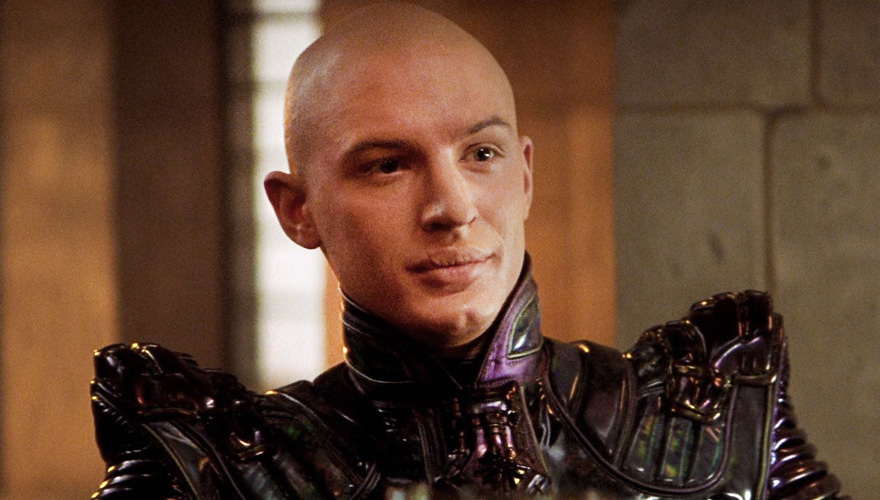
Tom Hardy plays a clone of the young Patrick Stewart in Star Trek: Nemesis. You can tell he’s identical ‘cos he’s got no hair

Director: Stuart Baird

Cast: Patrick Stewart (Captain Jean-Luc Picard), Jonathan Frakes (Commander William Riker), Brent Spiner (Lt Commander Data), LeVar Burton (Lt Commander Geordi LaForge), Michael Dorn (Lt Commander Worf), Gates McFadden (Dr Beverley Crusher), Marina Sirtis (Deanna Troi), Tom Hardy (Shinzon), Ron Perlman (Viceroy), Dina Meyer (Commander Donatra), Kate Mulgrew (Admiral Janeway)

There are few things in the Star Trek franchise with as poor a reputation as Star Trek: Nemesis. It’s as close as the series got to a franchise-killer, a film that bombed so colossally (the first ever Star Trek film to lose money at the box office) that it seemed to end not only the movie series but all planned television projects. Since then, it has been remembered as an incoherent, poorly plotted mess, crammed with terrible writing and direction and shoddy action. Is this memory fair? Well yes and no.

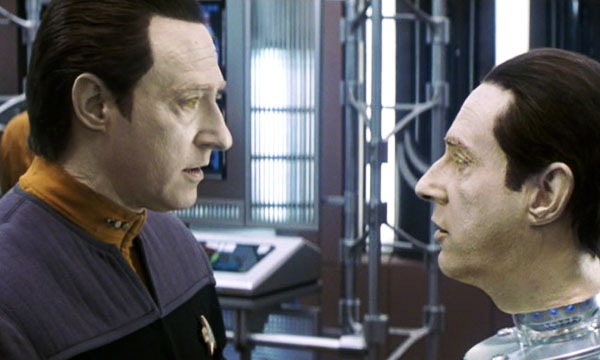
Picard (Patrick Stewart) and Data (Brent Spiner) have their sense of self thrown: first by Data’s discovery of an identical, unadvanced prototype of himself called B-4 (also Spiner) and then by Picard discovering on a mission to Romulus that the new leader of the Romulan Empire is a clone of his younger self, going by the name Shinzon (Tom Hardy). Having assassinated the Romulan government, Shinzon plans to give freedom to his “Reman brothers”, the slave race that raised him from childhood. But he also has sinister aims for the Federation…

This is a horrendously compromised product, cut to ribbons by the studio to get as close as possible to two hours as possible, regardless of the impact on plot or characters. Why? Because it was released at the same time as Lord of the Rings: Two Towers and the plan was all the people who didn’t want to see that would choose Nemesis instead. I won’t start to explain here all the reasons this plan was stupid. Suffice it to say, it didn’t work and meant we ended up with a gutted mess that jumps as quickly as it can to action set-pieces, many inadequately filmed on the cheap.

It also doesn’t help that Stuart Baird was brought on board to direct: a self-proclaimed “non-fan” who proudly announced he hadn’t watched any Trek before. A fresh perspective is great – but come on, if it’s the fourth film with the cast, following 175 episodes, you’d think some respect for the past would be good, right? Instead, Baird seems contemptuous of the whole genre and has no tonal understanding of Star Trek. The actors constantly struggle to keep their characters as consistent as possible, while events and actions keep spinning wildly out of whack. I could start nit-picking Star Trek errors (why is Worf here? Why is Wesley back in Starfleet? What’s happened to Data’s emotion chip? Why does no-one mention Data’s evil brother Lore? Picard was not always bald. Etc. etc. etc.) but I’d be here all day.

Anyway, if they were going to bring a new face on board, could they not have found a better director than Baird? Some of the sequences of this film are so wonkily filmed they look cheaper than they probably were. Any scene involving hand-to-hand fighting is cursed with poor shots and bizarre slow motion straight out of 1970s TV. They all look absurdly slow and cheap. The Romulans are redesigned as ludicrously camp, partly green skinned, heavily made-up softies. Shinzon and the Remans sashay around in noisy rubber costumes like space gimps. Baird has no sense of comic timing and virtually all the overtly “funny” parts of the film fall on their arse. The wedding scene is one long sequence of slightly embarrassing faux-comedy – the sort of thing that will confirm to any sceptic that loving Star Trek is desperately sad.

But the main problem is the plot. Shinzon is a character who should be really interesting: for starters, he’s played by the excellent Tom Hardy. He should be casting a dark light on Picard, with a feeling that these are men only a few degrees apart, or that Shinzon is a kind of renegade son pushing to find his own place in the universe. All lost in the edit. Shinzon’s back story and aims make no sense, and by the end his character degenerates into a motiveless nutter. If he’s all about freeing the Remans (a goal achieved at the start of the film) why does he want to destroy Earth? If his focus is on Picard why does he constantly delay capturing him? What would have worked was if the Enterprise were trying to stop Shinzon destroying Romulus, or if Shinzon’s focus was exclusively on Picard and we had more of a sense of Shinzon being a “dark Picard”. Instead he’s just a nutter with a homicidal plan for Earth which comes out of nowhere.

Badly structured as the Shinzon plot is, at least this has some decent scenes between Hardy and Stewart. However the B-4 plot makes little sense at all, while also providing an unfortunate opportunity for Spiner to play “simple Data”, like an android Rain Man. In terms of where he fits into Shinzon’s plan or the rest of the plot, B-4 makes no sense and provides no real contrast to Data or comment on the Picard/Shinzon relations. He should, of course, be another repeat of the theme of Picard seeing a disagreeable version of himself. But this never comes together. It just gets used for jokes or for Spiner to show-off. Neither option is that appealing.

This thematic material keeps getting constantly lost. It’s cut so badly that it often makes the film empty and unsatisfying. You keep wanting thematic juice: our heroes confronting dark versions of themselves, or the struggle of dealing with your lack of uniqueness in the galaxy. But the film only wants to sketch these in roughly in order to keep moving forward to action scenes. The worst of these is a prolonged car buggy chase on a primitive planet that not only takes ages, it’s desperately dully and makes no real sense at all when you think about (for starters, if the baddies wanted B-4 to be found, why break him up and sprinkle the bits all over a dangerous planet?). 

This means that, despite the title, we never get the sense of there being an actual nemesis in this film. Shinzon never really feels like a reflection of Picard. The film just tells us he’s a baddy, because, hell he just is. You can practically tick off the standard list of villain quirks. Lack of patience? Check. A creepy attitude to women? Check. Killing a subordinate for failing? Check. Any prospect of making him an interesting, different type of character gets pushed out in favour of the simple.

That’s many paragraphs saying what’s wrong. But it’s not all bad. Honestly it isn’t. In fact, there are some nice moments in there. There are some good character beats, and the cast are working hard to make these moments land. In particular, there are some lovely exchanges between Picard and Data, while Geordi gets more to do in this film than most of the last few (including some actual moments exploring his friendship with Data, often lost in the films). Picard feels more like the enlightened explorer and intellectual character from the TV show here than he did in any of the other films. When we are allowed to relax and breathe, the film touches on an elegiac, end-of-an-era quality (see scenes like that below).

Also, as awful as the buggy chase sequence is, the final space battle (while a clear lift from Star Trek II) is exciting and well filmed, and also showcases our characters’ professionalism. The hand-to-hand combat bits are hopeless, and Picard’s final “man on a mission” assault strains credibility. But Data’s final sacrifice is quite moving – especially the quiet moments afterwards where the rest of the cast respond to it. It’s sad because you know more of this warm interplay is on the cutting room floor with the thematic material of the film – leaving this neutered disappointment instead. Which is a shame because there is some decent material here – and some enjoyable moments. There is also a terrific score.

Star Trek: Nemesis is not as bad as you may remember. I mean, it’s a long way short of the best Star Trek films – but it’s got its moments. It’s made by a director who doesn’t understand (or care) about the franchise, but the cast do their best to hold it together. It’s a thoroughly compromised film, ruined by too many people trying to make a film that did too much, and it was clearly intended as a jumping off point for the next film (which never happened), but for all this, there is just about enough to keep a fan entertained – although probably not a non-fan. And if nothing else, this is the last chance to see the cast of one of the best sci-fi shows ever made.

Logan (2017)


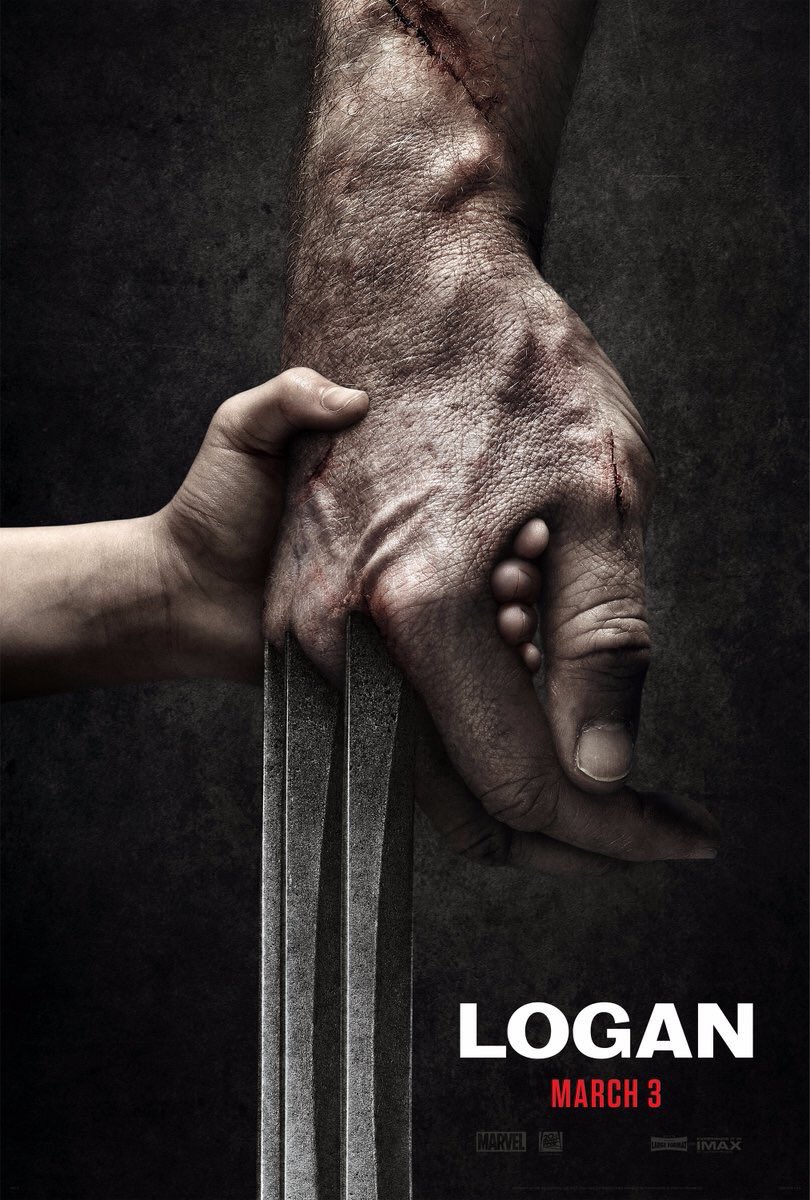
One looks at the past, the other their potential future in bleak superhero thriller Logan

Director: James Mangold

Cast: Hugh Jackman (Logan), Patrick Stewart (Charles Xavier), Boyd Holbrook (Donald Pierce), Stephen Merchant (Caliban), Richard E. Grant (Dr Zander Rice), Dafne Keen (Laura), Eriq La Salle (Will Munson), Elisa Neal (Kathryn Munsun), Elizabeth Rodriguez (Gabriela Lopez)

What were you doing 17 years ago? Personally, I was still at school: but Hugh Jackman was being parachuted into X-Men to take on the role of Wolverine after Dougray Scott’s shooting schedule on Mission Impossible 2 forced him to drop out. Since then he has appeared in eight films as the clawed superhero, some good, some shockingly bad – and this is his swansong. Taking a paycut, Jackman wanted to make the Wolverine “you’ve seen in the comics”: did he succeed?

The year is 2029 and mutants are nearly extinct. Logan (Hugh Jackman) lives in Mexico on an abandoned farm, caring for former X-Men leader Charles Xavier (Patrick Stewart), now suffering dementia and brain seizures with lethal effects on those around him. When young mutant Laura (Dafne Keen) arrives needing their help, Logan and Charles find themselves (reluctantly in Logan’s case) on one last adventure, travelling to reunite Laura with other new-born mutants – with a band of lethal mercenaries on their tail. Naturally a string of bodies follows in their wake.

Firstly I think its fair warning to say this is a bone-crunchingly, head-skeweringly, blood-spurtingly violent film. It’s easily more violent than every other X-Men film put together quadrupled. It’s also littered with strong swearing. To be honest, I’m surprised it’s not an 18 certificate – lord knows what strings they had to pull. Mangold’s intention is to show us what battle would actually be like if you were fighting with impossibly sharp knives for hands: limbs are hacked off, chests ripped to pieces, heads are punctured, bits of brain litter the floor. 

There is no romanticism of any of this violence – and the film needs to show it, as its primary theme is the impact a life full of this sort of extreme slaughter would have. Even Logan, his regenerative powers severely decayed, stumbles and limps through the action, often totally outmatched by those he fights – even a gang of car thieves get the jump on him in the opening scene. In fact, that scene serves to establish the mood of the film very quickly: Logan is slow and out of shape and eventually has to resort to extreme and brutal violence to desperately end the fight as quickly as possible. 

The action in the film is impressively filmed but never triumphalist in execution, and the overriding emotion is pain and sorrow. In many ways, it’s a bleak and depressing film, with precious little hope (it does find some peace and optimism in the final frames, but it’s almost the first time this happens). It has a huge body count, and many of the deaths hit home as both deserving and undeserving suffer. In this world there are no good decisions – whatever Logan decides to do, people around him suffer: and it’s the truth of this throughout his life that has led to such pain behind his eyes. The film’s comparatively small scale compared to previous films in the franchise helps keep the focus intimate and personal.

Its setting of course brings Westerns to mind, but also in its sense of the grim passing of an age. Emotionally, both Logan and Charles are exhausted and struggling under impossible burdens of guilt and sorrow., it’s a nihilist Western, a homage to especially perhaps to Shane and The Searchers. Mangold’s direction seizes these contrasts and infuses every frame of the film with visual and stylistic homages to this iconic American genre: even the inclusion of X-Men comic books “in-universe” gives the heroes the feeling of being, Wyatt Earp style, living legends, struggling to carry that burden.

Interestingly this is probably one of the first films that feels like a post-Trump movie. The future America it shows is grim and depressing, with big corporations ruling the roost and the little guy trodden down. The health system is a mess. The film is set partly across the border in Mexico (with brutally tight border control preventing easy passage). A large section of the plot even revolves around a desperate attempt to flee across a border before it is closed down. Of course it’s probably just part and parcel of the standard cinematic crapsack future, but right now the tone and mood of the film feels very much in sync with modern America. 

Hugh Jackman is of course front and centre in this film, and you can see straight away this project is a deeply felt one for him. Unlike any other X-Men film before, this is a character study and allows Jackman to first and foremost act. And he is terrific. With Logan’s powers failing, not only is he able to offer a very different physical performance than ever before, he also allows the character’s vulnerability, defensiveness and fear to come to the fore. Jackman explores the continual conflict in the character between his rage and isolation and his empathy and desire to be good. His protectiveness of Charles is balanced throughout by his deliberate distancing himself from Laura, as if he knows anyone whom he allows to get close will suffer. Jackman makes Logan feel old and beaten down, without losing the sense of fire under the surface.

There are in fact terrific performances throughout the film. Patrick Stewart similarly has never had a better written X-Men role in 17 years, and he makes the witty, profane, bitter but still optimistic and kindly Charles Xavier a stand-out. The interplay between him and Jackman is superb, drawing on the emotion of that years of working together on these films. Dafne Keen is a real find as Laura, convincingly feral and never less than compelling, even though she barely speaks for 2/3rd of the film – Mangold’s direction of her is perfect, drawing maximum impact from her performance. She perfectly captures the sense of being a younger version of Logan, struggling to understand the world and the impact of killing: is it any wonder Logan feels uncomfortable looking at her? Boyd Holbook is very good as a dry mercenary while Richard E Grant draws the maximum from limited screentime as a frightingly calm “mad” scientist.

While this is something very different from previous X-Men films, it’s not a perfect film. In terms of violence, I would argue it sometimes goes too far, like an excited child looking to see how far it can push us. It’s main problems are with narrative: far too many plot devices in the film are signposted like Chekov’s Guns, drawn to our attention in a forced way (often twice in case we forgot) so that most audiences could guess where events are going (there is only one real surprise in the film, and that one I defy you to really see coming). Similarly, while the film’s debt to classic Westerns is clear, to have the characters actually sit down and watch Shane seems a little too much (as well as giving a massive hint about the eventual destination this film is heading towards). Mangold’s direction is good but he lacks the profoundity of a Christopher Nolan to give these comic book happenings a shattering depth – their emotional impact comes from our familiarity with these actors in these roles over many years, not quite so much the film itself.

Saying all that, this is something strikingly different and showpieces some terrific performances. It also feels like it has something it wants to tell us about the burdens of violence on a man and how the past always eventually catches up with us.