
Tag: Paul Greengrass

United 93 (2006)

United 93 (2006)

Heartfelt, gripping and traumatic recreation of 9/11, superbly directed and edited

Director: Paul Greengrass

Cast: Christian Clemenson (Tom Burnett), Cheyenne Jackson (Mark Bingham), David Alan Basche (Todd Beamer), Peter Hermann (Jeremy Glick), Corey Johnson (Louis J. Nacke, II), Daniel Sauli (Richard Guadagno), Richard Bekins (William Joseph Cashman), Michael J. Reynolds (Patrick Joseph Driscoll), Peter Marinker (Andrew Garcia), David Rasche (Donald Freeman Greene), Erich Redman (Christian Adams), Khalid Abdalla (Ziad Jarrah), Lewis Alsamari (Saeed al-Ghamdi), Jamie Harding (Ahmed al-Nami), Omar Berdouni (Ahmed al-Haznawi), Ben Sliney (Himself), Patrick St Esprit (Major Kevin Nasypany), Gregg Henry (Colonel Robert Marr)

On 11 September 2001, the world changed. A glance at the Manhattan skyline brings back memories of the Twin Towers, now memorials to the thousands killed. United 93 is a memorial of another sort, an outstanding docudrama following the fateful journey of the only hijacked plane which didn’t hit its target. The passengers of United Airlines Flight 93 bridged two worlds: when they left the ground, American Airlines Flight 11 was four minutes from the North Tower. Just over an hour later, the passengers made their desperate attempt to seize control of their plane in a world a million miles away from the one they took off in. United 93 catches the terror of that moment where no one could comprehend events. Our full understanding only makes the film more heart-racingly, terrifyingly tragic.

Greengrass had pioneered this style of filmmaking in the past – most notably Bloody Sunday, his recreation of the 30 January 1972 firing on a civil rights march in Derry by British soldiers. For United 93 he approached events in rigorous detail, after copious research and hours of discussion with family members, air-traffic controllers and military responders (many of whom play themselves in the film). FAA operations manager Ben Sliney (9/11 unbelievably his first day on the job) even plays himself in a key role. The passengers were played by a series of unknown supporting players – correctly it was judged it would have felt wrong if the likes of Clooney or Pitt had led the fightback.

United 93 marries this careful recreation of events with the masterful tension-building of a skilled director. United 93 is highly immersive film in its fast-paced, handheld camerawork and sharp editing (much of this team also worked on Greengrass’ Bourne films). Greengrass understands he doesn’t need to resort to melodrama or manipulation to make us feel it. We learn little about the passengers, the early camerawork and editing stressing their everyday anonymity. But knowing their fate, it’s impossible not to wish you could warn them. When a passenger sprints to make the flight, you want to stop him. When the plane’s door closes, it’s gut-wrenching.

United 93 splits its narrative into two halves. The first focuses on events on the ground – while on the flight, the passengers are largely unaware the largest terrorist attack in history is happening around them. Those on the ground can’t even find the procedure guide for a hijack, never mind the unthinkable idea of planes converted into flying bombs. There was no playbook for 9/11, which becomes all too clear throughout the chair-arm grasping tension of watching people try to interpret events we know inside-out. Alongside this, Greengrass keeps carefully within the bounds of taste – the collision with the South Tower is seen from air traffic control at JFK, the camera panning across to watch the horrified faces of the crew at the moment of impact, the world changing before their eyes.

Greengrass doesn’t shirk on the chaos, uncertainty and disbelief that crippled decision making and the response to the unfolding horror. United 93 matches the lack of clarity on the day, throwing us into this pressure cooker of misinformation. The report of the number of hijacked planes zig-zags from three to a possible twelve (it is confidently reported as five consistently by the military). American Airlines 11 is consecutively reported: crashed, missing, presumed flown into the North Tower, unaccounted for and finally airborne. There are terrifyingly small number of military response planes jet available (barely enough to patrol Brooklyn, let alone the East coast). Air traffic controllers try to interpret garbled communications from hijacked (or possibly not) planes.
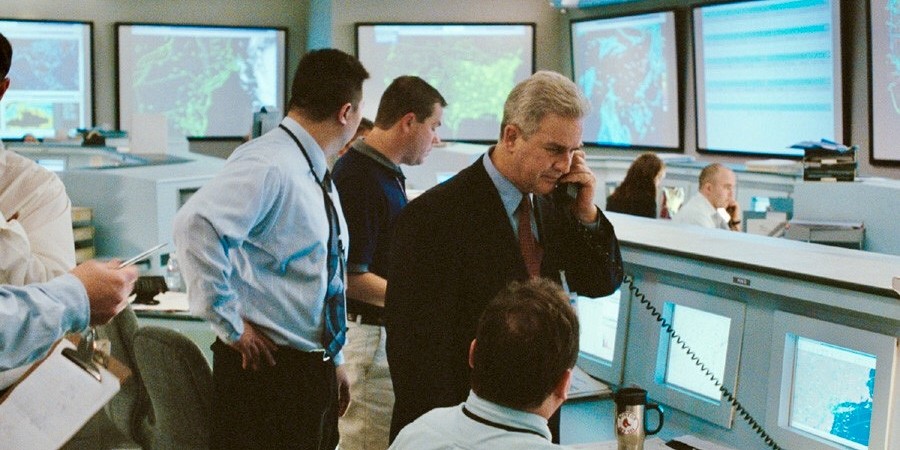
What emerges – a point Greengrass strives not to present politically – is the complete absence of central direction. Much of the response is disorganised – the inability to locate a missing military liaison means FAA and Eastern Air Defence barely communicate for a large chunk of the disaster – and air traffic controllers across multiple states only share information on their own initiative. Any political leadership is completely absent: the commander of Eastern Air Defence spends almost the entire crisis on the phone desperately trying to locate the President or Vice President for rules of engagement against hijacked passenger planes. Ben Sliney is forced to take a unilateral (way above his paygrade) decision to close American airspace.

This lack of central direction is eventually what motivates the passengers, as they slowly realise through phone calls with loved ones on the ground, exactly what their captors intend. As Tom Burnett says, no one is coming to save them. Most of the second half takes place entirely on United 93 as we watch in real time the passengers grapple with a simple choice: die when the plane hits its target or risk their lives to retake it. Greengrass makes clear their aim is to survive – one of the passengers, a light aircraft pilot, is picked to fly the plane. What’s superb about United 93 is that these actions are both astonishingly brave, but also realistic. United 93 doesn’t turn the passengers into superhuman martyrs and avoids Hollywood-ised speeches – even Todd Beamer’s ”let’s roll” is a throw-away line. Instead, it makes them ordinary, brave people doing all they can to stay alive. (Although the film’s interpretation of one German passenger, convinced cooperation with the terrorists will save them, rightly drew criticism for its unfair judgement)

United 93 similarly avoids definitive statements about the terrorists. It isn’t afraid to show their misguided faith. It even shows cell-leader Ziad Jarrah calling his girlfriend to tell her he loves her. But it doesn’t shirk on their ruthless fanaticism, from their murder of the pilots to the suicidal determination of their last stand against the passengers. Greengrass’ film argues the hijackers failed due to their inexplicable delay of almost 46 minutes to hijack the plane (the other cells carried out their hijacks almost as soon as the seatbelt lights were off), suggesting Jarrah lost his nerve. It’s this delay – leaving them 50 minutes’ flight from their presumed target (the Capitol) rather than 20 – that gave the passengers time to understand their situation and make a plan to try and save themselves.

The final desperate struggle to reclaim the plane is a brutal, extremely hard to watch, superbly executed sequence, made immeasurably worse by the fact we know it will fail (the film’s final shot pans away from a close-up of a desperate struggle for the plane’s steering wheel to the ground moving closer). Greengrass presents the facts as they are and by doing so makes it even more powerful. A polemic that went overboard in patriotic hagiography would have carried less impact. United 93 is overwhelmingly, unbearably moving because it forces us to imagine what we would do in that situation. It’s a film made up of the confusion, fear and grim, desperate determination of ordinary people, and in the end few things have more impact with a viewer than that.

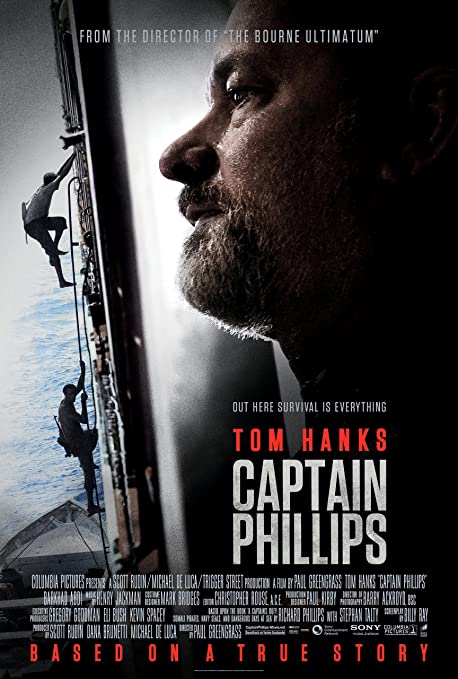
Captain Phillips (2013)

Tom Hanks is kidnapped by pirates in Captain Phillips

Director: Paul Greengrass

Cast: Tom Hanks (Captain Richard Phillips), Barkhad Abdi (Abduwali Muse), Barkhad Abdirahman (Adan Bilal), Faysal Ahmed (Nour Najee), Mahat M, Ali (Walid Elmi), Michael Chernus (Shane Murphy), David Warshofsky (Mike Perry), Corey Johnson (Ken Quinn), Chris Mulkey (John Cronan), Catherine Keener (Andrea Phillips), Max Martini (SEAL commander)

The best of Paul Greengrass’ directorial work brings documentary realism to compelling real-life events, laced with tragedy. He’s made extraordinary films about Bloody Sunday and 9/11 and bought his unique style to Jason Bourne and the Green Zone of Iraq. Captain Phillips continues this, bringing to life the true story of the hijacking of the container ship Maersk Alabama and the kidnapping of its captain Richard Phillips. And this is a brilliantly tense and dynamic film which seizes the viewer in a vice-like grip and never once lets up for a moment of its runtime. 

Tom Hanks plays Richard Phillips, dedicated and professional merchant captain, whose ship is eventually seized by four Somali pirates, led by Abduwali Muse (newcomer Barkhad Abdi, who landed BAFTA and  Oscar nominations for this work here). Phillips is determined to protect the crew (who are hidden around the ship), while the pirates are desperate for a life-changing score that could free them from lives of crushing poverty in Somalia. With such high stakes to play for, Phillips and Muse find themselves engaged in a battle of wills and wits – but with only one of them armed with a gun.

Greengrass’ film is almost unbelievably tense. From the first appearance of Muse’s skiff off the Maersk Alabama to the film’s end, Greengrass manages to keep the audience on a knife edge for over two hours – this despite it being based on a true story where we know the hero will come out in one piece. Shot in the typical Greengrass style, with an at-times jittery handheld camera – brilliantly shot by Barry Ackroyd, a master of this style – this is an immersive drama to an extreme degree. You really do feel part of the action, with the immediacy of the shooting infecting the entire viewing experience.

This is powered further by Greengrass’s superb work with actors – and he draws some marvellous performances here. Tom Hanks – inexplicably not nominated for an Oscar – gives a near career best performance as Phillips. Hanks’ natural skill at playing regular, relatable guys in impossible situations is perfect for Phillips, but he mixes it here first a slightly stern authoritative distance Phillips has with the crew and a deep sense of duty. On top of which, thrown into an impossible situation Hanks has Phillips walking a tight-rope of being seen to co-operate with the hijackers, while trying to work against them, while simultaneously becoming increasingly frayed around the edges. The final sequences alone – of a shocked and emotionally exhausted Phillips – were deserving of the highest honours, raw and honest work from Hanks who confirms he is a great actor.

To go toe-to-toe in scenes with Hanks would be a challenge for most actors – imagine how difficult it must be for a first time performer. Chosen from thousands of applicants, Barkhard Abdi is superb as Muse. Confident, determined but quietly, unspokenly, out of his depth, Muse is determined not to be taken for a ride, but also desperately improvising – a man who feels he doesn’t have choices in his own life, so must cling to an opportunity no matter how remote it becomes, until the bitter end. Abdi is fierce and strong – “Look me in the eye – I’m the captain now!” he firmly tells Phillips – but as the film progresses, it’s clear his control over the other pirates is loose and, smart as Abdi is, he’s also naïve in how much power he holds against the might of the US military sent to free Phillips.

Greengrass’ film skilfully adds enough beats of the poverty and desperation of Somalia to avoid these pirates ever becoming just faceless heavies and thieves. The group are introduced in a poverty-stricken fishing village, Muse choosing from dozens of desperate volunteers to man his crew. Muse stresses to Phillips that while there may be more choices than fisherman and pirate, in Somalia there aren’t – and that international shipping lines have disrupted the traditional fishing areas around the Somali coast. These are desperate and determined men –not blindly evil – and they need a massive score – the $30k they’re offered from the ship’s safe isn’t going to cut it.

The film brings this intensity into play for every action of the pirates. Early on, the smallness and decrepitude of Muse’s skiff is compared frequently with the height and vastness of the Maersk Alabama, with the pirates’ daring and dangerous boarding of the ship as tensely involving as the ship’s crew’s struggle to evade them and protect their own lives.

The wide open vastness and hide-and-seek of the Alabama is then expertly swopped for the claustrophobia of the escape ship that the four hijackers and Phillips spend the final hour of the film on. Here anger rises within the ship – cramped, hot, low on water, with some of those in the ship badly wounded – while outside, the US military masses to prevent the ship making it to the Somali shore. Any idea that the pirates will triumph is removed – but the tension still exists as to how Phillips himself can survive a situation on his small boat that is spiralling faster and faster out of control.

All this superbly marshalled by Greengrass from start to finish, the film a masterclass in wringing every drop of expectation and investment from a compelling real-life story. With wonderful performances from the two lead actors, the film never once lets up in its electric pace and all-pervading sense of danger. With Hanks and Abdi superb, it’s a film that won’t let you go for a second. Inexplicably, despite a Best Picture nomination, the main elements of its success (except Abdi) – Hanks, Greengrass and Ackroyd – all missed out on nominations. That’s the problem when you are so skilled you make it look easy.

Jason Bourne (2016)

Matt Damon swings back into action in after-thought Jason Bourne

Director: Paul Greengrass

Cast: Matt Damon (Jason Bourne), Tommy Lee Jones (Director Robert Dewey), Alicia Vikander (Heather Lee), Vincent Cassel (The Asset), Julia Stiles (Nicky Parsons), Riz Ahmed (Aaron Kalloor), Ato Essandoh (Craig Jeffers), Scott Shepherd (Edwin Russell), Bill Camp (Malcolm Smith), Vinzenz Kiefer (Christian Dassault), Gregg Henry (Richard Webb)

They say you should never go back. Producers had been begging Paul Greengrass and Matt Damon to get back together again and make another Bourne film. After all, there was hardly anyone asking for a sequel to that Jeremy Renner one was there? But Jason Bourne seems like a film that’s been made after Greengrass and Damon ran out of reasons for saying no. I can’t decide if we can blame them for that or not. But their making the film at all suggests they aren’t really losing any sleep about whether people feel this half-hearted effort has an impact on the legacy of the others.

Anyway it’s ten years later. The world is an increasingly technical place, with people living in an era of increasing social unrest and anti-government fury. Jason Bourne (Matt Damon), recovered from his amnesia, now lives off-the-grid – until of course he’s unearthed by his old colleague Nicky Parsons (Julia Stiles). Parsons is now working with a hacker commune in Iceland, and has unearthed more evidence about the shady CIA programme, Treadstone, that Bourne used to be a part of, and about Bourne’s own recruitment into it. Meeting in Athens in the middle of an anti-government riot, Parsons is killed and Bourne is set on a collision course with the CIA as well as finding out more about the mysterious death of his father 20 years before. 

Jason Bourne is basically going through the motions. There is an attempt to add another layer of mystery around Bourne’s background, but it barely seems to add much to the hinterland of Bourne we’ve already learned about in the last couple of films. Furthermore, I’m uncomfortable with a Bourne here who goes increasingly on a rampage of revenge. Part of the charm – or rather what makes Bourne different – in the previous films was that he was a man who lived in a world of violence, but didn’t care for it himself. He used brutal force only when it was absolutely necessary, and several times chose not to take a personal revenge. Here however, he dispatches at least three people, which doesn’t seem to square with the character as we’ve previously seen him.

Furthermore, the film seems to be struggling to reclaim Bourne as one of the formal good guys, a patriot and American hero. Again part of what made him different in the original trilogy was that he stood outside the government and nations, that (as Greengrass once said) “he’s on our side”. Here he’s clearly less than sympathetic to anti-government forces, and strongly opposed to exposing CIA secrets. In fact he ends up feeling rather conservative here to be honest, and more like the faceless killer that he started as rather than a renegade. 

It’s not helped by the fact that the plot is pretty meh, a remix of different elements from previous films, carefully ticked off to make sure we get everything we could expect. So we get a reworking of various car chases, fights, tense meetings in public locations etc. etc. The film-making is very well done – Greengrass rewrote the book on how to make films like this, and he carries that on here, brilliantly mixing twitchy editing, handheld camera work, immersive film-making and gloomy silences to create a really wonderfully done viewing experience. It’s just more of the same from the originals. The film just ends up living in the shadow of the originals, rather than really forging something out on its own.

Greengrass tries to tap into contemporary ideas. We get the sense of anti-establishment clashes and Internet data scams – but it never really feels like it goes anywhere or coalesces into any real point at the end of it. What is the actual message of this film? There are hints that Tommy Lee Jones’ gravelly CIA Director and Riz Ahmed’s Mark Zuckerberg-lite tech expert are planning some sort of mass intrusion on people’s privacy – but the film never explains this or explores it. It never even makes Bourne aware of it – and since Bourne is our “window” into this world, that means we never understand it either.

I mean, the film is fine other than that, but that’s all it really is. Matt Damon still hasn’t lost it as Bourne – and blimey he should have some inverted award for how little he speaks in this film – and he has not only the physicality but also the worn-down, haunted look of a man who has seen way, way too much. There are professional performances from the rest, but nothing that stretches any of the actors here, with Alicia Vikander particularly under-used as an unreadable CIA agent. 

But that sums up the whole film. Despite all the attempts to build in a modern “torn from the headlines” angle to the story, it feels more like Greengrass and Damon are quite happily (and with some enthusiasm at least) going through the motions in order to pick up a cheque. And I guess that’s fine. It just means we are probably not going to rush to see this again.