
Tag: Paul Richter

Die Nibelungen (1924)

Die Nibelungen (1924)

Wagnerian epic is crammed with gorgeous, dramatic imagery and relentless pace

Director: Fritz Lang

Cast: Paul Richter (King Siegfried of Xanten), Margarete Schön (Kriemhild of Burgund), Hans Adalbert Schlettow (Hagen of Tronje), Theodor Loos (King Gunther of Burgund), Hanna Ralph (Queen Brunhild of Isenland), Rudolf Klein-Rogge (King Attila), Bernhard Goetzke (Volker of Alzey), Rudolf Rittner (Margrave Rüdiger of Bechlarn), Georg John (Mime the Goldsmith/Alberich the Dwarf/Blaodel)

Fritz Lang wanted to create a film that would help a shell-shocked Weimar Germany start to feel proud of its heritage and culture. He would do this with a film of the legend of Siegfried. It’s not really Lang’s fault that this Aryan feel-good stuff, coupled with Lang’s flawless visual compositions dripping with power and authority, would turn into the wet dreams of the Nazi party Lang fled Germany to escape. Die Nibelungen has unfortunate associations, but it stands as a towering pinnacle of Lang’s visual artistry. An adaptation of the legend, not the Wagner operas, Lang created something both mystic but also subtly questioning the idealistic figures it celebrates.

He would do all this in two (epic of course) films, totalling almost five hours. In the first Siegfried, the hero (Paul Richter) overcomes dragons and murderous dwarves to gain powers of almost (that almost is key) total invulnerability, strength and invisibility. Powers he puts to the test to win the weak King Gunther of Burgundy (Theodor Loos) the hand of Brunhild (Hanna Ralph) by invisibly aiding Gunther best this Valkyrie at a series of challenges. He even takes on Gunther’s form to help lead Brunhild to the bridal bed. Brunhild however discovers the truth from the loose lips of Siegfried’s wife (and Gunther’s sister) Kriemhild (Margarete Schön). Brunhild’s tricks Gunther and his loyal heavy Hagen (Hans Adalbert Schlettow) to murder Siegfried via a spear in his one weak spot. In Kriemheld’s Rache, Kriemheld plots the destruction of everyone who conspired in the death of her husband, via a marriage with the warlord Attlia the Hun (Rudolf Klein-Rogge).

The first thing that strikes you about Die Nibelungen – aside from its surprisingly electric pace – is the powerful, undeniable beauty of nearly every single frame. Lang composed each image as if it was a painting, from Siegfried introduced in steaming smoke at the forge, to the formalist imperialism of the castle of Burgandy and the rigid order and symmetry of its soldiers. Locations, from grand castles to mystic forests, underground caverns full of scheming, wicked creatures are superbly bought to life. There is a martial power Lang’s composition of so many of these images, their perfect angles and symmetrical blocking: parts of Die Nibelungen are some of the greatest pageantry displays in movies.

There is a wonderful sense of overblown, geometric, artificiality in all this – Lang deliberately creates a world larger than life and full of the unworldly and impossible. Buildings tower over crowds, courts that hold thousands to view events of grand importance, sieges of burning halls that fill the frame, staircases up impossibly high buildings. The sort of world of medieval excess where Gunther and Kriemheld disembark from a boat by walking across a bridge of shields created by half-submerged knights. Power and magnificence come from every frame.

It’s matched with an impressive creation of the bizarre and magical. Of course Siegfried kills a giant, animatronic dragon (strangely it’s obvious – even then surely – fakeness works in a film where everything is a heightened, from the emotions to the buildings to the costumes). Siegfried trains in something not far off from Vulcan’s forge and the forest feels like a sort of fairy-tale wonderland. Lang pioneered cross-fades and double exposures to make extraordinary effects, as Siegfried disappears under a veil of invisibility and jumps impossible distances. There is an extraordinary shot where Brunhild, still in the midst of her Valkyrie-like super-powers, seems to jump straight into the camera lens at full force. A beautiful edit sees a tree seem to reform itself into a skill in front of the eyes of the grieving Krimhild.

But Die Nibelungen places its world of power and magical forces in an increasingly costly human world of realpolitik and conspiracy, where its mystical but naïve and simple hero is out of step. Even before then, Siegfried’s status as a hero is subtly questioned. The dragon he kills seems a peaceful, inoffensive creature for all is scale, sitting placidly when Siegfried attacks and stabs it in the eye. Lang introduces a lovely touch where it’s dying tail flick will send the leaf that shields a crucial spot of Siegfried’s back from the torrent of invulnerability-granting dragon’s blood he bathes in. Siegfried is easily manipulated by the dwarf Albereich (a Gollum-like, uncomfortably antisemitic in appearance) before a large dose of luck allows him to defeat his opponent and gain the treasure of Nibelungen.

At the court of Burgundy, for all his courage and blunt honesty, Siegfried is at sea among the subtle power dynamics. The kingdom is ruled by chronically indecisive weakling Gunther (a snivelling Theodor Loos), easily manipulated by Wagnerian-costumed Hagen (an imposingly arrogant and faintly psychotic Hans Adalbert Schlettow). Siegfried’s main acts are to trick and then break the resistance of Brunhild (a dynamic Hanna Ralph) while impersonating the weakling – hardly acts to brag about, which doesn’t stop Siegfried doing exactly that to his wife who then blurts it out to Brunhild in a fit of pique. This isn’t a hero covering himself with glory, just as even the formally idealistic Brunhild (much to her later self-disgust) is reduced to scheming and plotting revenge, a far cry from the noble actionee she prided herself on being.

It’s not a surprise to find Part 2 heads into a Götterdämmerung as Kriemhild’s obsessive, destructive desire for revenge against Hagen (her husband’s murderer) meets with Gunther’s own stubborn-short-sighted protection of his controlling vassal. Nearly half of Part 2 is dedicated to the prolonged siege of the King and his followers by the massed armies of Kriemheld’s new husband Attila the Hun, her manipulations of him helped a great deal by Hagen’s arrogant, impulsive violence against Attila’s people. This extended battle sequence is astounding in its scale, violence and excitement – you can see the influence it had on The Two Tower’s Helm’s Deep – and is shot with the same visual mastery as the more stately first half, even as it seeks into bloody desperation.
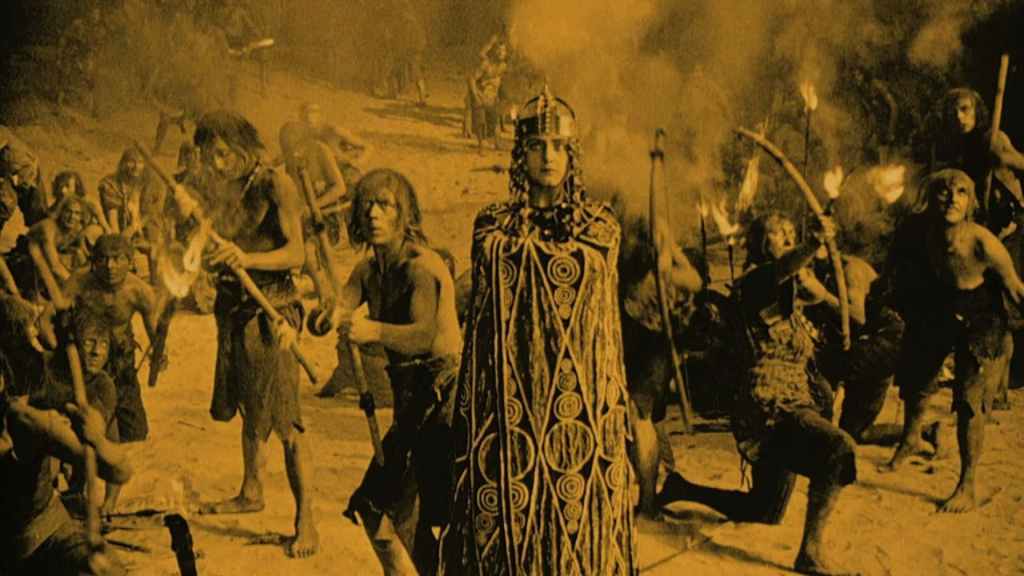
It must be stated that Die Nibelungen does feature more than its share of clumsily presented racism. As mentioned, the hook-nosed, gold-obsessed, murderous dwarf Albereich is a painful antisemitic stereotype. Rudulf Klein-Rogge is caked under layers of make-up as the ugly, Slavic Attila while his Hun army resemble crouching Orc like figures, frequently ripe for the sword edge of the relentless German soldiers. It’s the uncomfortable flip side of the Aryanism idealism and romantic framing given to Siegfried, that these un-German figures are painted so monstrously.

But Die Nibelungen’s subtle criticism of the flaws in its German leads – it would go some to call them heroes – balances this out. From the flawed, empty-headed, foolishness of Siegfried to the increasingly sadistic, unrelenting cruelty of Kriemheld (Margarete Schön’s performance is excellent, going from sweetly retiring to unblinking fanaticism over the course of the film) the Germanic characters are compromised, weak and cruel: Hagen and Gunther are no one’s ideas of admirable figures. Compared to them, for all his clumsy racist appearance, Atilla feels like a reasonable figure, loving his family, caring for his people and refreshingly free of vindictiveness and cruelty.

It makes for an intriguing complex undercurrent in a film which, of course, the Nazis interpretated entirely on surface-appearance as a celebration of Aryan super-might. Or at least they did for Part 1 – even they couldn’t kid themselves that Part 2 didn’t quite fit that bill. Today Die Nibelungen provokes the same interesting thoughts. But above all it’s a visual marvel from a gifted film director, a truly painterly masterpiece that, for all its great length, never flags and offers a new marvel, camera trick or miraculous composition with every frame. This is silent cinema at its best.

Dr Mabuse, der Spieler (1923)

Dr Mabuse, der Spieler (1923)

Lang’s crime drama is a sprawling silent mini-series, still gripping today

Director: Fritz Lang

Cast: Rudolf Klein-Rogge (Dr Mabuse), Bernhard Goetzke (State Prosecutor von Wenk), Aud Aged Nissen (Cara Carozza), Gertrude Welker (Countess Dusy Told), Alfred Abel (Count Told), Paul Richter (Edgar Hull), Robert Forster-Larringa (Spoebri), Hans Adalbert von Schlettow (Georg), Georg John (Pesch), Karl Huszar (Hawasch), Grete Berger (Fine)

In a world before television, there were only two places for long-form stories – and Fritz Lang wasn’t a novelist. His four-and-a-hour epic Dr Mabuse der Spieler is really a sort of gargantuan mini-series, a rollicking action-adventure about a conscience-free conman wiling to go to any lengths to get the things he wants. It’s pulled together as a pacey, episodic yarn – each reel is basically an individual act (or episode) and filmed with such visionary vividness that it remains compelling today. Whether you decide to settle in for the long haul or split its parts and acts over a series of nights (and why not, the film was released in two parts, months apart) it won’t fail to entertain.

It was based on Norbert Jacques novel, a publishing sensation (so much so this was rushed into production while Jacques novel was still being serialised). At its heart: Dr Mabuse (Rudolf Klein-Rogge), practically the dictionary definition of an omnipotent, amoral villain. Mabuse is a practiced liar, master-of-disguise, ruthless murderer, conman and has such demonic will power he is capable of extraordinary levels of hypnotic control, whose gang of acolytes switch between terror and outright worship of him. He can manipulate the rich into handing over their money as easily as he can the collapse of businesses on the stock exchange. No one knows who this malign spider is. But State Prosecutor von Wenk (Bernhard Goetzke) will make it his business to know.

Lang’s film is a gorgeous mix of the sort of urban realism he mastered in M and little touches of mystical realism more reminiscent of The Cabinet of Dr Caligari, wrapped up in the sort of action that inspired everything from The Sting to Mission: Impossible. It’s opening section is a brilliant example of both. Essentially a twenty-minute prologue to introduce Mabuse’s nefarious genius, it sees our anti-hero masterfully execute a plot mixing heist, disguise, manipulation and brazen self-confidence to make a fortune on the stock exchange. The theft of a secret commercial contract from a train involves the sort of disguises and split-second timing (to throw the contract from a train passing over a bridge into a car passing under it) which would make Ethan Hunt’s heart race.

It’s a perfect entrée to our villainous lead, Mabuse. First introduced rifling through photos of the many expert disguises he will effortlessly assume during the film – he becomes everything from banker to magician, psychologist to hypnotist, tramp to member of high society – Mabuse has no moral code what-so-ever other than the accumulation of things. That ranges from wealth, to an obsessive desire for ownership over attractive women (and his desire for Gertrude Welker’s Countess Told eventually contributes to his undoing) to simply the having power over the wills of weaker men. Rudolf Klein-Rogge is magnetic as this monster of the dark, ruthlessly calm but equally wild-eyed, unflappable but willing to go to any lengths.

Spieler is often translated as “gambler” – but it’s German meaning is richer than that and many have commented a better translation might well be “player”. Mabuse is certainly that. He is a master actor, who can be lose himself in different roles, undetectable to others. He weaves elaborate games around his victims, where only he knows the rules (and, often, only he knows a game is even being played). Other people are pawns to moved and gambled with. He’s a monster, but one born from disillusion of the end of the First World War, part of the hedonistic self-regard of dissolute Weimar. We can see touches of this environment throughout Lang’s film, in its hedonistic gambling dens and the casual thoughtlessness of the rich. Mabuse flourishes because he is the rash an age has come out in. (Retrospectively, you can detect the shadow of Hitler in this ruthlessly power-mad monster who hides in plain sight but demands absolute control).

Mabuse is “the Great Unknown” and the natural target of methodical if uncharismatic von Wenk, played with a stolidness by Bernhard Goetzke, balancing Klein-Rogge’s larger-than-life portrayal perfectly. The duel between these two moves from gambling rooms to elaborate houses, from the streets to the jails of the city, taking in chases, bombs, shootings, kidnappings and all sorts of attempted moves and counter-moves, culminating in a shoot-out that surely inspired countless Hollywood gangster movies.

Through it all Lang directs with astonishing freshness and invention. Dr Mabuse der Speiler throws a slice of cinematic visual inventiveness into almost every scene. Lang makes extensive use of superimpositions, cross-fading, location shooting, fast-paced editing and brilliantly evocative lighting to create a world both highly realistic and also dancing to the tune of its demonic lead. Some of this has become such a part of cinematic language that it’s unlikely to draw comment from modern viewers today – we are unlikely to be wowed by night-time footage of Wenk pursing Mabuse in a car, but to viewers at the time such scenes of photorealism taken in darkness were unheard of.

There is plenty that will continue to thrill audiences. Lang’s visual portrayal of Mabuse’s hypnotic powers is superb. In his first confrontation with von Wenk (both men are disguised at the time – this really is a game of move and counter-move), Mabuse attempts to implant a hypnotic suggestion in von Wenk. Lang demonstrates with an astonishing use of lighting which slowly concentrates the light into a small pool on Mabuse’s face before his face seems to grow to fill the frame (technical effects like this were a small miracle in 1923). On a second attempt, the hypnotically suggestive words are imposed on the screen as a set of animated letters which loom over von Wenk and later seem to be almost leading him (in his car) to the clifftop Mabuse has suggested he drive off. It’s a superb way of showing the power of Mabuse, building on the intimidating cross-fade from our stock-exchange opening that briefly shows Mabuse’s face super-imposed over the clutter-filed room.

Lang mixes this imaginative dynamism with some superbly done realist scenes that help make Dr Mabuse der Spieler a gripping crime thriller. That stock-exchange opening is followed by car chases and murders – one character is dispatched in the streets after dark with a brutal suddenness. Lang creates a series of locations, all perfectly detailed but instantly recognisable, from the distinctive look of each gambling den (from art deco lined walls to a strange rotating gambling pit filled with cards and erotic dangers) to the objet d’Art packed rooms of Mabuse’s mark Count Told (a gloriously ineffective Alfred Abel – unrecognisable from the world controller he would become in Metropolis) to the white-lined jails and careful detailed offices of von Wenk’s police headquarters.

Dr Mabuse der Spieler uses these real locations to constantly remind us that, underneath the Moriarty genius of its lead, this is also a tragedy of real people caught in the web of an uncaring spider. Mabuse cares nothing for his underlings, sacrificing them as readily as pawns. None more so than Cara Carozza, beautifully played by Aud Aged Nissen, a seducer in love with Mabuse who dedicates her life to him, at the cost of her own. She makes a dark mirror for Countess Told, drawn into Mabuse’s web but drawing strength from her admiration of Cara who is, in her own way, deeply principled. Mabuse’s victims are prodded, pushed and outright shoved into punishing and often self-destructive behaviours, their lives flourishing or ending according to his whims.

As a sort of epic mini-series, Dr Mabuse der Speiler is sublime entertainment. Each act follows its own clear arc and the culmination in a brutal shoot-out throws in a nightmare of surrealist imagery at its close as a crucial character tips, under pressure, into madness and delusion. (This series of horrors, the ghosts of fallen characters arising to torment him, is a masterclass in ghostly horror). It gripped audiences then and its surprisingly brisk pace and pulpy sensibility still do now.