Tag: Paul Winfield

The Terminator (1984)

The Terminator (1984)

Schwarzenegger becomes an icon in Cameron’s masterpiece, a darkly gripping sci-fi chase-thriller

Director: James Cameron

Cast: Arnold Schwarzenegger (The Terminator), Michael Biehn (Kyle Reese), Linda Hamilton (Sarah Connor), Paul Winfield (Ed Traxler), Lance Henriksen (Hal Vukovich), Bess Motta (Ginger), Rick Rossovich (Matt), Eal Boen (Dr Peter Silberman), Bill Paxton (Punk)

“It can’t be bargained with. It can’t be reasoned with. It doesn’t feel pity, or remorse, or fear. And it absolutely will not stop… ever, until you are dead!”

If that description doesn’t grab your attention, I don’t know what will. James Cameron cemented his place in cult-film history with The Terminator, such a pure shot-to-the-heart of filmic adrenalin, its hard to think it’s been bettered since. Cameron takes a fairly simple story – essentially a long, relentless chase – and fills it with energy, black humour and a genuine sense of unstoppable menace, in a film that barely draws breath until it’s over an hour in and then promptly throws you straight into a final action set-piece. It uses its low budget effectively to create a world of mystery and dark suggestion and leaves you gagging for more. So much so, they’ve tried to recapture the thrill ride six times since (and only Cameron did it right, with Terminator 2).

It’s 1984 and two naked people arrive in Los Angeles in a ball of light. They’re both from 2029, time-travellers looking for the same woman. One of them nicks a tramp’s piss-stained trousers and runs from the police. The other is a stoic, impassive mountain of muscle who offs a few violent punks after they refuse his blunt instruction to hand over their clothes. Which one do you wish you were eh? Unfortunately, the second one is a Terminator (Arnold Schwarzenegger), a machine in the skin of a man sent to eliminate Sarah Connor (Linda Hamilton), mother of the future leader of the post-apocalyptic human resistance to the machines. The first is Kyle Reese (Michael Biehn), the man sent to save her. Tough gig, since the Terminator is relentless, almost invulnerable and holds all the cards.

The Terminator is pulpy, dirty, punchy film-making – and its huge success became James Cameron’s calling card for a lifetime of success. Set in a neon-lit, dingy Los Angeles (it never seems to be daytime in The Terminator), it taps into the core of a million nightmares, the fear of being chased and nothing you do ever sees to get you further away. It’s a really elemental fear which The Terminator brilliantly exploits, as impassive and impossible to negotiate with as your deepest, darkest dreads. Throw into that Cameron’s gift for tension and you’ve got the almost perfect thrill-ride.

It’s also a film that gives us the perfect level of information we need. Unlike the cops (and Sarah Connor) who can’t believe this story Reese is peddling them that they are up against an unstoppable metal killing machine, we know from the start the whole story. It’s enough for us to feel a cheeky frustration as they bend over backwards to fit logical explanations to the things they’ve seen and for us to feel the sneaking dread that storing Sarah away in a police precinct crammed full of heavily armed cops isn’t going to make a jot of difference. He won’t let anything stop him.

Is it any wonder quite a few people came out of the film sympathising with Sarah and Kyle – but feeling a sort of guilty admiration for the Terminator? This is the foundation stone of the Schwarzenegger cult, his role as the monosyllabic machine sending him into the upper echelons of Hollywood stardom. Cameron’s original idea was the Terminator should be a perfect infiltration unit, the sort of guy who wouldn’t stand out in a crowd (the original choice was Lance Henriksen, relegated instead to the second-banana cop behind Paul Winfield’s folksily doomed decent guy, fundamentally out of his depth). That went out of the window when Schwarzenegger came on board: say what you like about the Austrian Oak, but he stands out in a crowd.

Why is the Terminator darkly cool? (After all literally no one ever pretended to be Kyle Reese, but everyone has put on a pair of shades and said “I’ll be BACH”.) Because he embodies all the qualities we’ve been taught by films to respect. He’s strong and silent, calm and confident, never complains, doesn’t need help and never gives up. He’s exactly the sort of guy Hollywood has cast admiring eyes at since film spooled through a camera. We can’t help ourselves.

The film becomes about Schwarzenegger (even if he’s not in the last set piece, replaced by a budget-busting CGI android). Cameron knew how to get the best out him, his tiny number of lines (17 in total) delivered in his emotionless, euro-accent make him seem mysterious, different and cool, frequently responding with either deadpan seriousness or sudden violence. His under-statement lines are funny because we anticipate already the bloodbath that will follow. And, unlike despicable villains, he’s not motivated by greed, jealousy or wickedness: he’s almost the quintessential American hero, taking care of business – it just so happens his business is killing people.

Reese should be someone we admire more: he’s a plucky, resourceful underdog. But, unlike the actions-rather-than-words Terminator, he’s got to speak all the time – while the Terminator is a killing machine, Reese is the exposition machine. Biehn does a terrific job with a difficult role, a decoy protagonist who spends much of the movie alternating between gunplay and spitting out reams and reams of exposition explaining to anyone and everyone the future and terminators. On top of that, while his opponent gets on with, Reese’s constant refrain of how scared he is and everyone else should be (who wants to hear a hero say how terrified he is eh?) and his frustrated whining at no-one listening to his fantastic story marks him as weak. Charismatic heroes persuade their audiences: no one believes Reese until they are literally watching Arnie shrug off a whole clip of ammo.

Reese is, in any case, a decoy protagonist of sorts. His romantic longing for Sarah (having fallen in love with her photo in the future) and nurturing personality actually mark him out as the more conventional ‘female lead’. In the first of several films where Cameron would show-case heroic female characters, the actual ideal rival for the machine is Sarah. One of the most interesting things about The Terminator is watching Linda Hamilton skilfully develop this character from ordinary young woman into the sort of archetypal Western hero the film ends with her as (she even gets the sort of badass kiss-off line “You’re terminated FUCKER” you can’t imagine the less imaginative Reese saying).

On top of this The Terminator is a triumph of atmosphere. With its synth-score, it has an unsettling quality from the off helping to build the sense of grim inevitability that is its stock-in-trade. Just like the Terminator’s never-ending pursuit, the whole film is a well-judged, inevitable, time-loop. Sending people back in time turns out to be the very thing that guarantees that future will happen. Throughout, Cameron’s little titbits about the future (partly constrained by budget) are perfect in giving us just enough information to understand the stakes but leave enough mystery for us to be so desperate to know more, we fill in the gaps from our imagination.

But the reason The Terminator works best is that it’s an undeniably tense thrill ride, an extended chase sequence that rarely eases off and never loses its sense of menace. You never feel relaxed or safe while watching The Terminator and never for a moment that its heroes are on a level playing field with their opponent. Atmospheric, tense and terrifying, it walks a brilliantly fine line (so much so, the Terminator methodically massacring a precinct full of cops is both unnerving and the most popular scene in the film) and never once let’s go of your gut. It’s not only possibly the best, most perfect, Terminator film made also still one of Cameron’s finest hours.
Star Trek II: The Wrath of Khan (1982)

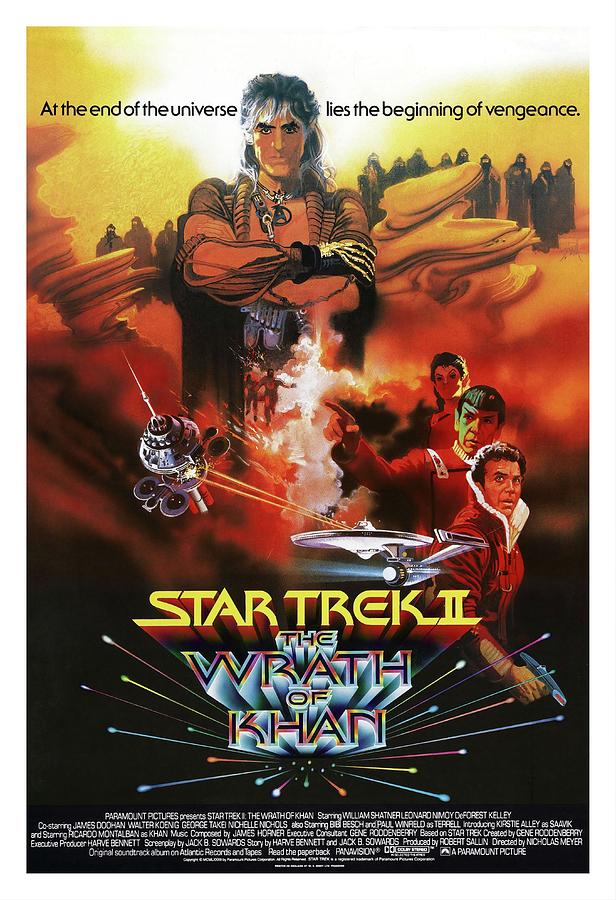
The Enterprise crew re-unite to face The Wrath of Khan

Director: Nicholas Meyer

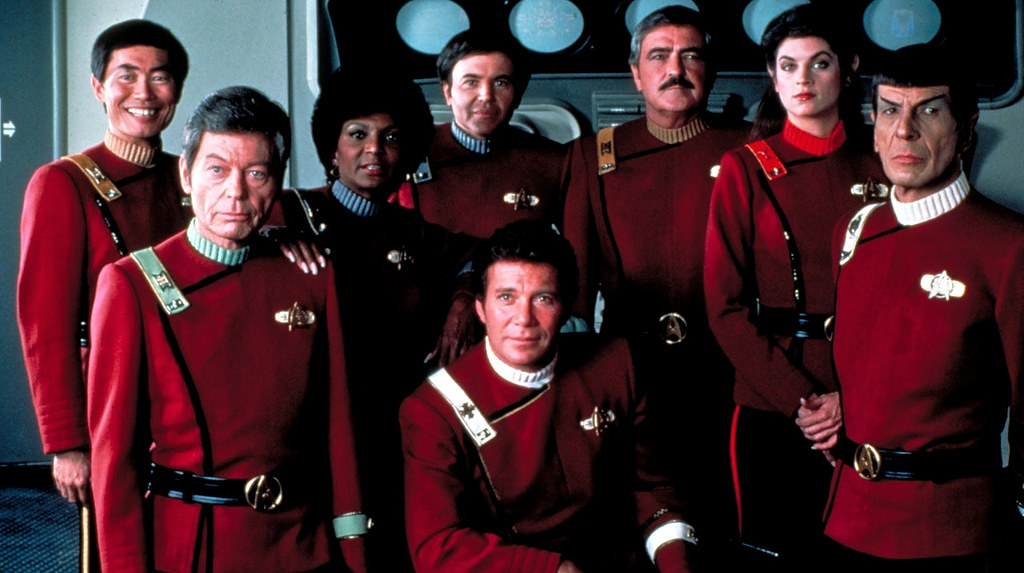
Cast: William Shatner (Admiral James T Kirk), Leonard Nimoy (Spock), DeForest Kelley (Dr Leonard McCoy), Ricardo Montalban (Khan Noonien Singh), James Doohan (Montgomery Scott), George Takei (Hikary Sulu), Walter Koenig (Pavel Chekov), Nichelle Nichols (Uhura), Bibi Besch (Dr Carol Marcus), Merritt Butrick (Dr David Marcus), Paul Winfield (Captain Terrell), Kirstie Alley (Saavik)

After the overblown, slow and tedious The Motion Picture, you’d have been forgiven for thinking that we had seen the Enterprise crew boldly go for the very last time. If there was going to be a sequel Paramount had very clear guidelines for what it wanted: more entertaining, exciting, don’t involve Gene Roddenberry and above all make it for a fraction of the price. I think it’s fair to say that the decision to bring producer Harve (“I could make three movies for the cost of that first one!”) Bennett and above all writer and director Nicholas Meyer on board, saved the franchise.

Neither Meyer or Bennett were familiar with the franchise in advance. But they did what those involved in the first film should have considered doing (looking at you Robert Wise!) – they went back and rewatched all the previous episodes and tried to work out exactly what people enjoyed about the show to begin with. And then tried to make a movie based around that. So first and foremost they decided they needed a villain – so after running through all the previous episodes they decided genetically-engineered superman Khan Noonien Singh, left abandoned on a planet with his followers after the episode Space Seed – was the best pick. Giving the film a simple “revenge” structure, it became a taught battle of minds and wills between Khan and the man he blames for all his problems – Admiral James T Kirk (William Shatner).

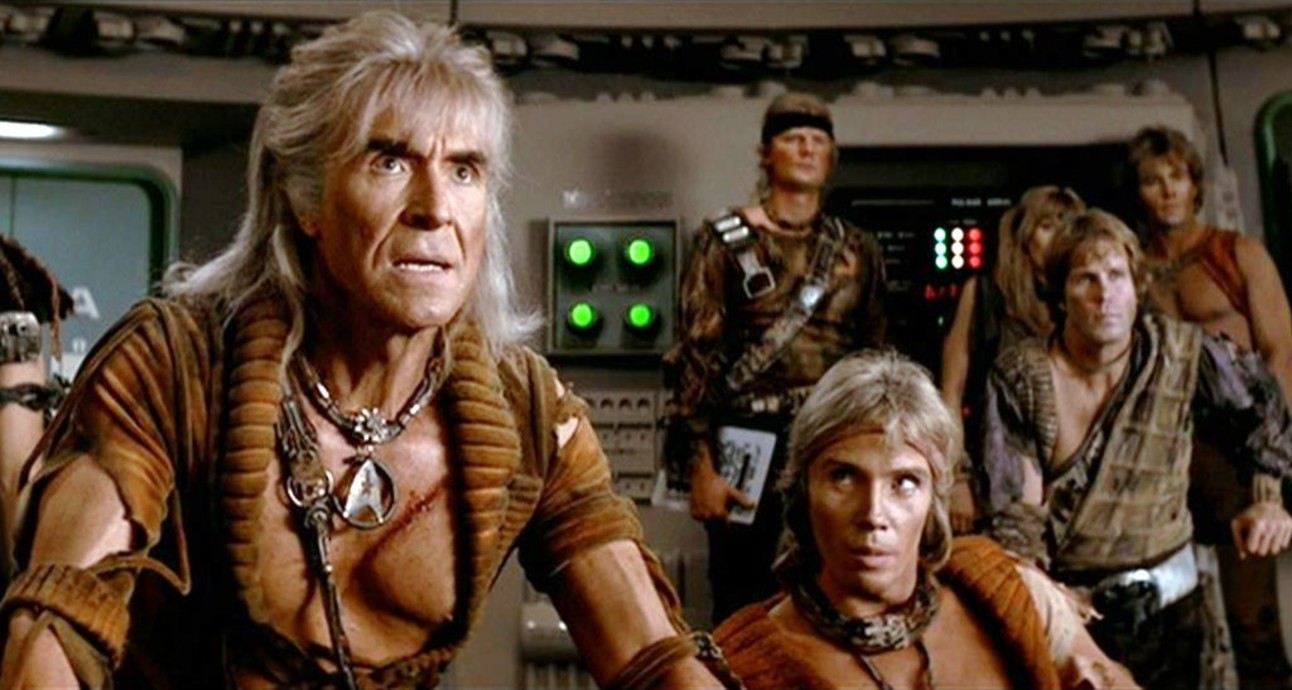
Star Trek II opens with an ageing Kirk, unsure of his place in the world while stuck in a desk job and scared about getting old. Running a cadet training voyage with his old crew, Kirk is called back into action after Starfleet loses touch with Federation scientists working on the Genesis device, a terraforming rocket that will help the Federation build new worlds and civilisations. The problems with Genesis are directly linked – without Kirk’s knowledge – with Khan’s (Ricardo Montalban) hijacking of the USS Reliantafter brainwashing the ship’s captain Terrell (Paul Winfield) and his first officer Chekov (Walter Koenig). Khan blames Kirk for the disasters that have taken place on the planet he was marooned on – and is determined to exact revenge on Kirk no matter the cost.

Unlike the dry Motion Picture, Wrath of Khan builds is action around a compelling, emotionally charged, story that gives each character a clear and relatable motive for their actions. Building a film about revenge may not exactly be in Roddenberry’s ideal for the 23rdcentury: but by heck it makes for a much better film. Because, if nothing else, while we may struggle to understand what the hell V’Ger wanted in the first film, everyone understands the dangerous obsession of revenge. It helps that the film has an excellent villain – a scowling, unbalanced but still strangely honourable and decent Khan, played with a grandstanding relish by Montalban who is clearly having a whale of a time. Despite never sharing the screen (or even being on set at the same time) Montalban and Shatner go at the rivalry and its impact on both characters with a real intensity that makes for compelling viewing.

Meyer also tightened and refocused the entire franchise. Roddenberry may have struggled with the increasingly naval view of Starfleet in this film – it’s at least twice referred to explicitly as the military – but Meyer recognised that if the franchise was partly Hornblower in Space, then why not redesign the film with that in mind. The ship is run with naval precision, including yeoman whistling to signal shifts and orders, uniforms that have a stylish naval formality to them, a greater focus on the ship’s movements being described in strictly naval terms – even the photon torpedo bays are prepped by enlisted men in what Meyer called his “running out the guns” sequences. This makes the entire operation not only easier to relate to, but interesting and entertaining in its own right.

It also adds huge tension to the duel that develops between the Reliant and the Enterprise that plays out part naval battle and late on – when battle turns to the Mutara nebula where systems and sensors work only intermittedly – part classic submarine drama, with Meyer practically throwing in depth charges. The battle scenes are filmed with simplicity and economy – but because the personal clashes between Kirk and Khan are so compelling and involving, they absolutely drip with tension, as these two go through move and counter move.

Meyer’s film is lean, engrossing and thrilling, and superbly well directed. It goes from skilled set-piece to set-piece, and never for a moment overlooks character. Unlike the first film, we get the moments of Kirk-Spock-McCoy discussing key themes together so beloved from the series, while most of the main cast also get their moment in the sun, most especially Walter Koenig who, as a brainwashed Chekov, gets more to work with here than he got in the whole original series. 

But this isn’t just an action adventure in space. Meyer’s literate and intelligent script has far more depth and thematic interest in it than the faux intellectualism of The Motion Picture. Taking as its starting point Kirk’s fear of on-setting age (the film opens with his 50th birthday, and McCoy’s gift of antique spectacles), it expands into an engrossing mediation of how we react to the impacts of our actions and lose-lose situations. Kirk has also to face the mortality of age and the impact of past actions – like his son (Merritt Butrick channelling Shatner’s impulsiveness) – coming back to bite him. All this while flying a ship of young cadets round – who need to shepherded into the risks of conflict. Khan meanwhile is confronted time and again with the damaging impact of his choices to follow revenge and obsession rather than settling for a winning hand.

Meyer gets his best work ever out of Shatner (allegedly after realising Shatner over committed to early takes, he made Shatner take multiple takes in order to focus his energy). This is a Kirk getting old, dealing with inner resentments and made to face up to the consequences of his actions – both with Khan and meeting the son he fathered. Shatner tackles all this with a world-weary resignation and touch of sadness that many felt were beyond him, while still making room for the fireworks that are his calling card (I suppose the famous “Khan!” was Meyer’s one major indulgence of Shatner’s exuberance).

However the other element the film is well known for is of course it’s tragic ending – the sacrifice of Leonard Nimoy’s Spock. Lured back to the film, but not convinced about ever returning, Nimoy agreed to the final reel shocker (although he enjoyed making the film so much he willingly agreed to leave the door open for Spock’s resurrection). It gives the film an emotional heft that none of the others in the franchise has. For the first time, our heroes would not magically escape unharmed to fly off onto the next adventure. Just as the film started with the cadets learning that sacrifice and facing a lose-lose scenario is a part of command (a lesson Kirk cheated on in his day, and a situation he has never faced or understood, as the film teaches him), so the film ends on the same beat. The ship can escape – but only if Spock takes a fatal radiation dose to restart the engine.

Both Nimoy and Shatner play the heck out of these scenes, probably the most emotional in the franchise – a low-key but deeply affecting moments of two old friends sharing their last moments together. It’s this successful switch into showing the real cost and loss associated with adventures like this that cap the thematic depth Meyer bought to the film.

Star Trek II succeeds on every count. Meyer’s intelligent script quotes and riffs everything from CS Forrester to Dickens via Moby Dick, while giving both heroes and villains deep and rich character arcs. It’s grippingly filmed – you wouldn’t believe how much cheaper it was than the first film, as it looks ten-times better with not a penny gone to waste – and hugely exciting. It carries real emotional force, and it’s hugely benefited by a fantastic score by a young James Horner. Even now it’s still the high point of Star Trek on screen – and probably a highlight of the franchise as a whole.